DOI 10.1007/s13173-013-0119-5 O R I G I NA L PA P E R
Mechanized metatheory for a
λ
-calculus with trust types
Rodrigo Ribeiro · Lucília Figueiredo · Carlos Camarão
Received: 7 September 2012 / Accepted: 15 July 2013 / Published online: 4 August 2013 © The Brazilian Computer Society 2013
Abstract As computer programs become increasingly complex, techniques for ensuring trustworthiness of infor-mation manipulated by them become critical. In this work, we use the Coq proof assistant to formalise aλ-calculus with trust types, originally formulated by Ørbæk and Palsberg. We give formal proofs of type soundness, erasure and simulation theorems and also prove decidability of the typing problem. As a result of our formalisation a certified type checker is derived.
Keywords Trust· Type systems· Proof assistants · Soundness proofs
1 Introduction
Ensuring security of information manipulated by computer systems is a long-standing and increasingly important prob-lem. There is little assurance that current computer systems keep data integrity and traditional (theoretical and practical) approaches to express and enforce security properties are, in general, unsatisfactory [46,53].
R. Ribeiro (
B
)·C. CamarãoDepartamento de Ciência da Computação, Instituto de Ciências Exatas, Universidade Federal de Minas Gerais,
Belo Horizonte, Brazil
e-mail: [email protected] C. Camarão
e-mail: [email protected] L. Figueiredo
Departamento de Computação, Instituto de Ciências Exatas e Biológicas, Universidade Federal de Ouro Preto, Ouro Prêto, Brazil
e-mail: [email protected]
One of such traditional approaches to protect data confi-dentiality is access control: privileges are required to access files or objects containing confidential data and information release is restricted according to some policy. Access control checks can restrict release but not propagation of informa-tion. Once information is released, a program can transmit it in some form and, since it is not feasible to suppose that all programs in a system are trustworthy, one cannot ensure that confidentiality is maintained. In order to guarantee that infor-mation is used only in accordance with relevant policies, it is necessary to analyse how information flows within the pro-gram. As modern computing systems are complex artefacts, automating such analysis is required [46].
An approach to ensure security property of computer soft-ware consists of the use of type systems in order to control information flow in software [46]. In programming languages with security types, variables and expressions types have annotations that indicate policies to be ensured by the com-piler on uses of such data. This approach has the following benefits: (1) since these policies are checked at compile-time, there is no run-time overhead; (2) once security policies are expressed by a type system, standard techniques for guar-anteeing type system soundness can be used to certify that security policies are enforced in an end-to-end way in the whole program.
However, proofs of programming language formalisms (e.g. type systems and semantics) are usually long and error prone. In order to give more reliability to these proofs, pro-gramming language researchers have been developing, in recent years, a large number of works devoted to machine assisted proofs [1,6,28,10].
1. type soundness, using standard small-step call-by-value semantics. Intuitively, type soundness property ensures that if a program is well-typed it does not cause any run-time errors,
2. erasure and simulation theorems [38, Sections 3.3 and 3.4]. Erasure and simulation theorems ensure that the λ-calculus with trust types is a restriction of the simply typed λ-calculus. Together these theorems ensure that after type-checking a term, we can simply erase all trust constructs and annotations and evaluate it using the rules of the simply typedλ-calculus,
3. decidability of type checking. From this proof we extract a certified type checker for the language.
The developed formalisation is axiom free, that is, all nec-essary results and properties were integrally proved in Coq. We choose Coq because it is an industrial strength proof assis-tant that has been used in several large scale projects such as a Certified C compiler [27] and Java Card platform [3]. The complete formalisation has approximately 1,400 lines of code. This makes it impossible to present here all details of the work. We only sketch the main proofs and some function definitions are omitted for brevity, when they are trivial. The Coq source code of this work is available on-line [43].
The rest of this paper is organised as follows. Section2 presents a brief introduction to the Coq proof assistant and its features used in our formalisation. Section 3 briefly reviews the syntax and defines a small-step semantics for the λ-calculus with trust types. Section4presents the non-syntax directed type system for theλ-calculus with trust, as pro-posed in [38], and proves its type soundness property. We also define a syntax directed version of this original type system and prove soundness and completeness between these two versions. Finally, we prove that the typing problem for this calculus is decidable. Section6 presents related work and Sect.7concludes.
2 A taste of Coq proof assistant
Coq is a proof assistant based on the calculus of induc-tive constructions (CIC) [5], a higher order typedλ-calculus extended with inductive definitions. Theorem proving in Coq follows the ideas of the so-called BHK-correspondence,1 where types represent logical formulas andλ-terms repre-sent proofs [49]. Thus, the task of checking if a piece of text is a proof of a given formula corresponds to checking if the term that represents the proof has the type corresponding to the given formula.
1Abbreviation of Brower, Heyting, Kolmogorov, de Bruijn and
Martin-Löf Correspondence. This is also known as the Curry–Howard “isomor-phism”.
Fig. 1 Sample Coq code
However, writing a proof term whose type is that of a log-ical formula can be a hard task, even for very simple proposi-tions. In order to make the writing of complex proofs easier, Coq providestactics, which are commands that can be used to construct proof terms in a more user friendly way.
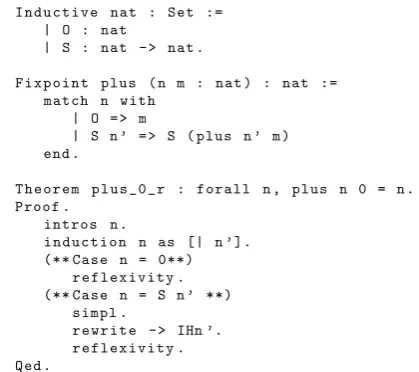
We briefly illustrate these notions by means of a small example, shown in Fig.1.
The source code in Fig.1shows some basic features of the Coq proof assistant: types, functions and proof definitions. In this example, a new inductive type is defined to represent natural numbers in Peano notation. This type is formed by two data constructors:O, that represents the number 0; and S, the successor function. For instance, in this notation the number 2 is represented by the termS (S O)of typenat. The commandFixpointallows the definition of struc-tural recursive functions. Functionplusdefines the sum of two unary natural numbers, in a straightforward way. It is noteworthy that, in order to maintain logical consistency, all functions in Coq must be total.
Besides the declaration of inductive types and functions, we can define and prove theorems in Coq. Figure1shows an example of a simple theorem about functionplus, namely that, for an arbitrary valuenof typenat, we have thatplus n 0 = n. The commandTheoremallows us to state some formula that we want to prove and it starts the interactive proof mode, in which tactics can be used to produce the wanted proof term. In an interactive section of Coq (after enunciation of theoremplus_O_r), we must prove the fol-lowing goal:
used to move premisses and universally quantified variables from the goal to the hypothesis. Now, we need to prove:
The quantified variablenhas been moved from thegoal to the hypothesis. Now, we can proceed by induction over the structure of n. This can be achieved by using tactic induction, that generates one goal for each constructor of typenat. This will leave us with the following two goals to be proved:
The goalplus 0 0 = 0holds trivaly by the definition of plus. Tactic reflexivityproves trivial equalities, after reducing both sides of the equality to their normal forms. The next goal to be proved is:
The hypothesis IHn’ is the automatically generated induction hypothesis for this theorem. In order to finish this proof, we need to transform the goal to use the inductive hypothesis. To do this, we use the tacticsimpl, which per-forms reductions based on the definition of functionplus. This changes the goal to:
Since the goal now has as a subterm the exact left hand side of the hypothesisIHn’, we can use therewritetactic, which replaces some term by another using some equality in the hypothesis. Now, we have the following goal:
This can be proved immediately using thereflexivity tactic. This tactic script builds the following term:
Instead of using tactics, one could instead write CIC terms directly to prove theorems. This is, however, a complex task, even for simple theorems likeplus_O_r, since the manual writing of proof terms requires knowledge of the CIC type system. Thus, tactics frees us from the details of constructing type correct CIC terms.
An interesting feature of Coq is the possibility of defining inductive types that mix computational and logic parts. This allows us to define functions that compute values together with a proof that this value has some desired property. The typesig, also called “subset type”, is defined in the Coq’s standard library as:
Theexistconstructor takes two arguments: the valuex of typeA—that represents the computational part—and an argument of typeP x—the “certificate” that the valuexhas the property specified by the predicateP. As an example of asigtype, consider:
This type represents a function that returns the predecessor of a natural numbern, together with a proof that the returned value preally is the predecessor of n. Defining functions using thesigtype requires writing the corresponding logical certificate. As with theorems, we can use tactics to define such functions.
3λ-Calculus with trust types
This section reviews some motivations for the use of trust types and gives definitions of the syntax and semantics of the trustλ-calculus, which differ from the original defini-tions in [38] as follows: (1) we use a small-step call-by-value semantics, and (2) without loss of generality, we consider only one base type:bool. Extensions to include other type constructors are straightforward.
3.1 Motivations
Data manipulated by computer programs can be classified as trustedoruntrusted. Trusted data come from trusted sources, like company databases, program constants, cryptographi-cally verified network data. All other data are considered untrusted [38].
Trust analysis is especially important in web applications, where user input data can be used to exploit security vulnera-bilities, using attacks such as cross-site scripting (XSS). XSS attacks can occur when a user is able to “dump” HTML text in a dynamically generated page [44]. Through this vulnerabil-ity, it is possible to inject JavaScript code to steal cookies, in order to acquire session privileges. Such a threat occurs due to a lack of verification on input data since, ideally, HTML code cannot be considered as valid input.
In order to avoid such invalid inputs, one can insert checks that ensure data trustworthiness. But, how can we guarantee that all paths, in which probably untrusted information flows, pass all required checks? The solution proposed by Ørbæk and Palsberg [38] is to use a type system to track the flow of untrusted data in a program.
The language considered is aλ-calculus with additional constructs to check if some piece of data can be trusted and mark data as trusted or untrusted. Ifeis some program expression, thentrust eindicates that the result ofecan be trusted. Dually,distrust eindicates that the result ofecannot be trusted andcheck eindicates thatemust be trustworthy. Well-typed programs do not have any sub-expressioncheck ewhereehas an untrusted type.
3.2 Syntax of types and terms
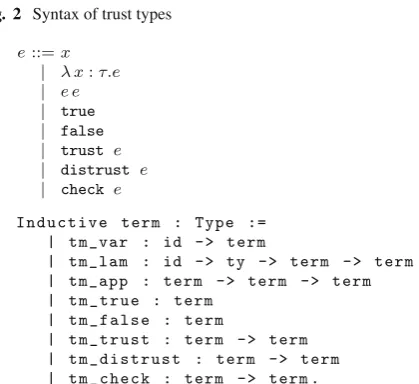
Type syntax is given in Fig.2, where metavariable usage is also given. It is exactly the type syntax of simply typed λ-calculus with boolean constants, except that each typet has a trust annotation to specify iftvalues can be trusted or not.
Fig. 2 Syntax of trust types
Fig. 3 Syntax of terms
The translation of the type syntax to a Coq inductive type is straightforward, and is also presented in Fig.2.
The syntax of terms consists of boolean constants, vari-ables, abstractions and applications, and the three additional constructs to deal with trust types, explained previously. Figure3defines the syntax of terms and the corresponding Coq data type.
The syntax of types and terms used in our formalisation is identical to [38], except that we require type annotations in everyλ-abstraction. We restrict ourselves to type annotated λ-terms, since our main interest is the development of a cor-rect type checker for this language. Allowing non-annotated λ-abstractions characterises a type inference problem that would require a formalisation of a unification algorithm. The formalisation of a unification algorithm has been studied else-where [26,32]. We let a formalisation of the type inference problem for this trust-calculus for future work.
Theidtype, used in the definition ofterm, represents a generic identifier with a decidable function for testing equal-ity and its simple definition is omitted to avoid unnecessary distraction.
3.3 Small-step operational semantics
Fig. 4 Definition of Values
proving progress and preservation theorems [39]. This dif-fers from the approach adopted in [38], where the semantics of the trustλ-calculus is formalised using a reduction seman-tics, with no predefined order of evaluation, and the Church– Rosser property and a subject reduction theorem are proved. The Church–Rosser property ensures that computation in the trustλ-calculus is deterministic and subject reduction guar-antees that reduction preserves typing [2,20].
Let us first define the notion ofvalue, i.e. a term that cannot be further reduced according to the intended seman-tics. We distinguish two kinds of values: primitive val-ues and untrusted valval-ues. Primitive valval-ues (represented by metavariablev) are boolean constants andλ-abstractions. An untrusted value (represented by metavariableu) is a term of the form (distrust v), wherevis a primitive value. Untrusted values arise as normal forms of terms that do not have any checkconstruct.
The definition of values is given in Fig.4. Corresponding Coq definitions for values are straightforward predicate def-initions overterm. Note that a termλx.eis always a value, no matter whethereis a value or not—in other words, we can say that reduction stops at abstractions.
The small-step semantics of the trust λ-calculus is an extension of the standard call-by-value semantics for the sim-ply typedλ-calculus. The required extensions deal with trust specific constructs (termstrust,distrustandcheck). As usual, semantics forλ-calculi rely on substitution. For any e1,e2andx, we define[x → e1]e2to be the result of
substi-tuting everyfreeoccurrence of variablexine2, that follows
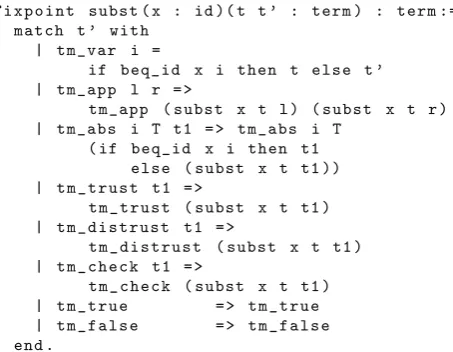
the standard definition of capture free substitution [2,20]. The Coq function presented in Fig.5encodes term sub-stitution. Functionsubstreplaces every free occurrence of xint’for t. It is straightforwardly defined by structural recursion overt’. Intm_varandtm_abscases we have to check whetherxis equal to the current variable. Substitu-tion becomes trickier to define if we consider the case where t, the term being substituted for a variable in termt’, may itself contain free variables. However, since our interest is on extracting a mechanically verified type checker, our
def-Fig. 5 Coq function for term substitution.
inition of the step relation may be restricted to closed terms (i.e. terms that don’t have free variables) and thus we can avoid the extra complexity of dealing with the problem of free variable capture in the formalisation of substitution.2
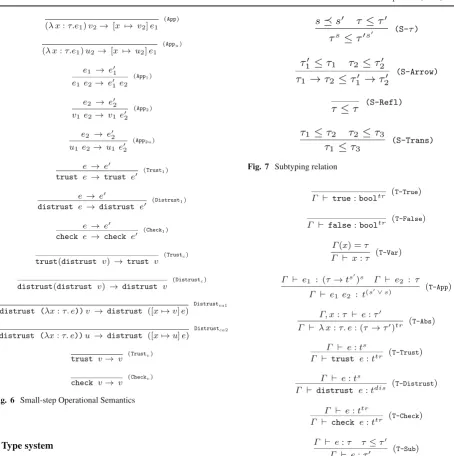
Figure 6 presents the small-step operational semantics. Metavariable v denotesvalues andu denotes anuntrusted value, as defined in Fig.4. Most of the rules are standard, but some deserve attention. Rules Trustc,Distrustc, Distrustca1,Distrustca2,TrustvandCheckvare rules for eliminating redundant uses of trust related con-structs. For example, rule Distrustc specifies that dis-trusting a value twice is the same as disdis-trusting it once. The other contraction rules have similar meanings.
We denote by→∗ the reflexive, transitive closure of the small-step semantics. If a termeis not a value (primitive or untrusted), andecannot be further reduced according to the rules of the small-step semantics, let’s say thateisstuck. An example of a stuck term ischeck(distrust true); sincecheck only reduces trusted values, this term does not reduce to any other term and it is not a primitive or untrusted value.
The main purpose of the type system is to rule out all pro-grams that contain stuck expressions such ascheck(distrust t), for some termt.
The following lemma states the property that the proposed semantics is deterministic.
Lemma 1 (Determinism of small-step semantics)For any e1,e2and e3, if e1→e2and e1→e3then e2=e3.
Proof Induction over the derivation ofe1 → e2 and case
analysis on the last rule used to concludee1→e3.
2 Several techniques can be used in order to deal with the problem
Fig. 6 Small-step Operational Semantics
4 Type system
The type system proposed in [38] is based on the Curry ver-sion of simply typedλ-calculus. Since our main interest is the development of a certified type-checker and proofs about the type system, we use a variation of a Church like type system for the simply typedλ-calculus. The type system is defined in Fig.8, as a set of rules for deriving judgements e:τ, meaning that termehas typeτ, in typing context(which contains type assumptions for the free variables ine). When eis a well-typed closed term, we omitand simply write e:τ.
,x:τis the standard notation for extending typing con-textwith a new assumption, after deleting fromany type assumption forx. We let(x) =τ ifx : τ ∈ . Typing contexts are represented in Coq by lists of pairs of identi-fiers and types. Definitions of typing contexts, functions and properties over them (and their corresponding lemmas) are straightforward.
Fig. 7 Subtyping relation
Fig. 8 Type System forλ-calculus with Trust Types
Trust annotations in types are subjected to a subtyping relations s, meaning that trust typesis a subtype ofs, which is defined as the smallest reflexive relation (encoded as an inductive type) such that (the only non-reflexive element of relationis )trdis.
Using the ordering relation over trust types, a subtyping relation over types is defined in Fig.7.
Fig. 9 Functions for least upper bound over trust types
T-App, the annotated type of the actual argument is required to match the annotated type of the formal argument. This includes trustworthiness. The trust of the result of an appli-cation is the least upper bound of the trust of that func-tion result type and the trust of the funcfunc-tion type itself. We let s ∨ s denote the maximum between the trust typessands.
In order to define the Coq inductive predicate for the typ-ing relation, we need a function to compute the least upper bound of a pair of trust types. The definitions of the least upper bound and trust type update functions are given in Fig.9. Functionlub_trusttyhas a straightforward defi-nition andupdate_trustyreceives as parameters a type τ =ts and a trust annotationsand updates the trust anno-tation on typeτ tos∨s.
We can now proceed to prove that the type system enjoys the type soundness property. In order to do this, we need to prove some lemmas about the typing relation, namely, inver-sion lemmas for the typing relation and canonical forms lem-mas [39]. We will not state each one of these “infrastructure” lemmas here, but only sketch the key ones. Type soundness of theλ-calculus with trust types essentially guarantees that well typed terms do not stuck by checking trustworthiness of an untrusted term. This comes as a consequence of two properties: (1) progress, which guarantees that any well typed closed term reduces to a value; and (2) preservation, that ensures that term reduction preserves types. These results are formalised below.
Theorem 1 (Progress)If e:τ, then either e is a value, or it is an untrusted value, or there exists some term esuch that e→e.
Proof Induction over the derivation of e:τusing canon-ical form lemmas.
Lemma 2 (Substitution lemma)If,x :τ e: τ and e is such thate:τ, then [x →e]e:τ.
Proof Induction over the structure ofeusing the correspond-ing inversion lemma for the typcorrespond-ing relation in each case.
Fig. 10 Syntax Directed Type System forλ-calculus with Trust Types
Theorem 2 (Preservation) If e : τ and e → e, then e:τ, for someτs.t.τ≤τ.
Proof Induction over the derivation of e : τ and case analysis over the last rule used to conclude e → e, using Lemma2.
Corollary 1 (Type soundness)If e : τand e→∗e, then eis not stuck(i.e., eis not of the formchecke, where e has an untrusted type).
Proof Induction overe→∗eusing Theorems1and2.
4.1 Syntax directed type system
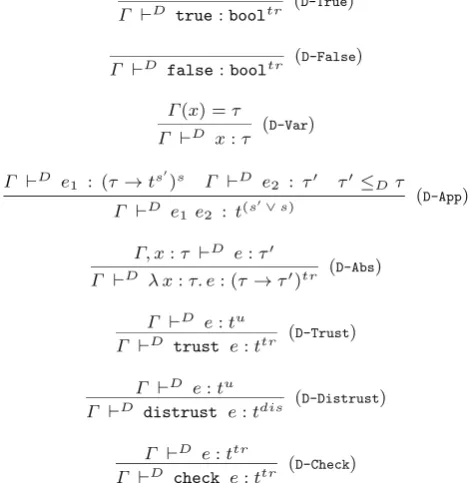
The type system presented in Fig. 8 has the drawback of allowing applications of ruleT-Subat any place in the type derivation for some expressione. This makes this set of rules not immediately suitable for implementation. This section presents a syntax-directed version of the type system for the trustλ-calculus and proves its soundness and completeness with respect to the original type system.
The syntax directed type system is presented in Fig.10as a set of rules for deriving judgements of the form D e : τ. The rules are almost the same as the ones in Fig.8except for the application rule that now includes, as a premise, a test of the subtyping relationτ≤D τ, which represents a function
The next theorems state soundness and completeness of the syntax directed type system, and their proofs are in the companion Coq scripts.
Theorem 3 (Soundness)IfDe:τ, thene:τ
Proof Induction on the derivation ofD e:τ.
Theorem 4 (Completeness)Ife:τ, thenD e:τ for someτsuch thatτ≤τ.
Proof Induction on the derivation ofe:τ.
Finally, we prove that the typing problem for the trust λ-calculus is decidable, that is, we prove that, given a typing contextand terme, it is decidable whether there exists a typeτ such that D e : τ. Because of the constructive nature of this proof, a certified algorithm for type checking an expression can be extracted from it. This theorem is stated as the following piece of Coq source code.
Predicatehas_type_algrepresents the syntax directed type system of Fig.10. Intuitively, this theorem means that either there exists a typetsuch thathas_type_alg ctx e tis provable or there is no such typet.
5 Erasure and simulation
As pointed out in [38], the type system for theλ-calculus with trust types is just a restriction of the classic (in our formalisa-tion) Church type system forλ-calculus. This notion is for-malised by an erasure function that converts terms, types and contexts from the trust calculus to simply typedλ-calculus.
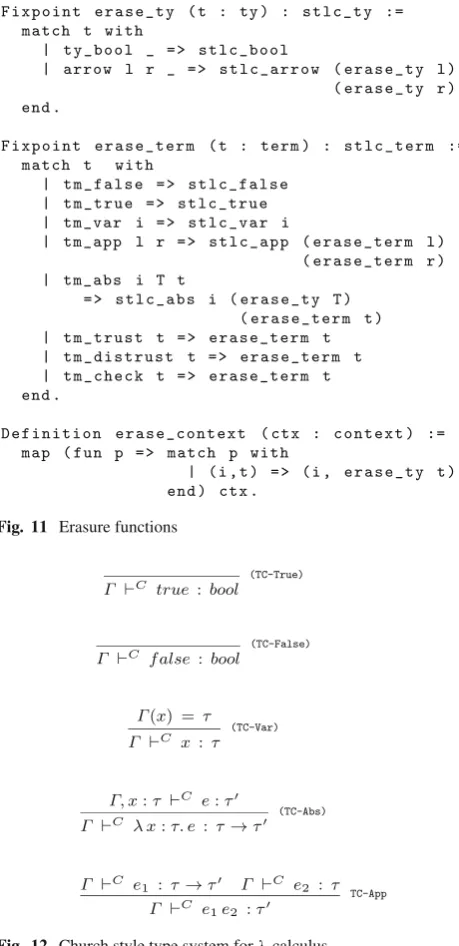
Intuitively, the erasure function removes trust annotations from types, as well as trust constructs from terms. These functions are given in Fig.11.
Following [38], we write these erasure functions using notation|φ|, whereφis used as a term, type or context.
Lemma 3 (Lemma 12 of [38])For any trust typesτ andτ such thatτ ≤τwe have that|τ| = |τ|.
Proof Induction over the derivation ofτ ≤τ.
The relationship between the trust calculus and original λ-calculus is stated by the next theorem, where the judge-ment C e : t denotes the Church style type system for theλ-calculus presented in Fig.12. The proof of this theo-rem uses some lemmas relating erasure and operations over typing contexts and types, that are necessary just for “lift-ing” the erasure functions. Since these lemmas are simple
Fig. 11 Erasure functions
Fig. 12 Church style type system forλ-calculus
consequences of these function definitions, they are omitted here.
Theorem 5 (Erasure)If e : τ, then we have that || C |e| : |τ|.
Proof Induction over e : τ.
Theorem 6 (Simulation)If e : τ and|e| →∗ e then there exists e1such that e→∗e1and|e1| =e.
Proof Induction overe.
6 Related work
Language support. The use of language based techniques for protecting information has as its most prominent example the security mechanism implemented by the Java run-time envi-ronment, which defines a set of security policies for applets [30,54].
Recently, an extension of Haskell was designed to deal with some language features that can be used to bypass the type system, referential transparency and module encapsula-tion [51]. The approach used by Safe Haskell is to classify modules and packages as safe, trust and unsafe based on its source code or in compiler pragmas that can be used to declare a possibly unsafe module as trustworthy. The Safe Haskell extension is available in the GHC compiler version 7.2 [45]. The authors used it to implement a web-based ver-sion of a Haskell interpreter, but no formal description of the safety inference process was given.
Type systems for security. The work of Volpano et al. was the first to use type systems to enforce security policies by a compiler [52]. They defined the lattice based analysis pro-posed by Denning in [15] as a type system for a prototyp-ical imperative language with first order procedures. Their type system relies on polymorphism, thus allowing that com-mands and expression types depend on the context in which they occur. The calculus proposed by Ørbæk and Palsberg in [38] does not support polymorphism as well as our formal-isation. In order to provide polymorphism in theλ-calculus with trust types, we need to deal with the combination of structural subtyping and parametric polymorphism that was developed in [22,47]. We leave this extension for future work.
Another proposal for a type system for ensuring security was described in [19], where a type system for a purely func-tional language was given and extensions like concurrency support were also discussed. The core calculus presented in [19] supports products and sums types and their related term constructs (projections and case expressions, respectively) and they prove type soundness results for closed expressions like the present work. Extending the formalisation of the λ-calculus with trust types with sum and product types is straightforward (e.g. [39, Chapter 15]).
The JFlow type system [35] is used in a language that extends Java with security types. Unlike other works in secu-rity type systems [52,19], JFlow applies the idea of a type system to ensure security policies over information flow on a full programming language, but no formal soundness proof is
presented. A production compiler for this language is avail-able [34] and was used in the development of a secure vot-ing system [13]. Later, Simonet et al. uncovered a couple of flaws in JFlow type system [41], during his development of an extension of ML with types for information flow control, called Flow-Caml [42]. Following ML tradition of provid-ing full type inference, Simonet developed a type inference algorithm for polymorphism and subtyping that was used as basis for Flow-Caml type system [47].
Barthe et al. [4] describe a security type system for a low level language with jumps and calls and prove that infor-mation flow types are preserved by the compilation from a high level imperative language. A mechanised proof that the type system proposed in Barthe’s work is sound was given in [24], using the Coq proof assistant. Compared to the present work, Kammüler’s formalisation deals with the problems of the lack of structure present in low level languages which make control flow more intricate than in a pure functional language.
As pointed out by Ørbæk and Palsberg in [38], security analysis focus on avoiding that classified information leaks out of a system to unprivileged users. The formalised type system ensures that untrustworthy information does not flow intothe system. So, a trust type system can be seen as the “dual” of security type systems.
Use of Proof Assistants. Proof assistants have been used with success in several verification tasks. The Compcert project aims to develop a certified C compiler for embed-ded systems programming, using Coq proof assistant [27]. Several intermediate results were reported such as a mech-anisation of a subset of C semantics [6], verification of the Compcert back-end [28] and a formalisation of C memory model [29]. The works of Chlipala describe compilers for small functional languages also using Coq proof assistant [10,11] and proofs about low level programs using separa-tion logic [12]. The main differential of Chlipala works was the use of dependent types and proof automation to enable maintainability of proof scripts. Coq was also used with suc-cess in the formalisation of well known mathematical theo-rems such as the four colour theorem and the Feit–Thompson theorem by Georges Gonthier team at Microsoft-INRIA joint research center [17,18].
Agda is a dependently typed language [37], based on Mar-tin Löf’s type theory [31], that can be used as a proof assistant. Licata et al. [33] developed a library, called Aglet, for embed-ding secure-typed programming in Agda. Security policies are, in Aglet, proof terms that ensure some security policy. In order to ease the task of writing proof terms, this library provides an implementation of proof search procedure.
Formal Proofs [21] is a online repository for Isabelle develop-ments that contains several formalisations of programming languages and mathematical theorems, such as the formal proofs of Volpano et al. type system for security [48,52].
A common issue in the formalisation of programming lan-guages metatheory using proof assistants is how to deal with languages whose syntax supports variable binding. The main issue with variable binding is the possibility of variable cap-ture in substitutions. Several techniques were developed to avoid variable capture such as de Bruijn indexes [7], high-order abstract syntax [14], locally nameless [8] and nominal logic [40]. For a detailed survey on binding techniques we refer the interested reader to [1]. In our work, we decided to avoid the extra complications of dealing with binding tech-niques (such as de Bruijn indexes and high-order abstract syntax) considering the formalisation of typing properties for closed terms only. There is a library for using the locally nameless approach for Coq proof assistant [9], but it relies on nonconstructive features that would not allow us to extract a verified type-checker from the developed formalisation.
7 Conclusion
We presented an axiom-free, fully constructive Coq formal-isation ofλ-calculus with trust types. The major differences between the original formulation of the trustλ-calculus and its presentation in this work is the use of a small-step seman-tics, instead of a reduction semanseman-tics, and a Church style, instead of a Curry style, type system. This allowed us to give concise proofs of type soundness, erasure and simulation the-orems.
We also presented a syntax directed formulation of the original type system, that is sound and complete with respect to the former. Decidability of type checking is proved using this syntax directed version and a correct type checker can be extracted from this proof.
Future directions for extending this work include: (1) a reviewed formalisation which deals with free variables cap-ture on substitutions, that could be used as a basis for the formalisation of other properties of the calculus; (2) modi-fying the type system in order to account for polymorphism; (3) formalising the type inference problem for the calculus and extracting a certified type inferencer; and (4) extending the calculus to a high level functional language.
References
1. Aydemir BE, Charguéraud A, Pierce BC, Pollack R, Weirich S (2008) Engineering formal metatheory. In: Necula GC, Wadler P (eds) POPL. ACM, New York, pp 3–15
2. Barendrecht HP: The Lambda calculus: its syntax and seman-tics, studies in logic and the foundations of mathemaseman-tics, vol 103. Elsevier, New York (1984)
3. Barthe G, Dufay G, Jakubiec L, de Sousa SM (2002) A formal correspondence between offensive and defensive javacard virtual machines. In: Cortesi A (ed) VMCAI, Lecture Notes in Computer Science, vol 2294. Springer, Berlin, pp 32–45
4. Barthe G, Rezk T, Basu A (2007) Security types preserving com-pilation. Computer Lang Syst Struct 33(2):35–59
5. Bertot Y, Castéran P (2004) Interactive theorem proving and program development. Coq’Art: The calculus of inductive con-structions. In: Texts in theoretical computer science. Springer, New York
6. Blazy S, Leroy X (2009) Mechanized semantics for the clight sub-set of the C language. J Autom Reason 43(3):263–288
7. de Bruijn N (1972) Lambda calculus notation with nameless dum-mies, a tool for automatic formula manipulation, with application to the church–rosser theorem. Indag Math (Proceedings) 75(5): 381–392. doi:10.1016/1385-7258(72)90034-0
8. Charguéraud A (2012) The locally nameless representation. J Autom Reason 49(3):363–408
9. Arthur C (2013) Locally nameless Coq library. http://www. chargueraud.org/softs/ln/
10. Chlipala A (2007) A certified type-preserving compiler from lambda calculus to assembly language. In: Ferrante J, McKinley KS (eds) PLDI. ACM, New Yok, pp 54–65
11. Chlipala A (2010) A verified compiler for an impure functional language. In: Hermenegildo MV, Palsberg J (eds) POPL. ACM, New York, pp 93–106
12. Chlipala A (2011) Mostly-automated verification of low-level pro-grams in computational separation logic. In: Hall MW, Padua DA (eds) PLDI. ACM, New York, pp 234–245
13. Clarkson MR, Chong S, Myers AC (2008) Civitas: toward a secure voting system. In: IEEE symposium on security and privacy. IEEE Computer Society, Los Alamitos, pp 354–368
14. Crary K, Harper R (2006) Higher-order abstract syntax: setting the record straight. SIGACT News 37(3):93–96
15. Denning DE (1976) A lattice model of secure information flow. Commun ACM 19(5):236–243
16. Dybvig RK (2009) The Scheme Programming Language, 4th edn. MIT Press, Cambridge
17. Gonthier G (2007) The four colour theorem: engineering of a for-mal proof. In: Kapur D (ed) ASCM, Lecture notes in computer science, vol 5081. Springer, Heidelberg, p 333
18. Gonthier G (2013) Engineering mathematics: the odd order theo-rem proof. In: Giacobazzi R, Cousot R (eds) POPL. ACM, New York, pp 1–2
19. Heintze N, Riecke JG (1998) The slam calculus: programming with secrecy and integrity. In: MacQueen DB, Cardelli L (eds) POPL. ACM, New York, pp 365–377
20. Hindley JR, Seldin JP (2008) Lambda-calculus and combinators: an introduction, 2nd edn. Cambridge University Press, New York 21. Isabelle Team (2013) The archieve of formal proofs.http://afp.
sourceforge.net/
22. Jones M (1994) Qualified types: theory and practice. PhD the-sis. Distinguished Dissertations in Computer Science. Cambridge University Press
23. Jones SP (2003) Haskell 98 language and libraries: the revised report
24. Kammüller F (2008) Formalizing non-interference for a simple bytecode language in Coq. Formal Asp. Comput. 20(3):259–275 25. Klein G, Andronick J, Elphinstone K, Heiser G, Cock D, Derrin P,
Elkaduwe D, Engelhardt K, Kolanski R, Norrish M, Sewell T, Tuch H, Winwood S (2010) seL4: formal verification of an operating-system kernel. Commun ACM 53(6):107–115
27. Leroy X (2009) Formal verification of a realistic compiler. Commun ACM 52(7):107–115
28. Leroy X (2009) A formally verified compiler back-end. J Autom Reason 43(4):363–446
29. Leroy X, Blazy S (2008) Formal verification of a C-like memory model and its uses for verifying program transformations. J Autom Reason 41(1):1–31
30. Lindholm T, Yellin F (1999) Java virtual machine specification, 2nd edn. Addison-Wesley Longman Publishing Co., Inc., Boston 31. Martin-Löf P (1984) Intuitionistic type theory. Bibliopolis, Naples 32. McBride C (2003) First-order unification by structural recursion.
J Funct Program 13(6):1061–1075
33. Morgenstern J, Licata DR (2010) Security-typed programming within dependently-typed programming. In: Proceedings of the International Conference on Functional Programming.
34. Myers A et al (1998) Jif Compiler.http://www.cs.cornell.edu/jif/ 35. Myers AC (1999) Jflow: practical mostly-static information flow
control. In: Appel AW, Aiken A (eds) POPL. ACM, New York, pp 228–241
36. Nipkow T, Paulson, LC, Wenzel M (2002) Isabelle/HOL—a proof assistant for higher-order logic. In: LNCS, vol 2283. Springer, Heidelberg
37. Norell U (2009) Dependently typed programming in Agda. In: Kennedy A, Ahmed A (eds) TLDI. ACM, New York, pp 1–2
38. Ørbæk P, Palsberg J (1997) Trust in the lambda-calculus. J Funct Program 7(6):557–591
39. Pierce BC (2002) Types and programming languages. MIT Press, Cambridge
40. Pitts AM (2003) Nominal logic, a first order theory of names and binding. Inf Comput 186(2):165–193
41. Pottier F, Simonet V (2002) Information flow inference for ML. In: Proceedings of the 29th ACM symposium on principles of pro-gramming languages. In: (POPL’02). Portland, Oregon, pp 319–330 42. Pottier F, Simonet V (2003) Information flow inference for ML. ACM transactions on programming languages and systems 25(1):117–158
43. Ribeiro R, et al (2013) A formalization of a lambda-calculus with trust types—on-line repository.https://github.com/ rodrigogribeiro/trust-calculus
44. Rimsa A, d’Amorim M, Pereira FMQ (2011) Tainted flow analysis on e-ssa-form programs. In: Knoop J (ed) CC, Lecture notes in computer science, vol 6601. Springer, Berlin, pp 124–143 45. Jones SP et al (1998) GHC—the Glasgow Haskell Compiler.http://
www.haskell.org/ghc/
46. Sabelfeld A, Myers AC (2003) Language-based information-flow security. IEEE J Sel Areas n Commun 21(1):5–19
47. Simonet, V (2003) Type inference with structural subtyping: a faithful formalization of an efficient constraint solver. In: Ohori A (ed) APLAS, Lecture notes in computer science, vol 2895. Springer, Heidelberg, pp 283–302
48. Snelting G, Wasserrab D (2008) A correctness proof for the Volpano–Smith security typing system. Isabelle Archive of Formal Proofs.http://afp.sourceforge.net/entries/VolpanoSmith.shtml 49. Sørensen M, Urzyczyn P (2006) Lectures on the Curry–Howard
isomorphism. No. v. 10 in studies in logic and the foundations of mathematics. Elsevier, Amsterdam.
50. Team IO. Objective Caml (OCaml) programming language web-site.http://caml.inria.fr/
51. Terei D, Mazires D, Marlow S, Jones SP (2012) Safe Haskell. In: Haskell ’12: proceedings of the fifth ACM SIGPLAN sympo-sium on Haskell. ACM, New York
52. Volpano D, Irvine C, Smith G (1996) A sound type system for secure flow analysis. J Comput Secur 4(2–3):167–187
53. Volpano D, Smith G (1997) A type-based approach to program security. In: Lecture notes in computer science, vol 1214, (chap. 48). Springer, Berlin / Heidelberg, Berlin/Heidelberg, pp. 607–621. doi:10.1007/BFb0030629