The Roles of Non-Governmental Organizations
in Development of Schools of Public Health:
An Example from Eastern Europe and Central Asia
Judith W. Overall, JD, MSc, M.Ed,1 Julien Goodman, M.Phil (Cantab)2
ABSTRACT
The international non-governmental community has played a major role in developing schools of public health and continues to do so. Nearly a century ago, seminal investments of the Rockefeller Foundation played a pivotal role in developing schools of public health in North America and several abroad. Today, involvement of non-governmental organizations in continuing development of schools of public health is needed, as many countries throughout the world continue to battle the burden of disease with insufficient numbers and quality of trained public health workers. In this paper we discuss in particular the roles of the Open Society Institute working together with the Association of Schools of Public Health in the European Region to foster the development of schools of public health in formerly socialist countries. We describe the development process in three example countries (Ukraine, Lithuania, and Macedonia), along with the difficulties they have faced. Government support and accreditation processes are needed to sustain the efforts to launch new schools of public health and to ensure their quality. The lessons learned in these initiatives are relevant to future development of public health education to provide the workforce required to address needs of professional public health in the 21stcentury.
Key Words: Public health, education, public health professional workforce, public health capacity-building, non-governmental organizations (NGOs)
Recommended Citation:Overall JW, Goodman J. The Role of Non-Governmental Organizations in Development of Schools of Public Health: An Example from Eastern Europe and Central Asia Public Health Reviews. 2011;33:168-89.
1 Public Health Consultant; Tulane School of Public Health and Tropical Medicine (Adjunct),
New Orleans, USA.
2 Liverpool School of Tropical Medicine, Liverpool, UK.
INTRODUCTION
Non-governmental organizations (NGOs) in the health sphere have gained strength, momentum and numbers over time. The Director General of WHO,1973-1988, recognized the ability of NGOs to influence policy makers, as noted by Narayan, Wise, and Ghebrehiwet: “Dr. Mahler, Director General of WHO at the time, publicly states that it was the non-governmental organizations (NGOs) who pressed WHO strongly to move beyond a disease-focused, expert-dependent, techno-management approach, based on the dominant system of medicine, to one wherein community participation, inter-sectoral coordination and appropriate tech-nology were important.”1 A recent (2010) acknowledgement by Laaser and Epstein of the power of NGOs in the health arena states that the fourth phase of the internationalization of health “is characterized by the growing influence of health-related, non-governmental organizations (NGOs)…”2 which include those in the arena of public health, such as the World Federation of Public Health Associations (WFPHA), the International Union for Health Promotion and Education (IUHPE), the International Association of National Public Health Institutes (IANPHI), national and regional public health associations, and national and regional associations of schools of public health.
Discussions of development of schools of public health (SPHs) almost uniformly include the 1915 Welch-Rose report3 and the resulting funding of the development of SPHs in the United States and abroad by the Rockefeller Foundation in particular. On a national scale, the development of schools by the Rockefeller Foundation sought to provide trained professionals for public health service.4 On an international scale, the Foundation implanted schools and institutes around the world creating a movement of professionals in which new ideas and techniques could be shared.5 Direct funding for establishment and capacity building of SPHs remains an issue in many parts of the world, but other aspects of their growth and development, such as the determination of competencies needed by public health professionals and the quality (and its measurement) of the educational programs to be taught in SPHs are crucial as well.
A 21ST CENTURY CALL FOR ACTION: EDUCATION OF HEALTH
PROFESSIONALS
of transformative health professional education.6,7 Although the report shows the dearth of information about health professionals’ education in general, its findings highlight the continuing lack of information about public health professional education per se:
1. of the 11,054 publications found in the Commission’s search for publications about health professions education, only two percent were about public health;
2. although there are an estimated 467 schools and departments of public health globally, the estimation of public health institutions was incomplete because of definitional ambiguity/variability in definition; and
3. the Commission could not estimate the number of public health graduates because of data and definitional restrictions.6,7
In a separate article, Evans notes that it is surprising how little research has been done to assess the role of SPHs in contributing to population health as well as the lack of research on the strengths and weaknesses of the different models of SPHs.8 Although efforts have begun to identify and map public health professional education institutions (e.g., AfriHealth9), and originally the data were to be included in a global database of health professions educational institutions (Avicenna Directories),10 the information available at the site to date is about medical education only. Databases about member schools and programs exist and are being updated within national and regional associations of SPHs, but many schools or programs are not association members.
Information in reports can appear contradictory. One message is that more SPHs and members of the public health workforce are needed, while a simultaneous message is that there is no clear identification of the public health workforce (and therefore the competencies needed) or of the existing SPHs. For example, some reports state: there is a shortage of public health specialists and critical skills (including health policy and management); SPHs do not graduate enough people each year; more SPHs are needed; and graduates’ competencies should meet local profiles of health needs to carry out essential public health functions and services.14 Other information, however, reveals that, as a result of the paucity of data about the public health workforce and its education institutions and training processes, several things are not known for sure: how many SPH graduates there are; who the specific members of the professional public health workforce are; how many of them there are (excluding doctors and other clinicians); or specifically what many of them do. What some of them do is sometimes described generally as to “improve, promote, protect, and restore” population health.15 Others, again in general terms, may support and manage health programs and services: identify, monitor and manage population health problems; inform, evaluate and advocate for appropriate health and inter-sectoral policies; or plan and manage the health system and services in response to population health needs.16
Questions arise from the reports. One is why there continues to be so little reliable data about public health professional education, practice, and workforce. A second is what can be done, by whom, to rectify this in a more specific, expedient manner. Until this issue is adequately addressed, it will continue to be difficult, if not impossible, to determine specific public health workforce and professional education needs (numbers and competencies).
A third question is what SPHs are expected to teach in this context – one in which they should meet international criteria of curriculum content and ensure that graduates are capable of carrying out geographically-articulated essential public health functions (PAHO)17,18/ services (US)19 /
SPECIFIC ROLES OF NGOs IN DEVELOPMENT OF SPHs
Employment and Workforce Data
NGOs are important in the employment of SPH graduates and are well-positioned to identify at least part of the professional public health workforce. This includes adding to the data about practitioners, identification of skills and competencies needed for particular jobs and specialties, and providing feedback to SPHs. This can augment government planning for workforce needs (including competencies), aid in the development of workforce performance standards, and support the need for governments and licensing bodies formally to recognize and regulate public health practice as a specialty. In addition to being potential employers of SPH graduates, NGOs are also potential sources of students, adjunct lecturers, and practicum sites for SPHs.
Competencies and Quality
A critical issue for some associations of SPHs is their work with partners to promote workforce-competencies development in curricula of varying levels, including bachelor, master and doctorate, of public health professional education.21,22 The American Association of Schools of Public Health (ASPH) is one example. The Association of Schools of Public Health in the European Region (ASPHER) is another; its Working Group on Public Health Core Competencies faces the task of determining and promoting competencies in a vast geographic area that includes Member States of the European Union, Council of Europe, and European Region of WHO. At the global level, the WFPHA, in collaboration with WHO Headquarters, established a working group on public health education in 2010; one item in its action plan is fostering the development of a global harmonization of the various articulations of public health essential functions and competencies based upon local practice needs,23 including coordination of efforts of governments and international organizations.
European Review (PEER) review of some SPHs in the European Region and provided a strong base for efforts to establish the European Agency for Public Health Education Accreditation (APHEA),25 an independent, non-profit organization in association with ASPHER, the European Public Health Association (EUPHA), and several other prominent European public health organizations.
Advocacy
Advocacy for the value of SPHs and the public health workforce is an important and necessary role, one that can best be played by actors actually working “on the ground” : many are NGOs. Of those NGOs, the associations of SPHs, the national and regional public health associations, and a few global organizations (such as WFPHA and IANPHI) are best positioned to lead the movement to fill in the gaps in the data regarding the identification of the public health workforce, the numbers and competencies needed, and their true corresponding educational needs. Those associations, and their individual members, are the organizations who must lead in proving in some countries or regions that public health professional education and the public health professional workforce are as valuable as medical education and the clinical health care workforce in protecting health at the population level.
Financing
An example of flexible, direct funding for a regional program of capacity building in schools and programs of public health in the 2000s is described in the section below. It was a broad, collaborative development program of two NGOs: funding by the Public Health Program of OSI, now the Open Society Foundations (OSF), and technical implementation by ASPHER, through faculty of its member schools. The flexibility available for use of the funds and the dedication and work of the individual faculty members of ASPHER schools as consultants to existing schools and mentors to new ones, along with the determination and focus of in-country faculty and other major stakeholders, were major keys to the individual successful projects within the initiatives.
“QUALITY DEVELOPMENT OF PUBLIC HEALTH TEACHING PROGRAMMES IN CENTRAL AND EASTERN EUROPE” AND PARALLEL PROJECTS, 2000-2007
As the World Health Report 2006 notes, the education of the health workforce requires attention to organization, curriculum, teaching methods, training of teaching staff, research and service.14 In addition, it notes that more SPHs are needed. These issues also comprise the themes of the OSI ASPHER workforce development program entitled “Quality Development of Public Health Teaching Programmes in Central and Eastern Europe,” 2000-2005,33 along with parallel projects in Central and Eastern Europe (CEE) and Central Asia that ended in 2007.
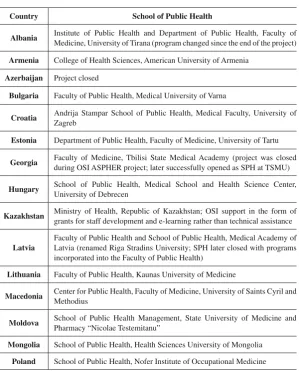
Designed with the understanding that a professional, qualified and multidisciplinary workforce, in sufficient numbers, is vital to the org-anization and management of effective public health systems in Europe and around the world, this was an initiative, along with parallel ones, to build public health workforce capacity by strengthening and developing public health schools and teaching programs in twenty countries (Table 1).33 The initiatives included the development of one new SPH or the further development of an existing one in each country (with the exception of Russia, in which there were four), while at the same time fostering regional networking. Although funding, evaluation, and participation in initial planning were provided by OSI, the specific content and implementation were determined and carried out primarily by individual faculty members of ASPHER schools and programs in collaboration with the faculty members and administration of the individual project schools.
university education standards (the Bologna Declaration and Process)34 that had to be taken into consideration. Several countries of the initiatives were in the process of EU accession and harmonizing many of their laws and sectors. Geographically, these schools and programs are located in a region where the model of public health often has been one that is largely infectious disease-focused and hospital-oriented.33
Table 1
Academic institutions of participating schools and programs
Country School of Public Health
Albania Institute of Public Health and Department of Public Health, Faculty of Medicine, University of Tirana (program changed since the end of the project)
Armenia College of Health Sciences, American University of Armenia
Azerbaijan Project closed
Bulgaria Faculty of Public Health, Medical University of Varna
Croatia Andrija Stampar School of Public Health, Medical Faculty, University of Zagreb
Estonia Department of Public Health, Faculty of Medicine, University of Tartu
Georgia Faculty of Medicine, Tbilisi State Medical Academy (project was closed during OSI ASPHER project; later successfully opened as SPH at TSMU)
Hungary School of Public Health, Medical School and Health Science Center, University of Debrecen
Kazakhstan Ministry of Health, Republic of Kazakhstan; OSI support in the form of grants for staff development and e-learning rather than technical assistance
Latvia
Faculty of Public Health and School of Public Health, Medical Academy of Latvia (renamed Riga Stradins University; SPH later closed with programs incorporated into the Faculty of Public Health)
Lithuania Faculty of Public Health, Kaunas University of Medicine
Macedonia Center for Public Health, Faculty of Medicine, University of Saints Cyril and Methodius
Moldova School of Public Health Management, State University of Medicine and Pharmacy “Nicolae Testemitanu”
Mongolia School of Public Health, Health Sciences University of Mongolia
Country School of Public Health
Romania
Department of Public Health and Management, University of Medicine and Pharmacy, “Carol Davila” and the National Institute for Research and Development in Health (NIRD later changed to the National School of Public Health)
Russian Federation
1. Chelyabinsk: Ural State Medical Academy of Postgraduate Education; 2. Moscow: Faculty of Public Health Management, I.M. Sechenov Moscow
Medical Academy (named changed in 2010 to I.M Sechenov First Moscow State Medical University);
3. St. Petersburg: College of Public Health, Medical Academy of Post-graduate Studies;
4. Tver: Faculty of Postgraduate Studies, Tver State Medical Academy
Tajikistan Faculty of Public Health, Tajik State Medical University
Ukraine School of Public Health, National University of Kiev-Mohyla Academy
Uzbekistan
Second Tashkent State Medical Institute (Presidential Order of 2005 merged 1st and 2nd TSMI into Tashkent Medical Academy; program now is housed in the Department of Public Health and Health Management, Tashkent Medical Academy)
In many countries there was pervasive dialogue about the merits of the Sanitary-Epidemiology (San-Epid) system/service and that of the New Public Health, described by Tulchinsky and Varivakova as “a contemporary application of a broad range of evidence-based scientific, technological, and management systems implementing measures to improve the health of individuals and populations.”35 Not all of the countries in the region, however, had adopted the San-Epid system, particularly those of the former Yugoslavia.36 Djubuti, Gotsadze, Mataradze, and Menabde described the San-Epid service in the former Soviet Union: it was a highly-centralized network, as part of the health system, focusing on environmental and epi-demiological health; it was highly successful in areas such as immunizations and communicable disease control; employees were graduates of a five-year course in San-Epid faculties in medical academies or universities that included some basic medical education and some clinical training, in addition to the major focus on environmental health and infectious disease epidemiology and control; graduates obtained the degree of medical doctor, with specialization in epidemiology, environmental health, nutrition, etc.37
that those who work to build or expand schools and programs of public health, as consultants or as funding organizations, for example, take the time to understand thoroughly any existing systems with corresponding educational programs, particularly when the system/service/network is as pervasive as the San-Epid system in the former Soviet Union. Otherwise, it is difficult at best, if not impossible, to have the full depth of discussion needed regarding the reasons and merits for adding to or changing the existing system/service and its corresponding education.
Goals and Methods of Implementation
The goals of the OSI ASPHER initiatives included: growth of selected, existing schools, programs and curricula; establishment of new ones within the framework of national and international standards and within existing academic institutions; and addressing the training needs of each country’s public health workforce and stakeholders. Examples of initiatives to develop standards of education/accreditation for SPHs in the region include the ASPHER PEER funded by OSI (2001-2005) and the EU Leonardo da Vinci Programme (2004-2007),39,40 which have evolved into APHEA to be operational and further developed during the 2011-2012 academic year.41 As the accrediting agency did not exist at the time of the OSI ASPHER initiatives, the ASPHER PEER was the standard used.
Primary methods of implementation included: systematic peer review (ASPHER PEER) of existing teaching programs and curricula; “twinning”/ partnerships with Western European SPHs; short-and long-term faculty training at established European SPHs; in-country lectures and workshops; and site visits by ASPHER consulting faculty. In response to requests from across the countries, two Faculty Development Pedagogic Institutes were added (2005), in collaboration with the John E. Fogarty International Center (US National Institutes of Health). The topics were Epidemiology and Health Management, as those were the two most consistently requested ones.
Other Activities for Faculty and Potential Faculty of Participating Schools
countries, Russia and Central Asia developing new SPHs. For potential junior faculty, OSI funded scholarships from 2001-2006 to the Braun International MPH program and to other SPHs on individual bases. OSI continues to provide support in 2010-2011 to the SPHs in Georgia, Kazakhstan, Mongolia, and Ukraine through its International Higher Education Support Program (HESP).
Challenges
There were widespread challenges; reflecting prior discussion, there were no clear definitions of “public health,” “public health workforce,” or public health skills and competencies. Therefore, it is not surprising that there were differences of opinion over whether public health professional edu-cation should be part of medical training or a separate multidisciplinary field taught by multidisciplinary faculty. If in a medical faculty, corresponding issues included whether a public health faculty or program should be housed and taught as part of basic medical education or higher level or taught at a postgraduate institute, along with whether the Bologna Declaration applies to medical education.
Another challenge was the need for faculty development in specific subject matter as well as teaching/research methodology. In many instances, there was lack of materials at the outset; simply providing copies or translations of materials from other countries was not sufficient, even though important. The same was true for curriculum expansion, revision, or development. A lack of defined employment for graduates was often problematic, while there was need for both short-and long-term training for the existing workforce. The need for health management training and the determination of how to balance health management with other core courses was a common theme. Differences in meaning and interpretation of terminology, such as “public health specialist,” “master’s,” and “postgraduate” caused difficulties. There were issues regarding Bologna Declaration levels, conversion to the European Credit Transfer and Accumulation System (ECTS), and compatibility of national accrediting standards and international ones.33
There was a major, consistent complaint from the field: the three-year window per individual school project was too short, particularly for the newly-established schools. Continued growth and success of new schools in particular therefore often are reflections of the determination, leadership and vision of “idea champions” in those schools plus commitments of the ASPHER partner schools and individual faculty members to continue to provide mentorship, lectures, collaboration, and, at least upon one occasion, additional funds.
BROAD OVERVIEW OF RESULTS
Though not all of the individual projects succeeded, much was accomplished from 2000-2007. In the larger OSI-ASPHER initiative, six of a possible seven PEER Reviews were conducted (Armenia, Bulgaria, Estonia, Hungary, Lithuania, Poland). In the combined initiatives, several newer programs that were started or supported then continued, sometimes with revisions, after the initiatives ended (Albania, Latvia expanded master program, Macedonia, Moldova, Mongolia, Romania, Russia,Tajikistan, Ukraine, Uzbekistan). Three research forums were established (Albania, Macedonia, Mongolia). It is impossible to describe here all of the individual school projects. However, in order to provide more in-depth information and insight about the initiatives, three specific examples are included below.
1. Kiev, Ukraine: Partnerships and Twinning
The start-up and development of a SPH at the National University of Kiev-Mohyla Academy (NaKUMA) contains many issues described above: where to house the SPH; whether a program of health management is appropriate as a program of public health; the importance of collaboration with the medical community and the Ministry of Health; the interaction of Ministries of Health and Education; how and where to train faculty; innovative teaching and research methods; and national licensing and accreditation.
four Ukrainian partners: the Ministry of Health, Kiev Medical Academy of Postgraduate Education (KMAPE), NaUKMA, and the Ministry of Education at the outset.
The Master of Health Care Management program finally opened at NaUKMA in 2004 with a multidisciplinary student body of medical and social workers, economists, lawyers, and foreign students. Problem-based Learning (PBL), a hallmark of Maastricht University teaching, was used from the outset, with NaUKMA faculty members being trained in PBL methods at Maastricht. The first students, accustomed to more didactic teaching, were less receptive to PBL methods than the second class that followed. Licensing of the program was another hurdle: there was resistance from both the medical profession and the professional council on management in addition to inaction by the Minister of Education, partly due to the fact that this is a very different and unique program based on European quality standards with content oriented to Ukraine’s needs.42 Support from a member of Parliament (later the Minister of Health) was key to successful licensing in 2005.42 The first cohort graduated in 2006, with national program accreditation awarded in 2007 as Master of Management of Organizations (Health Care Management); the Master of Public Health (MPH) did not exist in Ukraine.
The partnership continues, with the addition of Kiev-Mohyla Business School; Maastricht professors continued to lecture at the school; and some NaUKMA students have studied at Maastricht University for several months. The SPH offers two concentrations in the regular master level program of Public Health and Healthcare Management,43 a Master of Healthcare Management for Executives,44 and a PhD program.45 The commitment of Maastricht University and its individual faculty consultants (e.g, training of Ukraine SPH faculty members in PBL teaching methodology at Maastricht, assisting in individual teaching-unit development, lecturing at the new SPH) was, and continues to be, along with the NaUKMA SPH Dean’s clear vision for the school and the flexibility provided for development by the university, one of the strongest commitments in the initiatives and one of the key reasons for the new SPH success.
2. Kaunas, Lithuania: Need to Harmonize Accreditation/Assessment Criteria
FPH to move toward systematic evaluation and quality improvement by undergoing the ASPHER PEER and implementing its procedures. What happened during the process was important both within the context of the Bologna Declaration goal to develop a common European Higher Education Area (with harmonized academic regulations on accreditation of teaching programs and recognition of university degrees) and that of the development of the Lithuanian system of accreditation of university teaching programs. In 2002-2003, in addition to the ASPHER PEER Review, the FPH also went through a national accreditation review by the Lithuanian Center for Quality Assessment in Higher Education (LCQAHE). The national accreditation and international PEER criteria were different, as were the results of the two reviews: the LCQAHE viewed the international and European dimension in teaching negatively; the ASPHER PEER evaluation considered it to be very positive. According to FPH Dean Ramune Kaledienne, “This is why it is evident that this is a challenge for national and international experts and accreditation bodies to harmonize assessment criteria.”33
Later, in 2007, the MPH program at Kaunas FPH and the University of Sheffield (UK) were chosen as candidates for pilot accreditation in the EU-funded project, European Accreditation of Public Health Education (PH-ACCR). Lessons learned from that experience, as well as from the ASPHER PEER, were transferred to the creation of APHEA, the new European accrediting body created by ASPHER and sister organizations. The OSI ASPHER PEER project was an important piece in the development of the agency and its processes, as it provided basic ideas, precedent and tools. The new agency was established on April 1, 2011.
3. Skopje, Macedonia: Unifying Departments; Amending Bylaws; Creating a Market
The CPH was established to provide postgraduate training for a multidisciplinary group of professionals (medicine, dentistry, nursing, economics, law, social sciences,business administration, and engineering). A modular format was chosen in order to allow enrolment of students already working in the health sector. Planning and assistance from ASPHER faculty consultants began in 2001. However, implementation of the CPH was dependent upon revision of the Statute of the Faculty of Medicine, which did not occur until May of 2003. The CPH master program began in December of that year.
The CPH was possible due to the strong and continuous support from the Faculty of Medicine, the University, and the Ministry of Health, in addition to the OSI funding and the intensive technical assistance and mentoring from faculty of two ASPHER member schools. Key areas of technical assistance included curriculum design and materials preparation and the design and implementation of a research forum for students and junior faculty, in addition to meetings with officials of the University and the Ministries of Health and Education to promote the CPH.
OSI and the local national foundation (FOISM) supported the following: training for trainers conducted by international visiting faculty members; CPH faculty member study visits to well-established SPHs; participation of CPH faculty in international meetings; strengthening of infrastructure (e.g., teaching rooms, library, computer labs); writing/translation and publication of a glossary of public health terms; and translation of an international textbook, The New Public Health (Tulchinsky and Varavikova), 47 for use by CPH faculty and students. Most of the CPH faculty attended Visiting Faculty Programs at the Braun School of Public Health during the preparatory phase of development. At least one of the ASPHER consultants continued to lecture in the program after the OSI ASPHER initiative ended.
and Leadership that now is required for health managers of health care facilities in Macedonia (e.g, 400 participants in a six-week training module during 2006-2007).48 This is in addition to the regular teaching programs of the CPH. In February 2011, according to the head of the CPH, the National Accreditation Board at the Macedonian Ministry of Education and Science officially accredited the revised MPH program and the new PhD in Public Health (three years, 180 ECTS, harmonized with Bologna Declaration principles and prepared according to the new Macedonia Law for Higher Education).
CONCLUSIONS
Great strides have been made over the last century to supply a trained public health workforce. Much of this work has been accomplished through direct involvement and funding by NGOs, but the lack of funding and initiative remain a global issue. In 2003, for example, the Committee on Educating Public Health Professionals for the 21st Century acknowledged “the major contributions of philanthropic foundations to the development of public health education in the United States and emphasizes the renewed importance of foundation support to fund new initiatives and experiments in public health education.”49 In 2010, the Global Commission on Education of Health Professionals for the 21st Century stressed the gross underfinancing and sounded the call for donors to increase funding for health professional education as a significant share of development assistance.”6 Funding alone, however, is not sufficient.
that American and European Public Health are distinct.52 There are geographically-articulated public health “essentials” (e.g., “functions”, “services,” and “operations”). Against such a changing and varied backdrop in the very basic understandings of public health, it becomes comprehensible how implementing new systems in third countries has become fraught with hurdles where the issue of funding is only one piece of the puzzle. Associations of SPHs have demonstrated an increasingly important and active role in developing new schools. The OSI ASPHER initiatives highlighted in this article demonstrate one example of how one such association (ASPHER), its member schools, and individual faculty members can substantially change the landscape of public health training through partnerships, networking, the sharing of experiences, the transfers of knowledge, and moral support. A European accreditation system for MPH programs, not available during the time of the OSI ASPHER initiatives, was developed in part based on the PEER review experience and is being developed and operationalized with the initiative of ASPHER, EUPHA, and several other organizations during 2011-2012 as APHEA.41
Initiatives to adapt the training of public health workers to current and future health needs in Europe are reflective of the early attributes of the Rockefeller Foundation, et al. activities but with a major difference. Rather than seeking to build brand new infrastructures, the European (European Region of WHO) initiatives described here sought to change existing structures and practices in both sustainable and cost-efficient ways. More government and NGO funding is needed to continue establishment and expansion of schools and programs of public health education. In order to achieve this, there is need for advocacy from professionals in the field of public health in some countries and regions to show the value of public health education and to press for more clear identification of the public health workforce and its competencies.
Acronyms list:
APHEA = Agency for Public Health Education Accreditation ASPH = Association of Schools of Public Health
ASPHER = Association of Schools of Public Health in the European Region CEE = Central and Eastern European
CEPH = Council on Education for Public Health CPH = Center for Public Health
EUPHA = European Public Health Association FPH = Faculty of Public Health
IANPHI = International Association of Public Health Institutes MPH = Master of Public Health
NaUKMA = National University of Kiev-Mohyla Academy NGOs = Non-Governmental Organizations
OSF = Open Society Foundations OSI = Open Society Institute PBL = Problem-Based Learning
PEER = Public Health Education European Review San-Epid = Sanitary-Epidemiology
SPHs = Schools of Public Health
WFPHA = World Federation of Public Health Associations
Acknowledgements: We wish to thank Ted Tulchinsky and Joan Bickford for their assistance and patience during the review process and with the references.
Disclaimer: Judith Overall was a meta evaluator of the OSI ASPHER initiatives described in this article. She is a consultant for the Law and Health Initiative of OSF’s Public Health Program in the area of law, health and human rights in eight of the countries of the former OSI ASPHER initiatives, including support of development of academic courses in faculties of law, medicine, and public health. She is a member of the WFPHA Working Group on Education mentioned in this article and the ASPHER Working Group on Innovation and Best Practices in Public Health Education. Julien Goodman was the Program Manager for the larger OSI ASPHER initiative described in this article and lead author of the lessons learned book about the OSI ASPHER initiatives.
Conflicts of Interest: None declared.
REFERENCES
1. Narayan T, Wise M, Ghebrehiwet. NGO coalitions for global health promotion. Available from URL: http://www.phmovement.org/pha2/issues/documents/ NGOCOALITIONSFORGLOBALHEALTHPROMOTION.doc or at: http:// www.docstoc.com/docs/39064444/NH)-COALITIOND_FOR_GLOBSL_ HEALTH_PROMOTION (Accessed 18 May, 2011).
3. Welch WH, Rose W. Institute of Hygiene: a report to the General Education Board of the Rockefeller Foundation. New York, the Rockefeller Foundation. 1915. In: Delta Omega Honorary Society. The Welch-Rose Report: A public health classic (page 48). Available from URL: http://www.deltaomega.org/ WelchRose.pdf (Accessed 18 May, 2011).
4. Fee E. Designing schools of public health for the United States. In: Fee E, Acheson RM, editors. A history of education in public health: health that mocks the doctors’ rules. Oxford: Oxford University Press; 1991.
5. Fosdick RB. Adventure in giving: the story of the General Education Board: A foundation established by John D Rockefeller. New York: Harper and Row; 1962.
6. Frenk J, Chen L, Bhutta ZA, Cohen J, Crisp N, Evans T, et al. Health professionals for a new century: transforming education to strengthen health systems in an interdependent world. Lancet. 2010;376:1923-58.
7. Frenk J, Chen L, et al. The Commission Report. Health professionals for a new century: transforming education strengthen health systems in an interdependent world (reproduced in expanded book form in full recognition of the Lancet copyright). Cambridge, MA: Harvard University Press (distributor); 2010. Available from URL: http://www.healthprofessionals21. org/docs/HealthProfNewCent.pdf (Accessed 18 May, 2011).
8. Evans D. The role of schools of public health: learning from history, looking to the future. J Public Health. 2009; 31:446-50.
9. IJsselmuiden CB, Nchinda TC, Duale S, Tumwesigye NM, Sersadda D. Mapping Africa’s advanced public health education capacity: the AfriHealth project. Bull World Health Organ. 2007;85:914-22.
10. Avicenna Directories. Global directories of education institutions for health professions – a partnership of the World Health Organization and the University of Copenhagen. Available from URL: http://avicenna.ku.dk (Accessed 18 May, 2011).
11. Beaglehole R, Sanders D, Dal Poz M. The public health workforce in Sub-Saharan Africa: challenges and opportunities. Ethnicity and Disease. 2003;13:S2-29. 12. Petrakova A, Sadana R. Roundtable: Problems and progress in public health
education. Bull World Health Organ. 2007;85:963-4.
13. Magaña-Valladares L, Nigenda-López G, Sosa-Delgado N, Ruiz-Larious JA. Public health work force in Latin America and the Caribbean: assessment of education and labor in 17 countries. Salud Publica Mex. 2009;51:62-75. 14. World Health Organization. The world health report 2006: Working together for
health. Geneva: World Health Organization; 2006. Available from URL: http://www.who.int/whr/2006/whr06_en.pdf (Accessed 18 May, 2011). 15. Pan American Health Organization/World Health Organization (PAHO/WHO).
16. Bailey RJ, Dal Poz M. Building the public health workforce to achieve health-related development goals: moving forward in collaboration. J Public Health Policy. 2010;31:494-7.
17. Ramagen C, Ruales J. The essential public health strategies as a strategy for improving overall health systems performance: trends and challenges since the Public Health in America initiative, 2007-2009. Series 46 Human Resources for Health. Washington, DC: PAHO/WHO. 2008. (posted 2008). Available from URL: http://www.paho.org/english/DPM/SHD/HR/EPHF_ 2000-2007.pdf (Accessed 18 May, 2011).
18. The Pan-American Health Organization/World Health Organization (PAHO/ WHO) What are the EPHF? Available from URL: http://www.paho.org/ english/dpm/shd/hp/EPHF.htm (Accessed 18 May, 2011).
19. Communicable Disease Control (CDC). National public health performance standards program: orientation to the essential public health services. Available from URL: http://www.cdc.gov/nphpsp/documents/ EssentialServicesPresentation.pdf (Accessed 18 May, 2011).
20. World Health Organization. Regional Office for Europe, Regional Committee for Europe. Sixty-first Session. Provisional agenda item 6(b), EUR/RC61/10 + EUR/RC61/Conf.Doc./3: Strengthening public health capacities and services in Europe: a framework for action. Baku, Azerbaijan: WHO; 12-15 September, 2011. Available from URL: http://www.euro.who.int/_data/ assets/pdf_file/0008/147914/wd10E_StrengtheningPublicHealth_111348. pdf (Accessed 2 October, 2011).
21. Calhoun JG, Ramiah K, Weist EM, Shortell SM. Development of a core competency model for the master of public health degree. Am J Public Health. 2008;98:1598-1607.
22. Birt CA, Foldspang A. Public health capacity building – not only the property of the medical profession. Eur J Public Health. 2009;19:232-5.
23. World Federation of Public Health Associations. Available from URL: http:// www.wfpha.org/working-groups.html#phed (Accessed 27 May, 2011). 24. Council on Education for Public Health. Available from URL: http://www.ceph.
org/pg_about.htm (Accessed 18 May, 2011).
25. Agency for Public Health Education Accreditation in the European Region. http://www.aspher.org/index.php?site=accreditation_in_ph_education (Accessed 18 May, 2011).
26. Beaglehole R, Dal Poz M. Commentary. Public health workforce: challenges and policy issues. Hum Resour Health. 2003;1:4.
27. American Public Health Association. Bridging the gap in public health capacity in Africa: experiences from public health schools without walls (PHSWOW) in Uganda. APHA 135th Annual Meeting and Expo, November 3-7, 2007. Available from URL: http://apha.confex.com/apha/135am/techprogram/ paper_163935.htm (Accessed 18 May, 2011).
29. World Health Organization. Public health schools: six portraits. Bull World Health Organ. 2007;85:907-9.
30. Mushtaque A, Chowdhury R. A new school of public health in Bangladesh. In: Matlin S, editor. Global Forum Update on Research for Health Volume 2. Poverty, Equity and Health Research. pp. 145-148. London: Probook; 2005. Available from URL: http://www.globalforumhealth.org/Media-Publications/ Publications/Global-Forum-Update-on-Research-for-Health-Volume-2 (Accessed 18 May, 2011).
31. The Atlantic Philanthropies. Website. Available from URL: http://www. atlanticphilanthropies.org/about-atlantic (Accessed 18 May, 2011).
32. The Wellcome Trust. Press release: Notes to editors. Press release 29. July 2010. Available from URL: http://www.wellcome.ac.uk/News/Media-office/Press-releases/2010/WTX060350.htm (Accessed 18 May, 2011).
33. Goodman J, Overall J, Tulchinsky T. Public Health Workforce Capacity Building: Lessons Learned from “Quality Development of Public Health Teaching Programs in Central and Eastern Europe.” ASPHER Publication No.3, Brussels: ASPHER; 2008. Available from URL: http://www.aspher. org/pliki/pdf/ASPHER_BOOK_FINAL_04.04.08.pdf (Accessed 18 May, 2011).
34. European Commission. Education and Training. The Bologna process – towards the European higher education area. Available from URL: http://ec.europa. eu/education/higher-education/doc1290_en.htm (Accessed 18 May, 2011). 35. Tulchinsky TH, Varavikova EA. What is the “New Public Health”? Public
Health Reviews. 2010;32:25-53.
36. Gjorgjev D, Bacanovic A, Cicevalieva S, Sulevski A, Grosse-Tebbe S. The former Yugoslav Republic of Macedonia: health system review. Health Systems in Transition. 2006;8:1-98. OECD. Padstow, Cornwall, Great Britain. TJ International; 2006. Available from URL: http://www.euro.who.int/__ data/assets/pdf_file/0005/96413/E89275.pdf (Accessed 18 May, 2011). 37. Djibuti M, Gotsadze G, Mataradze G, Menabde G. Human resources for health
challenges of public health system reform in Georgia. Hum Resour Health. 2008;6:8.
38. Gotsadze G, Chikovani I, Goguadze K, Balabanova D, McKee M. Reforming sanitary - epidemiological service in Central and Eastern Europe and the former Soviet Union: an exploratory study. BMC Public Health. 2010;10:440. 39. ASPHER. ASPHER working group on accreditation in public health education.
Available from URL: http://www.aspher.org/index.php?site=accreditation_ in_ph_education (Accessed 18 May, 2011).
40. ASPHER. European Accreditation of Public Health project (ph-ACCR). Available from URL: http://www.aspher.org/index.php?site=acc&PHPSESSID=07865 8532d444116e5929f096d8e5853 (Accessed 18 May, 2011).
42. School of Public Health, National University of “Kyiv-Mohyla Academy”: Events at the Kyiv Mohyla School of Public Health, 21 -25 March, 2005. (see items: 2 March, 2005; 31 August, 2004 (opening of school)). Available from URL: http://www.sph.ukma.kiev.ua/?pageid=134&language=eng (Accessed 18 May, 2011)
43. NaUKMA SPH. Website: http://www.sph.ukma.kiev.ua (Accessed 16 May, 2011).
44. School of Public Health, National University of “Kyiv-Mohyla Academy”: “Management of Healthcare Organizations” Masters Program. Available from URL: http://www.sph.ukma.kiev.ua/?pageid=172&language=eng (Accessed 18 May, 2011).
45. School of Public Health, National University of “Kyiv-Mohyla Academy”. Available from URL: http://www.sph.ukma.kiev.ua/?pageid=186 and http:// www.ukma.kiev.ua/eng_site/en/edu/post_gr/index.php (Accessed 18 May, 2011).
46. Karadzinska-Bislimosvska J, Tozija F. New public health education in the Republic of Macedonia: expectations, experiences and perspectives. J Pub Health. 2006;14:217-23.
47. Tulchinsky TH, Varavikova EA. The new public health: second edition. San Diego: Academic Press; 2009.
48. Karadzinska-Bislimovska J, Gjorgiev D, Spasvoski M, Taushanova B, Tozija F, Popovska K, Kendrovski V. Macedonia: Unifying the Different Departments, Organization of the Center of Public Health (CPH), Medical Faculty of the Ss. Cyril and Methodius University, Skopje, Macedonia (p. 51-53). In: Goodman J, Overall J, Tulchinsky T. Public Health Workforce Capacity Building: Lessons Learned from “Quality Development of Public Health Teaching Programs in Central and Eastern Europe.” Brussels: ASPHER Publication No.3; 2008. Available from URL: http://www.aspher.org/pliki/ pdf/ASPHER_BOOK_FINAL_04.04.08.pdf (Accessed 18 May, 2011). 49. Gebbie K, Rosenstock L, Hernandez LM, editors. Who will keep the public
healthy? Educating health professionals for the 21st century. Washington, DC: National Academies Press; 2003. Available on line from URL: http:// books.nap.edu/openbook.php?record_id=10759 (Accessed 18 May, 2011). 50. Hill HW. The new public health. New York: Macmillan; 1916. Available from
URL: http://www.archive.org/stream/newpublichealt00hill#page/8/mode/2up or from URL: http://ia600101.us.archive.org/4/items/newpublichealt00hill/ newpublichealt00hill.pdf (Accessed 18 May, 2011).
51. Ashton J, Seymour H. The new public health. Milton Keynes: Open University Press; 1988.