Original Research Article
Study of breast feeding knowledge among mothers in perinatal period
admitted in a tertiary care centre in Dehradun, Uttarakhand, India
Sunil Kumar Thapliyal
1*, Akhil Bangari
1, Ruchi
2INTRODUCTION
Nutrition is of paramount importance especially during growing period of life. It affects both the growth and development, which are detrimental for living a happy and healthy life. All mothers should be able to practice breast feeding and all infants should be fed exclusively on breast milk from birth to 6 month of age.1-3 There are so many evidences in support of mother’s milk as the best milk for baby and additional benefits of breast feeding
According to UNICEF, only 39% of infants 0-5 month old in the developing world are exclusively breastfed (EBF). About 1.45 million lives are lost due to suboptimal/breastfeeding in developing countries per year.4,5 NFHS 4 data for 15 states from India shows rise in institutional deliveries to 82.2%, with initiation of early breastfeeding stagnant at 47.7%, and EBF values of 40% for the first six months of life.6 It is important that mother should have adequate knowledge regarding breast feeding, so that when time comes, she does not have to depend on others for the information.
ABSTRACT
Background: Exclusive breast feeding reduces infant and neonatal mortality. NFHS-3 (2005-06) and NFHS-4 (2015-16) (India), showed only marginal improvement from 46% to 55%, regarding exclusive Breast feeding, among children during first 6 months of life. If mother’s knowledge is good, she will be confident to take decision on Breast feeding. This study was conducted to assess, the knowledge, regarding breast feeding, among mothers in perinatal period admitted in a tertiary care centre in Dehradun, Uttarakhand, India.
Methods: This was descriptive, cross-sectional study carried out among 300 perinatal mothers. The data was collected using self-administered questionnaires.
Results: 95% of mothers knew that the breast milk is best for the baby. 75% of mothers were aware that the breast milk should be the neonates first feed, though only 55% knew about initial breast milk (colostrum). 77% of the mothers said the time for first feed should be within an hour. 27% said baby should be fed as and when hungry. 56% of the mothers stated that the baby should be allowed to feed as long as the baby sucks at the breast. 63.7% mothers were aware about the duration of EBF.
Conclusions: Knowledge regarding exclusive breast feeding is inadequate among mothers in Uttarakhand. The government must incorporate breast feeding topic in schools to improve the knowledge on breast feeding, so that mothers can take decision independently.
Keywords: Knowledge,Breast feeding, Colostrum
1Department of Pediatrics, Shri Guru Ram Rai Institute of Medical and Health Sciences, Patel Nagar, 2Department of
Community Medicine, Government Doon Medical College and Hospital, Dehradun, Uttarakhand, India
Received: 11 June 2019
Revised: 18 July 2019
Accepted: 05 September 2019
*Correspondence:
Dr. Sunil Kumar Thapliyal, E-mail: [email protected]
Copyright: © the author(s), publisher and licensee Medip Academy. This is an open-access article distributed under the terms of the Creative Commons Attribution Non-Commercial License, which permits unrestricted non-commercial use, distribution, and reproduction in any medium, provided the original work is properly cited.
This study was conducted to know the breast feeding knowledge among mothers in perinatal period admitted in a tertiary care centre in Dehradun, Uttarakhand, India.
METHODS
This was a cross-sectional study conducted using self-administered semi-structured questionnaire. The study was conducted in postnatal wards of Shri Mahant Indresh Hospital, Patel Nagar, Dehradun, Uttarakhand. 300 postpartum mothers were recruited for the purpose of this study between January 2017 to August 2017. A log of postnatal mothers admitted during study period was maintained and mothers were approached for the study using convenient sampling technique.
Inclusion criteria
Post-partum mothers delivered in SMIH (Shri Mahant Indresh Hospital) or mothers delivered outside but admitted in SMIH during study period. Post-partum mothers who gave consent to voluntarily participate in our study were included.
Exclusion criteria
Post-partum mothers who declined to give consent to participate in the study.
Data collection
The participants were briefed about the study purpose, objectives, benefits and informed consent was obtained
from each participant. The data was collected by interview method from all the eligible subjects willing to participate in the study by one time contact, within first three days of post-partum period by using semi-structured questionnaire.
Confidentiality was maintained at all levels of study.
Data analysis
All the data collected by questionnaire were entered in SPSS version 22 software (Statistical package of social sciences). Statistical analysis of the data was done using SPSS version 22. Categorical data was expressed in frequency and percentage. The graphs were formed using Microsoft Excel version 16. Association of breast feeding practices and socio-demographic factors of postnatal mothers were seen by applying binomial logistic regression in SPSS 22. P<0.05 was considered significant.
RESULTS
Data collected from 300 postnatal mothers from postnatal wards.
About 85% of mothers were in the age group of 20-30years. More than 90% of the postnatal mothers were educated upto matric or higher similar to educational status of their husbands. 90% of the postnatal mothers were housewives (Table 1).
Table 1: Distribution of demographic data (n=300).
Variables Frequency (N) Percentage (%)
Age in years
≤20 2 0.7
21-25 124 41.3
26-30 131 43.7
31-35 35 11.7
36-40 8 2.7
Mother education
Illiterate 16 5.3
Less than matric 12 4.0
Metric pass 134 44.7
Graduate 90 30.0
Post-graduate 48 16.0
Mother occupation
Housewife 271 90.3
Business 7 2.3
Service 22 7.3
Husband education
Illiterate 10 3.3
Less than matric 7 2.3
Metric pass 111 37.0
Graduate 125 41.7
Table 2: Distribution of demographic data (n=300).
Variables Frequency (N) %
Family income (Rs.)
≤4000 3 1.0
5000-10000 46 15.3
11000-20000 188 62.7
21000-30000 55 18.3
≥31000 8 2.7
Family type Nuclear 38 12.7
Joint 262 87.3
Parity Primigravida 153 51.0
Multigravida 147 49.0
Mode of delivery NVD 204 68.0
LSCS 96 32.0
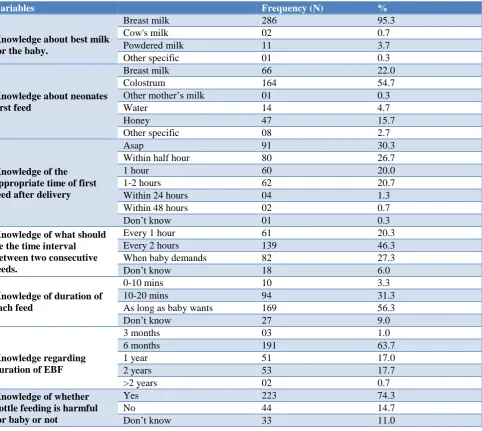
Table 3: Distribution of mothers as per their knowledge on feeding (n=300).
Variables Frequency (N) %
Knowledge about best milk for the baby.
Breast milk 286 95.3
Cow's milk 02 0.7
Powdered milk 11 3.7
Other specific 01 0.3
Knowledge about neonates first feed
Breast milk 66 22.0
Colostrum 164 54.7
Other mother’s milk 01 0.3
Water 14 4.7
Honey 47 15.7
Other specific 08 2.7
Knowledge of the appropriate time of first feed after delivery
Asap 91 30.3
Within half hour 80 26.7
1 hour 60 20.0
1-2 hours 62 20.7
Within 24 hours 04 1.3
Within 48 hours 02 0.7
Don’t know 01 0.3
Knowledge of what should be the time interval between two consecutive feeds.
Every 1 hour 61 20.3
Every 2 hours 139 46.3
When baby demands 82 27.3
Don’t know 18 6.0
Knowledge of duration of each feed
0-10 mins 10 3.3
10-20 mins 94 31.3
As long as baby wants 169 56.3
Don’t know 27 9.0
Knowledge regarding duration of EBF
3 months 03 1.0
6 months 191 63.7
1 year 51 17.0
2 years 53 17.7
>2 years 02 0.7
Knowledge of whether bottle feeding is harmful for baby or not
Yes 223 74.3
No 44 14.7
Don’t know 33 11.0
In this study, 87.3% of the postnatal mothers belonged to joint family and about half of the mothers had first baby. More than 2/3rd of the mothers delivered by normal
that it should also be the neonates first feed. Awareness that initial milk, during first few days, is different (Colostrum) was seen in 54.7% of mother. Only 30.3% of mother stated that baby should be breast fed as soon as possible and overall 77% of mother knew to breastfeed
within an hour. 27.3% of mother were aware of breast feed on demand while fixed schedule feeding like 1 hourly and 2 hourly was stated by 20.3% and 46.3% of mothers respectively.
Figure 1: Distribution of various responses regarding breast feeding knowledge among post-natal mothers.
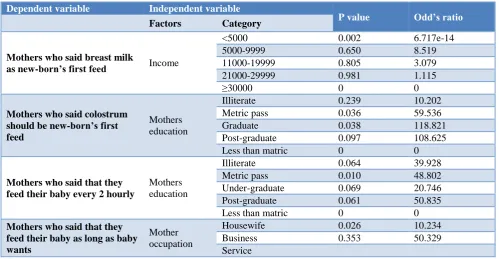
Table 4: Association between selected demographic factors with knowledge regarding feeding.
Dependent variable Independent variable
P value Odd’s ratio
Factors Category
Mothers who said breast milk
as new-born’s first feed Income
<5000 0.002 6.717e-14
5000-9999 0.650 8.519
11000-19999 0.805 3.079
21000-29999 0.981 1.115
≥30000 0 0
Mothers who said colostrum should be new-born’s first feed
Mothers education
Illiterate 0.239 10.202
Metric pass 0.036 59.536
Graduate 0.038 118.821
Post-graduate 0.097 108.625
Less than matric 0 0
Mothers who said that they feed their baby every 2 hourly
Mothers education
Illiterate 0.064 39.928
Metric pass 0.010 48.802
Under-graduate 0.069 20.746 Post-graduate 0.061 50.835
Less than matric 0 0
Mothers who said that they feed their baby as long as baby wants
Mother occupation
Housewife 0.026 10.234
Business 0.353 50.329
Service
95.3
0.7 3.7 0.3 22
54.7
0.3 4.7
15.7
2.7 30.3
26.7 20 20.7
1.3 0.7 0.3 20.3
46.3
27.3
6 3.3
31.3 56.3
9 1
63.7
17 17.7
Table 5: Association between selected demographic factors with feeding practices.
Dependent variable Independent variable
P value Odd’s ratio
Factors Category
Mothers who said they discard their initial milk
Mothers education
Illiterate 0.395 0.333
Metric pass 0.043 0.154
Graduate 0.039 0.114
Post-graduate 0.261 0.333
Less than matric 0 0
Regarding duration of each breast feed, 56% of the mothers informed that the baby should be fed as long as the baby sucks at the breast. 34.6% said that the baby should be allowed to suck for about 20 minutes. Only 63.7% mothers were aware about the duration of EBF. 74.3% mothers had knowledge about harmful effects of bottle feeding (Table 3).
Factors which were found to have statistically significant association with the knowledge of mothers in relation to neonates first feed were mothers with family income <5000 who said that breast milk should be neonates first feed and educated mothers who were matric pass and undergraduates who said that colostrum should be the first feed of the neonate.
Factors which were found to have statistically significant association with the knowledge of mothers in relation to the duration of each feed of the baby were housewife mothers who said that they feed their baby as long as the baby wants and mothers who were matric pass who said that they feed their baby every 2 hourly (Table 4). Factor which was found to have statistically significant association with practice of mothers in relation to discarding the initial milk after delivery was matric pass and undergraduate mothers who said they discarded their breast milk for the first 2-3 days after delivery (Table 5).
DISCUSSION
It is apparent from our study that it is almost well established (95.3%), among mothers of Uttarakhand, that breast milk is best for baby which is higher than reported by Kishore et al i.e., 84% in 2007 at Chandigarh, India.7 But this knowledge is not enough for safety of infant as we see 23.4% of mothers were not aware that breast milk should be the first feed of the baby and hence, were resorting towards prelacteal feeds. Mise et al from Karnataka reported that 24% of mothers believed in giving prelacteal feeds.8Junaid et alreported that 36% of mothers were discarding initial breast milk (colostrum) were giving prelactaeal feeds similar to Reshma et al.9,10 Shaili et al reported 61.8% of mother giving prelacteal feeds.11 Kala et al reported 77.8% of mothers were giving prelacteal feeds.12 Success of EBF depend largely on first feed whether it is prelacteal or a breast feed. Women who had experienced difficulties with breastfeeding in the first
4 weeks had a higher risk for discontinuing full breastfeeding before 6 months.13
77% of mothers were aware that breast feeding should be started within an hour of birth. Mise et al reported that 38% of the cases initiated breastfeeding within 1 hour of delivery, 30.4% after 4 hours and 11.6% on the 1st day.8 We reported high incidence, as these were admitted in tertiary level hospital and they were counselled throughout the stay. Shailireported a very low incidence of initiation of breast feeding of 21.4 % within an hour of birth.11 This is because this study was a community survey and it had recall bias. Nethra et al reported that 46% of mothers breast fed their newborn within 1 hour of delivery.14 Pati et al reported initiation of breastfeeding within 1 hour of delivery by mothers of tribal block of Odisha.15 The effect of time of initial breastfeed on subsequent establishment of breastfeeding and duration has been documented.16-17 The earlier the initiation the better the establishment and longer the duration of breastfeeding. It also ensures prompt intake of colostrum and exclusion of contaminated prelacteals. Prelacteal feeds are common in communities that have not been mobilized and studies also including from India have reported their use even up to 90-100%.18-20
On demand feeding was known to 27.3% of mothers while fixed breast feeding schedule was known to 66.6% of mothers and 6% did not know time gap between two feedings. Junaid et al. reported on demand feeding in 51.5% cases and fixed feeding schedule in 46% while 3 percent did not know feeding timings and would feed on elders advice.9 Mise reported 60.7% of the infants received breast milk on demand basis and 39.3% thought that breastfeeding should be given at scheduled time.8 Shaili et al reported feeding on demand was found in majority (89%) of mothers.11 Similar to (84.1%) study in Bengal by Bandyopadhyay.21 In yet another study at Kanpur by Srivastava et al it was found to be only 38%.22 Demand feeding has earlier been reported to be a common practice in India, a factor, which has a positive influence on breast-feeding. This is also recognized as one of the ten steps to successful breast-feeding as recommended by WHO or UNICEF.
Correct duration of EBF was known to 63.7% of mothers while Vijayalakshmi et al reported it as 85.2% in southern India.23 Junaid et al reported EBF practices among 41.41% of mothers.9 Mise et al reported that majority (74.1%) cases have an opinion that exclusive breastfeeding should be continued up to 6 months of age.8 Kishore et al reported EBF knowledge among 38% of the mothers.7 Only 38% of the mothers did the exclusive breast-feeding until 6 months in survey conducted by Acharya et aland Shaili et alreported only 5.13 mothers were practicing EBF.11
CONCLUSION
The study highlighted that breastfeeding knowledge is suboptimal in Uttarakhand and we need to educate mothers regarding the recommendations issued by WHO. This would help mothers to take independent decision as what is best for her baby rather than rely on inadequate information, from people around, after birth of baby. We recommend that such information should be a part of curriculum during school studies considering the benefits of breastfeeding. Even if mothers are not educated during ANC visits, they should be counselled along with the relatives in postnatal wards, to improve established breast feeding practices.
ACKNOWLEDGEMENTS
The authors are indebted to the mothers who participated in the study.
Funding: No funding sources Conflict of interest: None declared
Ethical approval: The study was approved by the Institutional Ethics Committee
REFERENCES
1. World Health Organization. Protecting, promoting and supporting breast feeding. The special role of maternity services. Geneva: World Health Organization; 1989.
2. American Academy of Pediatrics Work Group on Breast feeding. Breast feeding and the use of human milk. Pediatrics. 1997;100:1035-9.
3. Kramer MS, Kakuma R. The optimal duration of exclusive breastfeeding: a systematic review. Geneva: World Health Organization; 2002.
4. Breastfeeding: Impact on Child Survival and Global Situation. New York: UNICEF; 2014. Available at: https://www.unicef.org/nutrition/index_24824.html. Accessed on March 18, 2018.
5. Lauer JA, Betran AP, Barros AJ, Md O. Deaths and years of life lost due to suboptimal breastfeeding among children in the developing world: A global ecological risk assessment. Public Health Nutr. 2005;9:673-85.
6. International Institute for Population Sciences (IIPS) and ICF. 2017. National Family Health Survey (NFHS-4), 2015-16: India. Mumbai: IIPS.
7. Kishore MS, Kumar P, Aggarwal AK. Breastfeeding Knowledge and Practices amongst Mothers in a Rural Population of North India: A Community-based Study; J Trop Pediatr. 2009;55(3):183-8.
8. Misse PJ, Mise AJ, Mise SJ, Siddapa M. Study of breast feeding practices and problems among postnatal mothers: a hospital based study. Int J Reprod Contracept Obstet Gynecol. 2017;6(8):3343-6.
9. Junaid M, Patil S. Breastfeeding practices among lactating mothers of a rural area of central India: a cross-sectional study. Int J Community Med Public Health. 2018;5(12):5242-5.
10. Reshma, Sujatha R. Cultural practices and beliefs on newborn care among mothers in a selected hospital of Mangalore taluk. Nitte University J Health Sci. 2014;4(2):21-6.
11. Shaili V, Parul S, Kandpal SD, Jayanti S, Anurag S, Vipula N. Community based study on breastfeeding practices in a rural area of Uttarakhand. Nat J Comm Med. 2012;3(2):283-7.
12. Sasikala P, Jyothi C, Chandershekhar V, Kumar C, Bhashkar S. A study on traditional beliefs and practices in newborn care among Women attending UHTC, NMC, Nellore A.P. Nat J Res Comm Med. 2017;6(2):120-4.
13. Scott JA, Binns CW, Oddy WH, Graham KI. Predictors of Breastfeeding Duration: Evidence From a Cohort Study. Pediatrics. 2006;117(4):e646-55.
14. Nethra N, Udgiri R. A study on traditional beliefs and practices in newborn care among mothers in a tertiary health care centre in Vijayapura, North Karnataka. Int J Comm Med Public Health. 2018;5(3):1035-40.
15. Pati S, Chauhan AS, Panda M, Swain S, Hussain MA. Neonatal care practices in a tribal community of Odisha, India: a cultural perspective. J Trop Pediatr. 2014;60(3):238-44.
16. Salariya EM, Easton PM, Carter JI. Duration of breast feeding after early initiation and frequent feeding. Lancet. 1978;2:1141–3.
17. Lawson K, Tullock MI. Breast feeding duration, and postnatal practices. J Adv Nurs. 1995;22:841–9. 18. Kumar S, Nath LM, Reddaiah VP. Breast feeding
practices in a resettlement colony and their implications for promotional activities. Indian J Pediatr. 1989;56:239–42.
19. Okolo SN, Adewunmi YB, Okonji MC. Current breast feeding knowledge, attitude and practices of mothers in five rural communities in the Savannah region of Nigeria. J Trop Pediatr. 1999;45:323–6. 20. Kameswararao AA. Breastfeeding behavior of
21. Bandyopadhyay SK, Chaudhary N, Mukopadhyaya BB. Breast Feeding Practices in rural areas of West Bengal. Indian J Public Health. 2000;44:137-8. 22. Srivastava A, Srivastava P, Shrotriya VP, Martolia
DS. Breast feeding practices in women from urban and rural areas– a comparative study. IJMCH. 2010;12(2):2-10.
23. Poreddi Vijayalakshmi, Susheela T, Mythili D. Knowledge, attitude and breast feeding practices of postnatal mothers: A cross sectional survey. Int J Health Sci Qassim Univ. 2015;9(4):364-474.
24. Acharya R, Meena RR. A descriptive cross-sectional study of breast-feeding practice in Bikaner, Rajasthan. Int J Med Sci Public Health. 2016;5:1559-62.