Original Research Article
Defining some potential nutritional determinants of obesity
in adolescent population
Amit Sohani
1, Chincholikar Sanjeev
2*
INTRODUCTION
Obesity is widely regarded as a pandemic with potentially disastrous consequences for human health.It is perhaps the most prevalent form of malnutrition.65% of the world's population live in countries where overweight and obesity kills more people than underweight. Available studies from Chennai and Delhi have shown prevalence of childhood obesity 6.2% and 7.4% respectively.50-80% of obese children will continue as obese adults and falls into risk group of diabetes, hypertension, coronary heart diseases and many more
obesity related diseases. Complications of adult obesity are made worse if the obesity begins in childhood. According to NHFS 3, in India 12.1% male and 16% female were either overweight or obese.1
Increased intake of energy-dense foods that are high in sugars and fat but low in proteins, micronutrients, vitamins and minerals play important role in childhood obesity.2
The availability of variety of readymade foods in the market and the role of media regarding sensitization of
ABSTRACT
Background: The basic cause of obesity is over nutrition easy and increasing availability of energy-dense, high-calorie foods/snacks and drinks are one of the factors that could significantly affect children’s energy intake.
Methods: All adolescent school going boys and girls in the age group between 10 to 19 years were included as per definition of adolescent. 585 students were selected by systematic sample i.e. every third student was included in the study sample. A pretested standardized questionnaire which consisted of questions related to sociodemographic data and nutrition was used to screen the population for determining association between nutrition and obesity.
Results: It can be observed that 28.21% students were vegetarian while remaining 71.79% were having mixed diet. It can be observed from the Table 2 that overweight and obesity are not related to frequency of consumption of meal, It can be seen that 30.97% overweight subjects had frequent junk food. There was a significant association between frequency of junk food and prevalence of overweight as well as obesity. 25.73% Students with overweight and obese subjects were frequent sweet eaters.
Conclusions: Vegetarian diet or non-vegetarian diet did not have any effect on prevalence of underweight, overweight and obesity in adolescent population. Overweight and obesity are not related to frequency of consumption of meal. There was a significant association between frequency of junk foods, sweets with prevalence of overweight as well as obesity.
Keywords: Nutrition, Obesity, Junk food, Sweats
1
Medical Officer, P.H.C., Mudshingi, Tal. Karveer, Maharashtra, India
2Department ofCommunity Medicine, MIMER Medical College, Talegaon, Dabhade, Pune, Maharashtra, India
Received: 04 February 2019
Revised: 01 April 2019
Accepted: 02 April 2019
*Correspondence:
Dr. Chincholikar Sanjeev, E-mail: [email protected]
Copyright: © the author(s), publisher and licensee Medip Academy. This is an open-access article distributed under the terms of the Creative Commons Attribution Non-Commercial License, which permits unrestricted non-commercial use, distribution, and reproduction in any medium, provided the original work is properly cited.
the parents and children may also have contributed to childhood obesity. Easy and increasing availability of energy-dense, high-calorie foods/snacks and drinks is one of the factors that could significantly affect children’s energy intake.3
For establishing effective intervention, it is important to identify major nutritional determinants in an early stage of life. Effective prevention of adult obesity will require prevention and management of childhood obesity with special attention on nutrition. World Health Organisation has also emphasized on urgent need of understanding the prevalence trend, factors contributing and developing strategies for effective intervention. With this background in mind, present study was undertaken in semi-urban area of Maharashtra to identify potential nutritional determinants of obesity.
Aims and objectives
To study the prevalence of overweight and obesity in adolescent population.
To determine the association of obesity with some nutritional determinants.
METHODS
The study was carried out in 4 institutions (3 schools and 1 college)of semi-urban area of Maharashtra from Jan 2013 to Jan 2014.Ethical committee of parent institute approved the study. It was also approved by the concerned committee of the Maharashtra University of Health Sciences Nashik. Permission for the study was obtained from respective in-charges of schools and colleges. It was a cross sectional observational study. A pilot study of 100 adolescents was carried out for determining sample size and validating the questionnaire. It was found that the prevalence of obesity was 15%. Prevalence of obesity is between 10 to 30% in India as reported by various studies. 4-8 Finding of pilot study confirm the prevalence as 15% in the reference population also. Therefore considering prevalence of obesity in adolescent as 15%, with 95% confidence interval (α =0.05) power of test=80% (β=0.2), estimated sample size for adolescent population including 5% non-responsive error was 575. Actual study was carried out on 585 students. Out of all the schools and colleges which provided education up to 10th standard or above 10th standard were considered as reference population. As there were no government schools or colleges providing teaching up to 10th standard or above, only private schools and colleges were represented in data. Thus, reference population consisted of 17 schools and 3 colleges, all private. 3 schools and 1 college were selected by simple random sampling. Thus the study population consisted of 585 students.
All adolescent school going boys and girls in the age group between 10 to 19 years were included as per definition of adolescent. 585 students were selected by
systematic sample i.e. every 3rd student was included in the study sample. A pretested standardized questionnaire was used. Height and weight of each individual was measured with the help of fibre plastic measuring tape up to the nearest millimetres and weighing scale up to the 0.5 kg respectively. Height was measured by asking the subject to stand erect without footwear on flat surface with heels together and upper limbs hanging closely to the sides of the body with the investigator standing on the left side of the subject. By placing hard cardboard on the head of the subject marking was made on the wall and later with the help of measuring tape height was calculated to the nearest millimetres. For the weight measurement standardized calibrated spring balance was used and subject was made to stand on platform of the balance without footwear. The weight was recorded nearest to 0.5 kg. Body mass index was calculated by dividing the weight in kilogram by square of height in meter.
RESULTS
It was observed that prevalence of obesity and overweight was 4.5% and 20% respectively. Type of diet and frequency of meal has been studied with respect to prevalence.
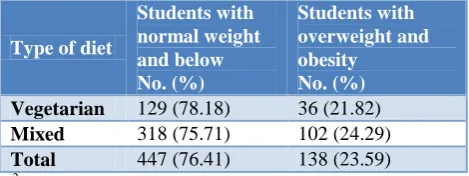
Table 1: Association of type of diet with prevalence of overweight and obesity.
Type of diet
Students with normal weight and below No. (%)
Students with overweight and obesity
No. (%)
Vegetarian 129 (78.18) 36 (21.82)
Mixed 318 (75.71) 102 (24.29)
Total 447 (76.41) 138 (23.59)
χ2
= 0.31, df= 1, p>0.05.
It can be observed that 28.21% students were vegetarian while remaining 71.79% were having mixed diet. When
association between prevalence of obesity and
overweight with type of diet of study subjects was studied, as revealed in Table 1, it was observed that there was no statistically significant difference between the two, meaning that type of diet may not be related to overweight and obesity. It was observed that out of 165 students taking vegetarian diet, 21.82% students were either overweight or obesity. It was also found that 420 students were taking mixed diet but out of them only 24.29% were either overweight or obese.
Table 2: Prevalence of overweight and obesity as per meal consumption.
Frequency of meal per day
Number of students No. (%)
Students with normal weight and below
No. (%)
Students with overweight and obesity
No. (%)
1 18 (100) 11 (61.11) 7 (38.89)
2 82 (100) 58 (70.73) 24 (29.27)
3 373 (100) 290 (77.75) 83 (22.25)
4 112 (100) 88 (78.57) 24 (21.43)
Total 585 (100) 447 (76.41) 138 (23.59)
χ2=3.411583, df= 3, p>0.05.
Table 3: Association of frequency of junk food with overweight and obesity in study subjects.
Frequency Number of students
No. (%)
Students with normal weight and below
No. (%)
Students with overweight and obesity
No. (%)
Occasional 430 (100) 340 (79.07) 90 (20.93)
Frequent 155 (100) 107 (69.03) 48 (30.97)
Total 585 (100) 447 (76.41) 138 (23.59)
χ2
= 4.865957, df=1, p<0.05.
Table 4: Association of prevalence of overweight and obesity with their breakfast habits.
Breakfast Number of students
No. (%)
Students with normal weight and below
No. (%)
Students with overweight and obesity
No. (%)
Yes 283 (100) 215 (75.97) 68 (24.03)
No 302 (100) 232 (76.82) 70 (23.18)
Total 585 (100) 447 (76.41) 138 (23.59)
χ2 = 0.044689, df=1, p>0.05.
Figure 1: Frequency of eating sweets and prevalence of overweight as well as obesity.
As mentioned in review of literature use of junk food is reported to be associated with obesity. Association of frequency of junk food with prevalence of overweight and obesity in study subjects is depicted in table III. Table 3 and Figure 1 contents have been reprinted with prior permission from the authors and respective journal.9
It can be seen that use of junk food frequently has a role in development of overweight and obesity. It was observed that overweight and obesity was relatively less in those who take junk food occasionally (once in a week or less). It can be seen that 30.97% overweight subjects had frequent junk food. There was a significant
0.00% 10.00% 20.00% 30.00% 40.00% 50.00% 60.00% 70.00% 80.00% 90.00%
Occasional Frequent
86.41%
74.27%
13.59%
25.73%
Pe
rc
en
ta
g
e
o
f
st
u
d
en
ts
Frequency of eating sweets per week
association between frequency of junk food and prevalence of overweight as well as obesity.
As revealed from Figure 1, there was statistically significant difference between frequency of eating sweets and prevalence of overweight as well as obesity. Obesity was more in study subjects who ate sweets frequently. 25.73% Students with overweight and obese subjects were frequent sweet eaters.
From the Table 4, it can be seen that breakfast does not seem to have any role in development of overweight and obesity as no association was found between the two.
DISCUSSION
Diet type, frequency of meal and prevalence of overweight and obesity
As revealed in table I; that there was no statistically significant difference between the prevalence of overweight and obesity with respect to type of diet.
Our findings are with accordance with those of Goyalet al. They concluded that vegetarian diet or non-vegetarian diet did not have any effect on prevalence of underweight, overweight and obesity in adolescent population.10
Further, it can be observed from the table II that overweight and obesity are not related to frequency of consumption of meal. Though the prevalence of overweight and obesity was higher among those who had only 1 meal per day, it remained almost same even though the frequency of meal per day increased. It can be seen that there were only 24 students either with overweight or obesity, who had frequency of meal more than 4 times a day.
Eating habits and prevalence of overweight and obesity
According to the WHO expert committee,high intakes of energy-dense micronutrient poor foods which is the case in most of fast food is convincingly related with unhealthy weight gain and there is a possible relation between the high proportion of intake of food prepared outside home and unhealthy weight gain.
Increased intake of energy-dense foods that are high in sugars and fat but low in proteins, micronutrients, vitamins and minerals play important role in childhood obesity.2 A diet containing more energy than needed may lead to prolonged postprandial hyperlipidaemia and deposition of triglycerides in adipose tissue resulting in obesity.
From Table 4, It can be seen that consumption of junk food and sweets, frequently has a role in development of overweight and obesity. There was a significant association between frequency of junk food, sweets with
prevalence of overweight as well as obesity. These results correlate well with previous reports which suggest that junk food (bakery items, pizza, burger, cheese, butter, oily items) chocolate intake tends to be more common among overweight and obese adolescents than among normal-weight adolescents.11,12 Hanley et al concluded that low consumption of fruits, green vegetables, and milk; increasing consumption of snacks, sweets, and soft drinks; and skipping breakfast; these eating habits result in continuous increase in adiposity among children. 13 Tawfi, Amin et al in their study revealed that lean students consumed more servings of fruits; vegetables; and dairy products, including milk, while overweight and obese children consumed significantly higher servings of egg, potato (especially fried), carbonated soft drinks, sugary drinks, and sweets per day. They also observed frequency of eating out was high among overweight and obese children.14
Berkey et al in their longitudinal study of preadolescent and adolescent boys and girls observed association between frequency of restaurant visit and obesity.15 Kotian MS et al found that prevalence of overweight was higher in those adolescents who ate chocolates daily.16 Sameer and AlGhamdi found a higher BMI in adolescent population who, ate more than three snacks per day.17 Goyal et al found a correlation between frequency of eating and overweight as well as obesity in adolescent population. They also observed correlation between junk food consumption and overweight as well as obesity.9 Snacking of high energy junk foods was one of the important influencing factors of obesity among the Davangere school children.18
One thing that can be mentioned from the present study is that, as age increased gradually, students may have become cautious about their figure and health, and may have tried to consume less amounts of junk food, which was reflected in the lower prevalence rate of overweight, as well as obesity, in the higher age groups.
Breakfast habits and prevalence of overweight and obesity
From the Table 4, it can be seen that breakfast does not seem to have any role in development of overweight and obesity as no association was found between breakfast habits and overweight as well as obesity. However our findings are in contrast with those from developed countries.
drinking something or only eating something sweet) were 69% more likely to be obese.19 Caprio et al from America reported a strong significance between sugar-sweetened beverages and prevalence of childhood obesity.20
Goyal et al found a correlation between frequency of eating and overweight as well as obesity in adolescent population. They also observed correlation between junk food consumption and overweight as well as obesity.10 A meta-analysis evaluating change in BMI per increase in sugar-sweetened beverage per day and showed a significant positive association between sugar-sweetened beverage intake and weight gain.21
Andrew, in his study observed that overweight and
obesity decreases as sugar-sweetened beverage
consumption is reduced.22
CONCLUSION
The important finding of the study are summarised below.
Vegetarian diet or non-vegetarian diet did not have any effect on prevalence of underweight, overweight and obesity in adolescent population. Overweight and obesity are not related to frequency of consumption of meal.
There was a significant association between frequency of junk food, sweets with prevalence of overweight as well as obesity. It was found that prevalence of obesity was more in subjects with more frequency of junk food (30.97%) as compared to having occasional junk food (20.93). subjects with more frequency of eating sweets (25.73%) as compared to occasional sweet eaters (13.59%). The dietary habits like more frequency of junk food, more sweet consumption, had a major impact on body mass index of children.
Psychological counselling session on nutrition
particularly about junk food and behaviour can be regularly arranged in schools and colleges to prevent obesity and obesity related hazards.
Funding: No funding sources Conflict of interest: None declared
Ethical approval: The study was approved by the Institutional Ethics Committee
REFERENCES
1. Park’s textbook of Preventive and Social Medicine: 22nd Edition. Jabalpur India: Banarsidas Bhanot Publishers; 2013: 367-369.
2. Global Strategy on Diet, Physical Activity and Health. Available at: http://www.who.int/diet physicalactivity/childhood_why/en/index.html. Accessed on 22 August 2014.
3. Sreevatsava M, Narayan KM, Cunningham SA.
Evidence for interventions to prevent and control obesity among children and adolescents: Its
applicability to India. Indian J Pediatr.
2013;80(Suppl 1):S115-22.
4. Bose K, Bisai S, Mukhopadhyay A, Bhadra M.
Overweight and obesity among affluent Bengalee schoolgirls of Lake Town, Kolkata, India. Maternal Child Nutrition. 2007;3:141-5.
5. Aggarwal T, Bhatia RC, Singh D, Sobati P.
Prevalence of obesity and overweight in affluent adolescent from Ludhiana Punjab. Indian Pediatr 2008;45:500-1.
6. Kaur S, Kapil U, Singh P. Pattern of chronic disease amongst adolescent obese children in developing countries. Curr Sci. 2005;88:1052-6.
7. Mehta M, Bhasin SK, Agrawal K, Dwivedi S.
Obesity among affluent adolescent girls. Indian Pediatr. 2007;74:619-22.
8. Kaneriya Y, Singh P, Sharma D. Prevalence
overweight and obesity in relation to socio economic conditions in two different groups of school age children of Udaypur city (Rajasthan). J Indian Assoc. Community Med. 2006;7:133-5.
9. Chincholikar S, Sohani A. Epidemiological
determinants of obesity in adolescent population, Maharastra, India. Indian J Comm Health. 2016;28:157-62.
10. Goyal RK, Shah VN, Saboo BD, Phatak SR, Shah NN, Gohel MC, et al. Prevalence of Overweight and Obesity in Indian Adolescent School Going Children: Its Relationship with Socioeconomic Status and Associated Lifestyle Factors. JAPI. 2010;58:151-8.
11. Klesges RC, Klesges LM, Eck LH, Shelton ML. A longitudinal analysis of accelerated weight gain in preschool children. Pediatrics. 1995;95:126-30.
12. Wolfe WS, Campbell CC, Frongillo Jr EA, Haas JD,
Melnik TA. Overweight schoolchildren in New York State: prevalence and characteristics. Am J Public Health. 1994;84:807-13.
13. Hanley JG, Harris SB, Gittlesohn J, Wolever MS, Saksvig B. Overweight among children and adolescents in a Native Canadian Community: Prevalence and associated factors. Am J Clin Nut. 2000;71:693-700.
14. Tarek T, Ali S, Ayub A. Overweight and Obesity and their Association with Dietary Habits, and Sociodemographic Characteristics Among Male Primary School Children in Al-Hassa, Kingdom of
Saudi Arabia. Indian J Community Med.
2008;33(3):172–81.
15. Berkey CS, Rockett HR, Field AE, Gillman MW, Frazier AL, Camargo CA Jr, et al. Activity, dietary intake, and weight changes in a longitudinal study of preadolescent and adolescent boys and girls. Pediatrics. 2000;105:56-65.
Adolescent School Children of South Karnataka, India. Indian J Community Med. 2010;35:176-8. 17. Sameer H, Ghamdi A. The association between
watching television and obesity in children of schoolage in Saudi Arabia. J Family Community Med. 2013;20(2):83-9.
18. Bose K, Bhunia D, Paul G, Mukhopadhyay A,
Chakraborty R. Age and sex variations in undernutrition of rural Bengalee primary school children of East Midnapur District, West Bengal, India. Ecol Culture Nutr Health Dis Human Ecol. 2006;14:71-5.
19. Wennberg M, Gustafsson PE, Wennberg P,
Hammarström A. Poor breakfast habits in adolescence predict the metabolic syndrome in adulthood. Public Health Nutr. 2014;28:1-8.
20. Caprio S. Calories from Soft Drinks -Do They Matter? N Engl J Med. 2012;367:1462-3.
21. Vasanti S. Sugar-Sweetened Beverages and Risk of
Metabolic Syndrome and Type 2 Diabetes. Am Diabetes Assoc Diabetes Care. 2010;33(11):2477-83.
22. Andrew A. Effects of Sugar-Sweetened Beverages on Children. Pediatr Ann. 2012;41(1):26-30.