Original Research Article
Prevalence of anaemia and its associated factors among the pregnant
women receiving antenatal care in a maternity hospital, Bengaluru
Ananya M. Balakrishna
1, Usha Rani S. Padmanabha
2*, Rajappa Maheswaran
2INTRODUCTION
Anaemia characterised by decreased concentration of haemoglobin, is one of the most common nutritional deficiency diseases observed globally as it affects more than a quarter of world’s population. It is a major public health problem affecting all ages of the population with its highest prevalence among children under five years of age and pregnant women.1 Globally anaemia affects 1.62 billion people which corresponds to 24.8% of the
population and the prevalence of anaemia in pregnant women according to WHO is 56 million.2 In India 16% of maternal deaths are attributed to anaemia and as per the NFHS 4 report the prevalence of anaemia during pregnancy is 50.3%.3
World Health Organization (WHO) as categorized and emphasized on the significant health consequences based on the prevalence of anemia. If the prevalence of anemia is 4.9% or less, it is considered as no public health
ABSTRACT
Background: Anaemia affects 1.62 billion people globally which corresponds to 24.8% of the population and the prevalence of anaemia in pregnant women is 56 million. In India 16% of maternal deaths are attributed to anaemia with prevalence of 50.3%. Hence, this study was done to assess the prevalence of anemia and its associated factors among the pregnant women attending the maternity hospital.
Methods: A hospital based cross section study was done among pregnant women receiving antenatal care over a period of 2 months. Based on the prevalence rate of anaemia; 39.6%, the estimated sample size was 368. Haemoglobin was estimated by cyanmethaemoglobin method. All pregnant women who voluntarily agreed to participate were selected by systematic sampling method.
Results: Majority of subjects were in the age group of 15 to 24 years, 60.6%. Nearly 90% were Hindus, 83.2% were homemakers and 62% belonged to nuclear family. The prevalence of anaemia was 56% in which 46.6% had mild anaemia, 51.9% had moderate and 1.5% were severely anaemic. Univariate analysis showed religion, occupation, gestational age and history of abortion being associated with anaemia. In multivariate analysis women in first trimester of pregnancy and history of abortion were significant factors for anaemia.
Conclusions: In developing nations like India anaemia is a major public health problem contributing to maternal and infant mortality and morbidities; henceforth there is a need for an effective intervention in the form of health education modules to the community and nutritional counseling for women in the reproductive age group about the importance of Iron supplementation during antenatal period.
Keywords: Anaemia, Prevalence, Pregnant women
2Department of Community Medicine, 1,2Sapthagiri Institute of Medical Sciences and Research Centre, R.G.U.H.S.,
Bangalore, India
Received: 16 October 2019
Revised: 19 November 2019
Accepted: 20 November 2019
*Correspondence:
Dr. Usha Rani S. Padmanabha E-mail: [email protected]
Copyright: © the author(s), publisher and licensee Medip Academy. This is an open-access article distributed under the terms of the Creative Commons Attribution Non-Commercial License, which permits unrestricted non-commercial use, distribution, and reproduction in any medium, provided the original work is properly cited.
problem for that country. The prevalence of anemia between 5.0% and 19.9% indicates a mild public health problem, considered moderate when the prevalence is between 20.0% and 39.9% and if the prevalence is 40.0% or more, it is considered as severe public health problem.4
Anaemia associated with iron deficiency may adversely affect the cognitive and motor development and may impair cellular immune response and increased susceptibility to infections. Anaemia in pregnancy can lead to Low birth weight along with increased risk of Perinatal and maternal mortality.5 Mild anemia may not have any effect on pregnancy and labour except that the mother will have low iron stores and may become moderately to-severely anemic in subsequent pregnancies. Moderate anemia may cause increased weakness, lack of energy, fatigue and poor work performance. Severe anemia, however, is associated with poor outcome. The woman may have palpitations, tachycardia, breathlessness and increased cardiac output leading on to cardiac stress which can cause de-compensation and cardiac failure which may be fatal.6 The relative contribution of each of these factors to anemia during pregnancy depends greatly on geographical location, season, and dietary practices.7
The high rates of anemia among Indian women reflect their social and biological vulnerability both within the society and household. Common customs and cultural taboos often aggravate the anemic status of these women. Some of these like eating last in the family, open air defecation, walking barefoot outside, early age at marriage, teenage pregnancy are still rampant in rural areas of our country. Coupled with this, poverty, illiteracy and unemployment take a heavy toll on the anemic pregnant women.8
Anaemia during pregnancy remains one of the India's major public health problems. In developing countries like India with prevalence rate of 50.3%, anaemia causes increased morbidity and mortality during pregnancy leading to maternal and fetal consequences like Low birth weight, infant mortality rates and maternal mortality rates. Hence this study was done to assess the prevalence of anaemia and its determinants among pregnant women who were receiving antenatal care in the maternity hospital of Bengaluru.
METHODS
A hospital based cross sectional study was conducted in the maternity hospital attached to the department of Community Medicine of a medical college, Bengaluru over a period of 2 months from July 2018 to September 2018. Pregnant women (15-45 yrs) age group receiving antenatal care at a maternity hospital in Bengaluru were included and those with reported bleeding disorders like thrombocytopenia, haemophilias, thrombotic micro-angiopathies and Von Willebrand disease were excluded from the study. Based on the prevalence rate of anemia of
39.6% as per the NFHS-4 report, Karnataka and at 5% of precision the estimated sample size was found to be 368.3 Data was collected through an interview method by systematic random sampling method. As per the ANC register reviewed till June 2018 in the maternity hospital, a minimum of 20 pregnant women visit daily for antenatal care. Data was collected over a period of 2 months, where around 1000 pregnant women were expected to visit for antenatal care. An estimated pregnant women (of 1000) divided by a minimum sample size of 368 gave an average sampling interval of 3 (Kth=3rd). First pregnant women were selected randomly and from there every 3rd women was interviewed till the sample size was achieved.
Initially a pilot study was done among 30 antenatal mothers attending the maternity hospital to check for the feasibility of study tool. The study tool contained details of socio demographic profile and factors associated with anaemia. The study participants were interviewed using a pretested semi structured questionnaire after obtaining a written informed consent. Haemoglobin estimation was done during their visits by Cyanmethaemoglobin method by using blood collected by finger prick under aseptic precautions. Anonymity of the study participants was maintained.
Principle of Cyanmethaemoglobin method is where blood is diluted in a solution containing potassium cyanide and potassium ferricyanide. Potassium ferricyanide converts Haemoglobin to Methaemoglobin which is in turn converted to Cyanmethaemoglobin by potassium cyanide. The absorbance of the solution is then measured in a spectrophotometer at a wavelength of 540 nm or in a colorimeter using a yellow green filter.9,10
Operational definition
Anaemia is a condition in which the number of red blood cells or their oxygen-carrying capacity is insufficient to meet physiologic needs, which vary by age, sex, altitude, smoking and pregnancy status.
Pregnant women are said to be anemic when hemoglobin levels are below 11 g/dl in first trimester, 10.5 g/dl in the second trimester and 11 g/dl in the third trimester. According to the ICMR classification of anemia, the severity of anaemia is graded as mild (10-10.9 g/dl), moderate (9.9-7 g/dl), severe (6.9-4) and very severe as hemoglobin of <4 g/dl.11
Statistical analysis
was done to see the association of independent risk factors with anemia. A p value of <0.05 was considered to be as significant. The study was approved by Institutional Ethics committee.
RESULTS
Out of 368 study subjects enrolled in the study, majority of them were in the age group of 15 to 24 years (60.6%)
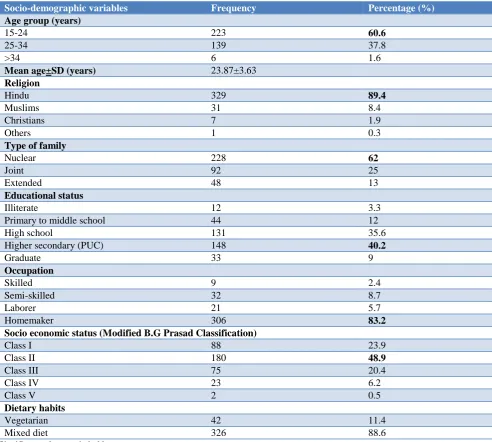
with minimum age of 18 years and maximum age of 38 years and the mean ag of the subjects was 23.87±3.63 years. Majority were Hindus 329 (89.4%), 40.2% studied upto higher secondary, 83.2% were homemakers, 48.9% were from class II socioeconomic status, 62% belonged to nuclear family and 89% had mixed dietary habits. Table 1 describes the socio demographic details of study subjects.
Table 1: Socio-demographic profile of study participants (n=368).
Socio-demographic variables Frequency Percentage (%)
Age group (years)
15-24 223 60.6
25-34 139 37.8
>34 6 1.6
Mean age±SD (years) 23.87±3.63
Religion
Hindu 329 89.4
Muslims 31 8.4
Christians 7 1.9
Others 1 0.3
Type of family
Nuclear 228 62
Joint 92 25
Extended 48 13
Educational status
Illiterate 12 3.3
Primary to middle school 44 12
High school 131 35.6
Higher secondary (PUC) 148 40.2
Graduate 33 9
Occupation
Skilled 9 2.4
Semi-skilled 32 8.7
Laborer 21 5.7
Homemaker 306 83.2
Socio economic status (Modified B.G Prasad Classification)
Class I 88 23.9
Class II 180 48.9
Class III 75 20.4
Class IV 23 6.2
Class V 2 0.5
Dietary habits
Vegetarian 42 11.4
Mixed diet 326 88.6
Significant values are in bold.
Table 2: Prevalence of anaemia in study population(n=368).
Frequency Percentage (%)
Prevalence of anaemia
Anaemic 206 56
Non anaemic 162 44
Severity of anaemia
Mild 96 46.6
Frequency Percentage (%)
Moderate 107 51.9
Severe 3 1.5
Prevalence based on gestational age
First trimester 44 21.4
Second trimester 80 38.8
Third trimester 82 39.8
Significant values are in bold.
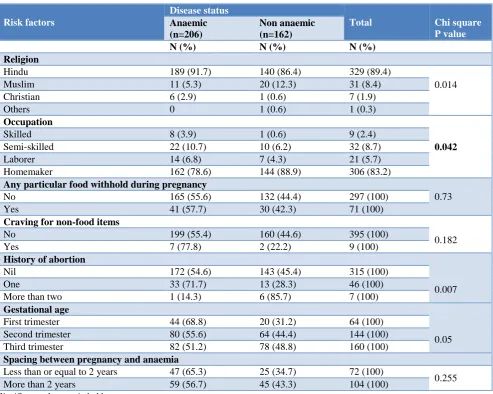
Table 3: Determinants of factors associated with anaemia.
Risk factors
Disease status
Total Chi square
P value Anaemic
(n=206)
Non anaemic (n=162)
N (%) N (%) N (%)
Religion
Hindu 189 (91.7) 140 (86.4) 329 (89.4)
0.014
Muslim 11 (5.3) 20 (12.3) 31 (8.4)
Christian 6 (2.9) 1 (0.6) 7 (1.9)
Others 0 1 (0.6) 1 (0.3)
Occupation
0.042
Skilled 8 (3.9) 1 (0.6) 9 (2.4)
Semi-skilled 22 (10.7) 10 (6.2) 32 (8.7)
Laborer 14 (6.8) 7 (4.3) 21 (5.7)
Homemaker 162 (78.6) 144 (88.9) 306 (83.2)
Any particular food withhold during pregnancy
0.73
No 165 (55.6) 132 (44.4) 297 (100)
Yes 41 (57.7) 30 (42.3) 71 (100)
Craving for non-food items
0.182
No 199 (55.4) 160 (44.6) 395 (100)
Yes 7 (77.8) 2 (22.2) 9 (100)
History of abortion
0.007
Nil 172 (54.6) 143 (45.4) 315 (100)
One 33 (71.7) 13 (28.3) 46 (100)
More than two 1 (14.3) 6 (85.7) 7 (100)
Gestational age
0.05 First trimester 44 (68.8) 20 (31.2) 64 (100)
Second trimester 80 (55.6) 64 (44.4) 144 (100) Third trimester 82 (51.2) 78 (48.8) 160 (100)
Spacing between pregnancy and anaemia
Less than or equal to 2 years 47 (65.3) 25 (34.7) 72 (100)
0.255 More than 2 years 59 (56.7) 45 (43.3) 104 (100)
Significant values are in bold.
Table 4: Multiple binary logistic regression to the see the association of independent factors with anaemia.
Covariates/
Independent factors B S.E. Wald P value
Adjusted Odds ratio
95 % C.I. for OR Lower Upper
Religion 5.608 0.132
Hindu 21.851 4.02 0.000 1.000 3.09 0.000 - Muslim 21.102 4.02 0.000 1.000 1.46 0.000 - Christian 23.394 4.02 0.000 1.000 1.44 0.000 -
Occupation 5.064 0.167
Skilled worker 1.699 1.080 2.475 0.116 5.470 0.658 45.440 Semi-skilled worker 0.479 0.419 1.307 0.253 1.614 0.710 3.667 Laborer 0.648 0.496 1.706 0.192 1.911 0.723 5.051
Covariates/
Independent factors B S.E. Wald P value
Adjusted Odds ratio
95 % C.I. for OR Lower Upper
Gestational age 4.977 0.083
First trimester 0.738 0.333 4.914 0.027 2.091 1.089 4.015 Second trimester 0.241 0.240 1.012 0.314 1.273 0.796 2.036
H/O abortion 8.280 0.016
Nil 2.017 1.097 3.379 0.066 7.519 0.875 64.616 More than or equal to 1 2.787 1.142 5.950 0.015 16.229 1.729 152.325
The overall prevalence of anaemia was found to be 56% where 46.6% of them had mild anaemia, 51.9% had moderate and 1.5% being severely anaemic. Majority of the subjects who were anaemic were found to be in their third and second trimester (39.8% and 38.8%) of pregnancy respectively (Table 2). Univariate analysis showed a significant association of anaemia with religion, occupation, gestational age and history of abortion (p<0.05). Table 3 determines the factors associated with anaemia using inferential statistics. After adjusting for other variables multivariate analysis was done, which showed women in first trimester of pregnancy having 2.09 times increased risk and those with history of more than 1 abortion with 16 times more risk of developing anaemia (p<0.05). Table 4 determines the association of independent risk factors with anaemia using logistic regression analysis.
DISCUSSION
In the current study, out of 368 study participants, majority of them belonged to 15 to 24 years of age group, 223 (60.6%) and the mean age was 23.8±3.7 years and this reflected the findings of Okube et al where 40.3% belonged to 18 to 24 years with mean age of 26.4±4.7 years and 48.5% were in the age group of 15 to 24 years in a study by Gopalkrishnan et al.12,13 Nearly 90% of our subjects belonged to Hindu religion, 62% belonged to nuclear family and 40.2% studied up to higher secondary and this findings were consistent with study by Dutta ,Gopalkrishnan and Bisoi et al where nearly 80% and 89.9% were Hindus, 63.3% belonged to nuclear family and 49.1% completed secondary schooling.8,13,14 Around 80% of our subjects were homemakers which reflected the findings of a study by Alene et al where 86.5% of the pregnant women were housewives.1
The prevalence of anaemia in the current study was found to be 56% (n=206) and among them 46.6% had mild anaemia, 51.9% had moderate and 1.5% were found to be severely anaemic. The findings in the present study was consistent with the prevalence in India, 50.3% as per the NFHS-4 report.3 Similar findings were also reflected in the study by Siddalingappa et al where the prevalence was 62.4%.15 Ahmed et al also showed a similar findings where majority had moderate anaemia, 50.7% and 30.1% and 18.9% with mild and severe anaemia respectively.16 Most of the anaemic subjects were found in third and second trimester (39.8% and 38.8%) of pregnancy respectively. Similarly, Lebso et al in their study conducted in Ethiopia also reported a prevalence of
47.8% and 42.7% in third and second trimester of pregnancy.17 Physiological occurrence of hemodilution in second and third trimester could be one of the reason for increase in prevalence in the current study.
Among the determinants an increased prevalence was seen among the subjects who belonged to Hindu by religion and this association was statistically significant, which reflected the findings of Ahmad et al where 85.9% of anaemic pregnant women were Hindus. Dietary habits and social factors could be the reason for increased prevalence in hindus.16 Majority of our study subjects,79.9% were homemakers and this was significantly associated with anaemia and a similar results were seen in study by Obai et al where being housewives was an independent risk factor for anaemia.18
Gestational age showed a significant association with anaemia where 68.8% of women who were in the first trimester of pregnancy were anaemic and the findings were consistent with study by Gopalkrishnan and Kumar et al where nearly 51.4% and 55% of first trimester antenatal mothers were anaemic.13,19 Among the study subjects with history of one abortion,71.7% were found to be anaemic with a statistically significant association (p=0.007) which reflected the study of Ahmad et al where abortion was found to be a significant risk factor.16 Pregnant women with inter pregnancy interval of less than two years, 65.3% were found to be anaemic in our study and similar observations were made by Suryanarayana et al where 68.4% of subjects with birth interval of less than two years were anaemic.20
In view of limited sample size of 368 we observed that other determinants like parity and gravidity, frequency of antenatal visits, contraception usage, dietary habits, IFA supplementation, co-morbidities, socio-demographic determinants like socio-economic status and literacy status had not shown any association with anaemia. However, as the study subjects were homogenous in terms of their place of residence, occupation, religion, family and dietary habits, the findings can be extrapolated to rest of the pregnant women receiving antenatal care in the urban population of Bengaluru.
CONCLUSION
anaemia. In developing nations like India anaemia remains a major public health problem contributing to maternal and infant mortality and morbidities; so the need of an hour is along with the government health care services there is a need for an effective intervention in the form of health education modules to the community about the ill effects of anaemia and nutritional counseling for women in the reproductive age group about the importance of iron supplementation during the antenatal period.
ACKNOWLEDGEMENTS
First and foremost we would like to thank all the participants for their cooperation and enthusiastic participation. We would also like to thank our interns of SIMS & RC who helped us during the data collection process. At last, we would like to acknowledge ICMR for funding this project.
Funding: ICMR STS-2018
Conflict of interest: None declared
Ethical approval: The study was approved by the Institutional Ethics Commitee, SIMS&RC, Bengaluru.
REFERENCES
1. Alene AK, Dohe MA. Prevalence of Anemia and Associated Factors among Pregnant Women in an Urban Area of Eastern Ethiopia, Hindawi Publishing Corporation , 2014;2014:561567.
2. WHO/CDC. Worldwide Prevalence of Anemia 1993–2005: WHO Global Database on Anemia, 2008. Available from: http://www.who.int. Accessed on 12th October 2019.
3. State Fact sheets. Karnataka. National Family Health Survey; 2018. Available from: http://www.rchiips.org/nfhs. Accessed on 12th October 2019.
4. McLean E, Cogswell M, Egli I, Wojdyla D, Benoist Bd. Worldwide prevalence of anaemia, WHO Vitamin and Mineral Nutrition Information System, 1993–2005. Public Health Nutrition. 2009;12(4):444–54.
5. Lokare OP, Karanjekar DV, Gattani LP, Kulkarni PA. A study of prevalence of anemia and sociodemographic factors associated with anemia among pregnant women in Aurangabad city, India. Ann Nigerian Med. 2012;6(1):30-4.
6. Vijayaraghavan K, Brahmam GN, Nair KM, Akbar D, Rao NP. Evaluation of the National Nutritional Anaemia Prophylaxis Programme. Indian J Pediatr. 1990;57(2):183-90.
7. WHO. The global prevalence of anemia in 2011: World Health Organization; 2015. Available from: http://www.who.int. Accessed on 12th October 2019.
8. Dutta S, Chatterjee S, Sinha D, Pal B, Basu M, Dasgupta A. Correlates of anaemia and worm infestation among rural pregnant women: a cross
Sectional study from Bengal. National J Community Med. 2013;4(4):603-7.
9. Hematology and blood bank technique; 2018. Available at: http:// www.nios.ac.in/media/ documents/dmlt/hbbt/Lesson-15.pdf. Accessed on 12th October 2019.
10. Srivastava T, Negandhi H, Neogi SB, Sharma J, Saxena R. Methods for haemoglobin estimation: A Review of "What works". J Haematol Transfus. 2014;2(3):1028.
11. Good clinical practice recommendations for Iron Deficiency Anemia in Pregnancy in India. J Obstetr Gynecol India. 2011;61(5):569-71.
12. Okube OT, MirieW, Odhiambo E , Sabina W, Hadtu M. Prevalence and Factors Associated with Anaemia among Pregnant Women Attending Antenatal Clinic in the Second and Third Trimesters at Pumwani Maternity Hospital, Kenya. Open J Obstetr Gynecol. 2016;6:16-27.
13. Abiselvi A, Gopalkrishnan S, Umadevi R, Rama R. Anaemia among pregnant women in rural areas of Kanchepuram district, Tamil Nadu. Int J Community Med Public Health. 2017;4(7):2400-5. 14. Bisoi S, Haldar D, Bhattacharya M. Correlates of
anemia among pregnant women in a rural area of West Bengal. J Family Welfare. 2011;57(1):72-8. 15. Siddalingappa H, Narayana Murty MR, Ashok NC.
Prevalence and factors associated with anaemia among pregnant women in rural Mysore, Karnatka, India. Int J Community Med Public Health. 2016;3(9):2532-7.
16. Ahmad N, Kalakoti P, Bano R, Aarif SMM. The prevalence of anaemia and associated factors in pregnant women in a rural Indian community. Australasian Med J. 2010;3(5):276-80.
17. Lebso M, Anato A, Loha E. Prevalance of anemia and associated factors among pregnant women in Southern Ethiopia: A community based cross sectional study. Plos One. 2017.
18. Obai G, Odongo P, Wanyama R. Prevalence of anaemia and associated risk factors among pregnant women attending antenatal care in Gulu and Hoima Regional Hospitals in Uganda: A cross sectional study. BMC Pregnancy Childbirth. 2016;16:76. 19. Kumar KJ, Asha N, Murthy DS, Sujatha M.
Maternal anaemia in various trimesters and its effect on newborn weight and maturity; an observational study. Int J Prev Med. 2013;4(2):193-9.
20. Suryanarayana R, Santhuram AN, Chandrappa M, Shivajirao P. Prevalence of anaemia among pregnant women in rural population of Kolar district. Int J Med Sci Public Health. 2016;5(3):454-85.