Original Research Article
Determination of awareness level of the female population, their
attitude and behaviours towards understanding the risk factors
associated with breast cancer
K. Krishnaveni
1*, R. Vijayalakshmi
1, S. Shenuka
1, R. Kameswaran
1,
Shanmuga Sundaram Rajagopal
2INTRODUCTION
Breast cancer is the most common cancer all over in India. Breast cancer is a malignant tumour that starts in the cells of the breast. The disease occurs almost entirely in women, but men can get it, too. Breast cancer is the most common cancer among American women, except for skin cancers. About 1 in 8 (12%) women in the US will develop invasive breast cancer during their lifetime. Breast cancer is the second leading cause of cancer death
in women, exceeded only by lung cancer. The chance that breast cancer will be responsible for a woman's death is about 1 in 36 (about 3%).1,2 Among Indian women, breast cancer is the commonest cancer overall. In 2012, 1, 44,937 new cases and 70,218 deaths were reported for breast cancer.3
There is an increased proportion of breast cancer in developed and underdeveloped countries. High incidence of breast cancer occurs in developed countries over the ABSTRACT
Background: Breast cancer is the most prevalent cancer among women all over the world. Due to the variation in cultural differences, diet and socio economic characters Indian women are more prone to the risk associated with breast cancer. Many women still remain ignorant about breast self-examination (BSE) which is the earliest and simplest way to detect breast cancer.
Methods: A prospective observational study was done on 100 women during the period of 6 months to find the association between breast cancer and its risk factors and to evaluate the attitude of common women towards BSE using standardised questionnaire.
Results: The BSE pattern of the participants showed that 65% had never done BSE and only 11% of the participants have knowledge about BSE and make it as a regular practice. Pain was the most common symptom reported by the women 32 (91.4%). The risk factors were also recorded and 46% of the participants were overweight, majority of the participants (69%) had a lactation period ranging from 1-2 years, 79 participants had undergone hormonal therapy, only 41% had a habit of doing regular physical activity. The literacy rate of the participants was 100%.
Conclusions: Only a fewer proportion of the participants is aware about BSE, and other risk factors associated with breast cancer. Even with high literacy level majority of the women follow poor life style habits.
Keywords: Breast cancer, Risk factors, Literacy, Hormonal therapy, Life style 1
Department of Pharmacy Practice, 2Department of Pharmacology, J.K.K Nattraja College of Pharmacy, Kumarapalayam, Tamil Nadu, India
Received: 21 August 2018
Revised: 08 October 2018
Accepted: 09 October 2018
*Correspondence:
Dr. K. Krishnaveni,
E-mail: [email protected]
Copyright: © the author(s), publisher and licensee Medip Academy. This is an open-access article distributed under the terms of the Creative Commons Attribution Non-Commercial License, which permits unrestricted non-commercial use, distribution, and reproduction in any medium, provided the original work is properly cited.
age of 50 and in India the prevalence of breast cancer is high after the age of 40.4India the age standardized incidence rate of breast cancer varies between 9 to 32 per 1,00,000 women.
To generate the reliable data on magnitude and pattern of cancer, India started National cancer registry program in 1981. Breast cancer is increased over the age of 10.5 With diverse population, cultures, variation in life style and diet habits among Indian populations make them more prone to many diseases. The reasons for varying incidence of breast cancer among women are not fully understood, which are likely to be explained by reproductive and lifestyle factors such as literacy, diet, age at menarche and menopause, age at first delivery, abortion, family history of breast cancer.6-13
The risk factors for breast cancer includefamily history, increased risk associated with a pattern characterised by high consumption of alcohol, also increases the risk of breast cancer. Age at menopause, age at menarche, height, and parity also affect the cumulative risk substantially. Reproductive risk factors influence risk accumulated by the time of menopause. Many studies have reported alcohol intake as a risk factor for breast cancer.
Increased BMI and weight is another contributing factor. A number of personal behaviours and exposures have been implicated as risk factors for breast cancer. They include habitual activities, such as diet, drinking alcoholic beverages, smoking and physical activity, as well as personal characteristics, such as body size, which are also influenced by lifestyle. Until the 1980s, oestrogen was mainly prescribed for postmenopausal women with symptoms such as hot flushes and genitourinary atrophy. Its use was relatively short term. In the past two decades, many observational studies have suggested that oestrogen reduces the incidence of coronary heart disease and osteoporotic fractures; therefore, HRT has been commonly prescribed for longer periods to asymptomatic women to prevent disease and prolong life. Long term use of oestrogen-alone was found to increase the risk of breast cancer. In 1997, the collaborative group on hormonal factors in breast cancer reported a pooled analysis of 51 studies in 21 countries, involving data on 52,705 women with and 108,411 women without breast cancer.14,15 The main objective of this study was to determine the awareness of common women population towards breast cancer and its associated risk factors using breast self-examination (BSE) as a standardised tool.
METHODS
A prospective observational pilot study was conducted for a time period of 6 months (January 2017-June 2017) in Ernakulum district (Kerala) for assessing and understanding the risk factors associated with breast cancer in common women population within the age
group of 25-45 years. For our study we have visited over 100 women randomly and asked them questions from the previously prepared questionnaires related to breast assessment.
The risk factors associated with breast cancer was set as a baseline for our study with a comprehensive questionnaire. We have obtained several articles related to our study and had made thorough observations.
The overall risk factors were evaluated and the results were calculated. Women with co morbid disease conditions and women from both urban and rural area were included in the study. Women who were diagnosed as pregnant and those who were having new born babies were excluded from the study.
RESULTS
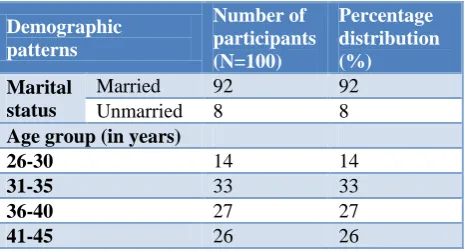
For our study 100 women were screened in Kerala over a period of four months. The women were selected based on the criteria mentioned above and assessed based on the questionnaire prepared. The demographic patterns of the participants are given in Table 1. The participants age ranges from 25- 45. Majority of the participants are in the age group 0f 31-35 (33%). 92 (92%) of the participants are married while only 8 (8%) of the participants are unmarried.
Table 1: Demographic patterns of the patients.
Demographic patterns
Number of participants (N=100)
Percentage distribution (%)
Marital status
Married 92 92
Unmarried 8 8
Age group (in years)
26-30 14 14
31-35 33 33
36-40 27 27
41-45 26 26
Table 2: BMI distribution of the participants.
BMI grade
Number of participants (N=100)
Percentage distribution (%)
<18.5 (Underweight) 7 7
18.5- 24.9 (Normal) 27 27
25-29.9 (Over weight) 46 46
< 30.0 (Obese) 20 20
and it was observations found that 64 (64%) of the participants had history of diabetes, followed by hypertension 49 (49%) and hypotension of 3 (3%).
Majority of the participants 36 (36%) had their menarche during the age of 13 years. 57 (57%) of the participants are occasional alcohol consumers while 43(43%) are not exposed to alcoholism. And among the 100 participants, 38 (38%) are vegetarians, 62 (62%) of the participants consume both vegetarian and non-vegetarian foods. Only 3 (3%) of the participants had their menarche after 15 years.
Out of 92 married participants, 78% had their first kid within the age of 25-30 years while 6% had their kids after the age of 30 years. The length of breast feeding varies from 1-2 years in 69%, 6 months to 1 year in 22% and less than 6 months in 9% only 5% (n=92) reported a previous history of abortion.
Table 3: Family history of breast cancer.
Types of cancer
Number of participants (N=38)
Percentage distribution (%)
Breast cancer 12 31
Other types (cervical, lung, endometrial etc.)
26 66
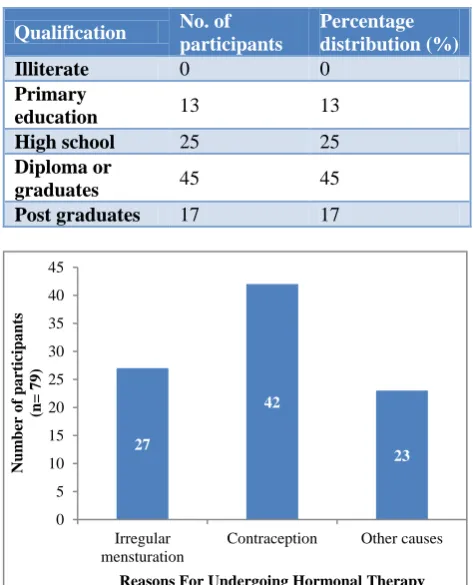
Only 79 participants had undergone hormonal therapy, this data is depicted in Figure 1, 27 (34%) among the participants had undergone hormonal therapy for irregular menstruation and 42 (53%) of the participants had used hormonal therapy for contraception while 13% had used hormonal therapy for the management of other diseases. 38% reported to have a family history of cancer among them, 12% had a family history of breast cancer while other 26% had other types of cancer (cervical, lung, endometrial) Table 3.
Table 4: BSE pattern showing common symptoms reported by the participants.
Observations
Number of participants (N=35)
Percentage distribution (%)
Redness 30 85.7
Rashes 23 65.7
Swelling 29 82.8
Soreness 17 48.52
Pain 32 91.4
Only a very few participants 33 (33%) have a habit of doing regular exercise, 41 (41%) are irregular and 26 (26%) of women not at all do any physical activities. The BSE patterns of the participants are explained in Table 4. Out of 100 participants, only 11 (11%) had undergone regular BSE, 24 (24%) had undergone occasional BSE
while majority of 65 (65%) had never undergone BSE and the following observations was made. Pain was the most observed symptom 32 (91.4%), followed by redness in 30 (85.7%), swelling 29 (82.8%), rashes 23 (65.7%), and the least reported symptoms was soreness 17 (48.52%). The literacy level of the participants was evaluated and 100% of the subjects were literate. And only a fewer proportion had stopped education in primary level 13 (13%) (Table 5).
Table 5: Evaluation of literacy level of the participants.
Qualification No. of
participants
Percentage distribution (%)
Illiterate 0 0
Primary
education 13 13
High school 25 25
Diploma or
graduates 45 45
Post graduates 17 17
Figure 1: Use of hormonal therapy among participants.
DISCUSSION
Breast cancer is the most common cancer in women worldwide both in developed and also in underdeveloped country. There is a higher incidence of breast cancer can be caused due to various factors including sedentary life style, genetic abnormality, lack of physical activity, obesity, menstrual problems and many other factors.16
The risk of breast cancer increases with age.17 The risk factors for younger population between age group of 25-35 years included early menarche, less duration of breast feeding and hormone related issues.18 Younger patients were associated with an increased risk factor for breast cancer.19 In a study it was founded that increased BMI in pre and post-menopausal women was due to abnormality in sex hormone binding globulin level.
27
42
23
0 5 10 15 20 25 30 35 40 45
Irregular mensturation
Contraception Other causes
Num
ber
o
f
pa
rticipants
(n=
7
9
)
The estradiol concentration was found to be in a decreased level in premenopausal women. Obesity was associated with increased estradiol concentration and hence increases the risk of breast cancer.20 It has been suggested that women who had taken lactation supplements due to lack of breast milk was found to be in a risk category. High risk was estimated among the women’s with use of hormonal supplements to induce cessation of breast feeding after one or two births.21,22 Women population with BRCA1 or BRCA2 mutated genes are 80-90% at risk of life.23
Changes in mammary glands after puberty and pregnancy have several effects on breast estrogen levels. During puberty the mammary glands develop and undergo many changes and differentiation. Proliferation and differentiation of breast tissues occur during first and final months of pregnancy.24,25 During pregnancy the breast contain many well differentiated lobules than before the pregnancy.
The differentiation in lobules occurs due to stimulation of estrogen, progesterone and many other growth hormones. Prolactin level is increased after pregnancy.26 By stimulating the ovulation cycle breast feeding reduces the risk of breast cancer.27 Women who had breast fed for first 6 months have less rate of ovulation (1%-15%) and the number of ovulation periods has a link towards breast cancer.14 Studies had found a positive correlation between breast cancer risks associated with dietary intake.28
The use of hormonal tablet and its type may vary the risk in pre and post-menopausal women. The use of estrogen supplementation may alone increase the risk by 2.1% according to predictions by Key et al.27 The longer use of hormonal tablets was also found to be in additional risk of depletion of DNA. History of benign breast disease and breast cancer was also associated with an increased risk of breast cancer.29 Density of the breast and the tissue composition is reported to be linked to breast cancer risk.30 Ethnic variations among white, Africans American and Asian American with higher breast density falls in a high risk category.31
The histological changes that occur in mammary glands while pregnancy, high fat deposition and high BMI can affect mammographic density and can be used to screen the risk factor for breast cancer. Tobacco smoke has an anti-estrogenic effect on mammary tissues.32 Steven et al conducted a study to assess the risk for breast cancer in women was linked to the cumulative amount of alcohol consumption during adulthood. The risk is proportional to the quantity of alcohol intake. Women who drank 2 or more cup per day were found to be 1.5 times higher with women who had never consumed alcohol (2.8%-4.8%). Chen et al conducted a study to find whether alcohol is a risk factor to breast cancer. He concluded that alcohol act as a risk factor for breast cancer through modification of
milieu. With few years of starting of Hormonal therapy it increases the breast carcinogenesis.33-35
According to a study conducted in women with advanced-stage breast cancer by Poly et al, it explained that self-described proficiency in BSE was generally low in both case and control subjects, the small percentage of women reporting more thorough self-examinations, regardless of frequency, had about a 35% decrease in the occurrence of advanced-stage breast cancer compared to women who did not perform BSE.36
But in contrast to our study results, a meta-analysis showed that there was no difference in death rate in studies on women who detected their cancer during an examination (pooled relative risk 0.90, 95% CI 0.72– 1.12). None of the trials of BSE training (in which most women reported practising it regularly) showed lower mortality in the BSE group (pooled relative risk 1.01, 95% CI 0.92–1.12). Most of the study states that BSE was associated with considerably more women seeking medical advice and having biopsies. Regular BSE is not an effective method of reducing breast cancer mortality.37
The literacy level of our participants was 100% since the study was conducted in Kerala. A study done in Vietnamese women resulted that those women with lowest literacy scores were less likely to perform BSE regularly.38 While another study done by Julie, et al based on breast self-examination beliefs and practices showed that women with adequate health literacy were more likely to perform BSE than women with inadequate literacy rate.39 Even though all of the participants were literate it this study results shows a lack of awareness on BSE.
CONCLUSION
Our study concludes that even with high literacy rate in Kerala, many women still remain ignorant about BSE and other related practices.Among total participants, only few women had undergone regular BSE, majority of them had never undergone BSE. It appears that the best way to save women’s lives is to increase their awareness of the potential harms of breast cancer, to raise their level of awareness about early warning signs, risk factors, and early detection procedures for this disease. The study helped women in many strata to take preventive measures against breast cancer with respective to modifiable factors including lifestyle changes and diet.
ACKNOWLEDGEMENTS
We wish to express our sincere gratitude to all our study participants.
Funding: No funding sources Conflict of interest: None declared
REFERENCES
1. Indian cancer organization website. Available at: http://www.who.int/cancer/detection/breastcancer/e n/. Published November 12, 2009. Updated July 5, 2015. Accessed 24 September 2016.
2. Agarwal G, Ramakant P. Breast Cancer Care in India: The Current Scenario and the Challenges for the Future. Breast Care. 2008;3(1):21-7.
3. Health education website. Available from http://www.webmd.com/women/picture-of-the-breasts. Accessed on 24 September 2016.
4. Gupta S, Rao YN, Agarwal SP. Emerging strategies for cancer control for women in India. 50 Years of Cancer control in India. International Agency for Research on Cancer (IARC), 2005.
5. Badwe RA, Gangawal S, Mittra I, Desai PB. Clinico-pathological features and prognosis of breast cancer in different religious communities in India. Indian J Cancer. 1990;27:220–8.
6. Development of an atlas of cancer in India. A Project of National Cancer Registry Programme supported by WHO 2001-2. Available at: http://www.ncrpindia.org/CancerAtlasIndia/about. htm. Assessed on 18 August 2017.
7. Chauhan P, Yadav R, Kushal V. Reproductive risk factors for breast cancer: A case control study. Online J Health Alied Sci. 2017;16(2):3.
8. Pakseresht S, Ingle GK, Bahadur AK, Ramteke VK, Singh MM, Gurg S, et al. Breast cancer among women in Delhi. Indian J Cancer. 2009;46:132–8. 9. Lodha SR, Nandeshwara S, Pal KD. Risk of breast
cancer in obese women: A case control study. Natl J Community Med. 2010;1:166–7.
10. Gajalakshmi CK, Shanta V, Hakama M. Risk factors for contralateral breast cancer in Chennai (Madras). India. Int J Epidemiol. 1998;27:743–50. 11. Gajalakshmi V, Mathew A, Brennan P, Rajan B,
Kanimozhi VC, Mathew SA, et al. Breast feeding and breast cancer risk in India: A multicenter case control study. Int J Cancer. 2009;125:662–5. 12. Rao DN, Ganesh B, Desai PB. Role of reproductive
factors in breast cancer in a low-risk area:A case-control study. Br J Cancer. 1994;70:129–32. 13. Gajalakshmi CK, Shanta V. Risk factors for female
breast cancer. A hospital-based case-control study in Madras, India. Acta Oncol. 1991;30:569–74. 14. Tamaki K, Tamaki N, Kamada Y, Uchara K, Zaha
H, Onomura M. The challenge to reduce breast cancer mortality in Okinawa: consensus of the first Okinawa breast oncology meeting. J Clin Oncol. 2013;43(2):208-13.
15. Jatoi I, Anderson WF. Qualitative age interactions in breast cancer studies:a mini-review. Future Oncol. 2010;6(11):1781-8.
16. Anders CK, Johnson R, Litton J, Phillips M, Bleyer A. Breast cancer before age 40 years. Semin Oncol. 2009;36(3):237-49.
17. Zhou P, Recht A. Young age and outcome for women with early-stage invasive breast carcinoma. Cancer. 2004;101:1264-74.
18. Potishman N, Swanson CA, Siiteri P, Hoover RN. Reversal of relation between body mass and endogenous estrogen concentrations with menopausal status. J Natl Cancer Inst. 1996;88:756– 8.
19. Newcomb PA, Storer BE, Longnecker MP. Lactation and a reduced risk of premenopausal breast cancer. N Engl J Med.1994;330:81–7. 20. Yang CP, Weiss NS, Band PR, Gallagher RP, White
E, Daling JR. History of lactation and breast cancer risk. Am J Epidemiol. 1993;138:1050–6.
21. Brinton LA, Potischman NA, Swanson CA, Schoenberg B, Coates RJ, Gammon MD. Breast-feeding and breast cancer risk. Cancer Causes and Control. 1995;6:199–8.
22. Beral V, Reeves G. Childbearing, oral contraceptive use, and breast cancer. Lancet. 1993;341:1102. 23. Russo J, Russo IH. Toward a physiological
approach to breast cancer prevention. Cancer Epidemio Biomarkers Prey. 1994;3:353-64.
24. Russo J, Tay LK, Russo IH. Differentiation of the mammary gland and susceptibility to carcinogenesis. Breast Cancer Res Treat. 1983;49:185-9.
25. Dickson R. Biochemical control of breast development. In: Harris J, Lippman M Morrow M, Hellman S, editors. Diseases of the breast. Philadelphia (PA): Lippincott-Raven; 1996: 15–25. 26. Henderson BE, Pike MC, Casagrande JT. Breast
cancer and the oestrogen window hypothesis. Lancet. 1981;2:363–4.
27. Gray RH, Campbell OM, Apelo R, Eslami SS, Zacur H, Ramos RM, et al. Risk of ovulation during lactation. Lancet. 1990;335:25–9.
28. Rose DP. Effects of dietary fatty acids on breast and prostate cancer:evidence from in vitro experiments. Am J Clin Nutur. 1997;66(4):1513-22.
29. Steinberg KK, Smith SJ, Thacker SB, Donna FS. Breast cancer risk and duration of estrogen use:the role of study design in meta-analysis. Epidemiol. 1994;5:415–21.
30. Pathak DR, Whittemore AS. Combined effects of body size, parity, and menstrual events on breast cancer incidence inseven countries. Am J Epidemiol. 1992;135:153–68.
31. Boyd NF, Martin LJ, Bronskill M, Yaffe MJ, Duric N, Minkin S. Breast tissue composition and susceptibility to breast cancer. J Natl Cancer Inst. 2010;102:1224–37.
32. Boyd NF, Guo H, Martin LJ, Sun L, Stones S, Fishell E, et al. Mammographic density and the risk and detection of breast cancer. N Engl J Med. 2007;356:227–36.
Norwegian women:a cross-sectional study. Breast Cancer Res. 2007;9:73.
34. Beral V, Reeves G, Bull D, Green J. Million Women Study Collaborators. Breast cancer risk in relation to the interval between menopause and starting hormone therapy. J Natl Cancer Inst. 2011;103(4):296-305.
35. Narod SA. Hormone replacement therapy and the risk of breast cancer. Nat Rev Clin Oncol. 2011;8(11):669-76.
36. Newcomb PA, Weiss NS, Storer BE, Sholes D, Young BE, Voiyt LF. Breast Self-Examination in Relation to the Occurrence of Advanced Breast Cancer. J Natl Cancer Inst. 1991;83(4):260-5. 37. Hackshaw AK, Paul EA. Breast self-examination
and death from breast cancer:a meta-analysis. Br J Cancer. 2003;88:1047–53.
38. Ho V, Yamal JM, Atkinson EN, Basen E, Tortolero G, Follen M. Predictors of breast and cervical
screening in Vietnamese women in Harris County, Houston, Texas. Cancer Nursing. 2005;28(2):119-29.
39. Julie A, Cristina HT, James V, Cunegendo V, Susan J. Breast self-examination beliefs and practices, ethnicity, and health literacy:Implications for health education to reduce disparities. Health Educ J. 2014;73(3):274–84.