Glare Deferred Tax Assets Recognition In Financial
Indicators of Brazilian Agribusiness Companies
Debora Cristina Farezin Centro Universitário La Salle
Margarete Luisa Alburgeri Menegotto
Post-Graduate Program in Business Administration, University of Caxias do Sul, Brazil
Maria Emilia Camargo
Post-Graduate Program in Business Administration, University of Caxias do Sul, Brazil
Abstract
The tax accounting as an accounting specialization must disclose the financial situation and economic results from companies, according to principles and tax rules. However, the tax laws can distort the economic results, to adapt them to tax requirements for tax calculation purposes on income. From this recognition, this present study examined the reflection of the recognition from deferred tax assets-DTA in rates of Current Liquidity, Liquidity General, Return on Equity and Debt Equity from two Brazilian agribusiness companies, with data from the financial statements for the period 2011 to 2013. We used the Balance Sheet and the Income Statement to indices calculation where they were used with and without consideration of DTA in these statements, aiming to meet the overall objective research: diagnose the reflection of the recognition of deferred tax assets in the economic and financial indicators for agribusiness companies. The research had its descriptive character and applied, and, with respect to the technical procedures, is documents and literature. Data were grouped in an excel spreadsheet and calculated after the indices proceeded with the analysis. It was found, by comparing the indices, there is significant impact of the recognition of AFD in the two analyzed companies, particularly with respect to the Equity Profitability index.
Keywords: Accounting. Deferred Tax Assets, Financial Economic Analysis
1INTRODUCTION
The tax accounting as an accounting specialization must disclose the financial situation and economic results from companies, according to principles and tax rules. However, the tax laws can distort the economic results, to adapt them to tax requirements for tax calculation purposes on income. Thus, usually the taxable income from companies differs from its accounting value. To minimize these differences, there are accounting standards geared exclusively from accounting treatment of profits on taxes (income tax and social contribution). These standards seek to be reflected in financial statements, the differences between the calculation of income taxes based on the tax laws and accounting regulations, appearing so, Deferred Tax Assets-DTA. DTA originate taxes on income, in particular from the standpoint from federal taxes on the results. It is worth noting that the recognition of deferred tax assets can change the result, increase or decrease the net worth, also impacting in financial and economic indicators from companies.
This gap led to a question about this reflection on recognition the DTA on the calculation of economic and financial ratios of two agribusiness companies with subsidiaries in Brazil. In this context, we present the following research problem: what is the reflection from the recognition of deferred tax assets in the financial structure and economic performance from two agribusiness companies? Overall, this study aims to diagnose the reflection about the recognition of deferred tax assets in economic and financial indicators from agribusiness companies.
This study is relevant to the extent that the financial statements are fundamental to the analysis of economic and financial situation from companies and also are used for decision-making by stakeholders. According to Matarazzo (2010), the financial statements analysis aim to evaluate the organizations financial performance through indexes, that is, through the relationship between accounts or accounts groups from financial statements in order to highlight certain aspects to assess the economic and financial situation of the company.
Recognition of DTA interferes over the result and financial position of the companies, and may be related to practices known by the names of: earnings management (Modigliani & Miller, 1958; Fields, Lys; Vicent, 2001; Paul, 2007; Martinez 2001; 2008), Creative accounting (Inignes; Poveda, 2004; Mendes; Rodrigues, 2006) or even misrepresentation (Dechow; Sloan; Sweeney, 1996; Osma, Noguer; Clemente, 2005; Paul, 2007).
2 THEORETICAL BACKGROUND
Perez Junior (1999), in a simplified concept, states that the accounts should be seen as an information system, whose working method is to collect, process and transmit data on the economic and financial position of an entity at a given moment and its evolution in a given period. From the accounting evolution, there were laws and regulations, specially the Generally Accepted Accounting Principles. Then, according Iudícibus et al. (2010), in 2005 with the creation of Accounting Pronouncements Committee-APC in Brazil and editing some laws and accounting rules during 2008 and 2009 produced a huge set of new rules, approved by the Securities Exchange Commission-SEC and the Federal Accounting Council-FAC, especially the full convergence with international accounting standards from International Accounting Standards Board-IASB.
As branch of accounting, tax accounting must show the patrimionial situation and the economic results of the company, according to principles and tax rules. Therefore, the tax laws can distort the economic results, to adapt them to tax requirements. Thus, generally taxable income differs from accounting result. In this context, Iudícibus et al. (2010, p.1) state: Accounting has always been very influenced by the limits and fiscal criteria, particularly the laws and income tax. This fact, while brought to accounting some important and good effects contributions, limited the evolution of Generally Accepted Accounting
According to Hendriksen; Vam Breda (1999), deferred taxes resulting from the difference between the tax calculated based on taxable profit and reported profit. The main difference is basically due to two groups: 1. Permanent differences: resulting from deductions or normative restrictions to economic, political or administrative purposes not related to calculation from net income. 2. Temporary differences: a. difference in the time they occur debits and credits to income, also called "differences between periods"; b. differences resulting from alternative measurement bases used in financial accounting and tax accounting, also called "valuation differences".
According Iudícibus et al. (2010) is important to keep a specific account in order to register properly the share of income tax and social contribution which representing differences between the profit amounts calculated under the fiscal rules and the accruals where the differences are temporary. Furthermore, The Federal Accounting Council from Brazil sets the temporary difference as following:
Temporary difference is the difference between the carrying amount of an asset or liability in the balance sheet and its tax base. Temporary differences may be either:
(a) taxable temporary difference, which is the temporary difference that results in taxable amounts over determining taxable profit (tax loss) of future periods when the carrying amount of an asset or liability is recovered or settled; or
(b) Deductible temporary difference, which is temporary difference that results in amounts that are deductible in determining taxable profit (tax loss) of future periods when the carrying amount of the asset or liability is recovered or settled. (CFC, 2009)
According to Wasserman, 2004, the Deferred Tax Assets (DTA) is a tax benefit brought into the body from financial statements of extraordinary events (reversal of temporary differences and tax loss compensation) that will reduce the income tax payable or paid. Also according to Wasserman (2004 p.17,18):
There are two sources from which originate the tax asset. The first source is deductible temporary differences between taxable income and accounting income. Deductions made in the accounts, but deductible at a later time for tax purposes when observing conditions of deductibility (reversal) established by tax rules, temporary differences are called. [...] The other source of the tax credit is tax loss, provided there is legal provision allowing their offset against taxable income. The DTA, in this case, represents the tax savings resulting from reduced tax calculation base due to the reduction in the tax loss.
In this context, international accounting standard through the IASB published IAS 12, which allowed the recognition of DTA from temporary differences and tax loss.
International Accounting Standard (IAS), also known as International Financial Reporting Standards (IFRS), is the set of international accounting pronouncements published and reviewed by the IASB.
In Brazil, based on IAS 12, the Accounting Pronouncements Committee, Issued the CPC 32 - "Income Taxes", that defines: "the deferred tax assets is the value from tax on income recoverable in future periods related to: (CFC, 2009) .
(a) deductible temporary differences; (b) future compensation of unused tax losses; and (c) future compensation of unused tax credits (CFC, 2009) .
The Brazilian Securities Commission, through its Resolution number 599 of September, 2009, approving the CPC 32, which deals with income taxes. In addition, the Resolution of the Federal Accounting Council, number 1,189/09, based on CPC 32, approved the Brazilian Accounting Standard - NBC TG 32. In this context, the CFC (2009) provides a clear definition of DTA:
According to Matarazzo (2010), the analysis of objective financial statements to evaluate the financial performance of organizations through indexes, that is, through the relationship between accounts or groups of accounts of the financial statements in order to highlight certain aspects of the situation economic or financial.
The most frequently used statements are: Balance Sheet and the Income Statement
According to Matarazzo (2010), the indexes are the most common technique. The key feature of indices is to provide a broad view of economic or financial situation from companies. (MATARAZZO, 2010, p. 82).
In this context it is worth noting that the recognition of deferred tax assets can change the result and increase or decrease the net worth, impacting also on economic and financial indicators of the company.
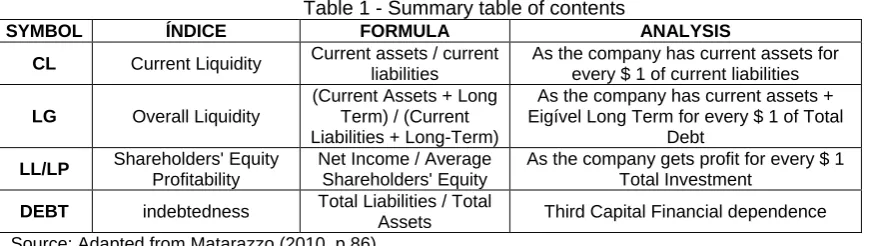
Table 1 - Summary table of contents
SYMBOL ÍNDICE FORMULA ANALYSIS
CL Current Liquidity Current assets / current liabilities
As the company has current assets for every $ 1 of current liabilities LG Overall Liquidity
(Current Assets + Long Term) / (Current Liabilities + Long-Term)
As the company has current assets + Eigível Long Term for every $ 1 of Total
Debt LL/LP Shareholders' Equity
Profitability
Net Income / Average Shareholders' Equity
As the company gets profit for every $ 1 Total Investment
DEBT indebtedness Total Liabilities / Total
Assets Third Capital Financial dependence Source: Adapted from Matarazzo (2010, p.86).
The set of financial indicators is the instrument known conceptually like balance analysis. According to Padoveze and Benedicto (2010), the goal is to seek elements that give greater clarity to the analysis or even indicates and presents financial performance result of the company.
DTA sets originate taxes over income, in particular from the standpoint of the Income Tax income and social contribution. In this context, it is important to note that the recognition of AFD can change the result, with increase or decrease the net worth, also impacting on economic and financial indicators of the company.
According to PWC (2011, p. 2):
DTA is measured and disclosed with a balance perspective on the differences between each asset / liability in the financial statements and the value of the asset / liability for tax purposes. Although it be measured with a balance sheet perspective and based on accounting differences in balance, one of the most important disclosures is the impact from income tax deferred over the company's results.
Studies related to deferred tax assets, such as Kronbauer and Moreno (2005) present some factors that determine their recognition and accounting. It is noticed that the accounting standards, national and international, could leave company managers with a choice of how best to recognize deferred tax assets in the financial statements. Therefore, this possibility leads us to a likely use for firms as well as a results management (WEBBER, 2009).
3 DATA AND METHODOLOGY
The aim of the study is to check the reflection of DTA over economic and financial ratios, so will not consider the amounts of tax debts. We adopted the same indicators used by Weber (2009), in collecting the data, namely: Current Liquidity-CL, General Liquidity-GL, Profitability on equity-POE, and Debt Total-DEBT, calculated based on the financial statements of the companies AGCO Corporation and Deere & Company for years 2011, 2012 and 2013.
The choice of agribusiness companies is justified by the importance for this segment in the global economy, and also for accessing the financial statements, available and published in the Securities and Exchange Commission (SEC). The two companies have subsidiaries in Brazil, therefore, are impacted by the Brazilian tax accounting, with the divergence between accounting and tax rules that generate the Deferred Tax Assets.
We analyzed financial statements during the period 2011-2013 available on the site of two US agribusiness companies AGCO Corporation and Deere & Company, which have subsidiaries in Brazil, with significant global market share. In Brazil, in 2013, these companies have market share of global approximately 70% market its flagship product: agricultural tractors, being 49.6% AGCO Corporation and 19.7% to DEERE & Company.
From published reports, were extracted data from Balance Sheet and the Income Statement, in currency US$. As it is applicable indicators, it was not necessary to convert the values for Brazilian currency.
Given the above, this study aimed to check the reflection of DTA over economic and financial ratios of these companies. As a basis for our study, we used the empirical research Webber (2009) found that the impact of tax assets in the calculation of economic and financial ratios of 36 companies from Brazilian Securities, Commodities and Futures Exchange.
First, we identified Deferred Tax Assets in the balance sheet of each company and then the following economic and financial indicators predefined were applied: LC, LG, POE and DEBT.
We conducted a free translation of two financial statements used, with the support from an accountant with expertise for ten years in agribusiness. We estimate the value of deferred tax assets in relation to total assets, using the formula: Deferred assets/Total Assets. On the balance sheet published by the company DEERE & Company there was not the subtotals of assets and liabilities Current and non-current, then we determined the subtotal of current assets and current liabilities in the balance sheet and then we applied the liquidity indicators.
The indicators were applied to the financial statements analyzed including and then excluding the DTA. We analyze the impact of DTA in the economic and financial situation, that is, the change that occurred in the result of indicators when applied the deferred tax assets. One of limitations from this methodology used, it was found that the annual accounts ended in different months. While the AGCO Corporation ended their annual accounts in December, the company DEERE & Company ended it in October of each year. Thus, there may be some bias in the results of indicators, especially when performed to compare the organizations, where groups and subgroups are the same, but the reporting periods are different.
In the Balance Sheet of DEERE & Company there was subtotal from assets and current liabilities. Thus, it was necessary to restructure the balance sheet in order to identify the subtotal for the implementation of the Current Liquidity indicator. We tried to apply concepts in this new restructuring trying to minimize the risk of data interference.
4 ANALYSIS AND DISCUSSION
We present in Table 2 the representativeness of DTA over total assets of each companies for the period analyzed.
Table 2 – DTA on the total assets of the companies AGCO Corporation
2013 2012 2011
265,60
3% 283,50 4% 180,30 2%
8.438,80 7.721,80 7.257,20
DEERE & Company
2013 2012 2011
2.325,40
4% 3.280,40 6% 2.858,60 6%
59.521,30 56.265,80 48.207,40
Source: prepared by the authors
As shown in Table 2 can be identified that DEERE & Company has deferred tax assets value higher than that of AGCO Corporation.
We calculated the financial economic indicators of enterprises for analysis before and after the DTA where the results are shown in Table 3.
Source: prepared by the authors
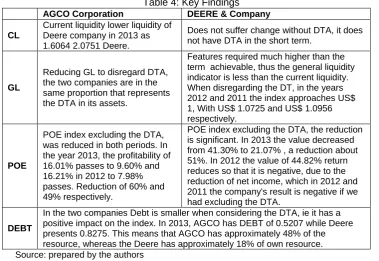
After analyzing each constant indicator in Table 3, we developed a descriptive summary of the main results and comments, shown in Table 4.
Table 4: Key Findings AGCO Corporation DEERE & Company CL
Current liquidity lower liquidity of Deere company in 2013 as 1.6064 2.0751 Deere.
Does not suffer change without DTA, it does not have DTA in the short term.
GL
Reducing GL to disregard DTA, the two companies are in the same proportion that represents the DTA in its assets.
Features required much higher than the term achievable, thus the general liquidity indicator is less than the current liquidity. When disregarding the DT, in the years 2012 and 2011 the index approaches US$ 1, With US$ 1.0725 and US$ 1.0956 respectively.
POE
POE index excluding the DTA, was reduced in both periods. In the year 2013, the profitability of 16.01% passes to 9.60% and 16.21% in 2012 to 7.98% passes. Reduction of 60% and 49% respectively.
POE index excluding the DTA, the reduction is significant. In 2013 the value decreased from 41.30% to 21.07% , a reduction about 51%. In 2012 the value of 44.82% return reduces so that it is negative, due to the reduction of net income, which in 2012 and 2011 the company's result is negative if we had excluding the DTA.
DEBT
In the two companies Debt is smaller when considering the DTA, ie it has a positive impact on the index. In 2013, AGCO has DEBT of 0.5207 while Deere presents 0.8275. This means that AGCO has approximately 48% of the resource, whereas the Deere has approximately 18% of own resource. Source: prepared by the authors
It is noticed that the financial and economic situation of the companies analyzed is applied in positive indicators. The results in Table 3 show that in both companies there are liquidity and positive profitability when applied to its original data, ie including the DTA. This research was focused on the analysis of DTA effect over the results of these economic and financial indices.
Reducing the overall liquidity indicator, when not considered the Deferred Tax Assets, follows in line what DTA represents related to total assets. In both companies, as show the representative frame, the percentage of each year is equal to the percentage reduction of the overall liquidity indicator.
C/ AFD S/AFD C/ AFD S/AFD
2013 1,6064 1,5206 2,0751 2,0751
2012 1,6045 1,5057 2,2376 2,2376
2011 1,6608 1,5961 2,0685 2,0685
C/ AFD S/AFD C/ AFD S/AFD
2013 1,9205 1,8601 1,2085 1,1613
2012 1,8282 1,7610 1,1389 1,0725
2011 1,7173 1,6746 1,1646 1,0956
C/ AFD S/AFD C/ AFD S/AFD
2013 16,01% 9,60% 41,30% 21,07%
2012 16,21% 7,98% 44,82% -5,75%
C/ AFD S/AFD C/ AFD S/AFD
2013 0,5207 0,5376 0,8275 0,8611
2012 0,5470 0,5678 0,8780 0,9324
2011 0,5823 0,5972 0,8586 0,9128
GL AGCO DEERE
CL AGCO DEERE
DEERE
DEBT AGCO DEERE
In DEERE company, the overall liquidity index is less than the AGCO. This aspect is not due to the fact of recognition or not of DTA. We note that the company has a significant amount of long-term liabilities, greater than its long-term assets, causing this effect on overall liquidity indicator.
One the most prominent impact in the research was the profitability indicator, that was significantly decreased in both companies. In DEERE company, in 2012 the profitability is negative, ie, the result presented in 2012 without the recognition of DTA is negative.
Regarding Debt, there is a difference between the companies analyzed. In 2013, the debt of AGCO is 0.5207, while DEERE presents 0.8275 for the same period. Therefore, AGCO commits approximately 48% of own resource, whereas the DEERE company commits approximately 18%.
In comparative analysis, The DEERE company has higher Current liquidity and profitability than to AGCO company, however, it is specially due to the recognition of DTA and also to a higher debt, when considering the long-term commitments. In the AGCO company, the ability to pay off all its commitments is greater, even with lower profitability, a fact that differs from the financial and economic situation of the companies examined, as defined by the authors used in this study.
5 CONCLUSIONS
The presence of an asset with characteristics of the DTA in accordance with generally accepted accounting principles, demonstrates the need, increasingly pressing, to equip users of accounting with forward-looking information. The recognition of DTA is valuable opportunity towards accounting geared to economic precepts.
The earnings management affects the clarity and transparency of financial statements, which, in turn, serve as a guide for decisions taken by multiple users, taking into account the need for information that each has on the company.
The companies included in the sample of this research have recognition of DTA in the analyzed statements. The content analysis of Current Liquidity, General Liquidity, Return on Equity and Debt, both with recognition of DTA where this recognition affects the statements from the companies studied.
The impact of the reduction in financial indicators due to the recognition of deferred tax assets does not result in "no liquidity", in view of they remain above $ 1.00 in three years for both companies analyzed. To verify that this impact is constant, it is recommended to apply research in a period of ten years.
The study made it possible to meet all objectives, and therefore concludes that the recognition of the DTA impacts the economic and financial analysis of the companies examined, with a view especially the impact on financial economic indicators analyzed. However, the results of the study does not allow us to say if companies recognize its DTA with a view to better management of its financial results, that incidentally can be a suggested framework for future research.
However, the study developed is not exempt from criticism, so it is important to emphasize the care to be taken when interpreting the results, given some limitations underlying for sample and methodologies used, of which derive suggestions for the development of future, more comprehensive studies and this complex subject. Thus, given the small sample size and the analyzed time horizon, a possible extension of this study would be to include in the agribusiness companies analysis in several countries, which in addition to certainly be reflected in more robust statistical tests also would be interesting extend the period of analysis and make comparative analyzes.
It is considered that the results of this study may have important practical implications, particularly for users of financial statements, as they provide evidence that companies serve the accounting discretion to stabilize the trends of results.
REFERENCES
Araujo, M. J. Fundamentos de agronegócios. 2ed. São Paulo: Atlas. 2005.
Assaf neto, A. Estrutura e Análise de balanços: um enfoque econômico-financeiro. 10. ed. São Paulo: Atlas. 2012.
BDO IFR Advisory Limited. IRFS AT A GLANCE: IAS 12 Income Taxes. Disponível em <http://www.bdointernational.com/Services/Audit/IFRS/IFRS%20at%20a%20Glance/Documents/IAS%2012.pdf> . Acesso em 29 mai. 2014.
Beuren, I M; Raupp, F. M. Metodologia da Pesquisa Aplicável às Ciências Sociais. Como Elaborar Trabalhos Monográficos em Contabilidade: teoria e prática. 3. ed. São Paulo: Atlas.2006.
Blouin, J. L., Gleason, C. A., Mills, L. F., & Sikes, S. A. (03 de Julho de 2007). What can we learn about uncertain tax benefits from FIN 48? McCombs Research Paper Series, Nº ACC-02-07. Retrieved Dec 11, 2013, from http://ssrn.com/abstract=990508
COMISSÃO DE VALORES MOBILIÁRIOS. Deliberação CVM Nº 599, DE 15.09.2009. Aprova o Pronunciamento Técnico CPC 32 do Comitê de Pronunciamentos Contábeis, que trata de tributos sobre o lucro. Disponível em: <http://www.cvm.gov.br/port/snc/deli599.pdf>. Acesso em 28 mai. 2014.
Dechow, P.M.; Sloan, R.G.; Sweeney, A. P. Causes and consequences of earnings manipulation: an analysis of firm of subject to enforcement actions by the SEC. Contemporary Accounting Research, v. 13, n. 1, p. 1-36.
http://dx.doi.org/10.1111/j.1911-3846.1996.tb00489.x. 1996.
DELIBERAÇÃO CVM Nº 599, DE 15 DE SETEMBRO DE 2009. Aprova o Pronunciamento Técnico CPC 32 do Comitê de Pronunciamentos Contábeis, que trata de tributos sobre o lucro. 2009. http://www.cvm.gov.br/port/snc/deli599.pdf
Fields, T.; Lys T.; Vincent L. Empirical research on accounting choice. Journal of Accounting and Economics, v. 31, p. 255-307. 2001. http://dx.doi.org/10.1016/S0165- 4101(01)00028-3
Gil, A. C.s. Métodos e técnicas de pesquisa social. São Paulo: Atlas. 2007.
Hendriksen, E. S.; Van Breda, Michael F. Teoria da Contabilidade. Tradução de AntonioZorattoSanvicente. 5. ed. São Paulo: Atlas. 1999.
IFRSBRASIL.com. Apuração dos impostos diferidos de acordo com o IAS12 – tributos sobre o lucro. [2014?]. Disponível em: <http://ifrsbrasil.com/passivos-e-pl/tributos-sobre-o-lucro/apuracao-dos-impostos-diferidos-de-acordo-com-a-ias-12-tributos-sobre-o-lucro>. Acesso em 29 mai. 2014.
Iniguez, R.; Poveda, F. Long-run abnormal returns and income smoothing in the Spanish stock market. European Accouting Review, v. 13, n. 1, p. 105-130. 2004.
IMPOSTO de renda diferido: conceitos básicos na divulgação da reconciliação de alíquota. Navegador contábil, n. 38, p. 1-4, ago. 2011. Disponível em: < https://www.pwc.com.br/pt/ifrs-brasil/navegador-contabil/assets/navegador-contabil-38.pdf>. Acesso em 27 jul 2013.
Iudicibus, S. de et al. Manual de contabilidade societária. São Paulo: Atlas. 2010.
Kern, B., & Luttman, S. (2011). Uncertain state tax position financial statement disclosures under FIN 48 and the new Internal Revenue Service Schedule UTP. Journal of State Taxation, 29(2), pp. 53-56.
Krombauer, C. A.; Moreno R. José.(2005). Tratamento contábil dos tributos sobre o lucro: um estudo comparativo entre as normas brasileiras da CVM e do CFC e a norma internacional de contabilidade n. 12 do IASB. Anais X Convenções de Contabilidade do Rio Grande do Sul, Bento Gonçalves.
Lev, A. M. (Julho/Agosto de 2008). FIN 48 Creates unexpected risks in business sales. The M&A LAWYER, 12, 2-7. 2008. Martinez, A.L.(2001). Gerenciamento de resultados contábeis: estudo empírico das companhias abertas brasileiras. Tese
(Doutoramento em Contabilidade e Controladoria) FEA/USP, São Paulo. 2001.
Martinez, A.L. Detectando earnings management no Brasil: estimando os accruals não discricionários. Revista de Contabilidade & Finanças, v. 19, n. 46, p. 7-17. 2008.
Matarazzo, D. C. Análise Financeira de Balanços: abordagem gerencial. 7. ed. São Paulo: Atlas. 2010.
Mendes, C.A.; Rodrigues, L.L. Estudo das práticas de Learnings management nas empresas portuguesas cotadas em bolsa: identificação do alisamento de resultados e seus fatores explicativos. Revista de Estudos Politécnicos. v. 4, n. 10, p. 149-171. 2006.
Modigliani, F.; Miller, M. (1958). The cost of capital. corporation finance and the theory of investment. American Economic Review, v. 48, p. 261-297. 1958.
Nunes, F. Produtores de máquinas agrícolas comemoram recordes de venda. PortalIG, 12 jul. 2013. Disponível em: http://economia.ig.com.br/empresas/agronegocio/2013-07-12/produtores-de-maquinas-agricolas-comemoram-recordes-de-venda.html> . Acesso em 21 mai 2014.
Osma, B.; Noguer, B.G.A.; Clemente, A.G. La investigación sobre earning management. Revista Española de Financiación y Contabilidad, v. 34, n. 127, p. 1001- 1033. 2005.
Padoveze, C. Benedicto, L. Carvalho, C. Análise das demonstrações financeiras. 3 ed.São Paulo: Cengage Learning. 2010.
Paulo, E; Martins, E.; Corrar, J.L. Detecção do gerenciamento de resultados pela análise do diferimento tributário. RAE. Revista de Administração de Empresas, v. 47, n. 1, jan./mar. 2007.
Perez Junior, J. H.; Oliveira, L. M.de. Contabilidade avançada. São Paulo: Atlas. 2001.
Prodanov, C. C. Metodologia do trabalho científico [recurso eletrônico]: métodos e técnicas da pesquisa e do trabalho acadêmico. 2. ed. Novo Hamburgo: FEEVALE. 2013.
Wasserman, C. O Ativo Fiscal Diferido no Sistema Financeiro Nacional: análise e proposta de contabilização. 2004. 142 f. Dissertação de Mestrado. Programa de pós-graduação em contabilidade. Universidade de São Paulo. 2004. Webber, F. L. O Impacto do Reconhecimento de Ativo Fiscal Diferido na situação econômica e financeira das empresas.
105 f. Dissertação de Mestrado. Programa de pós-graduação em ciências contábeis. Universidade do Vale do Rio dos Sinos – UNISINOS. São Leopoldo. 2009.