* To whom all correspondence should be addressed. Mob.: +91-8763530566;
E-mail :[email protected]
Isolation and Molecular Identification of Extreme an Halotolerant
Staphylococcus Sp. 13cc from Brackish Water of Chilika Lake
P.D. Mahapatra and B.B. Mishra
Department of Microbiology, CPGS, OUAT, Bhubaneswar - 751 003, India.
dx.doi.org/10.13005/bbra/1268
(Received: 03 March 2014; accepted: 06 April 2014)
Brackish water is the most extraordinary reservoir of bacterial community with an adaptability of tolerance to saline condition. In this research work, the halotolerance of the bacterial isolates were screened for identification and characterization of halotolerant bacteria from the brackish water of the chilika lake,Odisha. Representative samples of water was collected aseptically from four important sites of the lake viz Barkul,Kalupada Ghat,Parikuda and Rambha during the period from January to June 2012. Maximum possible number of culturable bacteria were obtained and screened for halotolerance. A total of 25 bacterial isolates were obtained and almost all the isolates survived upto 1 M NaCl but only one bacteria tolerated above 2.5M NaCl and was extremely halotolerant .This strain was identified as Staphylococcus sp.13CC. and designated with accession number KF657328 . It is a potential urease producer which is an important industrial enzyme. Further assay of enzyme is yet under study.
Key words: Halotolerant bacteria, Staphylococcus sp., Urease.
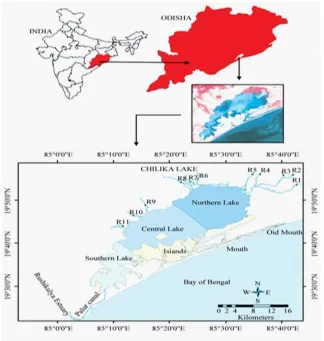
Asia’s largest brackish lake Chilika(190 28’ - 19 054’ N latitude and 8505’ – 850 38’E longitude)(Fig.1) is an estuarine (Biswas et al
.,1932 ) whose water is subjected to variation in
salinity due to the confluence of sea water from Bay of Bengal and fresh water from Daya and
Bhargabi rivers and its tributaries (Nayak et al
.,2004). This precisely affect the residential bacterial community which have developed
halotolerance to this salinity. Halotolerance is
the protoplasmic component of resistance to
salt stress. It involves the degree to which the
protoplasm, can tolerate the ionic imbalance associated with salt stress, and the osmotic and toxic effects of increased ion concentrations
(Larcher et al., 2001).These halotolerant bacteria
produces large quantity of compatible solutes,gas vesicles, intracellular and extracellular enzymes, salt resistant proteins and high contents of acidic to basic amino acids which acts as adaptive mode to tolerate high salt concentrations (Saum and Muller, 2007). and some may have certain inherent ability of biotechnological application.The research on
bacterial potency and their tolerance to variations
in physico chemical parameters of this lake is still under veil. Keeping in view of the above facts the
present investigation was under taken in order to
MATERIALS AND METHODS
Collection of Sample
Water samples were collected aseptically from four sites of chilika including Barkul,Kalupada Ghat,Parikuda and Rambha from January to June 2012 for investigation. The physico chemical parameters of the samples were analysed and processed immediately in the laboratory to isolate inhabiting bacterial flora, study their morphology and other characteristics features required for their identification and isolate the halotolerant bacteria.
Bacteriological analysis of water
Water samples were inoculated aseptically in the liquid medium i.e. Nutrient broth at 37ºC/24 hours. Hundred microlitres of inoculums was taken and spread plated on two different media viz., Nutrient Agar (NA) and Marine salt Agar for isolation of culturable bacteria . From these bacterial isolates, colonies showing different morphology
were selected, subcultured once or twice on Nutrient agar plates to obtain pure culture and were preserved in respective Nutrient agar slant at low
temperature (40C) for further characterization.
Screening for Halotolerance
The halotolerance of bacterial isolates was studied by incubating 100µl of culture in different tubes containing 5ml of NB with varying amount of NaCl at a difference of 0.5M concentration ranging from 0.5 M to 4 M of sodium chloride (NaCl). After incubating 18 to 24 hours at 37o C,
a loopful of the culture was sub-cultured onto NA
plates. All the plates along with a control NA plate without NaCl were incubated at 37oC for 18 to 24
hours. The highest concentration of NaCl on which
growth occurred, was detected.
Biochemical Identification of the halotolerant
bacteria
The halotolerant isolate from the screening was identified by studying colony characteristics on different pseudo selective media, Gram reaction and identification through a series of biochemical tests and also other features required for their characterization following standard microbiological techniques by (Collins and Lyne, 1970) with further study on their sugar utilization and enzymatic activities .
Effect of temperatures on growth of halotolerant bacterial isolate
The growth of isolate was tested on
Nutrient broth by incubating it at a difference of
50C temperatures ranging from 25oC to 550C for 370C/24 hours, respectively .Then OD was taken
at 600nm and its temperature resistance was observed from its turbidity.
Molecular Identification of the Isolate DNA extraction and PCR Amplification
The genomic DNA was isolated from the given organism using genomic DNA extraction Kit
(Bhat Biotech).
PCR Amplification of the 16s rRNA gene was performed using the universal primers.
Forward primer: 5’-AGAGTTTGATCC
TGGCTCAG-3’
R e v e r s e P r i m e r : 5 ’ - A C G G C TA C C T T
GTTACGACTT-3’
PCR was performed as follows in a total volume of 50 µl in a 0.2 ml thin walled PCR tube.
Components Volume
Nuclease free water 37 µl Genomic DNA (0.1µg/µl) 2.0 µl Forward Primer (10µM) 2.0 µl Reverse Primer (10µM) 2.0 µl 10X Reaction Buffer 5.0 µl dNTP Mix (10mM) 1.5 µl Taq DNA polymerase (5 U/µl) 0.5 µl Total volume 50 µl
The amplification was carried out in a Master cycler® Thermocycler (Eppendorf,
Germany) using the following program.
Initial denaturation of 94oC for 2 minutes
followed by 40 cycles of denaturation at 94oC for 1
min, annealing at 55oC for 1 min and extension at 72oC for 1.5 minutes. Final extension was carried out at 72oC for 10 min.The ~1500 bp PCR product
was purified to remove unincorporated dNTPS and Primers before sequencing using PCR purification
kit (Norgen Biotek, Canada). Sequencing
The strand of the rDNA region amplified by PCR were sequenced by automated DNA
DNA baser software before performing the bioinformatics analysis.
Bioinformatics analysis
Sequences were compared to the
non-redundant NCBI database by using BLASTN,
with the default settings used to find the most similar sequence and were sorted by the E score. A representative sequence of 10 most similar neighbours was aligned using CLUSTAL W2 for multiple alignment with the default settings. The multiple-alignment file was then used to create phylogram using MEGA5 software.The data is submitted to Genbank for accession number.
RESULTS AND DISCUSSION
Physico-chemical parameters of water sample
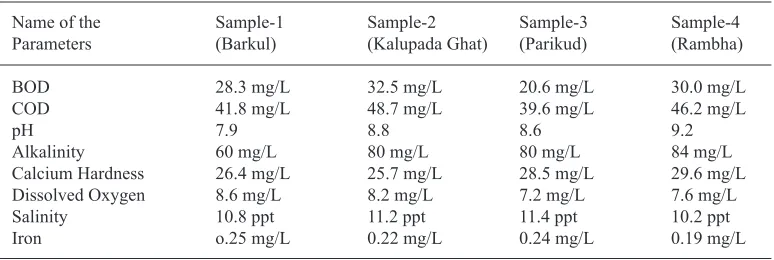
The analysed result of various parameters is enumerated in Table 1.The alkalinity of the water is found to be high .There is a variation in the salinity of the water .Highest salinity is found from parikud site of the lake.The BOD values indicates the presence of aquatic life in the lake and variation of these parameters in different sites of the same lake gives an indication of tolerance of microbes to this shifting habitat.
Screening for Halotolerance
Out of the the 25 bacterial isolates,all survived upto 1 M which gives a clear indication that the inherent bacterial flora is mildly halotolerant .However with increasing molarity very few survived above 2 M and only one was growing luxuriantly at 3M named 13cc .The halotolerance
was detected according to (Kushner et al 1993).
The details of tolerance to salinity is depicted in
Fig 2.
Biochemical Identification of the Halotolerant
bacteria 13CC
After gram staining it was found to be a gram positive cocci , It was positive for catalase , coagulase. It utilized almost all types of sugar while negative for Dulcitol and Inositol.It is hydrolysing lipid and producing little amount of DNAase, gelatinase, amylase but the urease activity is more as compared to other enzymes.This enzyme can be extracted and purified for further characterization.
It gives a clear indication that these halotolerant
bacteria are good source of enzymes. A parallel finding was scripted by(Daoud et al.,2013) where
lipase enzyme is produced from halotolerant
Staphylococcus sp.
Effect of temperature on bacterial isolate 13cc The isolate could withstand a wide
variation in temperature change. The optimum
growth was observed at 35oC but the cocci could
grow at a temperature of 500C.However It was unable to survive above 550C.The details of growth
at various temperature is represented in Fig 3.
Molecular Identification
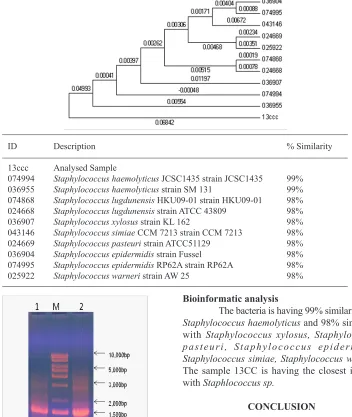
After DNA extraction ,the PCR amplification is carried and DNA was sequenced. The PCR amplification on agarose gel is given in fig 4.After sequence analysis the phylogenetic tree
was constructed. Phylogenetic tree 13ccc
The evolutionary history was inferred using the Neighbor-Joining method The optimal tree with the sum of branch length = 0.17552286
is shown. The tree is drawn to scale, with branch
lengths (next to the branches) in the same units as those of the evolutionary distances used to infer
the phylogenetic tree. The evolutionary distances
Table 1. Physicochemical parameters of the water samples
Name of the Sample-1 Sample-2 Sample-3 Sample-4 Parameters (Barkul) (Kalupada Ghat) (Parikud) (Rambha)
BOD 28.3 mg/L 32.5 mg/L 20.6 mg/L 30.0 mg/L
COD 41.8 mg/L 48.7 mg/L 39.6 mg/L 46.2 mg/L
pH 7.9 8.8 8.6 9.2
Alkalinity 60 mg/L 80 mg/L 80 mg/L 84 mg/L
Calcium Hardness 26.4 mg/L 25.7 mg/L 28.5 mg/L 29.6 mg/L Dissolved Oxygen 8.6 mg/L 8.2 mg/L 7.2 mg/L 7.6 mg/L
Salinity 10.8 ppt 11.2 ppt 11.4 ppt 10.2 ppt
Fig. 1. Location and position of chilika
Statistical analysis
r -1
95% confidence interval P value
P (one-tailed) < 0.0001
Exact or approximate P value? Exact
Significant (alpha = 0.05) Yes
Number of XY Pairs 8
Fig. 2. Halotolerance of the bacterial isolates
Statistical analysis
Std. Deviation 0.1514
Std. Error of Mean 0.05353
Fig 3. Effect of temperature on the growth of bacterial isolate 13cc
0 20 40 60
0.0 0.1 0.2 0.3 0.4 0.5
were computed using the Maximum Composite Likelihood method and are in the units of the number of base substitutions per site. The analysis
involved 11 nucleotide sequences. All positions
0.8% Agarose gel electrophoresis showed PCR product of 1.5 kb. Lane 1- 13CC M- 1kb DNA ladder (DNAmarkTM Logic Marker) and Lane2-13CC
Fig. 4. PCR amplification of 16srRNA gene
containing gaps and missing data were eliminated. There were a total of 1031 positions in the final
dataset. Evolutionary analyses were conducted in
MEGA5
ID Description % Similarity
13ccc Analysed Sample
074994 Staphylococcus haemolyticus JCSC1435 strain JCSC1435 99% 036955 Staphylococcus haemolyticus strain SM 131 99% 074868 Staphylococcus lugdunensis HKU09-01 strain HKU09-01 98% 024668 Staphylococcus lugdunensis strain ATCC 43809 98%
036907 Staphylococcus xylosus strain KL 162 98%
043146 Staphylococcus simiae CCM 7213 strain CCM 7213 98% 024669 Staphylococcus pasteuri strain ATCC51129 98% 036904 Staphylococcus epidermidis strain Fussel 98% 074995 Staphylococcus epidermidis RP62A strain RP62A 98%
025922 Staphylococcus warneri strain AW 25 98%
Bioinformatic analysis
The bacteria is having 99% similarity with
Staphylococcus haemolyticus and 98% similarity
with Staphylococcus xylosus, Staphylococcus pasteuri, Staphylococcus epidermidis, Staphylococcus simiae, Staphylococcus warneri.
The sample 13CC is having the closest identity
with Staphlococcus sp.
CONCLUSION
The brackish water of chilika exhibit a variation in its salinity which may lead to the halotolerance of the bacterial flora.The sample 13CC was identified as Staphylococcus sp.13CC
with accession number KF657328 designated
by by Genbank. The Staphylococcus sp. usually
tolerate 8% of NaCl( Ventosa et al 1998) however
it is extremely halotolerant and growing at and
activity and the enzyme extraction is under study.
REFERENCES
1. Biswas,K.Algal Flora of the Chilika Lake.The Asiatic Society of Bengal.,1932; 11: 65-198. 2. Nayak,L.,Behera,D.P.Seasonal Variation of Some
Physicochemical Parameters of Chilika Lagoon (East Coast of India) after Opening the New Mouth, near Sipakuda. Indian Journal of Marine Science., 2004; 33: 206-208.
3. Larcher, W: Physiological plant ecology: Ecophysiology and stress physiology of functional groups, Ed 4th ,NewYork, 2001:pp
474–482.
4. Saum, S.H., Mu¨ller. V. Salinity-dependent switching of osmolyte strategies in a moderately halophilic bacterium: glutamate induces proline
biosynthesis in Halobacillus halophilus. J Bacteriol.,2007; 189: 6968–6975.
5. Collins, C.H. and Lyne, P.M: Microbiological Methods. 6th edn., 1970:Butterworths, London,
UK.
6. Daoud, L., Kamoun. J., Ali, M.B., Jallouli ,R., Bradai, R., Mechichi, T., Gargouri, Y., Ali ,Y.B., Aloulou, A. Purification and biochemical characterization of a halotolerant Staphylococcus sp. extracellular lipase .International Journal of Biological Macromolecules., 2013; 57: 232-237. 7. Kushner,DJ., Forsyth,M.P ., Shindler,D,B.,
Gochnauer,M.B. Salt tolerance of intertidal marine bacteria. Canadian Journal of Microbiology.,1971;17(6): 825-828.
8. Ventosa,A., Joaquín, J. N., Aharon, O. Biology of Moderately Halophilic Aerobic Bacteria