IJSRSET11844129 | Received : 05 April 2018 | Accepted : 20 April 2018 | March-April-2018 [(4) 4 : 1248-1252]
Themed Section : Engineering and Technology
Design and Development of an Interactive Online Learning
Support System
Mgbeafuluike .I .J* , Ejiofor C. I
Department of Computer Science, Chukwuemeka Odumegwu Ojukwu University, Anambra, Nigeria
ABSTRACT
With the advancement of the internet and development of ubiquitous and pervasive computing, online educational systems are becoming more popular and are used for teaching and learning. However, most systems are still limited to dissemination of teaching materials. This research is aimed at design and implementation of an interactive learning support system for courses in Computer Science. The system is a set of interacting components that promotes the interest or cause of gaining knowledge or understanding by skill, study, instruction or experience through the use of information and Communication technology. The main function of the platform is to create systems of learning support to enable students to achieve extraordinary learning results in classrooms, laboratories and beyond. The Object Oriented Analysis and Design Methodology (OOADM) were used to analyze our findings as well as developing the information system. The system was designed and implemented as an online web based application capable of being accessed via the internet through the World Wide Web. The online learning support system is a valuable tool to aid an overall learning strategy. It also helps in the record keeping and tracking of students’ files as regards to their activities on the system.
Keywords : Learning. Online Learning, Learning Support System, ICT, Educational System, Interactive Learning
I.
INTRODUCTION
The rapid diffusion of the Internet has not only generated a renewed interest in the role of new information and communication technologies (ICTs) in higher education and learning it has also affected the way people teach and learn (1). At the same time, there has been growing concern over the possible decline of traditional practices in institutions, as e-learning, virtual universities, and distance education become feasible alternative platforms for higher education. Students, teachers, and administrators have continued to employ the Internet and Web for their practices, as e-learning has remained a key item on educational agenda. Among the various new
e-learning systems, electronic course management software has been one of the most widely disseminated technologies in colleges and universities (2). These Internet-based course management systems
within an academic institution. In addition, electronic courseware reshapes access to information by permitting interactive multimedia visualization, simulation of information, and the creation of educational networks beyond classroom walls (4). E-learning systems, as an education pattern, are becoming more and more popular. In e-learning systems, courseware management is an indispensable part. As the number of various courseware increases, how to find the courseware or learning materials that are most suitable to users and users of e-learning systems are most interested in is a practical problem (5). This research is aimed at design and implementation of an interactive learning support system for learning software engineering. The system objectives include (i) to provide a less expensive alternative to learning by proving a platform where all the relevant and necessary materials for the courses will be provided to the students. (ii) to provide a readily available self-paced learning system where courses can be taken when needed. (iii) To provide a highly interactive learning system for the student so as to encourage participation while learning and (iv) To enable students learn from any location and any time (6).
II.
CONCEPT OF LEARNING SUPPORT SYSTEM
Learning support system is a group of objects interacting independently or as a group (the system) that promotes the interest or cause (the support) of gaining knowledge or understanding by skill, study, instruction or experience (the learning). The learning support system creates a learning environment in which students live and interact(7). The system includes components (e.g. computer labs, electronic portfolios, libraries, web-based learning tools), processes and procedures (e.g. navigation systems, business operations, software tools), and expectations for engagement and connection, which work together to maintain a learning environment.
2.1 Types of Learning Support system
Learning support system can be developed and implemented through the following channels;
i. Traditional learning support: This type of learning support often consists of a teacher centered methodology in a face to face capacity (8). Numerous college professors practicing the
traditional strategy falls into a pattern of talking to their students rather than inviting them into the conversation (9).
ii. Computer mediated learning support: this type of learning support makes use of videotaped version of live lectures and an audio recording of the lecture with an accompanying PowerPoint presentation
iii. Innovative learning support: Innovative learning support makes use of new and advanced methods to support learning. The technique can take place in a variety of formats but what seems clear is that these practices are aimed at enhancing lecturing through unique tools such as clickers or video games.
2.2 Characteristics of learning support systems
Designing an online learning support system is relatively easy from the technical point of view. However, analyzing, designing and implementing the system to achieve better teaching and learning result is a difficult process (10). According to (10), the online learning support system should consider the following features: Complexity of learning support, Individuality and adaptability support, Interaction support, Activity and assessment support. This characteristic define what is needed in order to achieve a complete learning support system
III.
PROPOSED SYSTEM AND
IMPLEMENTATION
is designed for two categories of users – the Lecturers’ and the students’. In other words, the proposed system has two major aspects, the lecturer and the student.
(i) The Lecturer: The lecturer will be able to perform the following functions:-: Login, Register, View Reports made by the students, Submit Lesson Note Materials, Create Online Quiz tests for the students, Submit News stories to be viewed by the students
(ii) The Student: The student will be able to perform the following functions:-: Login, Register, View News Information made by the lecturers, Download Lesson Note Materials, Take Online Quiz tests created by the lecturer, Submit Reports to the lecturers.
Figure 1. System function Model
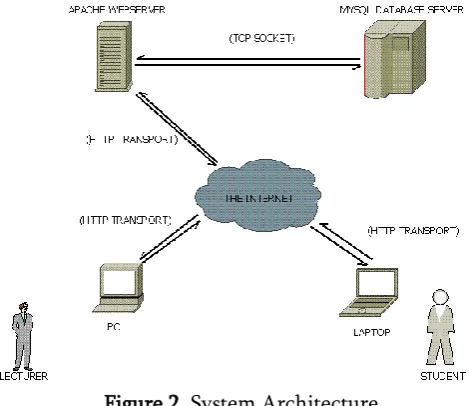
3.1 Architecture of the New System
In order to understand how the system works the
main components that make up the system will
have to be defined. This is done using the system
architecture. The system architecture showing the
main components of the proposed Online Learning
Support System is depicted in the system
architectural diagram displayed below
Figure 2. System Architecture
3.2 System Implementation
The system implementation shows how the proposed system modules will function and work to solve the problems identified by the researcher at the introduction part of this research work. The new system aims at (i) Provision of a web based platform through which lecturers and students can interact efficiently. (ii) Integration of a student portal into the platform so as to allow students access to the system. (iii) Integration of a lecturer’s portal into the platform so as to allow lecturer access to the system. (iv) Allowing for the posting of relevant comments or complaints to the school lecturers (v) Enabling lecturers to upload lesson notes and relevant academic resource for students, provision of news update to the students and to conduct online test/quiz for their students.
(a) Lecturer’s Algorithm
The set of instructions guiding the processing operation of the lecturer user are the following:
1. Start
2. Is Lecturer User registered? If Yes then go to 3 else 4
3. Login with username and password 4. Register as Lecturer User
The set of instructions guiding the processing operation of the student user are the following:
1. Start
2. Is Student User registered? If Yes then go to 3 else 4
3. Login with username and password
4. Register as Student User 5. View Lesson Note data 6. View News data 7. Take Quiz
8. Submit Report Data
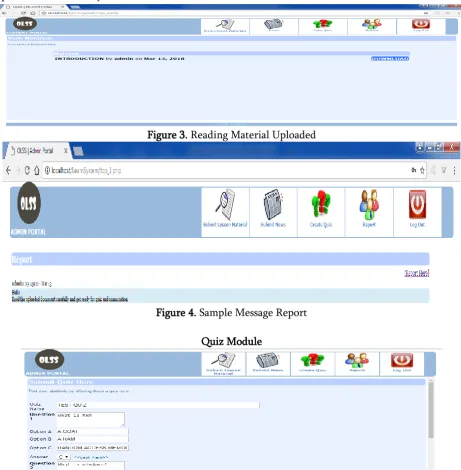
Sample Outputs
Uploaded Document by Lecturer
Figure 3. Reading Material Uploaded
Figure 4. Sample Message Report
Quiz Module
Figure 5. Quiz Module
Evaluation
data validation and data input collection. All modules were found to be accepting data and performing proper data validation. The output modules were tested to ensure that the data entered in the input module were displayed from the database correctly. All output modules displayed data as was expected
IV.
CONCLUSION
An online learning support system can be a valuable tool aid to an overall learning strategy which is a collection of other methods of instruction such as the lecture, tutorial sheets, and textbooks. It also helps in the record keeping and tracking of students’ files as regards to their activities on the interactive media. Through the use of an online support system, the students will be able to log in the system and learn the lessons interactively, making learning much more interactive and engaging. The aim of this project was to develop an online learning support system that will be developed to enable students and instructors take advantage of the benefits inherent in e-learning. The problems of learning in the traditional classroom environment were identified and a software communication tool was developed using appropriate software development methodologies to aid in curbing the identified problems.
V.
REFERENCES
[1]. DeLacey, B., & Leonard, D. (2002). Case study on technology and distance in education at the Harvard Business School. Educational Technology & Society, 5 (2). Retrieved March 2,
2018 from
(http://ifets.ieee.org/periodical/vol_2_2002 /delacey.html).
[2]. Green, K. (2001). The 12th National Survey of Computing and Information Technology in American Higher Education. Encino, CA: Campus Computing.
[3]. Fredrickson L., Venkatesh, V. (1999). Creation of favourable user perceptions: Exploring the
role of intrinsic motivation. MIS Quarterly, 23 (2), 239-260.
[4]. Dutton, W. H., Cheong, P. H., & Park, N. (2004a). An ecology of constraints on elearning in higher education: The case of virtual learning environment. Prometheus, 22 (2), 131-149. [5]. Stiles M. J (2012), Effective Learning, and the
Virtual Learning Environment, The Learning Development Centre, Staffordshire University, UK
(http://www.staffs.ac.uk/COSE/cose10/posnan.h tml).
[6]. Owston, R.D. (1997). The World Wide Web: A technology to enhance teaching and learning? Educational Researcher, 26(2), 27-33.
[7]. Aziz H, Romano J., Weeks D. (2004). Strategic Learning 5: Learning Support System. An essay. [8]. Berry, W. (2008) Surviving Lecture. A
pedagogical alternative. College Teaching, 56, 149-153.
[9]. Smit T.C (2009). The academic lecture: Learn to listen or listen to learn. Nawa Journal of language and communication. 3(1), 1-9.