R E V I E W
Open Access
A qualitative evaluation approach for
energy system modelling frameworks
Frauke Wiese
1*†, Simon Hilpert
2,3†, Cord Kaldemeyer
2,3,4†and Guido Pleßmann
5Abstract
Background: The research field of energy system analysis is faced with the challenge of increasingly complex systems and their sustainable transition. The challenges are not only on a technical level but also connected to societal aspects. Energy system modelling plays a decisive role in this field, and model properties define how useful it is in regard to the existing challenges. For energy system models, evaluation methods exist, but we argue that many decisions upon properties are rather made on the model generator or framework level. Thus, this paper presents a qualitative approach to evaluate frameworks in a transparent and structured way regarding their suitability to tackle energy system modelling challenges.
Methods: Current main challenges and framework properties that potentially contribute to tackle these challenges are derived from a literature review. The resulting contribution matrix and the described application procedure is then applied exemplarily in a case study in which the properties of the Open Energy Modelling Framework are checked for suitability to each challenge.
Results: We identified complexity (1), scientific standards (2), utilisation (3), interdisciplinary modelling (4), and uncertainty (5) as the main challenges. We suggest three major property categories of frameworks with regard to their capability to tackle the challenges: open-source philosophy (1), collaborative modelling (2), and structural properties (3). General findings of the detailed mapping of challenges and properties are that an open-source approach is a
pre-condition for complying with scientific standards and that approaches to tackle the challenges complexity and uncertainty counteract each other. More research in the field of complexity reduction within energy system models is needed. Furthermore, while framework properties can support to address problems of result communication and interdisciplinary modelling, an important part can only be addressed by communication and organisational structures, thus, on a behavioural and social level.
Conclusions: We conclude that the relevance of energy system analysis tools needs to be reviewed critically. Their suitability for tackling the identified challenges deserves to be emphasised. The approach presented here is one contribution to improve current evaluation methods by adding this aspect.
Keywords: Energy system analysis, Model challenges, Open science, Open source, Energy modelling framework, Oemof
Background
Energy systems are subject to substantial structural change, mainly due to environmental reasons and con-cerns about supply security. One central driver for these changes is the increasing share of decentralised and intermittent generation units based on renewable energy.
*Correspondence:[email protected]
†Equal contributors
1Department of Management Engineering, Technical University of Denmark, Produktionstorvet, Building 426, 2800 Kgs. Lyngby, Denmark
Full list of author information is available at the end of the article
As energy constitutes one foundation of modern soci-eties, modification within the generation, consumption, and distribution of energy affects a broad range of stake-holders. Ministries and likewise municipalities as well as economic and social interest groups are confronted with a constantly changing environment and high uncertainty regarding the future composition and design of increas-ingly complex energy systems.
Within the transformation process, model-based anal-yses have become indispensable for advice addressing a diverse set of questions. Among others, this includes grid
control and planning, dispatch and unit commitment, expansion planning, and energy market design, as well as environmental and social analysis of highly integrated energy systems. Energy system modelling software has been heavily discussed, and in recent years, model-based results have been criticised for the black box charac-ter of incharac-ternal model logic and underlying assumptions [1,2]. As a result, more researchers have opened their soft-ware and data [3] which improves transparency, enables reproducibility, and allows other people to re-use or build upon existing tools. Thus, a rough division into a group of closed (1stgeneration) and a group of open (2nd gen-eration) energy system models and frameworks can be identified [4].
The diverse research questions associated with the transformation of energy systems can obviously not be addressed by one single model or approach. This is under-pinned by the large amount of existing models and their differentiation along social, technologic, and economic lines.
In the following, we distinguish between the three terms
model,model generator, andframework. Models are con-crete representations of real-world systems (e.g. with a specific regional focus and temporal resolution). Such a representation may consist of multiple hard- or soft-linked sub-models to answer clearly defined research questions. Models can be built from model generators that allow to build models with a certain analytical and math-ematical approach (e.g. by the use of a pre-defined set of equations and represented technologies). Finally, a frame-work can be understood as a structured toolbox including sub-frameworks and model generators as well as specific models (e.g. wind feed-in models).
Although existing energy model and framework overviews are not comprehensive [3,5], it is obvious that their number is growing. Multi-purpose model gener-ators or frameworks such as MARKAL [6], TIMES [7], OSeMOSYS [8], PyPSA [9], or oemof [4] are important within the energy modelling community. In this context, it is crucial for users and developers to identify software that is fit for the intended purpose. Due to the nature of model generators and frameworks with their multi-purpose design and versatility, this task is not trivial. Hence, methods for quantitative as well as qualitative evaluation are important in terms of software selection. For this task, scientific model comparisons for specific models and model fact sheets as well as transparency checklists have been proposed (see section ‘Background and motivation’). However, there is a lack of compre-hensive evaluation of energy modelling software with regard to their suitability for tackling described modelling challenges.
In this paper, we propose a qualitative evaluation approach as a step towards model generator and
framework evaluation. To illustrate its application, we apply the approach to a 2ndgeneration energy modelling tool. Within a case study, the Open Energy Modelling Framework (oemof ) is evaluated regarding its capability to address present and future challenges in energy system modelling.
First, we give a short overview on existing evaluation approaches in the ‘Background and motivation’ section. Then, we describe the ‘Method’ section to derive our eval-uation approach. Subsequently, the ‘Challenges’ section is discussed and summarised in combination with the ‘Framework properties’ section. This forms the basis for the presented evaluation approach, for which the ‘ Appli-cation procedure’ section is described. In the next step, the approach is applied exemplarily in the ‘Case study’ section. Finally, we discuss the proposed approach and gen-eral findings of the challenge-property-matching in the ‘Discussion’ section. The ‘Conclusions’ section sum-marises the main findings.
Background and motivation
An evaluation of energy system modelling software can be undertaken by quantitative, qualitative, or mixed meth-ods. Quantitative approaches may be used to evaluate performance in terms of run-time or computational trace-ability as well as accuracy of results. The US Energy Mod-elling Forum has conducted model comparisons since the 1980s by looking at the foci of models, their internal logic and representation, and their results (see e.g. [10, 11]). One example is the ongoing projectRegMex, comparing simulation pathways of renewable energy systems [12]. In this context, standard test cases serve as a common basis for model comparisons. A mixed quantitative and qualitative approach is used in [13], where the evolu-tion of a model is characterised by comparing different model versions. In that paper, specific input- and output-related metrics are defined to allow for quantitative comparison.
for example practicability or the degree of openness. To our knowledge, this kind of analysis has not been applied to energy system modelling software. In particular, an approach specifically designed for a qualitative assess-ment of model generators or frameworks does not exist.
We know that on the one hand, literature that iden-tifies challenges for energy system modelling exists and on the other hand, model fact sheets characterise proper-ties of models are available as well. However, a systematic mapping of how framework properties can serve as solu-tions to specific challenges is missing. An evaluation based on the relationship between challenges and framework properties could therefore facilitate progress in model tool development with regard to the actual research needs. Furthermore, an analysis focusing on model gener-ators and frameworks is missing. The suggested approach builds upon fact sheets and checklists as well as on chal-lenge classifications, but combines both and lifts it from model to framework level.
Method
First, a literature review is conducted to compile energy system modelling challenges. Each of the five derived challenges and respective underlying aspects are then discussed and reasoned. Subsequently, framework charac-teristics that have the potential to tackle the derived chal-lenges are listed. These characteristics are mainly based on the Open Energy Platform framework factsheets [19], which describe the properties of existing frameworks. By means of existing reviews and own expert judgement, suit-able properties are selected and summarised in the list of characteristics. Challenge aspects and property char-acteristics are summarised in a matrix which serves as a template for the suggested evaluation. In the next step, the application procedure is tested with a case study and sub-sequently adapted. We illustrate the application procedure of the suggested evaluation by including the case study in this paper.
Challenges Overview
Other authors have characterised the field of energy sys-tem modelling and its models as opaque to outsiders [13, 15]. One reason for this may be the broad def-inition of the term energy system model. Depending on the research question, energy system models may range from detailed highly technical models of small sub-systems to large macro-economic models covering whole economies. Typical criteria for categorising models are top-down (macro-economic relationship of compo-nents) vs. bottom-up (technology specific) approaches, simulation vs. optimisation of the system, and partial equilibrium (e.g. considering only the power sector) vs. equilibrium (considering the whole economy) models
[20]. For a comprehensive description of the model (gen-erator) landscape as well as of model topology, we refer to existing reviews [14,15,21,22]. We restrict our analysis to general challenges and their respective aspects in the field of energy system modelling. These challenges relate to steps in the modelling process as described by [23], ranging from the development of a mental model of an energy system to the application of the model including the communication of results.
Coming up with a classification scheme for energy modelling challenges can be compared to proposing a scheme for energy model classification with regard to the generality of the categories. In case of energy system models, various options for classification exist, though there are ‘few models—if any—that fit into one distinct category’ ([24], p.7). This is similarly true for categori-sation of energy system modelling challenges. For our analysis, we propose the five major challenge categories
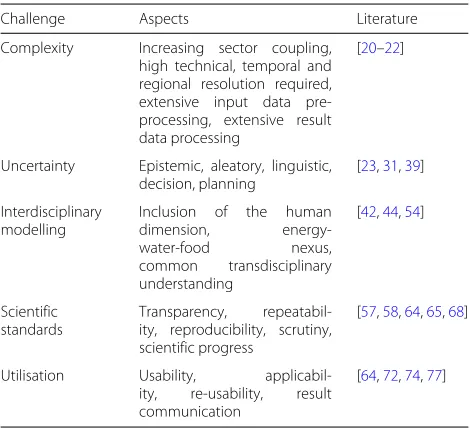
complexity, uncertainty, interdisciplinary modelling, scien-tific standards, and utilisation, which are characterised by different relevant aspects, summarised in Table 1. Generally, the relevance of a challenge for specific soft-ware may vary as it is determined by the focus of the underlying research question. The subsequent sections provide a detailed description for each of the identified challenges.
Complexity
The challenge categorycomplexitywith its main aspects sector coupling, technical, temporal, or regional resolu-tion, input data, and result processing is linked to the challenges in theutilisationcategory. There exists a con-tinuous trade-off between modelling complex interactions
Table 1Categorised energy system modelling challenges
Challenge Aspects Literature
Complexity Increasing sector coupling, high technical, temporal and regional resolution required, extensive input data pre-processing, extensive result data processing
[20–22]
Uncertainty Epistemic, aleatory, linguistic, decision, planning
[23,31,39]
Interdisciplinary modelling
Inclusion of the human
dimension,
energy-water-food nexus,
common transdisciplinary understanding
[42,44,54]
Scientific standards
Transparency, repeatabil-ity, reproducibilrepeatabil-ity, scrutiny, scientific progress
[57,58,64,65,68]
Utilisation Usability,
applicabil-ity, re-usability, result communication
with the required level of detail and keeping the model or framework simple and comprehensible for the recipients of the results and for the modellers themselves.
Diversification, distributed generation, and stronger integration of energy sectors with versatile interde-pendencies are growing challenges for energy system modellers. Considering the power-heat-transport nexus, integrated models nowadays play a decisive role in pro-viding insight into different flexibility options [25], using excess electricity economically [26], and for meeting climate goals [27]. While a high spatial and temporal reso-lution is required to consider varying weather conditions and cover different flexibility options, spatial and tempo-ral coverage is also necessary for analysing the long-term development of an increasingly interconnected power system. For instance, Després et al. [20] conclude that long-term energy models would benefit from an improved representation of fluctuating renewable energy sources in the power sector. The growing requirement of flexibility particularly on the demand side (e.g. storage or demand side management) additionally increases modelling com-plexity in systems with high shares of renewables.
The increasing complexity of models is accompanied by a rising amount and complexity of input and result data. Data are crucial since its absence may hamper the development of new modelling techniques, as Krysiak and Weigt [28] argue in the case of demand side management modelling. Keirstead et al. [22] state that data availabil-ity is one challenge for (urban) energy system modelling. Acquiring or generating input data is not a trivial task, as it requires versatile software skills (e.g. geographic infor-mation systems, databases, reverse engineering) and may be linked to other sophisticated research areas (e.g. mete-orology in the case of power production from wind tur-bines). Therefore, data processing to generate model input data is often not only one of the most time-consuming tasks of the whole modelling process but also adds to the complexity. Different kinds of input data from different sources need to be consistent, and their influence on the results have to be assessed adequately.
Regarding the output, models with high spatial, temporal, and technical resolution usually produce large amounts of result data that have to be anal-ysed. Among other aspects, appropriate visualisation of multi-dimensional data (temporal, regional, unit-wise) is increasingly challenging with increasing dimensions of model complexity. Depending on the kind of application and question to be analysed, the processing of results may be a difficult and time-consuming task in itself. Even if the question to be analysed focuses on just one result parame-ter, the relation to other result parameters and the relation between varying input parameters and the result param-eters of interest need to be checked thoroughly to grasp interdependencies.
Uncertainty
Uncertainty has already been identified as a challenge for energy system modelling decades ago [29]. Craig et al. [30] state that uncertainties in long-range energy fore-casts are systematically underestimated. Uncertainty in terms of energy system modelling can be sub-classified into a number of aspects. Generally, literature has dif-ferent scopes, approaches, and scientific backgrounds to classify uncertainty, resulting in different classification schemes [21, 23, 31]. Mirakyan and Guio miss a ‘com-mon agreement on typology of uncertainty’ [23]. They propose a new framework that has a broader scope and a more detailed classification compared to uncertainties described by Pfenninger et al. [21] and Hunter et al. [31]. This framework for categorisation of uncertainty incor-porates energy system modelling, decision making, and subsequent planning processes: (1)linguistic uncertainty, (2)knowledge or epistemic uncertainty, (3) variability or aleatory uncertainty, (4)decision uncertainty, (5)planning procedural uncertainty, and (6)level of uncertainty.
Even though not very often discussed in the context of energy modelling, the aspect oflinguistic uncertainty(1) affects energy system planning and decision making based on model results.Linguistic uncertaintyarises from nat-ural language being vague and ambiguous, as meaning of words may change over time [32]. An illustrative example is the ambiguous use of the termmodel.
Knowledge or epistemic uncertainty (2) covers various levels of uncertainty related to context or framing, data, structure of a model, or framework, as well as technical and accumulated uncertainty that includes all other. Vari-ous examples for this type of uncertainty exist in literature, as this category covers a wide range. Assumed learning rates and consequently future costs (e.g. for renewable energy technologies) are decisive parameters for energy system models, as those often aim for minimal system costs. If not carefully chosen, biased results may lead to incorrect policy recommendations if they do not reflect the sensitivity of these assumptions [33]. Methods and key pitfalls of assessing future costs of energy technolo-gies based on learning rates are an important topic among the research community [34,35] that illustrates the impor-tance of dealing with uncertainty related to assumptions and input data. Another problem related to uncertainty is associated with scenario development. Laugs and Moll show that most scenarios only represent a small band-width of possible pathways. This under-representation of extreme scenarios hampers the scientific discourses and ‘skews the overall outlook on possible energy futures’ [36].
the near-optimal decision space with their technique
modelling to generate alternatives(MGA) [39].
Variability or aleatory uncertainty(3) refers to ‘inherent variability manifested in natural and human systems’ [23]. It can also be referred to as random or stochastic. The aspectvariabilitycan be addressed with established math-ematical methods. For example, the open-source model generator TEMOA applies stochastic programming [31] to deal with variability uncertainty. For deterministic models, other options, such as scenario and sensitivity analysis or Monte Carlo simulations are available. How-ever, sensitivity analysis or stochastic programming coun-teract the challenge ofcomplexity, as these measures are computationally expensive. Even if such approaches are applied under the reasonable assumption of increasing computational resources, missing regulatory certainty in combination with disruptive events can hardly be tackled by existing technical methods. Hence, policy makers need to be aware that reliable policies and regulatory schemes are crucial for the degree of reliability that advice derived from energy modelling can offer in the future. Instead of handling these uncertainties as practical constraints, they have to be analysed additionally (e.g. influence of tempo-ral and regional resolution on results). This is important, as growing complexity of the modelled systems requires reducing model complexity. In turn, structural uncertain-ties of these simplified models increase. Connected to this issue are open questions that directly link toutilisation
(e.g. ‘Is a model with unquantified structural uncertainties fit for a specific purpose?’).
Decision uncertainty (4) stems from decision makers with a different understanding and judgement of objec-tives and appropriate solutions and strategies [23]. For example, risk perception or the way of presenting model results to decision makers may affect their decision [32]. Availability of resources in terms of information and time to process it affect decision making as well [23]. According to Wardekker et al. [40], uncertainty percep-tion varies depending on the way informapercep-tion is provided. This relatesplanning procedural uncertaintyto the afore-mentioned aspectdecision uncertainty.
Interdisciplinary modelling
The development of energy system models is typically undertaken from an engineering or economic perspec-tive. Jefferson [41] argues that emphasising equations and economic theories prevents researchers from focusing on complicated factors and their future implications. Fur-thermore, Wiese [42] states that twenty-first century chal-lenges need to include other perspectives than least-cost optimisation. As stated above, differences are inevitable between ideal results of optimisation models with one sin-gle rational decision maker and real-world developments with a multitude of heterogeneous stakeholders [43]. In
addition to an increased complexity, this is also a challenge from an interdisciplinary point of view since modellers need to integrate perspectives that are not captured by standard economic or engineering approaches. However, if energy research is not undertaken in an interdisciplinary way, researchers ‘are not likely to grasp the problems, and thus the solutions to this challenging (energy) research space’([44], p.247).
It is common to utilise Integrated Assessment Mod-els in climate change research [45]. Also for the energy field, Integrated Assessment Models like TIAM-WORLD exist [46].
Social and behavioural factors are important to assess the adoption of renewable technologies [47, 48] or the representation of consumers’ real behaviour in energy models [49]. For example, social acceptance has a rele-vant impact on grid and wind power expansion [50,51]. Heinrichs et al. [52] combine a survey, a macro-economic input-output model, and an energy system model to assess phase-outs of coal-fired power plants in Germany. They conclude that integrated assessment of energy systems provides more robust results.
Attempts exist to capture the human dimension in energy system modelling by applying social science meth-ods. But considering the strong interconnectedness of energy systems and society, social sciences are rather under-represented in contemporary energy research [53]. Another requirement in interdisciplinary modelling results from the strong interdependencies between the energy, water, and food sector. Granit et al. [54] argue that an increased understanding of the water-energy-food nexus is necessary to achieve sustainable development goals. They present first attempts for integrated tools and state that further cooperation between the modelling disciplines is required.
To comprehend the dimension of challenges in inter-disciplinary energy modelling, one has to consider that finding a coherent terminology and taxonomy within one field is already complex. This is referred to aslinguistic uncertaintyin the ‘Uncertainty’ section. Between different disciplines, a lack of understanding due to different terms impedes a common understanding of energy systems.
Scientific standards
be repeated by a different researcher in a different com-puter environment [56]. Although definitions exist, these two terms are not always used with this clear distinction in literature.
Transparency of methods, code, and data lays the foun-dation for the other three aspects, as it is a precondi-tion for building up on existing scientific work in the field of energy system modelling. However, Ince et al. [57] state that for computer science, transparency at all stages constitutes a basic condition for reproducibility. Even if this is fulfilled, reproducibility remains a challeng-ing task due to hardware, software, and natural language related uncertainty. The common situation of constantly changing versions of energy system models and failure to describe these precisely when presenting results, adds another dimension to the reproducibility challenge [13]. As Pfenninger et al. [1] argue, full—meaning effective— transparency of energy system models is still hampered by different barriers. Specifically, the lack of open licences on the original sources of data is an obstacle for making model data publicly available. Moreover, a sparse or non-existing documentation of data makes it inconvenient for others to use these data.
To facilitate repeatable analysis, DeCarolis et al. [58] recommend five steps of best practices in energy eco-nomic optimisation model development. These steps, we argue, can and should be applied to every energy sys-tem model and to some extent to frameworks: (1) make source code publicly accessible, (2) make model data pub-licly accessible, (3) make transparency a design goal, (4) develop test systems for verification exercises, and (5) work towards interoperability among models. In fact, with today’s information technology, it has never been easier to comply with these recommendations. However, regard-ing data, significant barriers still exist as explained above. In context of code, progress can be observed. Source code of different model generators has been made publicly accessible in recent years (e.g. Balmorel [59], OSeMOSYS [8], TEMOA [31], calliope [60], PyPSA [9]). Meanwhile, up to now, 25 open energy models and frameworks are registered on the website of the open energy modelling initiative [3]. Contrary to increasing model transparency, publishing solely aggregated results of energy system models is still a common procedure. For instance, a list of models used in the UK shows that input data and code of the majority of models are not open [15]. As almost any result can be generated by modifying decisive input data, variables, or code, the common practice makes repeat-able results impossible. Attempts exist to overcome these problems. Regarding data, the Dataverse project is one example of technical support in linking associated data with the published article [61].
While point three on the list (transparency as a design principle) has already been discussed above as the
foundation, the fourth point (verification exercises) refers to the aspect of scrutiny. The importance of scrutiny for energy system modelling is (in this paper) mainly dis-cussed not only in a technical sense but also on the soci-etal level. Point five on DeCarolis best practice checklist addresses applicability and re-usability which is discussed related toutilisation.
On the technical level, scrutiny refers to identifying inconsistencies or faults (so-called bugs). Every computer model is prone to bugs, whereas the probability of the-ses errors increathe-ses along with the complexity and size of the model. Detecting bugs is particularly vital in energy system modelling, as small errors may have great impact on the results. Johnson [62] highlights that peer-reviewed open-source software has significant advantages regard-ing bug detection. Besides this, Ndenga et al. [63] point out that the size of a community, i.e. users and developers, is one metric for bug reports.
On a social level, scrutiny refers to the detection of bias in model code and data. The possibility to scrutinise model results is essential for credibility [64], and the development of public trust in the mod-elling results, particularly as participation of society in the design of energy pathways, becomes increasingly important [65]. Methods for stakeholder participation in transition processes towards sustainability are available and applied [66] although simultaneously creating new challenges [67].
Being widely used for policy advice, the trade-off between being relevant without being policy-prescriptive is vitally important for model-based research [68]. Though, Mai et al. ([64], p.9) conclude that, acci-dentally or purposefully, all models incorporate biases. Going one step further, Biewald et al. [69] argue that value-laden and ethical issues cannot and should not be avoided in model-based studies, but assumptions based on ethical opinions should be communicated transpar-ently, which can increase policy relevance of these stud-ies. Similarly, Edenhofer and Kowarsch [70] state that value-neutral scientific recommendations for public pol-icy are not possible. As model-based research has to deal with normative-ethical aspects, they suggests a new cul-ture in academia that defines the role of modellers as cartographers of solution spaces. Detecting value-laden assumptions is even more difficult than detecting bugs, as software tests fail at this. Hence, again transparency of source code and data is pivotal for energy model use in policy advice and essential for complying with quality standards [71].
Utilisation
The aspects of the challengeframework and model utilisa-tionare linked to growing model complexity. In the mod-elling process, three main groups of persons are involved: (1) developers, (2) users, and (3) decision makers. It is noteworthy that in some cases, these groups may not be completely distinct, as developers and users might be identical. Regarding the user/decision maker interface, the user needs to be able to explain the model logic and its effects on results to recipients of the results. The aspects
usability and result communication are associated with the user/decision maker interface. The other two main aspects identified with regard toutilisationare applica-bility, that can be understood as a problem of ‘ease of use’ at the developer-user interface, andre-usability, that can be understood as ‘ease of adaptation’ at the devel-oper/developer interface.
As models only produce useful information if the recip-ients understand the causal relations to a certain degree, there remains a trade-off between the level of complex-ity and the general usabilcomplex-ity. Bale argues that ‘[m]odellers need to engage with their beneficiaries from the outset so that models are properly scoped and fit for purpose’ ([72], p.157). Most notably, this is important as models are made for obtaining insight, not for generating numbers [73].
The struggle of finding a common language between developers, users, and recipients of their results has existed almost as long as the models themselves. In 1976, the Energy Modelling Forum was formed to ‘foster bet-ter communication between the builders and users of energy models in energy planning and policy making’ ([74], p. 449). Energy research is generally application-oriented, but stands out among other policy fields with externalities. Due to its vertical and horizontal complex-ity, entailed costs, and strong path dependency, energy models are indispensable for policy support [75]. How-ever, the decision makers’ idea of useful information may differ significantly from those of the users ([64], p.9). This is a crucial point, as ‘[a] model is not fit for purpose if it is developed without sufficient critique of the motives for producing the model’ ([72], p.155). Therefore, the aspect
communication of resultsis a crucial aspect of the mod-elling process. In particular, valuable information may not only be lost at the user/decision maker interface. To tackle this problem in operation research, the concept ofmodel assessors, analysing, and evaluating models for decision makers has come-up a long time ago [76]. Additionally, Strachan et al. [77] propose further improvements, such as platform-based expert user groups for coordination and interdisciplinary external stakeholder review for energy system models.
Between developers and users, an easier and bet-ter understanding of framework or model mechanisms than at the developer/decision maker interface could be
assumed. However, this seems not always to be the case. One example for differences in understanding models and results is the discussion about results from the NEMS model (see [78] and [79] for details). The usefulness of a framework increases if it can be applied to a diverse set of problems and by different researchers. Ideally, the expense of a developer for building up on an existing framework should be lower than the expense for building a new one from scratch.
In context of energy system modelling, it has been argued that ‘[s]ociety as a whole saves time and money if researchers avoid unnecessary duplication’ ([1], p.212). Considering the rising number of open energy models and frameworks for similar purposes [3], it yet seems that developers tend to rather develop a new frame-work than use existing ones. A reason for this may be the increasing complexity and different software skills required for adapting models or frameworks. Conse-quently, being open does not seem to be sufficient in terms of usability, even if a deep modelling understanding exists. Thus, the aspect applicability is also connected to scien-tific standardsas it is vital for the repeatability and, more importantly, to the reproducibility of results.
The problem of how results are communicated is a recurring point in literature. Communication of energy system modelling results fails, when recipients only see concrete numbers (e.g. total energy system cost) as an outcome, though models should primarily be seen as a tool for understanding mechanisms and getting insights [70,73]. Strachan et al. [77] proposed approaches to rein-vent the modeller/policy interface for overcoming this problem. The communication with a recipient of model results cannot be tackled directly, but a framework can contribute to improving result communication by struc-tured output that includes effects of parameters, ranges of uncertainties, and relative differences between scenarios, instead of results reduced to individual figures. Further-more, extended use of pre-prints and discussions about results and methods within the community before the actual publishing process can be one step into the right direction.
Framework properties
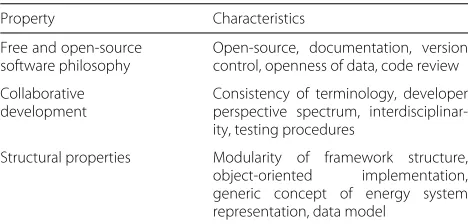
We categorise framework properties that can contribute to tackling the challenges described above in three major categories: (1) open-source philosophy, (2) collaborative development, and (3) structural properties. More detailed characteristics of these three properties are listed in Table2and described below.
Free and open-source philosophy
Table 2Framework properties with respective characteristics that are decisive for tackling the challenges
Property Characteristics
Free and open-source software philosophy
Open-source, documentation, version control, openness of data, code review
Collaborative development
Consistency of terminology, developer perspective spectrum, interdisciplinar-ity, testing procedures
Structural properties Modularity of framework structure, object-oriented implementation, generic concept of energy system representation, data model
reproducibility. Free software, source, and open-data are basic conditions for transparency and allow for repeatability, reproducibility, and scrutiny [58]. However, publishing undocumented source code of complex models still presents a serious obstacle to others. Therefore, code review, version control, and thorough documentation are important elements for effective transparency [81].
With a standardised input/output data format, simul-taneous publishing of model source code and the corre-sponding documentation (including data and meta-data) is possible. Cross-platform data structure provides a flexi-ble user interface and can contribute to lowering the entry barrier for new users. If supported by a clear version-control workflow, this allows for the release of monolithic model versions including data and documentation. In that way, scientific model results are transparent and enable reproducibility.
Policy measures and planning processes based on the results of energy system models cannot be affected directly by the modeller. However, an open-source and open-data approach enables decision makers and plan-ners to obtain a deeper understanding of model results considering details of model inputs. This may enhance communication between modellers, decision makers, and other stakeholders.
Collaborative development
Different important characteristics of frameworks origi-nate from collaborative development. This kind of devel-opment is a new challenge within the field of energy system modelling. But if it is done, it can trigger a process of finding common definitions and a shared understand-ing of energy research-related problems.
With a collaborative concept, frameworks can con-tribute to a process of addressing linguistic uncertainty. Identifying common elements in energy system mod-elling can help to determine coherent terminologies. Here, experience from collaborative modelling is key for the necessary interface definitions of different existing mod-els. Therefore, at least ambiguity is inherently tackled as developers have to agree on specific terms during the
development process. A common terminology enables the different groups to communicate effectively.
In the process of collaborative development, multiple perspectives of developers with different backgrounds can decrease the risk of overlooking or omitting decisive fea-tures of energy systems. Developing a common under-standing of interdisciplinary problems is not a trivial task, but a necessary basis for appropriate modelling. Here, collaborative development may play an important role in translating into interdisciplinary model development.
Additionally, a collaborative framework development and thus more people working with the code basis increases the probability of finding bugs [82]. This can also be integrated in a more structural way by standard test procedures before merging new developments into the master version. Test systems for verification exercises are one of the recommendations for repeatable analysis by DeCarolis et al. [58].
A collaborative framework development with develop-ers from different backgrounds requires a high-quality documentation. This results in improved transparency for new developers and external users and thus supports scientific progress.
The experience developers collect in a collaborative development process, how to find common definitions etc., are a good foundation for collaborating in an even more interdisciplinary team. The resulting generic basis allows for an easy coupling of energy system model com-ponents with new model comcom-ponents of other research areas (e.g. components in water resource modelling, investment delays due to public acceptance, demand changes due to behaviour changes). This supports the interoperability of models, which is important for repeat-able analysis [58]. The generic approach is part of the structural properties, which is explained in the following.
Structural properties
Structural properties of frameworks decide how flexi-ble energy system models can be created, adapted, and linked. If essential structural properties are shared, hard-and soft-linking of applications based on the same frame-work can be performed even with different modelling approaches or with models using different regional and temporal resolutions. As Trutnevyte et al. [83] argue, this can be a key for energy system analysis.
dimension which would thus support interdisciplinary modelling.
Overall, a generic basis in combination with a flexible programming language facilitates a modelling process for complex and changing systems. Generic classes facilitate the integration with other models.
An object-oriented approach generally provides a flex-ible interface for extensions. This supports the develop-ment of energy systems based on the same framework separately by different persons and to connect afterwards. Platform-independent software increases the usability of a model. If a model is tested on the main operation systems (Windows, Linux, Mac OSX), the potential user target group is enlarged. Python is a common program-ming language for relatively new open frameworks and models [81]. It has the advantage that required Python versions, and packages can be installed in a specific envi-ronment on the machine of the user. This makes sure that the framework can be run with the working version inde-pendently from other Python installations on the user’s machine. Such a high re-usability and adaptability could save other resources (e.g. time) in terms of parallel work, especially when it comes to long-term projects with a great extent of interfaces between groups and work pack-ages. This is in line with the argumentation of increased productivity through collaborative burden-sharing ([1], p.212).
Despite abovementioned problems of existing approaches to tackle variability uncertainty (see the ‘Uncertainty’ section), variability uncertainty can partly be addressed with incorporated tools for sensitivity analysis. Methods to explore a large space of parameter variations (i.e. scenario or sensitivity analysis) can be built on top of framework-based models. This is easier if a modular and
generic structure allows for it. However, one has to keep in mind thatuncertaintycannot only be fully tackled by an energy system framework with current methods but also depends on the regulatory consistency. Additionally, the trade-off between complexity and uncertainty has to be balanced by modellers and model users and does not fully depend on framework properties.
Application procedure
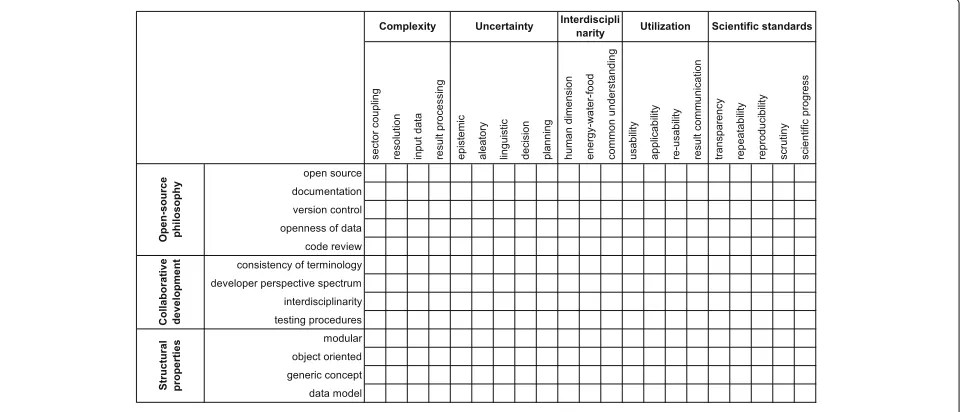
The result of our review of energy system modelling chal-lenges on the one hand and framework properties influ-encing the capability of frameworks to tackle these on the other hand is summarised in a matrix (Fig.1.)
This derived matrix can be used to evaluate energy sys-tem modelling frameworks or model generators regarding their capability to cope with present energy system mod-elling challenges.
The evaluation we suggest is made along the proposed challenge-property-matrix in the following steps:
• Quantify the characteristics of the framework’s properties in focus: no/not available (o) partly (+) -strongly (++).
• Argue for each challenge: how does each
characteristic partly/strongly address which aspect of the challenges?
• Quantify the contribution level for each
characteristic-aspect pair: not addressed (o) - partly addressed (+) - strongly addressed (++). Each characteristic can contribute to tackling a challenge aspect with at most equal rating. For example, if characteristicdocumentation is only partly available, it can contribute at maximum partly to tackling challenges.
• Check if the written argumentation supports the quantitative result.
• Optional: If the framework in focus has additional properties and/or characteristics relevant for the challenges, these might additionally be added to the matrix and evaluated with regard to their
contribution in a second round.
• Summarise potential changes of the framework that would improve the contribution to the challenges.
In the following, the procedure is exemplarily applied to a case study.
Case study
First, oemof is shortly described with respect to the listed properties (Open Energy Modelling Framework). Then, as outlined in the section ‘Application procedure,’ oemof ’s characteristics are checked for each challenge, and their contribution in tackling the challenge is debated (‘ Evalua-tion’ section). Finally, the resulting matrix summarises the findings (‘Summary’ section).
Open Energy Modelling Framework
The framework itself and the characteristics we refer to in this section are described in existing publications [4, 84] and the online documentation of the framework [85]. In the following, additional literature is referenced where necessary. The framework has been developed for the analysis of energy supply systems considering power and heat as well as (prospectively) mobility. It consists of different libraries with defined interfaces for their combination. Applications depict concrete energy system models constructed from oemof libraries. Inside compre-hensive models, specific parts of such an application can be developed flexibly by combining oemof libraries with
external libraries. The core concept of oemof is based on a network structure which describes the general topology of an energy system.
Available applications built within oemof (e.g. ren-passG!S [86], reegis [87], HESYSOPT [88]) demonstrate that the modular approach of the framework allows the creation of applications with very different objectives. The general description, the toolbox character, and the flex-ibility concerning temporal and spatial resolution makes oemof a framework instead of a model. It is implemented in Python using several packages (e.g. for data analy-sis, optimisation) and can optionally be combined with a PostgreSQL/PostGIS database.
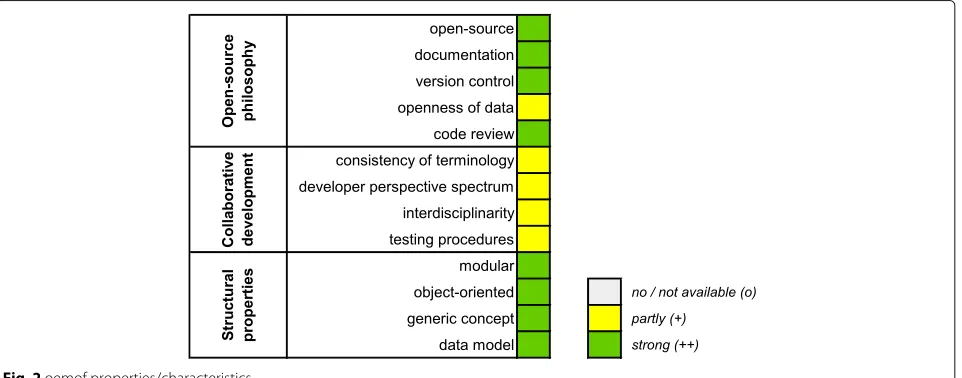
As a first step of the evaluation process, the characteris-tics are quantified in Fig.2.
Evaluation
Complexity
Due to its structural properties, oemof allows to create flexible energy system models which can be adapted and linked. For example, modelling strongly integrated energy systems is straightforward, due to oemof ’s network struc-ture. If, for instance, a specific sub-system should only appear in certain calculations, it can be connected and disconnected flexibly to a graph-based energy system rep-resentation with all its components depending on the requirements.
Additionally, generic classes can be used to easily inte-grate other models. This has, for instance, been tested with the PyPSA library [9]. Applications built in oemof have shown the integration of electricity, heat, and mobil-ity as well as energy market simulation models [89] and power flow analyses [90].
The temporal and regional resolution are not fully addressed, as no specific methods are implemented within
the framework. Nevertheless, the problem of resolution is partly addressed. For example, the optimisation library
solph provides step-flexible modelling with time-step-dependent weighting.
The object-oriented approach of oemof generally pro-vides a flexible interface for extensions. Different appli-cations based on oemof can be hard- or soft-linked even if using different regional or temporal resolution. Based on the underlying concept, incorporating new modelling methods is possible although not done yet (e.g agent-based models agent-based oncorecomponents).
Moreover, the framework provides a complete toolkit for modelling highly integrated, renewable-energy-based systems. Thus, not only optimisation models can be built but also input data such as feed-in or demand time series may be generated on the basis of oemof functions. Espe-cially, the feed-in libraries allow for a high spatial and temporal resolution.
Overall, the underlying generic basis in combination with a flexible programming language facilitates the mod-elling process for complex and changing systems.
Uncertainty
With its collaborative concept and a group of devel-opers with different backgrounds, oemof contributes to a process of addressing linguistic uncertainty.Epistemic uncertaintyrelated tomodel structure uncertaintyis partly addressed by oemof as well due to the multiple perspec-tives of the developers. At the moment, the framework does not provide any functions tackling problems of vari-ability uncertainty.
Interdisciplinary modelling
The provided framework does not directly address the aspect of taking down disciplinary walls between energy system modelling and other research disciplines. How-ever, the concept allows to integrate other modelling techniques, i.e. approaches that suit interdisciplinary modelling.
Scientific standards
oemof is licenced under the GNU General Public License v3.0 and thus meets a basic standard in terms of trans-parency and allows for repeatability, reproducibility, and scrutiny. The developer group also aims at open-data, but that is not yet fully achieved.
Another element of effective transparency is the four levels of documentation: (1) comments inside the code explaining non-intuitive lines of code; (2) docstrings inside the source code describing how to use the various classes, methods, and functions; (3) higher level descrip-tions of possible interacdescrip-tions between different libraries or application-specific usage information; and (4) applica-tion examples especially useful to new users.
Transparency on application level is supported by a standardised input/output data format and functions for simultaneous publishing of model source code, data, and meta-data. The data structure is human-readable, spreadsheet-based, and thus cross-platform applicable, which can contribute to lowering the entry barrier for new users. The version-control workflow supports repro-ducibility of model results. Backward and forward com-patibility is ensured as defined in the semantic versioning approach [91].
Regarding test procedures, there is a set of continu-ously extended tests (e.g. results, comparison of lp-files for mathematical models), which must be passed before merging into the development branch and thus also into the master branch. In addition, the oemof development uses (in addition to the tests) pull requests, which require review approvals of at least one more developer.
Utilisation
Beyond general challenges of utilisation outlined in ‘Framework properties’ above, oemof supports the energy system modelling community by providing a basis for model development that is highly reusable and adapt-able. It can be applied on the main operation systems and is—with Python as the programming language—based on platform-independent software.
Also, the applicability of oemof models is improved by the underlying structure. Once this structure has been internalised by users and model developers, its usage and development is straightforward. The different layers of omeof are partly independent from each other, which enables new users to create applications without knowing all parts of the framework.
Moreover, the overall concept is consistent and the graph-based structure is in line with the code, data, and documentation. Thus, even complex cross-sectoral models or applications developed with another scientific scope can be understood quickly. Generally, a well-defined modelling workflow increases overall transparency. The problem of result communication is only addressed indi-rectly by structured output that enables graphs for relative scenario comparison. However, this could be improved by providing methods for stating uncertainty ranges and methods for example visualising how strong input param-eter variations affect different output paramparam-eters.
Summary
Figure 3 summarises all challenges and properties with their specific contribution levels for the evaluated frame-work.
Fig. 3Visualisation of evaluation results. Derived from mapping challenges and their aspects with properties and their characteristics
integrated renewable energy systems, easy model linking as well as input and result processing.
Most aspects ofuncertaintyare not tackled by oemof, but the collaborative development and structural prop-erties may reduce linguistic and structural uncertainty. Important aspects like variability uncertainty are not addressed. This may be improved in future versions.
As delineated in the ‘Evaluation’ section, oemof lays important foundations forinterdisciplinary modelling, as the generic basis allows for modelling components that have their origin in other research areas. However, this has not been implemented in any oemof applications so far.
Being developed in an academic context, challenges related to scientific standards are addressed thoroughly with the free software and open-source philosophy. Collaborative framework development requires a high-quality documentation and improves transparency for new developers and external users. Moreover, potential bugs can be identified and fixed quickly, due to a grow-ing community and direct feedback between users and developers. This level of addressing is underlined by being in compliance with the best practice recommendations of DeCarolis et al. [58].
Regarding challenges in terms of utilisation, oemof ’s philosophy constitutes an important precondition for tackling these. Effective transparency at all stages is cru-cial for communication of results, as well as for application building and re-usability of models. Similar to uncer-tainty, we find that frameworks could support tackling the aspects of the challenge utilisationto some extent. However, for example result communication, changes in debate culture would be required to fully make use of this provided support by energy modelling frameworks.
From the evaluation, we conclude that challenges related tocomplexityandscientific standardsare strongly tackled. In contrast, uncertainty is not addressed at present, as major aspects of this challenge are not suf-ficiently considered. Regarding the challengesutilisation
andinterdisciplinary modelling, we argue that oemof cap-tures these partially.
Discussion
This described evaluation approach provides a structured, hands-on procedure that comes with different disadvan-tages and advandisadvan-tages.
Due to the intensive analysis of framework properties required in the evaluation process, the addressees of this approach are rather developers or experienced users of the respective frameworks. This has been affirmed by the case study, which required specific experience which is difficult to derive from documentation only.
However, the general scheme can contribute to broad-ening the scope of a developer team applying it. The method of matching properties of a framework with chal-lenges that need to be covered forces developers to think outside of the box of their own framework. Energy soft-ware development work is thus augmented by a societal perspective. Thus, it can be an assisting tool to relate one’s own work to the energy system analysis field. Further-more, it can assist in identifying potential improvements to increase the relevance of the framework. We argue that the evaluation approach may also be applied for framework comparisons, given that people with in-depth knowledge of the respective frameworks are involved.
in a structured way regarding the selected challenges and properties. For a framework comparison with a special focus, additional challenges or properties could be added to the matrix.
However, the step from the qualitative description of the properties to their evaluation, as well as the matching of the contribution level of the characteristics to the chal-lenges could incorporate subjective bias and vagueness. The potential bias could be lowered by a review of the valuation step from argumentation to the filled matrix by modellers new to the framework in focus. In the presented version of the evaluation approach, no weighting exists. Thus, results cannot reflect the importance of an indi-vidual aspect or characteristic. This would be a potential improvement.
Beyond the specific case study and the evaluation approach itself, the detailed discussion of challenges and properties in this paper identifies general issues in energy system modelling. Some approaches for tackling chal-lenges may counteract each other, such as complexity and uncertainty. To allow for rather sophisticated methods like stochastic programming, more research in the field of complexity reduction within energy system models is needed.
Furthermore, some challenges cannot be tackled solely by the framework approaches. Among these are problems of result communication and interdisciplinary modelling. We argue that these must be primarily addressed through changes in communication and organisational structures, thus, on a behavioural and social level. Additionally, we suggest to increase efforts in evaluating if a model is fit for purpose and what its results may reveal—or may not reveal—for each model application. Here, collaborative and interdisciplinary modelling can be a valuable method supporting this process.
Conclusions
Although different approaches for evaluating and com-paring models have been proposed, systematic evalua-tions of frameworks are under-represented. This paper presents an evaluation method for energy system mod-elling frameworks regarding their capability to address present challenges in energy system modelling.
The application of our approach in a case study demon-strates its general capability to assess energy system modelling software in terms of present and future chal-lenges. Advantages of the evaluation approach lie in its simplicity, flexibility, and transferability, whereas disad-vantages are mostly due to potential subjectivity and bias.
In addition, the detailed mapping of challenges and framework properties reveals that an open-source approach is a fundamental condition for complying with scientific standards. Openness of a framework is also
advantageous for its utilisation, meaning (re-)usability, and applicability. However, whether or not advantage can be taken from improved energy system modelling soft-ware is partly decided on social level. This is especially true for result communication and interdisciplinarity.
Acknowledgements
We would like to thank the working groups of the Center for Sustainable Energy Systems in Flensburg and the Reiner Lemoine Institute Berlin. Special thanks go to Birgit Schachler for valuable feedback on the manuscript, to Miriam Leich for proofreading, and to the oemof developing group for engagement in developing oemof and discussions regarding the evaluated framework.
Authors’ contributions
SH and CK performed the qualitative analysis of the framework (case study) in close cooperation and intensive discussion and contributed to the design of the paper; FW originally initiated the paper and contributed to the design of the study, to the review of energy system modelling challenges, and to the properties and the methodology. GP contributed to the review of challenges, in particular the challenge of uncertainty; all authors engaged in the initial design of the analysis; FW conducted the restructuring of the paper and the revision of the evaluation approach. All authors read and approved the final manuscript.
Competing interests
The authors declare that they have no competing interests.
Publisher’s Note
Springer Nature remains neutral with regard to jurisdictional claims in published maps and institutional affiliations.
Author details
1Department of Management Engineering, Technical University of Denmark,
Produktionstorvet, Building 426, 2800 Kgs. Lyngby, Denmark.2Center for
Sustainable Energy Systems (ZNES), Flensburg, Germany.3Department of
Energy and Environmental Management, Europa-Universität Flensburg, Auf dem Campus 1, 24943 Flensburg, Germany.4Department of Energy and
Biotechnology, University of Applied Sciences Flensburg, Kanzleistraße 91-93, 24943 Flensburg, Germany.5Reiner Lemoine Institut gGmbH, Rudower
Chaussee 12, 12489 Berlin, Germany.
Received: 31 October 2017 Accepted: 13 March 2018
References
1. Pfenninger S, DeCarolis J, Hirth L, Quoilin S, Staffell I (2017) The importance of open data and software: is energy research lagging behind? Energy Policy 101:211–215.https://doi.org/10.1016/j.enpol.2016.11.046 2. Pfenninger S (2017) Energy scientists must show their workings. Nature
542:393.https://doi.org/10.1038/542393a
3. Opemod Initiative (open energy modelling initiative) open models.http:// wiki.openmod-initiative.org/wiki/Open_Models. Accessed 24 Jun 2016 4. Hilpert S, Kaldemeyer C, Krien U, Günther S, Wingenbach C, Plessmann G
(2004) The open energy modelling framework—an approach to facilitate open science in energy system modelling. Submitted to Energy Strategy Reviews
5. RLI TOKNI KTH Energy Modelling Platform Europe.http://www. energymodellingplatform.eu/resources.html. Accessed 18 Dec 2017 6. Loulou R, Goldstein G, Noble K Documentation for the markal family of
models. Technical report. Energy Technology Systems Analysis Programme (ETSAP)
7. Loulou R, Remne U, Kanudia A, Lehtila A, Goldstein G (2005) Documentation for the times model - part i 1–78. Technical report. Energy Technology Systems Analysis Programme (ETSAP) 8. Howells M, Rogner H, Strachan N, Heaps C, Huntington H, Kypreos S,
structure and development. Energy Policy 39(10):5850–5870. Sustainability of biofuels.https://doi.org/10.1016/j.enpol.2011.06.033 9. Brown T, Hörsch J, Schlachtberger D (1991) PyPSA: Python for Power System Analysis (Version 0.6.1).http://pypsa.org. Accessed 5 May 2017 10. Sweeney J (1983) Energy model comparison: an overview.https://web.
stanford.edu/group/emf-research/docs/planning_papers/PP0604.pdf. Accessed 21 Jun 2017
11. Beaver R (1991) A structural comparison of energy-economy models used for global warming policy analysis. Working Paper 12.25 Energy Modelling Forum, Stanford University.https://web.stanford.edu/group/ emf-research/docs/emf12/WP1225.pdf. Accessed 22 Jan 2018 12. DLR RegMex—model experiments and comparison for simulation of
pathways to a fully renewable energy supply.http://www.dlr.de/tt/en/ desktopdefault.aspx/tabid-2885/4422_read-45643/. Accessed 29 Jun 2017
13. Dodds PE, Keppo I, Strachan N (2014) Characterising the evolution of energy system models using model archaeology. Environ Model Assess 20(2):83–102.https://doi.org/10.1007/s10666-014-9417-3
14. Connolly D, Lund H, Mathiesen BV, Leahy M (2009) A review of computer tools for analysing the integration of renewable energy into various energy systems. Appl Energy 87(4):1059–1082.https://doi.org/10.1016/j. apenergy.2009.09.026
15. Hall LMH, Buckley AR (2016) A review of energy systems models in the UK: prevalent usage and categorisation. Appl Energy 169:607–628.https:// doi.org/10.1016/j.apenergy.2016.02.044
16. Densing M, Panos E, Hirschberg S (2016) Meta-analysis of energy scenario studies: example of electricity scenarios for switzerland. Energy 109:998–1015.https://doi.org/10.1016/j.energy.2016.05.020 17. Zerrahn A, Schill WP (2017) Long-run power storage requirements for
high shares of renewables: review and a new model. Renew Sust Energ Rev 79:1518–1534.https://doi.org/10.1016/j.rser.2016.11.098
18. Cao KK, Cebulla F, Gómez Vilchez JJ, Mousavi B, Prehofer S (2016) Raising awareness in model-based energy scenario studies—a transparency checklist. Energy, Sustain Soc 6(1):28. https://doi.org/10.1186/s13705-016-0090-z
19. Opemod Initiative (open energy modelling initiative) OpenEnergy Platform (OEP) - Factsheets.https://oep.iks.cs.ovgu.de/factsheets/ overview/. Accessed 12 Feb 2018
20. Després J, Hadjsaid N, Criqui P, Noirot I (2015) Modelling the impacts of variable renewable sources on the power sector: reconsidering the typology of energy modelling tools. Energy 80:486–495.https://doi.org/ 10.1016/j.energy.2014.12.005
21. Pfenninger S, Hawkes A, Keirstead J (2014) Energy systems modeling for twenty-first century energy challenges. Renew Sust Energ Rev 33:74–86. https://doi.org/10.1016/j.rser.2014.02.003
22. Keirstead J, Jennings M, Sivakumar A (2012) A review of urban energy system models: approaches, challenges and opportunities. Renew Sust Energ Rev 16(6):3847–3866.https://doi.org/10.1016/j.rser. 2012.02.047
23. Mirakyan A, Guio RD (2015) Modelling and uncertainties in integrated energy planning. Renew Sust Energ Rev 46:62–69.https://doi.org/10. 1016/j.rser.2015.02.028
24. Beeck NV (1999) Classification of energy models. Technical Report FEW-777.http://citeseerx.ist.psu.edu/viewdoc/download?doi=10.1.1.43. 8055&rep=rep1&type=pdf
25. Connolly D, Lund H, Mathiesen BV, Werner S, Möller B, Persson U, Boermans T, D.Trier, Østergaard PA, Nielsen S (2014;) Heat Roadmap Europe: Combining district heating with heat savings to decarbonise the EU energy system. Energy Policy 65:475–489.https://doi.org/10.1016/j. enpol.2013.10.035
26. Schaber K Integration of Variable Renewable Energies in the European power system: a model-based analysis of transmission grid extensions and energy sector coupling. PhD Thesis. Technical University Munich, Institute for Energy Economy and Application Technology 27. Quaschning V (2016) Sektorkopplung durch die Energiewende
(Sector coupling by energy transition). Study, Berlin University of Applied Sciences (HTW), Accessed 1 July 2016.http://www.volker-quaschning.de/ publis/studien/sektorkopplung/Sektorkopplungsstudie.pdf
28. Krysiak FC, Weigt H (2015) The demand side in economic models of energy markets: the challenge of representing consumer behavior. Front Energy Res 3:24.https://doi.org/10.3389/fenrg.2015.00024
29. Hoffman KC, Wood DO (1976) Energy system modeling and forecasting. Annu Rev Energy 1(1):423–453
30. Craig PP, Gadgil A, Koomey JG (2002) What can history teach us? A Retrospective Examination of Long-Term Energy Forecasts for the United States. Annu Rev Energy 27:83–118.https://doi.org/10.1146/annurev. energy.27.122001.083425
31. Hunter K, Sreepathi S, DeCarolis JF (2013) Modeling for insight using Tools for Energy Model Optimization and Analysis (Temoa). Energy Econ 40:339–349.https://doi.org/10.1016/j.eneco.2013.07.014 32. II JCA, Maier HR, Ravalico JK, Strudley MW (2008) Future research
challenges for incorporation of uncertainty in environmental and ecological decision-making. Ecol Model 219(3–4):383–399.https://doi. org/10.1016/j.ecolmodel.2008.07.015
33. Yeh S, Rubin ES (2012) A review of uncertainties in technology experience curves. Energy Econ 34(3):762–771.https://doi.org/10.1016/j.eneco.2011. 11.006
34. Nemet GF (2006) Beyond the learning curve: factors influencing cost reductions in photovoltaics. Energy Policy 34(17):3218–3232.https://doi. org/10.1016/j.enpol.2005.06.020
35. Söderholm P, Sundqvist T (2007) Empirical challenges in the use of learning curves for assessing the economic prospects of renewable energy technologies. Renew Energy 32(15):2559–2578.https://doi.org/10. 1016/j.renene.2006.12.007
36. Laugs GAH, Moll HC (2016) A review of the bandwidth and environmental discourses of future energy scenarios: shades of green and gray. Renew Sust Energ Rev 67:520–530.https://doi.org/10.1016/j.rser. 2016.09.053
37. Hodges JS, Dewar JA (1992) Is your model talking? A framework for model validation. RAND Corporation.http://www.rand.org/pubs/reports/R4114. html. Accessed 1 Feb 2017
38. DeCarolis JF, Babaee S, Li B, Kanungo S (2016) Modelling to generate alternatives with an energy system optimization model. Environ Model Softw 79:300–310.https://doi.org/10.1016/j.envsoft.2015.11.019 39. DeCarolis JF (2011) Using modeling to generate alternatives (MGA) to
expand our thinking on energy futures. Energy Econ 33(2):145–152. https://doi.org/10.1016/j.eneco.2010.05.002
40. Wardekker JA, van der Sluijs JP, Janssen PHM, Kloprogge P, Petersen AC (2008) Uncertainty communication in environmental assessments: views from the Dutch science-policy interface. Environ Sci Pol 11(7):627–641. https://doi.org/10.1016/j.envsci.2008.05.005
41. Jefferson M (2014) Closing the gap between energy research and modelling, the social sciences, and modern realities. Energy Res Soc Sci 4:42–52.https://doi.org/10.1016/j.erss.2014.08.006
42. Wiese F (2015) renpass - Renewable Energy Pathways Simulation System - Open Source as an approach to meet challenges in energy modeling. PhD Thesis
43. Wittmann T (2008) Agent-based models of energy investment decisions. Sustainability and Innovation. Physica-Verlag HD, Heidelberg
44. Schuitema G, Sintov ND (2017) Should we quit our jobs? Challenges, barriers and recommendations for interdisciplinary energy research. Energy Policy 101:246–250.https://doi.org/10.1016/j.enpol.2016.11.043 45. Dowlatabadi H (1995) Integrated assessment models of climate change:
an incomplete overview. Energy Policy 23(4):289–296.https://doi.org/10. 1016/0301-4215(95)90155-Z
46. Loulou R, Labriet M (2008) ETSAP-TIAM: the times integrated assessment model part i: model structure. CMS 5:7–40.https://doi.org/10.1007/ s10287-007-0046-z
47. Robinson SA, Rai V (2015) Determinants of spatio-temporal patterns of energy technology adoption: an agent-based modeling approach. Appl Energy 151:273–284.https://doi.org/10.1016/j.apenergy.2015.04.071 48. Rai V, Robinson SA (2015) Agent-based modeling of energy technology
adoption: empirical integration of social, behavioral, economic, and environmental factors. Environ Model Softw 70:163–177.https://doi.org/ 10.1016/j.envsoft.2015.04.014
49. Fragnière E, Kanala R, Moresino F, Reveiu A, Smeureanu I (2016) Coupling techno-economic energy models with behavioral approaches. Oper Res:1–15.https://doi.org/10.1007/s12351-016-0246-9