INHERITANCE FORGERY
R
EID
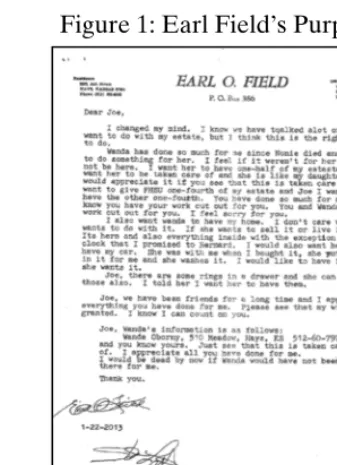
K
RESS
W
EISBORD
& D
AVID
H
ORTON
†
A
BSTRACT
Many venerable norms in inheritance law were designed to prevent
forgery. Most prominently, since 1837, the Wills Act has required
testators to express their last wishes in a signed and witnessed writing.
Likewise, the court-supervised probate process helped ensure that a
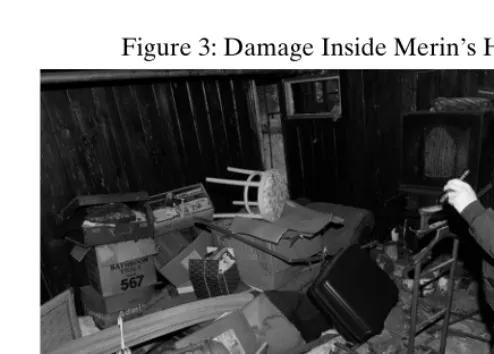
donative instrument was genuine and that assets passed to their rightful
owners. But in the mid-twentieth century, concern about forgery
waned. Based in part on the perception that counterfeit estate plans are
rare, several states relaxed the Wills Act and authorized new formalities
for notarized and even digital wills. In addition, lawmakers encouraged
owners to bypass probate altogether by transmitting wealth through
devices such as life insurance and transfer-on-death deeds.
This Article offers a fresh look at inheritance-related forgery.
Cutting against the conventional wisdom, it discovers that counterfeit
donative instruments are a serious problem. Using reported cases,
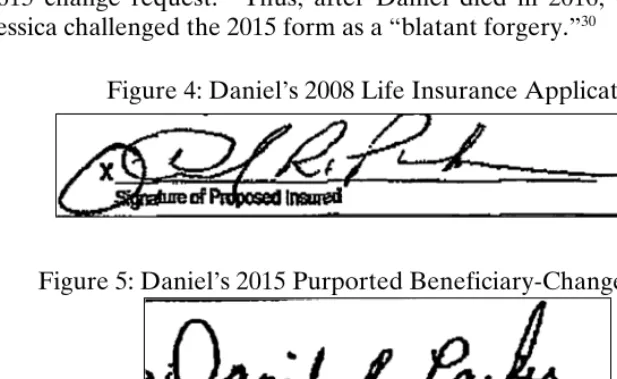
empirical research, grand jury investigations, and media stories, it
reveals that courts routinely adjudicate credible claims that wills, deeds,
and life insurance beneficiary designations are illegitimate. The Article
then argues that the persistence of inheritance-related forgeries casts
doubt on the wisdom of some recent innovations, including statutes that
permit notarized and electronic wills. The Article also challenges
well-established inheritance law norms, including the litigation
presumptions in will-forgery contests, the widespread practice of
rubber-stamping deeds, and the delegation of responsibility for
authenticating a nonprobate transfer to private companies. Finally, the
Article outlines reforms to modernize succession while remaining
sensitive to the risks of forgery.
Copyright © 2020 Reid Kress Weisbord & David Horton.
T
ABLE OF
C
ONTENTS
Introduction ... 856
I. The History of Inheritance Forgery ... 865
A. Traditional Protections Against Forgery ... 865
B. The Marginalization of Forgery ... 870
II. Modern Inheritance Forgery ... 875
A. Wills ... 875
B. Deeds ... 883
C. Life Insurance Beneficiary Designations ... 889
III. Normative Prescriptions ... 895
A. Wills ... 895
1.
Execution
...895
2.
Burden-Shifting
...899
B. Deed Authentication ... 905
C. Beneficiary Designations... 908
Conclusion... 913
Appendix... 913
I
NTRODUCTION
In 2013, a widower named Earl Field died in a small Kansas town,
leaving $20 million in property and two documents that purported to
be his will.
1One, which Field had executed in 2010, was prepared by
his longtime attorney and left most of his assets to a charitable
foundation run by his alma mater, Fort Hays State University
(“FHSU”).
2But a month before Field passed away, he allegedly
created a codicil—an amendment to his estate plan—by drafting a
letter that gave half of his property to his bookkeeper and caretaker,
Wanda Oborny.
3This self-made letter appeared to bear the signatures
1. In re Estate of Field, 414 P.3d 1217, 1221 (Kan. Ct. App. 2018); Brief of Appellee Fort Hays State University Foundation at 2, 15, In re Field, 414 P.3d 1217 (Nos. 116,456 and 117,079), 2017 WL 2616253, at *2, *15 [hereinafter Field FHSU Brief].
2. In re Field, 414 P.3d at 1221.
3. Field FHSU Brief, supra note 1, at 2. The letter stated in part: Dear Joe,
I changed my mind. I know we have [talked a lot] of what I want to do with my estate, but I think this is the right thing to do.
Wanda has done so much for me since [my wife] died and I want to do something for her. I feel if it weren’t for her I would not be here. I want her to have one-half of my estaste [sic]. . . .
of Field and two witnesses, Steve and Kathy Little.
4Because it seemed
to satisfy the black-letter requirements for making a will, it enjoyed a
presumption of validity.
5Figure 1: Earl Field’s Purported Codicil
6However, the circumstances surrounding the creation of this
instrument were suspicious. Oborny initially claimed that she had
found two similar but unwitnessed letters inside Field’s office desk
drawer.
7Only after she learned that a valid will must be executed by
attesting witnesses did she supposedly uncover the instrument that
Steve and Kathy Little had signed.
8Even more alarmingly, when the
FBI tried to question the Littles about witnessing the disputed codicil,
Steve killed Kathy and then committed suicide.
9Finally, although Field
had taken pains to minimize his taxes during life, his bequest to Oborny
rather than the charitable FHSU foundation would have
Id. app. D.
4. In re Field, 414 P.3d at 1222. 5. Id. at 1224.
6. Field FHSU Brief, supra note 1, app. D. 7. In re Field, 414 P.3d at 1222.
8. Id.
uncharacteristically saddled his estate with millions of dollars in tax
liability.
10Because of these peculiarities, FHSU contested the
purported codicil as a forgery.
11The discovery of two documents broke the case open. One was a
rough draft of the suspicious codicil prepared in Oborny’s
handwriting.
12The second was an unwitnessed, verbatim copy of the
purported codicil, complete with the same typographical errors and an
identical version of Field’s signature.
13Both were found in a paper
shredder near Oborny’s desk.
14These documents suggested that
Oborny, not Field, had drafted the purported codicil, traced Field’s
signature from another document, Xeroxed the page, and arranged for
the Littles to sign it.
15Figure 2: The Handwritten and Shredded Drafts of the
Purported Codicil
16***
In 2014, Jennifer Merin went to inspect a house she was about to
inherit in Queens, New York, and found Darrell Beatty, a stranger,
10. Id. at 1232. 11. Id. at 1223. 12. Id. at 1230. 13. Id. at 1226. 14. Id. at 1230. 15. See id. at 1226–27.
living there.
17The property had been in Merin’s family for eight
decades and was going to belong to her when she finished
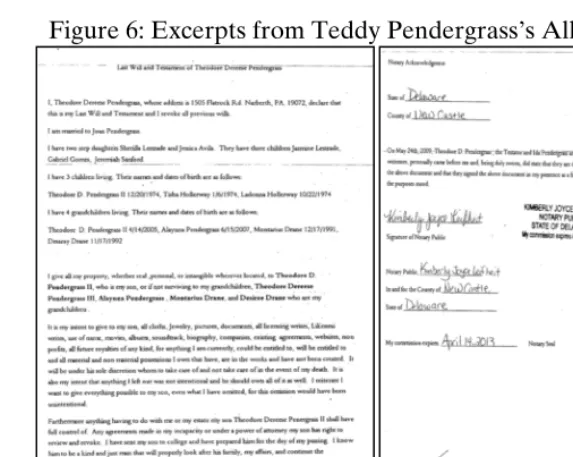
administering her mother’s estate.
18Nevertheless, she discovered that
Beatty had changed the locks, broken the garage door, taken her car,
and either stolen or broken the heirlooms inside.
19Figure 3: Damage Inside Merin’s Home
20When the police arrived, Merin’s nightmare intensified.
21Telling
the officers that he was the real owner, Beatty produced a deed to the
house in his name.
22Although this document lacked a legal description
and stated that Beatty had purchased title from a dead person
“residing” at a nonexistent address, it had been officially recorded by
the New York City Register.
23Thus, the police refused to intervene.
24***
17. Merin v. City of New York, No. 713069/15, 2016 WL 3454185, at *1 (N.Y. Sup. Ct. May 12, 2016).
18. See Plaintiff’s Memorandum of Law in Opposition to Defendants’ Motion to Dismiss Complaint at 4, Merin, 2016 WL 3417989 [hereinafter Merin Opposition Brief]; Barbara Ross,
Woman, 72, Whose Family House Was Stolen Through Deed Fraud Has No Right To Sue, N.Y.
DAILY NEWS (May 13, 2016, 5:18 PM),
https://www.nydailynews.com/new-york/queens/house-scam-victim-no-sue-queens-judge-rules-article-1.2636121 [https://perma.cc/D2GE-YQXC]. 19. Merin Opposition Brief, supra note 18, at 6.
20. Ross, supra note 18.
21. See Merin Opposition Brief, supra note 18, at 6. 22. Id.
In 2008, Daniel Parker, who lived in Mississippi, bought a policy
from Chesapeake Life Insurance Company.
25Daniel named his wife,
Gathel, as the death beneficiary and his daughter, Jessica, as the
contingent beneficiary.
26In 2014, Daniel separated from Gathel,
moved to Wisconsin, and began living with his sister, Connie.
27A year
later, Chesapeake received a beneficiary-change request in which
Daniel ostensibly substituted Connie for Gathel as the primary
beneficiary.
28There was just one problem: the signature on Daniel’s
2008 life insurance application looked nothing like the signature on his
2015 change request.
29Thus, after Daniel died in 2016, Gathel and
Jessica challenged the 2015 form as a “blatant forgery.”
30Figure 4: Daniel’s 2008 Life Insurance Application
31Figure 5: Daniel’s 2015 Purported Beneficiary-Change Request
32***
Forgery was once the great boogeyman of inheritance law. This
concern is easy to understand. Inheritance law’s primary goal is to
honor an owner’s intent about how to distribute her property at
25. Chesapeake Life Ins. v. Parker, No. 18-C-643, 2018 WL 4188469, at *1 (E.D. Wis. Aug. 31, 2018).
26. Id.
27. Id. at *2, *4. 28. Id. at *1.
29. Id. at *1.
30. Order Denying Summary Judgment at 7, Chesapeake Life Ins., 2018 WL 2766205, at *3. 31. Daniel R. Parker Life Insurance Application with Chesapeake Life Insurance Co. at 2,
Chesapeake Life Ins., 2018 WL 2766205 (filed June 30, 2017).
32. Daniel R. Parker Beneficiary Change Request with Chesapeake Life Insurance Co. at 2,
death.
33But the succession process suffers from what is known as the
“worst evidence” problem: decedents cannot speak up to correct the
record, clarify their wishes, or protect their interests.
34In turn, this
informational vacuum creates a window for opportunists.
Historically, the legal system went to great lengths to close this
gap. For example, the first criminal laws against forgery, which
emerged in ancient Rome, were specifically designed to combat phony
wills.
35Likewise, the Wills Act of 1837 requires testators to sign their
wills before two witnesses who are present at the same time to “guard
against forgery.”
36And the practice of requiring probate court
supervision helps prevent estate fraud, such as theft of a decedent’s real
property by deed forgery.
37These measures reflected the idea that
forgery was a grave threat to the orderly flow of assets from the dead
to the living.
But in the twentieth century, perceptions changed. Critics
observed that courts were rejecting would-be testamentary
instruments for minor deviations from the Wills Act, making the law
of will execution “notorious for its harsh and relentless formalism.”
38As a result, the greatest barrier to implementing a decedent’s intent no
longer seemed to be outsiders hijacking the execution process; rather,
it seemed to be the execution process itself. Likewise, dissatisfaction
with the cumbersome probate system fed the consensus that court
supervision of estates was “cautious to the point of absurdity.”
39Consequently, the cures for estate-related forgery came to be seen as
worse than the disease.
This critical view of traditional probate protections left a deep
imprint on the law. Over the last two decades, the Uniform Probate
Code (“UPC”) and several jurisdictions have authorized unwitnessed
but notarized wills and permitted courts to forgive harmless deviations
33. See RESTATEMENT (THIRD) OF PROP.: WILLS AND DONATIVE TRANSFERS § 10.1 (AM.
LAW INST. 2003); Ashbel G. Gulliver & Catherine J. Tilson, Classification of Gratuitous Transfers, 51 YALE L.J. 1, 2 (1941).
34. John H. Langbein, Will Contests, 103 YALE L.J. 2039, 2044, 2046 (1994) (book review). 35. J. W. Cecil Turner, “Documents” in the Law of Forgery, 32 VA. L. REV. 939, 941 (1946). 36. Waller v. Waller, 42 Va. (1 Gratt.) 454, 476 (1845); see Wills Act 1837, 7 Will. 4 & 1 Vict. c. 26, § 9 (Eng., Wales & N. Ir.).
37. See, e.g., PAULA A. MONOPOLI, AMERICAN PROBATE: PROTECTING THE PUBLIC,
IMPROVING THE PROCESS 57 (2003) (describing probate’s title-clearing function).
38. John H. Langbein, Substantial Compliance with the Wills Act, 88 HARV. L. REV. 489, 489 (1975).
from the Wills Act.
40In an even sharper break from tradition, a handful
of states have recently passed laws permitting testators to create
electronic wills.
41Finally, in a movement called the nonprobate
revolution, owners began structuring their estate plans around devices
that can transmit wealth without court oversight, such as life insurance
and transfer-on-death deeds (“TODDs”).
42These developments stem,
in part, from “the prevailing view . . . that forgery is rare.”
43This Article challenges this conventional wisdom by offering the
first scholarly investigation of forgery related to decedents’ estates
(“inheritance forgery”).
44It begins by demonstrating that inheritance
forgery has not disappeared. In fact, since 2000, there have been
several hundred reported opinions involving a litigated claim of
inheritance forgery. And in more than one hundred such cases,
inheritance forgery was a central issue in the litigation. Additionally,
the number of undetected forgeries, unprobated estates, and privately
settled disputes, as well as the enormous volume of summary court
adjudications, surely dwarfs the number of litigated cases that have
generated a reported judicial opinion. This steady stream of disputes
has exposed the confusion surrounding forgery litigation. For example,
related doctrines such as undue influence have well-oiled
burden-shifting rubrics that streamline will contests.
45But because forgery
doctrines do not possess such mechanisms, this type of misconduct is
difficult and often expensive to prove. Consider the forged codicil in
In
re Estate of Field
.
46Although this instrument might seem like an
obvious sham in hindsight, FHSU needed nine days, thirty witnesses,
and over three hundred exhibits to prevail at trial.
47In fact, Oborny
40. See infra Part I.B.
41. See infra notes 113–16 and accompanying text.
42. For the classic article on this movement, see generally John H. Langbein, The Nonprobate Revolution and the Future of the Law of Succession, 97 HARV. L. REV. 1108 (1984) [hereinafter Langbein, The Nonprobate Revolution]. For more on the basics of TODDs, see Stephanie Emrick, Note, Transfer on Death Deeds: It Is Time To Establish the Rules of the Game, 70 FLA. L. REV. 469, 473–81 (2018).
43. James Lindgren, Abolishing the Attestation Requirement for Wills, 68 N.C. L. REV. 541, 571 n.193 (1990).
44. This Article uses the term “inheritance forgery” to describe the broad range of forgery schemes that target the transfer of property shortly before, during, or shortly after the owner’s death.
45. See infra Part III.A.2.
46. In re Estate of Field, 414 P.3d 1217 (Kan. Ct. App. 2018); see supra notes 1–16 and accompanying text.
came so close to winning that the trial court granted her $1 million
under a state statute that authorizes awards of attorneys’ fees for “any
person named in a will or purported codicil . . . [who] prosecutes any
proceedings in good faith.”
48Unfortunately, inheritance forgery is not limited to wills. The
phenomenon also mars other popular gratuitous transfers. Scores of
recent newspaper articles
49and a startling December 2018 Grand Jury
Report from the Manhattan District Attorney’s Office have described
a national “epidemic” of counterfeit deeds involving real property
owned by estates.
50These bogus documents exploit a glaring loophole
in municipal deed-recording practices: officials often
cannot
refuse to
48. Id. at 1234 (quoting KAN. STAT. ANN. § 59-1504 (2018)). However, the trial court’s award of attorney’s fees was reversed on appeal. Id. at 1235.
49. In Philadelphia, for instance, investigative journalist Craig McCoy has reported extensively for the Philadelphia Inquirer on the scale and scope of the deed-theft problem. See
Craig R. McCoy, Stealing from the Dead, PHILA. INQUIRER (Jan. 23, 2019), https://www.inquirer.com/news/a/house-sales-fraud-theft-philadelphia-real-estate-dead-owners-william-johnson-20190124.html [https://perma.cc/YS5P-FQZK] (“They are all dead. Yet if city records are to be believed, they all walked into the office of a notary public and signed away their homes, which just happened to be in gentrifying neighborhoods with soaring property values.”);
see also Craig R. McCoy, After a Mass Theft of Philly Houses, Foreign Nationals Flee the Country, DA Says, PHILA. INQUIRER (May 1, 2019), https://www.inquirer.com/news/housing-theft-philadelphia-deeds-fraud-20190501.html [https://perma.cc/Y266-FJN4]; Craig R. McCoy, Ex-Con Charged with Stealing Homes from the Dead, PHILA. INQUIRER (Feb. 7, 2019), https://www.inquirer.com/news/theft-housing-fraud-deeds-willliam-johnson-krasner-20190207.html [https://perma.cc/GH4F-XQQY]; Craig R. McCoy, In Philly, Your House Being Ripped Off Isn’t Always Enough To Get Help from Police and the DA, PHILA. INQUIRER (July 6, 2019), https://www.inquirer.com/news/house-theft-philadelphia-larry-krasner-forged-deeds-20190706.html [https://perma.cc/6HLK-NT3B]; Craig R. McCoy, Philly DA Charges Point Breeze Man with Stealing Properties from the Dead, PHILA. INQUIRER (Mar. 8, 2019), https://www.inquirer.com/news/housing-theft-robert-stokes-district-attorney-larry-krasner-20190308.html [https://perma.cc/55BU-8FHQ]; Craig R. McCoy, A Real Estate Fortune Built on a Foundation of Forged Deeds and Tangled Titles, PHILA. INQUIRER (May 29, 2019), https://www.inquirer.com/news/house-theft-philadelphia-deeds-forgery-20190529.html [https:// perma.cc/JU4W-UFET]; Craig R. McCoy, Seven Ways the City Can Crack Down on House Theft,
PHILA. INQUIRER (June 3, 2019),
https://www.inquirer.com/news/house-theft-deeds-fraud-forgery-philadelphia-20190603.html [https://perma.cc/2GBY-MSAB]; Craig R. McCoy, With Questionable Signatures and a Dubious Will, a Man Lays Claim to a Dead Woman’s House,
PHILA. INQUIRER (Feb. 21, 2019),
https://www.inquirer.com/news/deed-will-forged-house-theft-philadelphia-william-johnson-20190221.html [https://perma.cc/W6UY-WJPY]. This Article discusses deed forgery in detail in infra Part II.B.
50. GRAND JURY OF THE SUPREME COURT OF THE STATE OF N.Y., REPORT OF THE
GRAND JURY 1, 8 (2018) [hereinafter Manhattan Grand Jury Report] (noting that the grand jury
record a suspicious instrument.
51The
New York Daily News
illustrated
the absurdity of this practice when, in a publicity stunt, it used a fake
notary stamp and two fictitious names to obtain title to the Empire
State Building.
52As con artists like Darrell Beatty in
Merin v. City of
New York
53have recognized, property owned by the deceased is
particularly vulnerable.
Finally, fake life insurance beneficiary designations are also a
pressing problem. Recall the discrepancy between the signature on
Daniel Parker’s 2008 application to Chesapeake and his alleged 2015
change-of-beneficiary form.
54At trial, Daniel’s sister, Connie, admitted
that she “actually signed the form using Daniel’s name.”
55How could
an insurance company fail to detect such a conspicuous fabrication?
The answer is surprising: these firms have little incentive to discourage
forgery. Indeed, if an insurer learns of a forgery allegation before it has
paid the proceeds, it can file an interpleader action. This procedural
step forces the parties with a stake in the matter to litigate while the
insurer recovers its attorneys’ fees and costs for “render[ing] beneficial
services” to the court.
56Alternatively, if an insurer disburses funds to a
wrongdoer, it can invoke what are known as “facility-of-payment”
statutes to shield itself from liability.
57Liberated from the specter of
liability, life insurers impose private formalities that fail to provide
meaningful protection against inheritance forgery.
This Article then suggests reforms that would strike a balance
between permitting inheritance law to evolve while deterring
inheritance forgery. First, it explains why a close reading of will-forgery
cases can help states update their Wills Acts and simplify forgery
disputes by importing a version of the burden-shifting regime from
undue influence. Second, it contends that local officials could contain
the problem of estate-related deed forgery by adopting a few
51. See supra note 176 and accompanying text.
52. See William Sherman, It Took 90 Minutes for Daily News To “Steal” the Empire State Building, N.Y. DAILY NEWS (Dec. 2, 2008, 10:46 PM), https://www.nydailynews.com/news/ money/90-minutes-daily-news-steal-empire-state-building-article-1.353477 [https://perma.cc/ ZZA9-QN9N].
53. Merin v. City of New York, No. 713069/15, 2016 WL 3454185 (N.Y. Sup. Ct. May 12, 2016); see supra notes 17–24 and accompanying text.
54. See supra notes 25–32 and accompanying text.
55. Chesapeake Life Ins. v. Parker, No. 18-C-643, 2018 WL 4188469, at *1 (E.D. Wis. Aug. 31, 2018).
straightforward measures. Third, it argues that insurance companies
should sometimes face liability when they fail to establish reasonable
protections against fake beneficiary designations.
The Article proceeds in three parts. Part I surveys the history of
inheritance forgery from ancient Rome to the most recent revisions to
the UPC. It shows that forgery’s perceived irrelevance has driven some
of the most important developments in the field of inheritance law.
Part II cuts against this received wisdom by revealing that inheritance
forgery continues to threaten the transfer of property at death. Part III
then uses insights from this research to outline how states could
continue to modernize the succession process while also deterring
wrongdoing.
I. T
HE
H
ISTORY OF
I
NHERITANCE
F
ORGERY
This Part traces the history of forgery in inheritance law. It reveals
that many of the ancient rules that populate the field were designed to
detect counterfeit wills. It also demonstrates that courts have long
struggled with the finer points of forgery contests, such as which party
bears the burden of proof. Finally, it explains how policymakers and
scholars in the second half of the twentieth century lost sight of these
issues.
A. Traditional
Protections
Against
Forgery
Trying to pass off a bogus instrument as legitimate—an act known
by the archaic phrase “uttering” a forgery
58—was once considered a
serious offense. The first statute against counterfeiting emerged in 81
B.C., and it was “mainly concerned with [the] falsification of
testamentary dispositions.”
59Likewise, in the third century, Roman law
extravagantly declared that “[a]nyone who writes . . . a forged will
. . . shall be deported to an island.”
60Believe it or not, Anglo-American
law was even more severe. In Georgian England, as society became
increasingly reliant on paper credit, Parliament passed 120 separate
laws against forgery, half of which imposed the death penalty.
6158. See State v. Washington, 1 S.C.L. (1 Bay) 120, 122 (S.C. Ct. Com. Pl. 1791). 59. Turner, supra note 35, at 941.
60. 1 S.P. SCOTT, THE CIVIL LAW 302 (1932).
Between 1741 and 1773, at least five people were sent to the gallows
for attempting to probate sham wills.
62Eventually, however, public
opinion changed, and these punishments were seen as draconian.
63In
1832, lawmakers demoted forgery of commercial instruments from a
capital crime to a mere felony.
64They extended the same leniency to
creating fake wills in 1837.
65Similarly, many important civil norms were designed to ensure the
authenticity of testamentary instruments. Execution formalities, for
example, date back to 1666, when the Great Fire of London destroyed
the city’s property records.
66Because “the effect and even existence of
wills were fruitful sources of dispute,” it was often unclear who owned
land that had been passed down through the generations.
67In response,
Parliament enacted the Statute of Frauds in 1677, which required wills
that transmitted land to be written, signed by the testator, and attested
by witnesses.
68A century and a half later, Parliament passed the Wills
Act, which extended these rules to all wills and added the requirement
that witnesses be “present at the same time” for the testator’s
execution of the will or acknowledgement of a prior signature.
69These
formalities crossed the Atlantic with the adoption of local Wills Acts
by every American state.
70As the Virginia Supreme Court explained
for the crime of forgery.” Furman v. Georgia, 408 U.S. 238, 304 (1972) (Brennan, J., concurring);
see Act of Apr. 30, 1790, ch. 9, § 14, 1 Stat. 112, 115 (imposing the death penalty for forgery). 62. See Randall McGowen, Forgery and the Twelve Judges in Eighteenth-Century England, 29 LAW & HIST. REV. 221, 225–26, 231, 238 & n.46, 245 (2011). Although many property offenses were capital crimes, these forgery cases stand out because juries at that time often found creative ways to avoid convicting defendants of nonviolent offenses punishable by death. See ADAM JAY
HIRSCH, THE RISE OF THE PENITENTIARY: PRISONS AND PUNISHMENT IN EARLY AMERICA 41
(1992).
63. Phil Handler, Forgery and the End of the “Bloody Code” in Early Nineteenth-Century England, 48 HIST. J. 683, 684 (2005) (“Forgery became the focal point for opposition to the death penalty . . . .”).
64. See 2 & 3 Will. 4 c. 62 & c. 123 (1832) (UK).
65. See 7 Will. 4 & 1 Vict. c. 26 (1837) (Eng., Wales & N. Ir.).
66. See Philip Hamburger, The Conveyancing Purposes of the Statute of Frauds, 27 AM. J.
LEGAL HIST. 354, 364–66 (1983).
67. Id. at 366.
68. See Statute of Frauds 1677, 29 Car. 2, ch. 3 (Eng. & Wales). 69. Wills Act 1837, 7 Will. 4 & 1 Vict. c. 26, § 9 (Eng., Wales & N. Ir.).
70. See, e.g., JESSE DUKEMINIER, ROBERT H. SITKOFF & JAMES LINDGREN, WILLS,
in 1845, will-execution formalities sought to “connect[] . . . the
instrument with the testator so as to guard against forgery.”
71Roughly half of U.S. jurisdictions also recognize holographic wills,
which are valid without witness attestation if all the material provisions
are in the testator’s handwriting and she has signed the document.
72In
theory, holographic wills contain enough of the testator’s handwriting
for courts to detect forged wills without witness attestation.
73But
opinions diverge about whether this formality is adequate.
74Probate—the court-based regime for administering decedents’
estates—was also designed with vigilance in mind. For starters, it
establishes a layer of judicial review that backstops the Wills Act
formalities.
75Other transfers, such as gifts and contracts, only find their
way into the legal system if they breed litigation, but probate requires
every proponent of every will to persuade a court that it is valid.
76Probate also culminates in a court order that formalizes the transfer of
assets from the dead to the living.
77This paper trail is especially useful
for conveying real estate because it makes “records . . . more exact[]
and title . . . less clouded.”
78Despite these safeguards, forgery claims continued to arise during
the nineteenth century. These cases revealed diverging views about the
appropriate procedural framework for forgery contests. For one, it was
unclear whether the proponent or the contestant bore the burden of
71. Waller v. Waller, 42 Va. (1 Gratt.) 454, 476 (1845); see also Murray v. Lewis, 121 A. 525, 527 (N.J. Ch. 1923) (“These [formal testamentary] provisions are reasonable and easily understood and their purpose is to prevent frauds.”).
72. See, e.g., Richard Lewis Brown, The Holograph Problem—The Case Against Holographic Wills, 74 TENN. L. REV. 93, 93 n.2 (2006). The recognition of holographic wills is based on principles from the Napoleonic Code that likely evolved from will-writing practices in Ancient Rome. See R.H. Helmholz, The Transmission of Legal Institutions: English Law, Roman Law, and Handwritten Wills, 20 SYRACUSE J. INT’L L. & COM. 147, 153 (1994).
73. See Gulliver & Tilson, supra note 33, at 13; Lindgren, supra note 43, at 558.
74. See Mark Glover, Minimizing Probate-Error Risk, 49 U. MICH. J.L. REFORM 335, 381 n.213 (2016) (“Some argue that holographs are particularly susceptible to fraud and forgery.”); Kevin R. Natale, Note, A Survey, Analysis, and Evaluation of Holographic Will Statutes, 17
HOFSTRA L. REV. 159, 169 (1988) (“Because of the absence of an attestation requirement, a
legitimate concern with holographic wills is that there be sufficient protection against forgery or fraud.”).
75. See, e.g., LEWIS M. SIMES & PAUL E. BASYE, PROBLEMS IN PROBATE LAW 401 (1946) (describing the traditional powers of probate courts).
76. See, e.g., Edward H. Ward & J. H. Beuscher, The Inheritance Process in Wisconsin, 1950 WIS. L. REV. 393, 394 (1950) (“The transfer of wealth on death typically involves the formal intervention of the state to a degree not true of inter vivos transfers.”).
77. See Langbein, The Nonprobate Revolution, supra note 42, at 1117.
proof.
79As noted earlier, the party seeking to enforce a will must have
made a threshold showing that it satisfies the Wills Act.
80Arguably,
this meant that if there was doubt about the authenticity of a document,
the proponent needed to show that it was real.
81Yet most courts
treated forgery as an affirmative defense, like fraud or undue influence,
that the challenger must establish by clear and convincing evidence.
82This meant that forgery contestants not only bore the burden of proof,
but they also had to satisfy that burden with evidence that was
especially persuasive. However, the requisite degree of persuasion was
not uniform across the states, as courts devised
sui generis
, loosely
defined evidentiary standards to deal with will forgeries. For instance,
the South Carolina Supreme Court remarked in 1908 that a contestant
“must satisfy the court of [forgery] by something more than mere
romance and suspicion.”
83In addition, the use of attestation clauses and self-proving
affidavits—short paragraphs within the will in which the witnesses
declare they saw the testator sign or acknowledge the document—
muddied the waters. Although these provisions can easily be
counterfeited, courts viewed them as powerful badges of legitimacy.
84For example, in
Newell v. White
,
85two witnesses who had no pecuniary
interest in the estate were alleged by the proponent to have attested
the will, but they swore at trial that they had neither signed the will nor
79. See, e.g., Charles E. Clark, Confidential Relations and Burden of Proof of Undue Influence in Will Cases, 26 YALE L.J. 62, 63 (1916) (“There has been much confusion in the rules determining the incidence of the burden of proof upon a proceeding for the probate of a will.”). 80. See, e.g., Williams v. Robinson, 42 Vt. 658, 663–64 (1870) (“[T]he proponent must first proceed with proof of the due execution of the will.”).
81. See, e.g., In re Simcox’s Estate, 11 Pa. C. 545, 550 (Orphans’ Ct. 1892), 1892 WL 2904, at *5 (“[T]he burden is upon [the proponent] to prove affirmatively the execution of the paper.”); Newell v. White, 73 A. 798, 804 (R.I. 1908) (Blodgett, J., dissenting) (remarking in a forgery contest that “the burden of proving the due and solemn execution of this instrument, which the law wisely casts upon the proponents, has not been sustained”).
82. Cf. Colby v. Richards, 107 A. 867, 868 (Me. 1919) (“[W]hen a serious crime like forgery is set up in a civil action, the evidence to sustain the charge must be full, clear, and convincing.”); Gillis v. Smith, 75 So. 451, 452–53 (Miss. 1917) (“[T]he person alleging that a contract, deed, gift, or will was procured through the exercise of undue influence has the burden of proving that fact. . . . The proof must be clear and convincing.” (omission in original) (quoting 1 HENRY
CAMPBELL BLACK, A TREATISE ON THE RESCISSION OF CONTRACTS AND CANCELLATION OF
WRITTEN INSTRUMENTS § 253 (1916))).
83. Thames v. Rouse, 62 S.E. 254, 254 (S.C. 1908) (quoting the challenged opinion of the circuit court).
84. See, e.g., O’Keefe v. Murphy (In re Estate of Murphy), 131 N.W.2d 220, 225 (Minn. 1964) (describing the traditional evidentiary potency of attestation clauses).
even knew of its existence.
86Nevertheless, the Rhode Island Supreme
Court admitted the instrument to probate, relying on the purported
will’s attestation clause rather than the witnesses’ live testimony in
court:
A will, duly attested upon its face, . . . may be admitted to probate,
although none of the subscribing witnesses are able to swear, from
recollection, that the formalities required by the statute were
complied with, and even although some of them should swear
positively that they were not . . . .
87Finally, the evidence in forgery cases was rarely clear. As one
attorney put it, forgery is a “deed[] of darkness” that can be hard to
either prove or disprove.
88Forgery contests usually devolved into a
“great mass of conflicting testimony.”
89Occasionally, the will’s
witnesses took the stand, followed by a second wave of witnesses who
spoke to the original witnesses’ credibility.
90Sometimes, judges offered
their own opinions about the authenticity of the testator’s signature.
For example, one New Jersey court decided that the handwriting on a
purported will “lacks the life of the genuine signature” and “presents
the appearance of a labored and dead production.”
91In other cases,
litigants called a motley assortment of “experts,” such as “cashiers and
tellers of different banks in this city, who were accustomed to examine
hundreds of signatures each day”
92or longtime “merchants and
bookkeepers [who] . . . had seen a great many handwritings.”
93Eventually, an entire cottage industry emerged of professional
handwriting analysts.
94This was the birth of forensic science, a
86. Id. at 799.
87. Id. at 800 (quoting Orser v. Orser, 24 N.Y. 51, 52 (1861)). 88. McGowen, From Pillory to Gallows, supra note 61, at 115 n.16. 89. See Smith v. Smith’s Ex’rs, 10 Ky. (3 A.K. Marsh.) 308, 308–09 (1821).
90. See, e.g., Ford v. Ford, 26 Tenn. (7 Hum.) 92, 97 (1846) (“A great number of persons have been examined in relation to the credit of these witnesses. Many support, and some discredit, them.”).
91. In re Gordon’s Will, 26 A. 268, 277 (N.J. Prerog. Ct. 1893), aff’d sub nom. Gordon v. Old, 30 A. 19 (N.J. 1894).
92. In re Williams’ Will, 15 N.Y.S. 828, 833 (Sur. Ct. 1891), aff’d, 19 N.Y.S. 778 (Gen. Term 1892), aff’d, 36 N.E. 345 (N.Y. 1894).
93. Kennedy v. Upshaw, 1 S.W. 308 (Tex. 1886) (West Headnote 3); Kennedy v. Upshaw, 64 Tex. 411, 420 (1885) (affirming the qualification of expert witnesses who offered opinion testimony at trial regarding the authenticity of signatures on the will).
discipline that has long been controversial because it was “invented
specifically for use in the legal arena.”
95B. The Marginalization of Forgery
Despite these developments, massive changes in inheritance law
gradually deflected attention away from forgery. To begin with, the
unforgiving rules of will execution began to seem like a greater danger
to testamentary freedom than the remote possibility of probating
counterfeit wills. Courts have refused to enforce writings for trivial
deviations from the statutory mandates since the passage of the Wills
Act, such as when the testator signed the wrong page
96or a witness
stepped out of the room too early.
97But as one prescient author
asserted in 1875, this practice “ha[d] not succeeded in preventing
forgeries,” but had instead nullified many “genuine wills.”
98Likewise,
in a seminal 1941 piece, Ashbel Gulliver and Catherine Tilson argued
that orthodox wills law was overprotective because, unlike the
seventeenth-century practice of executing death-bed wills, modern
testators typically prepare estate plans at a younger age, thereby
avoiding the danger of executing a donative instrument in a vulnerable
state of cognitive decline.
99Observations like these fed the perception that “forged wills are
rare”
100and “just the stuff of novels.”
101Academics began to mention
95. Jennifer L. Mnookin, Scripting Expertise: The History of Handwriting Identification Evidence and the Judicial Construction of Reliability, 87 VA. L. REV. 1723, 1727 (2001).
96. See, e.g., McGrew v. Bartlett, 387 S.W.2d 702, 703, 705 (Tex. Civ. App. 1965) (holding that a testator failed to sign a will when her signature appeared on a separate affidavit that was attached to the will).
97. See, e.g., In re Groffman [1968] 1 W.L.R. 733 at 739 (Eng.) (holding that a will was not witnessed by people who were “present at the same time” when they entered the room where the testator was acknowledging his signature mere moments apart).
98. The Adolphus Will Case, LAW J. 561, 562 (1875); see also Bruce H. Mann, Self-Proving Affidavits and Formalism in Wills Adjudication, 63 WASH. U. L.Q. 39, 60 (1985) [hereinafter Mann, Self-Proving Affidavits] (“Courts . . . routinely invalidate wills on formal grounds despite ample evidence that the document offered for probate accurately represents the testator’s intent.”).
99. See Gulliver & Tilson, supra note 33, at 10. But see Danaya C. Wright & Beth Sterner,
Honoring Probable Intent in Intestacy: An Empirical Assessment of the Default Rules and the Modern Family, 42 ACTEC L.J. 341, 360 tbl.1 (2017) (finding that 93 percent of decedents in a sample of probate cases were sixty years or older at death and that 61 percent of wills were executed within ten years of death).
100. Lindgren, supra note 43, at 558; see id. at 571 n.193 (“[T]he prevailing view of scholars [is] that forgery is rare . . . .”).
forgery only to dismiss it as outmoded and irrelevant: a phenomenon
that once may have been “a significant risk,” but now is much “less
prevalent.”
102Similarly, the
Restatement (Third) of Property: Wills and
Other Donative Transfers
does not even list forgery as a grounds for
refusing to enforce a will.
103Assuming that forgery was no longer a
major concern, the legal system began to dilute longstanding defenses
against misconduct in the will-execution process.
104Eleven jurisdictions
have adopted a novel rule called “harmless error,” which allows courts
to probate a noncompliant writing if there is strong evidence that the
decedent intended it to be her will.
105In the same vein, the UPC and
several states abolished what are known as “purging statutes,” which
require “interested witnesses”—those who have a dual role in the will
as both beneficiary and attesting witness—to forfeit their
perma.cc/E7PB-ZEX8] (discrediting this contention).
102. Glover, supra note 74, at 355. Citing the prevailing view of scholars, even one of us has recited the conventional wisdom that “deathbed wills and deed forgeries are uncommon.” Reid Kress Weisbord, Wills for Everyone: Helping Individuals Opt Out of Intestacy, 53 B.C. L. REV. 877, 914 (2012).
103. See RESTATEMENT (THIRD) OF PROP.: WILLS & DONATIVE TRANSFERS § 8.3 (AM. LAW
INST. 2003) (mentioning fraud, undue influence, and duress). In a comment, the Restatement observes that “[i]f the donor’s signature on a donative document was forged, the document is not valid because the document was not signed by the donor.” Id. cmt. o. This suggests that forgery is not an independent defense to enforcement, but rather an application of the general principle that a will must be “signed by the testator.” Id. § 3.1. However, the Restatement also provides that “the burden of establishing . . . forgery . . . is on the party contesting the validity of the donative transfer.” Id. § 8.3 cmt. o. This is confusing, because it seems to contradict the general principle that the proponent of the will bears the burden of proving that the testator signed it. See supra note 82 and accompanying text. The RESTATEMENT (SECOND) OF PROP.: DONATIVE
TRANSFERS § 34.7 (AM. LAW. INST. 1992) does not mention forgery at all in its discussion of
transfers induced by undue influence, duress, fraud, or mistake.
104. Forgery is still prohibited by criminal law, but it is no longer a capital crime. See, e.g., N.Y. PENAL LAW §§ 70.00(2)(d), 170.10 (McKinney 2018) (prohibiting the falsification of deeds, wills, codicils, and contracts as forgery in the second degree, a class D felony punishable by seven years’ imprisonment). Some prosecutors, however, have stated publicly that inheritance forgery is a low priority. See Craig R. McCoy, A Philadelphia Story: Falsely Declared Dead, Home Stolen and No One Will Help, PHILA. INQUIRER (July 2, 2018) [hereinafter McCoy, A Philadelphia Story], https://www.inquirer.com/philly/news/breaking/stolen-abandoned-houses-deeds-theft-fraud-philadelphia-20180629.html [https://perma.cc/QBJ4-GHWW].
105. CAL. PROB. CODE § 6110(c)(2) (West 2018); COLO. REV. STAT. § 15-11-503 (2018); HAW. REV. STAT. § 560:2-503 (2018); MICH. COMP. LAWS § 700.2503 (2017); MONT. CODE ANN. § 72-2-523 (2018); N.J. STAT. ANN. § 3B:3-3 (West 2019); OHIO REV. CODE ANN. § 2107.24 (West 2018); OR. REV. STAT. § 112.238 (2018); S.D. CODIFIED LAWS § 29A-2-503 (2018); UTAH CODE
ANN. § 75-2-503 (West 2019); VA. CODE ANN. § 64.2-404 (2018); UNIF. PROBATE CODE § 2-503 (amended 2010); RESTATEMENT (THIRD) OF PROP.: WILLS & OTHER DONATIVE TRANSFERS
inheritance.
106The UPC’s drafters believed that purging statutes were
more likely to punish innocent beneficiaries than to deter misconduct
by interested beneficiaries against vulnerable testators.
107Fourteen
jurisdictions and the UPC have similarly liberalized the requirements
for holographic wills by mandating that only the “signature and the
material provisions [or portions] of the will”—rather than the entire
document—be written “in the testator’s handwriting.”
108This reform
allows courts to validate a holograph “even though immaterial parts
such as date or introductory wording are printed, typed, or stamped.”
109Lastly, in 2008, the UPC authorized testators to secure a notary’s
approval instead of witnesses.
110This maneuver sought to align the law
with a common—but mistaken—view that notarization is a proper
substitute for witness attestation.
111Lawrence Waggoner, one of the
UPC’s reporters, acknowledged that this relaxation of the Wills Act
might create the “possibility of wrongdoing” but ultimately dismissed
this concern:
To be sure, someone could forge a relative’s will and, using fake
identification, perhaps succeed in getting it notarized. That danger is
also present, however, in the case of an attested will in which, under
the UPC and many non-UPC statutes, the attesting witnesses need
not know the testator and need not be disinterested. A fraudulent
will, whether attested or notarized, would typically be challenged by
106. UNIF. PROBATE CODE § 2-505(b) (“The signing of a will by an interested witness does not invalidate the will or any provision of it.”); see also MONT. CODE ANN. § 72-2-525; N.D. CENT. CODE § 30.1-08-05 (2018); UTAH CODE ANN. § 75-2-505.
107. The UPC drafters predicted that rational wrongdoers would want to avoid compromising the appearance of their own objectivity by keeping themselves at arm’s length from the will-making process; thus, instead of signing as an attesting witnesses, wrongdoers would prefer to “procure disinterested witnesses.” UNIF. PROBATE CODE § 2-505(b) cmt.
108. Id. § 2-503 cmt. (“material provisions”); Id. § 2-502(b) (amended 1993), 8 U.L.A. 145 (1998) (“material portions”); see also ALASKA STAT. § 13.12.502(b) (2018); ARIZ. REV. STAT. ANN. §§ 14-2502B, 2503 (2019); CAL. PROB. CODE § 6111; COLO. REV. STAT. § 15-11-502(2), (3); HAW. REV. STAT. § 560:2-502(b), (c); IDAHO CODE § 15-2-503 (2018); ME. STAT. tit. 18-A, § 2-503 (2019); MICH. COMP. LAWS § 700.2502(2), (3); MONT. CODE ANN. § 72-2-522(2), (3); N.J. STAT. ANN. § 3B:3-3; N.D. CENT. CODE § 30.1-08-02(2), (3); S.D. CODIFIED LAWS § 29A-2-502(a), (c); TENN. CODE ANN. § 32-1-105 (2019); UTAH CODE ANN. § 75-2-502(2), (3).
109. UNIF. PROBATE CODE § 2-502(b) cmt.
110. See id. § 2-502(a)(3)(B); see also COLO. REV. STAT. § 15-11-502; N.D. CENT. CODE
§ 30.1-08-02.
the decedent’s disappointed relatives. The law has long relied upon
the courts to identify such cases and rule accordingly.
112The movement to modernize the Wills Act has shifted into high
gear since 2017. Because millennials “are so acclimated to digital and
electronic forms of communication that they seldom encounter sheets
of paper in their daily lives,” there has been rising interest in bringing
the law of will execution into the digital age.
113Companies that offer
do-it-yourself legal services, including LegalZoom and Bequest, Inc.,
began trying to persuade state legislatures to permit them to oversee
the creation of digital wills over the internet and then serve as
“qualified custodians” who would “store the executed electronic
document[] for an additional fee.”
114As a result, several American
jurisdictions have either passed or are considering laws that expressly
validate electronic wills,
115and the Uniform Law Commission has
released a draft Electronic Wills Act.
116Meanwhile, as the rules of will execution were evolving, a
movement known as the nonprobate revolution transformed the
estate-planning industry. In 1965, Norman Dacey published
How to
Avoid Probate!
, a surprise best-seller that contended that the
conventional court-bound process for administering decedents’ assets
was slow, expensive, and unnecessary.
117Individuals began relying on
“will substitutes,” such as pensions, joint accounts, and revocable
trusts, all of which transmit wealth privately.
118112. Lawrence W. Waggoner, The UPC Authorizes Notarized Wills, 34 ACTEC L.J. 83, 84, 86 (2008) (footnote omitted).
113. John H. Langbein, Absorbing South Australia’s Wills Act Dispensing Power in the United States: Emulation, Resistance, Expansion, 38 ADEL. L. REV. 1, 9 (2017); see also Developments in the Law: More Data, More Problems, 131 HARV. L. REV. 1714, 1790–91 (2018) (describing societal forces that have sparked interest in electronic wills); David Horton, Tomorrow’s Inheritance: The Frontiers of Estate Planning Formalism, 58 B.C. L. REV. 539, 563–77 (2017) (explaining why it is unclear whether e-wills are valid under traditional wills law).
114. NAT’L CONFERENCE OF COMM’RS ON UNIF. STATE LAWS, DRAFT: ELECTRONIC WILLS
ACT 2 (Oct. 24, 2018) [hereinafter DRAFT ELECTRONIC WILLS ACT],
https://www.uniformlaws.org/HigherLogic/System/DownloadDocumentFile.ashx?DocumentFile Key=5713cffd-8bf2-e628-4469-aa8152b81931&forceDialog=0 [https://perma.cc/P8C3-HL47].
115. See NEV. REV. STAT. § 133.085 (2019); H.B. 2656, 53d Leg., 2d Reg. Sess. (Ariz. 2018); H.E.A. 1303, 120th Gen. Assemb., 2d Reg. Sess. (Ind. 2018); DRAFT ELECTRONIC WILLS ACT,
supra note 114, at 2 (noting that e-will legislation is pending in California, Florida, and New Hampshire).
116. DRAFT ELECTRONIC WILLS ACT, supra note 114, at 1–2.
Two of these mechanisms are especially important for our
purposes. First, fueled by the desire for probate avoidance, the total
amount of life insurance coverage in the United States soared from
$586 billion in 1960
119to $20.8 trillion in 2015, as measured in nominal
dollars.
120Second, in the last decade, sixteen states have passed the
Uniform Real Property Transfer on Death Act (“URPTDA”), which
allows owners to convey land posthumously simply by naming a
beneficiary on a TODD and recording that deed as the property’s
formal titling instrument.
121The designation of death beneficiaries for
both of these techniques is functionally identical to the equivalent
procedure for wills because the owner can freely amend them until she
passes away.
122Yet neither needs to comply with the Wills Act. Indeed,
insurance companies promulgate their own idiosyncratic formalities
that govern what insureds must do to name or change beneficiaries.
123Likewise, TODDs must only bear the grantor’s signature and a
notary’s seal.
124These changes demonstrate that lawmakers have
become much less preoccupied with ensuring that a purported donative
transfer is genuine.
In sum, the need to prevent estate-related forgery was once a
major concern, but now it barely registers on the policymaking radar.
Next, this Article explains why the legal system should take inheritance
forgery more seriously.
119. BUREAU OF LABOR STATISTICS, U.S. DEP’T OF LABOR, A BLS READER ON
PRODUCTIVITY 174 (1983).
120. AM. COUNCIL OF LIFE INSURERS, LIFE INSURERS FACT BOOK 2016, at 63 (2016), https://www.acli.com/-/media/ACLI/Files/Fact-Books-Public/2016LIFactBook.ashx?la=en [https://perma.cc/JL69-PWQ4].
121. UNIF. REAL PROP. TRANSFER ON DEATH ACT (UNIF. LAW COMM’N 2009); see ALASKA
STAT. §§ 13.48.010–.195 (2018); D.C. CODE §§ 19-604.01–.19 (2018); HAW. REV. STAT. §§ 527-1 to -17 (2018); 755 ILL. COMP. STAT. 27/1 (2018); NEB. REV. STAT. §§ 76-3401 to -3423 (2018); NEV. REV. STAT. §§ 111.655–.699 (2018); N.M. STAT. ANN. 1978, §§ 45-6-401 to -417 (2018); N.D. CENT. CODE §§ 30.1-32.1-01 to -14 (2018); OR. REV. STAT. §§ 93.948–.979 (2018); S.D. CODIFIED
LAWS §§ 29A-6-401 to -435 (2018); TEX. EST. CODE ANN. §§ 114.001–.152 (West 2018); VA. CODE
ANN. §§ 64.2-621 to -638 (2018); WASH. REV. CODE §§ 64.80.010–.904 (2018); W. VA. CODE §§ 36-12-1 to -17 (2018); H.B. 94, 2018 Leg., REG. SESS. (Utah 2018).
122. See UNIF. REAL PROP. TRANSFER ON DEATH ACT § 6 (“A transfer on death deed is revocable even if the deed or another instrument contains a contrary provision.”); Langbein, The Nonprobate Revolution, supra note 42, at 1110 (explaining why “[t]he beneficiary designation in a life insurance policy serves precisely the function of the designation of a devisee in a will”). 123. See infra Part II.C.
II. M
ODERN
I
NHERITANCE
F
ORGERY
This Part examines the three most problematic types of
inheritance forgery: wills, real-property deeds, and life insurance
death-beneficiary designations. To challenge the prevailing view that
inheritance forgery is a
de minimis
problem, we reviewed several
hundred recently reported judicial opinions that addressed or
mentioned a claim of inheritance forgery. We then analyzed in greater
detail more than one hundred court cases decided since 2000 in which
inheritance forgery was a central issue in the litigation.
125The
discussion in this Part focuses on the latter set of cases. Along the way,
this Part also identifies regulatory gaps that may contribute to the
pervasiveness of falsified instruments in modern wealth transfer.
A. Wills
Contrary to conventional wisdom, the ancient scam of will forgery
remains a serious problem. To understand the modern practice of will
forgery and how courts have dealt with will-forgery contests, we
examined more than forty court decisions in the last two decades in
which a contestant asserted a nonfrivolous claim of will forgery.
126We
collect those opinions in Table 1 of the Appendix. In a majority of cases
decided on the merits, courts held that the contested will or signature
was not authentic.
127Moreover, empirical evidence from probate court
reveals that allegations of forgery are relatively common. One of us has
assembled a dataset of every matter on the probate court’s docket in
Alameda County, California between January 1, 2009, and December
125. Of course, our research does not support any conclusion about the change of inheritance forgery over time. It also necessarily excludes the many forged instruments that go undetected and the countless disputes resolved without litigation or settled before a court rendered a decision. Thus, we surmise that the sample of forgery cases collected in this Article represents only a small fraction of the overall volume of forged inheritance documents.
126. There are also anecdotal reports from outside of the United States that “[w]ill forgery is
not as uncommon as one might think or hope.” Alexander Learmonth, Forgery and Forensics— Or, How Not To Forge a Will and Get Away with It, CHANCERY BAR (2016), https://www.chba.org.uk/for-members/library/overseas-seminars/forgery-forensics [https:// perma.cc/PW3R-FBD3].
31, 2010. In these estates, about 10 percent of will contests—seven out
of seventy-four—featured forgery claims.
128Several motifs emerge from will-forgery cases. First, an alarming
number of cases involve crooked notaries. To give one high-profile
example, Teddy Pendergrass, a platinum-selling R&B singer, died in
Philadelphia in 2010.
129Pendergrass was famous not only for his
baritone, but also for his grit: after a car accident paralyzed him from
the chest down in 1982, he continued to record and tour.
130Pendergrass
had apparently executed a will that disinherited his wife and daughters
and left all of his assets, including his valuable intellectual property
rights, to his son, Teddy, Jr.
131This instrument featured Pendergrass’s
initials, signatures from two witnesses, and a stamp from a notary
public declaring that she had personally supervised the execution
process.
132It also included a discursive passage in which Pendergrass
explained his estate plan:
I have sent my son to college and have prepared him for the day of
my passing. I know him to be a kind and just man . . . . I have also
instructed him that in the event of my death he watch those around
him very closely to see who was real and who was fake. . . . In the days
when the bible was written the father would leave everything to his
son to take care of the land and this is my wish.
133128. See David Horton, Partial Harmless Error for Wills: Evidence from California, 103 IOWA
L. REV. 2027, 2058, 2061 (2018).
129. In re Estate of Pendergrass, No. 2010-X0189, 2014 WL 11201432, at *1 (Pa. Ct. Com. Pl. Oct. 14, 2014); Tom Huizenga, Teddy Pendergrass Dies at 59, NPR (Jan. 14, 2010, 10:19 AM), https://www.npr.org/templates/story/story.php?storyId=122563163 [https://perma.cc/KMG9-Q3BE].
130. See In re Pendergrass, 2014 WL 11201432, at *1. 131. See id.
132. See id. at *11.
Figure 6: Excerpts from Teddy Pendergrass’s Alleged Will
134Ironically, this writing—with its biblical reference and
condemnation of “fake” people—was itself phony. Teddy, Jr., his
mother-in-law, and the notary testified under oath that Pendergrass
had initialed the will in a van outside of the notary’s office on May 24,
2009.
135But notes from the nurses who cared for Pendergrass
established that he had not left his house on that date.
136Consequently,
the Pennsylvania Court of Common Pleas held that the proponents of
the will had perjured themselves and that their “entire case was a
fabrication.”
137The court was particularly troubled by the notary’s
involvement, remarking that “[w]hy [she] would lie under oath is a
mystery.”
138134. Id. at 1, 4.
135. In re Pendergrass, 2014 WL 11201432, at *10–12. 136. Id. at *1–2.
137. Id. at *15.
138. Id. For another case involving a dishonest notary, see Estate of Konjolka v. Brown (In re
Second, the burden of proof in will-forgery cases remains hazy. As
noted, the same question—whether the testator signed the will—is
both part of the proponent’s efforts to show compliance with the Wills
Act and the core of the contestant’s case.
139Whereas the Wills Act
establishes a bright-line rule for the proponent to prove due execution,
the contestant’s burden of proof for forgery is neither well-defined nor
consistently applied. Most states place the onus on the challenger to
rebut the proponent’s
prima facie
showing of due execution.
140And
courts usually require the contestant to prove forgery by clear and
convincing evidence.
141Yet it is unclear exactly what kinds of
suspicious circumstances suffice to shift the burden back to the
proponent. For example, in a 1983 Tennessee case, the contestant
introduced forensic expert testimony that called into question certain
pencil markings on the will.
142Because the will’s physical condition was
dubious enough “to excite suspicion,” the court held that the
contestant had rebutted the validity presumption, and that the
proponent faced “the burden of removing the suspicion or [sic] forgery
or alteration.”
143More recently, however, another Tennessee appellate
panel applied the same “excite suspicion” standard to affirm the
nom. Tinley v. Pleasanton, 791 A.2d 751 (Del. 2002) (unpublished table decision); Waters v. Iverson (In re Estate of Waters), No. 1–13–262, 2014 WL 4402826, at *1 (Ill. Ct. App. 2014) (same); In re Estate of Cruciani, 986 A.2d 853, 855–56 (Pa. Super. Ct. 2009) (same).
139. See supra notes 79–83 and accompanying text.
140. See, e.g., Anderton v. Latham, 342 So. 2d 779, 780 (Ala. 1977) (“It is the duty of the contestants . . . to offer evidence to satisfy the court that the testator did not sign the instrument . . . .”); In re Will of DiScala, 500 N.Y.S.2d 976, 978 (Sur. Ct. 1986) (“The objectant pleaded forgery and has the burden of proof upon this issue.”). In some states, a key distinction is whether the will has already been admitted to probate when the contestant files her forgery claim. See Curtis v. Curtis, 481 F.2d 549, 551 (D.C. Cir. 1973) (“[O]nce a will has been admitted to probate, the ultimate burden of persuasion even as to execution rests on the caveator.”); Succession of Acheé, 229 So. 3d 5, 8 (La. Ct. App. 2017) (noting that the contestant bears the burden “unless the action was instituted within three months of the date the testament was probated”); In re Estate of Zerboni, 556 S.W.3d 482, 486 (Tex. App. 2018) (holding that contestants “carr[y] the burden of proof on the issue of forgery on [an] already probated will”). 141. See, e.g., In re Tinley, 2001 WL 765177, at *2; In re Estate of Field, 414 P.3d 1217, 1221 (Kan. Ct. App. 2018); Slack v. Truitt, 791 A.2d 129, 133 (Md. 2002); Kita v. Matuszak, 222 N.W.2d 216, 221 (Mich. Ct. App. 1974); Bryant v. Bryant, 856 N.Y.S.2d 22 (Sur. Ct. 2007), 2007 WL 4458189, at *3 (unpublished table decision); In re Estate of Luongo, 823 A.2d 942, 967 (Pa. Super. Ct. 2003).
142. Coates v. Thompson, 666 S.W.2d 69, 73 (Tenn. Ct. App. 1983); see also Haynes v. Mullins, 209 S.W.2d 278, 279 (Tenn. Ct. App. 1947) (holding that suspicious circumstances existed when there was evidence that the witnesses’ names had been added after the will had been submitted to probate and the testator’s signature appeared to be traced).
probate of a will that misspelled the testator’s name and was riddled
with strange staple holes.
144Despite similar circumstances, the results
were inconsistent.
Adding to the confusion, there is conflicting authority on whether
judges can look beyond the instrument’s four corners when ruling on
the threshold question of due execution. For example, in
In re Estate
of Field
, which was mentioned in the Introduction, a Kansas appellate
panel held that the proponent did not need to authenticate the
signatures on the codicil even though she had a history of dishonesty,
she had created and shredded drafts of the instrument, and the
witnesses had died in a murder-suicide after being interviewed by the
FBI.
145The court explained that the contestant should bear the burden
of rebutting the validity presumption “where nothing
on the face of the
document
raises . . . suspicion.”
146In another recent case in New York,
the trial court granted summary judgment upholding a will that, like
the codicil in
Field
, appeared on its face to contain all necessary
signatures.
147But on appeal, the New York Supreme Court Appellate
Division took the opposite approach to the threshold authentication
rule applied in
Field
, and reversed based on extrinsic evidence of
forgery, including proof of “the decedent’s physical inability to execute
documents before and following the date [she] allegedly executed the
will.”
148The unsettled scope of judicial review at this threshold stage is
pivotal because, if suspicious circumstances prevent the proponent
from establishing due execution, no presumption of validity attaches,
144. In re Estate of Link, 542 S.W.3d 438, 459–60 (Tenn. Ct. App. 2017) (quoting Haynes, 209 S.W.2d at 279). In Link, the contestants claimed “that multiple sets of staple holes in Ms. Link’s 1998 will, a misspelling of Ms. Link’s name in the attached affidavit, and the fact that Article II of the will has a subsection ‘A’ and no subsection ‘B’” were “similar indicators of forgery,” comparable to those in Haynes, “such that the burden of proof remained on [the alleged forger] to remove the suspicion that Ms. Link’s 1998 will was forged.” Id. The Link court disagreed but did not explain why Haynes was distinguishable. Id. at 460 (“We disagree. None of those features ‘excites suspicion’ that the will was forged or altered.”).
145. In re Field, 414 P.3d at 1228, 1233–34; see also supra notes 1–15 and accompanying text. 146. In re Field, 414 P.3d at 1224 (emphasis added). The court noted that the Wills Act could easily be interpreted to require the proponent “to show the genuineness of [the testator’s] signature.” Id. However, the court opted to treat forgery like fraud and undue influence by assigning the burden to the challenger so long as a document seems to satisfy the execution formalities. See id. (“[T]he better practice is to shift to the will contestant the burden of showing the invalidity of a competent testator’s signature at the end of a testamentary document witnessed by two persons.”).
147. In re Estate of Greene, 932 N.Y.S.2d 544, 545 (App. Div. 2011).