e-ISSN: 2278-067X, p-ISSN: 2278-800X, www.ijerd.com Volume 7, Issue 3 (May 2013), PP. 93-97
An Infinity Differentiable Weight Function for Smoothed
Article Hydrodynamics Approaches
DaMing Yuan
1, Hao Fu
2, JianJie Yu
31,2 College Of Mathmatics and Information Science, Nanchang Hangkong University,Nanchang,330063,P R China
3 College Of Civil Engineer and Architecture, Nanchang Hangkong University,Nanchang,330063,P R China
Abstract:- In this paper, we make a brief review of smoothed particle hydrodynamic method and develop a new infinity differentiable weight function in the three-dimensional space. The function satisfies the demanded properties. Furthermore, we investigate the consistency and analyze the estimation errors of the SPH interpolation with the weight function.
Keywords:- weight function, smoothed particle hydrodynamic, meshless Method
Ⅰ. INTRODUCTION
In the past thirty years, meshless methods have been developed excellently. In these methods, the central and most important issue is how to create shape functions using only nodes scattered arbitrarily in a domain without any predefined mesh. Development of more effective methods for constructing shape functions is thus one of the hottest area of research in the area of meshless methods. A number of ways to construct shape functions have been proposed and these methods can be classified into three major categories [1]: (1) Finite integral representation methods; (2) Finite series representation methods; (3) Finite differential representation methods. Among these methods, the finite integral representation methods are relatively young, but have found a special place in Meshless methods with the development of smoothed particle hydrodynamics
The term smoothed particle hydrodynamics (SPH) was coined by Gin-gold and Monaghan in 1977 [2]. By using a kernel estimation technique to estimate probability densities from sample values, Gingold and Monaghan[2] and Lucy [3] independently proposed a way to reproduce the equations of fluid dynamics or continuum mechanics. Because of its close relation to the statistical ideas, Gingold and Monaghan [2] described the method as a Monte Carlo method, as did Lucy [3] who had, in effect, rediscovered the statistical technique. The basic SPH algorithm was improved to conserve linear and angular momentum exactly using the particle equivalent of the Lagrangian for a compressible nondissipative fluid [4].
In SPH, the function u(x) is represented using its information in a local domain via an integral form, i.e.,
u 𝐱 = −+∞∞u ξ δ 𝐱 −ξ dξ (1)
where 𝐱 ∈ Rν (νis the spatial dimension) and δ(𝐱) is the Dirac delta function
The representation (1) is difficult to use for numerical analysis, though it is exact. So u(x) is approximated by the finite integral form of representation as follows [2, 3].
uh 𝐱 = u ξ W 𝐱 −ξ, h dξ
Ω (2)
where W(x-ξ,h) is called weight function or kernel or smoothing function, his the smoothing length, which controls the size of the compact support domain Ω whose name is the influence domain. A finite integral representation (2) is valid and converges when the weight function satisfied these properties as follows [1, 5].
W 𝐱, h > 0 for x ∈Ω (Positivity) (3a)
W 𝐱, h = 0 for ∀x ∈ Rν/Ω(Compact) (3b)
u Ω ξ W 𝐱 −ξ, h dξ=1 (Unity) (3c)
W 𝐱, h →δ 𝐱 as h → 0 (Dalta function behavior) (3d) W(x, h)∈ Cp Ω , p ≥ 1
(Smooth) (3e)
It is noted that the property (3a) is not necessary mathematically but are important to ensure meaningful presentation of some physical phenomena.However, properties (3b) and (3c) are the minimum requirements. The fourth property ensures the method is converging to its exact form (1).
need to use finite differences and no need for a grid. The continuous of the derivative of the weight function can prevent a large fluctuation in the force felt. This also gives rise to the name smoothed particle hydrodynamics. For details, we recommend [1, 5, 6] and the references therein.
It’s important to chose weight functions in meshless methods. They should be constructed according to the demanded properties (3a)-(3e). After normalized for one dimension, we denote W(x-ξ,h) as W(r) where r=⌈x-ξ⌉/d_W,|.| denotes the Euclidean norm, positive numbers d_W are related to h and it can be different from point to point in general. It proves convenient to choose W(r) to be an even function [2]. Some commonly used weight functions include the Gaussian weight function[2], the cubic spline weight function [9], the quartic spline weight function [7] and so on. In practice, when choosing an appropriate weight function for one’s SPH code, the main considerations are the order of interpolation, the number of nearest neighbours, the symmetry and stability properties. The readers interested in it are referred to find more references in [1]. In this paper, we propose a new weight function that satisfies the conditions (3a)-(3e). Furthermore, we investigate its consistency and analyze the estimation errors of the SPH codes with the weight function.
1. The cubic spline weight function(W1)[10]:
W1 d =
2 3− 4d
2+ 4d3 for d ≤1
2 4
3− 4d + 4d
2−4
3d
3 for 1
2< 𝑑 ≤ 1 0 for d > 1
2. The quartic spline weight function (W2)[10]:
W2 d = 1 − 6d
2+ 8d3− 3d4 for d ≤ 1
0 for d > 1
3. The exponential weight function (W3) [10]:
.W3 d = e −(d
α)2 for d ≤ 1
0 for d > 1
where αis a parameter.
II. A NEW INFINITY DIFFERENTIABLE WEIGHT FUNCTION
Inspired by the idea of the smeared-out Heaviside function in the level set method [8], we propose a new weight function which is infinity differentiable and satisfies the demanded properties (3a)-(3e).
For Heaviside function H(x) defined as
H x = 1; if x > 0,0 ; if x ≤ 0
we can define a smeared-out Heaviside function
Hε x =
1
πarctan
x
ε+
1
2
Where εis a positive infinitely small parameter. The approximation concerning the different parameters ϵ are showed in Fig.1. We can see that the parameter ϵ influence the degree of smeared-out.
Denotes δε x the derivative of Hε x on x, then we obtain δε x =1
π ε
1 + x2
After normalized for one dimension, a new weight function Wε(r) is defined as
Wε r =
1
4πdw3 δε r , if 0 ≤ r ≤ 1;
It is obvious that the weight function Wϵ r has compact support, that is, the interactions are exactly zero for
𝐱 −ξ>dW This is a great computational advantage, since a potentially small number of neighbouring particles
are the only contributors in the sums over the particles.
The function Wϵ r is infinity differentiable. So Wϵ r is not sensitive to the disorder of the particles. That is, the errors in approximating the integral interpolation by summation interpolation are small provided the particle disorder is not too large [6, 9].
The continuous consistency conditions result in a generalized approach to construct analytical smoothing functions that play a key role in the SPH formulation. The numerical solution obtained by the meshless method must converge to the true one when the nodal spacing approaches zero. So the shape functions have to satisfy a certain degree of consistency, which is achieved by properly choosing the weight function [1]. The term of consistency is used to measure the degree of approximation. In general, if the approximation can produce a polynomial of up to k-th order exactly, the approximation is said to have k-th order consistency, or
Ckconsistency.
Fig. 2 weight functions: W1:ubic spline weight function; W2: quartic spline weight function; W3:
exponential weight function; Wε: the new weight function.
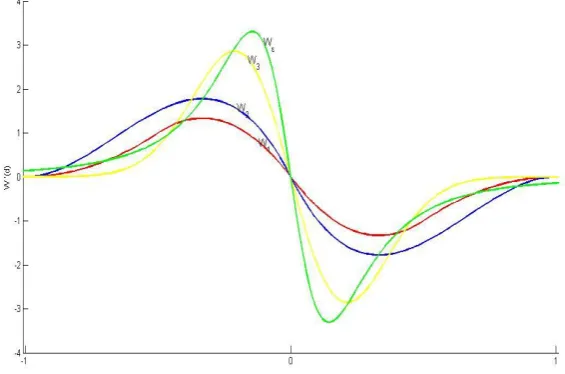
Fig. 3 The first derivatives of weight functions: W1:cubic spline weight function; W2:quartic spline weight
function; W3:exponential weight function; Wε: the new weight function..
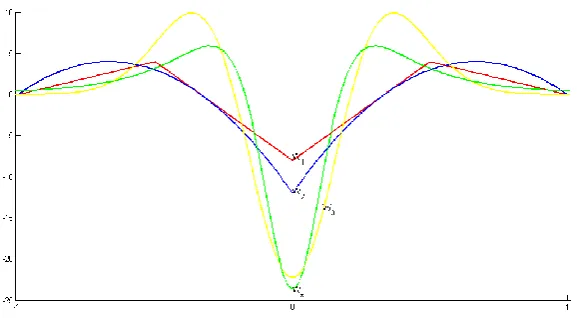
Fig. 4 The second derivatives of weight functions: W1: cubic spline weight function; W2: quartic
spline weight function; W3: exponential weight function; Wε:: the new weight function. Definition 1. We call a weight function W(x, h) is asymptotic unity if the equation as follows holds.
lim
h→0 u Ω ξ W 𝐱 −ξ, h dξ= 1
By tedious but simple integral operation, we find that functionWε(r) is asymptotic unity when ε= O h . It is clear that the property of unity mean the lowest C0consistency. So we can see that the SPH
approximation with weight function Wε(r) possess C0 consistency in asymptotic sense.
In general, SPH does not possess C1 consistency if the weight function satisfies only the properties
(3a)-(3e). Furthermore, the condition that the weight function has to satisfy C1 consistency is given in the following
equation[1].
𝐱 = ξW 𝐱 −ξ, h dξ
Ω
As for the weight functionWε(r) , we can now prove the following Theorem.
Theorem 1. when the parameter ε and dwis proportional to h, the new weight function Wε r possesses C1
consistency in the asymptotic sense, that is, the equation as follows holds.
𝐱 = lim
h→0 Ω ξW 𝐱 −ξ, h dξ
Proof Denoting Iε the first moment of the function and supposing 𝐱 −ξ∈ (ax, bx), where axand bx are two
variables which related to the point 𝐱, then
Iε=1
π
ε x −ξ ε2+ x −ξ 2
dW2
dξ
bx
ax
= −εdW
2
2π
1
ε2+ x −ξ 2
dW2 bx
ax
d x −ξ
2
dW2
= −εdW
2
2π ln ε2d
W 2 + b
x 2
ε2d W 2 + a
x 2
= −c1
h4
2πln
h4+ c 2 2
h4+ c 3
2 → 0 (h → 0)
where c1 is a constant related to ε= O(h2) and dW= O(h),c2, c3∈ (−1,1)and expresses the distance between
points ξand 𝐱.
Last, we analyzes the estimation errors of the SPH interpolation with the weight function Wε r . In [6], the author stated that the errors are proportional to h2 when the weight function is an even function of 𝐱 −ξ
since all odd moments are eliminated. Simply on account of its symmetry of Wε r , so the function can interpolate to order h2
accuracy. Moreover, a weight function is accurate to O(h4
) when it satisfies the equation
𝐱2
W(x, h)dx=0
Following the evaluation of integral in asymptotic unity and C1 consistency, we can find that the
III. CONCLUSIONS
An infinity differentiable weight function, which satisfies the demanded properties, is developed in this paper. The C1 consistency and the O(h4) order estimation errors are also illustrated in the paper.
ACKNOWLEDGMENT
This work is partially support by the Chinese National Science Foundation (N0. 11261040), the Youth Fund of Department of Education of JiangXi Province (N0.GJJ13486), the Doctoral Research Fund of NanChang Hangkong University (No. EA201107261).
REFERENCES
[1]. G. R. Liu, Mesh Free Methods: Moving beyond the finite element methods, 64-142. CRC Press LLC , London (2003)
[2]. [2] R. A. Gingold, J. J. Monaghan, Smoothed particle hydrodynamcis: the-ory and application to non-spherical stars, Mon. Not. R. Astron. Soc., 181,375-389 (1977)
[3]. L. B. Lucy, A numerical approach to the testing of the fission hypothesis,Astron. J., 82, 1013-1024 (1977)
[4]. R. A. Gingold, J. J. Monaghan, Kernel estimates as a basis for general particle methods in hydrodynamics, J. Comput. Phys., 46, 429-453 (1982)
[5]. S. F. Li, W. K. Liu, Meshfree and particle methods and their applications,Appl. Mech. Rev., 55 (1), 1-34 (2002)
[6]. J. J. Monaghan, Smoothed particle hydrodynamics, Annu. Rev. Astron. Astrophys., 30, 543-574 (1992) [7]. I. J. Schoenberg, contributions to the problem of approximation of equidistant data by analytic
functions, Part A, Quart. Appl. Math. 4,45-99, (1946)
[8]. S. Osher, J. A. Sethian, Fronts propagating with curvature dependent speed: Algorithms based on hamilton-jacobi formulations, J. Comput. Phys., 79, 12C49, (1988)
[9]. J. J. Monaghan, J. C. Lattanzio, A refined particle method for astrophysical problems, Astron, Astrophys, 149, 135-143, (1985)