Extracting Multi Band Approach of Acoustic
Vectors Extractors: Using HMM Classifier
Lamkadam Abdelmajid Karim Mohamed
Department of Mathematics & Computer Science Department of Mathematics & Computer Science Faculty of Science, P.O Box 1796, Dhar El Mehraz,
University of Sidi Mohamed Ben Abdellah, Fez, Morocco
LISTA Faculty of Science University Sidi Mohammed Ben Abdellah FEZ
Abstract
Currently, speech recognition not yet optimized, it still has difficulties, in particular when it comes to the recognition in the Arabic language. This complexity is due to the ambiguities contained in the speech signal, and the various obstacles encountered during the processing of the signal. Indeed, a comparative study of extraction methods (LPC, MFCC, PLP, and RASTA) is made, and a review of existing combinations is carried out, to assess the rate of recognition of authentication systems. Our goal is reserved to develop an extractor’s recombination using the HMM classifier, with the aim of reaching a full treatment with a considerable amount of extracted vectors acoustic, in order to improvement the recognition rate of Arabic numerals.
Keywords: Acoustic Vectors Extraction, ACP, DFE, Diagonalization, Discrimination, HMM, LDA, LPC, MFCC, PLP, RASTA, Recognition, Recombination
________________________________________________________________________________________________________
I. INTRODUCTION
The step of extraction of acoustic vectors [5] [6]is fundamental in speech recognition systems. Its role is to provide relevant representation of information to deal with the classification module located downstream in the processing chain. However, the problems of optimal representation of the signal are now far from being resolved.
This work is part of signal processing, specifically in extraction methods [4], and coding of acoustic parameters [8]. However, it seems reasonable to think that coding method is suitable for a particular task which allows improving system performance. The goal is to provide an overview of the extractions technologies of acoustic vectors, and existing or potential combined applications, which are to adapt the feature extraction module to the task in order to process with several algorithms [6] of extraction.
Indeed, several extraction methods arise, including the most famous ones namely LPC [18], MFCC [18], PLP [8] and RASTA [12], these methods have common properties, but each of which is characterized by a special treatment, depending on the context of use, and each has advantages and disadvantages.
Afterwards, we compared different methods [6] [12] according to the aspects they take into account, as we explored their already existing combinations [6]. Since the main idea of multi-stream systems [15] is to combine several sources of information to improve the performance of automatic speech recognition systems.
Hence, to degrade the complexity [4] of the signal, or solve the problems [2] of processing and the influence of the speaker marked at this level, and ameliorate the extraction principle, we proposed and discussed a new Recombination of these extractors; which consists of collecting as much information [8] extracted from the speech signal; in order to add more performance and trust, therefore overcome some obstacles at this stage, with the objective of increasing the resistance and robustness of speech recognition system.
II. PROBLEMS AND OBJECTIVES
Complexity of the speech signal
Here it comes to quote some features [3] and important aspects of the speech signal to highlight the problems [1] during his treatment. In fact the speech signal can be represented by several aspects such as:
Temporal aspect,
Frequency aspect,
Stationary aspect,
Linearity aspect,
Static and dynamic aspect,
Deterministic and random aspect,
So it seems difficult to model and manipulate the speech signal, taking into account its redundancy [2][17], its ambiguities [2], and a very high variability [3] (Intra locator, Inter locator, Environment,…) for the same lexical content.
Indeed the signal of speech [1] is quite a complex mixture of acoustic features [5] (Formants, F0, Energy and Spectrum,...) its traits are even related to perceptual variables [2][3] such as: Pitch, Timbre, Intensity, Speed, Intonation, Noise,...
This leads to different types of disparities. An individual never pronounces a word twice identically; this causes problems at the level of recognition.
Thus, several studies are conducted with the objective of having robust recognition systems to noise, but the signal processing performances are still far from being reached, which makes it a bit complicated treatment, and may be degraded.
Comparison of the Old Extraction Methods
Comparative studies were done before [11] [12], and performed in our work [13], the following table illustrating an overall classification of these different extractors according to the most used criteria in signal processing:
Table - 1
Organization of the extractors according to the evaluation criteria Criterion Temporal
Aspect
Frequency Aspect
Linearity Aspect
Auditory Aspect
Use Filtering
Robust To Noise Extractors
LPC
MFCC
PLP
RASTA
Among these methods several combinations are already completed and tested, so it is difficult to compare the results of all these methods, and those of their combinations [10][15] already exist; since the test databases [13], the classifiers used, annotation and evaluation criteria (Table above) vary considerably from one study to another, so the parameters and characteristics of sound signals used and segmentation methods are also specified.
Functional Diagram of the Extraction Techniques
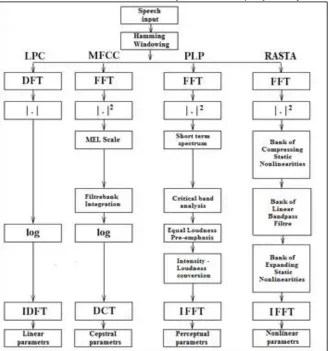
Taking into account the methods [14]of signal processing, and in our comparative study already cited in [13], the Fig.1 show the treatment steps in the form of blocks for different methods, from acquisition and analysis phases up to acoustic parameters:
Combinations Already Completed
Many recombinations were performed in this domain, and summarized in our work [13]. However, we can declare among those presented encouraging results as:
LPCC-MFCC [10], LPC-MFCC [19],
LPC-RASTA [10], LPCC-RASTA [10],
MFCC-RASTA [10], PLP-RASTA [8] [15][10],
LPC Smoothed MFCC [14], MF-PLP[14],
CJPLP-RASTA [8], J-RASTA-PLP [15],
LPC-MFCC-PLP-RASTA [13], using DTW.
Or just additional factors that have been added to the extraction techniques such as:
LPC+ Energy+ ZCR [12], MFCC+ Energy+ ZCR [12], PLP+ Energy+ ZCR [12],
MFCC FM-AM [11], MFCC-MSR [11], PLP6-MSR [11], LPC-MSR [11], PLP-MSR [11],
LPCC-CMS-ACWC [10], MFCC-CMS [10].
These solutions and suggestions led to modest results but not enough ones, the rate of recognition is not yet stabilized and maximized (not reach 100%), since they take some aspects of the speech signal neglecting others.
III. MATERIALS AND METHODOLOGY
Classification Method
To overcome the vagaries of pronunciation, our tests are use the HMM [8] [15] (Hidden Markov Model). Using the acoustic process, it gets a list of phonemes over times (due to FFT). However the words may be pronounced more or less slowly, so the duration of phonemes can vary. The Markov model corrects this detail keeping only the succession of sounds.
Why the choice of HMM?
Using HMM [15] is based on two main tasks are controlled by three types of algorithms:
Assess the likelihood of an observation sequence given the model (Forward algorithm),
Consider all possible paths through the topology of the Markov model (Baum-Welch algorithm),
Find the most likely path (optimum) through the model of an observation sequence given (Viterbi algorithm).
Advantages of HMM
HMM presents several advantages among:
Modularity: HMM can be combined into more HMMs,
Statistics: Introducing random process (a stochastic finite state machine with issuers states),
Transparency: Easy design of architecture, with good design,
Power: More powerful modelling tools (for probabilities) than many statistical methods,
Temporal aspect: Models the temporal evolution, but with limits,
Mathematical analysis of results, and free manipulation of training process.
Acquisition and Configuration of the Database
As our comparative study of acoustic vectors already realized in [13], The Table - 2 collect the acoustic characteristics, to establish the basic references containing Arabic numbers (0 to 9). The corpus record is done for one Moroccan speaker.
Table - 2
Acoustic characteristics of the database speech
Parameter Value
Format Mono, (.wav)
Sampling 8 Khz
Codage 16 Bits
Frames number 50
Recording time 5 secondes/digit
Windowing Hamming
Corpus 10 Arabic numerals
Each number {0 to 9}, constituting the basic test given by a single speaker; tested with other numbers {0 to 9} (forming the base for references), these files are distributed as follows:
Directory "dictionaries" contains 100 files form the references: 10 digits, each digit pronounced 10 times (10 trials).
Directory "tests" contains 10 files form the tests: 1 digit, each digit pronounced once (1 trial).
Approach multi band extraction with HMM classification
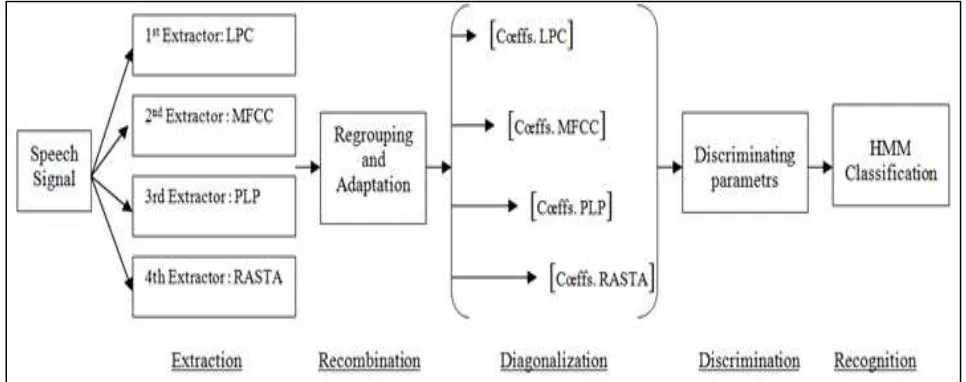
We proceeded to the multi band recombination created in [13] using HMM classifier, which was combined those extractors:
MFCC[19]
PLP[8]
RASTA[12][13]
So we adopted this recombination (Fig.2) so as to condense and concatenate [12] acoustic parameters, ensuring maximum of elements resources, and use for the adaptation and reduction [11] [15] acoustic elements, to have just discriminating parameters.
For reasons of compilation’s optimality [3], adaptability [3] and normalisation [3], it leads to the transfer [6] and transcription [9] parameters, this task is assured by the passage from a redundant representation (Hilbert space) to a reduced space (proper space).
Fig. 2: Recombination multi band Approach (Diagonalization).
This extraction method developed takes in common and at once the following aspects:
Adaptation and discrimination,
HMM advantages.
Temporal and frequency,
Linear and nonlinear,
Psycho acoustic and perceptual.
Performance Space
Representation Space
Indeed, the family on which decomposed the signal not being free, the coefficients of the decomposition are redundant, and the representation is not reduced. However, this representation has the advantage of being more robust and less sensitive to disturbances.
Free space (Base)
As against the representation in a database uses less memory which reduces the computation time as more, especially compiling Matlab is still slow, and time consuming when it comes to huge processing performed on the speech signal.
Discrimination and optimization of acoustic vectors
View this recombination; it has resulted in a considerable amount of acoustic vectors, which affects the time manipulation if used Matlab as a practical tool in this work, so the task of the reduction and discrimination are passed through three methods:
LDA
Indeed, the approach adopted is the principal component analysis LDA [6] (Linear Discriminant Analysis), is a method that provides a linear transformation [6] of the observation space Ep (dim Ep= p), in an acoustic vectors space Eq (dim Eq = q) (q <p).
DFE
So to further enhance and improve the quality of acoustic coefficients, and avoid certain types of noise, the second analysis technique adopted is the DFE [6] (Discriminative Feature Extraction), the base of this method is that extraction and classification steps must be driven simultaneously to improve the system of recognition.
ACP
IV. RESULTS AND DISCUSSION
Detailed results of the extraction methods:
The table - 3 shows the detailed results for the tests of a number from 0 to 9 with a lot of digits in the base {0,1,2, ..., 9}, by the old techniques (LPC, MFCC, and PLP-RASTA) and with the approach recombination, using HMM as classifier.
Table - 3
Recognition detailed report of the Arabic numbers by all methods.
Extractors LPC MFCC PLP-RASTA Approach multi band
(Recombination)
Digits RPF (%) RPF (%) RPF (%) RPF (%)
0 (Siffr)رفص 50 80 80 70
1 (wahed) دحاو 40 70 50 90
2 (Ithnan)نانثإ 50 60 50 70
3 (thalatha) ةثلاث 40 50 60 90
4 (Arbaa)ةعبرا 60 80 70 80
5 (Khamsa) ةسمخ 40 60 60 70
6 (Sitta)ةتس 30 100 80 90
7 (Sabaa)ةعبس 30 50 50 70
8 (Thamania)ةينامث 30 70 70 90
9 (Tisaa)ةعست 20 50 60 100
Average results of recognition for the extraction methods
We collected in the table - 4, the average results of scores for the all methods. Table - 4
Recognition average report by different methods Extractors FPR (%)
LPC 39
MFCC 67
PLP-RASTA 63
Recombination 82
Graphic Results
The Fig.3 and Fig. 4 shows successively the graphic result of Table -3 and Table - 4, comparing the new approach multi band method with the old extractors:
Fig. 3: Detailed result of recognition digits by different methods. Fig. 4: Average result of recognition for different methods.
Comparison and discussion of Different Extraction Methods
Recognition using DTW in our last study [13] is less than using HMM classifier,
Always MFCC shows better recognition (RPF report) as LPC or PLP-RASTA,
The new Recombination shows RPF report is higher than the old methods except for some numbers 0 and 6.
V. CONCLUSION AND PERSPECTIVES
In this manuscript, we became interested in the foundations of the theory of classification of acoustic vectors, and we saw what the theoretical foundations of the various used algorithms.
After, we had to compare these various methods of classification using HMM as a classifier and according to the applied aspects taken into account, and then flew on different recombination systems already made over the last decade, by comparing the results of multiple searches and work in several laboratories using well defined contexts. Indeed, these works on some methods have presented better and more efficient results.
This has enables us to offer and to chart a way out approach to recombination of already existing methods, to increase the level of the comparison and to raise the quality of recognition.
With the completed new approach of recombination, results are significant and encouraging, and as future work we can devise other combinations of extractors work and other hybridizations classifiers.
REFERENCES
[1] Yves Laprie, “Analyse spectrale de la parole,” 16 octobr 2009, Lorrain Laboratory of research in computer science and its applications, CRNS, Nancy.
[2] H. Cerf-Danon, M. El-Bèze, B. Merialdo, “Reconnaissance automatique de la parole,” Volume 4, 1991, Scientific Center IBM, Paris-Cedex 01.
[3] H. Ezzaidi, “Discrimination Parole/Musique et étude de nouveaux paramètres et modèles”, Presnted 4 October 2002 at University of Quebec.
[4] Lise REGNIER, “Détection de la voix chantée dans un morceau de musique,” Master ATIAM 2008, Institute of research and Coordination University Paris
VI Pierre & Marie Curie- Paris.
[5] Hadi Harb, “Classification du signal sonore en vue d’une indexation par le contenu des documents multimédias,” Lab. LIRIS, Central School of Lyon.
December 2003.
[6] Mohamed CHETOUANI, “Codage neuro- prédictif pour l’extraction de caractéristiques de signaux de parole,” Presented 14 December 2004, at University
of Pierre & Marie Curie, France.
[7] Laurent Besacier, “Un modèle parallèle pour la reconnaissance automatique de locuteur,” Presented 17 April 1998, at University of Avignon and the
country of Vaucluse.
[8] H. MISRA, “Multi-stream Processing for Noise Robust Speech Recognition,” Presented 12 May 2006, at Federal Polytechnic school of Lausanne.
[9] Benjamin LECOUTEUX, “Reconnaissance automatique de la parole guidée par des transcriptions a priori,” Presented 5 december 2008, at University of
Avignon and the country of Vaucluse (Laboratoire d’Informatique EA 4128).
[10] Atanas Ouzounov, “Cepstral features and text-dependent speaker Identification- A comparative study,” Cybernetic and information technologies. Volume
10, N°:1 Sofia. 2010.
[11] C.Levy, G.Linarés, P.Nocera, Jean-François Bonastre, “Reconnaissance de chiffres isolés embarquée dans un téléphone portable,” LIA, Avignon, &
Stepmind SA, Cannet. Studies of speech days, SSD (JEP), Fez, Morocco, 2004 (ACTN).
[12] A. Rabaoui, Z. Lachiri et N. Ellouze, “Classification Robuste des Sons Environnementaux : Amélioration des Paramètres et Adaptation des Modèles,”
(TAIMA'07), 21-26 Mai 2007, Hammamet, Tunisia.
[13] A.LAMKADAM, M.KARIM, “Comparative study and improvent of acoustic vectors extractors, multiple streem applied to the recognition of Arabic
numeral,” March 25-26 2015, ISCV 2015, Fez, Morocco.
[14] Reinhold Haeb Umbach, Marco Loog, “An investigation of Cepstral parameterisations for large vocabulary speech recognition,” 6th European Conference
on Speech Communication and Technology (EUROSPEECH’99) Budapest, Hungary, September 5-9, 1999.
[15] Loïc BARRAULT, “Diagnostic pour la combinaison de systèmes de reconnaissance automatique de la parole,” Presented on July 18, 2008, in Avignon
computer lab.
[16] H. Satori, M. Harti, and N. Chenfour, “Système de Reconnaissance Automatique de l’arabe basé sur CMUSphinx,” ISCIII 2007, Agadir, Morocco. (28-30
Mars 2007).
[17] Viet Bac Le, “Reconnaissance automatique de la parole pour des langues peu dotées,” Presented 1st June 2006, at University of J. Fourier Grenoble 1.
[18] F.Bonnet, B.Deveze, M.Fouquin, J.Jeany, “Reconnaissance automatique de la parole, application: calculatrice vocale,” EPITA November 2004.
[19] Urmila Shrawankar, “Techniques for Feature Extraction in Speech Recognition System: A comparative Study,” 6 May 2013, IJCAETS, ISSN 0974-3596,