e-ISSN: 2278-067X, p-ISSN: 2278-800X, www.ijerd.com
Volume 9, Issue 7 (January 2014), PP. 31-39
Video Object Detection and Tracking using kalman filter
and color histogram-based Matching algorithm
S.Saravanan
1, Dr.K.A.Parthasarathy
21Research scholar,CMJ university 2
Principal, Aksheya college of engineering and technology
Abstract:- Video coding is most popular from 1990 starting with video teleconferencing, videophone, videoCD, DTV, HDTV,Multimedia framework,etc.,Video compression becomes most important when considering the space requirement, channel width and the requirement of hardware. However, when multiple objects must be tracked simultaneously, significant computation is often introduced in order to handle occlusion and to calculate the appropriate region correspondence between successive frames.In this paper, we proposed a new algorithm that considers the confusing situations (i.e. inter-object occlusions and separation) when multiple objects are being tracked.This data provides the information for evaluating the motion detection and tracking systems. We demonstrate our techniques using real-world video data to automatically track humans with both inter-object and scene occlusions.Experiments have demonstrated the method is valid and fast when applied on several vid-eos under confusing situations.
Keywords:- Motion detection and tracking; Kalman filter; object tracing; color histogram; video segmentation; video coding
I.
INTRODUCTION
1.1 INTRODUCTION
In computer vision, tracking algorithms have been greatly researched. This is due to the increasing in-terest in tracking applications together with the development of novel techniques aiming to answer the chal-lenges of real-time tracking. However, despite of the potential advancements, it is still challenging to develop a set of standard approaches that are appropriate for all the applications[1].
The general aim behind tracking is to estimate the target objects in video sequences over an interval. However, issues related to tracking undermine the performance and the efficiency of tracking algorithms. The two funda-mental issues are: first, finding the spatial location of target object; second, variations in light and noise due to camera. Further issues may arise when real-time complexities are considered for example, inter- object occlu-sion and separation. Due to these issues, the contextual information of moving object is lost which results in uncertainty during tracking[2,3].
In this paper, we present a new algorithm that considers the confusing situations (i.e. inter-object occlusions and separation) when multiple objects are being tracked. The two approaches are integrated here: first, feature-guided tracking is carried out by modifying the conventional HI technique; whereas, in the second approach, Kalman filter is used for tracking moving objects[4].
1.2 GENERAL TRACING SYSTEM
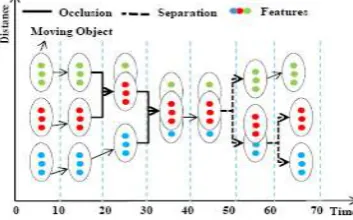
An overview of general tracking system is shown Fig.1.1.This illustration depicts the behavior of the moving objects in real-time where the confusing situations are observed in different intervals, such as inter-object occlusion or separation.
Kalman filters are based on linear dynamical systems discredited in the time domain. They are modeled on a Markov chain built on linear operators perturbed by Gaussian noise[5]. The state of the system is represented as a vector of real numbers. At each discrete time increment, a linear operator is applied to the state to generate the new state, with some noise mixed in, and optionally some information from the controls on the system if they are known. Then, another linear operator mixed with more noise generates the observed outputs from the true ("hidden") state. The Kalman filter may be regarded as analogous to the hidden Markov model, with the key difference that the hidden state variables take values in a continuous space (as opposed to a discrete state space as in the hidden Markov model). Additionally, the hidden Markov model can represent an arbitrary distribution for the next value of the state variables, in contrast to the Gaussian noise model that is used for the Kalman filter. There is a strong duality between the equations of the Kalman Filter and those of the hidden Mar-kov model. A review of this and other models is given in Roweis and Ghahramani (1999)[6,7-8].
II.
EXISTING SYSYTEM FOR TRACKING
2.1 INTRODUCTION
Moving object detection in a video is the process of identifying different object regions which are mov-ing with respect to the background. More specifically, movmov-ing object detection in a video is the process of iden-tifying those objects in the video whose movements will create a dynamic variation in the scene. This can be achieved by two different ways:
1) Motion detection/ change detection, and 2) Motion estimation.
2.2 EXISTING MODEL
Change or motion detection is the process of identifying changed and unchanged regions from the ex-tracted video image frames when the camera is fixed and the objects are moving.
For motion estimation, we compute the motion vectors to estimate the positions of the moving objects from frame to frame. In case of motion estimation, both the objects and the camera may move. After detecting the moving objects from the image frames, it is required to track them. Tracking of a moving object from a video sequence helps in finding the velocity, acceleration, and position of it at different instants of time. In visual sur-veillance, sometimes it may be required to obtain the speed/velocity of a moving vehicle so as to keep an eye on the movement of a particular vehicle[9]. Moving object detection by the process of motion/change detection is again restricted by the requirement of a reference frame (where the object is not present). This can be accom-plished by the use f intensity difference based motion detection algorithm (where objects may move slow or fast).
In the absence of a reference frame, if there is a substantial amount of movement of an object from one frame to another, the object can be tracked exactly by generating a reference frame. However, for those cases where the reference frames are not available and:
1) The objects in the scene do not have a substantial amount of movement from frame to frame, or
2) The objects in a given scene move and stop for some time and move further, identification of moving objects becomes difficult with temporal segmentation.
A robust video image segmentation algorithm is essential to solve these problems. Watershed algo-rithm (a region based approach) is a famous approach in this context. A computationally efficient watershed based spatial segmentation approach was proposed by Salember.
They had used spatial segmentation and temporal segmentation to detect object boundaries. However, this me-thod produced over segmented results and hence could not detect the objects satisfactorily.
Different stochastic model based approaches are available in the literature and they provide better results. MRF model, because of its attribute to model spatial dependency, is proved to be a better model for image segmenta-tion. MRF models and Hidden MRF models have also been used for moving object detection for the last two decades. Since in a video, spatial and temporal coherence is there, MRF model is shown to be a better resi-lience[10]. An early work on MRF based object detection scheme was proposed by Hinds. In order to obtain a smooth transition of segmentation results from frame to frame, temporal constraints was introduced. They had adhered to a multi-resolution approach to reduce the computational.
2.3 LIMITATIONS OF EXISTING SYSTEMS
All the above said methods are constrained to assume the availability of the reference frame. These methods fail to segment the targets in the absence of reference frame and also fail when temporal changes in between the frames are not substantial
III. PROPOSED SYSTEM
In this paper we have performed detection and tracking of video objects in two different domains: 1) Tracking object using Kalman filter; 2) Color histogram-based matching.
3.1 INTRODUCTION
The Kalman filter is a set of mathematical equations that provides an efficient computational (recur-sive) means to estimate the state of a process, in a way that minimizes the mean of the squared error. The filter is very powerful in several aspects: it supports estimations of past, present, and even future states, and it can do so even when the precise nature of the modeled system is unknown[12].
The Kalman filter is a recursive estimator. This means that only the estimated state from the previous time step and the current measurement are needed to compute the estimate for the current state. In contrast to batch
esti-mation techniques, no history of observations and/or estimates is required. In what follows, the notation represents the estimate of at time n given observations up to, and including at time m.The state of the filter is
represented by two variables: , the a posteriori state estimate at time k given observations up to and
includ-ing at time k; , the a posteriori error covariance matrix (a measure of the estimated accuracy of the state estimate)[13].
The Kalman filter has two distinct phases: Predict and Update. The predict phase uses the state estimate from the previous time step to produce an estimate of the state at the current time step. This predicted state esti-mate is also known as the a priori state estiesti-mate because, although it is an estiesti-mate of the state at the current time step, it does not include observation information from the current time step. In the update phase, the current a priori prediction is combined with current observation information to refine the state estimate. This improved estimate is termed the a posteriori state estimate[6,7-8].
PREDICT
Predicted (a priori) state
Xk|k-1 = FkXk-1|k-1 + Bkuk (1)
Predicted (a priori)estimate covariance Pk|k-1 = FkPk-1/k-1Fk
T
+ Qk-1 (2)
UPDATE
Innovation or measurement residual
ỹk= = zk - Hk Xk|k-1 (3)
Innovation (or residual) covariance
Sk = HkPk|k-1 + Rk (4)
The formula for the updated estimate covariance above is only valid for the optimal Kalman gain. Usage of other gain values requires a more complex formula found in the derivations section[6,7,14].
3.2 INVARIANTS
If the model is accurate, and the values for X^0|0 and P0|0 accurately reflect the distribution of the initial state values, then the following invariants are preserved: (all estimates have mean error zero)
E [Xk -X^ k | k] =E[X k -X^ k | k -1] =0 (5)
E[Y~ k] =0 (6)
Where, E[ξ] is the expected value of ξ, and covariance matrices accurately reflect the covariance of estimates
Pk|k = cov(Xk - Xk|k) (7)
Pk|k-1 = cov(Xk - Xk|k-1) (8)
Sk = cov(ỹk) (9)
3.3 EXTENDED KALMAN FILTER
In the extended Kalman filter, (EKF) the state transition and observation models need not be linear functions of the state but may instead be (differentiable) functions.
Xk = f (Xk-1, uk) + wk (10)
Zk = h(Xk) + vk (11)
The function f can be used to compute the predicted state from the previous estimate and similarly the function h can be used to compute the predicted measurement from the predicted state. However, f and h cannot be applied to the covariance directly. Instead a matrix of partial derivatives (the Jacobian) is computed.
Use the Measurement matrix source parameter to specify how to enter the measurement matrix values. If you select Specify via dialog, the Measurement matrix parameter appears in the dialog box. If you select Input port <H>, the H port appears on the block. Use this port to specify your measurement matrix[4,5-6]. Fig 2.8(b) shows how well the Kalman Filter was able to estimate the position, in spite of the large measurement noise.
Fig.3.1: Performance of kalman filter
3.4 TRACKING WITH KALMAN FILTERS
Kalman filter recursively estimates the state of target object; hence in tracking it is a useful technique which predicts the states of the moving objects. In the original paper, a recursive solution for linear optimal fil-tering is proposed by R.E. Kalman in 1960. Since then, an extensive research has been done in various domains such as in navigation systems. Thus, a wide range of literature is available on this subject. But, here we are li-miting our review to Kalman filtering for multi-object tracking. [15].Nguyen used Kalman filter in distributed tracking system for tracking multiple moving people in a room using multiple cameras, whereas Chang used both Bayesian network and Kalman filtering to solve the correspondence problem between multiple objects. In, a video surveillance system is proposed where detection, recognition and tracking of object is carried out. How-ever, multiple objects are tracked by using the c-constant velocity Kalman algorithm. The performance of the approach is dependent on the proposed detection and recognition algorithms. In another work, vector Kalman is proposed for tracking objects. In this paper, separate methods for occlusion and merge are applied to handle the confusing situations. Further states of the corresponding moving objects are searched using spiral searching prior to tracking.
More recently Czyzewski and Dalka used Kalman filter with RGB color-based approach to measure the similarity between moving objects. A threshold is applied to measure the similarity between the detected regions which fails in fully occluded scenarios. Besides, the contextual information of moving objects is lost due to occlusion and separation which results in incorrect correlation. Also, this technique is not suitable under the light variations, fully occluded conditions which affect the object appearance and consequently the histo-gram[16,17-18].
In this paper, a new CWHI based method is employed with Kalman filter. The implementation contains a manager oriented logical framework which handles confusing states, associates CWHI approach with Kalman tracker, and ensure tracking of moving objects during the entire process.
3.5 COLOR HISTOGRAM-BASED TRACKING
Feature-based matching requires good description of the objects which can be used under diverse con-ditions. The commonly used features are shape, color, and temporal (motion) properties[19,20-21]. Each of them has its advantages and disadvantages but the color contains useful information and it is visually perceiva-ble as well. A well-known technique is color-based matching using RGB color histogram. In this approach, col-or histogram technique is exploited to efficiently match objects through indexing. This approach has been used for various tracking algorithms. However, the robustness is affected under the illumination variation[22,23-36]. Color-based tracking methods can also be combined with other techniques. An algorithm is proposed for track-ing objects ustrack-ing both color histogram and particle filtertrack-ing by Liu. Similarly, Limin used color-based Kalman particle filter algorithm for object tracking. For tracking objects in cluttered environments, a hue-saturation his-togram with a particle filter based probabilistic technique is implemented in. Recently, a technique proposed by Jia. For number plate matching of vehicles where Gaussian weights are used to develop the corresponding rela-tionship between the distance of two histograms and their Gaussian relarela-tionship. However, the scope of this technique is limited to the selected application. Also, for tracking high resolution images and scenes which con-tain multiple objects, this technique is not efficient computationally[37,38-41].
pro-pose a novel approach which ensures an efficient and robust tracking with less computational load. The steps in the proposed mechanism are shown in the Figure 2.1.
Fig.3.2: Proposed tracking Mechanism
IV. WORKFLOW OF OUR APPROACH
The key action of our tracking algorithm is to associate every Kalman tracker to its respective moving object coming from moving object extraction process. For this purpose, an intelligent CWHI based algorithm is proposed that assists Kalman tracker during each confusion states.
In this approach, each tracker and moving object pair is associated with manager-oriented logical framework which verifies the status of each moving object during tracking using conventional feature-based technique (i.e. area, boundary and center of gravity) and with the proposed CWHI-based technique. Each mov-ing object can have the followmov-ing status. For example, isNew, isReachAtEnd, is Occluded/ is Occluder, and is Reappear with two integrity constraints (i.e. is Overlap and is Split). The “manager” as a logical controller man-ages the entire tracking process and assists trackers (i.e., Kalman filter). More precisely, it assists Kalman track-er during tracking even if nonlinear conditions (i.e., inttrack-er-object occlusion and separation) occurred. Fig.4.1 illu-strates the workflow of the logical-framework of the proposed research. The “manager” is responsible for han-dling the two cases (i.e. inter-object occlusion and separation) with a “normal case” when no confusion is ob-served. These are:
Fig.4.1: Workflow of our project is showing the implementation
4.1 NORMAL CASE
In the most ideal situation, there is no inter- object occlusion and separation. This is the simplest and ideal scenario in tracking, where a newly detected moving object “isNew” is assigned a new tracker. When the moving object is reached at “isReachAtEnd”, then both the moving object and the tracker is removed.
4.2 INTER-OBJECT OCCLUSION
When moving object (i.e. cars) are overlapped (i.e. temporarily behind another object), the “is Overlap” state is activated. The occluded moving object is tagged as “is occluded” whereas carrier moving object is tagged as “isOccluder”. When “is Overlap” is observed, the multiple trackers refer a group of overlapped mov-ing objects. Thus, for each of the overlapped movmov-ing object, tracker associated with it is updated with the para-meter measurements of the occluder.
4.3 INTER-OBJECT SEPARATION
respec-tive moving objects in the sequence by calculating the “measure of similarity”. Based on the “measure of simi-larity”, a tracker is assigned to its respective moving object under confusions. The result proves that tracking of multiple objects is possible even if non-feasible situation appeared using the proposed intelligent feature-based approach.
V. EXPERIMENTAL RESULTS
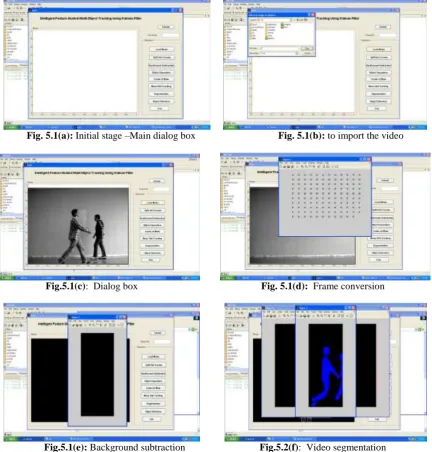
The experimental results are presented which shows the good tracking of moving objects under confu-sions. The performance is satisfactory particularly when the number of moving objects (i.e. cars) is not large and size of the moving object is not too small. The results are presented in Fig.5.1 in which a synthetic video illu-strates the sample situation where three cars are moving separately. It is observed that the paths are continuous when no confusion arises. However, errors are noticed in the trajectories when inter-object occlusion and sepa-ration is initially observed. It is shown that the inter-object occlusion and sepasepa-ration is occurred during irregular interval of time. Each trajectory of moving object is represented by a different color. The graph in Fig.5.2 shows the result of our proposed algorithm CWHI based approach which represents the data association under confu-sion, where the matched moving object have the maximum CWHI-weights.
Fig. 5.1(a): Initial stage –Main dialog box Fig. 5.1(b): to import the video
Fig.5.1(c): Dialog box Fig. 5.1(d): Frame conversion
Fig.5.2 (g): Final stage-Object detection
5.1 RESULTS OF MOVING CARS AND GRAPH
The presented work is based on our initial research analysis on multi-object tracking using stochastic tracking and feature-based matching techniques. These results motivate us to further investigate histogram-based matching techniques together with stochastic tracking algorithms. In particular, more distinctive tech-niques will be exploited such as fuzzy logic or AdaBoost classifier with histogram to handle more complex real-time scenarios. However, the proposed algorithm performs very well on tested videos achieving robust tracking with 97.3% accuracy and 0.07% covariance error.
Fig.5.2(h): Results of moving cars with motion trajectories
5.2 ADVANTAGES
Good tracking of moving objects under confusing situations.
Time consumption is less.
Easy to detect the moving objects in crowded areas.
High performance, Good estimation in tracking multi-objects.
5.3 APPLICATIONS
This project is used to track many moving objects in crowded areas like temples, banks, shops.
Our project has been used extensively for data fusion in navigation.
Our project is also used to track users' heads and limbs in virtual environments.
This project is used as a practical tool for recognition and development in aerospace applications.
VI. CONCLUSION
In this work, a new approach is proposed for tracking multiple moving object in confusing states (i.e. inter-object occlusion and separation) using Kalman filter and CWHI based algorithm. We exploited Kalman filter with proposed CWHI based algorithm.
vid-eos under confusing situations.The proposed algorithm performs very well on tested vidvid-eos achieving robust tracking with 97.3% accuracy and 0.07% covariance error.
REFERENCES
[1]. Wonsang You, M.S.Houari Sabirin, Munchurl Kim, Real-timedetection and tracking of multiple ob-jects with partial decoding inH.264/AVC bit stream domain, Proceedings of SPIE (2009), Vol.7244, 2009.
[2]. http://www.researchgate.net/publication/224226764 [3]. http://www.sribd.com/doc/44778683
[4]. Chris Poppe, Sarah De, Bruyne, Tom Paridaens, Peter Lambert,Rik Van de, Walle, Moving object de-tection in the H.264/AVCcompressed domain for video surveillance application, Journal of Visual Communication and Image Representation, Vol.20,Issue 6, 2009,Page 428.
[5]. C.Solana-Cipres, G.Gernandez-Escribano, L.Rodriguez-Benitez,J.Moreno-Garcia, L.Jimenez-Linares, Real- time moving object segmentation in H.264 compressed domain based on approximate reason-ing , International Journal of Approximate Reasoning,Vol.51,Issue.1, 2009Page 99-114.
[6]. http://www.primidi.com/kalman_filter [7]. http://www.thefullwiki.org/Kalman_filter
[8]. http://dictionary.sensagent.com/kalman+filter/en-en/
[9]. Fei HAO, Zhenjiang MIAO, Ping GUO, Zhan Xu, Real Time Multiple Object Tracking Using Track-ing Matrix, Proceedings of the 2009 International Conference on Computational Science and En-gineering, Vol. 02, 2009.
[10]. B. N. Subudhi and P. K. Nanda, Compound Markov random field model based video segmentation, in
Proc. SPIT-IEEE Colloq. Int. Conf. 2007– 2008, vol. 1. Feb. 2008, pp. 97–102.
[11]. N. Anjum and A. Cavallaro, Multifeature object trajectory clustering for video analysis, IEEE Trans. Circuits Syst. Video Technol., vol. 18, no. 11, Nov. 2008,pp. 1555–1564.
[12]. Francesca Manerba, Jenny Benois-Pineau, Riccardo Leonardi, and Boris Mansencal, Multiple moving object detection for fast video content description in compressed domain, EURASIP J. Adv. Signal Process, vol. 2008, no. 1, 2008,pp. 1–13.
[13]. A. Czyzewski, P. Dalka, Examining Kalman Filters Applied to Tracking Objects in Motion: 9th Inter-national Workshop on Image Analysis for Multimedia Interactive Services, 2008, pp. 175-178.
[14]. http://en.wikipedia.org/wiki/Extended_Kalman-filter
[15]. S. S. Huang and L. Fu, Region-level motion-based background modeling and subtraction using MRFs,
IEEE Trans. Image Process., vol. 16, no. 5, May 2007, pp. 1446–1456.
[16]. M. Ritch and N. Canagarajah, Motion-based video object tracking in the compressed domain, IEEE In-ternational Conference on Image Processing (ICIP) 2007, vol. 6, 2007,pp. VI – 301–VI – 304.
[17]. Zhi Liu, Zhao yang, and Liquan Shen, Moving object segmentation in the H.264 compressed domain,”
Opt. Eng., Vol.46, 2007.
[18]. E. Y. Kim and S. H. Park, Automatic video segmentation using genetic algorithms, Pattern Recogni-tion Lett., vol. 27, no. 11, 2006, pp. 1252–1265.
[19]. http://www.scribd.com/doc/44778683/
[20]. http://chestofbooks.com/new-age/astral-projection/
[21]. http://banque-credit.org/EN/banks/secret-stock exchange.html/
[22]. S. D. Babacan and T. N. Pappas, Spatiotemporal algorithm for joint video segmentation and foreground detection, in Proc. EUSIPCO, Sep.2006, pp. 1–5.
[23]. A. Yilmaz, O. Javed, and M.Shah, Object Tracking: A Survey, ACM Computing Survey, vol.38, no.4, 2006, pp. 1-40.
[24]. W. Jia, H. Zhang, X. He, and Q. Wu. Symmetric colour ratio gradients in spiral architecture: Proceed-ings of the 18th International Conference on Pattern Recognition, 2006.
[25]. T. Yang, S. Z. Li, Q. Pan, and J. Li., Real-time multiple objects tracking with occlusion handling in dynamic scenes: In Proceedings of the 2005 IEEE Computer Society Conference on Computer Vision and Pattern Recognition, 2005, pp. 970– 975.
[26]. R. Collins, Y. Liu, and M. Leordeanu.Online selection of discriminative tracking features, IEEE
Transactions on Pattern Analysis and Machine Intelligence, vol. 27, 2005, pp. 1631–1643. [27]. F. Liu, Q. Liu, H. Lu, Robust Color-Based Tracking: 3rd International Conference on Image and
Graphics, 2004, pp. 132–135.
[28]. X. Limin, Object tracking using color-based Kalman particle filters: IEEE International Conference on Signal Processing, 2004, pp. 679–682.
[30]. R. E. Kalman,A new approach to linear filtering and Prediction Problems, Transactions of the ASME, Journal of Basic Engineering, 1960,vol. 82, pp. 34-45.
[31]. P. S. Maybeck, Stochastic Models Estimation and Control, Academic Press, New York, Vol. 1, 1979. [32]. N. Funk, a Study of the Kalman Filter applied to Visual Tracking, University of Alberta, and Project
for CMPUT 652, 2003.
[33]. N. Nguyen, H. H. Bui, S. Venkatesh, G. West, Multiple camera coordination in a surveillance system,
ACTA Automatica Sinica, vol.29, pp. 408-422, 2003.
[34]. T. H. Chang, S. Gong., Tracking Multiple People with a Multi-Camera System: IEEE Workshop on Multi- Object Tracking, 2001, pp. 19–26.
[35]. H. YU, Y. Wang., F. Kuang, Q. Wan, Multi-moving Targets Detecting and Tracking in a Surveillance System: In Proceeding of the 5th World Congress on Intelligent Control and Automation, China, June, 2004.
[36]. S. A. Vigus, D. R. Bull, C. N. Canagarajah, Video object tracking using region split and merge and a Kalman filter tracking algorithm: In proceedings of ICIP, 2001, pp. 650-653.
[37]. http://www.luckhan.com/kalman-filter.htm [38]. http://i-health.u-aizu.ac.jp/KAF/index.h.
[39]. http://www.fileguru.com/Visual-Kalman-Filter/screenshot [40]. http://encycl.opentopia.com/term/Kalman_filter