ISSN (e): 2250-3021, ISSN (p): 2278-8719
Vol. 06, Issue 12 (Dec. 2016), ||V1|| PP 73-80
RBF Identifier Based Adaptive Sugeno Type FLC for Vector
Controlled Asynchronous Motor
Sami Sit
1, Hasan Riza Ozcalik
2, Erdal Kilic
2, Osman Dogmus
2,
1(Department of Electrical and Electronic Engineering, Hakkari University, Turkey)
2(Department of Electrical Electronics Engineering, K.Maras Sutcu Imam University, Kahramanmaras, Turkey)
Abstract:
-
In this paper a simulation study of Adaptive Sugeno type Fuzzy Logic Control (FLC) for indirect field oriented controlled (IFOC) asynchronous motor drive system have been suggested. The structure of control scheme consists of neural network identifier and FLC. The Radial Basis Function (RBF) neural network parameters are online updated by using back-propagation method. The consequent parameters of FLC are tuned online by using the RBF identified model. Speed control of asynchronous motor performance parameters such as steady state error, rise time, overshoot, undershoot and settling time are obtained for the suggested controller and compared with the conventional PI controller. Simulation results are included to show the suitability, effectiveness and robustness of the adaptive Sugeno type FLC. Adaptive Sugeno type FLC using the Matlab / Simulink simulation software was compared with the results obtained from conventional PI type controller.Keywords: -
Adaptive Sugeno type FLC, Asynchronous Motor, Indirect Field Oriented Control, PI Control, Radial Basis Function.I.
INTRODUCTION
II.
MATHEMATICAL MODEL OF ASYNCHRONOUS MOTOR
Three phase asynchronous motor mathematical model can be expressed by the five order nonlinear state equation in rotating d-q reference frame model as follows [19-21].
Equivalent resistance; 2 2 E m s
R Lr
R R L r (1) Leakage coefficient; 2 2 1 m s L
L L r
(2) 2 1 r r
s d m r m
E s d s s s q r d r q s d
s r
d i L R L
R i L i V
d t L L L
(3) 2 1 - -
-s q m r m
E s q s s s d r q r r d s q
s r r
d i L R L
R i L i V
d t L L L
(4) ( )
r d r m r
s d r d s r r q r r
d R L R
i
d t L L
(5)
- - ( - )
r q r m r
s q r q s r r d r r
d R L R
i
d t L L
(6) 3 2 ( )
r m L
s q r d r q s d r r
d p L B T
i i
d t JL J J
(7)
Slip speed;
R ir q s
s l s r L i
r d s
(8)
Synchronous position;
d t s s
(9)
where, ωs and ωr are the electrical synchronous stator and rotor speed, respectively; Vsd , Vsq, isd , isq ,
ψrd and ψrq are d-q axis stator voltages, d-q axis stator currents and d-q axis rotor fluxes, respectively; Rs and Rr
are the stator and rotor resistances per phase, respectively; Ls, Lr and Lm are stator and rotor main inductances
and the mutual inductance, respectively; p is the number of motor poles, J is the rotor inertia, B is the viscous friction coefficient, TL is the load torque, RE is the equivalent resistance, σ is the leakage coefficient.
III.
DESIGN OF ADAPTIVE SUGENO CONTROLLER BASED ON RBF NEURAL
NETWORK
Sugeno Fuzzy Model (SFM) known as the TSK fuzzy model, is proposed by Takagi, Sugeno and Kang. SFM is a systematic approach to obtain fuzzy rules from a given set of input-output. When we compare Sugeno method with Mamdani method, Sugeno method is faster and easier to implement. Because Sugeno method is used with optimization and adaptive methods, it can be successful in solution problems of nonlinear dynamic systems [22-23, 24].
A typical fuzzy rule of SFM has following form: If x = A and y = B and then z = f ( x, y )
where A and B are input fuzzy sets, z = f(x, y) is a function which provides crisp outputs.
Generally, f(x, y) is depend on x, y and it is a polynomial but f(x, y) can be any function as long as it properly defines the output of a system including specified region by the input rule.
model is a special case of Mamdani model that has one ton of fuzzy set came from the result of each rule. Also this model is considered as a special case of Tsukamoto model which is a fuzzy set defined as step function came from result of central constant factor. Fig.1. shows the fuzzy inference mechanism of the first order Sugeno model. Because each rule is a sharp output, the result is obtained from weighted average of sharp output value. This approach is a method which compensate waste of time and computational load in the rinsing process of Mamdani model.
Moreover, it is an online system model and it is an inference mechanism which is suitable for controller design. In practice, the weighted aggregation operator (z=w1z1+ w2z2) is used instead of the weighted average
operator. Unless sum of activation degree of rules is close to ‗‗1‘‘ (Σwi=1), this simplification process can cause to loss linguistic meaning of membership functions (MF) [25, 26, 27].
Fig. 1: Sugeno Fuzzy Model
If conditions of neighbour MF is enough, Zero-order Sugeno model will be a suitable function depending on their input variables. However in Mamdani model, overlaps in MFs don‘t have good effect on regularity of interpolation [25, 29]. Output of each rule is referred as a linear combination of input. Numerical output value is calculated by taking weight average of sharp output value for each output functions. Results in Sugeno model are discrete digital values determined by (wi) require operator. Merge result for Sugeno method is
obtained by summing weighted results given as the Fig. 1.
m in ( , )
i A i B i
w (10)
i i i i
z p xq yr (11)
The output of adaptive Sugeno controller is given as:
i i i
i i
w z
z
w
(12)
IV.
RBF NEURAL NETWORK
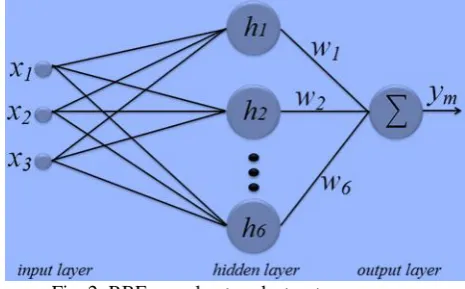
RBF neural network is a kind of neural network that uses radial basis functions as activation function. Due to the good generalization capabilities and a simple network structure, RBF neural network has recently attracted much attention [30]. The RBF neural network is used to identify the system online. RBF neural network has three layers: the input layer, the hidden layer, and the output layer. We supposed that RBF neural network was provided with 3 inputs, 6 hidden layer nodes and one output node. The structure of network is shown in Fig.2.
The output of hidden layer can be defined as follows:
2
2 ( ) e x p
2 j j j X C h x b (13)
where hj denotes the output of the jth node in hidden layer, X is the input vector, Cij=[c1j,
c2j,…cij,…cnj]T is center vector, bj is the basis width parameter of the jth node. cj and bj must be chosen according
to the scope of the input value. The output of network is given as:
1
( ) ( )
J
m j j
j
y k w h x
(14)where wj is weights of the RBF neural network. The performance index function can be presented as:
2 1
( ) [ ( ) ( ) ]
2 m
E t y k y k (15)
where y(k) is ideal output. Based on the gradient descent method, the RBF neural network parameters can be updated as follow:
( 1) ( ) [ ( ) ( ) ] [ ( ) ( 1) ]
j j m j j j
w k w k y k y k h w k w k (16)
2
( )
( 1) ( ) [ ( ) m( )] i ij [ ( ) ( 1)]
ij ij j j ij ij
j
x c
c k c k y k y k h w c k c k
b
(17)
2
3
( 1) ( ) [ ( ) ( ) ] [ ( ) ( 1) ]
j
j j m j j j j
j
x c
b k b k y k y k h w b k b k
b
(17)
where, η (0,1) is a learning rate and (0,1) is momentum factor. The Jacobian matrix algorithm is as follows [16-18]:
1 1 2 1 ( ) ( ) ( ) ( ) m j m j j j j c x y k y k w h
u k u k b
(19)where x1=u(k). The PI controller parameters are adjusted by Jacobian matrix of control plant that is
obtained by RBF neural network identification.
V.
DESIGN OF ADAPTIVE SUGENO CONTROLLER BASED ON RBF NEURAL
NETWORK
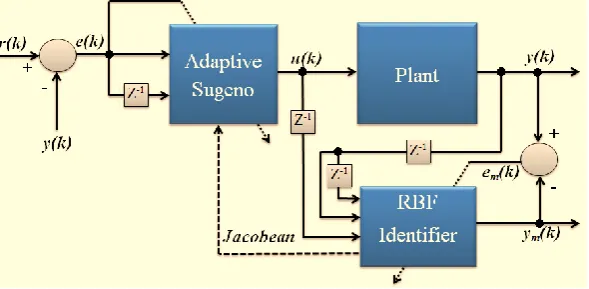
The adaptive Sugeno type controller based on RBF neural network identification is proposed in this paper for speed control of asynchronous motor. The proposed control system structure is as shown in Fig.3.
Fig. 3: Adaptive Sugeno Controller based on RBF neural network
In Fig. 3, r(k) is the reference input, y(k) is the output of plant, ym(k) is the output of RBF identifier,
( ) ( ) ( )
e k r k y k (20)
( ) ( ) ( )
m m
e k y k y k
(21) The input variables of Sugeno controller are chosen as error and change of error. The back-propagation method is used for adjustment of consequent parameter of Sugeno controller.
( )
( 1) ( ) ( ) ( )
( )
i i i
w y k
p k p k e k e k
u k w
(22)( )
( 1) ( ) ( ) ( )
( )
i i i
w y k
q k q k e k e k
u k w
(23)( )
( 1) ( ) ( )
( )
i i i
w y k
r k r k e k
u k w
(24)where, the ( )
( ) y k
u k
can be obtained by identification of RBF neural network.
VI.
SIMULATION RESULTS
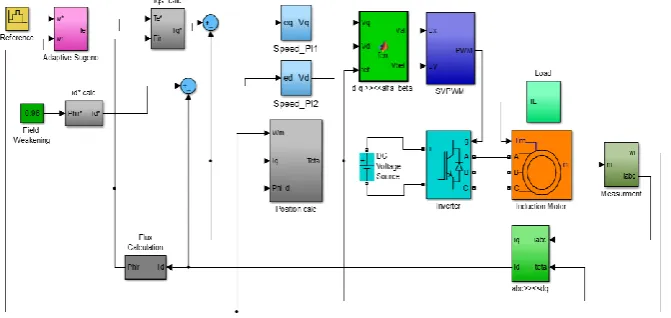
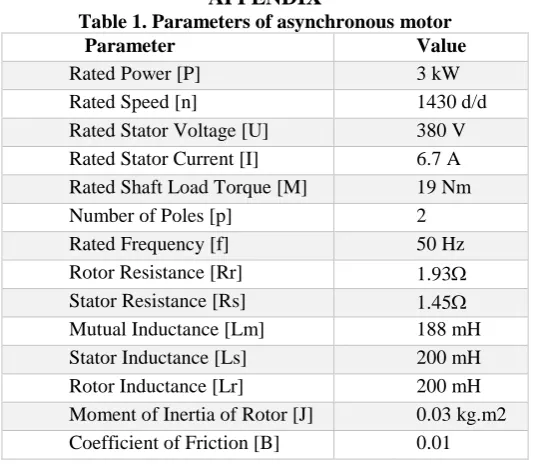
The computer simulation of vector controlled asynchronous motor drive is simulated by using MATLAB/Simulink environment. IFOC and SVPWM have been used in the drive system of asynchronous motor. The performance comparisons between the proposed adaptive Sugeno type FLC based on RBF neural network and the conventional PI controller scheme are shown in Fig.4-7. For both types of controller, the performance of asynchronous motor drive is presented during starting, step change in speed and step change in load. The block diagram of simulation system is shown in Fig.4. The parameters of the asynchronous motor used in simulation research are as in appendix. The PI controller parameters which are tuning by trial-and-error method have been considered with proper coefficients. These parameters are Kp=3, Ki=200 for speed controller,
Kp=50, Ki=100 for torque controller and Kp=20, Ki=800 for flux controller. The inverter switching frequency is
selected to be 5 kHz, a nominal DC link voltage of 550 Vis chosen. The sample interval time Ts =0.02 ms was
used in the simulation.The first order model is used for the reference model of proposed method.
Fig. 4: Simulink model for IFOC asynchronous motor drive system
Fig. 6: Electromagnetic torque response for step change reference speed
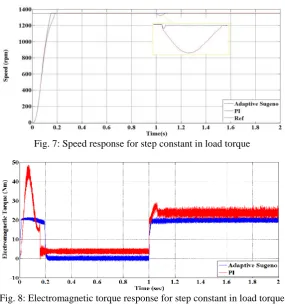
Fig. 7: Speed response for step constant in load torque
Fig. 8: Electromagnetic torque response for step constant in load torque
Fig.7 shows speed response of motor at step constant in load torque at steady state speed of 1350 rpm. When the load torque step change 0 Nm to 19 Nm at t=1.0 sec, in the conventional PI control, the speed drops to 1328 rpm and takes 0.075 sec to recover the speed to rated value and in the proposed control, the speed drops to 1348 rpm and takes 0.015 sec to recover the speed to rated value.
Fig. 8 shows electromagnetic torque response for step constant in load torque. It is seen from the Fig.8 that the adaptive Sugeno type FLC based on RBF neural network has the fast torque response and low torque ripple compared with the conventional PI controller.
VII.
CONCLUSION
APPENDIX
Table 1. Parameters of asynchronous motor
Parameter Value
Rated Power [P] 3 kW
Rated Speed [n] 1430 d/d
Rated Stator Voltage [U] 380 V
Rated Stator Current [I] 6.7 A
Rated Shaft Load Torque [M] 19 Nm
Number of Poles [p] 2
Rated Frequency [f] 50 Hz
Rotor Resistance [Rr] 1.93
Stator Resistance [Rs] 1.45
Mutual Inductance [Lm] 188 mH
Stator Inductance [Ls] 200 mH
Rotor Inductance [Lr] 200 mH
Moment of Inertia of Rotor [J] 0.03 kg.m2
Coefficient of Friction [B] 0.01
Nm.s/rad
REFERENCES
[1] Kilic, E., Ozcalik, H.R., Yilmaz, S., Sit, S., A Comparative Analysis of FLC and ANFIS Controller for
Vector Controlled Induction Motor Drive, 2015 IEEE International Aegean Conference on Electrical Machines & Power Electronics (ACEMP2015), 2-4 September 2015, Side-Antalya, Turkey.
[2] Eltamaly, A.M., Alolah, A.I., Badr, B.M., Fuzzy Controller for Three Phases Induction Motor Drives, 2010 IEEE Autonomous and Intelligent Systems - First International Conference, (AIS 2010), Povoa de Varzim, Portugal, June 21-23, 2010.
[3] Sit, S., Kilic, E., Ozcalik, H.R., Altun, M., Gani, A., Model Reference Adaptive Control based on RBFNN for Speed Control of Induction Motors. International Conference on Natural Science and Engineering (ICNASE‘16), p. 3355-3364. 2016.
[4] Kim, G-S., Ha, I-J., Myoung-Sam KO., Control of Induction Motors for Both High Dynamic
Performance and High Power Efficiency. IEEE Transactions on Industrial Electronics, Vol. 39, No. 4, August 1992.
[5] Sit, S., Ozcalik, HR., Kilic, E., Yilmaz, S., Investigation of Speed Control Method in Three-Phase Induction Motor Drives. International Refereed Journal of Engineering and Sciences, Vol: 2 No: 5, p.125-151. 2015.
[6] Uthra. R., Kalaiarasi, N., Aruntej, P.S., Neural Network Based Vector Control of Inductıon Motor. Computer Science & Information Technology (CS & IT). p. 75–83. 2013,
[7] Niasar, A.H. and Khoei, H.K., Sensorless Direct Power Control of Induction Motor Drive Using Artificial Neural Network. Hindawi Publishing Corporation Advances in Artificial Neural Systems, Volume 2015, Article ID 318589, 9 pages. 2015,
[8] Rani, S. and George, V., Performance of ANN Based Indirect Vector Control Induction Motor Drive. International Journal on Advanced Computer Theory and Engineering (IJACTE). Vol:2, Issue-5, 2319– 2526 pp. 2013,
[9] Sharma, A.K., Gupta, R.A., Srivastava, L., Performance of ANN Based Indirect Vector Control Induction
Motor Drive. Journal of Theoretical and Applied Information Technology (JATIT). 50-57 pp. 2007,
[10] Roslina Mat Ariff, R.M., Hanafi, D., Utomo1, W.M., Sim, S.Y., Bohari, A.A., Zin, N.M., Comparison of
Sugeno-Type and Mamdani-Type Speed Controller for Induction Motor Drive System. 3rd International Conference on Computer Engineering & Mathematical Sciences (ICCEMS 2014), At Langkawi. 2014.
[11] Uddin, M.N., Radwan, T.S., Rahman, M.A., Performances of Fuzzy-Logic-Based Indirect Vector Control
for Induction Motor Drive. IEEE Transactions on Industry Applications, Vol. 38, No. 5,
September/October 2002.
[12] Yousef, H.A., Wahba, M.A., Adaptive Fuzzy Mimo Control of Induction Motors. Expert Systems with
Applications, Vol.36, 4171–4175 pp. 2009.
[13] Ying G.Y., Wang, H., Liu, Y-J., Adaptive Fuzzy Control with Minimal Leaning Parameters for Electric
[14] Bounar, N., Boulkroune, A., Boudjema, F., M'Saad, M., Farza, M., Adaptive Fuzzy Vector Control for A Doubly-Fed Induction Motor. Neurocomputing, Vol.151, p.756–769, 2015.
[15] Wang, S-Y., Tseng, C-L., Chiu, C-J., Design of a Novel Adaptive TSK-Fuzzy Speed Controller for use in
Direct Torque Control Induction Motor Drives. Applied Soft Computing, Vol. 31, 396–404 pp. 2015.
[16] Fu, X., and Li, S., A Novel Neural Network Vector Control Technique for Induction Motor Drive. IEEE
Transactions on Energy Conversion, Vol. 30, No. 4, December 2015. 1428-1437 pp. 2015.
[17] Arulmozhiyal, R., Baskaran, K., Space Vector Pulse Width Modulation Based Speed Control of
Induction Motor using Fuzzy PI Controller. International Journal of Computer and Electrical
Engineering, Vol. 1, No. 1, April 2009, 1793-8198 pp.
[18] Al-Sulaiti, M.K., Abu-Rub, H., Nounou, H., Al-Khuleifi, A., Al-Motawa, A., Iqbali, A., Induction Motor Drive System with Adaptive FLC. 14th IFAC Conference on Methods and Models in Automation and Robotics. Vol.42, No.13, 97-102 pp. 2009,
[19] Ohm, D.Y., Dynamic Model of Induction Motor for Vector Control, Drivetech, Inc, Blacksburg, Virginia.
2000.
[20] Amrane, A., Louri, M., Larabi, A., Hamzaoui, A., A Fuzzy Model Reference Adaptive System Control
for Induction Motor Drives, Proceedings of the 3rd International Conf. on Sys. and Control, Algiers, Algeria. 2013.
[21] Rezgui, S.E., Benalla, H., High Performance Controllers for Speed and Position Induction Motor Drive
using New Reaching Law, International Journal of Instrumentation and Control Systems, Vol.1, No.2. 2011.
[22] Takagi, T., Sugeno, M., ―Fuzzy Identification of Systems and Its Applications to Modeling and Control‖
IEEE Trans. Syst. Man Cybern., Vol: 15, pp. 116–132. 1985.
[23] Wang, H.O., Tanaka, K., Griffin. M., ―Parallel Distributed Compensation of Non-linear Systems by
Takagi–Sugeno Fuzzy Model‖ Proc. 4th IEEE Int. Conf. Fuzzy Syst., Yokohama, pp. 531–538, Japan. 1995.
[24] Precup, R-E., Hellendoorn. H., A Survey on Industrial Applications of Fuzzy Control. Computers in Industry Vol: 62 pp.213–226, 2011.
[25] Lin, S. C. and Chen, Y.Y., ―Design of Adaptive Fuzzy Sliding Mode for Nonlinear System Control,‖
Proc. of IEEE Int. Conf., pp. 35-39. 1994.
[26] Boverie, S., Demaya, B., Ketata, R., Titli, A., Performance Evaluation of Fuzzy Controller, in: Proceedings of IFAC Symposium on Intelligent Components and Instruments for Control Applications (SICICA‘92), Malaga, Spain, pp. 105–110. 1992.
[27] Setnes, M., Complexity Reduction in Fuzzy Systems, Ph.D. thesis, Delft University of Technology, The Netherlands. 2001.
[28] Roubos, J.A., Setnes, M., Abonyi, J., Learning Fuzzy Classification Rules from Labeled Data, Information Sciences, Vol: 150 (1–2) pp.77–93. 2003.
[29] Blazˇicˇ, S., Sˇkrjanc, I., Design and Stability Analysis of Fuzzy Model-based Predictive Control—a Case Study, Journal of Intelligent and Robotic Systems, Vol: 49 (3) pp.279–292. 2007.