ISSN (Online): 2320-9364, ISSN (Print): 2320-9356
www.ijres.org Volume 2 Issue 7 ǁ July. 2014 ǁ PP.19-24
Optimization of Sunflower Methyl Ester and its Tribological
Studies
G Senthil Kumar
1≠, K Balamurugan
2and R Karthi
1,
1≠
Associate Professor, Department of Mechanical Engineering, Bannari Amman Institute of Technology, Sathyamangalam, Erode District, Tamil Nadu.
2Associate Professor, Department of Mechanical Engineering, Institute of Road Transport and Technology, Chithode, Erode District, Tamil Nadu.
1
PG Scholar, Final Year ME CAD/CAM, Bannari Amman Institute of Technology, Sathyamangalam, Erode District, Tamil Nadu.
ABSTRACT: The mineral oil lubricants that are being used these days are not sure of lasting for a long time. There are chances of them being depleted in a short span of years. As a replacement for the mineral oils, various vegetable oils are taken up for research purpose in order to use them as an alternate for the present mineral lubrication. Bio lubricant is produced by transesterification of a triglyceride with methanol in the presence of catalyst to produce fatty acid methyl esters (FAME) and glycerol. The main parameters affecting the transesterification reactions are molar ratio, catalyst type and amount, reaction time, temperature and stirrer speed. In this work, the producrion of sunflower methyl ester (SFME) can be optimized by using Taguchi technique and the properties of a lubricant like viscosity, flash point and fire point is found out, also four ball wear test proved that the SFME+crude SFO proportions produced less wear scar than conventional 2T oil which revealed that the prepared bio lubricant can be used in a commercial vehicle.
Keywords: Taguchi Technique, Bio lubricant, Transesterification, Sunflower Methyl Ester (SFME), Catalyst, Viscosity and Four ball wear test.
I.
INTRODUCTION
World’s crude oil and natural gas reserves are finite and that of India are small. India imports 65-75% of its petroleum fuel needs from Middle-East and other OPEC countries. Therefore, India has to depend upon foreign / imported petroleum fuels for the ever-increasing fuel supply needs. Thus, vegetable oils is used cooking oils and their methyl esters are excellent substitutes that are environmentally sustainable and provide energy security for the future Indian energy requirements sunflower, a member of the compositea family is important oil seed crop worldwide, yielding approximately 45–50% oil. In India, sunflower considered as a non-conventional oilseed crop is generally grown in two seasons, spring and summer. Sunflower oil, widely used in foods for cooking and frying purposes, is also gaining attention as a feed stock for bio lubricant production.
Biodiesel is an alternative fuel made from renewable biological sources such as vegetable oils both edible and non edible oil and animal fat [1]. The Transesterification process is carried out in order to get the pure form of a biodiesl by removing all the free fatty acid [2]. The production of a biodiesel is worthy of continued study and optimization of production procedures because of its environmentally beneficial attributes and its renewable nature [3]. Sunflower is one of the leading oil seed crop, cultivated for the production of oil in the world . The waste sunflower oil used for domestic purposes such as cooking oil had been converted it into biodiesel using an alkali catalysed transesterification process [4]. The yield of biodiesel and oil conversion were mainly affected by operating conditions like catalyst formulation and concentration [5]. The molar ratio (oil to methanol) is considered as a major parameter while removing the FAME in a vegetable oil [6].
compared on a weight basis. The reactions were carried out in Oscillatory Baffled Reactor at room temperature 25° C to 30° C [12].
II.
EXPERIMENTAL SETUP
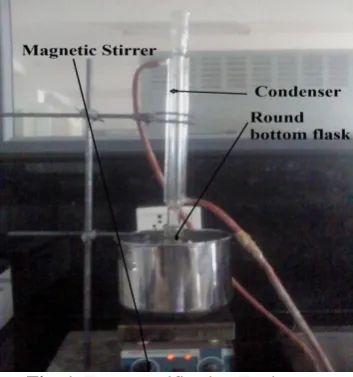
The experimental setup contains a 500 ml two-necked round-bottomed flask was used as a reactor. The flask was placed in a water bath, whose temperature could be controlled within ±2 0C. One of the two side necks was equipped with a condenser and the other was used as a thermo well. A thermometer was placed in the thermo well containing little Sunflower oil for temperature measurement inside the reactor. A magnetic stirrer was used with speed regulator for adjusting and controlling the stirrer speed. The Trans esterification experimental setup for the production of sunflower methyl ester is shown in Figure 1.
Fig. 1. Transesterification Equipment
2.1 TRANSESTERIFICATION PROCESS
Transesterification process is the reaction of triglyceride (fat/oil) with an alcohol in the presence of acidic, alkaline or lipase as a catalyst to form monoalkyl ester that is bio lubricant and glycerol. The presence of strong acid or base accelerates the reaction. The main purpose of transesterification is to reduce the high viscosity of oil. The basic catalyst was dissolved in methanol and added into esterified sunflower oil while heating. This mixture is heated for 60 minutes. Once the reaction is completed, it is allowed to settle for 10-12 hours in a separating funnel. The products formed during the transesterification were sunflower methyl ester and glycerin. The bottom layer consists of glycerin, excess alcohol, catalyst impurities and traces of unreacted oil. The washing is carried out in a separating funnel. The hot water having temperature as that of esterified oil added in a separating funnel. Impurities like dust, carbon content, sulfur content is washed away with water. The separated biolubricant is taken for characterization.
RCOOR' + R"OH↔RCOOR" + R'OH
If methane is used in this process it is called Methanolysis. Methanolysis of glyceride is represented as shown below.
III.
DESIGN OF EXPERIMENT FOR THE OPTIMIZATION OF
TRANSESTERIFICATION OF SUNFLOWER OIL
Table 1. Design of experiment for the production of sunflower methyl ester
Parameters Levels
1 2 3
Mehanol (ml) 90 100 110 Catalyst
Concentartion (g/cc)
0.6242 0.8343 1.0401
Reaction
Temperature (C) 55 60 65
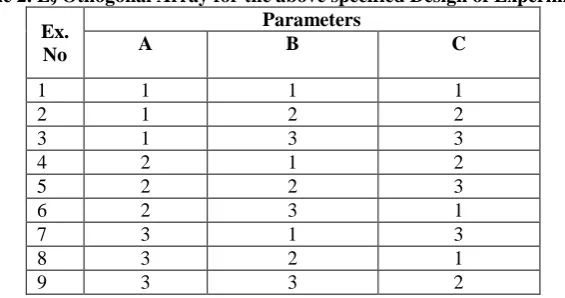
Conducting matrix experiment using orthogonal array is an important technique. It gives more reliable estimates of factor effects with fewer numbers of experiments when compared with the traditional methods such as one factor at a time experiments. The design of experiment via Taguchi method uses a set of orthogonal array for performing of the fewest experiments. Taguchi method involves the determination of large number of experimental situation, described as orthogonal array, to reduce errors and enhance the efficiency and reproducibility of experiments. The columns of an orthogonal array are pair wise orthogonal that is for every pair of column, all combination of factor levels occur at an equal numbers of times. The columns of an orthogonal array represent factors to be studied and the rows represent individual experiments. This study is associated with three factors with each at three levels. The orthogonal array used to find the effects of three parameters namely the molar ratio (oil to methanol), catalyst concentration and stirrer speed on the production of sunflower methyl ester. The three selected parameters at three levels which were experimentally studied are shown in Table 1. Table 2 showed the orthogonal array used to design experiments with three parameters at three levels.
Table 2. L9 Othogonal Array for the above specified Design of Experiments
Ex. No
Parameters
A B C
1 1 1 1
2 1 2 2
3 1 3 3
4 2 1 2
5 2 2 3
6 2 3 1
7 3 1 3
8 3 2 1
9 3 3 2
In this study, Minitab16, which is software for automatic design, was used to analyze the results and optimize the experimental conditions for setting the control variables. In Taguchi method, the signal to noise ratio is used to measure the quality characteristics deviating from the desired value. S/N ratio developed by Taguchi, is a predictor of quality loss after making certain simple adjustments to the product’s function. It isolates the sensitivity of the product’s function to noise factors. The signal to noise ratios (S/N) are log functions of desired output, serve as the objective functions for optimization, help in data analysis and the prediction of the optimum results. There are three forms of signal to noise (S/N) ratio that are common interest for optimization of static problems. Thus, the generic form of S/N ratio becomes,
Larger-the-better expressed as
η = -10Log [mean of sum of squares of reciprocal of measured data]
According to the analysis for the case of larger the better the mean squared deviations (MSD) of each experiment were evaluated using the following equation.
IV.
PHYSICAL TEST
4.1 MEASUREMENT OF VISCOSITY
each other and the transfer of momentum. Lubricating oils viscosity is typically measured and defined in two ways, either based on its kinematic viscosity or its absolute (dynamic) viscosity. Viscosity is an important physical property that must be monitored and controlled carefully because of its impact on the oil and the oil’s impact on equipment life.
Fig. 2. Redwood Viscometer
The Kinematic Viscosity is calculated by using the above formulae, V = A ∗ t −B
t x10
-6 in m2/s Where,
V= kinematic viscosity of the oil in m2/s t = Time of flow in seconds
A & B are instruments constants A=0.26 and B=171.5
4.2 DETERMINATION OF FLASH AND FIRE POINT
The flash point of a volatile material is the lowest temperature at which it can vaporize to form an ignitable mixture in air. The flash point is often used as a descriptive characteristic of liquid fuel, and it is also used to help characterize the fire a hazard of liquids. It refers to both flammable liquids and combustible liquids.
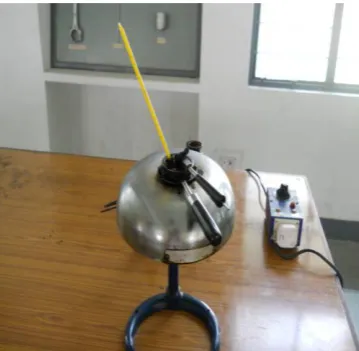
The fire point of a fuel is the temperature at which it will continue to burn for at least 5 seconds after ignition by an open flame. At the flash point, a lower temperature, a substance will ignite briefly, but vapour might not be produced at a rate to sustain the fire. This is a point on which oxidation of a lubricating oil starts. Flash point can be calculated by the Pensky-Marten’s closed cup. A brass test cup is filled with a test specimen and fitted with a cover. The sample is heated and stirred at specified rates depending on what it is that's being tested. An ignition source is directed into the cup at regular intervals with simultaneous interruption of stirring until a flash that spreads throughout the inside of the cup is seen. The corresponding temperature is its flash point and after the flash point the sample which starts to fire at least for 5 seconds, the corresponding temperature is fire point. The sample is heated in a test cup at a slow and constant rate with continuous stirring
V.
Four-Ball Wear Test
One of the most important functions of any motor oil is wear protection. Because motorcycle engines operate under more severe operating conditions than automobiles, the ability of motorcycle oil to deliver adequate wear protection is especially important. The ASTM D-4172 Four-Ball Wear Test is the standard test used to determine a lubricant’s ability to minimize wear in metal-to-metal contact situations. Three steel balls are secured and placed in a triangular pattern within a bath of the test lubricant. With load, speed and temperature kept constant, a fourth ball sits atop the other balls and is rotated and forced into them for 1 hour. Following the test, the lower three balls are inspected for wear scars at the point of contact. The diameters of the wear scars are measured and the results are reported as an average of the three scars. The lower the average wear scar diameter, the better the wear protection properties of the oil.
Fig.4. Four ball wear tester
The Ball wear of SFME+ crude SFO and 2T oil is shown in Figure 5 and 6.
Fig. 5. Ball Wear of SFME+ crude SFO
Fig. 6. Ball Wear of 100% 2T Oil
VI.
RESULT & DISCUSSION
VII.
CONCLUSION
In this study, the optimum parameter for high percentage yield was selected by varying parameters through Taguchi method. With an orthogonal array (L9) a total set of nine experiments having three parameters each at three levels indicated that the Taguchi method was an efficient method of determining the optimum parameters for high percentage yield of Sunflower methyl ester and the ANOVA is used to find out the individual contribution of an each parameter. The four ball wear test result proved that the SFME+crude SFO proportions produced less wear scar than conventional 2T oil which revealed that the prepared bio lubricant can be used in a commercial vehicle.
VIII.
ABBREVIATIONS
FAME - Fatty Acid Methyl Ester
SFME - Sunflower Methyl Ester
SFO - Sunflower oil
ANOVA – Analysis of Variance
S/N Ratio- Signal to Noise ratio
REFERENCES
[1] Prabu and Anand. R, “Production and Application of Biodiesel – A Case Study”, International Journal of Engineering Research and Development (IJERD), Vol.2, pp.28-41, 2012.
[2] Ulf Schuchardta, Ricardo Serchelia, and Rogerio Matheus Vargas, “Transesterification of Vegetable Oils: a Review”, J. Braz. Chem. Soc., Vol. 9, No. 1, pp.199-210, 1998.
[3] Thirumarimurugan. M, Sivakumar. V. M, Merly Xavier. A, Prabhakaran.D, and Kannadasan.T, “Preparation of Biodiesel from Sunflower Oil by Transesterification”, International Journal of Bioscience, Biochemistry and Bioinformatics, Vol. 2, No. 6, pp.441-444, 2012.
[4] Singh. A, He. B, Thompson. J, Van Gerpen. J, “Process Optimization of Biodiesel production using Alkaline Catalysts”, Applied Engineering in Agriculture, Vol. 22, pp.597-600, 2011.
[5] Chongkhong. S, Tongurai. C, Chetpattananondh. P and Bunyakan. C, “Biodiesel production by Esterification of palm fatty acid distillate”, Biomass and Bioenergy, Vol.38, pp.563-568, 2007.
[6] Refaat. A. A, Attia. N. K, Sibak. H. A, Sheltawy. S. E and Eidiwani. G. I, “Production optimization and quality assessment of biodiesel from waste vegetable oil”, International Journal of Environmental Sciences and Technology (IJEST), Vol.5, pp.75-82,2008.
[7] Hulya Karabas, “Biodiesel production from crude acorn (Quercusfrainetto L.) Kernel oil: An optimisation process using the Taguchi method”, Renewable Energy, Vol.53, pp.384-388, 2013.
[8] George Anastopoulos, Ypatia Zannikou, Stamoulis Stournas and Stamatis Kalligeros, “Transesterification of Vegetable Oils with Ethanol and Characterization of the Key Fuel Properties of Ethyl Esters”, Energies, Vol.2, pp.362-376, 2009.
[9] Wu Xuan, Leung. Y. C and Dennis, “Orthogonal array design for biodiesel production optimization - using ultrasonic-assisted transesterification of Camelina sativa L. Crantz oil”, Bioenergy Technology, Vol.1, pp.79-86, 2011.
[10] Minodora Leca, Luminiţa Tcacenco, Marin Micutz1 and Teodora Staicu, “Optimization of Biodiesel production by Transesterification of vegetable oils using Lipases”, Romanian Biotechnological Letters, Vol. 15, No. 5, pp.5618-5630, 2010. [11] Sun Tae Kim, Bongbeen Yim and Youngtaek Park, “Application of Taguchi Experimental Design for the Optimization of
Effective Parameters on the Rapeseed Methyl Ester Production”, Environmental Engineering Research, Vol.3, pp.129-134, 2010.