Summary
Objectives
This study aimed to assess the psychometric properties of the Italian versions of the Devaluation of Consumers Scale (DCS) and the Devaluation of Consumer Families Scale (DCFS), two short-scales examining public stigma towards people with men-tal disorders and their relatives.
Methods
The scales were administered to 117 individuals with a clini-cal diagnosis of affective or non-affective psychoses (ICD 10 criteria F20-29, F30-33). Translation procedures were carried out according to accepted standards. Internal reliability was as-sessed using Cronbach’s alpha coefficient. Convergent validity was evaluated in terms of correlation with the Global Function-ing Scale (GAF) and with the Questionnaire on Users’ Opinions (QUO). Known-group validity was assessed comparing patients at first-episode of psychosis and patients with a history of psy-chosis of at least 3 years (long-term psypsy-chosis).
Results
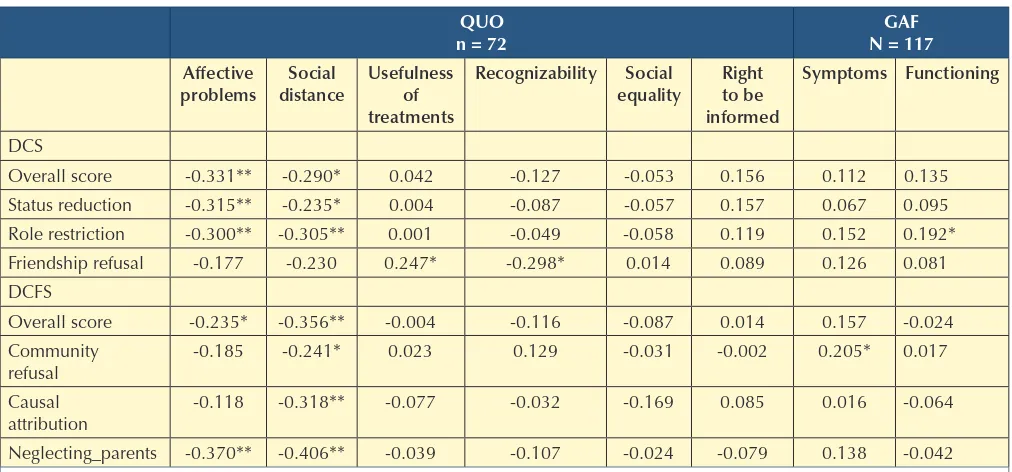
The overall Cronbach’s alpha value was 0.85 for DCS and 0.81 for DCFS; subscales’ alpha values ranged from 0.80 to 0.55 for DCS, and from 0.68 to 0.55 for DCFS. Negative correlations were found between the Italian DCS and the DCFS total score and the QUO affective problems (DCS -0.33; DCFS -0.235) and social distance subscales (DCS -0.290; DCFS -0.356). Moreo-ver, the GAF positively correlated with some of the DCS and DCFS subscales. Patients with long-term psychosis had higher scores in most DCS and DCFS subscales.
Conclusion
The Italian translation of DCF and DCFS showed good internal consistency, known-group validity, and convergent validity. These psychometric properties support their application in routine clini-cal practice in Italy as well as their use in international studies.
Keywords
Perceived stigma • Stereotype awareness • Devaluation of Consumers Scale • Devaluation of Consumer Families Scale • Questionnaire on Us-ers’ Opinions
Validation of the Italian version of the Devaluation Consumers’ Scale
and the Devaluation Consumers Families Scale
L. Sideli1*, A. Mulè2, C. La Cascia1,2, M.V. Barone1, F. Seminerio1, C. Sartorio1, I. Tarricone3, M. Braca3, L. Magliano4,
A. Francomano1,2, M. Inguglia5, R. D’Agostino5, G.Vassallo5, D. La Barbera1,2
1 Department of Experimental Biomedicine and Clinical Neuroscience (BioNec), Section of Psychiatry, University of Palermo; 2 University Hospital
“Paolo Giaccone”, Psychiatry Unit, Palermo; 3 Bologna Transcultural Psychosomatic Team, Department of Medical and Surgical Science, University
of Bologna; 4 Department of Psychology, University of Naples SUN, Caserta; 5 Department of Mental health, Pathological addictions, and Child
and Adolescent Neuropsychiatry, Azienda Sanitaria Provinciale di Palermo, Palermo
Correspondence
Lucia Sideli, Department of Experimental Biomedicine and Clinical Neuroscience (BioNec), Section of Psychiatry, via G. La Loggia 1, 90127 Palermo, Italy • Tel. 091/6555166 • Fax 091/6555165 • E-mail: [email protected]
Introduction
Stigma is a factor associated with negative outcomes in se-vere mental disorders, especially in schizophrenia 1. Stigma
negatively affects the quality of life of people with mental disorders and their caregivers, as well as the short and long-term clinical course of psychotic disorders. Examples of the negative impact of stigma are delays in care seeking and treatment 2, poor therapeutic adherence 3, low social
inte-gration 4, and difficulties in finding or keeping a job 5. These
negative effects, taken together, result in an increased risk for clinical relapse and poor functional recovery.
Stigma may be expressed through three different levels: stereotyping (cognitions, beliefs), prejudice (emotions, feelings), and discrimination (behaviors). Furthermore, stigma is classified in three main types: public stigma,
self-stigma, and experienced stigma. Public stigma refers to what the society or the majority of lay people believe about the person with mental health problems; self-stig-ma expresses the degree of internalization of the stigself-stig-ma by the victim; experienced stigma corresponds to objec-tive discriminations 6. According to the “modified
labe-ling theory” 7, receiving a diagnostic label of
schizophre-nia increases the perception of public negative attitudes towards individuals affected with mental disorders (pub-lic stigma). In people with mental disorders, this “stereo-type awareness” may lead to internalize such negative at-titudes and to anticipate possible acts of discrimination 8.
cal diagnosis of schizophrenia (ICD 10 criteria F20), oth-er non-affective psychoses (ICD 10 F21-29), or affective psychoses (F30-33) 26, attending mental health services
of Palermo (Southern Italy) in the period 2010-2015. In-clusion criteria were: 1. age between 18 and 65 years; 2. being resident in Palermo; 3. diagnosis of psychotic disorders according to ICD-10 F20-29 or F30-33 crite-ria. Exclusion criteria were: 1. psychosis due to organic causes; 2. presence of severe learning disability.
Ethical approval was obtained for the EUGEI study by the ethical committee of the University Hospital “P. Giac-cone” of Palermo. Potential participants were informed about the study aims and procedures, data anonymi-zation (carried out by assigning to each participants a unique number key), and the possibility to withdraw from the study in any moment. Participants that agreed to par-ticipate in the study signed an informed consent and then completed the Devaluation of Consumers scale (DCS), the Devaluation of Consumer Families scale (DCFS), and the Questionnaire on Users’ Opinions (QUO) about schizophrenia. Main socio-demographic characteristics were also collected by an ad hoc schedule. Symptom and disability severity were registered using the Global As-sessment of Functioning (GAF) on the basis of clinical records and information provided by care coordinators.
Measures
The Devaluation of Consumers Scale (DCS)
The Devaluation of Consumers Scale (DCS) is an eight-item scale assessing stereotype awareness by patients with severe mental disorders 24-27. Factorial analysis
led to the identification of the following three-factor solution (total explained percentage: 68.6%): factor 1 “status reduction”, describes the altered patients’ sta-tus in society (five items, 28.7% of variance); factor 2 “role restriction”, concerns a pessimistic view related to the possibility of finding a job or getting married (two items, 23.5%); and factor 3 “friendship refusal”, accounts for difficulties in establishing friendships (one item, 16.4%). Internal consistence of the DCS was es-timated as 0.82 25.
The Devaluation of Consumers Families Scale (DCFS) The Devaluation of Consumers Families Scale (DCFS) complements the DCS by assessing the perceived de-valuation or discrimination towards family members of patients with severe mental disorders 24-26. The seven
items of the DCFS were grouped in three factors, ex-plaining 71% of the variance. The factors were: fac-tor 1 “community rejection”, describes the tendency to avoid friendships and other forms of social contact stigma, are associated with poor therapeutic alliance in
patients with psychotic spectrum disorders 9.
Compared to stigma towards people with common and socially accepted mental disorders, such as depres-sion 10 11, public attitudes are particularly negative
to-wards People With Schizophrenia (PWS). A large number of studies confirmed that PWS are often viewed as dan-gerous, unpredictable, and socially impaired. These at-titudes have been found associated with desire for social distance and prognostic pessimism 12-14.
Stigma not only invests people diagnosed with mental disorders, but also those around them, primarily their caregivers. The so-called “affiliate stigma” or “courtesy stigma” 6 15 refers to the process of being stigmatized
be-cause of an association with a stigmatized person. Affiliate stigma is associated with increased family burden, as well as with stereotype awareness and increased symptoms in patients 16 17, suggesting pervasive effects of the
stigmatiza-tion process both on PWS and caregivers’ quality of life.
Given the relevance of stigma in many domains of the life of people with severe mental disorders, it is worthwhile measuring stigma – by means of valid and reliable assess-ment tools – as a first step to promote sensitization and educational programs for the public. Some international assessment scales on stigma have been recently validat-ed in Italian, such as the Attribution Questionnaire-27/ AQ-27 18, whereas other instruments, as the
Question-naire on Users’ Opinions/QUO 19 and the Questionnaire
on Families’ Opinions/QFO 20 have been originally
de-veloped in Italy and subsequently used in different popu-lations 21-23.
Within the EUGEI project, the most recent epidemiologi-cal European survey on psychotic disorders 24, stereotype
awareness towards PWS and their family members were assessed using the Devaluation of Consumers Scale (DCS) and the Devaluation of Consumer Families Scale (DCFS)25.
These short-scales stand out for their convenience of ad-ministration – since they require few minutes to be com-pleted – the possibility of evaluating public stigma towards family members – not covered by other scales – and the ability to evaluate various features of public stigma to-wards mental disorders, such as social status reduction, friendship refusal, or community rejection. In this study, we report data on the assessment of the psychometric properties of the Italian versions of the DCS and the DCFS, both administered to a sample of 117 PWS.
Method
Participants and procedure
clini-and lower scores indicate greater disability/more severe symptoms 29.
Data Analysis
Internal reliability was assessed using Cronbach’s alpha coefficient on total scales and related subscales. Con-vergent validity was evaluated in terms of correlation with the GAF and, only for the subgroup of patients with long-term psychosis (n = 72), with the QUO; cor-relations were calculated using Pearson’s r coefficient. Known-group validity was assessed by comparing pa-tients with first-episode of psychosis (FEP) with papa-tients affected by long-term psychosis (LTP). Differences be-tween groups were tested by performing Student’s t test. Statistical significance was set at p < 0.05. Analyses were performed using SPSS version 21.
Results
Sample
A total of 117 people with psychosis were assessed. Par-ticipants had a mean age of 36.32 (sd 12.33) and were mostly males (75, 64.1%), with high level of education (high school degree 53 (45.3%), middle school degree 45 (38.5%), primary school degree 19 (16.2%), and single (99, 84.6%).
Seventy-two out of 117 participants had a clinical his-tory of at least 3 years of psychosis (mean illness dura-tion 16.64 years, sd 9.93), while 45 participants were at their first-episode of psychosis (i.e. presenting for the first time to psychiatric services for psychotic symptoms). In both groups, most participants were males (patients with FEP 25 [55.6%] vs patients with long-term psycho-sis 50 [69.4%], χ2 = 2.321, p= 0.128), and with high
level of education (middle school degree 20 [44.4%]
vs 25 [34.7%] or high school degree 20 [44.4%] vs 33
[45.8%], χ2 = 1.877, p = 0.391). The two groups were
dif-ferent in their mean age (mean 29.98 [sd 11.38] vs 40.28 [11.26], t = -4.795, p < 0.001) and marital status (single 32 [71.1%] vs 67 [93.1%], χ2 = 10.244, p = 0.001).
Internal reliability
As reported in Table I, Italian DCS had moderate-high in-ternal reliability both for the total scale (alpha 0.85) and the subscales (status reduction alpha 0.80; role restriction alpha 0.57). Similar level of internal reliability was found for the Italian DCFS (Table I).
Validity
Analysis of convergent validity showed that the GAF functioning subscale positively correlated with the DCS with caregivers of patients with psychiatric disorders
(four items, 32.9% of variance); factor 2 “causal attri-bution”, is related to the tendency to treat some people in a different way because of the disease of their family member, and to blame parents for the mental illness of their children (two items, 20.9%); and factor 3 “uncar-ing parents” expresses the view that children affected by mental disorders had received inadequate paren-tal care (one item, 17.2%). The internal consistence of DCFS was estimated 0.77.
The DCS and the DCFS were forward-translated by an Italian psychiatrist and an Italian clinical psychologist, who agreed on the Italian translations of the two scales. Subsequently, the two translations were reviewed and approved by a committee of the EU-GEI research pro-ject coordination, including an Italian mother tongue researcher with expertise in psychosis. This was con-sistent with established methods for translating health status instruments 28.
The Questionnaire on Users’ Opinions
The Questionnaire on Users’ Opinions (QUO) assesses users’ view of their own mental disorder. QUO includes 24 items on the psychosocial impact of severe mental disorders, grouped in the following six subscales: “af-fective problems” (7 items, Cronbach’s alpha 0.73) re-ferring to patients’ difficulties in establishing relation-ships, friendrelation-ships, and set up their own family; “social distance” (5 items, alpha 0.74), concerning perceived distance, lack of understanding, and fear of “the oth-ers” towards PWS; “usefulness of drug and psychoso-cial treatments” (3 items, alpha 0.56), accounting for benefits and side effects of psychiatric interventions; “right to be informed” (3 items, alpha 0.58) referring to users’ right to be informed about own mental problem and treatments; “recognizability” (2 items, alpha 0.56) examining the belief that PWS are easily identifiable because of their symptoms and drugs’ side effects; and “social equality” (4 items, alpha 0.55), exploring re-spondent’s views of discriminations in social and work opportunities. Factor analysis identified two factors, the former accounting for social and affective impact of se-vere mental disorders (33.3%) and the latter being re-lated to clinical outcome and usefulness of treatments for schizophrenia (19.5%) 19.
Global Assessment of Functioning
role restriction subscale, while the GAF symptom sub-scale positively correlated with the DCFS community re-fusal subscale.
Negative correlations were found between the DCS and the DCFS total score and the QUO affective problems and social distance subscales. Moreover, the DCS status reduction and the DCS role restriction subscales nega-tively correlated with the QUO affective difficulties and social distance subscales, while the DCS friendship refus-al correlated with the QUO usefulness of treatments and recognizability subscales. Finally, the DCFS community
refusal and causal attribution subscales negatively cor-related with the QUO social distance subscale, whereas the DFCS neglecting parents correlated with the QUO af-fective problems and social distance subscales (Table II). Comparisons between the two groups (patients with FEP
vs patients with LTP) revealed that participants with
long-term psychosis had higher scores than participants at ear-ly stage of psychosis in all DCS and DCFS subscales, ex-cept for DCS status reduction and friendship refusal and the DCFS causal attribution subscales (Table III).
Discussion
The results of this study confirm that the Italian version of the DCS and DCFS are valid and reliable assessment tools to explore public stigma towards PWS and their relatives. The Italian DCS had an acceptable to good internal reli-ability for total scale (Cronbach’s alpha 0.85), and sub-scales (status reduction: alpha 0.80; role restriction: al-pha 0.57). Similarly, adequate level of internal reliability was found for the Italian DCFS, whose Cronbach’s alphas were respectively 0.81 for total scale and 0.68 and 0.56 for subscales. These values are consistent with those re-ported in the original version 25, where internal
consist-ency of the DCS and the DCFS were, respectively, 0.82 and 0.71.
The validity of the Italian DCS and DCFS was
investi-TABLE I.
Reliability of the Italian Devaluation Consumers’ Scale and the Italian Devaluation Consumers’ Family Scale
Items Cronbach’s alpha
DCS Total Score Status reduction Role restriction DCFS
Total Score Community refusal Causal attribution
8 5 2
7 4 2
0.851 0.806 0.558
0.808 0.685 0.558
DCS: Devaluation Consumers’ Scale; DCFS: Devaluation Consumers’ Families Scale.
TABLE II.
Convergent validity of Italian Devaluation Consumers’ Scale and the Italian Devaluation Consumers’ Families Scale.
QUO n = 72
GAF N = 117
Affective
problems distanceSocial Usefulness of treatments
Recognizability Social
equality Right to be informed
Symptoms Functioning
DCS
Overall score -0.331** -0.290* 0.042 -0.127 -0.053 0.156 0.112 0.135
Status reduction -0.315** -0.235* 0.004 -0.087 -0.057 0.157 0.067 0.095
Role restriction -0.300** -0.305** 0.001 -0.049 -0.058 0.119 0.152 0.192*
Friendship refusal -0.177 -0.230 0.247* -0.298* 0.014 0.089 0.126 0.081
DCFS
Overall score -0.235* -0.356** -0.004 -0.116 -0.087 0.014 0.157 -0.024
Community refusal
-0.185 -0.241* 0.023 0.129 -0.031 -0.002 0.205* 0.017
Causal attribution
-0.118 -0.318** -0.077 -0.032 -0.169 0.085 0.016 -0.064
Neglecting_parents -0.370** -0.406** -0.039 -0.107 -0.024 -0.079 0.138 -0.042
Pearson r correlations. ** Correlations statistically significant at p < 0.01 ; * Correlations statistically significant at p <. 0.05.
gated as known-group validity and as convergent valid-ity. The higher mean scores of DCS and DCFS found in patients with long-term disease compared to those at their first-episode of psychosis (see Table 3) could be related to the greater experience of public stigma in the former. This is partially in line with a previous study re-porting association between the DCS score and age 16. It
is likely that the higher mean score found among long-term psychosis participants is attributable to a deeper internalization of negative stereotype, as well as to par-ticipants’ higher insight about their own condition, and to a greater likelihood of having experienced discrimi-nation and marginalization 30 31. Nevertheless, the lack
of significant differences in the DCS status reduction and friendship refusal and the DCFS causal attribution suggests that these dimensions of public stigma might be perceived by PWS since the onset of the disease and do not vary substantially over time.
Both DCS and DCFS showed significant correlations with the QUO. In particular, the DCS status reduction and the DCS role restriction subscales positively correlated with affective difficulties and social distance as measured by QUO, while the DCS friendship refusal subscale nega-tively correlated with the QUO social recognizability subscale. This is consistent with previous studies on clini-cal samples of people with severe mental disorders show-ing that public stigma was strongly related to alienation, social withdrawal, and stereotypes endorsement 32 33.
Moreover, we found that the DCS friendship refusal sub-scale positively correlated with the QUO usefulness of treatments subscale, suggesting that perceived public at-titude towards mental disorders is related with
treatment-seeking behaviors. This association corroborates findings reported by Jennings et al. 34 on a large sample of college
students. A further result concerns the negative correla-tions of all DCFS subscales with the QUO social distance subscale, pointing out at the effects of courtesy stigma on social relationships.
DCS and DCFS showed few correlations with the GAF subscales. Specifically, the DCS role restriction negatively correlated with the GAF functioning scale. This result is in line with previous studies showing a relationship between public stigma and functional outcome 35-37. It is likely that
psychosocial functioning and stereotype awareness are part of a vicious circle, in which worst functioning leads to greater discrimination in employment and social con-texts, while perceived devaluation prevents PWS from looking for a job and intimate relationship, even in ab-sence of experience of discrimination 24 38. This study also
found a positive relationship between symptoms severity (GAF symptoms scale) and perceived marginalization of the families (DCFS community refusal), which replicates the findings of previous research on the link between courtesy stigma and psychopathology 15 16. These findings
suggest that the course of severe mental disorders is re-lated not only to perceived patient’s devaluation but also to family devaluation, a condition further contributing to self-defeat and isolation of people with psychosis 39 40.
According to a cognitive model of psychosis, discrimina-tion and stigma, along with other psychosocial stressors (i.e. childhood adversities, see 41 42), might increase the
risk for psychotic symptoms by promoting negative rep-resentations of the self and the others, favoring reason-ing biases, and increasreason-ing the sensitivity of the
biologi-TABLE III.
Known group validity of Italian Devaluation Consumers’ Scale and the Italian Devaluation Consumers’ Families Scale.
Patients at their FEP
n = 45 Patients with LTPn = 72 Students’ t p value
DCS Mean (SD) Mean (SD)
Overall score 2.35 (0.62) 2.65 (0.62) -2.539 0.012
Status reduction 2.42 (0.70) 2.66 (0.66) -1.865 0.065
Role restriction 2.24 (0.67) 2.72 (0.76) -3.429 0.001
Friendship refusal 2.18 (0.89) 2.44 (0.90) -1.559 0.122
DCFS
Overall score 1.98 (0.62) 2.37 (0.58) -3.375 0.001
Community refusal 1.97 (0.60) 2.43 (0.60) -3.863 <0.001
Causal attribution 2.10 (0.78) 2.31 (0.75) -1.415 0.160
Neglecting_parents 1.75 (0.90) 2.24 (0.93) -2.688 0.008
5 Link BG, Mirotznik J, Cullen FT. The effectiveness of stigma coping orientations: can negative consequences of mental illness labeling be avoided? J Health Soc Behav
1991;32:302-20.
6 Goffman E. Stigma: notes on the management of spoiled identity. 1st edn. New York: Simon & Schuster 1963, p. 153. 7 Link BG, Cullen FT, Struening E, et al. A modified labeling theory approach to mental disorders: an empirical assess-ment. Am Sociol Rev 1989;54:400-23.
8 Corrigan P, Watson A, Barr L. The self-stigma of mental ill-ness: implications for self-esteem and self-efficacy. J Soc Clin
2006;25:875-84.
9 Niolu C, Barone Y, Bianciardi E, et al. Predictors of poor adherence to treatment in inpatients with bipolar and psy-chotic spectrum disorders. Riv Psichiatr 2015;50:285-94. 10 Latalova K, Kamaradova D, Prasko J. Perspectives on
per-ceived stigma and self-stigma in adult male patients with depression. Neuropsychiatr Dis Treat 2014;10:1399-405. 11 Kelly CM, Jorm AF. Stigma and mood disorders. Curr Opin
Psychiatry 2007;20:13-6.
12 Mestdagh A, Hansen B. REVIEW: Stigma in patients with schizophrenia receiving community mental health care: a review of qualitative studies. Soc Psychiatry Psychiatr
Epide-miol 2014;49:79-87.
13 Magliano L, Fiorillo A, De Rosa C, et al. Beliefs about schizophrenia in Italy: a comparative nationwide survey of the general public, mental health professionals, and patients’ relatives. Can J Psychiatry 2004;49:322-30.
14 Magliano L, Read J, Rega S, et al. The influence of causal explanations and diagnostic labeling on medical students’ views of schizophrenia. Acad Med 2011;1155-62.
15 Mak WWS, Cheung RYM. Affiliate stigma among caregivers of people with intellectual disability or mental illness. J Appl
Res Intellect Disabil 2008;21:532-45.
16 Van Zels C, Van Nierop M, Oorschot M, et al. Stereotype awareness, self-esteem and psychopathology in people with psychosis. Mechelli A, editor. PLoS One 2014;9:e88586. 17 Phelan JC, Bromet EJ, Link BG. Psychiatric illness and family
stigma. Schizophr Bull 1998;24:115-26.
18 Pingani L, Forghieri M, Ferrari S, et al. Stigma and discrimi-nation toward mental illness: translation and validation of the Italian version of the attribution questionnaire-27 (AQ-27-I). Soc Psychiatry Psychiatr Epidemiol 2012;47:993-9. 19 Magliano L, Fiorillo A, Del Vecchio H, et al. Development
and validation of a self-reported questionnaire on users’ opinions about schizophrenia: a participatory research. Int J
Soc Psychiatry 2009;55:425-41.
20 Magliano L, Marasco C, Guarneri M, et al. A new question-naire assessing the opinions of the relatives of patients with schizophrenia on the causes and social consequences of the disorder: Reliability and validity. Eur Psychiatry 1999;14:71-5. 21 Gutiérrez-Maldonado J, Caqueo-Urízar A, Ferrer-García
M. Effects of a psychoeducational intervention program on
the attitudes and health perceptions of relatives of patients
cal stress-response system (the so called “sensitization process”). Sensitization determines an impaired response to life events and social stress (including minor daily life hassles) that, in turn, may trigger delusion and hal-lucinations, increasing the risk for the onset of psychotic disorders or their relapse. Furthermore, anticipated and experienced discrimination may affect the course of the disease as a maintenance factor, by increasing negative affect and social isolation, lowering self-esteem, and fos-tering ineffective coping strategies1 43-45. Therefore,
assess-ing public stigma in individuals with severe mental disor-ders might contribute to identify a relevant factor for the course and outcome of psychiatric diseases. Strategies to reduce discrimination should include both anti-stigma interventions, providing the public with information and contact with people with psychosis, and provision of psy-chosocial treatment to people with psychosis to reinforce their coping strategies and self-esteem1 46-48.
The findings of this study should be interpreted with caution in light of several limitations, such as: the small sample size that might have affected the statistical power, the cross-sectional study design preventing inferences on causal relations, and the effect of potential, unmeasured confounders (i.e., self-esteem, depression, or perceived social support) on the association between DCS/DCFS, duration of illness, and QUO. Nevertheless, the Italian version of DCS and DCFS showed high internal consis-tency, relevant association with the stage of the disease, and mild-to moderate correlations with the QUO and the GAF. These encouraging results support the use of these scales in clinical and community settings in Italy. Moreover, because of their convenience of administra-tion and the possibility to assess various dimensions of public stigma (including affiliate stigma towards family members of PWS), DCS and DCFS seem particularly suit-able to assess public stigma in the community and how it is modified in response to anti-stigma campaigns 16 25 41.
Conflict of interest
None.
References
1 van Zelst C. Stigmatization as an environmental risk in schizo-phrenia: a user perspective. Schizophr Bull 2009;35:293-6. 2 Henderson C, Evans-Lacko S, Thornicroft G. Mental illness stigma, help seeking, and public health programs. Am J
Pub-lic Health 2013;103:777-80.
3 Van Brakel WH. Measuring health-related stigma—A litera-ture review. Psychol Health Med Routledge 2006;11:307-34. 4 Prince PN, Prince CR. Perceived stigma and community
in-tegration among clients of assertive community treatment.
34 Jennings KS, Cheung JH, Britt TW, et al. How are per-ceived stigma, self-stigma, and self-reliance related to treatment-seeking? A three-path model. Psychiatr Rehabil J
2015;38:109-16.
35 Galderisi S, Rossi A, Rocca P, et al. Pathways to functional outcome in subjects with schizophrenia living in the com-munity and their unaffected first-degree relatives. Schizophr
Res 2016;175:154-60.
36 Karidi MV, Vasilopoulou D, Savvidou E, et al. Aspects of per-ceived stigma: the Stigma Inventory for Mental Illness, its development, latent structure and psychometric properties.
Compr Psychiatry 2014;55:1620-5.
37 Thomè ES, Dargèl AA, Migliavacca FM, et al. Stigma expe-riences in bipolar patients: the impact upon functioning. J
Psychiatr Ment Health Nurs 2012;19:665-71.
38 Thornicroft G, Brohan E, Rose D, et al. Global pattern of experienced and anticipated discrimination against peo-ple with schizophrenia: a cross-sectional survey. Lancet
2009;373:408-15.
39 Krupchanka D, Kruk N, Murray J, et al. Experience of stigma in private life of relatives of people diagnosed with schizo-phrenia in the Republic of Belarus. Soc Psychiatry Psychiatr
Epidemiol 2016;51:757-65.
40 Angermeyer MC, Schulze B, Dietrich S. Courtesy stigma--a focus group study of relatives of schizophrenia patients. Soc
Psychiatry Psychiatr Epidemiol 2003;38:593-602.
41 van Zelst C, van Nierop M, van Dam DS, et al. Associations between stereotype awareness, childhood trauma and psy-chopathology: a study in people with psychosis, their sib-lings and controls. PLoS One 2015;10:e0117386.
42 van Nierop M, van Os J, Gunther N, et al. Does social de-feat mediate the association between childhood trauma and psychosis? Evidence from the NEMESIS-2 Study. Acta
Psy-chiatr Scand 2014;129:467-76.
43 Garety PA, Bebbington P, Fowler D, et al. Implications for neurobiological research of cognitive models of psychosis: a theoretical paper. Psychol Med 2007;37:1377-91.
44 Garety PA, Kuipers E, Fowler D, et al. A cognitive mod-el of the positive symptoms of psychosis. Psychol Med
2001;31:189-95.
45 Myin-Germeys I, van Os J. Stress-reactivity in psychosis: evi-dence for an affective pathway to psychosis. Clin Psychol
Rev 2007;27:409-24.
46 Thornicroft G, Mehta N, Clement S, et al. Evidence for ef-fective interventions to reduce mental-health-related stigma and discrimination. Lancet 2016;387:1123-32.
47 Basso L, Boggian I, Carozza P. et al. Recovery in Italy: an update. Int J Ment Health 2016;45:71-88.
48 Magliano L, Read J, Sagliocchi A, et al. Social dangerous-ness and incurability in schizophrenia: results of an edu-cational intervention for medical and psychology students.
Psychiatry Res 2014;219:457-63.
with schizophrenia. Soc Psychiatry Psychiatr Epidemiol
2009;44:343-8.
22 Caqueo-Urízar A, Gutiérrez-Maldonado J, Ferrer-García
M, et al. Attitudes and burden in relatives of patients with
schizophrenia in a middle income country. BMC Fam Pract
2011;12:101.
23 Nitsche I, Kallert TW. Weisen Angehörige von Patienten mit unterschiedlichen psychischen Erkrankungen auch Unter-schiede in ihrer Einstellung zu diesen Erkrankungen auf?
Nervenarzt Springer-Verlag 2006;77:791-9.
24 van Os J, Rutten BP, Myin-Germeys I, et al. Identifying gene-environment interactions in schizophrenia: contem-porary challenges for integrated, large-scale investigations.
Schizophr Bull 2014;40:729-36.
25 Struening EL, Perlick Link BG, et al. Stigma as a barrier to recovery. The extent to which caregivers believe most peo-ple devalue consumers and their families. Psychiatr Serv
2001;52:1633-8.
26 World Health Organization. ICD-10: classificazione statisti-ca internazionale delle malattie e dei problemi sanitari cor-relati: 10a revisione. Roma: Istituto poligrafico e Zecca dello Stato 2001.
27 Link BG, Struening EL, Neese-Todd S, et al. Stigma as a barrier to recovery: The consequences of stigma for the self-esteem of people with mental illnesses. Psychiatr Serv
2001;52:1621-6.
28 Sartorius N, Kuyken W. Translation of Health Status Instru-ments. In: Orley J, Kuyken W, editor. Quality of life assess-ment: international perspectives. Proceedings of the Joint-Meeting Organized by the World Health Organization and the Fondation IPSEN in Paris, July 2-3, 1993. Springer Berlin
Heidelberg 1994, pp. 3-18.
29 Endicott J, Spitzer RL, Fleiss JL, et al. The global assessment scale. A procedure for measuring overall severity of psychi-atric disturbance. Arch Gen Psychiatry 1976;33:766-71. 30 Quinn DM, Williams MK, Weisz BM. From discrimination
to internalized mental illness stigma: the mediating roles of anticipated discrimination and anticipated stigma. Psychiatr
Rehabil J 2015;38:103-8.
31 Staring A, Van der Gaag M, Van den Berge M, et al. Stig-ma moderates the associations of insight with depressed mood, low self-esteem, and low quality of life in patients with schizophrenia spectrum disorders. Schizophr Res
2009;115:363-9.
32 Brohan E, Gauci D, Sartorius N, et al. Self-stigma, empower-ment and perceived discrimination among people with bi-polar disorder or depression in 13 European countries: The GAMIAN-Europe study. J Affect Disord 2011;129:56-63. 33 Kao Y-C, Lien Y-J, Chang H-A, et al. Evidence for the
indi-rect effects of perceived public stigma on psychosocial out-comes: The mediating role of self-stigma. Psychiatry Res