Page 326
EVALUATION OF EFFECTIVENESS OF E-COURSE “PROSEMINAR FROM MATHEMATICS” AND E-COURSE “LOGIC”
Naďa Krivoňáková
Faculty of Chemical and Food Technology, Slovak University of Technology in Bratislava, Slovakia
Abstract
Nowadays e-learning becomes more used in university education. Well-prepared e-course has an important position in students‘ preparation. It helps the students to master and strengthen their knowledge actively so that they are able to apply the knowledge suitably in further learning process, scientific activities or in practical life. In this paper we deal with e-courses already created by us and used by our students. We focus mostly on e-course „Proseminar from mathematics” designated to technical university students as well as on e-course „Logic” designated to humanities oriented students. In the paper we evaluate effectiveness and applicability of their utilization for students of both scientific orientations.
Key words: e-learning, e-course, education, evaluation, logic, mathematics
1. INTRODUCTION
Classical education has a very long tradition and is a strong part of universities’ educational systems, not only in Slovakia. But the culture of education is changing; students do more realize the need to connect to the educational process actively. As one of the educational methods, e-learning is being moved to the front.
When implementing new methods of study, it is necessary to adapt to cultural conventions and demands of students and teachers. Full-featured automatic e-learning courses are rather rare in university-environment of Slovakia. Slovak student is used to interact with the teacher and to his responsibility during educational process.
Therefore, we focus on the use of e-learning as a tool to support traditional “face-to-face” education in this paper. Thus, e-learning enables the students to think creatively and to know main generally valid principles in a certain study program. These will help the student to learn and be able to orient himself/herself in given field independently. We may assume that with classical education process being amended with e-learning, a higher quality and speed of knowledge and skills obtaining will be accomplished. Interactivity of study materials allows the student to move from passive to active role. Learning process will be more creative, natural and attractive for the student.
When teaching the subject Proseminar from mathematics and Logic, beside contact lessons, the students are allowed to access lectured subject, independently of time and place. The student is thus able to choose the time and place of study optimally, at his/her best possibilities. Also, the student may spend as much time as necessary to handle given task. The main goal of incorporating of whole e-courses to educational process was to allow the students to adopt and strengthen their knowledge.
2. E-COURSES PREPARATION
At the beginning of e-courses creation there was a thorough problem analysis. We have focused mainly on whom are the courses intended for and what is expected from the course attendant. Based on this, we have focused on answering these questions:
1. Who – whom are the courses intended for and who will the course lead?
2. What – what the course goal shall be?
Page 327
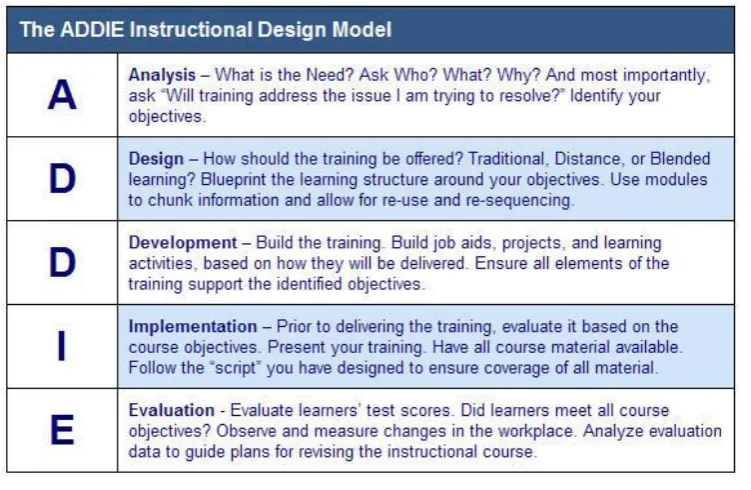
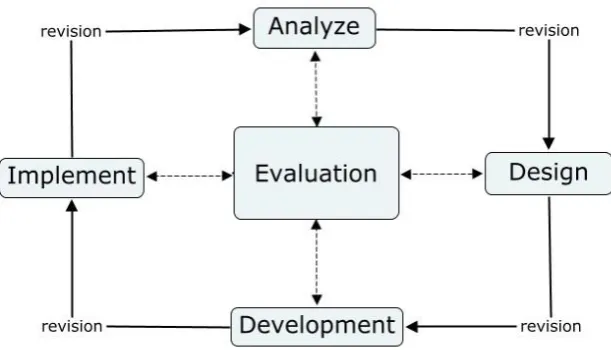
When creating e-courses, we also had a good experience using ADDIE Model. ADDIE consist of five phases – Analysis, Design, Development, Implementation, and Evaluation – that represent a dynamic, flexible guideline for building effective training and performance support tools (Harris 2015).
Figure 1. ADDIE model.
Source: “Instructional Design”, LearningFrontier Web site, http://www.learningfrontier.org/instructional-de, accessed July 2016.
3. E-COURSE “PROSEMINAR FROM MATHEMATICS”
Slovak university of technology in Bratislava offers university studies, especially in technical study programs. Similarly to other technically-oriented universities, high level of mathematical education and mathematical culture is necessary for the students. But, the students come to the university from different types of secondary schools with different level of mathematical knowledge. Insufficient range of education in mathematics on these schools leads to the fact that even interested students do not often have basics necessary to successful understanding of explained issues. For students to become successfully established not only in science and practice but also in further studies, it is necessary for them to be able to work with mathematical object and to understand important relations with other scientific disciplines (Krivoňáková & Gall 2016).
Therefore, at Faculty of Chemical and Food Technology (FCHPT STU), we decided to create an e-course to classify and enhance knowledge obtained at secondary schools. This e-e-course shall also provide new knowledge and mathematical abilities. It is applied at Faculty of chemical and food technology.
3.1. Who, What, How
Page 328
To reduce and eliminate these differences, student may attend Proseminar and Mathematics seminar in the first semester. They are oriented on special chapters of secondary school mathematics and are a prerequisite to further successful graduation in Mathematics I and other subjects.
We decided to support this traditional “face to face” education with an e-course “Proseminar from mathematics” creation. Our ambition was to create electronic study texts so that they are attractive, motivating, actual, accessible and easy to understand, helping the students in self-teaching and motivating them to achieve educational goal. Creating of the discussion forum platform started the dialogue between the teacher and the student and between students as well. It also motivated searching and comparing of information from different sources (Krivoňáková & Gall 2016).
The course was led by professors and lectors from Department of Mathematics on FCHPT STU. To achieve the goal of the course, we decided to build it divided into parts, which connect each other and form an integral complex.
Parts of e-course are mainly: study texts,
demonstrative exercises with steps of solving for easy understanding of a given topic, exercises with solutions,
control questions with the possibility to show the correct answer, tests with the possibility of step-by-step-like student self-control, final exam.
We paid attention mainly to database of testing tasks and exercises for particular chapters. Thus, students might check how much they have understood study texts and if they need to return to certain parts of lessons etc. The creation of the tests was a key part of the whole e-course project. Our aim was not only to create tests as a final student knowledge evaluation, but tests as a self-learning instrument with an interactive character (Krivoňáková & Gall 2016).
3.2. Evaluation of effectiveness
Page 329
Figure 2. The five components of the ADDIE Model.
Source: Forest, E 2014, “The ADDIE Model: Instructional Design, Educational Technology”, http://educationaltechnology.net/the-addie-model-instructional-design/, accessed July 2016.
One of evaluation parts is e-learning effectiveness evaluation as well. When measuring e-learning effectiveness, it is important to realize that situation in university-environment differs from company-environment; because university forms students personality and students obtain correct study and work skills there. Besides that, the aim of university education is to support self-thinking and to manage principles – in contrast with company aims, that represent only profit generating mostly (Fabuš, Kremeňová & Galovič 2006).
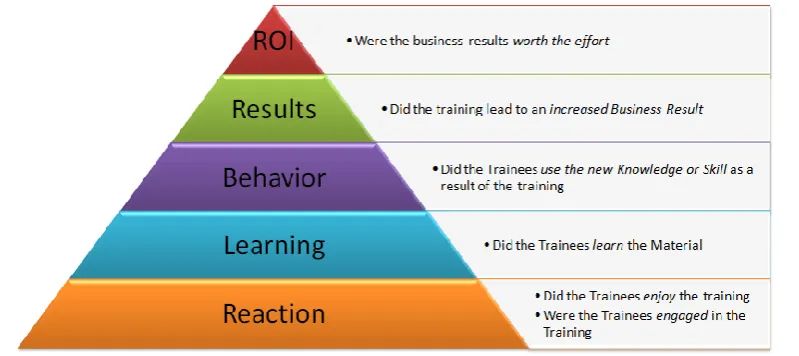
One of the methodologies mostly used for e-learning effectiveness evaluation is Donald Kirkpatrick’s Four Level Evaluation Model, first published in a series of papers in 1959 in the Journal of American Society of Training Directors.
The four steps of evaluation consist of (Clark 2012):
1. Reaction - How well did the students like the learning process?
2. Learning - What did they learn? (the extent to which the students gain knowledge and skills)
3. Behavior - What changes in job performance resulted from the learning process? (capability to perform the newly learned skills while on the job)
4. Results - What are the tangible results of the learning process in terms of reduced cost, improved quality, increased production, efficiency, etc.?
These criteria are being used more than 40 years now. For e-learning, Phillips add one more criteria (Phillips 1998).
5. Investment return (ROI) – Did the training results overweigh its price?
Page 330
Figure 3. The Kirkpatrick-Phillips Model for Evaluating. Source: Robertson, A 2016, “Quality Training for Effective Learning”,
http://www.cqeacademy.com/cqe-body-of-knowledge/quality-system/quality-training-for-effective-learning/, accessed July 2016.
For effectiveness verification of our e-course, we have processed partial results only till now. We have focused mainly on effectiveness evaluation of established e-support of classical (traditional) form of education.
3.2.1. Reaction
We were finding out the satisfaction of students and teachers, using a “Reaction sheet” delivered to both groups. The sheets answered the questions about design construction, functionality, motivating environment and e-course usability.
There were two types of questions in the sheets. Questions were set to be answered with a value from 1 to 5, 1 meaning the best and 5 the worst rating. Second type of questions had free answers.
Questions Evaluation
1 2 3 4 5
Score graphic layout of the course. 22,31% 33,47% 27,09% 15,94% 1,20%
Score logical order of course parts. 38,65% 25,10% 26,69% 9,56% 0,00%
Score course structure. 28,29% 40,64% 31,08% 0,00% 0,00%
Score your overall satisfaction with the subject. 37,85% 50,20% 11,55% 0,40% 0,00%
I clearly understood requests of the subject and what was expected from me.
39,44% 39,44% 19,12% 1,20% 0,80%
Score the content of the subject in terms of contribution of new knowledge for you.
39,04% 40,24% 18,33% 1,59% 0,80%
Page 331
Based on all types of questions evaluation, we have decided to add a part with user instructions to the e-course. These instructions explain closely logical connections of individual parts and related course structure. Also, from the free answers resulted that used e-exams of e-course are suitable and provide the students with reliable feedback about the level of taught subject handling. We are updating the course continuously. And also the feedback about the e-course supporting the classic form of education from students and teachers was positive.
3.2.2. Learning
At the semester beginning we examined the knowledge of students registered for Proseminar and Seminar from mathematics from high-school mathematics. Themes from individual chapters of the Proseminar from mathematics e-course were included in the exam. During semester, the students had to test their knowledge after each finished chapter of the course. At the end of the semester, when finished the course, the students had to pass an exam similar to the one given to them at the semester’s beginning, with similar tasks.
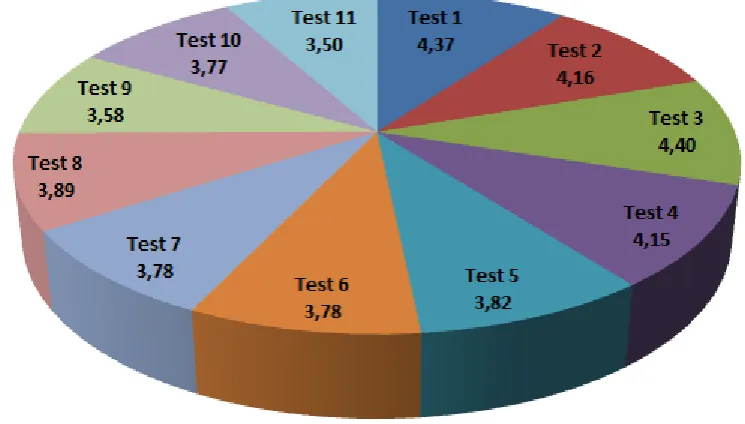
We collected exam results from the beginning of the e-course, during e-course (after individual chapters) and after finishing of the whole e-course. From the results, it was obvious, which parts were more difficult for the students and which chapters will need more attention (Figure 4).
Figure 4. Average points value gained in the during-semester-exams (maximum 10 points).
Page 332
Figure 5. Average points value gained before and after course completion (maximum 100 points).
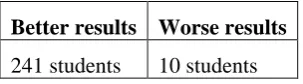
The difference in results was significant – 48,12 percent. Only ten students from the class (251 students) gained less points after than before finishing of the course. But, when looking at the activity of those students, it was low. Seven of them did not attend exams compulsory after individual chapters.
Better results Worse results 241 students 10 students
Table 2. Amount of students with better/worse results after finishing of the course, compared with pre-beginning state.
Evaluation of steps, behaviour and results is not finished yet. Results gained from subjects Mathematics I and Mathematics II requiring good high-school mathematical knowledge are collected already. But they are being evaluated currently. From subjective teacher evaluation it is obvious that successful e-course “Proseminar from mathematics” finishing had a positive impact on other students’ results in other mathematical subjects, notably Mathematics I and II.
4. E-COURSE “LOGIC”
E-course “Logic” was created in 2012 (more about it can be found in articles (Jasečková, Krivoňáková, & Langerová 2012a) and (Jasečková, Krivoňáková, & Langerová 2012b)). It was created as a support for classical “face to face” education based upon a resolution of a project backed by KEGA grant of The Ministry of Education, Science, Research and Sport of the Slovak Republic.
The aim of the project was to create study materials and e-course for the subject Logic for the students of social-humanities oriented study program on the first and second level of university education.
This study program is relatively new and in Slovak Republic it is being educated at Faculty of Humanities at the University of Žilina only. Therefore, there have not existed any suitable study materials for the study of Logic (nor for e-education) that would consider specifics of this study program. Thus, Logic in this study program was taught two years prior to the creation of our e-course.
Page 333
logic, elements of propositional and 1st-order predicate logic and the basics of sylogistics of Aristoteles.
Based upon experience form the first year of project application, we add modern proof theory in Gentzen form of natural deduction (describing the real process of deductive thinking most adequately) to the course. This required reworking and amending of the study texts. Experiment proved to be working as intended because students (or those ready to work seriously, respectively) understood the aim of logical inferences and managed to solve equivalent tasks well (Jasečková & Krivoňáková 2016).
4.1. Use of Google Apps in e-learning
Department of Mediamatics and Cultural Heritage (KMKD) as the first education position in Slovakia started to use Google Apps for education, having these benefits:
every teacher and student has his/her own email, allowing them to communicate with each other, documents shared among each user are used
it is possible to manage time using shared calendars, where timetable, events and dates are stored.
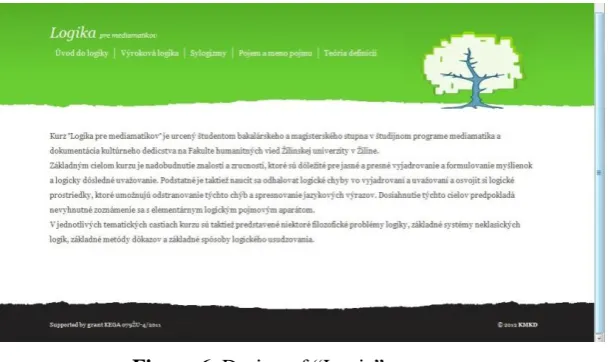
Positive experience with Google Apps use at KMKD inspired us to create Google pages for our e-course. Therefore, e-course of the subject Logic for bachelor and magister education level in the study programme Mediamatics and Cultural Heritage, is located in LMS Moodle system of University of Žilina and on Google pages under the domain of Department of Mediamatics and Cultural Heritage and it is available for the users of those systems.
Figure 6. Design of “Logic” e-course.
4.2. Evaluation of effectiveness
Page 334
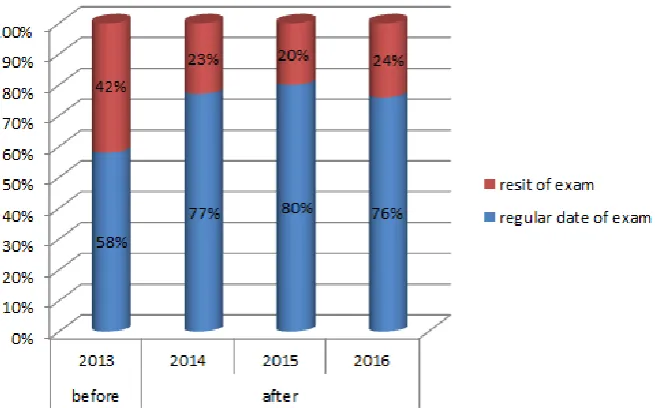
Also, we did comparison of the results gained using e-education with the results obtained with classic methods only (applied on 2013). Results of the students using at the time already finished parts were better as the results of the students in 2013. Correction exam dates attended approximately 20 percent less students as compared to previous period (Figure 7).
Figure 7. Students results before and after e-course “Logic” application.
But, to come with relevant quantitative and qualitative conclusions a longer time period is necessary, therefore we will prepare complex evaluation after certain time of electronical education course using.
4.3. Contribution of e-course “Logic”
Big contribution to the application of the project and creates e-course “Logic” is the new conception of Logic education in social-humanity oriented study programs. Gained results and created e-course “Logic” in particular both contribute to educational activity quality improvement and overall better preparation of the students for praxis and common life. Course is created in accordance with recent requirements and criteria set for knowledge and skill level of the university students. Interactivity of the e-course allows the students to act actively instead of passively. Thus, learning becomes more creative, natural and attractive for the student. Also, its big advantage is modifiability that will reflect reactions and feedback from the students, praxis requirements and need of the changing society. Materials created will be amended and content-wise innovated consistently so that they are usable on a long term basis.
5. CONCLUSION
The task of teaching mathematical and other higher level disciplines is to show to students fundamental ideas of given science. It is important to show to students these ideas that are hidden behind scientific statements. But, we always have to be aware of who we do want to teach, what to teach and what strategy will be used to gain required goal.
Page 335
technically oriented students, we used standard teaching syllabi. When evaluating, these students did not consider graphic design of the course as important. But, they were stricter when evaluating functionality and logical structure of the course.
But to create e-course “Logic” for humanities-oriented students was for us a challenge. In our environment, logic is often taught formally and without adequate motivation. But study program Mediamatics and Cultural Heritage has humanities orientation, therefore when teaching, we had to approach the students carefully. We have created new study materials and applied a concept of logic teaching, in which logic would act as a tool to help us cognize and remove the defects in our thinking and expressing. Humanities oriented students preferred quality-driven e-course design more – as one of the motivation factors.
In both cases, our e-course was created as a support for traditional “face to face” form of education. After applying e-courses to the education, we were able to remove defects of traditional education partially. Therefore, from common education process has become catchy, targeted and interactive education. This undoubtedly contributes to make education process more effective.
ACKNOWLEDGMENT
This paper is supported by grants KEGA 047STU-4/2016 and KEGA 010ŽU-4/2015.
REFERENCES
Clark, D 2012, Kirkpatrick's Four Level Evaluation Model, viewed 14 July 2016, <http://www.nwlink.com/~donclark/hrd/isd/kirkpatrick.html>.
Fabuš, J, Kremeňová, I & Galovič, M 2006, Metodológia merania efektívnosti e-learningu, In: Sborník příspěvků ze semináře a soutěže eLearning 2006, Hradec Králové, Gaudeamus, Univerzita Hradec Králové, 2006.
Forest, E 2014, The ADDIE Model: Instructional Design, Educational Technology, viewed 14 July 2016, <http://educationaltechnology.net/the-addie-model-instructional-design/>.
Harris, L 2015, Online Teaching & Instructional Design, viewed 14 July 2016, <https://gradgirl149.wordpress.com/>.
Jasečková, G, Krivoňáková, N & Langerová, M 2012a, Logic for mediamatics and cultural heritage, In: EDULEARN12 4th international conference on education and new learning technologies, Barcelona, Spain (2012), IATED, 2012, pp. 2159-2162.
Jasečková, G, Krivoňáková, N & Langerová, M 2012b, E-learning for logic, In: Journal of international scientific publications: Educations alternatives Vol. 10, part 2 (2012), pp. 58-64.
Jasečková, G & Krivoňáková, N 2016, Logic as a key tool in education, In: 15th International Conference on Applied Mathematics Aplimat 2016, Bratislava, Slovakia (2016), Vydavateľstvo STU 2016, pp. 614-620.
Krivoňáková, N & Gall, M 2016, The need to implement e-course to the basics of university mathematics education, In: 15th International Conference on Applied Mathematics Aplimat 2016, Bratislava, Slovakia (2016), Vydavateľstvo STU 2016, pp. 734-739.