https://doi.org/10.5194/tc-13-237-2019
© Author(s) 2019. This work is distributed under the Creative Commons Attribution 4.0 License.
Brief communication: Rapid machine-learning-based extraction
and measurement of ice wedge polygons in high-resolution
digital elevation models
Charles J. Abolt1,2, Michael H. Young2, Adam L. Atchley3, and Cathy J. Wilson3
1Department of Geological Sciences, The University of Texas at Austin, Austin, TX, USA 2Bureau of Economic Geology, The University of Texas at Austin, Austin, TX, USA
3Earth and Environmental Sciences Division, Los Alamos National Laboratory, Los Alamos, NM, USA
Correspondence:Charles J. Abolt ([email protected]) Received: 15 August 2018 – Discussion started: 11 September 2018
Revised: 17 December 2018 – Accepted: 4 January 2019 – Published: 25 January 2019
Abstract. We present a workflow for the rapid delineation and microtopographic characterization of ice wedge poly-gons within high-resolution digital elevation models. At the core of the workflow is a convolutional neural network used to detect pixels representing polygon boundaries. A water-shed transformation is subsequently used to segment imagery into discrete polygons. Fast training times (<5 min) per-mit an iterative approach to improving skill as the routine is applied across broad landscapes. Results from study sites near Utqia˙gvik (formerly Barrow) and Prudhoe Bay, Alaska, demonstrate robust performance in diverse tundra settings, with manual validations demonstrating 70–96 % accuracy by area at the kilometer scale. The methodology permits precise, spatially extensive measurements of polygonal microtopog-raphy and trough network geometry.
1 Introduction and background
This research addresses the problem of delineating and mea-suring ice wedge polygons within high-resolution digital el-evation models (DEMs). Ice wedge polygons are the sur-face expression of ice wedges, a form of ground ice nearly ubiquitous to coastal tundra environments in North Amer-ica and Eurasia (Leffingwell, 1915; Lachenbruch, 1962). High-resolution inventories of ice wedge polygon microto-pography are of hydrologic and ecologic interest because decimeter-scale variability in polygonal relief can drive pro-nounced changes to soil drainage (Liljedahl et al., 2016),
and surface emissions of CO2 and CH4(Lara et al., 2015;
Wainwright et al., 2015). At typical sizes, several thousand ice wedge polygons may occupy a single square kilometer of terrain, motivating our development of an automated ap-proach to mapping. The key innovation in our method is the use of a convolutional neural network (CNN), a variety of machine learning algorithm, to identify pixels representing polygon boundaries. Integrated within a set of common im-age processing operations, this approach permits the extrac-tion of microtopographic attributes from entire populaextrac-tions of ice wedge polygons at the kilometer scale or greater.
Previous geospatial surveys of polygonal microtopogra-phy have often aimed to map the occurrence of two geo-morphic endmembers: basin-shaped low-centered polygons (LCPs), which are characterized by rims of soil at the perime-ters, and hummock-shaped high-centered polygons (HCPs), which often are associated with permafrost degradation. Analyses of historic aerial photography have demonstrated a pan-Arctic acceleration since 1989 in rates of LCP con-version into HCPs, a process which improves soil drainage and stimulates enhanced emissions of CO2 (Jorgenson et
spatial scales; however, geomorphology was inferred from the characteristics of pixels larger than typical polygons, pre-venting inspection of individual features.
Higher resolution approaches to segment imagery into dis-crete ice wedge polygons have often been motivated by ef-forts to analyze trough network geometry. On both Earth and Mars, for example, paleoenvironmental conditions in remnant polygonal landscapes have been inferred by com-paring parameters such as boundary spacing and orienta-tion with systems in modern periglacial terrain (e.g., Pina et al., 2008; Levy et al., 2010; Ulrich et al., 2011). An early semi-automated approach to delineating Martian polygons from satellite imagery was developed by Pina et al. (2006), who employed morphological image processing operations to emphasize polygonal boundaries, then applied a watershed transformation (discussed in Sect. 4.1.3) to identify discrete polygons. This workflow was later applied to lidar-derived DEMs from a landscape outside Utqia˙gvik, Alaska, by Wain-wright et al. (2015), but in their experience and our own, ro-bust results at spatial scales approaching a square kilometer or greater were elusive.
Our application of CNNs to the task of identifying polyg-onal troughs was inspired by the remarkable solutions that CNNs recently have permitted to previously intractable im-age processing problems. Aided by advances in the perfor-mance of graphics processing units (GPUs) over the last decade, CNNs have demonstrated unprecedented skill at tasks analogous to ice wedge polygon delineation, such as cell membrane identification in biomedical images (Ciresan et al., 2012) or road extraction from satellite imagery (Kestur et al., 2018; Xu et al., 2018). Motivated by this potential, an exploratory study was recently conducted by Zhang et al. (2018), who demonstrated that a sophisticated neural net-work, the Mask R-CNN of He et al. (2017), is capable of the end-to-end extraction of ice wedge polygons from satellite-based optical imagery, capturing∼79 % of ice wedge poly-gons across a >134 km2 field site and classifying each as HCP or LCP. The authors concluded that the method has po-tential for the pan-Arctic mapping of polygonal landscapes. Here we explore an alternative approach, using a less com-plex CNN paired with a set of post-processing operations, to extract ice wedge polygons from high-resolution DEMs derived from airborne lidar surveys. An advantage of this method is that training the CNN is rapid (∼5 min or less on a personal laptop), permitting an iterative workflow in which supplementary data can easily be incorporated to boost skill in targeted areas. We demonstrate the suitability of this ap-proach to extract ice wedge polygons with very high accu-racy (up to 96 % at the kilometer scale), applying it to 10 field sites of 1 km2outside Utqia˙gvik and Prudhoe Bay, Alaska. Because our method operates on high-resolution elevation data, it enables direct measurement of polygonal microto-pography, and we anticipate that in the future, the method
2 Study areas and data acquisition
To demonstrate the flexibility of our approach, we applied it simultaneously at two clusters of study sites near Utqia˙gvik and Prudhoe Bay, Alaska, settings with highly divergent ice wedge polygon geomorphology,∼300 km distant from one another (Fig. S1 in the Supplement).
2.1 Utqia˙gvik
The first cluster of study sites (Figs. S2–S3) is located within 10 km of the Beaufort Sea coast in the Barrow Environmen-tal Observatory, operated by the National EnvironmenEnvironmen-tal Ob-servatory Network (NEON). Mean elevation is less than 5 m above sea level, and vegetation consists of uniformly low-growing grasses and sedges. Mesoscale topography is mostly flat but marked by depressions up to 2 m deep associated with draws and drained lake beds. In the land cover map of Lara et al. (2018), the area is characterized by extensive coverage by both LCPs and HCPs, with occasional lakes and patches of non-polygonal meadow. Microtopography at the sites re-flects nearly ubiquitous ice wedge development, which be-comes occluded in some of the depressions. Ice wedge poly-gons are of complex geometry and highly variable area, rang-ing from∼10 to>2000 m2. An airborne lidar survey was flown in August 2012 as part of the U.S. Department of En-ergy’s Next Generation Ecosystems Experiment-Arctic pro-gram (https://ngee-arctic.ornl.gov/, last access: 18 January 2019). The resulting point cloud was processed into a 25 cm horizontal resolution DEM with an estimated vertical accu-racy of 0.145 m (Wilson et al., 2013). In the present study, to compare algorithm performance on data of variable spatial resolution, the 25 cm DEM was resampled at 50 and 100 cm resolution. Two sites of 1 km2, here referred to as Utqia˙gvik-1 and Utqia˙gvik-2, were extracted from the DEMs and pro-cessed using our workflow.
2.2 Prudhoe Bay
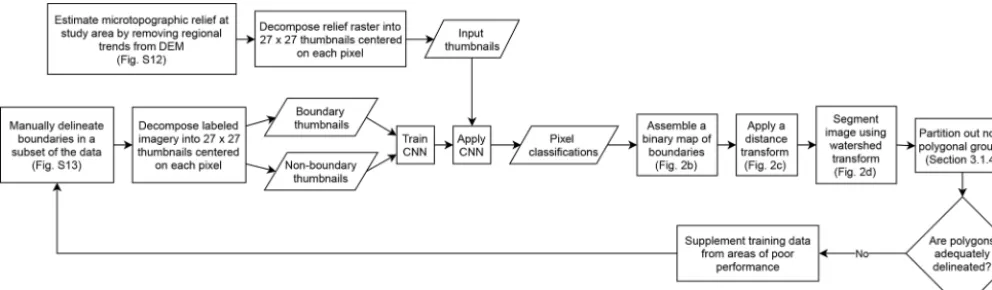
Figure 1.Schematic of our iterative workflow for polygon delineation.
and subsequently processed into 25, 50, and 100 cm resolu-tion DEMs. Vertical accuracy was estimated at 0.10 m. As the Prudhoe Bay survey area is substantially larger than the survey area at Utqia˙gvik, eight sites of 1 km2, here referred to as Prudhoe-1 through Prudhoe-8, were extracted from the DEMs and processed using our workflow.
3 Methods
3.1 Polygon delineation algorithm
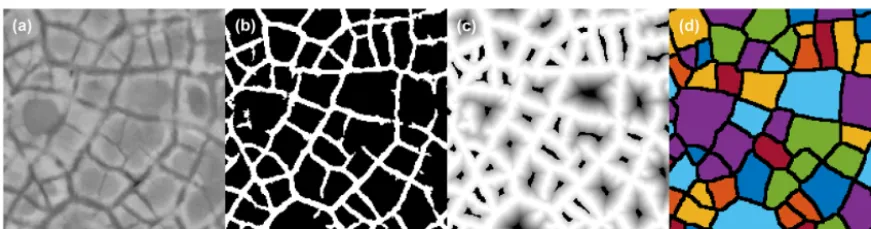
A chart summarizing our iterative workflow is presented in Fig. 1, and several intermediate stages in the polygon delin-eation algorithm are illustrated in Fig. 2. In the first (prepro-cessing) stage, regional trends were removed from a DEM (Fig. S12), generating an image of polygonal microtopogra-phy (Fig. 2a). Next, the microtopographic information was processed by a CNN, which was trained to use the 27×27 neighborhood surrounding each pixel to assign a label of “boundary” or “non-boundary” (Fig. 2b). A distance trans-formation was then applied (i.e., each non-boundary pixel was assigned a negative intensity proportional to its Eu-clidean distance from the closest boundary), generating a grayscale image analogous to a DEM of isolated basins, in which the polygonal boundaries appear as ridges (Fig. 2c). Subsequently, a watershed transform was applied to segment the image into discrete ice wedge polygons (Fig. 2d). These steps, and a post-processing algorithm used to remove non-polygonal terrain from the final image, are described in de-tail below.
3.1.1 Preprocessing
In the preprocessing stage, regional topographic trends were estimated by processing the DEM with a 2-D filter, which assigned to each pixel the mean elevation within a 20 m ra-dius. This radius was chosen such that the area over which elevation was averaged would be larger than a typical ice
wedge polygon. Polygon-scale microtopography was then estimated by subtracting the regional topography from the DEM (Fig. S12). In preparation for passing the data to the CNN, microtopography was subsequently converted to 8-bit grayscale imagery. The minimum intensity (0) was as-signed to depressions of 0.7 m or greater, and the maximum intensity (255) was assigned to ridges of 0.7 m or greater. These bounds captured>99 % of pixel values at each study site. Finally, one thumbnail-sized image was created for each pixel in the microtopography raster, capturing the immedi-ate neighborhood surrounding it. These thumbnail images were the direct input to the CNN. The CNN required the width in pixels of each thumbnail to be an odd multiple of 9; therefore, at 50 cm resolution the thumbnails were assigned a width of 27 pixels (13.5 m), at 25 cm resolution a width of 45 pixels (11.25 m), and at 100 cm resolution a width of 27 pixels (27 m). The width of these thumbnails was chosen such that each image would contain sufficient spatial context for a human observer to distinguish easily between polyg-onal boundaries, which typically were demarcated by inter-polygonal troughs, and other microtopographic depressions such as LCP centers.
3.1.2 Convolutional neural network
func-Figure 2.Illustration of several intermediate stages in our workflow. The CNN processes information stored in 8-bit grayscale imagery representing microtopography(a), estimated by removing regional trends from the lidar DEM (Fig. S2). The CNN identifies pixels likely to represent troughs(b). Each non-trough pixel is assigned a negative intensity equal to its distance from a trough(c)and a watershed transformation is applied to segment the image into discrete polygons(d)(colors randomly applied to emphasize polygonal boundaries).
tion of each layer in our CNN; for more detailed description, the reader is directed to Ciresan et al. (2012).
Summarized in Table S1, the most important components of our CNN were a single convolutional layer, a max-pooling layer, and two fully connected layers. In the convolutional layer, a set of 2-D filters was applied to the input image, generating intermediate images in which features including concavities, convexities, or linear edges were detected. The max-pooling layer downsized the height and width of these intermediate images by a factor of 3, by selecting the high-est intensity pixel in a moving 3×3 window with a stride of 3 pixels. Each pixel in the downsized intermediate images was then passed as an input signal to the fully connected layers, which functioned identically to standard neural net-works. Two additional components of our CNN were Recti-fied Linear Unit (ReLU) layers, which enhance nonlinearity by reassigning a value of zero to any negative signals out-put by a preceding layer, and a softmax layer, which con-verted the output from the final fully connected layer into a probability for each categorical label (i.e., boundary or non-boundary).
During training, the weights of the 2-D filters in the convo-lutional layer and the activation functions of the neurons in the fully connected layers were optimized to correctly pre-dict the labels in a training deck of images. Our workflow was designed to generate the training deck primarily by pro-cessing 100 m×100 m tiles of manually labeled imagery. In each of these tiles, boundary pixels were delineated by hand in a standard raster graphics editor, a process that required ∼1 h per tile at 50 cm resolution (Fig. S13a). Our algorithm imported these tiles, identified the geographic coordinates of each pixel identified as a boundary, then created a thumb-nail image centered on that pixel from the 8-bit microtopo-graphic imagery. This procedure generated several thousand thumbnail images centered on boundaries from each manu-ally delineated tile. Subsequently, an equal number of pix-els not labeled as boundaries were selected at random, and the thumbnail extraction procedure was repeated, generating
a set of non-boundary images for the training deck. Finally, for more targeted training that did not require full delineation of a 100 m×100 m tile, individual instances of boundary or non-boundary features could also be added to supplement the training deck, based again on manual delineation (Fig. S13b). Just prior to training, 25 % of the training deck assembled by these methods was set aside to be used for validation.
Once trained, the CNN was executed to assign a label of boundary or non-boundary to the thumbnail image cor-responding to each pixel of a study site. These labels were then reassembled into a binary image of polygon boundaries (Fig. 2b), which was further processed to extract discrete ice wedge polygons.
3.1.3 Polygon extraction
poly-gons tend to measure at least several meters across (Leffing-well, 1915; Lachenbruch, 1962). Next, watershed segmenta-tion was applied to divide the valleys into discrete polygons (Fig. 2d). Our use of this operation was inspired by its in-corporation in the polygon delineation method developed by Pina et al. (2006). Conceptually, this procedure was analo-gous to identifying the up-gradient region or area of attrac-tion surrounding each local minimum.
3.1.4 Partitioning of non-polygonal ground
In the final stage of delineation, we partitioned out regions of a survey area that had been segmented using the tech-niques described above, but were unlikely to represent true ice wedge polygons. For example, polygons were eliminated from the draw in the southern half of Utqia˙gvik-1 (Fig. S2a), where microtopography was too occluded to permit accu-rate delineation. Toward this aim, our algorithm individually analyzed each boundary between two polygons (black line segments in Fig. 2d), tabulating the number of pixels that had been identified positively by the CNN (white pixels in Fig. 2b). It then dissolved all boundaries in which less than half the pixels had been classified positively, merging adja-cent polygons. In practice, this procedure resulted in areas of non-polygonal terrain being demarcated by unusually large “polygons.” We removed these areas by partitioning out any polygon with an area greater than 10 000 m2, a threshold se-lected to be arbitrarily larger than most real ice wedge poly-gons. This procedure had the strengths of being conceptually simple and providing a deterministic means of partitioning non-polygonal terrain from the rest of a survey area. 3.2 Microtopographic analysis
To demonstrate the capabilities of our workflow for microto-pographic analysis, we developed a simple method for mea-suring the relative elevation at the center of each delineated polygon, serving as a proxy for LCP or HCP form. In each polygon, we first applied a distance transform, calculating the distance from the closest boundary of all interior pixels. We then divided the area of the polygon in half at the me-dian distance from boundaries, designating a ring of “outer” pixels and an equally sized core of center pixels. Microtopo-graphic relief was then estimated as the difference in mean elevation between the center and outer pixels.
3.3 Case study experimental design
The case study was first conducted using topographic data at 50 cm resolution, then repeated at 25 and 100 cm res-olution. Training was focused primarily on sites Prudhoe-1 and Utqia˙gvik-Prudhoe-1. Leveraging the rapid training and ap-plication times of our CNN, we manually delineated one 100 m×100 m tile of imagery at a time from either site, trained the CNN, extracted results from both sites, then in-troduced additional training data from regions of poor
per-formance to improve skill (Fig. 1). After four iterations of this approach, the CNN incorporated training data from three fully delineated tiles at Utqia˙gvik-1 and one at Prudhoe-1, representing 3 % and 1 % of the sites, respectively. From this point, we opted to “fine-tune” the CNN by supplementing the training deck directly with instances of problematic features, rather than using information from fully delineated tiles. Sev-eral examples of boundary and non-boundary features were included from Utqia˙gvik-1 and Prudhoe-1. Next, to test its extensibility, the CNN was applied across the remaining sites, and retrained once more. In this final iteration, sev-eral instances of boundary and non-boundary features (but no fully delineated tiles) were incorporated into the training deck from sites Prudhoe-2, Prudhoe-3, and Prudhoe-4. No training data at all were incorporated from sites Prudhoe-5 through Prudhoe-8 or Utqia˙gvik-2. (All training data used in the final iteration of our workflow can be viewed in the data and code repository accompanying this article.) Once this procedure was complete at 50 cm resolution, training decks at 25 and 100 cm resolution were prepared. To gener-ate CNNs comparable to the network trained on 50 cm data, the 25 and 100 cm training decks were constructed using data sampled from identical geographic locations, but manual la-beling was performed without reference to the labeled 50 cm resolution data.
After the CNN was trained and applied across all study sites, we quantified the performance of the polygon delin-eation algorithm through manual validation. At each site, we first calculated the total area and number of polygons ex-tracted from the landscape. We then randomly sampled 500 of the computer-delineated polygons, and classified each as either whole, fragmentary, conglomerate, or false. Fragmen-tary polygons were defined as computer-delineated polygons that included less than 90 % of one real polygon, conglomer-ate polygons were defined as computer-delineconglomer-ated polygons comprising parts of two or more real polygons, and false polygons were defined as computer-delineated polygons oc-cupying terrain in which no polygonal pattern was deemed visible to the human evaluator. The percentage of computer-delineated polygonal terrain corresponding to each class was then calculated by number of polygons and by area. This pro-cedure was completed for all 10 study sites at 50 cm data res-olution, and for sites Prudhoe-1 and Utqia˙gvik-1 at 25 and 100 cm resolution.
4 Results and discussion
4.1 Training speed and accuracy
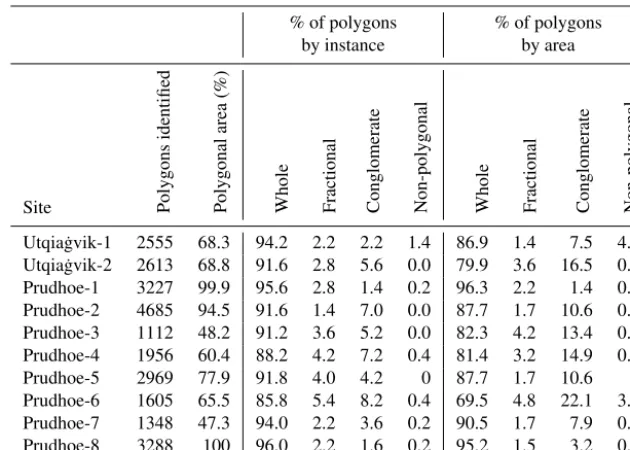
% of polygons % of polygons
by instance by area
Site Polygons
identified
Polygonal
area
(%)
Whole Fractional Conglomerate Non-polygonal Whole Fractional Conglomerate Non-polygonal
Utqia˙gvik-1 2555 68.3 94.2 2.2 2.2 1.4 86.9 1.4 7.5 4.2 Utqia˙gvik-2 2613 68.8 91.6 2.8 5.6 0.0 79.9 3.6 16.5 0.0 Prudhoe-1 3227 99.9 95.6 2.8 1.4 0.2 96.3 2.2 1.4 0.0 Prudhoe-2 4685 94.5 91.6 1.4 7.0 0.0 87.7 1.7 10.6 0.0 Prudhoe-3 1112 48.2 91.2 3.6 5.2 0.0 82.3 4.2 13.4 0.0 Prudhoe-4 1956 60.4 88.2 4.2 7.2 0.4 81.4 3.2 14.9 0.5 Prudhoe-5 2969 77.9 91.8 4.0 4.2 0 87.7 1.7 10.6 0 Prudhoe-6 1605 65.5 85.8 5.4 8.2 0.4 69.5 4.8 22.1 3.4 Prudhoe-7 1348 47.3 94.0 2.2 3.6 0.2 90.5 1.7 7.9 0.0 Prudhoe-8 3288 100 96.0 2.2 1.6 0.2 95.2 1.5 3.2 0.0
GPU, accuracies >97 % on the training deck and >95 % on the validation deck of thumbnails were achieved in less than 5 min. At 100 cm resolution, the procedure operated on ∼12 000 thumbnail images, achieving comparable levels of accuracy within 90 s. These speeds enable the iterative ap-proach to training on which our workflow is based (Fig. 1), as the CNN can be retrained quickly to incorporate new data when applied across increasingly large areas.
Using 25 cm resolution data, the training procedure op-erated on a set of∼115 000 thumbnail images. Accuracies >97 % on the training deck and >95 % on the validation deck were once more obtained, but training required just un-der 1 h on the same computer. This substantial increase to training time is attributable to the facts that more thumbnail images were processed, and the number of pixels in each thumbnail was larger, making execution of the CNN more computationally expensive.
4.2 Delineation speed and validation
Operating at 50 cm resolution, delineation of ice wedge poly-gons within a 1 km2 field site required ∼2 min, including application of the CNN and subsequent post-processing. Re-sults generally were very accurate; across study sites, ∼ 1000–5000 ice wedge polygons were detected per square kilometer, of which 85–96 % were estimated as “whole” dur-ing manual validation, representdur-ing 70–96 % of the polygo-nal ground by area (Table 1). The most common type of error at all sites with <95 % accuracy was incorrect aggregation of several real ice wedge polygons into a single feature. Un-surprisingly, performance was strongest at sites with clearly defined polygon boundaries and relatively simple
polygo-nal geometry, such as Prudhoe-1, Prudhoe-7, and Prudhoe-8 (Figs. S4, S10, S11). In contrast, performance was weakest at sites such as Utqia˙gvik-2 or Prudhoe-6 (Figs. S2, S9), where considerable swaths of terrain are characterized by faint mi-crotopography, as ice wedge polygons appear to grade into non-polygonal terrain. In such locations, polygonal bound-aries frequently went undetected, resulting in the delineation of unrealistically large conglomerate polygons. In general, the results of the delineation clearly illustrate that the polyg-onal network at Utqia˙gvik possesses more complex geometry than Prudhoe Bay, with many instances in which secondary or tertiary ice wedges appear to subdivide larger ice wedge polygons.
Although simple, our post-processing procedure for par-titioning out non-polygonal ground from the results was generally accurate. Examples of features successfully re-moved from the 50 cm resolution DEMs included thaw lakes (Figs. S6–S10), drained thaw lake basins (Fig. S2), streambeds (Figs. S5, S9), non-polygonal marsh (Figs. S3, S7, S9), shallow ponds (Fig. S7), and the floodplain of a braided stream (Fig. S10). Because the partitioning proce-dure removed areas with a low density of boundaries iden-tified by the CNN, we found that it could be trained effi-ciently by supplementing the training deck with extra ex-amples of non-boundary thumbnails extracted from these re-gions. Across the study sites, we encountered almost no cases in which well-defined polygons were mistakenly partitioned out. Instances of non-polygonal ground mistakenly classi-fied as polygonal accounted for less than 1 % of machine-delineated polygons by area.
Figure 3.DEMs and estimates of polygonal relief at sites Prudhoe-1(a, b)and Utqia˙gvik-1(c, d). Polygons crossing the boundaries of study sites are removed in(b, d).
but performance dropped significantly, with greater declines occurring in the challenging environment of Utqia˙gvik (Ta-ble S2). We attribute declines in performance to an obscura-tion of fainter polygonal boundaries at this resoluobscura-tion, and to decreases in the amount of contextual information that can be derived from the neighborhood of any given pixel, reducing the capacity for the algorithm to distinguish be-tween polygonal troughs and other microtopographic depres-sions (Fig. S14). Somewhat surprisingly, performance also declined slightly using data at 25 cm resolution, with larger fractions of fragmentary and false polygons accounting for most of the increases in errors (Table S2). We attribute these mistakes to the larger number of distinguishable features in the higher resolution data, leading the algorithm to more frequently mistake features not encountered in the training dataset as boundary pixels. As the imagery nonetheless is of sufficient resolution for our purposes, we anticipate that, with augmentations to the training dataset, performance at 25 cm resolution could improve and even exceed performance at
50 cm resolution; however, performance speeds were gen-erally inhibitory to our workflow, as delineation required ∼50 min km−2. We therefore conclude that 50 cm resolution data are optimal for our analysis.
4.3 Measurement of polygonal microtopography
re-HCP. We anticipate these measurements may be useful for further investigations into relationships between microtopog-raphy, soil moisture, and carbon fluxes (e.g., Wainwright et al., 2015).
4.4 Comparison with Mask R-CNN and future applications
Several key differences are apparent between the workflow presented in this paper (hereafter termed the CNN-watershed approach) and a recent implementation of Mask R-CNN for the mapping of ice wedge polygons (Zhang et al., 2018), re-vealing relative strengths of each approach. An advantage of the CNN-watershed approach, stemming from its sparse neu-ral architecture, is that training times are extremely rapid, fa-cilitating iterative improvements to skill (Fig. 1). In contrast, although inference times using the CNN-watershed approach are reasonable, extraction of ice wedge polygons over broad landscapes is several times faster using Mask R-CNN, with a reported time of∼21 min for inference over 134 km2of terrain (Zhang et al., 2018). Because the CNN-watershed ap-proach operates on high-resolution DEMs, it enables direct quantification of polygonal relief, whereas Mask R-CNN in-stead produces a binary classification of each polygon as ei-ther LCP or HCP. The CNN-watershed approach is ei-therefore useful for generating unique datasets summarizing polygonal geomorphology, demonstrating high performance at spatial scales typical of airborne surveys using lidar or photogram-metry to produce high-resolution DEMs. In comparison, be-cause Mask R-CNN has been trained to operate on satellite-derived optical imagery with global coverage, it is uniquely well suited for application across very broad regions, with the potential to generate pan-Arctic maps of land cover by poly-gon type. Because of differences in training and inference procedures and the spatial scales at which they ideally oper-ate, the training data requirements and accuracy of the two approaches are difficult to compare directly; nonetheless, in several aspects, performance appears to be similar (Sect. S1). Because the CNN-watershed approach generates direct measurements of polygonal microtopography, one applica-tion to which it is uniquely amenable is the precise monitor-ing of microtopopographic deformation in areas covered by repeat airborne surveys. Through such analysis, we anticipate that it will permit the polygon-level quantification of ground subsidence over time spans of years, potentially yielding new insights into the vulnerability of various landscape units to thermokarst. An additional research problem to which the CNN-watershed approach is well suited is the quantification of polygonal network parameters, such as boundary spac-ing and orientation, to explore relationships to environmental factors such as climate (e.g., Pina et al., 2008; Ulrich et al., 2011). These boundaries (black line segments in Figs. 2d, 3b and d) are naturally delineated through the
implementa-subtle or nonexistent, ground-based delineation methods are the highest accuracy approach to mapping ice wedge net-works (Lousada et al., 2018). Nonetheless, by segmenting machine-delineated networks into individual boundaries, our workflow permits the estimation of network statistics at spa-tial scales unattainable through on-site surveying.
5 Conclusions
A relatively simple CNN paired with a set of common im-age processing techniques is capable of extracting polygons of highly variable size and geometry from high-resolution DEMs of diverse tundra landscapes. Successful application of the CNN is facilitated by its sparse neural architecture, which permits rapid training, testing, and incorporation of new data to improve skill. The optimal spatial resolution for DEMs processed using the workflow is∼50 cm. Poten-tial applications for the technology include the generation of high-resolution maps of land cover by polygon type, the pre-cise quantification of microtopographic deformation in areas covered by repeat airborne surveys, and the rapid extraction of center elevations and boundary parameters including spac-ing and orientation. These capabilities can improve under-standing of environmental influences on network geometry and facilitate assessments of contemporary landscape evolu-tion in the Arctic.
Data availability. Data and code are available at https://doi.org/10.5821/zenodo.2537167 (Abolt et al., 2018).
Author contributions. CJA and MHY conceived the project. CJA developed the algorithm with guidance from MHY and ALA. CJW developed the lidar DEM for Utqiagvik, and all authors contributed to the two-site experimental design. CJA wrote the paper with as-sistance from all authors.
Competing interests. The authors declare that they have no conflict of interest.
preparation. We acknowledge the Texas Advanced Computing Center (TACC) at the University of Texas at Austin for providing HPC resources that have contributed to the results reported within this paper.
Edited by: Moritz Langer
Reviewed by: Ingmar Nitze and Weixing Zhang
References
Abolt, C. J., Young, M. H., Atchley, A. L., and Brown, C. J.: CNN-watershed: A machine-learning based tool for delineation and measurement of ice wedge polygons in high-resolution digital elevation models, Zenodo repository, https://doi.org/10.5821/zenodo.2537167, 2018.
Ciresan, D., Giusti, A., Gambardella, L. M. and Schmidhuber, J.: Deep neural networks segment neuronal membranes in electron microscopy images, in: Advances in Neural Information Process-ing Systems 25, edited by: Pereira, F., Burges, C. J. C., Bot-tou, L., and Weinberger, Q., Curran Associates, Inc., 2843–2851, 2012.
He, K., Gkioxari, G., Dollar, P., and Girshick, R.: Mask R-CNN, in: Proceedings of the 2017 IEEE International Conference on Computer Vision, IEEE, Piscataway, NJ, USA, 2017.
Jorgenson, M. T., Shur, Y. L., and Pullman, E. R.: Abrupt increase in permafrost degradation in Arctic Alaska, Geophys. Res. Lett., 33, L02503, https://doi.org/10.1029/2005GL024960, 2006. Jorgenson, M. T., Kanevskiy, M., Shur, Y., Moskalenko, N., Brown,
D. R. N., Wickland, K., Striegl, R. and Koch, J.: Role of ground ice dynamics and ecological feedbacks in recent ice wedge degradation and stabilization, J. Geophys. Res.-Earth Surf., 120, 2280–2297, https://doi.org/10.1002/2015JF003602, 2015. Kestur, R., Farooq, S., Abdal, R., Mehraj, E., Narasipura, O. and
Mudigere, M.: UFCN: A fully convolutional neural network for road extraction in RGB imagery acquired by remote sensing from an unmanned aerial vehicle, J. Appl. Remote Sens., 12, 016020, https://doi.org/10.1117/1.JRS.12.016020, 2018.
Lachenbruch, A. H.: Mechanics of thermal contraction cracks and ice-wedge polygons in permafrost, Special Paper, Geological So-ciety of America, New York, 1962.
Lara, M. J., McGuire, A. D., Euskirchen, E. S., Tweedie, C. E., Hinkel, K. M., and Skurikhin, A. N.: Polygonal tundra geomor-phological change in response to warming alters future CO2and CH4 flux on the Barrow Peninsula, Global Change Biol., 21,
1634–1651, 2015.
Lara, M. J., Nitze, I., Grosse, G., and McGuire, A. D.: Tundra landform and vegetation trend maps for the Arc-tic Coastal Plain of northern Alaska, Sci. Data, 5, 180058, https://doi.org/10.1038/sdata.2018.58, 2018.
Leffingwell, E. K.: Ground-ice wedges: The dominant form of ground-ice on the north coast of Alaska, J. Geol., 23, 635–654, 1915.
Levy, J. S., Marchant, D. R., and Head, J. W.: Thermal contraction crack polygons on Mars: A synthesis from HiRISE, Phoenix, and terrestrial analogue studies, Icarus, 226, 229–252, 2010. Liljedahl, A. K., Boike, J., Daanen, R. P., Fedorov, A. N., Frost,
G. V., Grosse, G., Hinzman, L. D., Iijma, Y., Jorgenson, J. C., Matveyeva, N., Necsoiu, M., Raynolds, M. K., Romanovsky, V.
E., Schulla, J., Tape, K. D., Walker, D. A., Wilson, C. J., Yabuki, H., and Zona, D.: Pan-Arctic ice-wedge degradation in warming permafrost and its influence on tundra hydrology, Nat. Geosci., 9, 312–318, https://doi.org/10.1038/ngeo2674, 2016.
Lousada, M., Pina, M., Vieira, G., Bandeira, L., and Mora, C.: Eval-uation of the use of very high resolution aerial imagery for accu-rate ice-wedge polygon mapping (Adventdalen, Svalbard), Sci. Total Environ., 615, 1574–1583, 2018.
Paine, J. G., Andrews, J. R., Saylam, K., and Tremblay, T. A.: Air-borne LiDAR-based wetland and permafrost-feature mapping on an Arctic Coastal Plain, North Slope, Alaska, in: Remote Sens-ing of Wetlands: Applications and Advances, edited by: Tiner, R. W., Klemas, V. V., and Lang, M. W., CRC Press, Boca Raton, FL, USA, 413–434, 2015.
Pina, P., Saraiva, J., Bandeira, L., and Barata, T.: Identification of Martian polygonal patterns using the dynamics of watershed con-tours, in: Image Analysis on Recognition, edited by: Campilho, A. and Kamel, M., Springer-Verlag, Berlin-Heidelberg, 691–699, 2006.
Pina, P., Saraiva, J., Bandeira, L., and Antunes, J.: Polygonal ter-rains on Mars: A contribution to their geometric and topological characterization, Planet. Space Sci., 56, 1919–1924, 2008. Raynolds, M. K., Walker, D. A., Ambrosius, K. J., Brown,
J., Everett, K. R., Kanevskiy, M., Kofinas, G. P., Ro-manovsky, V. E., Shur, Y., and Webber, P. J.: Cumula-tive geoecological effects of 62 years of infrastructure and climate change in ice-rich permafrost landscapes, Prudhoe Bay Oilfield, Alaska, Global Change Biol., 20, 1211–1224, https://doi.org/10.1111/gcb.12500, 2014.
Soille, P.: Morphological Image Analysis, Springer-Verlag: Berlin Heidelberg, 2004.
Ulrich, M., Hauber, E., Herrzschuh, U., Hartel, S., and Schirrmeis-ter, L.: Polygon pattern geomorphometry on Svalbard (Norway) and western Utopia Planitia (Mars) using high resolution stereo remote-sensing data, Geomorphology, 134, 197–216, 2011. Wainwright, H. M., Dafflon, B., Smith, L. J., Hahn, M. S., Curtis, J.
B., Wu, Y., Ulrich, C., Peterson, J. E., Torn, M. S., and Hubbard, S. S.: Identifying multiscale zonation and assessing the relative importance of polygon geomorphology on carbon fluxes in an Arctic tundra ecosystem, J. Geophys. Res.-Biogeosci., 120, 788– 808, https://doi.org/10.1002/2014JG002799, 2015.
Wilson, C., Gangodagamage, C., and Rowland, J.: Digital eleva-tion model, 0.5 m, Barrow Environmental Observatory, Alaska, 2012, Next Generation Ecosystem Experiments Arctic Data Col-lection, Oak Ridge National Laboratory, US Department of En-ergy, https://doi.org/10.5440/1109234, 2013.
Xu, Y. Y., Xie, Z., Feng, Y. X., and Chen, Z. L.: Road extraction from high-resolution remote sensing im-agery using deep learning, Remote Sens., 10, 1461, https://doi.org/10.3390/rs10091461, 2018.