© 2016 IJSRST | Volume 2 | Issue 3 | Print ISSN: 2395-6011 | Online ISSN: 2395-602X Themed Section: Science and Technology
Implementation of Feed-forward Neural Network Models for Pattern
Classification Using Transformation Based Feature Extraction Methods
Sandeep Kumar, Amit Rawat
Faculty of Engineering & Technology, Agra College. Agra, Uttar Pradesh, India
ABSTRACT
Automatic recognition of handwritten Hindi characters is a difficult and one of the most interesting research areas of pattern recognition field. A lot of work has been done in this area till date; still it is a subject of active research. Hindi characters are cursive in nature and thus characters may be written in various cursive ways. Characters also show a lot of similar features such as header line, vertical bar, curves and etc. Handwritten characters may be of varying sizes, width and orientation, which makes the problem more complicated and difficult to solve. The performance of an optical character recognition system extremely depends on the procedure used to extract quality features from characters. A number of feature extraction, classification and recognition techniques have been used successfully in this area. Proposed work is focused on some of the existing techniques like neural networks for the recognition of handwritten Hindi characters. Neural networks are good at recognizing handwritten characters as these networks are insensitive to the missing data. In this paper, we are implementing and analyzing the performance of feed-forward neural network models to perform pattern classification for handwritten Hindi characters using different transformation based feature extraction methods.
Keywords: Feed-Forward Neural Network, Radial Basis Network, Discrete Wavelet Transform, Radon Transform, Pattern Recognition.
I.
INTRODUCTION
Handwritten character recognition is wide and one of the most explored areas of pattern recognition field. It covers all sorts of character recognition in various application domains such as signature recognition, script recognition, text recognition, handwriting recognition and document analysis etc. [1]. An automatic character recognition systems can be characterized as online or offline. An online recognition system utilizes the digitizer which captures writing in the form of real time data, i.e. temporal information is available for the system. Two dimensional coordinates of the successive points in the writing are represented as a function of time. An offline recognition system works on previously written data on paper. This data is scanned by using a digital camera or scanner and presented to the system in the form of images. Scanned character images are then converted to bit pattern to be processed by the recognition system. Online recognition systems proved to be better than offline systems as they are provided
information about order of the strokes, speed of the writing, pen-up and pen-down etc. as well as temporal information [2].
width, orientation and thickness. It should also be able identify and recognize missing data.
Neural networks are widely used in the field of handwritten character recognition [4-7], due to their learning, storing and recalling capabilities. Also, these networks are insensitive to missing and incomplete data, which makes them appropriate and most suitable for the handwritten character recognition problem.
Efforts done in the field of handwritten Hindi character recognition using neural network systems in the last few years are reviewed next.
Ramteke R.J. (2010) presented a handwritten Hindi vowel character recognition system. The system works by segmenting the vowels into five groups using projection approach. Core character is extracted by removing the header line by applying horizontal projection and modifiers are removed using vertical projection [8]. Khanale & Chitnis (2011) presented a feed-forward neural network system with 92% recognition accuracy. They converted the preprocessed input character into a Boolean matrix of size 5 X 7 size. The matrix is then assigned to the neural network for classification. Network was trained with back-propagation algorithm with adaptive learning rate [9].
Agnihotri V.P. (2012) achieved 85.78% recognition accuracy for 10 handwritten samples of each vowel. A series of image preprocessing operations like binarization, morphological dilation, edge detection are applied on collected character samples. Feature vector was created by dividing the pre-processed character image into 54 equal zones, each of size 10x10 pixels. To further use the feature vector, they converted diagonal based features into chromosome bit string of size 378. During the recognition process the fitness value of unknown character was compared with the stored patterns [10]. Gupta & Rana (2012) evaluated the performance of restricted feed-forward neural network, with two hidden layers, to perform patter classification for Hindi modifiers. They collected 60 samples of modifiers. System worked by dividing the modifier image into 16 equal parts and calculating density values of pixels for each part. System is trained with four learning methods: genetic algorithm with back-propagated error, generalized delta learning with distributed error, simple genetic algorithm and hybrid
evolutionary algorithm [11]. Singh & Lehri (2012)
presented a feed-forward back-propagation network for first five consonants and attained 93% accuracy [12]. They preprocessed scanned images by applying noise reduction operation, binarization and thinning. Then images are normalized to the size of 7x7. Feature extraction is done by converting the 7x7 matrix to 49x1 vector form. Vaidya & Bombade (2013) achieved 82.89% recognition accuracy using a generalized regression network. Feature extraction is done by adding all training sample character image matrices into a single matrix of size 64x64 and dividing this matrix by the total number of samples to get the Avg_matrix, Avg_matrix is then subtracted from each sample character image to get the matrix X. Transpose of first 100 vectors of matrix X is obtained and the result of the transposed matrix multiplied with the matrix X [13].
A multi-layer neural network with 75% - 80% accuracy for Hindi characters and numerals was presented by
Jaiswal G. (2014). System was trained with Gradient Descent learning algorithm. A series of pre-processing operations were performed for noise reduction, binarization, segmentation, negative transformation, thinning and normalize images to the size of 50x70. Zone and count metric based feature extraction is done [14]. K. Tanuja et al. (2015) presented back-propagation neural network system which yielded 95% recognition accuracy [15]. They preprocessed character images and applied canny edge detection method to segment characters, distance transformation method for thinning and to convert the character image into feature & non-feature elements. Till date, there is no complete OCR for handwritten Hindi characters that gives 100% success rate.
presented to three feature extraction techniques like Discrete Fourier Transform, Discrete Wavelet Transform and Radon transform. These patterns are then presented to each of the selected models. Results demonstrate that Radial basis function network and Exact radial basis function network make better recognition accuracy that the feed-forward neural network.
This paper is organized into five sections. Section 2 is devoted to the three feature extraction methods selected for the experiment. Section 3 presents implementation details of the neural network models selected for the experiment. In section 4, comparison of the results and detailed discussion of results is presented. Section 5 considers the conclusion followed by references.
II.
METHODS AND MATERIAL
A. Feature Extraction
Feature extraction is one of the most essential steps of recognition process. Extraction of significant and meaningful features set direction for proper and accurate classification [16]. These features should be independent of the size, orientation and location of the pattern for the smooth functioning of the recognition system. Thus, the goal of feature extraction process is to create an optimal feature vector to support classification process and to maximize the efficiency & effectiveness of the recognition process.
The pattern set used in the present research work consists of 288 handwritten characters of Hindi language. Set is created by collecting six samples of 48 characters, each from five different people on paper. 192 characters, i.e. 4 samples of each character, are used as training samples and rest 96 characters are considered as the unknown sample of the test pattern set. Collected samples are scanned from paper through an optically digitizing device such as optical scanner or camera. A set of scanned characters are shown in figure 1.
Figure 1: Scanned images of the character set
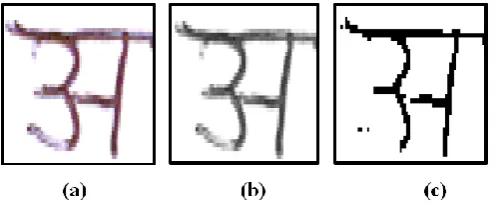
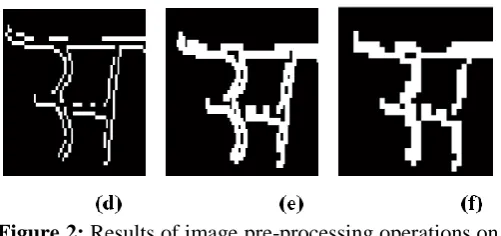
A series of pre-processing operations are applied on scanned images to make them suitable for the further processing. Pre-processing operations improve the quality and heighten the details of the characters. In this work, we converted the RGB character images to gray scale form and then to the binary form by applying the global thresholding. Morphological dilation operation is performed to fill the gaps & holes in characters and edge detection operation to get the boundary of the character. Finally character images are scaled down to the size of 30x30. Results of these pre-processing operations are shown in figure 2.
Figure 2: Results of image pre-processing operations on character image– (a) Scanned image, (b) Gray scale image, (c) Binary image, (d) Edge of the character, (e) Dilated image and (f) Normalized image.
Performance and recognition accuracy of selected model depends greatly on the preferred feature extraction methods. In this work, character images are presented to three feature extraction methods: Discrete Fourier Transform, Discrete Wavelet Transform and Radon transform.
The first method we used for feature extraction is Discrete Fourier Transform (DFT). Fourier transform are basic method to convert an image from space domain to frequency domain and provide a better alternative to spatial domain filtering. Fourier transform facilitates to isolate and process particular frequencies among a range of frequencies [17]. It also allows separating low-pass and high-pass frequencies. Fourier method transforms a signal from one domain to another. Thus detailed and finer features of the signal are exposed to be used in further processing. The Fourier descriptor methods have been successfully applied in character recognition, shape analysis and shape classification. Fourier transform for discrete images is called Discrete Fourier Transform or DFT. Many algorithms have been devised to compute DFT. Fast Fourier Transform is one of the most effective transformation algorithms to obtain the DFT and Inverse Discrete Fourier Transform (IDFT) of an image.
DFT of two dimensional function f (x, y) of an image of size M x N is given by:
(1) for u = 0, 1, 2, …., M-1 and v = 0, 1, 2, …., N-1
To get the original function, inverse DFT is used as follows-
(2) for x = 0, 1, 2, …., M-1 and y = 0, 1, 2,…., N-1.
The second feature extraction method used in this work is Discrete Wavelet Transform (DWT). Wavelet transform decomposes a signal into a set of basic functions called wavelets. We can also say that Wavelet transforms are based on wavelets or small waves. These wavelets have varying frequencies & of limited duration and are obtained from a single prototype wavelet called mother wavelet by dilations and shifting [18] as:
a b t
a t
b a
1) (
,
(3)
where a is scaling parameter and b is shifting parameter
A Basis function is a particular set of functions that are orthogonal and that construct a function f(x) (of a signal or a musical tone). The concept is taken from basis vectors. Vectors (1,0) and (0,1) are said to be the basis vectors of every two-dimensional vector (x, y), as any two-dimensional vector can be called a combination of these two vectors. Wavelet transforms provides better analysis of images than Fourier transform as the latter provides only the frequency information not the temporal information. Wavelets allow multi-resolution analysis of an image and allow transformation in space and time simultaneously.
compression. Two most frequently used discrete wavelets are Haar wavelets and Daubechies wavelets. Daubechies wavelets are used in the proposed work.
The third feature extraction method used in this work is Radon transformation method. Radon transform of an image f(x,y) for a given set of angles can be computed by calculating the projections of the image along the given angles [16]. Basically it is a mapping from the Cartesian rectangular coordinates to polar coordinates (ρ,θ), where ρ is the distance and θ is the angle. Resulting projection is the sum of the intensities of the pixels in each direction. A point in the projection
) ,
( j k
g
is the ray-sum alongj k
k y
xcos
sin
Thus, Discrete Radon transform of an image f (x, y) at coordinates (ρ, θ) is given by:
(4)
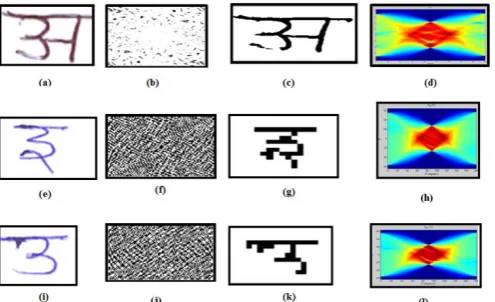
Results of applying each of the defined feature extraction method is described in figure 4.
Figure 3: Results of feature extraction methods: (a) Image of character v , (b) DFT of character v, (c) DWT of character v and (d) Radon transform of character v, (e) Image of character b, (f) DFT of character b, (g) DWT of character b, (h) Radon transform of character b, (i) Image of character m, (j) DFT of character m , (k) DWT of character m and (l) Radon transform of character m.
Dimensionality of the feature vectors obtained by these
methods is reduced by applying the Singular vector
decomposition (SVD). SVD in the feature extraction
works by considering the most relevant and significant
data points for the classification process by taking a high
dimensional, highly variable set of data points and
reducing it to a lower dimensional space. Thus, the
image matrix A is broken down into an orthogonal
matrix U, a diagonal matrix S and the transpose of
orthogonal matrix V as:
T nn mn mm
mn U S V
A
B. Implementation of Neural Networks
An artificial neural network (ANN) is a machine which is designed to act like a human brain to achieve a certain goal related to pattern classification, pattern association, pattern mapping and so on. Motivation behind the development of neural networks is structure and performance of biological neural network, which enables ANN to perform routine as well as the complicated tasks in parallel mode as a human brain does. Thus, a neural network can be termed as a computing architecture designed to resemble the learning and storing capability of human brain [19]. Neural networks store information in the strengths of the interconnections. Neurons are arranged in layers and each derives its input from one or more other neurons and/or external sources. Number of nodes in input layer depend on the number of elements in input feature vector provided to the network, number of nodes in output layer depends upon the number of classes in which data is to be classified and number of nodes in hidden layer are decided by the number of nodes in input layer and complexity of the problem to be solved. Each neuron consists of a summing part, a threshold value and an output part. Directed communication links exists between neurons and each link is associated by a weight, whose value represents the strength of the connection between the units. Based on the number of layers in the network, a neural network can be a single layer network or a multi-layer network.
There are two or more layers of connection weights. In the current work, we used multi-layer feed forward neural network trained with back-propagation learning rule. Back-propagation is a supervised learning
algorithm and belongs to a class of “learning with the teacher”[20]. The back-propagation algorithm works by selecting a random pattern x and calculating the net outputs for each of the hidden layer‟s neurons expressed as:
i N
i ji h
j w x
net
1
1
yj f(nethj)
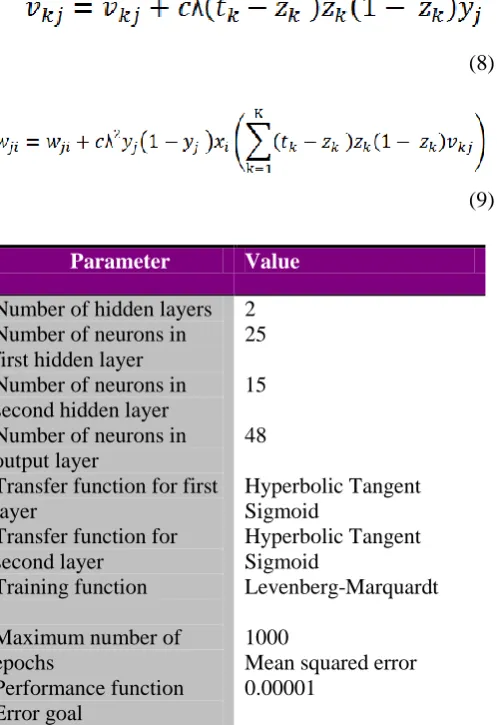
Then, net inputs and outputs of the output layer‟s neurons are calculated. Finally weights are updated in the output layer and in the hidden layer expressed as respectively by equations:
(8)
(9)
Parameter Value
Number of hidden layers Number of neurons in first hidden layer Number of neurons in second hidden layer Number of neurons in output layer
Transfer function for first layer
Transfer function for second layer
Training function
Maximum number of epochs
Performance function Error goal
2 25
15
48
Hyperbolic Tangent Sigmoid
Hyperbolic Tangent Sigmoid
Levenberg-Marquardt
1000
Mean squared error 0.00001
Table 1: parameters used for multilayer feed-forward neural network
The second model selected for the experiment is Radial Basis Function Network (RBFN). RBFN is a feed forward neural network with three layers-
input-hidden-output as presented in figure 2. It is faster than the multilayer perceptron network.
Figure 4: Radial Basis Function Network
Radial basis functions are special classes of functions. Value of the function decreases (or increases) monotonically with distance from a center point. To implement a Radial basis function, hidden unit activation function is required. In pattern classification problems, Gaussian function is widely used. Gaussian activation function for the RBF network is given by the equation:
(10) for j = 1,2,3,………, M
where x is an N-dimensional input vector, σj represents the width of the neuron and μj is the mean of the jth Gaussian function. μj is the vector which determines the center of the basis function ɸj.
Training of the network is done in two steps. In the first step weights from the input layer to the hidden layer are determined and in the second step weights from the hidden layer to the output layer are determined [21]. Units in the output layer implement linear summation function as given below
(11) for K=1,2,3,………., M.
where M is the number of output units, λjk is the weight between the hidden unit and the corresponding output unit.
Parameter Value
Spread of Radial basis function
3.0
Maximum number of neurons 200
Number of neurons in layer 1 177
Number of neurons in layer 2 4
Transfer function in layer 1 Radial basis transfer function
Transfer function in layer 2 Linear transfer function
Number of neurons to add between displays
50
Back-propagation learning rate
0.1
Table 2: Parameters used for Radial basis function neural network
Third model used in this work is Exact Radial Basis Network. The Exact Radial basis network is a radial basis network in which the basis function produces a network with zero error on training vectors. Spread is kept large to make the network perform well. Thus, at any given time point, the active input regions of the neurons have properly large output. The larger the spread is, the smoother the function approximation will be.
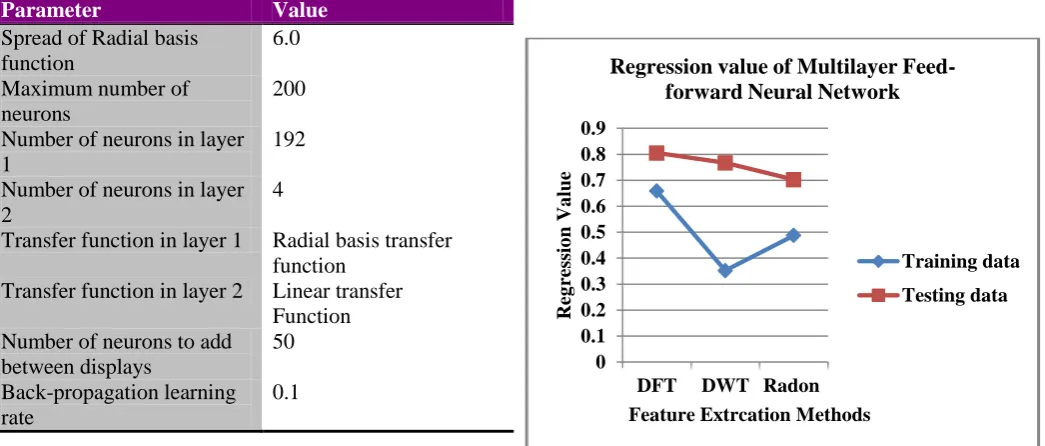
Parameter Value
Spread of Radial basis function
6.0
Maximum number of neurons
200
Number of neurons in layer 1
192
Number of neurons in layer 2
4
Transfer function in layer 1 Radial basis transfer function
Transfer function in layer 2 Linear transfer Function Number of neurons to add
between displays
50
Back-propagation learning rate
0.1
Table 3: Parameters used for Exact radial basis function neural network
III.
RESULT AND DISCUSSION
In the proposed simulation, we are implementing and analyzing the performance of all the seven neural network models for created training patterns (192) and test pattern (96) vectors those have been created from selected feature extraction methods. The results from the simulations are considered from the variants of the feed-forward multilayer neural network models. The performance of these neural network models is presented in table 5.
Table 4: Regression rate of selected networks for
training and testing patterns
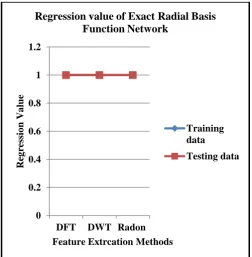
Based on the values of regression, a comparative analysis is presented in figure 7, 8 and 9 for each of the neural network models.
Figure 5: Comparison of regression values of training and testing patterns for Multilayer Feed-forward network
0 0.1 0.2 0.3 0.4 0.5 0.6 0.7 0.8 0.9
DFT DWT Radon
Reg
re
ss
io
n
Va
lue
Feature Extrcation Methods
Regression value of Multilayer Feed-forward Neural Network
Training data
Figure 6 : Comparison of regression values of training and testing patterns for Radial basis function network
Figure 7: Comparison of regression values of training and testing patterns for Exact Radial basis function network
In these figures, we are showing the comparison of the performance of the multilayer feed-forward neural network, Radial basis function network and Exact radial basis function network for the training and testing
pattern vectors. Results show that Exact radial basis function neural network model performs better for training and testing feature pattern vectors than other selected neural network models. Network exhibits 100% recognition accuracy for the selected feature extraction methods. Results also show that the Radial basis function network performs almost similar to that the Exact radial basis function network for the created feature vectors. It is clear from the results that the multilayer feed-forward back-propagation neural network model gives the highest recognition accuracy for DFT method as compared to the other two feature extraction methods.
IV.
CONCLUSION
In this paper we implementing and analyzed the performance of Multilayer feed-forward network, Radial basis function network and Exact radial basis function network for the recognition of handwritten Hindi characters. Simulated results of the performance evaluation are presented and discussed. Following observations have been drawn from the simulated performance evaluation.
(i) Results show that there is a significant difference in training and testing pattern recognition rate in Multilayer feed-forward back-propagation network. The network shows better recognition accuracy for the test pattern set than the training pattern set.
(ii) Results indicate that the Exact radial basis function network is showing 100% recognition accuracy for the selected feature extraction methods. Thus, the network is exhibiting good generalization and approximation behavior for the test and training pattern vectors.
(iii) Results are also showing that the performance of Radial basis function network is almost similar to the performance of Exact radial basis function network. The Radial basis function network is showing above than 97% recognition rate and thus generalized well for the feature extraction methods.
(iv) Results show that feature vector created for training by applying Discrete Fourier transform method gives better results for most of the selected networks.
0.97 0.971 0.972 0.973 0.974 0.975 0.976 0.977 0.978 0.979
DFT DWT Radon
Reg
re
ss
io
n
Va
lue
Feature Extrcation Methods
Regression value of Radial Basis
Function Network
Training data
Testing data
0 0.2 0.4 0.6 0.8 1 1.2
DFT DWT Radon
Reg
re
ss
io
n
Va
lue
Feature Extrcation Methods
Regression value of Exact Radial Basis Function Network
Training data
Results show that feature vector created for testing by applying Discrete Wavelet transform method gives better results for most of the selected networks.
V.
REFERENCES
[1] Govindan V.K. and Shivprasad A.P., “Character Recognition: A Review”, Pattern Recognition, pg. 671-683, Vol. 23, No. 7, 1990.
[2] Plamondon R. and Srihari S.N., “On-Line and Off-Line Handwritten Character Recognition: A Comprehensive Survey,” IEEE Transactions on Pattern Analysis & Machine Intelligence, pg. 63-84, Vol. 22, No. 1, 2000.
[3] Bunke H. and Wang P.S. P., “Hand Book of Character Recognition and Document Image Analysis”, World Scientific, 1997.
[4] Starzyk J. A. and Ansari N., “Feed-forward Neural Network for Handwritten Character Recognition”, IEEE symposium on circuit and systems, 1992. [5] Mangal M. and Singh M.P., “Handwritten English
Vowels Recognition Using Hybrid Evolutionary Feed Forward Neural Networks”, Malaysian Journal of Computer Science, pp. 169-187, Vol. 19, Issue 2, 2006.
[6] Srivastava S. and Singh M.P., “ Performance Evaluation of Feed-forward Neural Network with Soft Computing Techniques for Handwritten English Alphabets”, Applied Soft Computing, pg. 1156-1182, Vol. 11, 2010.
[7] Parappa S.N. and Singh M.P., “Performance Analysis of Conjugate Descent Learning Rule of Feed Forward Neural Networks for Pattern Classification”, International Journal of Multidisciplinary and Current Research, pg. 723-725, Vol. 3, 2015.
[8] Ramteke R. J., “ Invariant Moments Based Feature Extraction for Handwritten Devanagari Vowels Recognition”, International Journal of Computer Applications, Vol.1, No. 18, pp. 1-5, 2010.
[9] P.B. Khanale and S.D. Chitnis, “Handwritten Devanagari Character Recognition using Artificial Neural Network”. Journal of Artificial Intelligence, pg 55-62, Vol. 4, Issue 1, 2011.
[10] Agnihotri V. P., “Offline Handwritten Devanagari Script Recognition”, International Journal of Information Technology and Computer Science, pg. 37-42, Vol. 8, 2012.
[11] Gupta M. and Rana A., “Hybrid Evolutionary Techniques to Restricted Feed Forward Neural Network with Distributed Error for Recognition of Handwritten Hindi „MATRAS‟ International Journal of Soft Computing and Engineering, pg. 161-169, Vol. 2, Issue 2, 2012.
[12] Singh G. and Lehri S., “ Recognition of Handwritten Hindi Characters Using Back-propagation Neural Network”, International Journal
of Computer Science and Information
Technologies, pg. 4892-4895, Vol. 3, Issue 4, 2012. [13] Vaidya S. A. and Bombade B. R., “A Novel
Approach of Handwritten Character Recognition Using Positional Feature Extraction”, International Journal of Computer Science and Mobile Computing, pg. 179-186, Vol. 2, Issue 6, 2013. [14] Jaiswal G., “Handwritten Devnagari Character
Recognition Model Using Neural Network”, International Journal of Engineering Development and Research, pg. 901-906, Vol. 2, Issue 1, 2014. [15] Tanuja K., Kumari U. V and T. M. S.,
“Handwritten Hindi Character Recognition System Using Edge Detection & Neural Network”, International Journal of Advanced Technology and Engineering, pg. 71-75, Vol. 2, Issue 6, 2015. [16] Gonzales R.C. and Woods R.E., “Digital Image
processing”, Pearson Education Pub., Third Edition, 2008.
[17] James J.F., “A Student‟s Guide to Fourier Transforms – With Applications in Physics and Engineering”, Cambridge University Press, Third Edition, 2011.
[18] Goswami J.C. and Chan A.K., “Fundamentals of Wavelets – Theory, Algorithms and Applications”, Wiley & Sons Publications, Second Edition, 2011. [19] Haykin S., “Neural Networks: A Comprehensive
Foundation”, New York: Macmillan College Publishing Company Inc., 1994.
[20] Yagnanarayana B., “Artificial Intelligence”, Prentice Hall Pub., Ninth Edition, 2004.