A Study on Green IT Adoption
Houn-Gee Chen
1, Jamie Chang
2,*1National Taiwan University, Taipei, Taiwan 2Tunghai University, Taichung Taiwan
*Corresponding Author: [email protected]
Copyright © 2014 Horizon Research Publishing All rights reserved.
Abstract Green IT adoption is a plausible attempt for
organizations to tackle the current environmental problem. The objective of this study is to examine the leading factors of Green IT adoption decisions. More specifically, we are interesting the issue of whether government support playing a key factor on determining Green IT adoption in developing countries. Based upon a survey of 64 organizations in Taiwan, the results indicated that environmental compliance (i.e., responding to the environmental regulation changes and citizenships), instead of economic consideration, was the driving force for organizations to adopt Green IT. Furthermore, government support, indeed, played an important role for leading organizations to pursuit their social responsibilities. Technological resources and governance toward green IT were also important factors for organizations to be ready to exercise their social responsibilities.Keywords
Green IT Context, Perceived Organizational G-readiness, Green Drivers, Intention to Adopt Green IT, Governance Support1. Introduction
Green issues have been academically proposed since the end of the 20th century. Due to its environment- oriented essence, some economists put emphasis on pollution issues and argued “green” from mandatory points of view [3]. To respond effectively and efficiently to the environmental sustainability challenge, appropriate strategies and operations are needed [1], such as a new service system needs to consider green technology, processes and product development. Nowadays, most service-oriented organizations develop new technologies or products to deal directly with environmental constraints, and improve their energy efficiency [21,38]. Government is, therefore, considered to be the one who has to take responsibility for environmental protection and ordinarily required to initiate the amelioration. The adoption of green IT, although to some extent could be similar to the adoption of other technologies, but it has a number of differences [30, 12]. On the corporate
level, it has been debated that whether there is a tradeoff between environmental protection and business performance. Palmer et al. [31] comment that productive investments will be restrained under environmental regulation. The tension between the social responsibilities and the business revenues influences the pace of green technology adoption [10]. It suggests that in seeking to explain the adoption of Green IT, effort should be exerted to cover both the economic and environmental compliancy factors [27].
In the literature, the Technology-Organization- environment (TOE) framework [34] and the Perceived E-Readiness Model (PERM) [25,26] have provided a framework to examine the antecedents of IT innovation adoption[27]. A number of studies have tested both TOE [17, 40] and PERM [20, 33] and demonstrated their usefulness for studying determinants of innovation adoption in general. TOE helps to identify the static and primary contextual variables for Green IT (i.e., Green IT context). The PERM, on the other hand, is useful to capture the dynamic and perceptual readiness dimensions (i.e., Green IT readiness). Molla [27] suggests that both the TOE and PERM constructs as second-order facilitators and argues that these are the antecedents for the two key Green IT adoption drivers – economics and environmental compliancy. Unfortunately, there is no empirical evidence to support that TOE and PERM are second-order constructs. Each dimension within TOE (or PERM) is, in fact, not necessary caused by the same “underline cause”, a critical requirement as a second-order construct. Therefore, it is likely TOE or PERM is neither a second-order reflective nor formative second-order formative constructs. This study, therefore, argue that the exact antecedents for Green IT adoption should be examined separately. More specifically, we suggest that business resources, technological resources, and government supports are among the others, the most important antecedents to influence the economic and environmental compliance.
developing country content. Second, we argue that business resources and technological resources among others are most important factors leading to the economical driver for the Green IT adoption; on the other hand, government support and corporate governance are the most critical factors leading to environmental compliance driver of the Green IT adoption. The results of this study will contribute the literature, at least, in the followings: (1) it will provide an empirical evidence on the debate of whether government will play an important role on determining organizational Green IT adoption decisions; (2) the results will support the proposed economic and environmental compliance as the two key Green IT adoption drivers; (3) some of the key antecedents for economic or environmental compliance are identified under a developing country context; and (4) finally, these empirical evidences will shed lights on our understanding of Molla’s [27] proposed Green IT adoption model.
2.Theoritical Background
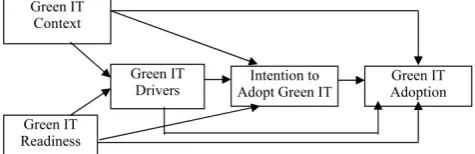
Green IT adoption is a nascent field and there is lacking both theoretical and empirical research on the topic with few exceptions [27]. From service science literature, it indicates that Green IT can deal with the environmental and economical challenge to fulfill stakeholder’s need [22]. Much of the service literature has provided practical examples on how service-oriented firms adopted green service practices and achieve better organizational performance [14, 18]. However, how to motive organizations to adopt Green IT for environmental sustainability is lacking of exploring. From IS literature, Molla [27] explores the determinants of Green IT adoption intention base on TOE framework [34] and the PERM [25,26]. Figure 1 depicts the Molla’s proposed Green IT adoption model. TOE framework [34] proposed three elements that influence the process when adopting technological innovations, including:(1) the environmental context, (2) the technology context, and (3) the organization context. This framework can help to identify the static and primary contextual variables for Green IT. The existing literature suggests the followings: (1) technology context play an important role for determining organizational adoption decisions, while financial resources, global scope, and regulatory environment have significant impact on e-business value as well; (2) organization size is negatively related to e-business value, which indicates that large organization face more hindrances on creating e-business value; (3) innovation adoption is influenced more on internal resources (e.g., technological readiness) than external pressure (e.g., competitive pressure); (4) from the business cycle perspective, financial resources are important for companies to adopt innovations in early stage. However, technological capabilities are far more significant when organizatinos step into advanced development; (5) top-management support is a critical factor for determining organizational innovation adoption decisions; and (6)
[image:2.595.313.551.199.276.2]government regulation has more significant impact on developing countries than developed ones. In general, it has been concluded that government regulation and top management support are the most important factors for determining the innovation adoption, based upon the TOE framework. In this study, we, therefore, will only focus on the top-management support and government regulations as we believe that these are important for Green IT adoption under developing countries.
Figure 1. The green IT adoption model (Molla, 2008)
PERM, on the other hand, posits that perceived organizational and environmental e-readiness are critical in a business’s decision to adopt innovative technologies [25,26]. The PERM model includes two key sub-constructs: POER (Perceived Organizational e-Readiness) and PEER (Perceived External e-readiness). Furthermore, both POER and PEER include the following four dimensions: (1) Awareness refers to an organization’s perception, comprehension, and perceived benefits and risks of adopting technologies; (2) Resources (consisting of human, business, and technology) refers to the capabilities that an organization possesses for future needs or dynamic changes; (3) Commitment refers to the promise from group members, particularly top executives who preside over long-term strategies of an organization; and (4) Governance refers to strategies and tactics which conduct decision making, resources allotment, and develop overall goals. In Molla and Licker’s [25] research, organizational readiness and environmental readiness have profound impact than PEER on innovation adoption. Therefore, as one of early Green IT studies, we would only focus on the POER factors. Among the POER factors, this study will only examine the following three factors: business resources, technological resources, and governance.
Given that Green IT is an emerging concept and there is no complete standard and reference for government in present situation, government plays a significant role as a facilitator (Velte et al., 2008). The incentives and assistances provided by government are important for organizations to realize the Green IT adoption. For example, among others, the “ABCDE Program [24]”, “Industrial Technology Development Program (ITDP)”, and “Innovation Technology Applications & Services Program (ITAS)” are recently proposed green IT adoption government supporting programs in Taiwan, and as a result, many enterprises were supported to implement new Green ITs. Even some other technical or organizational context factors (e.g., organization utilizing high density servers, utility companies such as oil, gas and electricity) have been proposed as important organizational context for Green IT adoption, the objective of this study is, however, interesting in the importance of government support on leading the Green IT adoption in developing countries. Furthermore, technical resources, business resources, and governance are important factors for determining the IT adoption decisions [25]. These factors should also play critical role on Green IT adoption given that resources are often a key consideration for adopting a new innovative IT.
3. Research Model
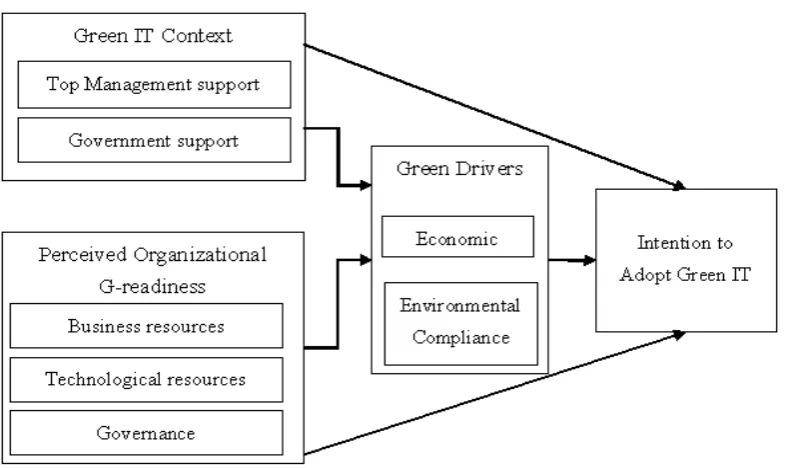
Based upon the Molla’s [27] proposed model and the above discussion, in the study, we, therefore proposed the following research model (Figure 2). We design Green IT context as a package containing two dimensions from organizational and environmental factors: top management support and governance support. On the other hand, POGR includes three dimensions: business resources, technological resources, and governance.
3.1. Green IT Context
3.1.1. Top Management Support
Top management support is crucial factors of adoption [7] and can be treated as companies’ supportive attitude. When the strategies endorse to set aside resources and guaranteed promise with a will, organizations are more willing to adopt green IT [15]. Under such supportive attitude and believe, corporations hold powerful backing and their green motivation will be triggered accordingly. Concluded above constructs and proposed linkages included in organizational context, we infer following hypotheses:
Hypothesis 1a. Top Management support is positively
associated with intention to adopt Green IT.
Hypothesis 1b. Top Management support is positively
associated with Green IT economic drivers.
Hypothesis 1c. Top Management support is positively
[image:3.595.110.503.463.697.2]associated with Green IT environmental compliance drivers.
3.1.2. Governance Support
Government support we define here are the perception of fiscal support, knowledge sharing, and supportive laws by government perceived by corporations. Enterprises implementing green IT could gain the long-term benefits such as reputation. Needleless, they may not have the ability or resources to conduct environmental technologies. Government should provide some incentives for them to accept such concept then take them into considerations.
It is common in US that government volunteer to invest green project as well as guide and assist companies to adopt green IT. When government provides incentives for green practices, there must be some more enterprises which have higher intention to adopt such technology. In Taiwan, some of the organizations have neither enough resources nor proficient green IT personnel; therefore, they need assistance from others. Government is the most possible organization who will volunteer to help due to green technologies reduction on pollution which might harmful for whole people. This study therefore proposes the hypotheses as below:
Hypothesis 2a. Government support is positively associated with intention to adopt green IT.
Hypothesis 2b. Government support is positively associated with Green IT economic drivers.
Hypothesis 2c. Government support is positively associated with Green IT environmental compliance drivers.
3.2. Perceived Organizational G-readiness
3.2.1. Resources
Resources refer to the capabilities that an organization possesses for future needs or dynamic changes. Technological resources related to the IT based of an organizational, the extent of computerization, and experience with network-based applications [32]. Business resources cover capabilities and assets, including openness of organizational communication, risk-taking behavior, nature of existing business relationship, and financial resources.
Severe organizational constraints on technological and business resources often cause not only on economic, environmental compliance drives but also on organizational intention to adopt green IT. As the result, their resources could become crucial to either facilitating or impeding both on green IT drivers and intention to adopt green IT. This study therefore proposes the hypotheses as below:
Hypothesis 4a.Business resources contribute positively
associated with intention to adopt Green IT.
Hypothesis 4b.Business resources contribute positively associated with Green IT economic drivers.
Hypothesis 4c.Business resources contribute positively associated with Green IT environmental compliance drivers.
Hypothesis 5a. Business resources contribute positively
associated with intention to adopt Green IT.
Hypothesis 5b. Business resources contribute positively
associated with Green IT economic drivers.
Hypothesis 5c. Business resources contribute positively
associated with Green IT environmental compliance drivers. 3.2.3. Governance
Governance refers to strategies and tactics which conduct decision making, resources allotment, and develop overall goals. It involves a set of relationships between a company’s management, its board, its shareholders and other stakeholders, and also provides the structure through which the objectives of the company are set, and the means of attaining those objectives and monitoring performance are determined [29]. Finally, enterprises should have supporting measures, or governance, as a standard for whole company to follow. Otherwise, it will lead to the inconsistency and disorder of company objectives and staff identification. Therefore, the following hypotheses are formulated:
Hypothesis 6a. Governance support is positively associated with intention to adopt green IT.
Hypothesis 6b. Governance support is positively associated with green IT economic drivers.
Hypothesis 6c. Governance support is positively associated with green IT environmental compliance drivers.
3.3. Green IT Drivers
3.3.1. Economic Drivers
Economic driver refers to organization pursuits of tangible cost saving from IT operations. Williamson et al. [36] pointed out that economic drivers are particularly appealing to those organizations who adopt Green IT since its direct and obvious benefit. In Zhu et al., [40], economic driver is the most influential element when corporations adopt Green IT. Thus, this study therefore proposes the hypothesis as below:
Hypothesis 6. Organizations with stronger economic drivers tend to have higher intention to adopt green IT.
3.3.2. Environmental Compliance Drivers
therefore proposes the hypothesis as below:
Hypothesis 7. Organizations with stronger environmental compliance driver tend to have higher intention to adopt Green IT.
4. Research Methodology
4.1. Sampling Procedures and Characteristics
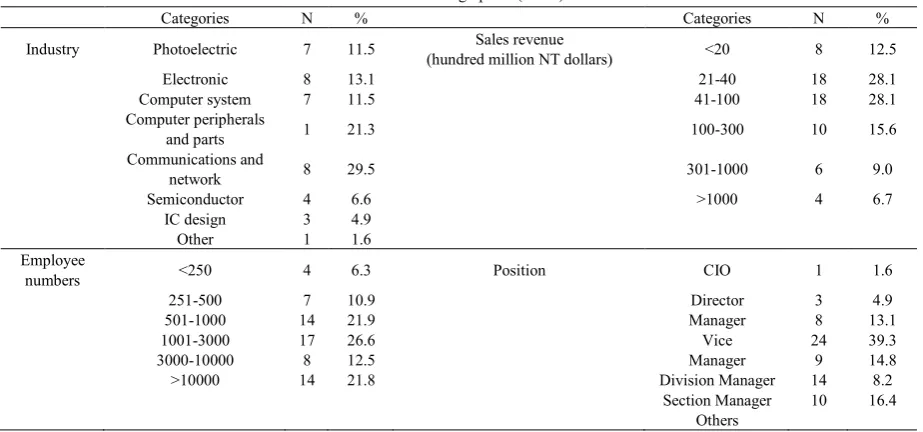
A mail survey was conducted from top1000 manufacturing firms identified by China Credit Information Service, Ltd. The target sample was the green decision-makers in corporations. We enclose a stamped envelope with the cover letter and questionnaire. A total of 70 respondents were returned. Out of those responses, 6 were incomplete and thus discarded from the sample. Finally, the characteristics of 64 respondents are depicted in Table 1.
4.2. Measurement
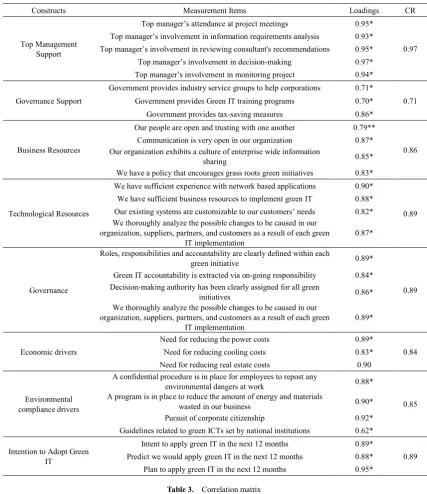
All the examined research variables were measured from prior studies reported in the literature. The items were translated into Chinese and verified for accuracy by two faculty members and two practitioners fluent in both Chinese and English. All items were measured on a 5 point Likert scale according to the original sources for the measures, with anchors ranging from 1 (strongly disagree) to 5 (strongly agree). The 5 items for measuring top management support were adapted from Yap et at. [39]. Items for governance support were developed for this study. The 4 items for measuring business resource and 4 items technological resource, and 4 items for measuring governance were adapted from Molla and Licker [25]. The 3 items for measuring economics drivers and the 4 items for measuring environmental compliance drivers were developed for this study.
5. Data Analysis
SmartPLS was used to evaluate the measurement and structural models. A recommended two-step procedure including measurement validation followed by structural path analysis was used for data analysis [5].
5.1. Assessing the Measurement Model
Item reliability, convergent validity, and discriminant validity tests are often used to validate the measurement model. Individual item reliability can be examined by the factor loading of each item. A high loading implies that the shared variance between constructs and its measurement is higher than error variance [16, 13]. Factor loadings higher than 0.7 are viewed as high reliability and factor loadings<0.5 should be dropped. Convergent validity should be assured when multiple indicators measure one construct. It can be examined by item reliability, composite reliability, and the variance extracted by constructs (AVE) [11, 19]. To have required convergent validity, composite reliability of each construct should be higher than 0.7 [6]. Moreover, if the square root of the AVE is <0.707, it means that the variance captured by the construct is less than the measurement effect and the validity of the associated indicators is questionable [11].
[image:5.595.75.537.539.755.2]Discriminant validity focuses on testing whether the measures of constructs are different from each other (Messick, 1980). There are two procedures for assessing discriminant validity. First, the square root of AVE should be higher than inter-construct correlation coefficients [11,5]. Second, the correlation between pairs of constructs should be lower than 0.80 [2]. The square roots of the AVEs shown on the diagonal of the correlation matrix in Table 3, ranged from 0.79 to 0.95, exceeding the threshold of 0.707. As indicated in Table 3, the AVEs are greater than the inter-construct correlations. The results exhibit strong construct reliability and validity.
Table 1. Demographics (N=64)
Categories N % Categories N %
Industry Photoelectric 7 11.5 (hundred million NT dollars) Sales revenue <20 8 12.5
Electronic 8 13.1 21-40 18 28.1
Computer system 7 11.5 41-100 18 28.1
Computer peripherals
and parts 1 21.3 100-300 10 15.6
Communications and
network 8 29.5 301-1000 6 9.0
Semiconductor 4 6.6 >1000 4 6.7
IC design 3 4.9
Other 1 1.6
Employee
numbers <250 4 6.3 Position CIO 1 1.6
251-500 7 10.9 Director 3 4.9
501-1000 14 21.9 Manager 8 13.1
1001-3000 17 26.6 Vice 24 39.3
3000-10000 8 12.5 Manager 9 14.8
>10000 14 21.8 Division Manager 14 8.2
Section Manager 10 16.4
Table 2. Measurement model: reliability and convergent validity
Constructs Measurement Items Loadings CR
Top Management Support
Top manager’s attendance at project meetings 0.95*
0.97 Top manager’s involvement in information requirements analysis 0.93*
Top manager’s involvement in reviewing consultant's recommendations 0.95*
Top manager’s involvement in decision-making 0.97*
Top manager’s involvement in monitoring project 0.94*
Governance Support
Government provides industry service groups to help corporations 0.71*
0.71
Government provides Green IT training programs 0.70*
Government provides tax-saving measures 0.86*
Business Resources
Our people are open and trusting with one another 0.79**
0.86
Communication is very open in our organization 0.87*
Our organization exhibits a culture of enterprise wide information
sharing 0.85*
We have a policy that encourages grass roots green initiatives 0.83*
Technological Resources
We have sufficient experience with network based applications 0.90*
0.89 We have sufficient business resources to implement green IT 0.88*
Our existing systems are customizable to our customers’ needs 0.82* We thoroughly analyze the possible changes to be caused in our
organization, suppliers, partners, and customers as a result of each green
IT implementation 0.87*
Governance
Roles, responsibilities and accountability are clearly defined within each
green initiative 0.89*
0.89 Green IT accountability is extracted via on-going responsibility 0.84*
Decision-making authority has been clearly assigned for all green
initiatives 0.86*
We thoroughly analyze the possible changes to be caused in our organization, suppliers, partners, and customers as a result of each green
IT implementation 0.89*
Economic drivers
Need for reducing the power costs 0.89*
0.84
Need for reducing cooling costs 0.83*
Need for reducing real estate costs 0.90
Environmental compliance drivers
A confidential procedure is in place for employees to repost any
environmental dangers at work 0.88*
0.85 A program is in place to reduce the amount of energy and materials
wasted in our business 0.90*
Pursuit of corporate citizenship 0.92*
Guidelines related to green ICTs set by national institutions 0.62*
Intention to Adopt Green IT
Intent to apply green IT in the next 12 months 0.89*
0.89 Predict we would apply green IT in the next 12 months 0.88*
[image:6.595.89.517.86.581.2]Plan to apply green IT in the next 12 months 0.95*
Table 3. Correlation matrix
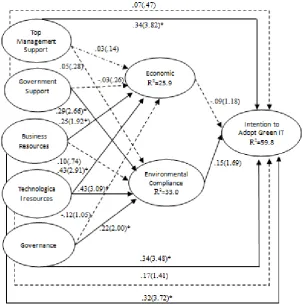
Figure 3. Structural model
5.2. Assessing the Structural Model
The test of the structural model includes estimating the path coefficients, which indicate the strengths of the relationships between the independent and dependent variables, and the R2value, a measure of the predictive power of the model for the dependent variables. A bootstrap resampling procedure was used to generate t-statistics and standard errors [5]. The overall results of the analysis are shown in Figure 3 (* indicate significant at p < 0.05 level). As hypothesized, top manager support (path coefficient =.34, p<0.05), business resources (path coefficient =.35, p <0.01) and governance (path coefficient =.34, p<0.05) are significantly associated with intention to adopt green IT, accounting for 59.8% of the variance. Business Resources (path coefficient =.25, p<0.05), technological resources (path coefficient =.43, p<0.05) are significantly associated with economic driver, accounting for 25.9%. Governance support (path coefficient =.29, p<0.05), technological resources (path coefficient =.43, P<0.05), and governance (path coefficient =.22, p<0.05) are significantly associated with environmental compliance drivers, accounting for 33% of variance.
6. Discussion and Conclusions
To respond the environmental sustainability challenge, Green IT needs to be concerned for a new service system
development. This study adopted a framework that draws upon TOE and PEOR to examine the Green IT adoption factors. The results indicated that environmental compliance played a more critical role than economic for determining the Green IT adoption decision in developing countries. The business benefits derived from green IT is remains questionable and difficult to be objectively evaluated. Organizations were less motivated to implementing green IT projects by view implementing such adoption is a capital consuming investment. Therefore, managers should foresee the requests and standards set by public institutions or government. This is consistent with suggestion that as legislations become enforceable, they motivate the adoption of certain green IT practices despite a business’s lack of intention to do so [27]. Furthermore, governance support is important factor leading to environmental compliance. Government must provide the necessary infrastructure and knowledge to organizations especially when the organizations may not fully realize the Green IT’s economic benefits.
Green IT. Organizations should equip themselves with sufficient resources and capabilities. Without such resources, organization may not be able to cope with the environmental compliance. Governance mechanisms provides a control and intervention mechanisms for organizations to adopt the Green IT. It indicated that when organizations have clear defined roles, responsibilities and accountabilities on green initiatives, the organizations were more likely to adopt the Green IT.
This study is not without limitations. First, common method variance (CMV) may inflate or deflate the dependent-independent relationship when a single information source is adopted. Data from multiple viewpoints are encouraged in future studies. Second, the research scope is limited by validating relationships through cross-sectional data since causality cannot be inferred.
REFERENCES
[1] Albino, V., Azzurra, B. & Dangelico, R.M. (2009), “Environmental strategies and green project development: An overview on sustainability-driven companies”, Business Strategy and the Environment, Vol. 18, Pp. 83-96.
[2] Bagozzi, R.P. & Yi, Y. & Phillips, L.W. (1991), “Assessing construct validity in organizational research”, Administrative Science Quarterly, Vol. 36, No. 3, Pp. 421–458.
[3] Baumol, W.J. & Oates, W.E. (1988), “The Theory of Environmental Policy”, Cambridge: Cambridge University Press.
[4] Bernauer, T. Engels, Kammerer, & Seijas, J. (2006), “Explaining Green Innovation -Ten Years after Porter's Win-Win Proposition: How to Study the Effects of Regulation on Corporate Environmental Innovation?” CIW Working Paper, No. 17, Center for Comparatie and International Studies, ETH Zurich.
[5] Chin, W.W. (1998), “The partial least squares approach to structural equation modeling”. In: Marcoulides, G.A. (Ed.), Modern Methods for Business Research. Lawrence Erlbaum Associates, New Jersey, Pp. 295–336.
[6] Chin, W.W., Marcolin, B.L. & Newsted, P.R. (2003), “A partial least squares latent variable modeling approach for measuring interaction effects: results from a Monte Carlo simulation study and an electronic-mail emotion/adoption study”, Information Systems Research, Vol. 14, No. 2, Pp. 189–217.
[7] Cooper, R.B. & Zmud, R.W. (1990), “Information technology implementation research: a technological diffusion approach”, Management Science, Vol. 36, No. 2, Pp. 123-139.
[8] Dechant, K. & Altman, B. (1994), “Environmental Leadership: From Compliance to Competitive Advantage”,
Academy of Management Executive, Vol. 8, No. 3, Pp. 7-20.
[9] DiMaggio, P.J. & Powell, W. (1983), “The iron cage revisited: Institutional isomorphism and collective rationality in organizational behavior”, American Sociological Review,
Vol. 48, Pp. 147-160.
[10] Esty, D.C. & Winston, A.S. (2006), “Green to Gold: How Smart Companies Use Environment Strategy to Innovate, Create, Value, and Build Competitive Advantage”, Yale University Press.
[11] Fornell, C. & Larcker, D.F. (1981), “Evaluating structural equation models with unobservable variables and measurement error. Journal of Marketing Research”, Vol. 18, No. 1, Pp. 39–50.
[12] González, P.d.R. (2005), Analyzing the factors influencing clean technology adoption: A Study of the Spanish pulp and paper industry, Business Strategy and the Environment, Vol, 14, No. 1, 20-37.
[13] Goodhue, D., Lewis, W. & Thompson, R. (2006), “PLS, small sample size, and statistical power in MIS research”.
Proceedings of the 39th Hawaii International Conference on
System Sciences.
[14] Goodman, A. (2000), “Implementing sustainability in service operations at scandic hotels”, Interfaces, Vol. 30, No. 3, Pp.202–214.
[15] Hemingway, C.A. & Maclagan, P.W. (2004), Managers' Personal Values as Drivers of Corporate Social Responsibility. Journal of Business Ethics, Vol. 50, No. 1, Pp. 33-44.
[16] Hulland, J. (1999), Use of partial least squares (PLS) in strategic management research: a review of four recent studies. Strategic Management Journal, Vol, 20, No. 2, Pp. 195–204.
[17] Iacovou, C. Benbasat, I. & Dexter, A. (1995), “Electronic data interchange and small organizations: Adoption and impact of technology”, MIS Quarterly, Vol. 19, No. 4, Pp. 465–485.
[18] Kassinis, G.I. & Soteriou, A.C. (2003), “Greening the service profit chain: The impact of environmental management practices”, Production Operations
Management, Vol, 12, No. 3, Pp.386–403.
[19] Kerlinger, F.N., Lee, H.B. (2000). “Foundations of Behavioral Research”, fourth ed. Harcourt College Publishers, California.
[20] Lai, F., Dahui, L., Wang, J. & Hutchinson, J. (2006), “An empirical investigation of the effects of e-readiness factors on e-business adoption in China's international trading industry”, International Journal of Electronic Business, Vol. 4, No. 3-4, Pp. 320-339.
[21] Laperche, B. & Picard, F. (2013), “Environmental constraints, Product-Service Systems development and impacts on innovation management: learning from manufacturing firms in the French context”, Journal of Cleaner Production, Vol. 53, Pp. 118-128.
[22] Lee, S.W. & Kim, Y.S. (2010), “A product-service systems design method integrating service function and service activity and case studies”, CIRP ISS2 Conference, Linköping, Pp-275-282.
[23] Messick, S. (1980), “Test validity and the ethics of assessment”, American Psychologist, Vol. 35, Pp. 1012–1027.
create the future, September, 2006.
[25] Molla, A. & Licker, P. (2005a), “Perceived e-readiness factors in e-commerce adoption: an empirical investigation in a developing country”, International Journal of Electronic
Commerce, Vol. 10, NO. 1, Pp. 83-110.
[26] Molla, A. & Licker, P. (2005b), “E-commerce adoption in developing countries: A model and instrument”, Information & Management, Vol. 44, No. 6, Pp. 877-899.
[27] Molla, A. (2008), “GITAM: A model for the acceptance of Green IT”, The 19th Australasian Conference on Information
Systems, Christchurch, December.
[28] Noci, G. & Verganti, R. (1999), “Managing green' product innovation in small firms”, R&D Management, Vol. 29, No. 1, Pp. 3-15.
[29] OECD, Corporate Governance. A Survey of OECD Countries. OECD, Paris, 2004.
[30] Olson, E.G. (2008), Creating an enterprise-level "green" strategy", The Journal of Business Strategy, Vol. 29, No. 2, Pp. 22-30.
[31] Palmer, K., Oates, W. & Portney, P. (1995), “Tightening environmental standards: The benefit-cost or the no-cost paradigm?” Journal of Economic Perspectives, 9(4), Pp. 119-132.
[32] Powell, T.C., & Dent-Micallef, A. (1997), “Information technology as a competitive advantage: The role of human, business and technology resources”, Strategic Management Journal, Vol. 18, No. 5, Pp. 375–405.
[33] Tan, J., Tyler, K. & Manica, A. (2007), “Business-to-business adoption of eCommerce in China”,
Information & Management, Vol, 44, No. 3, Pp. 332-351. [34] Tornatzky, L.G. & Fleischer, M. (1990), “The Processes of
Technological Innovation”. Lexington, MA: Lexington Books.
[35] Velte, T.J., Velte, A.T. & Elsenpeter, R.C. (2008), “Green IT: Reduce your information system's environmental impact while adding to the bottom line”, McGraw-Hill, New York, [36] Williamson, D. & Lynch-Wood, G. (2006), "Drivers of
environmental behaviour in manufacturing SMEs and implications for CSR". Journal of Business Ethics, Vol. 6, No. 3, Pp. 317–330.
[37] Williamson, D., Lynch-Wood, G. & Ramsay, J. (2006), “Drivers of Environmental Behaviour in Manufacturing SMEs and the Implications for CSR. Journal of Business Ethics, Vol, 67, No. 3, Pp. 317-330.
[38] Wong, W. & Boon-itt (2013), “Performance implications and role of EMS”, Service Science, Articles in Advance, Pp-1-16.
[39] Yap, C.S., Thong, J.Y.L. & Raman, K.S. (1994). “Effect of government incentives on computerization in small business”,
European Journal of Information Systems, Vol. 3, No. 3, Pp.
191-206.