A Study In The Performance Of Mid-Day Meal
Scheme In The Hapjan Block Of Assam
Lipika jyoti Dowarah
Abstract: Education plays a vital role in fulfilling the basic needs food, shelter and clothing of a common man. It contributes in flourishing the individuality through the enhancement of social and professional integration. Mid-Day Meal Scheme is one of the popular schemes introduced by the Government of India to universalize the elementary education. The basic objective of the scheme is to enhance enrollment, attendance and retention of primary school children along with a proper nutritious meal within the school premise. In the present study an attempt has been made to study the performance of the scheme in government primary schools of Hapjan Block of Assam.
Index Terms: Education, Mid-Day Meal, Enrollment, Hapjan Block, Assam
————————————————————
1.
INTRODUCTION:
Education acts as an important indicator of human resource development, it helps in empowering and uplifting individuals with basic knowledge and technical skills necessary for their survival. It is a process of developing the capabilities that lies within the individual. But it is believed that a hungry child is less likely to attend school regularly. Hunger drains of the ability and willingness to learn of a child. Chronic hunger not only leads to malnutrition among the children it also stops their physical and mental growth. Malnutrition not merely gives rise to morbidity and mortality, and prevents a child from developing into a fully functional adult; it also adversely affects Universalization of Elementary Education (UEE). As compared to the healthy child, a malnourished child is less likely to attend school regularly. Even if they attain school, he/she finds it difficult to concentrate and participate in teaching learning activities. As a result, because of inability to cope up he/she therefore tends to dropout or even if the child does not actually dropout, but their attendance level tends to be low as compared to the others. Mid-day meal is a public welfare programme introduced for the first time in the Madras Cooperation area dates back in 1925 for underprivileged children so that they can attain primary education along with proper nutrition. The programme was later introduced on large scale in 1960s for providing daily and nutritious meal of 400 calories to poor children in the age group of 2 to 10. Noon Meals Scheme was introduced for the first time by Tamil Nadu Government on July 1 1982. Besides these, several other states of India too have started the school meal programme prior to the government of India’s initiative. The main aim of the noon meals in the school premises is to attack more and more children to the schools so that they are not left out from the basic education.
Mid-day Meal Scheme was launched in India for the first time by the Narsimha Rao Government in 15August 1995 to eliminate the classroom hunger by serving cooked hot meal to the school going children and improving their nutritional status nationwide. The Mid-Day Meal Scheme focuses on providing lunch free of cost to the primary school children within the school premises between the age group of 4 to 14 years on all working days. The main objective of the scheme introduced by the Government of India is to increase the enrollment and attendance of the children in the government primary schools by reducing the hunger of the children and also by improving socialization among the children’s belonging to different religion and castes and also by overcoming the problem of malnutrition. Although the scheme was launched in India in 1995 but in Assam Mid-Day Meal Scheme was introduced in 2005 covering all the educational blocks of the district. In the present study an attempt has been made to study the performances of Mid-Day Meal Scheme in enhancing enrollment and reducing primary school dropouts of Hapjan Block of Assam. Hapjan Educational Block is one of the largest Educational Block of Tinsukia district Assam in terms of area. As per 2011, the block constitutes maximum amount of illiterates compared to other blocks of the district. The study covers the enrolment and dropouts of students in sample schools from 2009 to 2014. The year 2004 is taken as a base year since because the scheme was implemented in the government schools of Assam from 2005.
2.
OBJECTIVE:
The present study aims to fulfill the following objectives: 1. To study the performance of Mid-Day Meal
Scheme in enhancing enrollment of children in Government primary school of Hapjan Block of Assam.
2. To study the performance of Mid-Day Meal Scheme in reducing dropouts of children in the study area.
3.
METHODOLOGY:
Descriptive methodology has been used to study the performances of Mid-Day Meal Scheme in enhancement of enrollment and retention of primary school children in Hapjan Educational Block of Assam. A sample of 20 Government schools consisting of both rural and urban schools has been randomly selected from the block for the
____________________
study. Both primary and secondary data’s were used to study the performance of the scheme. Primary data’s were collected with the help of self-structured questionnaire through interview schedule from the teachers, students and cooks of the selected sample schools. The interview schedule has covered the information related to performance of the scheme in enhancing enrollment, attendance and reducing dropouts. Secondary data’s were collected from the Department of Elementary Education, Government official websites, journals, books and census report. Collected raw data’s were statistically analyzed in SPSS 20. Tables, bar diagrams, graphs, Average Annual Growth Rate were used during the analysis.
4.
ANALYSIS:
4.1 Enrollment:
By enrolment in primary schools we generally mean the number of children’s getting enrolled in educational institutions regardless of their religion, sex, age, status etc. Government of India has implemented the Mid-Day Meal Scheme in the government primary schools mainly to enhance the enrolment of the children and reduce their dropouts. Average Annual Growth Rate (AAGR) also known as Enrollment Rate is being calculated in the table below to observe the change in enrolment of children’s in government primary schools since after the implementation of the scheme.
Table 1: Percentage Distribution of Enrollment of Total students in Sample Schools from 2004-19
Year Total Enrolled Percentage Change on base year :
2004 AAGR (%)
2004 4057 ___ ___
2005 4096 0.96 0.96
2006 4088 0.76 -0.19
2007 4091 0.83 0.07
2008 4076 0.46 -0.36
2009 4035 -0.54 -1.00
2010 4089 0.78 1.33
2011 4077 0.49 -0.29
2012 4039 -0.44 -0.93
2013 4016 -1.01 -056
2014 4025 -0.78 0.22
2015 3989 -1.67 -0.89
2016 3977 -1.97 -0.30
2017 3965 -2.26 -0.30
2018 3971 -2.11 0.15
2019 3966 -2.24 -0.12
Source: Field Survey
The table 1 above shows the year wise enrollment of children in government primary schools of Hapjan Block of Assam. 2004 is taken as a base year since; the Mid-Day Meal Scheme has been implemented in Assam from 2005. It is seen from the table above that in the year 2004, the total number of children enrollment in Hapjan Block is 4057. The table also indicates that there is rise in the enrolment of children in the beginning years of implementation of the
scheme from 0.96 % in 2005 to 1.33% in 2010. But in the latter years from 2011(-0.29%) to 2019 (-0.12%) enrolment of primary school children in government schools has continuously decreased. Survey reveals that fall in enrollment of children in government primary schools is mainly because of mushrooming private educational institutions in the locality.
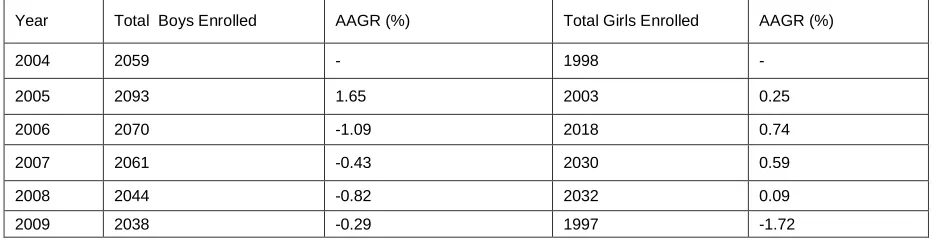
Table 2: Percentage Distribution of Enrollment of Total Boys and Girls in Sample Schools from 2004-19
Year Total Boys Enrolled AAGR (%) Total Girls Enrolled AAGR (%)
2004 2059 - 1998 -
2005 2093 1.65 2003 0.25
2006 2070 -1.09 2018 0.74
2007 2061 -0.43 2030 0.59
2008 2044 -0.82 2032 0.09
2010 2061 1.12 2028 1.55
2011 2041 -0.97 2036 0.39
2012 2033 -0.39 2006 -1.47
2013 2018 -0.73 1998 -0.39
2014 2011 -0.34 2014 0.80
2015 2009 -0.09 1980 -1.68
2016 2006 -0.14 1971 -0.45
2017 1991 -0.74 1974 0.15
2018 1986 -0.25 1985 0.55
2019 1987 0.05 1989 0.20
Source: Field Survey
Figure1: Average Annual Growth Rate of Enrollment of Boys and Girls of Hapjan Block
The table 2 and figure1 above shows that immediately since after the implementation of the scheme in 2005 the enrollment of both boys and girls in Hapjan Block has increased to 1.65% and 0.25% as compared to the base year 2004. It is observed that except in the years 2005 (1.65%), 2010 (1.12%) and 2019 (0.05%) the enrolment of boys in government schools is negative which proves that the Mid-Day Meal Scheme had no positive impact in increasing the total enrollment of boys in the sample schools. It also reveals that the increase in the enrolment of girls is comparatively more than the boys in the sample schools. Enrollment of girls in government schools shows a positive trend since after the implementation of the scheme, except in the years 2009 1.72%), 2012 1.47%), 2013 (-0.39%), 2015(-1.68%) and 2016 (-0.45%) where the enrollment rate is negligible. Fall in enrollment of boys over girls in government schools is mainly because of mushrooming private educational institutions in doorstep and the preferences of the parents to send their boys over
girls in those private institutions. Thus it is seen from the above analysis that the Mid-Day Scheme is not fully successful in increasing the total enrollment of boys in government schools, however it is successful in increasing the rate of enrollment of girls over the years. But the field survey reveals that in some schools children comes regularly to school with an empty stomach only to have the meal provided by the school.
4.2. Dropouts:
Those children who are enrolled in school, but leave school before completing five years of primary education due to socio-economic constraint of the family or because they do not find school environment joyful and satisfying are known as dropouts. One of the important aspects of the Mid-Day Meal Scheme is reduction of primary school dropouts. The table below shows the number of primary school dropouts of Hapjan block.
-2.00% -1.50% -1.00% -0.50% 0.00% 0.50% 1.00% 1.50% 2.00%
2005 2006 2007 2008 2009 2010 2011 2012 2013 2014 2015 2016 2017 2018 2019 1.65%
-1.09% -0.43%
-0.82% -0.29%
1.12%
-0.97%
-0.39%
-0.73% -0.34%
-0.09% -0.14%
-0.74% -0.25%
0.05% 0.25%
0.74% 0.59%
0.09%
-1.72% 1.55%
0.39%
-1.47% -0.39%
0.80%
-1.68% -0.45%
0.15% 0.55%
0.20%
Table 3: Percentage Distribution of Dropouts of Sample Schools from 2004-2019
Year Boys Dropouts
Total Enrolled
Dropout Rate
Girls Dropout s
Total
enrolled Dropout Rate Total
Dropouts Total Enrolled Dropout Rate
2004 39 2059 1.89 29 1998 1.45 68 4057 1.67
2005 37 2093 1.76 28 2003 1.39 65 4096 1.58
2006 23 2070 1.11 30 2018 1.48 53 4088 1.29
2007 21 2061 1.01 30 2030 1.47 51 4091 1.24
2008 30 2046 1.46 28 2030 1.37 58 4076 1.42
2009 20 2038 0.98 24 1997 1.20 44 4035 1.09
2010 20 2061 0.97 15 2028 0.73 35 4089 0.85
2011 17 2041 0.83 20 2036 0.98 37 4077 0.90
2012 19 2033 0.93 21 2006 1.04 40 4039 0.99
2013 9 2018 0.44 14 1998 0.70 23 4016 0.57
2014 12 2011 0.59 16 2014 0.79 28 4025 0.69
2015 9 2008 0.44 8 1977 0.40 17 3985 0.42
2016 11 2006 0.54 9 1971 0.45 20 3977 0.50
2017 7 1991 0.35 9 1974 0.45 16 3965 0.40
2018 4 1986 0.20 12 1985 0.60 16 3971 0.40
2019 4 1987 0.20 6 1979 0.30 10 3966 0.25
Source: Field Survey
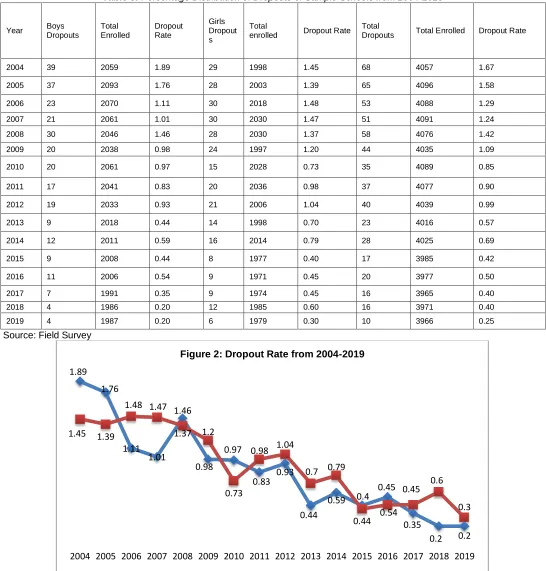
Dropout rate of primary school children are shown with the help of the table 3 and the figure 2 above. In the session 2004 the total dropout of primary school students was 68 students and the dropout rate was 1.67. It had already been mentioned that till 2004, the Mid-Day Meal Program was not implemented in the Assam it was implemented only in the year 2005. It is observed from the table above that after the implementation of the Mid-Day Meal Programme in the
Hapjan Block of Assam dropout rate of children is continuously falling from 1.58% (2005) to 0.25% (2019). An attempt has also been made to compare the dropout rates of boys and girls in the sample schools. The table reveals that the dropout rates of both boys and girls are lower in the Hapjan Block in the subsequent years as compared to the base year 2004. But the rate of dropout of boys is greater than girls. The dropout rate of boys has fallen from 1.76% in
1.89
1.76
1.11 1.01
1.46
0.98 0.97
0.83 0.93
0.44 0.59
0.44 0.54 0.35
0.2 0.2
1.45 1.39
1.48 1.47
1.37 1.2
0.73
0.98 1.04
0.7 0.79
0.4 0.45 0.45
0.6
0.3
2004 2005 2006 2007 2008 2009 2010 2011 2012 2013 2014 2015 2016 2017 2018 2019
Figure 2: Dropout Rate from 2004-2019
2005 to 0.20 % in 2019, and that of girls has fallen 1.58 % in 2005 to 0.25 % in 2019. However despite of free and compulsory primary education and nutritional support to primary school children introduced by the Government of India, school dropouts were still observed in the sample schools of the Hapjan Block. Most of the head teachers of the surveyed school reported that with the mushrooming growth of private English medium schools in the locality parents transfer their children from Government primary school to private schools. It was also reported that girls of Upper Primary schools leave school and enter in marriage without completing primary education. But in spite of these factors, it may be concluded that Mid-Day Meal Programme has been successful partially in reducing primary school dropouts particularly in rural areas where a child of poor economic background comes to the school with an empty stomach only to have the meal provided by the school.
5.
FINDINGS:
The present study concludes with the following findings: 1. From the study it was found that there is rise in the
enrollment of children in the government schools in the beginning years of implementation of the scheme from 0.96 % in 2005 to 1.33% in 2010. But in the latter years from 20110.29%) to 2019 (-0.12%) enrolment of total enrollment of children in government schools has been negligible.
2. The study shows that except in the years 2005 (1.65%), 2010 (1.12%) and 2019 (0.05%) the enrollment of boys in sample schools is negative. It proves that the Mid-Day Meal Scheme had no positive impact in increasing the total enrolment of boys in Hapjan Block
3. Enrolment of girls on the other hand, in the sample schools shows a positive trend since after its implementation in the schools, except in the years 2009 (-1.72%), 2012 (-1.47%), 2013 (-0.39%), 2015(-1.68%) and 2016 (-0.45%) where the enrollment rate is negligible.
4. In the year 2005 the enrollment of boys was 1.65% and that of girls was 0.25% over the base year 2004.
5. Findings of the study shows that the implementation of the scheme is not fully successful in increasing the enrollment rate of boys in the sample schools, but however the scheme is somewhat successful in increasing the enrolment of girls.
6. It was observed that the scheme was successful in reducing total primary school dropouts from 1.58% in 2005 to 0.25% in 2019.
7. Dropout rate of both boys and girls were lower in the subsequent years as compared to the base year 2004. But the findings of the study reveal that the dropout rate of boys is greater than that of girls. 8. During the survey, teachers of the sample schools
opined that the dropout rate of boys is comparatively more than the girls because of the mushrooming private educational institutions in the locality and preference of parents to send their boys to these private schools over girls.
9. In the year 2005 the dropout rate of boys is 1.76% and that of girls was 1.58%. Dropout rate of both
boys and girls has fallen to 0.20% and 0.25% in 2019.
10. During the field survey it was also learned that in some schools children comes to school only to have the lunch provided by the school since because most of them basically belongs to socially and economically deprived section of the society. Headmasters of the school reveals that this children comes to school only to meet their hunger, if the school does not provide meal continuously for some days because of shortage of supply of grains they stops coming to school.
11. From the study it was observed that scheme was partially successful in reducing total primary school dropouts.
6. CONCLUSIONS:
From the above study it can be concluded that Mid-Day Meal Scheme played an important role in achieving universal primary education of satisfactory quality for all school children below the age of 14 by enhancing enrollment, improving attendance and reducing dropouts and simultaneously improving the nutritional status of the children. The scheme has attracted young children to school, especially the one belonging to the weaker section of the society who were otherwise irregular to school. But in spite of its success the scheme in the recent years fails to increase the total enrolment of students because of mushrooming private educational institutions in the locality.
REFERENCE:
[1] Baru. R. V. Dasgupta. R., Deshpande. M., Mohanty. A., “Full Meal or Package Deal” Economic and Political Weekly, Vol.43, No.24 (Jun.14-20, 2008)
[2] Best. J. W. and Kahn J.V. (1999), “Research in Education” New Delhi: Prentice Hall of India Private Limited
[3] Bewani W.S. and Jebarcy, Rachel. (2010), “Nutritional Status and Creativity among Children at primary level”, Edutracks, March 2010, Vol. 6(7)
[4] Dreze & Goyal (2003), “Future of Mid-Day Meals”, Economic and Political Weekly, November 1
[5] Government of India Ministry of Human Resource Development, “Report of Joint Review Mission on Mid-Day Meal Scheme Assam” from 11November-19 November 2013”
[6] Hamid Y& Hamid. A., “Mid-Day Meal Scheme and Growth of Primary Education: A Case Study of District Anantnag in Jammu and Kashmir” Bangladesh e-Journal of Sociology. Vol.9, January 2012
[7] Kulkani. M (2003), “More on Mid-Day Meals” Economic and Political Weekly December 6, 2003
[8] Nielsen, A.C. (2007), “Mid-Day Meal Programme for School Children, Akshayapatra-Unlimited Food for life. Journal of Community Guidance and Research”, Vol.26(1), March 2009
[9] Pattanaik. B. &Singh. M. M. (2011), “Sarva Shikhya Abhiyan and Inclusive Education” Kurukshetra: A Journal on Rural Development.
[11]Shatrugna. M. (1985), “No Mid-Day Meals for Poor Children” Economic and Political Weekly, Vol.20, No.21 (May 25, 1985)