Licensed under Creative Common Page 214
http://ijecm.co.uk/
ISSN 2348 0386
EFFECT OF FINANCIAL MANAGEMENT PRACTICES AND
PROJECT PERFORMANCE IN UASIN GISHU COUNTY, KENYA
Doreen Chebet Cheluget
Phd Student, Jomo Kenyatta University of Agriculture and Technology, Kenya
Valentine Jepkorir Morogo
Phd student, School of business Moi University, Kenya
Abstract
This paper sought to establish effect financial management practices on project performance in
Uasin Gishu County, Kenya. The study was guided by the Theory of Planned behavior.
Stratified and simple random sampling techniques were used to select a sample size of 87 top
management employees from 31 projects in Uasin Gishu County. Data was collected using
structured questionnaires. Test-retest technique was employed to test reliability of the data
collection instruments at Alpha>0.7. The study adopted ex post facto research design.
Descriptive and inferential statistics were used to analyze the data. Regression analysis was
used to test the hypotheses at p<= 0.05. Findings revealed a positive influence of budgeting and
financial reporting on project performance. This study recommends that project managers
enhance the training on calculation of interest rate and need to have budget expertise. Similarly,
there is need for employees to have the necessary reporting and analyzing skills.
Keywords: Budgeting, Financial Reporting, Project Performance, Financial Management,
Analytical skills
INTRODUCTION
Project performance remains a prominent issue in project delivery all over the world. Most
popular determinants of projects successes accepted by research community are-project
mission, top management support, project schedule/plan, client consultation, personnel,
Licensed under Creative Common Page 215 communication, troubleshooting expertise. Financial management practices have been shown
to be essential in improving transparency, efficiency, accuracy and accountability resulting in the
organizations achieving their objectives (Koitaba, 2013). Increasing the chances of performance
among projects would have huge implications for the growth and socio-economic wellbeing of a
country (Asian-Pacific Economic Cooperation, 2004). Thus, understanding predictors of
performance in projects is critical. The creation of more performing project could potentially
create new jobs, increase trade and consequently the Gross Domestic Product (GDP) of the
country. Although it has been difficult to ascertain why in similar situations some entrepreneurs
fail while others succeed, this study focuses on relationship between financial management
practicesandprojectperformance‟stoofferapracticalmeansofaddressingthephenomenon.
Capacity building of project in terms of preparing financial statements, budgets and
record keeping, as well as improving their financial literacy and management training, is shown
to have positive impact on Project performance. Furthermore, strengthening the horizontal
linkages with other project and vertical linkages with larger firms would improve project market
access (Hogarth et al., 2002)
Effective implementations of financial management practices lead to improvement in
Project performance due to improved ability to track business events from the record system
(Siekei, et al., 2013). Most new business owners are daunted by the mere idea of recordkeeping
and accounting including budgeting, financial reporting and analysis. The significance of
projects performance in developing Kenya's economy has continued to grow since the sector
was first brought to the limelight by the International Labor Organization (ILO) in 1972.
The success of the project depends on the variety of resources such as physical and
financial capital, technology and human resource. However, the element of human resource is
not given much importance at the time of project designing which is a wrong practice on the part
of the project designers (Arindam Banik & Pradip, Bhaumik, 2006). In Kenya, county
government‟s projects face problems, despite their great importance in terms of support
provided to the national economy. It is noted that such projects confront barriers and challenges
of a similar nature in most cases. Given the high failure rate and the pivot role played by the
county projects in the country, it becomes vital to research on the factors required to enable the
projects to survive and indeed progress to the growth phase of the organizational life cycle
(Kamunge et al., 2014). This calls for financial management practices intervention to train the
project managers and employees on how to use the available means of accessing financial
services to improve their enterprises and also reduce cost of doing business. Financial
management practices is one of the factors that impact positively on project performance
Licensed under Creative Common Page 216 enterprises to constantly changing business environments (King & McGrath, 2002). However, it
is not clear whether financial management initiatives have translated to better performance
(CMA, 2010; Wanjohi, 2011). Reviews of the literature on the effect of financial management
practices on Project performance are limited. Where the same has been done, none has dealt
with all the four variables and its direct impact on projects, more specifically in Uasin Gishu. This
study intends to fill the gap by identifying effect of financial management practices and
performance of projects in Uasin Gishu County, Kenya. Thus the study hypothesized that:
H1: There is an effect of financial reporting and analysis practice on project performance in
Uasin Gishu County
H2:There is an effect of budgeting practice and performance of projects in Uasin Gishu County
THEORETICAL FRAMEWORK
The study was informed by Financial Literacy Theory. The theory argues that the behavior of
people with a high level of financial literacy might depend on the prevalence of the two thinking
styles according to dual-process theories: intuition and cognition. Dual-process theories (Evans,
2008) embrace the idea that decisions to have a high performing enterprise can be driven by
both intuitive and cognitive processes. Dual-process theories have been studied and applied to
many different fields; reasoning and social cognition (Evans, 2008).Financial literacy remains an
interesting issue in both developed and developing economies, and has elicited much interest in
the recent past with the rapid change in the financial landscape. According to this theory,
Gallery, Newton and Palm (2011) framework in financial knowledge is a form of investment in
human capital like the necessary financial management skills, and many empirical surveys
establish that people need to know much more to become informed. The authors show how
financial literacy, knowledge on financial management practices, shapes economic outcomes
derived from performing firms.
Financial literacy theory argues that the behavior of people with a high level of financial
management practices might depend on the prevalence of the two thinking styles according to
dual-process theories: intuition and cognition. Dual-process theories (Idowu 2010) embrace the
idea that decisions can be driven by both intuitive and cognitive processes. Dual-process
theories have been studied and applied to many different fields, e.g., reasoning and social
cognition (Idowu, 2010). Financial literacy, which embeds the financial management practices
helps in empowering and educating investors and owners of businesses so that they are
knowledgeable about financial management practices in a way that is relevant to their business
and enables them to use this knowledge to evaluate products and make informed decisions that
Licensed under Creative Common Page 217 and knowledge would help overcome recent difficulties in advanced credit markets that inhibit
Firms‟performance(LusardiandOliver,2006).
EMPIRICAL REVIEW
Financial Reporting and Analysis Practice and Performance
Turyahebwa, Sunday and Ssekajugo (2013) conducting a study on establish the relationship
between financial management practices and business project performance in western Uganda
with a view to establishing a coherent model directed at improving business performance and it
was hypothesized that financial reporting positively influences Business performance. The
study adopted a positivist (quantitative paradigm) with cross sectional and correlational designs.
The study used a respondent sample of 335 FIRMs operating in Mbarara, Sheema and
Bushenyi whose owners/managers were the unit of enquiry. Structural Equations Modeling with
Analysis of Moment Structures were used to for statistical modeling. The findings in respect of
the main purpose of the study indicated that financial management practices accounted for
33.8% of the variance in business project performance. The results also indicated that working
capital management influences highly since it predicts over 22% of the variance in business
performance. The present study supported a multi-theoretic approach in explaining business
project performance in Uganda. The study supports the pecking order theory in explaining the
financing of Firms together with resource based view as the theories that help in explaining
business project performance. The study confirmed efficient financial management practices
factor structure of observed variables and the latent variables.
Mathuva (2009) examined the influence of working capital management components on
corporate profitability by using a sample of 30 firms listed on the Nairobi Stock Exchange (NSE)
for the periods 1993 to 2008. The findings from his study revealed that there exists a highly
significant negative relationship between the time it takes for firms to collect cash from their
customers. The results also revealed that there exists a highly significant positive relationship
between the period taken to convert inventories into sales (the inventory conversion period) and
profitability, and there exists a highly significant positive relationship between the time it takes
the firm to pay its creditors and profitability. The same results are not at variance with Uyar
(2009) results which showed statistical significant between working capital and firm
performance.
Muinde (2013) conducted a study on financial reporting and analysis practices adopted
by small and medium enterprises in Kenya and to establish the relationship between financial
reporting and analysis practices and financial performance in Kenya. The study adopted a
Licensed under Creative Common Page 218 Firms in Kenya for the year 2012. The researcher used simple random sampling to select 50
respondents. Primary data is information gathered directly from respondents and for this study
the researcher used questionnaires. Quantitative data collected was analyzed by the use of
descriptive statistics using SPSS and presented through percentages, means, standard
deviations and frequencies. The information was displayed by use of bar charts, graphs and pie
charts and in prose-form. The study found that there is a strong positive relationship between
financial reporting, financial analysis, financial management and management accounting and
financial project performance. The study was also limited to establish the financial reporting and
analysis practices adopted by small and medium enterprises in Kenya and to establish the
relationship between financial reporting and analysis practices and financial performance in
Kenya.
Budgeting Practice and Performance
Warue and Wanjiru (2013) assessed factors affecting the budgeting processes among Small
and Medium Enterprises (Firms)inthehospitalityindustryinNairobi‟sCentralBusinessdistrict
(CBD). Descriptive research design was used. Target population comprised 98,608 of all the
registered small enterprises located within the CBD of Nairobi city. Stratified random sampling
was employed in selecting the sample. The population strata were based on the nature of the
business conducted by the FIRM in the Hospitality industry. The sample of 104 was shared
proportionately among the 526 Firms in Hospitality industry in the CBD. Semi structured
questionnaires of the Likert scale of 1 (for strong disagreement) to 5 (for strong agreement) and
administered to Firms managers, was used to measure the study variables. The data was
analyzed using panel data analysis. The study finds evidence that computerized accounting
system contributes to budgeting process at a higher magnitude than firm size, participation of
workers, skills and powers of managers and ownership structure.
A study conducted by Chidi & Shadare (2011) in Nigeria focusing on challenges
confronting human capital development in Firms in Nigeria found that budgeting among Firms
faced challenges by the businesses not taking ownership or not being accountable, there being
a lack of cooperation and/or participation and a lack of understanding of the budgeting process
or what‟s required. This was compounded by the inability to meet, deadlines, padding their
budgets/providing unrealistic numbers and sheer ignorance of the importance of budgeting by
the business owners. These researchers confirmed that the skill that managers have concerning
budgeting affect the budgeting process. The influences of the managers inform whether the
Licensed under Creative Common Page 219 Based on Mahmood (2008), study, if the owners of Firms have clearly defined relationship with
the business, the budgeting process becomes more formal, sophisticated and accurate due to
the limited influence of the owners. Diamond & Khemani (2006) studied accounting systems
among businesses in the developing countries, focusing on Africa deduced that budget
execution and accounting processes were either manual or supported by very old and
inadequately maintained software applications and hardware. He found that this had damaging
effects on their functioning due to the consequent lack of reliable and timely revenue and
expenditure data for budget planning, monitoring, expenditure control, and reporting negatively
impacting budget management. Further, this study found that there was poorly controlled
commitment of resources. This meant that the nature of the computerization of accounting
affected the budgeting process to a large extend.
RESEARCH METHODOLOGY
The study employed Ex post facto design research design. The population of study comprised
155 top management employees from 31 projects in Uasin Gishu County, Kenya. Simple
random sampling technique was used to select the 87 respondents out of the target population.
The primary data was obtained from questionnaires. The Content Validity Index (CVI) was used
to quantify the content validity. On this study, test-retest technique was employed. Pearson‟s
product moment correlation coefficient and regression correlation was used to correlate the
results.
The collected data was analyzed through the use of both descriptive and inferential
statistics. Descriptive statistics were presented in form of frequencies, percentages, means and
standard deviation. The researcher used inferential statistics viz. Pearson correlation and
regression analysis to show the relationship between the variables.
FINDINGS AND DISCUSSION
Descriptive Statistics
In general, the results on financial reporting summed up to a mean of 3.0955 and standard
deviation of 0.69073. The results on the budgeting practice summed up to a mean of 2.6652
and standard deviation of 0.78491. Firm performance summed up to a mean of 3.82 and
standard deviation of 1.017. There was a strong relationship between financial reporting and
Project performance (r = 0.530, p-value < .01). Also, the study exhibited a strong relationship
Licensed under Creative Common Page 220 Table 1: Correlation Results
Mean
Standard Deviation
Firm Performance
Financial Reporting
Budgeting Practice Firm Performance 3.82 1.017 1
Financial Reporting 3.08 0.69073 .530** 1
Budgeting Practice 2.6652 0.78491 .590** 0.071 1 ** Correlation is significant at the 0.01 level (2-tailed).
Hypothesis by Regression Analysis
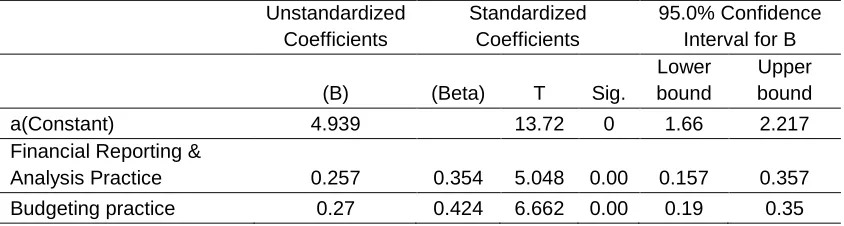
The table 2 describes the significance of the financial management practice; financial reporting
and analysis practice and budgeting practice in relation to Project performance. Results from
(Table 2) its demonstrated that Independent variables: Financial Reporting and analysis practice
as well as budgeting practice which are the variables ,since the null hypothesis for record
keeping practices was accepted indicating that the alternate hypothesis was rejected , (sig
0.420 , p > 0.05) .
Moreover, financial reporting was also found to have a significant effect on Project
performance. This means that through financial reporting, Firms are able to analyze their growth
and secure essential growth funding as well as attract new and retain outside financial support
from new equity holders. This is an essential ingredient for improved Project performance.
Cognate to the results, Moore‟s&Mula‟s(2003)resultsclearlyindicateincreasingemphasison
financial reporting as businesses grow in employment terms and progress through the earlier
stages. The eventual outcome for increased financial reporting is improved performance of the
businesses. On the same note, Maingot and Zeghal (2006) observed that financial reporting for
Firms results in improved Project performance. It is evident that much has not been done with
reference to the relationship between financial reporting and Project performance. The study
therefore adds significant insights on the positive effect of financial reporting on Project
performance.
Budgeting practice has a significant effect on Project performance. This infers that
budgeting provides a framework in which Firms spend their funds in the best way possible so as
to realize profits. As such, preparation of budgets, budget expertise and participation of
employees in the budget process enhance the overall project performance. In line with the
results, Joshi et al (2003) examination of budgeting practices by a survey of 54 medium and
large sized companies in Bahrain found that an increase in firm size lead firm to implementing a
more comprehensive budgeting process to achieve a better performance. In a similar vein, a
study conducted by Chidi & Shadare (2011) in Nigeria focusing on challenges confronting
Licensed under Creative Common Page 221 was detrimental to the performance of the Firms. From the extant literature, it is evident that
budgeting enhances Project performance. The results therefore augment prior findings that
budgeting practice has a positive and significant effect on Project performance.
Table 2: Regression
Unstandardized Coefficients
Standardized Coefficients
95.0% Confidence Interval for B
(B) (Beta) T Sig.
Lower bound
Upper bound
a(Constant) 4.939 13.72 0 1.66 2.217
Financial Reporting &
Analysis Practice 0.257 0.354 5.048 0.00 0.157 0.357 Budgeting practice 0.27 0.424 6.662 0.00 0.19 0.35
Dependent variable: Project performance
CONCLUSION AND RECOMMENDATIONS
Financial reporting is of essence in enhancing Project performance. Through financial reporting,
FIRM owners are able to determine if they have the capacity to generate future profit. For
instance, by analyzing and evaluating the growth of their accounts periodically, FIRM owners
ensure that their expectations of the organization performance, based on knowledge of the
business, are confirmed by the formally presented results. Reporting and analysing skills is an
added incentive
Additionally, budgeting practice has a positive and significant effect on Project
performance. The preparation of budgets coupled with budget expertise provides a spending
plan for finances making it possible for availability of funds to enhance future growth and overall
project performance. , budgeting practice as a predictor to performance has a very strong
relationship hence has a very strong contribution to performance. This however requires the
participation of employees in the budget process in order to realize improved performance
Financial information used in financial reporting and analysis is useful mainly in
evaluating the success of past decisions and in determining present position. There is thus need
for periodical reporting on the balances of their accounts. The growth of accounts also needs to
be analyzed and evaluated periodically. Additionally, there is need for employees to have the
necessary reporting and analyzing skills.
Budgeting practice has a positive and significant effect on Project performance. It is
therefore necessary for employees to have budget expertise. Most importantly, FIRM owners
Licensed under Creative Common Page 222 prepared or not. Moreover, budgets should be prepared regularly with full participation of
employees in the budget process.
Based on the findings the study recommends involvement of banks to train Firms on
budgeting, and continuous improvement of managers‟ skills that covers all the variables in financial management practices for the benefit of the Firm‟s as well as financial institutions.
This study focused on the relationship between financial management practices and
performance in Uasin Gishu County. It can be replicated with a larger, more representative
sample. It is also recommended that this study be replicated in different business sectors within
the North-Rift region. A similar study can also be carried out in other counties like Nairobi that is
largely urbanized with elite and very diverse FIRM owners. Furthermore, it would be interesting
to know whether the observed findings hold for other firms as well. More research is needed in
this subject area to fully establish the effect of record keeping on Project performance since the
study exhibited no significant effect. Major contextual and settings to be considered in future
researches should consider insights from this study influencing Project performance including
the three factors: 1) budget practice; 2) financial reporting 3) borrowing practice as playing an
important role in enhancing Project performance.
REFERENCES
Abanis, T., Sunday, A., Burani, A., & Eliabu, B., (2013) "Financial management practices in small and medium enterprises in selected districts in western Uganda," Research Journal of Finance and Accounting, 4(2): 29-42.
Ajzen, I., (1991). The theory of planned behavior. Organizational behavior and human decision processes, 50, 179–211
Ajzen, Icek. (2002). Perceived Behavioral Control, Self-Efficacy, Locus of Control, and the Theory of Planned Behavior1. Journal of Applied Social Psychology, 32(4), 665–683. doi:10.1111/j. 1559-1816.2002.tb00236.
Akers, R ., L., (1998). Social Learning and Social Structure: A General Theory of Crime and Deviance. Boston, MA: Northeastern University Press
Amoako,G., K.,(2013)."Accounting practices of FIRMs: A case study of Kumasi Metropolis in Ghana," International Journal of Business and Management, 8(24): 73-83.
Asia-Pacific Economic Cooperation (2004). Implementation of the SPAN: An update by Malaysia
Atkinson, A. and Messy, F. (2005) Assessing financial literacy in 12 countries an OECD Pilot Exercise. Paris: OECD Financial Affairs Division.
Bandura, A. & Ross, S. A. (1961). Transmission of aggression through the imitation of aggressive models. Journal of Abnormal and Social Psychology
Bandura, A. (1977). Self-Efficacy: Toward a Unifying Theory of Behavioral Change, Psychological Review.
Bolton, J., E., (2001) Report of the Committee of Inquiry on Small Firms, London, HMSO.
Licensed under Creative Common Page 223 Capital Markets Authority (2010) Capital Raising Opportunities For FIRMS: The Development Of Micro-Cap Securities Markets In Kenya. Nairobi: Micro-Capital Markets Authority
Chidi, C., O., & Shadare, O., A.,. (2011). Managing human capital development in small and medium-sized enterprises for sustainable national development in Nigeria, International Journal of Management & Information Systems – Second Quarter 2011 Vol. 15, No. 2
Connor, T., (2002). The Resource-Based View of Strategy and Its Value to Practicing Managers. Strategic Change, 11: 307-316
Diamond, J., & Khemani, P., (2006). „Introducing financial management information systems in developing countries‟, OECD Journal on Budgeting 5(3), 97–132. http://dx.doi.org/10.1787/budget-v5-art20-en 8.
Djankov, S., McLiesh, C., Shleifer, A., 2007. Private credit in 129 countries. Journal of Financial Economics 84, 299–329.
Ekanem,I.,(2010)."Liquidity management in small firms: a learning perspective," Journal of Small Business and Enterprise Development, 17(1): 123-138
Eniola, A., A., & Entebang, H., (2014). FIRM firms performance in Nigeria: Competitive advantage and its impact. International Journal of Research Studies in Management, 3(2), 75-86. http://dx.doi.org/10.5861/ijrsm.2014.854
Evans, J., St. B., T., (2008). Dual-processing accounts of reasoning, judgment and social cognition. Annual Review of Psychology, 59, 255–278.
Finkler, S., A.,(2011). Financial management for public, health and not-for-profit organizations. Upper Saddle River, NJ: Prentice Hall.
Fishbein, M. & Ajzen, I., (1975). Belief, attitude, intention and behavior: An introduction to theory and research. Reading, MA: Addison-Wesley.
Freeman, J., (2008). Accounting Practical Approach. United States
Gallery, N, Gallery, G, Brown, K, Furneaux, C & Palm, C( 2011), „Financial Literacy and Pension InvestmentDecisions‟,FinancialAccountabilityandManagement(inpress).
Gildenhuys, J., S., H., ( 1993). Public financial management. Pretoria: Van Schaik.
Glaeser, E., and J., Scheinkman (2003]. Non-market interactions, in: M. Dewatripont, L.P. Hansen, and S. Turnovsky (Eds.), Advances in Economics and Econometrics: Theory and Applications, Eight World Congress, Cambridge University Press.
Goel, V., & Dolan R., (2003). Explaining Modulation of Reasoning by Belief. Cognition.
Grable, J., Lytton, R., & O‟Neill, B. 2004, Projection bias and financial risk tolerance, Journal of Behavioral Finance, vol. 5, no. 3, pp. 142–147.
Gravetter, R. and Forzano, S., (2003). Research Methods for Behavioural Sciences, Belmont: Wardsworth.
Greenspan, A., (2002) Financial Literacy: A Tool for Economic Progress: The Futurist, Vol. 36, (4), 37-41. Harrison, R., (2010).Employee Development, Beekman Publishing, Silver Lakes, Pretoria. 24.http://www.buzzle.com/articles/employee-performance/ 25.
Hogarth, J., and Hilgert. A., (2002).Financial knowledge, experience and learning preferences: Preliminary results from a new survey on financial literacy. Consumer Interests Annual, 48, 1-7.
Hrubes, D., Ajzen, I., & Daigle, J. (2001). Predicting hunting intentions and behavior: An application of the theory of planned behavior. Leisure Sciences, 23, 165-178.
Idowu, F. (2010).Impact of Microfinance on Small and Medium-Sized Enterprises in Nigeria.
Licensed under Creative Common Page 224 Kamunge M., S.,, Njeru A., & Tirimba O.I., (2014)Factors Affecting the Performance of Small and Micro Enterprises in Limuru Town Market of Kiambu County, Kenya. International Journal of Scientific and Research Publications, Volume 4, Issue 12
Kennedy, J., Tennent, B., & Gibson, B. (2006) "Financial Management Practices in Small Businesses: Regional and Metropolitan," Small Enterprise Research: The Journal of SEAANZ, 14(1): 55-63
King, K., & McGrath, S., (2000). Globalization, Enterprise and knowledge; Educational Training and Development, International Review of Education, 50(1), 74-76 (3).
Koitaba, E., K., (2013). Analysis of factors influencing financial control practices in community based organizations in Baringo County, Kenya. MBA Thesis, Kabarak Public sector in Mirangine Sub County, Kenya
Kothari C., R., (2009) "Research Methodology: Methods & Techniques" (Second Revised Edition), New Age International Publishers, New Delhi.
Kothari, C., K., (2008) .Research Methodology: Methods and Techniques. 2nd edition revised. New Delhi: New Age International Limited Publishers.
Kubickova, D., & Soucek, J., (2013). "Management of receivables in FIRMs in the Czech Republic," European Research Studies, 16(Special Issue on FIRMs): 97-111.
Longenecker, J. G., Petty, C. W., Moore, J. W. and Palich, L. E. (2006). Small Business Management, An entrepreneurial emphasis. London: Thomson South Western.
Lusardi A.,& Oliver, M., (2006).Financial Literacy and Planning; Implications for Retirement wellbeing, Pension Research Council Working Paper 1, The Wharton School
Mahmood, S., (2008). Corporate governance and business ethics for FIRMs in developing countries: challenges and way forward, Islamabad, Pakistan, retrieved on 18th January from http://www.kantakji.com/fiqh/files/companies/w111.pdf
Maingot,M.,andZeghal,D.,(2006).„FinancialreportingofsmallbusinessentitiesinCanada‟,Journal of Small Business Management, Vol. 44,No.4.
Mboma L, Mwaipopo,R and Philemon R.M( 2010), Challenges facing Small Food Vending owned Enterprises in Dar salaam
McGuiness, T., & Morgan, R., E., (2002).“ Strategy, Dynamic Capabilities and Complex Science: ManagementRhetoricvsReality” Strategic Change, 9, 209– 220
Miller, D., (2003). An Asymmetry-Based View of Advantage: Towards an Attainable Sustainability. Strategic Management Journal, 24: 961-976.
Moores, K. & Mula, J., (1993), Managing and Controlling Family Owned Businesses: A Life Cycle Perspective of Australian Firms, Research Report, Bond University, Gold Coast, Queensland.
Mugenda, M., O.,and Mugenda, G.,.A., (2003). Research Methods: Quantitative and Qualitative Approaches.
Mungal, A., & Garbharran, H., L., (2014)."The perceptions of small businesses in the implementation of cash management techniques," Journal of Economics and Behavioral Studies, 6(1): 75-83
Neyman, J., (1934). “On the Two Different Aspects of the Representative Method: The Method of Stratified Sampling and the MethodofPurposiveSelection”,JournaloftheRoyalStatisticalSociety,Vol. 97, 558-606
Nieuwenhuizen, C., and Rossouw, R.A.,( 2013). Business Management. A Contemporary Approach. 1st ed. Juta
OECD (2010). FIRMs, Entrepreneurship and Innovation, Paris, Organisation for Economic Co-operation and Development
Licensed under Creative Common Page 225 Orobia, L. A., Byabashaija, W., Munene, J.C., Sejjaaka, S.K., & Musinguzi, D. (2013) "How do small business owners manage working capital in an emerging economy?; A qualitative inquiry," Qualitative Research in Accounting & Management, 10(2): 127-143
Orodho, A., J., (2012). Techniques of Writing Proposals and Research Reports in Education and Social Science Research Methods: Maseno, Kenya: Kanezja Publishers
Oso WY, Onen D., (2005). A General Guide to Writing Research Proposal and Report: A Handbook for Beginning Researchers. Kisumu, Kenya: Option Press and Publishers
Otenyo-Matanda, M., (2008). Entrepreneurial Orientation and Access to New Markets by Small Scale Earthenware Manufacturers in Kenya. A Research Report Funded by Investment Climate and Business Environment Research Fund. TrustAfrica, Kenya
Pauw, J.C., Woods, G., Van der Linde, G., J.A., Fourie, D. & Visser, C.B. (2012). Managing Public Money: A System from the South. Cape Town: Heineman Publishers (Pty) Ltd
Peacock, R. W. (2008). Small Business Bankruptcy, Accounting Forum, 1 (3), 51-52.
Perera, S., & Baker, P., (2007.)."Performance Measurement Practices in Small and Medium Size Manufacturing Enterprises in Australia," Small Enterprise Research: The Journal of SEAANZ, 15(2): 10-30.
Prakash, P., & Poudel, S. (2012). The impact of credit risk management on financial performance of commercial banks in Nepal, Published PhD Thesis, University of New England Australia Business School Priem, R., L., & J. E. Butler (2001a), “Is the Resource-Based “view” a Useful Perspective for Strategic ManagementResearch?” Academy of Management Review Vol. 26, No.1, pp.22-40.
Priem, R.., L., & J., E., Butler (2001b).Tautology in the Resource-Based View and the Implication of Externally Determined Resource Value: Future Comments,”Academy of Management Review Vol. 26, No.1, pp.57-66
Purcell, J., Kinnie, N., Hutchinson, S., Rayton, B. & Swart, J. 2003. Understanding the People and Performance Link: Unlocking the Black-Box. Research Report, CIPD, London
Saunders M., Lewis P., and Thornhill A.,(2007).Research Methods for Business Students (5th Edition) 5th Edition
Sensis (2014) .Sensis Business Index, December 2014: A survey of confidence and behaviour of Australian small and medium enterprises, Sensis Pty Ltd. [available online] www.sensis.com.au
Siekei, J., Juma W., & Aquilars K., (2013). An assessment of the role of financial literacy on performance of small and micro enterprises: Case of Equity Group Foundation Training Program on FIRMS in Njoro district, Kenya
Simiyu, S., (2008).A Survey Of Techniques Of Credit Risk Management In Micro-Finance Institutions In Kenya, Unpublished MBA Project, University of Nairobi
Uwonda, G., Okello, N., & Okello, N., G., (2013). "Cash flow management utilization by small medium enterprises (FIRMs) in northern Uganda," MERIT Research Journal of Accounting, Auditing, Economics and Finance, 1(5): 67-80.
Vijayakumar, A. and Tamizhselvan, P. (2010), “Corporate Size and Profitability-An Empirical Analysis”, College Sadhana – Journal for Bloomers of Research, Vol. 3, No. 1, pp. 44 – 53.
Wanjohi, A., (2011) Kenya Vision 2030 and Youth Agenda. Kenpro Papers Portal. available http://www.kenpro.org/tag/firm-sector-in-kenya/
Wanjohi, A.M., (2011). Sustainability of Community Based Projects in Developing Countries. Saarbrucken, Germany: LAP LAMBERT Academic Publishing. Available online at http://www.amazon.co.uk/Sustainability-Community-Projects-Developing-Countries/dp/3843376085 Countries.
Licensed under Creative Common Page 226 Wijewardena, H. and De Zoysa, A.(2001). The Impact of Financial Planning and Control on Project performance in Australia. Journal of Enterprising Culture, 9(4), 353- 365.
Williams, Jan, R., Susan, F., Haila, Mark, S., Bettriel, Joseph, V., and Carcello, (2008): Financial & Managerial Accounting. New York: Mc Graw-Hill Irwin.
Williams. A., J., (2010). A longitudinal analysis of the characteristics and performance of small business in Australia, Institute of Industrial Economics, 2(3) 201258