A beyond-mean-field example with zero–range effective interactions in
infinite nuclear matter
K. Moghrabi1,a, M. Grasso1, X. Roca-Maza2, G. Col`o2,3, and N. Van Giai1
1 Institut de Physique Nucl´eaire, Universit´e Paris-Sud, IN2P3-CNRS, F -91406 Orsay Cedex, France 2 INFN, Sezione di Milano, Via Celoria 16, 20133 Milano, Italy
3 Dipartimento di Fisica, Universit`a degli Studi di Milano, Via Celoria 16, 20133 Milano, Italy
Abstract. Zero–range effective interactions are commonly used in nuclear physics to describe a many-body system in the mean-field framework. If they are employed in beyond-mean-field models, an artificial ultraviolet divergence is generated by the zero-range of the interaction. We analyze this problem in symmetric nuclear matter with thet0−t3Skyrme model. In this case, the second-order energy correction diverges linearly with the momentum cutoffΛ. After that, we extend the work to the case of nuclear matter with the full Skyrme interaction. A strong divergence (∼Λ5) related to the velocity-dependent terms of the interaction is obtained. Moreover, a
global fit can be simultaneously performed for both symmetric and nuclear matter with different neutron-to-proton ratios. These results pave the way for applications to finite nuclei in the framework of beyond mean-field theories.
1 Introduction
Contact interactions are reasonable approximations for the real finite-range forces that can be employed in cases where the interaction range is much smaller than the typical length-scale for the inter-particle distance. The main advantage of using zero–range interactions when treating many-body systems is that the equations to handle are usually simpli-fied in this case. This is why contact interactions are exten-sively employed in many-body physics. Two examples of commonly adopted contact interactions are the zero-range effective Skyrme forces which are used in nuclear physics [1, 2] and the contact interactions with coupling strengths depending on the s-wave scattering length which are em-ployed for dilute atomic gases [3].
In phenomenological effective interactions, such as Skyrme forces, a set of parameters has to be adjusted. These parameters are commonly fitted to reproduce several ob-servables at the mean-field level (for instance, in the clear case, binding energies and radii of some selected nu-clei and the properties of nuclear matter); this means that these interactions are constructed to be used for mean-field -based calculations. When one goes beyond the standard mean-field theories, it is not obvious at all that the same effective interactions are still suitable to be used. An ad-ditional problem arises when these interactions are con-tact forces. In several beyond mean-field theories, an ar-tificial ultraviolet divergence actually appears if the range of the interaction is zero. An ultraviolet divergence already appears in the mean-field-based Hartree-Fock-Bogoliubov (HFB) [4] or Bogoliubov-de Gennes (BdG) [5] models with zero-range forces in the pairing channel.
Examples of beyond-mean-field models where ultravi-olet divergences appear owing to the use of a zero-range interaction are: Higher-Tamm-Dancoffmodels where mul-tiparticle–multihole configurations are introduced [6],
sec-a e-mail:[email protected]
ond random-phase-approximation models where not only phmatrix elements are included in the matrix to diagonal-ize owing to the presence of two particle-two hole config-urations [7] and models that describe the particle-phonon coupling between individual degrees of freedom and col-lective vibrations [8, 9]. In nuclear physics, this divergence is usually treated by introducing a momentum cutoffΛ[10, 11] or by applying the the techniques of dimensional regu-larization [12].
To summarize, when phenomenological zero-range inte-ractions are used, two issues have to be addressed if beyond-mean-field theories are adopted:
1) Choosing a strategy to handle the ultraviolet divergence associated to the use of a contact force;
2) Deciding at which level the fitting procedure of the pa-rameters has to be done and which constraints have to be included.
In this article, we apply to a simple case a strategy to account for points 1) and 2). This strategy is quite general and can be applied to different cases and domains. We ex-plore the possibility to fit phenomenological interactions at some beyond-mean-field level (so that these interactions are suitable to be used in beyond-mean-field models) by including the numerical momentum cutoffamong the pa-rameters of the interaction.
The article is organized as follows. In Sec. 2, we con-sider symmetric nuclear matter with a simple zero-range density-dependent interaction that corresponds to the so-calledt0−t3Skyrme model in nuclear physics. The energy per particle at the second-order beyond the mean-field ap-proximation is derived analytically. In section 3, we con-sider nuclear matter with the full Skyrme interaction. Con-clusions are summarized in Sec. 4.
DOI: 10.1051/ C
Owned by the authors, published by EDP Sciences, 2012
epjconf 20123/ 806002
This is an Open Access article distributed under the terms of the Creative Commons Attribution License 2 0 , which . permits unrestricted use, distributi and reproduction in any medium, provided the original work is properly cited.
2 Second-order equation of state with the
t
0−
t
3Skyrme model
In this section, we will consider symmetric nuclear matter and a zero-range density-dependent interaction written as
V(r1,r2)=δ(r1−r2)
(
t0+
t3 6ρ
α), (1)
wheret0,t3andαare parameters. We introduce the strength gof the interaction:g(ρ)=t0+t63ρα.This choice of the in-teraction corresponds to the so-calledt0−t3model that is a simplification of the usual Skyrme model where the non-local terms (i.e velocity dependent terms) and the spin-orbit part are neglected. Also, in nuclear physics, the finite-range Gogny force has a zero-finite-range density dependent term.
+
+
k1 k2
k1+q k
1
q
q k2-q k2
k1
k2 q
k1+q k1 k2 k2-q
k1-k2+q
Fig. 1.Direct and exchange first-order (upper line) and second-order (lower line) contributions to the total energy.
The equation of state with the simplified Skyrme inter-actionV(r1,r2) at the mean-field level for symmetric nu-clear matter is calculated by considering the first-order di-agram (plus the exchange term) displayed in the first line of figure 1
E A(ρ)=
3~2 10m
(
3π2 2 ρ
)2/3 +3
8t0ρ+ 1 16t3ρ
α+1. (2)
The second-order correction is given by the diagram (plus the exchange term) plotted in the second line of figure 1
∆E=d Ω
3
(2π)9
∫
k1,k2<kF,|k1+q|,k2−q|>kF
d3k1d3k2d3q
× v2(q)
ϵk1+ϵk2−ϵk1+q−ϵk2−q
. (3)
In Eq. (3), the energiesϵare expressed asϵk =~2k2/2m∗, wherem∗ is the fermion effective mass. It is equal to the fermion massmin the case of the t0−t3 Skyrme model due to the absence of non-local terms.v(q) represents the interaction in the momentum space.
A simple power counting argument shows the presence of ultraviolet divergence. Whereask1andk2are limited by the Fermi momentumkF,qcan be arbitrarily large and for large values of this momentum the second-order correction behaves like
∆E∝
∫ ∞
d3q v 2(q)
q2 .
-40 -30 -20 -10 0 E/A+ ∆ E/A (Mev) SkP Λ = 0.5 fm-1 Λ = 1.0 fm-1 Λ = 1.5 fm-1 Λ = 2.0 fm-1
0 0.05 0.1 0.15 0.2 0.25 0.3
ρ (fm-3)
-30 -25 -20 -15 -10 -5 0 ∆ E/A (Mev) (a) (b)
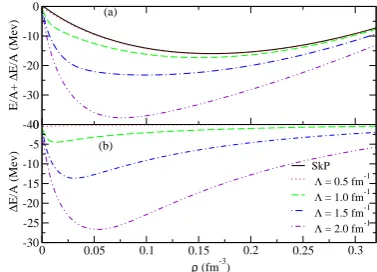
Fig. 2.(a):E/A+∆E/Aas a function of the densityρ(in units of fm−3for different values of the cutoffΛ(in units of fm−1)
com-pared with the SkP-mean-field equation of state (solid black line). (b): Second-order correction∆E/Afor different values ofΛ.
In other words, the second-order correction in symmetric nuclear matter with the simplified Skyrme interaction di-verges linearly with the momentum cutoffΛ[10, 11]
∆E
A (ρ, Λ→ ∞)= 1
105(−11+2 ln 2) χ(ρ)
+ Λ
9kF
χ(ρ)+O
(
kF
Λ )
,
χ(ρ)=− 3
4π6
m k7 F
~2ρ g 2
(ρ), (4)
where kF is the Fermi momentum and A is the particle number.
In figure 2(a),E/A+∆E/Ais plotted for different values of the cutoffΛ(from 0.5 to 2 fm−1) and compared with the SkP-mean-field curve (solid black line). The correction
∆E/Ais also plotted for different values of the cutoffΛin figure 2(b). One observes that the second-order correction causes a shift of the equilibrium point to lower densities.
Eq. (2) actually coincides with the equation of state ob-tained with the SkP Skyrme parameterization [13] where no contribution coming from the velocity dependent terms t1 andt2 appears. In this work, the SkP-mean-field equa-tion of state is used to make comparisons with the beyond-mean-field equations and is employed as our reference to perform the fit of the parameters.
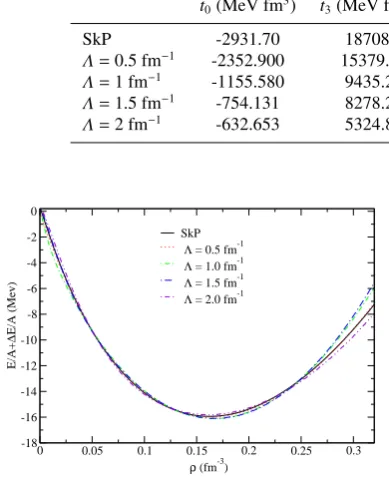
For each value of the cutoffΛ, we have performed a least square fit to determine a new parameter set SkPΛfor the beyond-mean-field corrected equation of state E/A+
∆E/Aso that the SkP mean-field EoS is reproduced. The corresponding curves obtained with the adjusted parame-ters are shown in figure 3 for different values ofΛ. In the inset of figure 3, the refitted EoS are plotted and compared with the SLy5 mean-field EoS (solid line). The refitted pa-rameters and the saturation point are listed in Table 1.
3 Second-order equation of state with the
full Skyrme interaction
Table 1.From the second line, columns 2, 3 and 4: parameter sets obtained in the fits associated with different values of the cutoffΛ compared with the original set SkP (first line). In the fifth column theχ2/N-value (χ2divided by the number of fitted points) associated
to each fit is shown. In column 6 the saturation point is shown.
t0(MeV fm3) t3(MeV fm3+3α) α χ2/N ρ
0(fm−3) E/A(ρ0) (MeV)
SkP -2931.70 18708.97 1/6 0.16 -15.95
Λ=0.5 fm−1 -2352.900 15379.861 0.217 0.00004 0.16 -15.96
Λ=1 fm−1 -1155.580 9435.246 0.572 0.00142 0.17 -16.11
Λ=1.5 fm−1 -754.131 8278.251 1.011 0.00106 0.17 -16.09
Λ=2 fm−1 -632.653 5324.848 0.886 0.00192 0.16 -15.82
0 0.05 0.1 0.15 0.2 0.25 0.3
ρ (fm-3)
-18 -16 -14 -12 -10 -8 -6 -4 -2 0
E/A+
∆Ε
/A (Mev)
SkP
Λ = 0.5 fm-1
Λ = 1.0 fm-1
Λ = 1.5 fm-1
Λ = 2.0 fm-1
Fig. 3.Refitted second-order-corrected equations of state com-pared with the reference SkP-mean-field equation of state.
a standard Skyrme interaction such as SLy5 in its complete form
V(r1,r2)=t0(1+x0Pσ)δ(r1−r2) +t1
2(1+x1Pσ)[k ′2δ(r
1−r2)+δ(r1−r2)k2] +t2(1+x2Pσ)k′·δ(r1−r2)k
+t3
6(1+x3Pσ)ρ
α(r1+r2 2
)
δ(r1−r2)
+iW0(σ1+σ2)·[k′×δ(r1−r2)k]. (5)
In Ref. [11], the energy per particle in nuclear matter calculated at the second-order has been derived analyti-cally using the general Skyrme force of Eq. (5). Its asymp-totic behaviour for large values of the momentum cutoffΛ shows that the divergence is strong (∼Λ5) and that this di-vergence is much stronger than the linear didi-vergence of the t0−t3model in Eq. (4)
∆E(2)
A (δ, ρ, Λ→ ∞)=a1(δ, ρ)Λ
5+a
2(δ, ρ)Λ3
+a3(δ, ρ)Λ+a4(δ, ρ)+O
(
kF
Λ )
. (6)
The last terma4(δ, ρ) in Eq. (6) has been calculated ex-plicitly in Ref [12] for symmetric nuclear matter (δ =0), asymmetric matter and for pure neutron matter (δ=1).
In the upper panel of figure 4 we plot, as an exam-ple, the second-order EoS of symmetric nuclear matter ob-tained for different values of the cutoffΛ(see legend), from 0.5 up to 2 fm−1. The different equations of state are calcu-lated by using the SLy5 Skyrme parameters and are com-pared with the reference mean-field SLy5 EoS (solid line
-80 -60 -40 -20 0
E/A (MeV)
SLy5 Λ = 0.5 fm-1 Λ = 1.0 fm-1 Λ = 1.5 fm-1 Λ = 2.0 fm-1
0 0.05 0.1 0.15 0.2 0.25 0.3
ρ (fm-3)
-80 -60 -40 -20 0
∆
E
(2)
/A (MeV)
(a)
(b)
Fig. 4. (a) Second-order EoS for different values of the cutoff
Λand (b) second-order correction for symmetric nuclear matter calculated with the SLy5 parameters. The SLy5 mean-field EoS is also plotted in (a) (solid line).
in (a)). In (b) the second-order correction is plotted for the same values of the cutoffΛ.
In Ref. [11], the problem of ultraviolet divergence has been solved in the following way. For each value of the cutoffΛ, we have performed a chi-squared minimization to determine the new sets of parameters for the beyond-mean-field corrected equation of stateE/A+∆E/A. All the parameters are kept free in the adjustment procedure. The minimization has been performed on 15 equidistant points using the following definition for theχ2
χ2 = 1
N−1 N
∑
i=1
(
Ei−Ei,re f
∆Ei
)2
. (7)
The errors or adopted standard deviations,∆Ei, are cho-sen equal to 1% of the reference SLy5 mean-field energies Ei,re f. This choice is arbitrary since we are fitting a theo-retical EoS where a standard deviation for this quantity has not been estimated. However, the magnitude of theχ2 de-fined in Eq. (7) has a clear and reasonable meaning: if it is smaller or equal to one, the reference EoS is reproduced within one standard deviation, i.e., within a 1% average error by our second-order EoS.
Table 2.Parameter sets obtained in the fit of the EoS of symmetric, asymmetric (δ=0.5) and pure neutron matter for different values of the cutoffΛcompared with the original set SLy5. The standard deviation,σ, estimated for the different parameters is also given. In the last columns theχ2and the incompressibiltyK
∞values are shown.
t0 t1 t2 t3 x0 x1 x2 x3 α k∞
σt0 σt1 σt2 σt3 σx0 σx1 σx2 σx3 σα
(MeV fm3) (MeV fm5) (MeV fm5) (MeV fm3+3α) (Mev)
SLy5 -2484.88 483.13 -549.40 13736.0 0.778 -0.328 -1.0 1.267 0.16667 229.90
Λ(fm−1) χ2
0.5 -2022.142 290.312 1499.483 12334.459 0.481 -5.390 -1.304 0.880 0.259 0.411 236.36
0.49 0.212 1.75 4.5 0.001173 0.00657 0.00020 0.001632 0.000280
1.0 -627.078 83.786 -971.384 186.775 3.428 -1.252 -1.620 200.360 0.338 0.540 230.52
1.668 0.2740 0.782 0.078 0.00260 0.01927 0.00026 0.082 0.000314
1.5 -743.227 112.246 -42.816 5269.849 1.013 3.478 -2.114 0.189 0.814 1.733 236.28
0.306 0.685 0.2972 5.4 0.01415 0.01309 0.00519 0.045037 0.000784
2.0 -718.397 573.884 -497.766 6179.243 0.391 -0.393 -0.574 0.785 1.051 1.313 222.76
0.343 0.251 0.261 8.33 0.005876 0.001850 0.000597 0.017475 0.00104
-15 -10 -5 0
E/A (MeV)
SLy5
Λ = 0.5 fm-1
Λ = 1.0 fm-1
Λ = 1.5 fm-1
Λ = 2.0 fm-1 -5
0 5
E/A (MeV)
0 0.05 0.1 0.15 0.2 0.25 0.3
ρ (fm-3) 0
40 80
E/A (MeV)
δ = 0.0
δ = 0.5
δ = 1.0
(a)
(b)
(c)
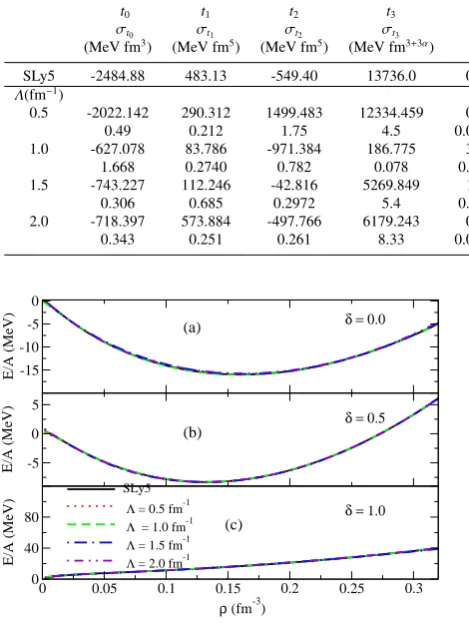
Fig. 5.Refitted EoS (global fit) for symmetric (a), asymmetric
δ = 0.5 (b), and pure neutron matter (c). The reference SLy5 mean-field curves are also plotted in the three panels (solid lines).
Theχ2 in the global fit is composed by the three con-tributions and its final value is divided by three in order to make our different results comparable to one another. In other words,
χ2= 1
3
[
χ2(δ=0)+χ2(δ=0.5)+χ2(δ=1)].
Globally, as one can see from theχ2 values, the fit is of good quality. Specifically, these values are still less than 1 up toΛ=1 fm−1. Values between 1 and 2 (to be judged by considering the adopted choice of the errors in the expres-sion ofχ2) are found for larger values of the cutoffmeaning that the fit is still good. Finally, we have estimated the stan-dard deviation of the fitted parameters [14]. This analysis allows one to asses how well the used reference data to-gether with the adopted errors constraint the parameters of our model. In particular, the standard deviation associated to such parameters are displayed in Table 2.
4 Conclusions
We have introduced a general method to handle the ultra-violet divergence generated by the use of a contact force in the evaluation of the second-order energy correction be-yond the mean-field level. As a first step, we have consid-ered symmetric nuclear matter with a simple zero-range
density-dependent interaction, corresponding to the so cal-ledt0−t3Skyrme model in nuclear physics. A cutoff reg-ularization has been proposed to treat the ultraviolet diver-gence which is linear with the momentum cutoff Λ. We then proposed a fitting procedure such that the equation of state (EoS) including the second-order correction matches rather well the one obtained with the original SkP mean-field force.
After that, we have extended our work to the case of nuclear matter with the nuclear Skyrme interaction. In this case, the velocity dependent terms of the Skyrme interac-tion have been included and the second-order equainterac-tion of state shows a strong divergence (∼Λ5). A global fit is per-formed simultaneously for the EoS of symmetric, asym-metric (δ = 0.5) and pure neutron matter at the second-order so that their corresponding SLy5 mean-field curves are well reproduced. These adjusted interactions display reasonable properties for nuclear matter. This opens new perspectives for future applications of this kind of interac-tion in beyond-mean-field models to treat finite nuclei.
Acknowledgments
Kassem Moghrabi is thankful to Haitham Zaraket and Bira van Kolch for valuable and fruitful discussions.
References
1. T.H.R. Skyrme, Phil. Mag.1, 1043 (1956); Nucl. Phys. 9, 615 (1959)
2. D. Vautherin and D.M. Brink, Phys. Rev. C 5, 626 (1972)
3. G. Bruun,et al., Eur. Phys. J. D7, 433 (1999)
4. P. Ring and P. Schuck,The Nuclear Many-Body Prob-lem, (Springer-Verlag Berlin Heidelberg New York, 1980)
5. P.G. de Gennes, Superconductivity of Metals and Al-loys, (Perseus Books Publishing, L.L.C. 1966)
6. L. Bonneau,et al., Phys. Rev. C76, 014304 (2007) 7. D. Gambacurta,et al., Phys. Rev. C81, 054312 (2010) 8. V. Bernard and N. Van Giai, Nucl. Phys. A 348, 75
(1980)
9. E. Litvinova,et al., Phys. Rev. C75, 064308 (2007) 10. K. Moghrabi, M. Grasso, G. Col`o, and N. van Giai,
11. K. Moghrabi, M. Grasso, X. Roca-Maza, and G. Col`o, Phys. Rev. C85, 044323 (2012)
12. K. Moghrabi and M. Grasso, in preparation.