i m p r o vi n g t h e i m p a c t of c o m p l e m e n t a r y c u r r e n c y s y s t e m s
t h r o u g h i m p a c t a s s e s s m e n t f r a m e w o r k s . I n t e r n a ti o n al Jo u r n al of
C o m m u n i ty C u r r e n c y R e s e a r c h , 1 9 (D). p p . 1 5 2-1 6 4 .
Do w n l o a d e d fr o m : h t t p ://i n si g h t . c u m b r i a . a c . u k /i d/ e p ri n t/ 2 1 6 8 /
U s a g e o f a n y i t e m s f r o m t h e U n i v e r s i t y o f C u m b r i a’ s i n s t i t u t i o n a l r e p o s i t o r y
‘I n s i g h t ’ m u s t c o n f o r m t o t h e f o l l o w i n g f a i r u s a g e g u i d e l i n e s .
Any it e m a n d it s a s s o ci a t e d m e t a d a t a h el d i n t h e U niv e r si ty of C u m b r i a ’s in s ti t u ti o n al
r e p o si t o r y I n si g h t ( u nl e s s s t a t e d o t h e r wi s e o n t h e m e t a d a t a r e c o r d ) m a y b e c o pi e d ,
di s pl ay e d o r p e rf o r m e d , a n d s t o r e d i n li n e wi t h t h e JIS C f ai r d e a li n g g ui d eli n e s ( av ail a bl e
h e r e
) fo r e d u c a t i o n al a n d n o t-fo r-p r ofi t a c tiviti e s
p r o v i d e d t h a t
• t h e a u t h o r s , ti tl e a n d full bi blio g r a p h i c d e t ail s of t h e it e m a r e ci t e d cl e a rly w h e n a n y
p a r t
of t h e w o r k is r ef e r r e d t o v e r b a lly o r i n t h e w ri t t e n fo r m
• a h y p e rli n k/ U RL t o t h e o ri gi n al I n si g h t r e c o r d of t h a t it e m is i n cl u d e d i n a n y
ci t a ti o n s of t h e w o r k
• t h e c o n t e n t is n o t c h a n g e d i n a n y w a y
• all fil e s r e q ui r e d fo r u s a g e of t h e it e m a r e k e p t t o g e t h e r wi t h t h e m a i n it e m fil e.
Yo u m a y n o t
• s ell a n y p a r t of a n it e m
• r e f e r t o a n y p a r t of a n it e m wi t h o u t ci t a ti o n
• a m e n d a n y it e m o r c o n t e x t u ali s e it i n a w a y t h a t will i m p u g n t h e c r e a t o r ’s
r e p u t a t i o n
• r e m ov e o r a l t e r t h e c o py ri g h t s t a t e m e n t o n a n it e m .
T h e full p oli cy c a n b e fo u n d
h e r e
.
Alt e r n a t iv ely c o n t a c t t h e U niv e r si t y of C u m b ri a R e p o si t o ry E di t o r b y e m a ili n g
International Journal of
Community Currency Research
V
OLUME19
(2015)
S
ECTIOND
152-164
VALIDATING AND IMPROVING THE IMPACT OF
COMPLEMENTARY CURRENCY SYSTEMS
THROUGH IMPACT ASSESSMENT FRAMEWORKS
Christophe Place* And Leander Bindewald**
* HEG-Geneva School Of Business Administration, Switzerland
** New Economics Foundation, United Kingdom
ABSTRACT
Credibility and legitimacy are required to improve the design and implementation of comple-‐ mentary currency systems (CCS) and to engage with public institutions, while depending on sustained support from funders. It is hence necessary to evidence the impact of CCS as effective and ef@icient tools to reach sustainable development goals. Only around a fourth of the existing studies even touch upon impact evaluation processes. A standardisation of impact evaluation would lead to improve the quantity, quality and comparability of the data collected, as well as to support longitudinal studies and juxtapositions of different types of currencies in their envi-‐ ronmental and socio-‐economic context. After reviewing the literature, this article proposes two complementary approaches to assess the impact of CCS: a prototype of an integral Impact As-‐ sessment Matrix based on the goals, objectives and performance indicators, and a tool based on the “Theory of Change” methodology as a common, comprehensive and incremental approach for impact evaluation. Both propositions are currently being applied and further developed by the authors.
ACKNOWLEDGEMENTS
Both authors gratefully acknowledge the great work and generous contributions of all the peo-‐ ple in the @ield of CCS. We are standing on the shoulders of giants. Both authors acknowledge the work and collaboration leading up to this paper of Gill Seyfang, Marie Fare, Alan Patterson, Juliana Braz, Helene Joachim, Erick Brenes, Camille Meyer, Marc Münster, William O. Ruddick, Etienne Hayem, Vincent Demontalivet, Nicolas Briet, and Matthieu Langeard. Christophe Place acknowledges the Geneva School of Business Administration and especially Andrea Baranzini, Christophe-‐Alexandre Dunand, Emmanuel Fragnière, Jean-‐Pierre Meynard, Iliya Markov, Ste-‐ fano Carattini, Maria Nginamau, and Cédric Chervaz for their inputs in his research. Leander Bindewald gratefully acknowledges Susan Steed and Natalie Nichols at the New Economics Foundation and the partners and funders of the Community Currencies In Action EU-‐Interreg Project.
KEYWORDS:
impact, assessment, evaluation, monitoring, standards, measurement, indexing, indicators, per-‐ formance.
* Email: [email protected] ** [email protected]
INTRODUCTION
For over 3 decades, from 1983 until now, up to 4,500 com-‐ plementary currency, community credit and alternative @inance systems have aimed, without commonly accepted proof, for economic integration through reciprocity, redis-‐ tribution, sharing, solidarity and the protection of regional or local economies (Servet, 2013; Blanc, 2013). These Complementary Currency Systems (CCS) cover a wide range in the diversity of currency types and applied de-‐ signs, and, more fundamentally, cover a wide range of spe-‐ ci@ic objectives or “raisons d'être” Some focus more on so-‐ cial integration, environmental sustainability or cultural diversity, others more on economic resiliency, crisis mitiga-‐ tion or political autonomy. These economic and monetary innovations to date lack consistent scrutiny in evaluating their viability and genuine evidence of their economic, so-‐ cial, environmental and political impact.
Today, practitioners in the so-‐called CCS movement, policy makers and academics all exhibit a growing interest in im-‐ pact evaluations of CCS, particularly concerning community empowerment, social capital, participatory governance, the sociology of their users and local development goals. This is contrasted with a relative lack of historical studies, theo-‐ retical frameworks, standards for comparison, data collec-‐ tions and systematic articulations of these monetary inno-‐ vations in the literature to date. Indeed, most of impact evaluations presented so far had been based on individual descriptive case studies (Blanc, 2013).
The purpose of this paper is to launch a deliberate process of improvement to this situation in order to live up to the growing demand for proof and validation of CCS, as well from users as from funders and policy makers. Here, we propose, in a bipedal approach, two methodologies that aim to accelerate this process: 1) an Impact Assessment Matrix (IAM) prototype which integrates monitoring and evaluation methodologies and 2) a “Theory of Change” framework as an intermediary step towards standardisa-‐ tion in evaluation, impact assessment, reporting and analy-‐ sis. Our propositions are based on a literature review of impact assessment as presented at the University of Split in July 2012 (Place et al., 2012), further work on the typolo-‐ gies and objectives of CCS were prepared for the UNRISD conference in Geneva in May 2013 (Bindewald et al., 2013), the ISS conference in The Hague in June 2013 (Place et al., 2013), and the action-‐research done for the Community Currencies in Action project (CCIA).
The contribution of this paper is to present the need and context of impact assessment for CCS (Section 1) analyse the existing impact literature (Section 2) and reviews the objectives of CCS (Section 3), from which a non-‐exhaustive impact assessment matrix is derived (Section 3). As a sec-‐ ond currently piloted approach we describe a “Theory of Change” framework as an immediate and incremental step towards a universally applicable and comparable process for the evaluation of CCSs (Section 4). Both Theory of Change (ToC) and Impact Assessment Matrix (IAM) frame-‐ works will here be presented at a prototyping and proof of
concept stage, to prepare wider collaborations, delibera-‐ tions and applications of impact assessment and processes of standardisations for this adolescent @ield of innovation.
PURPOSE AND CONTEXT OF EVALUATION
STANDARDS FOR CCS
Because of the high diversity of CCS already in use and the constant adaption and innovation in this @ield, any monitor-‐ ing and evaluation systems need to be balanced, coherent and comparable across different currency models on one hand, and suf@iciently @lexible to mirror the speci@icities of the initiative on the other hand. Consequently, due to the diversity of stakeholders and objectives of CCS, standardi-‐ sations of indicators need to be designed in a bottom-‐up approach, taking into account a wide number of speci@ic currency systems before conceptualizing common sets of indicators. To do so we will @irst analyse the purpose of impact assessment frameworks and then elaborate on ap-‐ propriate approaches for CCS.
We see four important and interdependent reasons for the deployment of evaluation standards in CCS impact assess-‐ ment, as represented in Figure 1:
• Internal viability: improving project implementa-‐ tions in regard to operational, structural and organ-‐ izational aspects
• Internal ef@iciency: improving uptake by users and reduce overheads and transaction costs
• External viability: attracting funders and support and widen the recognition
• External credibility: proving impact and ef@iciency to international organizations and the public sector.
Impact assessment and impact reports are necessary to receive @inancing, especially through impact philanthropy and through donation fundraising (Place, 2010). Those donations often imply a “counter-‐donation” of qualitative and quantitative information about the impact of the pro-‐ ject. Indeed, a study in 2008, based on data from 165 sys-‐ tems in 28 countries, found 74% of CCS being dependent on external @inancing: only 9% achieve it thanks to internal service taxes and 65% rely on voluntary institutional or individual @inancing (Demeulenaere, 2008).
Figure 1. The need for and purpose of impact assessment and evaluation frameworks (Source NEF, 2014.)
No Small Change Evaluating the success of your community currency project
Figure 2: The purpose of an evaluation
In this section we have provided a whistle-stop tour of impact details of impact measurement. But thinking upfront about what how you can collect data along the way can save a lot of time and effort further down the line.
6 • Policy makers
• Regulators • Project leader• Management
team
• Financing institutions • Development
agencies
• Designer • Architect • Computer
engineer External
credibility Stakeholder
legitimacy
Internal viability Project management
External viability Fundraising
support
Internal efficiency
Tool design
REVIEW OF EXISTING IMPACT ASSESSMENT
WORK
In CCS speci@ically, we should pay particular attention to territorial development on the one side and @inancing vehi-‐ cles on the other side. The @ields with established evalua-‐ tion frameworks are international development aid and sustainable @inance. In both domains, among various and numerous resources dealing with tools and methodologies, we can already and easily identify some state-‐of-‐the-‐art guidelines, principles, standards and even handbooks which present impact assessment, measurement indica-‐ tors, monitoring and evaluation systems (Bindewald et al., 2013). Complementary and community currency research is currently in the process of developing into a solid disci-‐ pline, but even if some research in this @ield has already existed for a long time, it still remains scarce compared to the work done on development projects and even impact @inance. Graph 1 depicts the ratio between reference stud-‐ ies and general material. Reference papers and authors are those that are directly, pertinently and genuinely dealing with impact assessment and can thus be considered as a point of reference about this topic in its @ield. Only 5 of the 12 reference studies in CCS present quantitative measure-‐ ment indicators and could be seen as references in the nar-‐ rower sense, as they deal with indicators, evaluation, im-‐ pact and social or environmental capital bene@its such as process and results (Place, 2012).
In the @ield of complementary, local and community cur-‐ rencies, a personal literature review of 36 out of the 76 aforementioned documents, which means 47.37%, are dealing with the topic of impact assessment. Most of the evaluation process and results are based on conceptual models of economic, social and well-‐being issues with ei-‐
ther a qualitative or quantitative approach (Place, 2012).
Graph 1. Number of impact assessment reference versus general material in different fields Source: Place, 2012.
According to the bibliography of community currency re-‐ search, called CC-‐Literature, only 76 or 18.7% of all 406 English sources listed there, appear in the keyword search “impact assessment” and related terms. 406 English re-‐ sources represent 37% of the 1251 total sources in the database. By searching for the key-‐words: impact, evalua-‐ tion, measure, rating, audit, indicator, scorecard, assess-‐ ment, monitoring, performance we can respectively extract 30, 21, 14, 5, 3, 2, 1, 0, 0, 0 sources, a total of 76 sources. Furthermore, most of those reports are descriptive case studies, which do not refer or adhere to any impact evalua-‐ tion framework (Schroeder et al., 2011; Place, 2012).
Graph 2: number of papers dealing with impact assess-ment in different CCS databases
Finally, among the 104 papers published between 1997 and 2013 in the 17 volumes and 2 special issues of the IJCCR-‐International Journal of Community Currency Re-‐ search, the only peer-‐reviewed journal of empirical, critical and theoretical research on CCS, only 13 pertinent papers deal with impact evaluation approach of CCS1, which means
12.5%.
The economic, social and environmental impact of different CCS models is under debate but the presented studies relay on data and methodologies that are mostly incomparable across the studies and don’t allow us to score or rank the different CCS initiatives. Most of these studies are based on qualitative research methods with punctual @ield surveys or are embedded in certain events like period of crisis, there
INTERNATIONAL JOURNAL OF COMMUNITY CURRENCY RESEARCH 2015VOLUME 19(D)152-164 PLACE AND BINDEWALD
is little quantitative research and even fewer established performance indicators. Furthermore, the majority of the individual research has been conducted during a short pe-‐ riod of 1 or 2 years, and often dates back till before 1993 when the Agenda 21 for sustainable development only emerged from the United Nations to become a major driver for territorial and community development projects. The recent emergence of new complex CCS types, called 4th generation (Blanc, 2013), is also not covered by evaluation research yet. In most cases the research only focuses on one aspect of sustainable development: economic, social or environmental and rarely takes the interactions of these three into account. These differences are depicted in Graph 2.
Among those various empiric analyses, we congratulate the proposition of a matrix of performance indicators made by Instituto Palmas and NESOL-‐USP in 2013. Nevertheless, this matrix has not been fully implemented and only covers information of a 2 years study without a meta-‐analysis focusing on impact and its native scope is centred on one speci@ic CCS type and geographical region and thus it will be dif@icult to transpose its @indings to other CCS types and localities.
Two meta-‐analyses have been recently made one by Gill Seyfang and Noel Longhurst; the other by Kristofer Dittmer both published in 2013, both presenting neutral or nega-‐ tive conclusions about the impact of CCS. The data for these analyses cover research since 1996 and 2011 respectively and integrate the consequence of sustainable development as a major issue for territorial and community develop-‐ ment projects like CCS. We appreciate those initiatives and we hope that extensive, in-‐depth and thorough impact analysis will be done in the future.
OBJECTIVES OF CCS
To establish an appropriate approach and scope for evalua-‐ tion and impact assessment, it is necessary to @irstly focus on objectives and purpose before any other typological differentiation, in order to appropriately evaluate CCS against their own and diverse targets and not against im-‐ plicit notions of success or ambition which might speak through third party typologies.
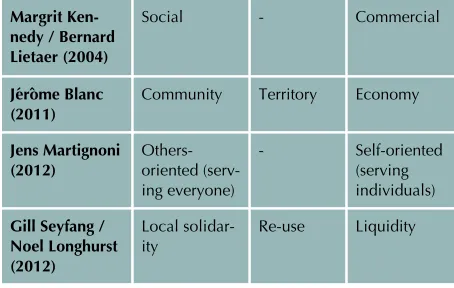
As shown in table 1, the various existing attempts at CCS typologies all exhibit some form of differentiation by objec-‐ tives and thus allude to the impact aspect of CCS. Beyond their complex operational systems and technical designs as alternative @inancing mechanism, most CCS exhibit genuine strategic objectives linked to a sustainable and ethical vi-‐ sion. That is why recently CCS impact research has started to focus on the intentional objectives of different curren-‐ cies.
Table 1: objective approach of complementary currency systems according to their typology (Place et al., 2013.)
Margrit Ken-nedy / Bernard Lietaer (2004)
Social - Commercial
Jérôme Blanc (2011)
Community Territory Economy
Jens Martignoni (2012)
Others-oriented (serv-ing everyone)
- Self-oriented
(serving individuals)
Gill Seyfang / Noel Longhurst (2012)
Local solidar-ity
Re-use Liquidity
Recent re@lections about CCS intentional objectives, espe-‐ cially during the 1st International Conference on Commu-‐ nity and Complementary Currencies which took place in Lyon in February 2011, revealed that those initiatives aim to frame exchanges differently, try to rethink the role of money in the context of the common good, and creating tools to activate unrealized values. Thus, what exchange do we want to promote, between whom, for what, how, are the main questions of the self-‐labelled CCS movement. Com-‐ mon motivations and core objectives of such initiatives revolve around strengthening solidarity and sharing in communities, develop local employment and galvanizing the economy.
The @irst notable re@lection about intentional objectives, portrait CCS as tools for scale changes in sustainable local development through a collaborative and cooperative vec-‐ tor, innovative wealth valuation and the preservation of social protective systems2. (Cahier d’espérance richesses et
monnaies, 2011).
A recent re@lection made by Kristofer Dittmer divides CCS by their meso and macro objectives and looking at per-‐ formance criteria. According to Dittmer’s analysis “Local Exchange Systems” allow for alternative @lexible libertarian measures of value, “Time Banks” focus on community-‐ building through improving local social networks and reaching the socially excluded, “HOURS” (as in Ithaca Hours) offer alternative livelihoods by supporting primary occupation in the alternative service sector, and “Converti-‐ ble Local Currencies” incentiving eco-‐localization by at-‐ tracting local businesses (Dittmer, 2013). On the same no-‐ tion of performance criteria, intentional objectives are the focus of another notable re@lection made by Monnaie en Débat in 2011, which focuses more on CCS’ meso and macro objectives and divide them among different main objectives such as services exchange and mutual aid, eco-‐ nomic development, social and solidarity economy (or local economy, social economy, solidarity economy), eco-‐ friendly behaviour development, and hybrid forms (Mon-‐ naie en Débat, 2011).
INTERNATIONAL JOURNAL OF COMMUNITY CURRENCY RESEARCH 2015VOLUME 19(D)152-164 PLACE AND BINDEWALD
Dimension Level Vision/Goal Mission/Objective
Culture Meta Societal acceptance Recognition, credibility, legitimacy from (inter)- governmental
institu-tion
Culture Meta
Community Tranverse cross-disciplinary integral holistic collective intelligence Culture
Macro Inner/ outer sense harmony Other oriented cooperation & self-oriented competition equilibrium Culture
Meso Pluralism, inclusiveness, diversity, creativity
Alternative flexible libertarian measure of value Culture
Meso Pluralism, inclusiveness, diversity, creativity
Soft skills and hard skills design thinking Culture
Micro Innovation, confidence, humility Open questioning capacity
Governance Meta Participatory democracy Collaborative election decision process: consent sociocracy
Governance
Macro Citizenship engagement recogni-tion
Effective stakeholder involvement stimulation Governance
Meso Independent control Independent quality control process
Governance
Micro Monetary creation as common
good
Open free code and legality
Economic Meta Crisis resilience Sufficient currency tool constellation: diversity inter-connexion
Economic Meta Crisis resilience
Appropriate socio-environmental accountancy scheme
Economic Meta Crisis resilience
Efficient externalities internalisation Economic
Macro Make exchange possible Unsatisfied needs meet unused resources
Economic
Meso Inclusive community-building Income, employment and activities generation Economic
Meso Inclusive community-building
Financial inclusion & credit clearing & social inclusion Economic
Meso Inclusive community-building
Local economic actor liquidity Economic
Micro Financial autonomy development Turnover, sales Economic
Micro Financial autonomy development
Client loyalty Economic
Micro Financial autonomy development
Purchasing power Economic
Micro Financial autonomy development
Value-added
Social Meta Link share reciprocity solidarity Local, time and knowledge exchange
Social
Macro Equity and justice Public debt reduction
Social
Macro Equity and justice
Egalitarian or ethical value hierarchy Social
Macro Equity and justice
Public services increase Social
Macro Equity and justice
Social protection preservation Social
Macro Equity and justice
Non-Speculative economy circulation Social
Meso Needs satisfaction Informal primary livelihoods activities support
Social
Meso Needs satisfaction
Voluntary work valuation Social
Meso Needs satisfaction
Keep wealth locally Social
Micro Cohesion cooperation sharing vector
Value co-creation process Social
Micro Cohesion cooperation sharing vector
SSE network activation Social
Micro Cohesion cooperation sharing vector
Consumer-producer link reinforcement
Environment Meta Transition and autonomy Encourage territorial community: conurbation regional development
Environment
Macro Eco-localization relocation Incentive to attract local producer and consumer Environment
Meso Ecological footprint reduction Eco-citizen behaviour incentive: consumption reduction, repair, reuse, energy saving, waste recycling, biodiversity rehabilitation, organic agroforestry, water conservation, ethical banking, sustainable investment
Environment
Micro Responsible consumption motiva-tion
Label network integration: Fair Trade, Organic products, Eco-friendly
Another re@lection made by Philippe Derudder and Michel Lepesant in 2011 deals with CCS micro objectives re@lected by economics actors such as producers, consumers, stake-‐ holders and institutions (Derudder et al., 2011). Dealing even more with the integration of the stakeholder point of view, some recent re@lections made by Maria Nginamau in 2013 and Cédric Chervaz in 2014 look at CCS’ micro and meso objectives based on how service design concepts relate to communicative blueprint methodologies (Chervaz, 2014; Nginamau, 2013).
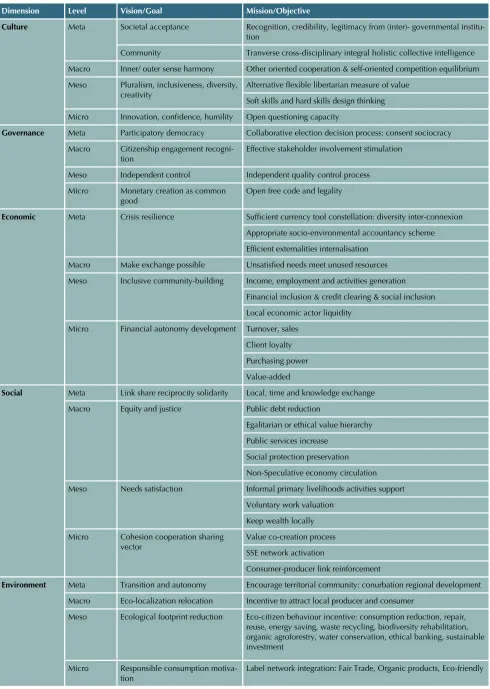
Nevertheless, all different objective approaches currently being conceptualized within the CCS movement aim to re-‐ veal its high potential to ful@il sustainable development. Beyond looking at their purpose, this paper argues, that it is important to prove that CCS are a strategic ef@icient tool to reach these goals, creating a real impact for sustainable development in either sense (Table 2)
AN "IMPACT ASSESSMENT MATRIX" PROPOSI-‐
TION FOR CCS
An Impact Assessment Matrix deals with reporting against indicators for set goals and objectives measuring the quan-‐ titative outputs of an activity and verifying the qualitative outcomes of a project (UPEACE, 2011). It’s a systematic method for collecting, analysing, and using information to answer questions about projects, policies and programs, particularly about their effectiveness and ef@iciency, usually using an indicators dashboard. They can involve both quan-‐ titative and qualitative methods of environmental and so-‐ cial research with different background such as economics, politics, cultural, sociology, anthropology, philosophy and psychology domains.
For the work on any Impact Assessment Matrix, we pro-‐ pose to respect the norms for evaluation proposed in the handbook on planning, monitoring and evaluating for de-‐ velopment results by the United Nations Development Pro-‐ gramme (UNDP, 2009: page 130). Furthermore, to reach such wide objectives as sustainable development, a greener, social and solidarity economy or prosperity with-‐ out growth, any economic and monetary innovation must integrate a diversity of cross-‐disciplinary domains in its impact assessment approach. As these are complex cross-‐ disciplinary dimensions, a transverse research approach is a key in the CCS @ield (Furtado, 2005). And as such we can take our inspiration from the well-‐structured work made in the development domain and the impact @inance sector but shall even overpass them by designing a transverse and integral approach which takes into account more than strictly rational data collection and assessment.
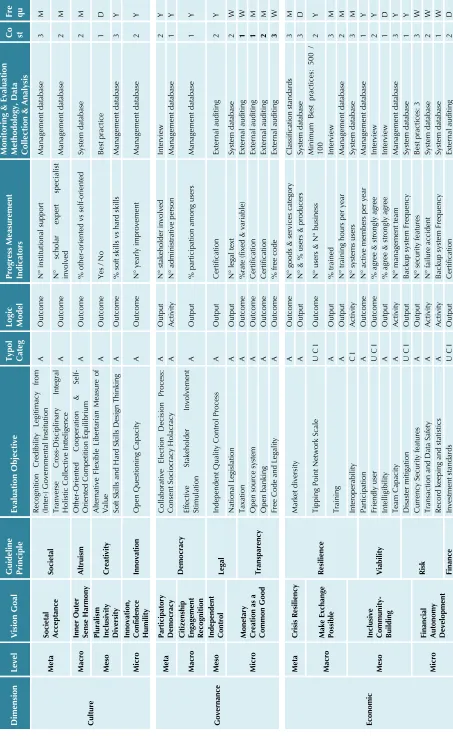
Taking all the above into account, the following prototype Impact Assessment Matrix, shown in table 3, serves as an illustration of what a @inal dashboard or scorecard for the impact assessment of CCS might encompass, with an expla-‐ nation of the category headings:
• Dimension: linked with scienti@ic research domains in different background such as ecology (environ-‐
ment), sociology (social), economics (economy), politics (governance), anthropology, philosophy and psychology (culture) to insure a cross disciplinary approach.
• Level: meta, macro, meso or micro.
• Vision goal: as described above.
• Guideline principle: main topic, issue, subject which might be integrated, followed and respected.
• Evaluation objective: as discussed above.
• Typology: bilateral barter (B), multilateral barter (M), mutual credit (U), issued currency (C), hybrid exchange system (I) or relating to any of these types (A).
• Logic model hierarchy: measuring activities (A), outputs (P) or outcomes (C).
• Progress measurement against eco-‐socio-‐ environmental indicators of different kinds.
• Monitoring and evaluation methodology: data collec-‐ tion and analysis with quantitative or qualitative research methods.
• Cost: estimation of the time, money and human re-‐ sources needed for data collection: low (1), medium (2), high (3).
• Frequency of the data collection and analysis: daily (D), weekly (W), monthly (M), yearly (Y).
DEPLOYING THE "THEORY OF CHANGE" METH-‐
ODOLOGY FOR BOTTOM=UP ADVANCEMENT OF
EVALUATION IN CCS
For an on-‐going international EU-‐Interreg co-‐funded, cross-‐ sectorial collaboration project (COMMUNITY CURRENCIES IN ACTION, 2012) around the consolidation of complemen-‐ tary currency tools, a framework for the evaluation of com-‐ plementary and community currencies has been developed and deployed with the project's different CCS pilots (NEF, 2014). The methodology is here proposed as the second, incremental approach towards standardisation and con-‐ solidation of impact assessment of CCS.
long-‐term outcomes have been achieved by the interven-‐ tion or are expected to be achieved respectively. The inter-‐ actions between these outcomes are mapped in a temporal manner, portraying earlier changes as the preconditions for later and possibly more high-‐level outcomes/changes.
As part of a full evaluation or impact assessment (Figure 3), the ToC covers the @irst two parts, allowing for the third part, the determination of appropriate indicators to follow. Through breaking up outcomes into very concrete and manageable components, it becomes easier to @ind qualita-‐
tive and quantitative indicators for individual outcomes that are the basis for data collection and @inally evaluation (including the discounting of deadweight).
In a ToC, the elements and effects of a project, initiative or intervention are clearly distinguished from each other, which helps the (meta-‐)communication within a project team and the outwards communication to stakeholders, users and funders. The most important distinction is the one between “activities” and “outcomes”. Particularly dur-‐ ing the stakeholder workshops, the facilitator’s question
INTERNATIONAL JOURNAL OF COMMUNITY CURRENCY RESEARCH 2015VOLUME 19(D)152-164 PLACE AND BINDEWALD
Figure 2: Parts of an impact assessment process covered by the ToC approach (Source: NEF, 2014).
Figure 3: Example of a Theory of Change flow chart for CCIA TimeCredit currencies in Wales (Source: NEF, 2014).
36
No Small Change
Evaluating the success of your community currency project
Example ToC: TradeQoin - Cooperative Trade Exchange
Sale of spare capacity, otherwise unsold Faster turnover of stock Better utilisation of fixed costs
Increased throughput
TradeQoin Activities Short-term outcomes Medium-term outcomes Long-term outcomes
•
• •
Increased liquidity Increased sales (in €)
Break down barriers between different business networks
• Investments (stock, supplies, marketing) otherwise not prioritised are now possible
• Euros are “freed up” of other spending
Break down barriers between individual
businesses
Engaging other networks and communities
(Increased range of) goods and services made available
without using Greater visibility - promotion through online marketplace
and other services Access to credit line in TQs
(at zero interest )
Proactive brokering within the network
Proactive extension of the network to meet demand
• New clients
• Existing client loyalty
• Deep selling, cross selling and upselling
Greater trust between small businesses
• New B2B clients
• Deep selling, cross selling and upselling
Increased sales (in TQ)
• Increased demand leads to less lay-off
• Part-pay or bonuses in TQ leads to greater employee loyalty
Increase/retain employment
Increased profit
Stronger local economy
• Greater business diversity
• More decentralised innovation
• More level playing field
• Greater pride of SMEs
• TQ can’t ‘leak out’ of network
• Improved wellbeing
• People value their local economy more
“What is the project (supposed to be) doing?” can be an-‐ swered with either category. But as a tool for impact as-‐ sessment the ToC is only concerned with outcomes, or, in other words, the effects of activities on people or the situa-‐ tion they are in. These are the “changes” happen and which this methodology seeks to articulate clearly. To make sure an outcome rather than an activity is articulated, the ques-‐ tion “Why does this (the activity) matter?” can be asked iteratively (NEF, 2014).
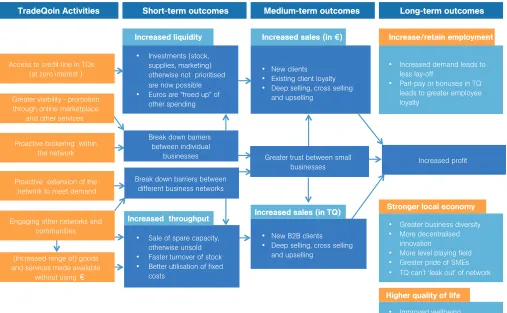
To validate and adapt it for CCS, ToC workshops were con-‐ ducted with the CCIA implementation partners and their stakeholders. The results of two of these workshops with different CCS are presented here (Figures 4 & 5).
Each outcome, on the short-‐, mid. and long-‐term, depicted in one of the building blocks of the graphic ToCs, can then be targeted in the search for appropriate indicators, which could show that this one outcome has been achieved or not. In addition to determining indicators for a speci@ic evalua-‐ tion, one of the strong extra advantages of a Theory of Change approach and process is that many unarticulated and even unconscious assumptions can surfaced and get tested for their relevance to the project or intervention (Vogel, 2012). This is of course increasingly important the more different stakeholder groups are involved in a pro-‐ ject. And since many CCS initiatives aim to be more inclu-‐ sive and collaborative than conventional projects, diver-‐ gent assumptions and individual motivations of different stakeholder(-‐groups) are a hazard to the success and sus-‐
tainability of the initiative. In this sense the ToC approach serves the recommendations of Seyfang and Longhurst, who cite “expectation management” to be one of the key success factors for the sustainability of social niche tech-‐ nologies like CCS (Seyfang et al., 2012).
In conclusion, a ToC framework has several bene@its be-‐ yond the development of the CCS @ield and the incremental and peer driven development of general indicators and quality standards of impact evaluation:
• It is applicable at all stages of development of a given system or initiative.
• It is supportive of the design, marketing and valida-‐ tion processes of currency initiatives through a focus on the clear articulation of objectives and assump-‐ tions.
• It is compatible with different stakeholder situations (grass-‐root, non-‐pro@it, commercial, public).
• It can be an integrated part of an evaluation process or can be a stand-‐alone result for better communica-‐ tion (towards funders and new stakeholders) and assisting the project development process.
• It is adaptable to self-‐driven, facilitated or commis-‐ sioned evaluation efforts.
Figure 4: Example of a Theory of Change flow chart for CCIA TradeQoin pilot in the Netherlands (Source: NEF, 2014).
37
No Small Change
Evaluating the success of your community currency project
Example ToC: Time Credits in Ely/Caerau and Blaengarw
Medium-term outcomes
More appealing build environment
Improved environment
Cleaner, cared for natural environment More social networks –
local and global Elderly feel less isolated
Young people engaged in positive activities
Different family culture
Involvement fosters pride & respect
Connected community
Long-term outcomes
Increased aspirations, skills and employment
People feel healthier and happier
Individual wellbeing
Feeling empowered to support themselves and
help others
More support services available
People proud of their community and
environment Over reliance on organisers/leaders
Greater awareness of mental health, drug use,
isolation Improved confidence
Less barriers between groups & generations
Changed awareness /attitude/behaviour towards environment
Feel valued
Build friendships
Children learn new attitudes & behaviours Experience new
activities and interests despite lack of money Meet new people
People contribute to
Only reported in Ely/Caerau Only reported in Blaengarw their environment
e.g. litterpicks People’s (time) contributions get
acknowledged
People nervous about trying new things
Discomfort about “pay” for volunteering
• It is a pre-‐requisite for a peer driven development of general evaluation and quality standards (including the above proposed matrix and scorecard approach) of CCS.
We proposed the Theory of Change framework as a @irst stage for wide spread and consolidated impact assessments of CCS in order to increase the legitimacy, external visibil-‐ ity, and internal viability of such initiatives as an ef@icient impact tool for sustainable development.
CONCLUSION
In the @irst section we identi@ied the context and need for more rigorous and coherent impact assessment of CCS. In the second section we show how current literature on CCS does not fully accommodate this need.
Thus, after reviewing the diverse objectives of different CCS in section 3, we provided two prototype approaches for the improvement and spread of impact assessment: 1) an Impact Assessment Matrix, and 2) a practical and in-‐ cremental approach in that direction through the applica-‐ tion of the Theory of Change methodology as piloted in the CCIA project.
Thanks to these impact evaluation and monitoring ap-‐ proaches, we hope to accelerate and enhance the validation of complementary currency systems as strategic and ef@i-‐ cient impact tools for sustainable and ethical prosperity. Even in the short term, this is important to make the case to funders and policy makers. Our proposed approaches re@lect how they contribute to these broad aims in the dis-‐ tinct spheres of culture, governance, economy, social inte-‐ gration and environment. Solid impact assessment and monitoring would also allow CCS to improve their internal design and implementation in order to reach their impact objectives and consequently advance their performance, legitimacy, scaling-‐up and replication processes.
A practical yet principle driven approach to standardisa-‐ tions of evaluation and impact assessment could ultimately also enable the establishment of a certi@ication system for “impact currencies”, which will allow this @ield to prove not only its innovativeness and viability but also its genuine transverse and integral impact for territorial and commu-‐ nity development.
It is expected that in overlay of the indicators from differ-‐ ent currencies a set of general and another set of speci@ic indicators can be derived, with speci@ic sets for different currency models. This will inform the design of future evaluation standards and dashboard systems. From this conceptual and action research driven approach we expect to ultimately derive the impact evaluation standards neces-‐ sary to validate CCS as appropriate and effective tools for the sustainable development expansion and appraisal.
Both complementary and connected approaches that we presented here aim at this goal, but which of them will be taken up and used by practitioners and researchers re-‐ mains to be seen. However, the Impact Assessment Matrix
and the Theory of Change methodology remain under de-‐ velopment by the authors and will hopefully facilitate new collaborations and strategic developments in and for the @ield of complementary currency systems.
REFERENCE
Anderson, A. (2005) ‘The Community Builder's Approach to The-‐ ory of Change’, (Aspen Institute). Available on-‐line: www.aspeninstitute.org/sites/default/@iles/content/docs/rcc/rcc sommbuildersapproach.pdf. Accessed 21st August 2014.
Aldridge T. and A. Patterson (2002) ‘LETS get real: constraints on the development of local exchange trading schemes’. Area. Vol 34(4) pp.370-‐381.
Aldridge T., A. Patterson and J. Tooke (2003) ‘Trading places: geog-‐ raphy and the role of local exchange trading schemes in local sus-‐ tainable development’. Local environmental sustainability. Pp.169-‐194.
Blanc, J. (2014) ‘Classifying CCS: Community, complementary and local currencies types and generations’. In International Confer-‐ ence on Community and Complementary Currencies 1, 16th and 1 7 t h o f F e b r u a r y 2 0 1 1 , L y o n . A v a i l a b l e o n -‐ l i n e : http://www.monnaiesendebat.org/spip.php?Rubrique18. Ac-‐ cessed 21st August 2014.
Blanc J. (2013) ‘Community and complementary currencies, prac-‐ tices and research: state of the art’. In UNRISD International Sym-‐ posium on Potential and Limits of the Social and Solidarity Econ-‐ omy – Special Session on Alternative Finance and Complementary Currencies, 6th, 7th and 8th of May 2013. (Geneva: International Labour Organization).
Bindewald, L., M. Nginamau, and C. Place (2013) ‘Validating com-‐ plementary and community currencies as an ef@icient tool for so-‐ cial and solidarity economy networking and development: the deployment of theory of change approach and evaluation stan-‐ dards for their impact assessment’. In International Symposium on Potential and Limits of the Social and Solidarity Economy – Special Session on Alternative Finance and Complementary Currencies, 6th, 7th and 8th of May 2013. (Geneva: International Labour Or-‐ ganization). Available on-‐line: http://www.unrisd.org/sseconf > accessed 21st August 2014.
Brenes, E. (2014) ‘Complementary currencies for sustainable local economies in Central America’. Journal of Community Currency Research. Vol 15(D) pp.32-‐38.
Briet, N. (2013) ‘L’émergence des monnaies complémentaires en Rhône Alpes et Suisse – co-‐créons une @inance durable et equita-‐ ble’. In 4ème RENCONTRES ÉCO-‐CITOYENNES DU TIOCAN, 29th, 30th, and 31st of March 2013. (Thoiry, France).
Brink, P., L. Mazza, T. Badura, M. Kettunen and S, Withana (2014) ‘Nature and its role in the transition to a green economy’. (Institute for European Environmental Policy) Available on-‐line: http://www.teebweb.org/wp-‐content/uploads/2012/10/Green-‐E conomy-‐Report.pdf . Accessed 21st August 2014.
J u n e 2 0 1 1 . ( P a r i s ) . A v a i l a b l e o n -‐ l i n e : http://cahier.collectif-‐richesses.org. Accessed 21st August 2014.
Cahn, E. (2001) On LETS and Time Dollars. International Journal of Community Currency Research 5.
Chervaz, C. (2014) ‘La monnaie comme service: diverses appro-‐ ches et élaboration d’un design de service pour une monnaie com-‐ plémentaire’ Unpublished Master dissertation (Geneva Business School of Administration).
Chien, M. (2010) ‘From sustainability to human rights: a case study on Endesa/Endesa Brasil.’ (United Nations Global Compact). Avail-‐ able on-‐line: http://www.unglobalcompact.org/case_story/373. Accessed 21st August 2014.
Collom, Ed. (2014) ‘Key indicators of time bank participation: us-‐ ing transaction data for evaluation’. International Journal of Com-‐ munity Currency Research. Vol 16(A) pp.18-‐26.
CCIA, Community Currencies in Action, Available on-‐line: www.communitycurrenciesinaction.eu. Accessed 21st August 2014.
Derudder, P. and M. LEPESANT (2011) ‘Monnaie locale com-‐ p l é m e n t a i r e é d i t o r i a l ’ . A v a i l a b l e o n -‐ l i n e : http://monnaie-‐locale-‐complementaire.net/category/fondamenta ux. Accessed 21st August 2014.
Demeulenaere, S. (2007) ‘Yearly report of the worldwide database of complementary currency systems’. International Journal of Community Currency Research. Vol 12 pp.2-‐19.
Demontalivet, V. and O. Chaussavoine (2013) Myrecyclestuff
Dittmer, K. (2014) ‘Local currencies for purposive degrowth? A quality check of some proposals for changing money-‐as-‐usual’. Journal of Cleaner Production. Vol 54 pp. 3-‐13
Fare, M. (2011) ‘Les conditions monétaires d’un développement local soutenable: des systèmes d’échange complémentaire aux monnaies subsidiaires’ Unpublished Doctoral thesis, (Université Lumière Lyon 2).
Furtado, J. I. dos Remedios (1005) ‘Multiple approaches towards sustainable development’. (Los Banos: IRRI).
Gelleri, C. (2009) ‘Chiemgauer regiomoney: theory and practice of a local currency’. International Journal of Community Currency Research. Vol 13 pp.61-‐75.
Graugaard, J. D. (2012) ‘A tool for building community resilience? A case study of the Lewes Pound’. Local Environment: The Interna-‐ tional Journal of Justice and Sustainability. Vol 17(2).
Hayem, E. (2013) ‘Une monnaie pour relier les acteurs de l’écono-‐ mie symbiotique et developer une économie vertueuses sur les territoires’. (Paris: Zoupic, le propre de l’om) Available on-‐line: http://www.zoupic.com/2013/05/30/une-‐monnaie-‐pour-‐relier-‐le s-‐acteurs-‐de-‐leconomie-‐symbiotique-‐et-‐developper-‐une-‐economie -‐vertueuse-‐sur-‐les-‐territoires. Accessed 21st August 2014.
Ingleby, J. (1998) ‘Local economic trading systems: potentials for new communities of meaning: a brief exploration of eight lets sys-‐ tems, with a focus on decision making’. International Journal of Community Currency Research. Vol 2.
INSTITUTO PALMAS -‐ NESOL-‐USP (2013) ‘Banco Palmas 15 anos: resistindo e inovando’, (São Paulo: A9 Editora)
Jacob, J., M. Brinkerhoff, E. Jovic and G. Wheatley (2004) ‘The social and cultural capital of community currency: an Ithaca Hours case study survey’. International Journal of Community Currency Re-‐ search. Vol 8 pp.42-‐56.
Kokabu, M., O. Katai, T. Shiose and H. Kawakami (2004) ‘Design concept of community currency based on fuzzy network analysis’. In 8th Asia Paci@ic Symposium on Intelligent and Evolutionary Systems, (Cairns, Australia), pp.107-‐116, Available on-‐line <http://www.ormita.com/pdf/library/communitycurrencydesign. pdf >. Accessed 21st August 2014.
Louette, A. (2008) Sustainability compendium: social and envi-‐ ronmental responsibility management tools, (São Paulo: Antakar-‐ a n a C u l t u r a A r t e C i ê n c i a ) . A v a i l a b l e o n -‐ l i n e : http://www.compendiosustentabilidade.com.br. Accessed 21st August 2014.
Louette, A. (2009) Sustainability indicators of nations: a contribu-‐ tion to dialogue, (São Paulo: Antakarana Cultura Arte Ciência/ W i l l i s H a r m a n H o u s e ) . A v a i l a b l e o n -‐ l i n e : http://www.compendiosustentabilidade.com.br. Accessed 21st August 2014.
Monnaie en Débat. (2011) ‘Faire mouvement’. In: Rencontre Inter-‐ nationale des acteurs des monnaies sociales et complémentaires, 1 8 t h o f F e b r u a r y 2 0 1 1 . L y o n . A v a i l a b l e o n -‐ l i n e : http://www.monnaiesendebat.org/. Accessed 21st August 2014.
Molnar, S. (2011) ‘Time is of the essence: the challenges and achievements of a Swedish time banking initiative’. International Journal of Community Currency Research. Vol 15(A), pp.13-‐22.
Naughton-‐Doe, R. (2011) ‘Time banking in social housing: a toolkit for co-‐production in public services’. International Journal of Community Currency Research. Special issue, Vol 15(D) pp.17-‐21
NEF (New Economics Foundation) (2014) ‘No Small Change. Evaluating the success of your community currency project’. Avail-‐ a b l e o n -‐ l i n e : http://www.neweconomics.org/publications/entry/no-‐small-‐cha nge. Accessed 21st August 2014.
Nginamau, M. (2013) ‘Étude de faisabilité de l’implémentation d’une monnaie sociale complémentaire au sein d’un réseau de l’économie sociale et solidaire’ Unpublished Master dissertation (Geneva Business School of Administration).
Ozanne, L. (2010) ‘Learning to exchange time: bene@its and obsta-‐ cles to time banking’. International Journal of Community Currency Research. Vol 14(A) pp.1-‐16.
P2P FOUNDATION (2013) Complementary currency de@inition. A v a i l a b l e o n -‐ l i n e : http://p2pfoundation.net/Complementary_Currencies. Accessed August 2014.
Park, S. (2011) ‘Reinventing @inancial services for a digital cur-‐ rency’. In LIFT Conference, 4th of February 2011, Geneva. Avail-‐ able on-‐line: http://www.parkparadigm.com/. Accessed 21st August 2014.
Place C. and L. Bindewald (2013) ‘Validating and improving the impact of complementary currency systems’. In 2nd International Conference on Complementary Currency Systems: Multiple mon-‐ eys and development -‐ making payments in diverse economies, 19th, 20th, 21st, 22nd, and 23rd of June 2013, The Hague. Avail-‐
http://www.iss.nl/research/conferences_and_seminars/previous_ iss_conferences_and_seminars/complementary_currency_systems /#Papers > Accessed 21st August 2014.
Place, C. (2010) ‘Moedas sociais e @ilantropía: o impact to investi-‐ mento social privado para o desenvolvimento de alternativas?’. Revista Benchmarking. Vol 5 pp. 46-‐48. Available on-‐line: http://www.maisprojetos.com.br/benchbrasil/revista/. Accessed 21st August 2014.
Place, C. (2012) ‘Impact assessment of economic and monetary innovations for their @inancing and improvement: why is it neces-‐ sary for social transformation projects management?’. In TESLA International Social Transformation Conference – Energy Currency Energy as the Fundamental Measure of price, cost and value, 10th, 11th and 12th of July 2012, Split. Available on-‐line: http://teslaconference.com/documents/PLACE%20Christophe.pd f. Accessed 21st August 2014.
Ruddick, W. and L. Mariani. (2013) ‘Complementary currencies strengthening the Social and Solidarity Economy: case studies from Kenya’. In UNRISD International Symposium on Potential and Limits of the Social and Solidarity Economy – Special Session on Alternative Finance and Complementary Currencies, 6th, 7th and 8th of May 2013. (Geneva: International Labour Organization). Available on-‐line: http://www.unrisd.org/sseconf. Consulted the 21st of August 2014.
Ruddick, W. (2911) ‘Eco-‐pesa: an evaluation of a complementary currency programme in Kenya’s informal settlements’. Interna-‐ tional Journal of Community Currency Research 15 (A) 1-‐12,
Scott Cato, M. and M. Suárez (2012) ‘Stroud pound: a local cur-‐ rency to map, measure and strengthen the local economy’. Interna-‐ tional Journal of Community Currency Research. Special issue, Vol 16(D) pp.106-‐115.
Schroeder, R., Y. Miyazaki and M. Fare (2011) ‘Community cur-‐ rency research: an analysis of the literature’. International Journal of Community Currency Research. Vol 15(A) pp.31-‐41.
Schroeder, R. (2006) ‘Community exchange and trading systems in Germany’. International Journal of Community Currency Research. Vol 10 pp.24-‐42.
Servet, J.-‐M. (2013) ‘Monnaie complémentaire versus microcredit solidaire et tontines: contribution compare à un développement solidaire local’. In UNRISD International Symposium on Potential and Limits of the Social and Solidarity Economy – Special Session on Alternative Finance and Complementary Currencies, 6th, 7th and 8th of May 2013. (Geneva: International Labour Organization). Available on-‐line: http://www.unrisd.org/sseconf. Accessed 21st August 2014.
Seyfang, G. and N. Longhurst, (2013) ‘Growing green money? Map-‐ ping community currencies for sustainable development’. Ecologi-‐ cal Economics. Vol 86 pp. 65-‐77.
Seyfang, G. and N. Longhurst (2012) ‘Grassroots innovation for sustainability: a niche analysis of community currencies’. Science, Society and Sustainability Research Group, Norwich
Seyfang, G. (2002) ‘Tackling social exclusion with community cur-‐ rencies: learning from LETS to Time Banks’. International Journal of Community Currency Research. Vol 6.
Seyfang, G. (2001) ‘Spending time, building communities: evaluat-‐ ing time banks and mutual volunteering as a tool for tackling social
exclusion’. Voluntary Action. Vol 4(1).
Seyfang, G. (1997) ‘Examining local currency systems: a social audit approach’. International Journal of Community Currency Research. Vol 1.
Silva Junior, J. (2008) ‘Avaliação de impactos e de imagem: Banco Palmas – 10 anos’, (Universidade Federal do Ceará). Available on-‐
l i n e :
http://www.banquepalmas.fr/IMG/pdf/Rapport_Jeova_Evaluation _BP.pdf. Accessed 21st August 2014
Solis, B. (2011) ‘Engage: the complete guide for brands and busi-‐ ness to build, cultivate, and measure success in the new web’, (New York: John Wiley & Sons).
Sotiropoulou, I. (2011) ‘Alternative exchange systems in contem-‐ porary Greece’. International Journal of Community Currency Re-‐ search. Special issue Vol 15(D) pp.27-‐31
Thiel, C. (2011) ‘Complementary currencies in Germany: the Regi-‐ ogeld system’. International Journal of Community Currency Re-‐ search. Special issue 15(D) pp.17-‐21.
UNDP (United Nations Development Programme) (2009) Hand-‐ book on Planning, Monitoring and Evaluating for Development R e s u l t s . A v a i l a b l e o n -‐ l i n e : http://web.undp.org/evaluation/handbook/index.html. Accessed 21st August 2014
UPEACE (University for Peace mandated United Nations – Center of Executive Education) (2011). ‘Entrepreneurship, Innovation and Social Change: Measuring Impact and Evaluation’. Available on-‐line http://centre.upeace.org/courses/entrepreneurship-‐innovation-‐a nd-‐social-‐change/. Accessed 21st August 2014
Vogel, I. (2012) ‘Review of the use of “Theory of Change” in inter-‐ national development’. UK department of International Develop-‐ m e n t . A v a i l a b l e o n -‐ l i n e : https://www.gov.uk/government/news/d@id-‐research-‐review-‐of-‐t he-‐use-‐of-‐theory-‐of-‐change-‐in-‐international-‐development. Ac-‐ cessed 21st August 2014
Walker, D. (2009) ‘The impact of community currency systems on gender relations in rural northeast Thailand: a hybrid social audit – gender analysis approach’. International Journal of Community Currency Research. Vol 13 pp.36-‐60.
Wheatley, G. (2004) ‘Complementary currency and quality of life: social and economic capital effects on subjective well-‐being’. Inter-‐ national Journal of Community Currency Research. Vol. 8.
Wheatley, G., C. Younie, H. Alajlan and E. Macfarlane (2011) ‘Cal-‐ gary dollars: economic and social capital bene@its’. International Journal of Community Currency Research. Vol 15(A) pp.84-‐89.
Williams, C. (1997) ‘Local exchange and trading systems (LETS) in Australia: a new tool for community development?’. International Journal of Community Currency Research. Vol 1.