Available online on 15.05.2017 athttp://jddtonline.info
Journal of Drug Delivery and Therapeutics
Open access to Pharmaceutical and Medical research© 2011-17, publisher and licensee JDDT, This is an Open Access article which permits unrestricted noncommercial use, provided the original work is properly cited
Review Article
D
RY POWDER INHALER; SPECIAL EMPHASIS TO FORMULATION,
DEVICES, CHARACTERIZATION & PROCESS VALIDATION
PROTOCOL: A REVIEW
Dadarwal D
Sanjivani College of Pharmaceutical Sciences, Village-Rajota, Khetri, Dist-Jhunjhunu, Rajasthan, India
ABSTRACT
The therapy was carried out by inhalation of medicinal plants to cure illness of respiratory tract by ancient people. A wide range of dry powder inhaler devices are presently available on the market to convey drugs into lungs with a view to capitalize on drug delivery with low variability. Drug powder inhalers also face copious clinical challenges, particularly related to capricious patient factors such as age, clinical condition and inspiratory flow. Due to the drug formulation and the design of devices, different drug powder inhalers do not demonstrate the same performance and manufacturers are taking an assortment of device design approaches. The characteristics of an ideal drug powder inhaler, current innovations in powder formulation and device design are not unanimously unswerving in terms of dose variability, clinical efficacy, user friendliness and economy. Particle Size of active pharmaceutical ingredient must be present in size range about 1-10 μm which also assurance that the patient gets the same dose every time at dissimilar airflow rate. Drug powder inhaler are formulated using four types of formulation strategies such as; Carrier free, Drug carrier, Drug additive, Drug carrier additive. Lung deposition study is accomplished by ‘Twin Stage Impingner’. The interior breath gadget is vital in accomplishing adequate transference of breathed in medication to lung which fundamentally grouped in view of measurements sort into single-unit and multi-dosage stores.
Keywords: Drug Delivery, Nebulizer, Twin stage Impingner, Respirable particle
Article Info: Received 24 April, 2017; Review Completed 13 May, 2017; Accepted 13 May, 2017; Available online May 15, 2017
Cite this article as:
Dadarwal D, Dry powder inhaler; special emphasis to formulation, devices, characterization & process validation protocol: a review, Journal of Drug Delivery and Therapeutics. 2017; 7(3):50-54
DOI:http://dx.doi.org/10.22270/jddt.v7i3.1448
*Address for Correspondence
Diwaker Dadrwal, Sanjivani College of Pharmaceutical Sciences, Village-Rajota, Khetri, Dist-Jhunjhunu, Rajasthan, India E-mail id: [email protected], Contact Info - +91-9829205374
________________________________________________________________________________________________
INTRODUCTION:
The dry powder inhaler device is paramount to the triumph of a DPI product. It is the medium the formulation is delivered through for local or systemic effect via pulmonary the route. The thriving delivery of drugs into the deep lung depends on the integration between device recital and powder formulations. The amalgamation of the device and the formulation needs to demonstrate safety, usefulness, bioequivalence and steadfastness for product approval. Numerous factors impinge on the device performance. Some of the factors include mouth piece configuration, grid structure and mouthpiece length, impaction angle of the powder with
devices and air inlet size. Due to the complexity and various configurations of the device, there are numerous device designs. 1, 2, 3
Development of inhalation devices:
Development of inhalation devices have diverged into 3 distinct classes:
Nebulizers
Pressurized metered dose inhalers (pMDIs) Dry powder inhalers (DPI)
DRY POWDER INHALERS:
DPIs are devices through which a drug powder formulation of an active drug is delivered for local and systemic effect via pulmonary route. In DPIs, the drug particles (<5μm) are blended with the suitable large carrier (e.g. Lactose), to improve the flow properties and dose uniformity and the dry powders are delivered to the lung through a device known as Dry Powder Inhalers.
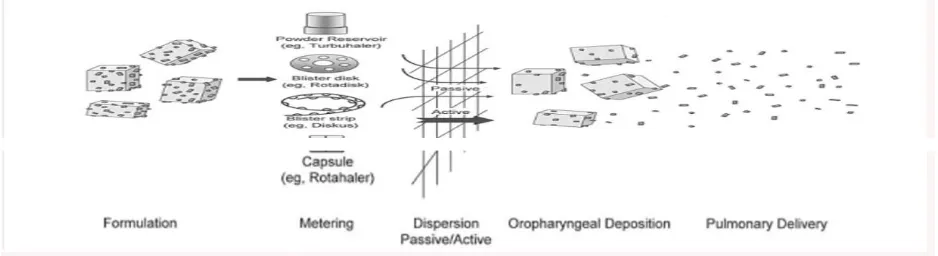
Powder deagglomeration and aeroionisation of the formulation occurs via patients own effort. In order to achieve this, a high turbulence is needed to break the large agglomerates to the smaller, fine and inhalable particles. 4
Characteristics of ideal DPI systems: 5
Simple and comfortable to use It should be compact and economical Highly reproducible fine particle dosing Reproducible emitted doses
Powder should be physically and chemically stable Minimal extra-pulmonary loss of drying. - Low
oropharyngeal deposition. - Low device retention. - Low exhaled loss
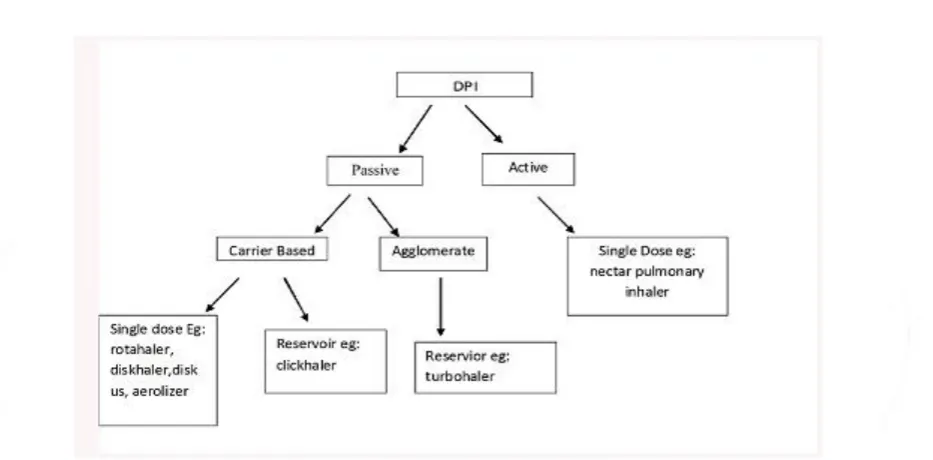
Multidose system
Figure 1: Classification of dry powder inhaler
Capsule Based Devices: 6, 7
Capsule based devices generally have a chamber to store a capsule. The capsule is broken by external force by action of twist or pins. Powder is released from the capsule upon aspiration.
Examples: Aerohaler, Aerolizer, Arcus, Axahaler, Braunform, Breezhaler, Cipla rotahaler, DOTT, Eclipse, Rohahaler.
A simple capsule based device is the Rotahaler as shown in Figure 2. The device has a barrel-shaped cap and body shell. The cap has two holes, one for capsule insert and the other one is for air inlet during aspiration. The body serves as a mouthpiece to be inserted into mouth. There is a grid between the cap and the body. The grid has many functions, it generates small eddies and allows high speed collisions for the drug particles. The space between cap and grid is the capsule chamber. When in use, the patient inserts the capsule prefilled with the drug
through the mouthpiece. Drug particles pass through the grid and eventually deposit in the lung following the air stream.
Another capsule based device is the Aerolizer (Figure 3). It has a capsule chamber in the base of the inhaler, ports for air inlet, pins near the air inlet, grid in between the capsule chamber and the mouthpiece. The powder is released by piercing the capsule by the pins. 6,7
Blister Based Device: 8, 9
Blister based devices normally have a ring of aluminum blisters inside the device. Each blister contains one dose
of drug pre-dispensed. The device also has a dose counter as a dosing indication. Drug powder is released by piercing the blister before inhalation. The drug powder is carried away by the air stream created by the patient’s inhalation. Examples are: Acu breathe, Acu-breathe single dose, Prohaler, Puffhaler, Multihaler, Gyrohaler, Forspiro, Elpenhaler, Diskhaler
Figure 4: Illustration of microdose
Reservoir/Cartridge Based Device:
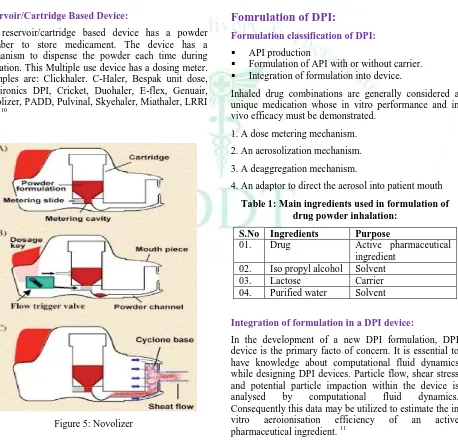
The reservoir/cartridge based device has a powder chamber to store medicament. The device has a mechanism to dispense the powder each time during inhalation. This Multiple use device has a dosing meter. Examples are: Clickhaler. C-Haler, Bespak unit dose, Aespironics DPI, Cricket, Duohaler, E-flex, Genuair, Novolizer, PADD, Pulvinal, Skyehaler, Miathaler, LRRI DPI. 10
Figure 5: Novolizer
Fomrulation of DPI:
Formulation classification of DPI:
API production
Formulation of API with or without carrier. Integration of formulation into device.
Inhaled drug combinations are generally considered a unique medication whose in vitro performance and in vivo efficacy must be demonstrated.
1. A dose metering mechanism.
2. An aerosolization mechanism.
3. A deaggregation mechanism.
4. An adaptor to direct the aerosol into patient mouth
Table 1: Main ingredients used in formulation of drug powder inhalation:
S.No Ingredients Purpose
01. Drug Active pharmaceutical ingredient
02. Iso propyl alcohol Solvent 03. Lactose Carrier 04. Purified water Solvent
Integration of formulation in a DPI device:
Figure 6: Principles of design of DPI
Factors affecting devices of drug powder inhaler: 12
Humidity
Physical property of powder Drug carrier and carrier size Particle engineering
Characterization of drug powder inhaler: 13
Appearance and color Sieve analysis Particle size analysis Moisture content Laser diffraction
Flow properties of Powder: Carr’s Flowability Index: The flow properties of a DPI were measured by the Carr’s method which involves following four tests:
1) Angle of repose
2) Compressibility
3) Angle of spatula
4) Uniformity coefficient
Analytical testing to finished product 1) Identity
2) Microbial limit test 3) Water content
4) Foreign particulate matter
Respirable particles: 14
The optimal particle size of respirable paticles are 1-5 µm. Systemic particle size of less than 2 µm is needed for drug deposition. In oropharyngeal region, particles size greater than 5 µm deposits and improves systemic effects. The particle deposition in the lung depends upon aerodynamic particle nature such as particle size, particle density, particle shape, hygrocopicity and electric charge.
Process validation for drug powder inhalation: 15
There are three stages of process validation:
Process design or process pre qualification Process qualification
Continued process qualification
Protocol of process validation for drug powder inhaler:
Protocol approval sheet Table of contents Scope and objectives
Validation term and responsibility
Steps for validation and acceptance criteria Process flow chart
Procedure
For review of raw material/packing material Evaluation of active raw material
Evaluation of inactive raw material Qualification of equipment Test instrument qualification Test instrument calibration Revalidation criteria Reference document Product details
Raw material for bulk manufacturing and their function
Packing material detail Equipment detail
Manufacturing process flow chart Critical process parameters In process specification
Sampling procedure and testing plan Revalidation criterion
Change protocol Stability Deviations Incidence Conclusion
Report and approval
Process validation master plan:
Dispensing packing and raw material
Granulation (FBD)
Micronization (Air jet mill)
Sieving (Vibro sifter)
Blending (Turbo blender)
Empty capsule
Filling
Primary packing
Secondary packing
Dispatch
General Flow diagram of manufacturing process of dry powder inhaler
CONCLUSION:
As drug powder inhaler have several benefits like propellant free nature, high patient compliance, high dose carrying capacity and drug stability it has become topic of interest for the dealing of diseases like: asthma, chronic obstructive pulmonary disease. It is estimated by WHO that worldwide, some 300 million people suffer from Asthma and 240 million people from chronic obstructive pulmonary disease. The potential research in drug powder inhaler will integrate drug in a matrix particle to attain precise pulmonary drug deposition and most likely to accomplish intracellular drug delivery particularly, proteins, peptides, plasmids, DNA etc. The aim of inhaler needs upgrading to meet requirements of an idyllic inhaler. An enhanced understanding of the influencing properties of powder on the performance of drug powder inhaler will assist to tackle the challenges in the growth of drug powder inhalation formulation and inhaler devices for most advantageous therapeutic benefits.
REFERENCES:
1. Coates M, Chan H-K, Fletcher D, Chiou H. Influence of Mouthpiece Geometry on the Aerosol Delivery Performance of a Dry Powder Inhaler. Pharm Res. 2007; 24(8):1450-1456. 2. Coates MS, Fletcher DF, Chan H-K, Raper JA. Effect of
design on the performance of a dry powder inhaler using computational fluid dynamics. Part 1: Grid structure and mouthpiece length. Journal of Pharmaceutical Sciences. 2004; 93(11):2863-2876.
3. Adi S, Tong Z, Chan H-K, Yang R, Yu A. Impact angles as an alternative way to improve aerosolisation of powders for inhalation? European Journal of Pharmaceutical Sciences. 2010; 41(2):320-327.
4. Islam N and Gladki E. Dry Powder Inhalers (DPIs): A review of device reliability and innovation. Int. J. Pharm. 2008; 360:1-11.
5. Swarbrick J, Boylan C. J. Encyclopedia of pharmaceutical technology. New York: Marcel Dekker; Vol .20. 123-126. 6. Coates MS, Chan H-K, Fletcher DF, Raper JA. Effect of
design on the performance of a dry powder inhaler using computational fluid dynamics. Part 2: Air inlet size. Journal of Pharmaceutical Sciences. 2009; 95(6):1382-1392.
7. Chan H-K, Young PM, Traini D, Coates M. Dry powder inhalers: challenges and goals for next generation therapies. Pharmaceutical technology erupoe. 2007; 19-24.
8. Oyarzun Ampeuri FA, Brea J, Loza MI, Torres D, Alonso MJ. Chitosan hyaluronic acid nanoparticles loaded with heparin for the treatment of asthma. Int. J. Pharm. 2009; 381(2):122-129. 9. Frijlink HW, de Boer AH. Trends in the technology-driven
development of new inhalation devices. Drug Discovery Today: Technologies 2005; 2(1):47-57.
10. Hoppentocht M, Hagedoorn P, Frijlink HW, de Boer AH. Technological and practical challenges of dry powder inhalers and formulations. Advanced Drug Delivery Reviews. 2014; 75:18-31.
11. Young PM, Traini D, Edge S. Advances in pulmonary therapy. In Williams III R.o., Taft D.R., McConville J.T. Advanced drug formulation design to optimize therapeutics outcomes. Informa healthcare. 2008; 72:2-8.
12. Malcolmson RJ, Buckton G, darcy P, Cox RL, RenwichCE, Embleton JK; In byron PR, Dalby RN and Farr SJ. Respiratory Drug Delivery VI, Interpharm press IL.1998, 365. 13. Yadav N and Lohani A. Dry powders inhalers: A review. Indo
global journal of pharmaceutical sciences. 2013; 3(2):142-155. 14. Maa YF, Prestrelksi SJ. Biopharmaceutical powders: particle formation and formulation consideration. Current pharm biotech. 2000; 1(282-302):1389-2010.