Twenty-Fourth European Conference on Information Systems (ECIS), İstanbul,Turkey, 2016
– DEVELOPING A RESEARCH MODEL
Research in Progress
Andreas Reitz, Frankfurt School of Finance & Management, Germany,
[email protected]
Abstract
Recent developments force companies to rethink their value creation model and open themselves to other companies, which results in a shift from the traditional matrix or functional design to a more modular organization design. For example, even traditional banks open themselves and allow the ser-vices of specialized companies, to be integrated into their organization. Through this modular design, it is very easily possible to do it the other way around and conduct the outsourcing of certain business processes. The question that arises from this is whether and how the modularity of a firm’s architecture, consisting amongst others of the modularity of its business processes and its underlying IT support infrastructure, influences the incentive to outsource certain business processes. As a research-in-pro-gress paper, this manuscript develops a model of the multidimensional concept of modularity and links it causally to the determinants of a selective business process outsourcing (BPO) decision.
Keywords: business process outsourcing (BPO), modularity, survey approach, IT architecture,
architectural modularity.
Twenty-Fourth European Conference on Information Systems (ECIS), İstanbul,Turkey, 2016 2
1
Introduction
Recent developments, especially the fundamental transformation of organizations towards digitally en-abled enterprises, which enables them to gain access to specialized skills and capabilities globally, also forces them to unbundle their value chain processes (Tanriverdi, Konana, & Ling, 2007). Due to the risen amount of IT intensity in business processes, there exist much more possibilities to recombine resources in many categories of services and products (Tafti, Mithas, & Krishnan, 2013, p. 4). From this results a shift from matrix or functional designs with clean boundaries between the company and others to a more modular organization design where parts of business activities are selectively outsourced to partners – this creates digitally enabled ecosystems or value networks of a variety of organizations, which in turn results in a blurry of firms’ boundaries (Anand & Daft, 2007). This disintegration trend is not new in many industries but has gained momentum from the recent digitalization trends; for example, FinTechs1 – technology-based start-ups in the financial industry – have started to become valuable part-ners for banks and insurance companies by both taking over activities such as mobile sales or by adding value-added services; in any case the FinTechs’ processes and systems need to be seamlessly integrated into the financial firm’s value chain. M. Lacity and Willcocks (2008) already identified modular systems theory as an interesting theory for outsourcing decisions.
Here, business process outsourcing (BPO; Wüllenweber and Weitzel (2007)) could be an attractive op-tion for companies to reshape their borders in terms of make-or-buy and also to strengthen their internal capabilities by building digitally enabled extended enterprises that tap into specialized skills and capa-bilities of other firms across the globe (Hagel, 2002). Since all these developments should lead to pro-cesses designed with a high modularity, I focus my research on the role of modularity. Therefore the research question is:
Does modularity of a firm’s business processes and underlying IT systems drive the intention to out-source business processes?
In this research-in-progress paper, I develop a theoretical model that builds on the modular systems theory and posits that modularization of business processes and their underlying information technology (IT) support infrastructures are associated with the intention of BPO. In later steps, this model will be empirically evaluated by conducting a series of case studies and a survey-based study in the European banking industry. The potential contributions of this study are:
Theorists will get a much better understanding on how modularity of enterprise architectures of firms influences the incentives to outsource specific business processes.
Practitioners will be supported in knowing how to design their architecture and especially their business processes to be flexible enough while maintaining a manageable cost level.
The remainder of this paper is structured as follows: first, the concepts of modularity as well as BPO are introduced. Based on that, I develop our research model. This construct of modularity is related with potential BPO benefits and risks. Lastly, I do briefly introduce our planned next steps (operationalization of constructs and planned data collection process).
2
Theoretical Foundation and Related Research
This paper is about the role and effect of modularity on the success of business process outsourcing. I are particularly interested whether there is an effect on BPO if the corresponding modules on the busi-ness and the IT side are well aligned.
1 Examples for FinTechs are Pich technologies (provides specialized financial data) or Wirecard (offers alternative payment services), which provide services that banks and other clients integrate into their existing portfolio to offer specialized services.
Twenty-Fourth European Conference on Information Systems (ECIS), İstanbul,Turkey, 2016 3 Modularity itself has been thoroughly researched. The principle of modularity was introduced by Simon (1981). He mentioned that a complex system is composed of distinct interacting subsystems that are to some degree both independent and dependent. Based on that, Schilling (2000, p. 314) proposed the modular systems theory in which she argues that it is possible to view all natural entities as hierarchically nested systems and that each system can be seen as a smaller system with higher granularity. These systems and subsystems are linked to a certain degree and are therefore able to interact with each other. The units are both independent and interdependent according to the degree of linkage (Schilling, 2000). Interactions between the subsystems of a modular system are significantly weaker than those within them (Ethiraj & Levinthal, 2004).
2.1
IT architecture and business process modularity
Based on the theory of modularity, different research strands have evolved. The role of modularity has been investigated in many contexts. It has been researched as product modularity in Production research (Hoetker, 2002), organizational modularity in organization science (Karim, 2006). In information sys-tems it has been researched as IT architecture (Tiwana & Konsynski, 2010) as well as modular business processes and IT infrastructure (Susarla, Barua, & Whinston, 2010; Tanriverdi et al., 2007)
Modularity can be a property of organizations or of technical systems, which correspond to the facets of Langlois (2002), technical and organizational modularity. It can be used to characterize the organi-zational as well as the technical structure of information systems. So far, modularity of business pro-cesses and of IT architecture has been in the focus of research before, but never as a holistic construct consisting of the alignment of modules on different levels of an enterprise architecture.
To define the alignment of modules on different layers, I make use of a classical layered enterprise architecture (EA) model. The EA model of Brown (2001) is very suitable for this. He, like others (Goup, 2009; Meschke & Baumoel, 2010), use three layers (business process, business applications, and infra-structure). This framework distinguishes among business, IS (comprising data and application architec-ture), and technology architectures. This paper is written with the focus on modularity layers of business processes and business applications (or IS) and therefore I combine the business application (or soft-ware) and there underlying IT infrastructure together as one layer.
On the level of business applications, I speak of IT architecture. According to Tiwana and Konsynski (2010) IT architecture is the arrangement of software applications and how they and the corresponding subsystems are interlinked to each other. Modularity in case of IT architecture can be described as “de-gree of decomposition of an organization’s IT portfolio into loosely coupled subsystems that communi-cate through standardized interfaces” (Tiwana & Konsynski, 2010, p. 290). If an IT architecture is mod-ular, the IT architecture reflects this, because changes to one application affect the others only to a certain level2 (Fowler, 2001; Nambisan, 2002). Besides loose coupling, standardization is another dis-tinct dimension of IT architecture modularity (Tiwana & Konsynski, 2010). If organization-wide stand-ards and policies specify how different applications communicate and interact with each other, this ob-viously drives modularity (Weill & Ross, 2005). This does not mean that standardization drives loosely coupling or vice-versa (Tiwana & Konsynski, 2010).
Moving to the process layer of the organization, I define a business process as a “set of logically related tasks performed to achieve a defined business outcome” (Davenport & Short, 1990). A business process can be modular itself and in relation to others. By modular itself, I mean, that the single steps or sub-processes of a business process are loosely coupled and only interact through well-defined interfaces and only as much as necessary. It is modular in relation to others, if it is loosely coupled with other business processes (Sanchez & Mahoney, 1996). The design tries to shield a process from others and make it self-contained (Tanriverdi et al., 2007). The needed information is encapsulated in the process
Twenty-Fourth European Conference on Information Systems (ECIS), İstanbul,Turkey, 2016 4 itself and hidden to the others. To achieve that, standardized interfaces, i.e., processes’ inputs and out-puts, between the processes are needed to define how they will interact and communicate with each other. The processes are therefore designed as a black box, revealing as little information as possible about how they process their tasks (Parnas, 1972). To ensure that different modules are able to com-municate and work with each other, a clear definition of interfaces has to be created. These interfaces can be tested using the standards that were defined with it. These also make it possible to benchmark modules and compare those (Langlois, 2002). A modular IT architecture therefore could also be de-scribed as “one-to-one mapping from functional elements to physical components of the product, and specifies decoupled interfaces between components” (Ulrich, 1995, p. 422).
2.2
Business Process Outsourcing (BPO)
Business process outsourcing refers to the transfer of a business process and, often, its supporting re-sources, such as IT systems or even people, to another party. This party is usually an external service provider (Gewald, Wüllenweber, & Weitzel, 2006). In contrast to IT outsourcing, where basic IT func-tions, the operation of a technological platform, or a certain software gets outsourced to a vendor, BPO refers to a whole process with a determined business outcome being taken over by the provider. The provider firm is free to choose how it will conduct this process internally, while the client only receives the result of the process.
Most existing research on BPO draws on IT outsourcing. This means that they either identify determi-nants and inhibitors of BPO adaption empirically (Gewald & Dibbern, 2009; Gewald, Wüllenweber, & Weitzel, 2006), determine the outcome of BPO or investigate the role of success factors (Wüllenweber, Beimborn, Weitzel, & König, 2008).
Previous research has shown that increasing product modularity leads to more effective outsourcing of product components and also helps to differentiate between strategic and non-strategic components (Ernst & Kamrad, 2000; Momme, Moeller, & Hvolby, 2000). I investigate whether this is also true for the modularity of IT architecture. This is important as business processes have become highly IT inten-sive and Davenport (2005) emphasizes that standard interfaces between information systems allow eas-ier outsourcing.
3
Model Development
In this section I focus on the question whether or how the modularity of business processes affects the perceived potentials, and thus the intention, for BPO. I will first explain the different determinants of BPO; then the multi-dimensional model of modularity is composed before I derive how these determi-nants are influenced by the concept of modularity.
3.1
BPO and its Determinants
The main influential factors for BPO decisions made by an organization are the anticipated benefits and risks that would result from outsourcing (Gewald & Dibbern, 2009). The more anticipated benefits and the less anticipated risks, the higher the intention to outsource a business process. There are more po-tential decision determinants, but for this proposal our research model it is sufficient to stick to those two arguments because they are the main explanatory factors for understanding the relationship between modularity and BPO (Beimborn, Joachim, & Weitzel, 2012, p. 7).
Perceived benefits from BPO arise in three categories: Cost advantage, Quality improvement and Focus on core competencies. So a firm could have benefits by outsourcing a business process, because the vendor could do the process for less money, in a better quality or it could allow the company to focus on its core competencies (for a detailed explanation, please see table 1).
Drawing on the perceived risk framework of Cunningham (1967), Gewald et al. (2006) have described how the outsourcing of business processes is affected by the different types of perceived risks.
Twenty-Fourth European Conference on Information Systems (ECIS), İstanbul,Turkey, 2016 5 They define perceived BPO risks as the potential loss in the pursuit of a desired outcome of BPO and they distinguished between performance, financial, strategic, and psychosocial risks. Their empirical analysis finds the first three dimensions to be highly relevant for determining the BPO intention. I draw on their findings and propose financial risk, performance risk, and strategic risk as (negatively) influ-encing the intention to outsource processes (for a detailed explanation, please see table 2).
Dimension Definition Description
Cost advantages
Reduction in overall costs (production costs and transaction costs, includ-ing costs for migration, negotiation etc.)
Cost advantages result from economies of skill (Lammers, 2004), scale (Kakabadse & Kakabadse, 2002), and scope. The vendor proposes produc-ing the same service at a lower price (Dibbern, Goles, Hirschheim, & Jayatilaka, 2004; Lacity, Khan, & Willcocks, 2009). Nevertheless, cost ad-vantages have to incorporate additional costs that are caused by outsourcing (Slaughter & Ang, 1996).
Quality improvement
Improving quality of ser-vice by tasking a provider that has superior capabil-ities
Outsourcing tasks to a vendor, specialized in performing these particular tasks, will lead to quality improvements for the outsourcer, which does not possess the superior capabilities necessary for performing these tasks (Gewald & Dibbern, 2009). Moreover, outsourcing can trigger the redesign of existing processes and thus further improve the quality.
Focus on core compe-tencies and strategic flexibility
Focus own management on the firm’s core compe-tencies in order to gain productivity and to sus-tain the firm’s competi-tiveness
If the firm’s management is unburdened by outsourcing tasks that are not within the firm’s set of core competencies, the firm becomes more agile in the market and the management can focus on maintaining and improving existing core competencies as well as developing new ones (Grover, Cheon, & Teng, 1996). The development of sustainable core competencies is es-sential for a firm’s survival and competitive advantage in the market de-mands (Slaughter & Ang, 1996; Young-Ybarra & Wiersema, 1999); there-fore outsourcing from a strategic perspective helps the management to stay focused and supports its long-term survivability.
Table 1. Perceived Benefits of BPO (Adapted from Beimborn, Joachim, and Schlosser (2011, p. 126))
Dimension Definition Description
Financial risk
The risk that actual costs may exceed planned/budgeted costs of the outsourcing en-gagement
Costs may exceed the budget due to various issues (Earl, 1996). Contracting and transition of services can be more expensive than anticipated, incomplete contracts might require renegotiations during the ongoing relationship, or in-ternal management of monitoring the vendor and maintaining the relationship may lead to more effort than expected.
Perfor-mance risk
The risk that the ser-vice provided by the outsourcing vendor will not be delivered as expected by the client.
Performance risk can be caused by overextended expectations on the client side, incomplete contracts that insufficiently document the duties and service levels the vendor has to fulfil, or simply by lacking capabilities and resources on the client side. Adverse selection of incompetent vendors and moral hazard in the ongoing relationship are typical reasons for performance risk.
Strategic risk
The risk that the client firm will lose its ability to react flexibly and unconstrained to changing market con-ditions.
Strategic risk is often rooted in the client’s loss of competencies because eve-rything is outsourced (Earl, 1996; Quinn & Hilmer, 1994). Another important and related problem is the lock-in to a particular vendor’s services, i.e., limited or no possibilities to backsource the service or to change the providers. These can be caused by prohibitively high switching costs, caused, for example, by the technological infrastructure or by a too low number of valid alternatives (no superior provider in the market). Finally, strategic risks are driven by the fact that contracts are inherently incomplete and that the outsourcing firm cannot prepare for every eventuality which might arise during the ongoing relation-ship.
Twenty-Fourth European Conference on Information Systems (ECIS), İstanbul,Turkey, 2016 6
3.2
Architectural Modularity
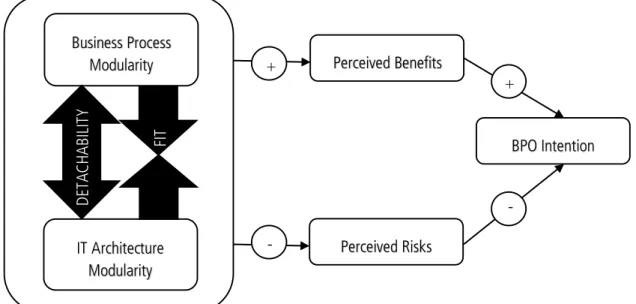
Research on Modularity has focused on different levels of the enterprise architecture. In our understand-ing, a whole enterprise architecture can be modular as well. To cover all the different aspects of modu-larity in this context, I construct architectural modumodu-larity consisting of four dimensions (as can be seen in figure 1).
The first dimension is modularity of IT architecture as described in section 2.1. If the architecture is modular, a change in or to a software application affects the others only to a certain level (Fowler, 2001; Nambisan, 2002). The architectural can only be modular, if the underlying IT architecture is modular as well. To measure architectural modularity, I therefore need to measure the modularity of the IT archi-tecture, because it is a necessary part of it.
The enterprise architecture can only be modular if the business processes are also modular, therefore the second dimension of our architectural modularity construct is business process modularity. Business processes can have inner modularity, which means that the process steps are organized as modules. These modules encapsulate their data and communicate through standardized interfaces. Business pro-cesses are also modular if the loosely coupling between them is high and their interfaces are standard-ized. Both together represent a part of architectural modularity. So, both IT architecture modularity and business process modularity could increase overall modularity but do not necessarily increase each other. To capture the interdependence between these two levels of modularity, I introduce the concept of modular alignment or fit. For example, two modules of a business process could use parts of the same software module.
As fourth and last dimension of modularity, I apply the concept of IT detachability (ITD) from Tanriverdi et al. (2007) who define it as “extent to which the process and its underlying IT infrastructure are loosely coupled to allow separation, independent execution of the process on another IT infrastruc-ture, and recombination without loss of functionality”. If detachability is low, software applications and their software-subsystems are tightly integrated – thus this serves as another, complementary, facet of modularity.
3.3
How Modularity Influences BPO Determinants
The aim of our research is to get a deeper understanding on whether and how the modularity of an enterprise influences its intent to outsource business processes. To accomplish this, I link the previously described determinants of BPO (section 3.1) intention (perceived risks and benefits) to the concept of architecture modularity.
Figure 1: Architectural modularity Business Process Modularity Perceived Risks + Perceived Benefits + BPO Intention - IT Architecture Modularity + DE TA CH ABI LIT Y + + - - FI T
Twenty-Fourth European Conference on Information Systems (ECIS), İstanbul,Turkey, 2016 7 If the IT architecture is modular, interfaces of applications should be standardized and stable. This ena-bles vendors to work in an efficient way and reduces errors that occur due to communication and transfer of data between the elements of the system. This reduced coordination effort leads to lower transaction costs (Langlois, 2002) and shorter completion time (Gomes & Joglekar, 2008). It also reduces the risk of information leakage hazards (e.g., (Riordan & Williamson, 1985)). If these risks are lowered, the level of monitoring can be reduced as well, which in turn leads to lower monitoring costs.
Since modularizing business processes means splitting them into smaller parts that can be executed independently, vendors can reduce production costs by grouping the tasks for multiple clients together (Beimborn et al., 2012). Through this they are able to obtain economies of scale, scope (Levina & Vaast, 2008; Weill & Ross, 2005) and skill. Additionally, the standardization of interfaces enables to decline transaction costs because processes can interact with each other without customization or further inte-gration (Langlois, 2002; Schilling, Kevin, 2001), and therefore eases outsourcing (Davenport, 2005). Standardized processes also lead to a better comparability between different offers from vendors (Wüllenweber et al., 2008). It also allows firms to use specialized resources from a globally dispersed network of vendors and source their processes at lower production costs or at higher quality (Sanchez & Mahoney, 1996). In developments of products, modularity is likely to reduce time and costs (Garud & Kumaraswamy, 1995).
By repeated interactions with clients vendors gain an in-depth understanding of their business processes. For example, many offshoring service providers in India nowadays are at Level 4 or 5 in the Capability Maturity Model (CMMI). This means that they are able to provide processes optimized not only for costs but quality (Prahalad & Ramaswamy, 2004). If functions can be reused due to their modularity, this allows both the vendor and the client to utilize well established, and thus reliable and predictable, business services. Further, external services can be easier integrated with internal business functions and thus enable/facilitate the creation of seamlessly running, and thus higher-quality business processes (Bieberstein, Bose, Walker, & Lynch, 2005).
Momme et al. (2000, p. 135) argue that higher product modularity allows a distinction to be made “be-tween strategic and non-strategic components and thereby preserve the core competencies associated with the product and process technology”. Grover et al. (1996) argue that outsourcing all non-core ac-tivities allows a company to focus on its core acac-tivities. This could be achieved by following the princi-ples of specialization and division of labor (Quinn & Hilmer, 1994; Smith, Mitra, & Narasimhan, 1998).
Proposition 1: If a firm has high architectural modularity, it will perceive higher BPO benefits regard-ing those business processes relyregard-ing on modularity.
The standardization of business processes increases transparency (Davenport, 2005; Münstermann, Joachim, & Beimborn, 2009). Standardization and transparency in turn reduce the risk that transaction costs are higher than anticipated. Modularity and standardization also make migration costs more con-trollable, because it is easier to extract processes from the outsourcers ecosystem and implement them on the vendor’s infrastructure (Ren & Lyytinen, 2008). Furthermore, it enables both parties to precisely define the tasks. This reduces the risk that the parties are not aligned on the outsourced process, which reduces performance risk (Davenport, 2005). Therefore low levels of modularity can increase coordina-tion and transaccoordina-tion costs and overwhelm the cost advantages gained from the sourcing (Tanriverdi et al., 2007). In contrast, higher levels of modularity are therefore more likely to reduce overall costs of sourcing (Tanriverdi et al., 2007).
By standardizing business processes not only increases transparency but also performance (Davenport, 2005; Münstermann et al., 2009) This leads to a clear definition of tasks which reduces transaction costs. Additionally, vendors can more easily estimate up-front whether they will be able to provide sufficient resources and have the capabilities.
Shared standards reduce specificity and provide a form of embedded control that enables a firm to effi-ciently exchange with multiple partners by reducing search, monitoring, and enforcement costs (Sanchez
Twenty-Fourth European Conference on Information Systems (ECIS), İstanbul,Turkey, 2016 8 & Mahoney, 1996). The possibility to easier switch the supplier helps the company to avoid lock-in situations more efficiently (e.g., (Hoetker, 2002)).
Companies have to react fast to new developments. That means that if a new business requirement ap-pears (for example customer self-service) sometimes an entire new system gets developed, as the archi-tecture is not flexible enough to allow the new component to be just plugged in. In contrast, if a company uses a modular IT architecture with standardized interfaces between the components, the risk that a component (software application) gets developed twice is reduced which leads to reduced financial risk. Additionally this reduces maintenance costs as it lowers the probability that systems developed in par-allel and therefore have to be maintained in parpar-allel afterwards. If the input and outcome of a component (interface) is not standardized, it induces that there has to be additional communication between vendor and client which leads to higher communication costs and bears the risk that proprietary information is leaked between the components of the system during the redefinition of the interfaces (Teece, 1996). In an integrated IT architecture, it could be possible for vendors to gain a lot more knowledge about components than necessary, because it is not possible to hide certain information of other components. This could enable them to, in addition to build and operate certain components, to reconstruct an eco-nomically valuable set of information if it is possible to distribute modules to different (Brynjolfsson & Hitt, 2004). If components, for example single business processes, can be distributed by different vendors, this risk is reduced.
Proposition 2: If a firm has high architectural modularity, it will perceive lower BPO risks regarding those business processes relying on modularity.
4
Proposed Methodology
Goal of our project is to evaluate and test this model by applying a two-staged empirical approach in the German banking industry. The banking industry is a suitable field since the increasing regulatory pres-sure during the last years has forced banks to document, to analyse, and often to redesign their core business processes in recent years. This has led to major process standardization, modularization, and outsourcing activities across the industry.
I will first apply case studies with banks and BPO providers in the German financial industry to evaluate whether our theoretical argumentation remains solid. The cases will involve interview partners from banks’ credit business segment, since this is a rising area for BPO in financial institutions in Central Europe, and with corresponding experts from the IT side (IT architects).
In the second step, I will collect cross-sectional data using a survey approach covering the largest 1,000 banks in the DACH region. Again, I will focus on the credit business and contact the senior managers in charge for the process of granting and managing loans (both mortgage loans to retail customers and commercial loans to SMEs). In earlier studies, these persons have shown to be responsible for BPO decisions and being capable for answering questions on process modularity and the support by underly-ing IT systems (Beimborn, 2008; Beimborn, Franke, & Weitzel, 2005).
For operationalizing the constructs, I will partly use established scales: the measures for BPO intention, BPO risks, and BPO benefits will be taken from (Beimborn, Joachim, & Weitzel, 2012; Gewald & Dibbern, 2009). For measuring modularity of the credit process and the underlying IT systems I will draw on Tiwana (2008), but will need to adjust the items to our unit of analysis and thus will have to conduct a measurement development procedure which involves item pre-testing and pilot testing first. Overall, this research is intended to shed light into the role and interplay of architecture modularity at the process and IT level in order to facilitate BPO. Thus, I hope to contribute to a well-structured trans-formation of firms towards digitally enabled organizations and integrated ecosystems.
Twenty-Fourth European Conference on Information Systems (ECIS), İstanbul,Turkey, 2016 9
References
Anand, N., & Daft, R. L. (2007). What is the Right Organization Design? Organizational Dynamics, 36(4), 329-344. doi: http://dx.doi.org/10.1016/j.orgdyn.2007.06.001
Beimborn, D. (2008). Cooperative Sourcing - Simulation Studies and Empirical Data on Outsourcing Coalitions in the Banking Industry. Wiesbaden: Gabler.
Beimborn, D., Franke, J., & Weitzel, T. (2005). Drivers and inhibitors for outsourcing financial processes - a comparative survey of economies of scale, scope, and skill. Paper presented at the 11th Americas Conference on Information Systems (AMCIS), Omaha (NE).
Beimborn, D., Joachim, N., & Schlosser, F. (2011). The Role of SOA for BPO Intention – Proposing a Research Model. In R. Sharman, H. R. Rao & T. S. Raghu (Eds.), Exploring the Grand Challenges for Next Generation E-Business: 8th Workshop on E-Business, WEB 2009, Phoenix, AZ, USA, December 15, 2009, Revised Selected Papers (pp. 122-136). Berlin, Heidelberg: Springer Berlin Heidelberg.
Beimborn, D., Joachim, N., & Weitzel, T. (2012). Do service-oriented IT architectures facilitate business process outsourcing? Zeitschrift für Betriebswirtschaft, 82(4), 77-108. doi: 10.1007/s11573-012-0583-y
Bieberstein, N., Bose, S., Walker, L., & Lynch, A. (2005). Impact of Service-Oriented Architecture on Enterprise Systems, Organizational Structures, and Individuals. IBM Systems Journal, 44(4), 691–708.
Brown, R. H., Karamouzis, F. (2001). The Services Value Chain: Forging the Links of Services and Sourcing. Gartner Research.
Brynjolfsson, E., & Hitt, L. M. (2004). Computing Productivity: Firm-Level Evidence: Massachusetts Institute of Technology (MIT), Sloan School of Management.
Cunningham, S. M. (1967). The Major Dimensions of Perceived Risk. In D. F. Cox (Ed.), The Major Dimensions of Perceived Risk, Risk Taking and Information Handling in Consumer Behaviour
(pp. 82-108). Boston (MA): Harvard University Press.
Davenport, T. H. (2005). The coming commoditization of processes. Harvard Business Review, 83(6), 100-108.
Davenport, T. H., & Short, J. E. (1990). The new industrial engineering: information technology and business process redesign.
Dibbern, J., Goles, T., Hirschheim, R., & Jayatilaka, B. (2004). Information systems outsourcing: a survey and analysis of the literature. ACM Sigmis Database, 35(4), 6-102.
Earl, M. J. (1996). The risks of outsourcing IT. Sloan Management Review, 37(3), 26-32.
Ernst, R., & Kamrad, B. (2000). Evaluation of supply chain structures through modularization and postponement. European Journal of Operational Research, 124(3), 495-510. doi:
http://dx.doi.org/10.1016/S0377-2217(99)00184-8
Ethiraj, S. K., & Levinthal, D. (2004). Modularity and Innovation in Complex Systems. Management Science, 50(2), 159-173. doi: doi:10.1287/mnsc.1030.0145
Fowler, M. (2001). Reducing Coupling. IEEE Softw., 18(4), 102-104. doi: 10.1109/ms.2001.936226 Garud, R., & Kumaraswamy, A. (1995). Technological and organizational designs for realizing
Twenty-Fourth European Conference on Information Systems (ECIS), İstanbul,Turkey, 2016 10 Gewald, H., & Dibbern, J. (2009). Risks and benefits of business process outsourcing: A study of
transaction services in the German banking industry. Information & Management, 46(4), 249-257. doi: http://dx.doi.org/10.1016/j.im.2009.03.002
Gewald, H., Wüllenweber, K., & Weitzel, T. (2006). The Influence of Perceived Risks on Banking Managers' Intention to Outsource Business Processes - A Study of the German Banking and Finance Industry. Journal of Electronic Commerce Research, 7(2), 78-96.
Gewald, H., Wüllenweber, K., & Weitzel, T. (2006). The Influence of Perceived Risks on Banking Managers' Intuition to outsource business processes: A study of the german Banking and Finance Industry. Journal of Electronic Commerce Research, 7(2), 78.
Gomes, P. J., & Joglekar, N. R. (2008). Linking modularity with problem solving and coordination efforts. Managerial and Decision Economics, 29(5), 443-457. doi: 10.1002/mde.1402
TOGAF Version 9, Van Haren Publishing (2009).
Grover, V., Cheon, M. J., & Teng, J. T. C. (1996). The Effect of Service Quality and Partnership on the Outsourcing of Information Systems Functions. Journal of Management Information Systems, 12(4), 89-116.
Hagel, J. (2002). Out of the Box: Strategies for Achieving Profits Today and Growth Tomorrow through Web Services: Harvard Business School Press.
Hoetker, G. (2002). Do Modular Products Lead to Modular Organizations? : University of Illinois at Urbana-Champaign, College of Business.
Kakabadse, A., & Kakabadse, N. (2002). Trends in Outsourcing:: Contrasting USA and Europe.
European Management Journal, 20(2), 189-198. doi: http://dx.doi.org/10.1016/S0263-2373(02)00029-4
Karim, S. (2006). Modularity in organizational structure: the reconfiguration of internally developed and acquired business units. Strategic Management Journal, 27(9), 799-823. doi: 10.1002/smj.547
Lacity, M., & Willcocks, L. P. (2008). Information systems and outsourcing: studies in theory and practice.
Lacity, M. C., Khan, S. A., & Willcocks, L. P. (2009). A review of the IT outsourcing literature: Insights for practice. The Journal of Strategic Information Systems, 18(3), 130-146.
Lammers, D.-K. M. (2004). Make, buy or share. Wirtschaftsinformatik, 46(3), 204-212.
Langlois, R. N. (2002). Modularity in technology and organization. Journal of Economic Behavior & Organization, 49(1), 19-37.
Levina, N., & Vaast, E. (2008). Innovating or doing as told? status differences and overlapping boundaries in offshore collaboration. MIS Q., 32(2), 307-332.
Meschke, M., & Baumoel, U. (2010). Architecture Concepts for Value Networks in the Service Industry.
http://aisel.aisnet.org/icis2010_submissions/266
Momme, J., Moeller, M. M., & Hvolby, H.-H. (2000). Linking modular product architecture to the strategic sourcing process: case studies of two Danish industrial enterprises. International Journal of Logistics, 3(2), 127-146.
Münstermann, B., Joachim, N., & Beimborn, D. (2009). An Empirical Evaluation of the Impact of Process Standardization on Process Performance and Flexibility. Paper presented at the 15th Americas Conference on Information Systems (AMCIS), San Francisco.
Twenty-Fourth European Conference on Information Systems (ECIS), İstanbul,Turkey, 2016 11 Nambisan, S. (2002). Complementary Product Integration by High-Technology New Ventures: The
Role of Initial Technology Strategy. Management Science, 48(3), 382-398.
Parnas, D. L. (1972). On the criteria to be used in decomposing systems into modules. Commun. ACM, 15(12), 1053-1058. doi: 10.1145/361598.361623
Prahalad, C. K., & Ramaswamy, V. (2004). Co-creation experiences: The next practice in value creation.
Journal of Interactive Marketing, 18(3), 5-14. doi: http://dx.doi.org/10.1002/dir.20015
Quinn, J. B., & Hilmer, F. G. (1994). Strategic outsourcing. Sloan Management Review, 35(4), 43-55. Quinn, J. B., & Hilmer, F. G. (1994). Strategic outsourcing. Sloan management review, 35(4), 43. Ren, M., & Lyytinen, K. (2008). Building Enterprise Architecture Agility and Sustenance with SOA.
Communications of the AIS, 22(75-86).
Riordan, M. H., & Williamson, O. E. (1985). Asset specificity and economic organization. International Journal of Industrial Organization, 3(4), 365-378. doi: http://dx.doi.org/10.1016/0167-7187(85)90030-X
Sanchez, R., & Mahoney, J. T. (1996). Modularity, Flexibility, and Knowledge Management in Product and Organization Design. Strategic Management Journal, 17, 63-76.
Schilling, M. (2000). Toward a General Modular Systems Theory and Its Application to Interfirm Product Modularity. The Academy of Management Review, 25(2), 312-334.
Schilling, M. A. S., H Kevin. (2001). The use of modular organizational forms: An industry-level analysis. Academy of Management Journal, 44(6), 1149-1168.
Simon, H. A. (1981). The sciences of the artificial: MIT Press.
Slaughter, S., & Ang, S. (1996). Employment outsourcing in information systems. Commun. ACM, 39(7), 47-54. doi: 10.1145/233977.233994
Smith, M. A., Mitra, S., & Narasimhan, S. (1998). Information systems outsourcing: a study of pre-event firm characteristics. Journal of Management Information Systems, 15(2), 61-93.
Susarla, A., Barua, A., & Whinston, A. (2010). Multitask Agency, Modular Architecture, and Task Disaggregation in SaaS. J. Manage. Inf. Syst., 26(4), 87-118. doi: 10.2753/mis0742-1222260404
Tafti, A., Mithas, S., & Krishnan, M. S. (2013). The Effect of Information Technology–Enabled Flexibility on Formation and Market Value of Alliances. Management Science, 59(1), 207-225. doi: doi:10.1287/mnsc.1120.1579
Tanriverdi, H., Konana, P., & Ling, G. (2007). The Choice of Sourcing Mechanisms for Business Processes. Information Systems Research, 18(3), 280-299.
Teece, D. J. (1996). Firm organization, industrial structure, and technological innovation. Journal of Economic Behavior & Organization, 31(2), 193-224. doi: http://dx.doi.org/10.1016/S0167-2681(96)00895-5
Tiwana, A. (2008). Does technological modularity substitute for control? A study of alliance performance in software outsourcing. Strategic Management Journal, 29(7), 769-780. doi: 10.1002/smj.673
Tiwana, A., & Konsynski, B. (2010). Complementarities Between Organizational IT Architecture and Governance Structure. Info. Sys. Research, 21(2), 288-304. doi: 10.1287/isre.1080.0206 Ulrich, K. (1995). The role of product architecture in the manufacturing firm. Research Policy, 24(3),
Twenty-Fourth European Conference on Information Systems (ECIS), İstanbul,Turkey, 2016 12 Weill, P., & Ross, J. (2005). Designing IT governance. MIT Sloan Management Review, 46(2). Wüllenweber, K., Beimborn, D., Weitzel, T., & König, W. (2008). The impact of process
standardization on business process outsourcing success. Information Systems Frontiers, 10(2), 211-224. doi: 10.1007/s10796-008-9063-x
Wüllenweber, K., & Weitzel, T. (2007). An empirical exploration of how process standardization reduces outsourcing risks. Paper presented at the System Sciences, 2007. HICSS 2007. 40th Annual Hawaii International Conference on.
Young-Ybarra, C., & Wiersema, M. (1999). Strategic Flexibility in Information Technology Alliances: the Influence of Transaction Cost Economics and Social Exchange Theory. Organization Science, 10(4), 439-459. doi: 10.1287/orsc.10.4.439