. 389
In search of focus and effectiveness
IOB Evaluation | no 389 | In search of focus and effectiveness | IOB Evaluation | no. 389 | In search of focus and effectiveness | IOB Evaluation | no. 389 | In search of focus and effectiveness | IOB Evaluation | no. 389 | In search of focus and effectiveness | IOB Evaluation | no. 389 | In search of focus and effectiveness | IOB Evaluation | no. 389 | In search of focus and effectiveness | IOB Evaluation | no. 389 | In search of focus and effectiveness |
IOB Evaluation
In search of focus and
effectiveness
Policy review of Dutch support for private sector development
2005-2012 (extensive summary)
IOB Evaluation
In search of focus and effectiveness
Policy review of Dutch support for private sector development
2005-2012 (extensive summary)
11 The basis for this extensive summary is a report that was published in Dutch under the title ‘Op zoek naar focus en effectiviteit.
Beleidsdoorlichting van de Nederlandse inzet voor private sector ontwikkeling 2005-2012’. The Hague, January 2014. IOB Evaluation no. 389. This summary devotes less attention to the analysis of the Dutch set of policy instruments. The findings and issues for further consideration regarding Dutch policy are almost fully rendered.
| 3 |
Preface
Private sector development (PSD) is a central focus of the current development cooperation policy. By strengthening the entrepreneurial climate in developing countries, the policy aims to create better opportunities for private investment, increase employment opportunities and ultimately also reduce poverty. The government has actively committed itself to achieving these objectives and in its effort has mobilised the Dutch business sector. This policy review of Dutch support for private sector development focuses on the relevance, effectiveness and coherence of the instruments and the contribution that the business sector has made to economic growth and poverty reduction in developing countries. The review describes and analyses the Netherlands Ministry of Foreign Affairs’ policy and expenditures during the period 2005-2012. The review will play a part in establishing accountability for the implementation of the policy, but it also aims to create insights that can be used to formulate future policy.
Policy reviews make use of existing evaluations of the policy. This report’s approach deviates slightly from that. The Policy and Operations Evaluation Department (IOB) has expanded on the evaluation approach by using conclusions from international literature because it appears there are only a handful of robust, high-quality evaluations of Dutch PSD
programmes. The review follows the same categorisation of five clusters (in effect, outcome areas) used by the Ministry of Foreign Affairs: (1) infrastructure, (2) financial sector
development, (3) market development, (4) knowledge and skills and (5) laws and
regulations. The review also focuses special attention on public-private partnerships (PPPs) and the role that international corporate social responsibility (ICSR) plays in PSD policy. By way of four country case studies, the policy review examines the question of coherence in the set of PSD instruments.
Dutch support has generated visible outputs in many areas. Nonetheless, we are not any closer to achieving our ultimate development objectives, nor is there as prominent a focus on poverty as there should be. The effectiveness of the PSD instrument is limited by the fact that specialised programmes devote particular attention to a number of specific problems, while in practice there are actually multiple – interrelated – bottlenecks. Moreover, IOB is critical of the appraisal that activities are completely additional to the market and would not have occurred without public assistance. Coordination between programmes and alignment with local needs do not always take place, partly because three quarters of the PSD programmes are managed from the Netherlands.
The policy review was conducted under the supervision of IOB evaluators Max Timmerman, Antonie de Kemp and Jan Klugkist, with the support of research assistants Jiska Gietema (until March 2013) and Bart Woelders. Internal commentary was provided by Peter Henk Eshuis, Paul de Nooijer and Frans van der Wel. The external reference group consisted of the following people: Renko Campen (independent consultant, ex-chairman of the executive board at DHV), Rob van Tulder (professor of international business-society management at
| 4 |
the Rotterdam School of Management at Erasmus University), Robert-Jan Scheer (strategic advisor at DDE, the Sustainable Economic Development Department of the Ministry of Foreign Affairs) and Thijs Woudstra (DIO, the International Enterprise Department – Directorate-General for Foreign Economic Relations). The field studies conducted in Bangladesh, Ethiopia, Burundi and Vietnam were supervised by Sönke Buschmann (Triodos Facet).
IOB would like to thank all those involved in this policy review for the information and critical feedback that they have provided.
IOB assumes final responsibility for this report. Prof. dr. Ruerd Ruben
Director Policy and Operations Evaluation Department (IOB) Ministry of Foreign Affairs, the Netherlands
| 5 |
Table of Contents
Table of Contents
Preface 3
List of figures, tables and text boxes 7
List of abbreviations 8
Findings and issues for further consideration 10
1. Introduction 22 2. Private sector development in international development
cooperation policy 26
3. International literature on private sector development 32
3.1 Infrastructure development 33
3.2 Financial sector development 37
3.3 Market development 45
3.4 Knowledge and skills 48
3.5 Laws and regulations 53
4. Dutch private sector development policy: activities and results 58
4.1 Dutch policy promoting private sector development 59
4.2 Intervention logic and expenditures 59
4.3 Policy clusters: activities and results 63
4.4 Coherence in the set of policy instruments 71
Bibliography 74
Annexes 88
Annex I International corporate social responsibility (ISCR) and
public-private partnerships (PPPs) 89
Annex II About IOB 92
Evaluation and study reports of the Policy and Operations Evaluation
| 7 |
List of figures, tables and text boxes
List of figures, tables and text boxes
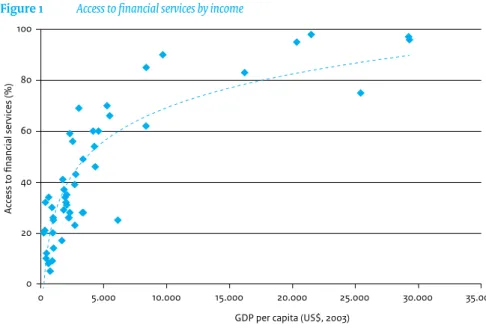
FiguresFigure 1 Access to financial services by income (GDP per capita; US$, 2003) 37 Figure 2 PSD expenditures by the Netherlands by sector, compared to several other donors
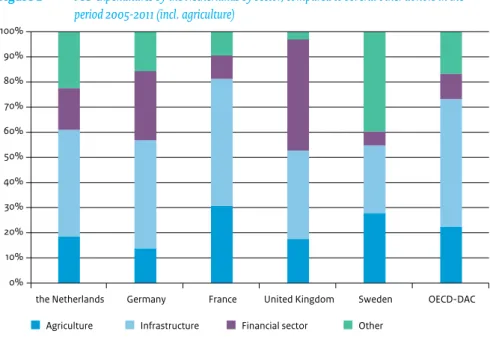
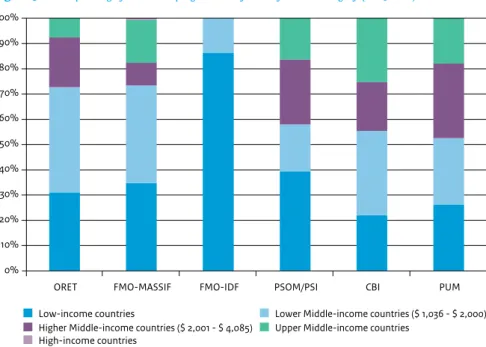
in the period 2005-2011 (incl. agriculture) 62 Figure 3 Spending by six central programmes by country income category (2005-2011) 63 Figure 4 Expenditures by thematic cluster in millions of euros and in percentages (2005-2012) 64
Tables
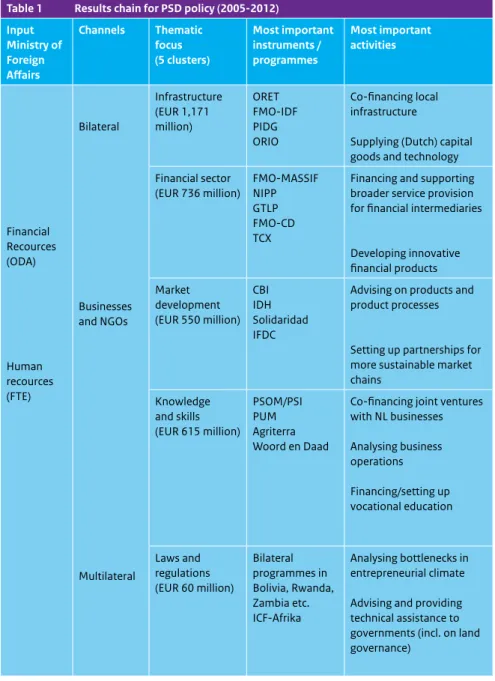
Table 1 Results chain for PSD policy (2005-2012) 60
Table 2 Number of activities and number of evaluated programmes (2005-2012) 64
Table 3 Total expenditures and expenditures by evaluated programme (2005-2012) 65
Table 4 Distribution of central programmes; countries and regions (2005-2011) 72
Boxes
| 8 |
List of abbreviations
ADB Asian Development Bank AfT Aid for Trade
AIV Advisory Council on International Affairs (Adviesraad Internationale
Vraagstukken)
BRICs Brazil, Russia, India and China
CBI Centre for the Promotion of Imports from Developing Countries (Centrum tot
Bevordering van de Import uit ontwikkelingslanden)
CSR Corporate social responsibility
DANIDA Danish International Development Agency DC Development cooperation
DDE Sustainable Economic Development Department of the Ministry of Foreign Affairs (Directie Duurzame Economische ontwikkeling)
DFID Department for International Development (United Kingdom) DGIS Directorate-General for International Cooperation of the Ministry of
Foreign Affairs (Directoraat-Generaal voor Internationale Samenwerking) ECP Expert coaching programme
EU European Union FDI Foreign direct investment
FIRST Financial Sector Reform and Strengthening Initiative
FMO Dutch Development Finance Institution (Financieringsmaatschappij
Ontwikkelingslanden)
FOM-OS Fund Emerging Markets (Fonds Opkomende Markten – Ontwikkelingssamenwerking) FTE Full-time equivalent
GDP Gross domestic product GNP Gross national product
GPFI Global Partnership for Financial Inclusion GTFP Global Trade Finance Program
IBRD International Bank for Reconstruction and Development ICF Investment Climate Facility for Africa
ICSR International corporate social responsibility ICT Information and communication technology
ICTSD International Center for Trade and Sustainable Development IDF Infrastructure Development Fund
IDH Sustainable Trade Initiative (Initiatief Duurzame Handel) IEG Independent Evaluation Group
IFAD International Fund for Agricultural Development IFC International Finance Corporation
IFDC International Fertilizer Development Center IMF International Monetary Fund
INRA National Institute for Agrarian Reform, Bolivia (Instituto Nacional de Reforma Agraria)
| 9 |
IOB Policy and Operations Evaluation Department of the Netherlands Ministry of Foreign Affairs (Inspectie Ontwikkelingssamenwerking en Beleidsevaluatie) KfW German Reconstruction Credit Institute (Kreditanstalt für Wiederaufbau) LDCs Least-developed countries
MASSIF Micro And Small Enterprise Fund
MILIEV Environmental and Economic Self-Sufficiency (Milieu en Economische
Verzelfstandiging)
MMF Matchmaking Facility for Developing Countries
NCSTE National Center for Science and Technology Evaluation (China) NGO Non-governmental organisation
NIPP Netherlands-IFC Partnership Program ODA Official development assistance ODI Overseas Development Institute
OECD Organisation for Economic Co-operation and Development OECD-DAC OECD Development Assistance Committee
OPM Oxford Policy Management
ORET Development-related Export Transactions (Ontwikkelingsrelevante Export
Transacties)
ORIO Infrastructure Development Facility (Ontwikkelingsrelevante
Infrastructuurontwikkeling)
PIDG Private Infrastructure Development Group PPP Public-private partnership
PSI Private sector investment programme PSD Private sector development
PSOM Programme for Cooperation with Emerging Markets (Programma
Samenwerking Opkomende Markten)
PUM Netherlands Senior Experts Programme (Programma Uitzending Managers) RPE Ministerial decree on performance measurement and evaluation (Regeling
Periodiek Evaluatieonderzoek)
SER Social and Economic Council of the Netherlands (Sociaal Economische Raad) SMEs Small and medium enterprises
TCX The Currency Exchange Fund
TK Dutch House of Representatives (Tweede Kamer der Staten-Generaal) UN United Nations
UNCTAD United Nations Conference on Trade and Development US United States
USAID United States Agency for International Development
WRR Dutch Scientific Council for Government Policy (Wetenschappelijke Raad voor
het Regeringsbeleid)
WTO World Trade Organization
| 10 |
Findings and issues for further
consideration
| 11 |
The findings of the evaluation are modelled on the intervention logic and the RPE. The first finding concerns the relevance of Dutch support (ex ante): which problems did the Netherlands aim to solve with the available instruments? The second finding continues with the direct results (outputs). Finding three examines the effectiveness (outcome and impact) of the many different instruments. Findings four and five analyse the way in which the Netherlands used the instruments. In doing so, finding four mainly focuses on how purposeful the instrument has been, while finding five concerns the added value of the public instruments in addition to the private ones. The sixth finding deals with the coherence of the instruments, and the seventh does the same for their administration. In line with the findings, several issues for further consideration have been identified for Dutch policy.
1. The ministry uses its PSD programmes to address important bottlenecks for the development of the private sector in developing countries.
A comparison with the bottlenecks mentioned in international literature confirms the relevance of the specific clusters identified in Dutch policy. This is especially clear with the programmes that aim to strengthen infrastructure. In many developing countries, especially in Africa, there are serious shortcomings in this area. One billion people do not have access to passable roads, and another 300 million people do not have electricity. Safe drinking water and sanitation facilities are still out of reach for another 2.4 billion people. Moreover, the literature reveals that inadequate infrastructure is a major constraint to economic growth and poverty reduction. The lack of financial resources is huge, however. The estimated gap that will emerge between now and 2030 is EUR 43 billion. Investing in infrastructure rarely appeals to the private sector. This is especially the case for energy, transport (roads), and water and sanitation.
A number of major Dutch programmes address the above-mentioned bottlenecks, especially energy supplies and transport infrastructure. The ministry spent a total of more than EUR 1.2 billion on strengthening infrastructure between 2005 and 2012.
In addition, the Netherlands is trying to remove barriers to private sector development. Small and medium enterprises invariably cite poor access to financial services as one of the largest obstacles to growth. Small enterprises in particular face high interest rates and other financial barriers, such as high costs or a minimum charge to open a bank account. Dutch support between 2005 and 2012 amounted to almost EUR 740 million.
The ministry also supports organisations that focus on market development, often with the aim of improving market access for small producers (frequently in agriculture). Small enterprises have to contend with high transaction costs, market risks and limited information. Between 2005 and 2012, the ministry contributed EUR 550 million to programmes focused on this goal (16% of the PSD expenditure).
Other programmes use a host of different paths in an attempt to strengthen knowledge and technological skills in enterprises and promote technology transfer. The total amount for
| 12 |
the period 2005-2012 amounts to EUR 615 million,1approximately 18% of the total.2
Although good evaluations are scarce on this point, there is quite a large consensus internationally that the lack of knowledge and skills and the poor access to technology present an obstacle to private sector development. The World Development Report 2013 shows that many job opportunities in developing countries are concentrated in small businesses that are not particularly dynamic. Productivity is low, often due to a combination of insufficient skills and poor access to modern technology. The businesses create jobs, but they are just as easily lost again. Different Dutch programmes are trying to break this pattern.
Dutch expenditure in the area of laws and regulations is limited (less than 2% of the total). In part, this is because support in this area requires almost by definition far fewer financial resources than investing in infrastructure, for example. Moreover, the cluster is much less conducive to bilateral engagement and much more to an approach that uses multilateral channels. The Netherlands uses a few bilateral programmes to support land reform and the registration of land ownership. This could help to provide access to land and investments in land.
2. The implementing organisations used the available resources to develop and finance a wide range of activities, which in most cases resulted in substantial outputs and considerable reach.
The implementing organisations and evaluations reported mainly about achieving direct outputs, such as roads and power plants, but also about the size of loans to banks, for example. Following are several examples.
Infrastructure:
• A programme’s support to encourage infrastructure projects (ORET) resulted in facilities for drinking water and sanitation (especially in Ghana), energy (in countries such as Madagascar, Tanzania, Ethiopia, Suriname and Indonesia), wet infrastructure (mainly dredging ports), health care (medical systems, in countries such as Tanzania, Zambia, Ghana, China and the Philippines) and transport (boats for countries such as Cuba, Colombia and Indonesia and buses for Ghana). According to the latest evaluations of this programme, 36 of the 50 examined projects actually managed to improve infrastructure. • The fund for infrastructure projects in developing countries (FMO/IDF) had a portfolio of
EUR 273 million in late 2012, which was used to financially support several dozen infrastructure projects, including energy (28%), immovable infrastructure (35%) and water (9%). By the end of 2012, 93% of the fund had gone to low-income countries, and the remaining 7% to lower middle-income countries.
Financial sector development:
• In 2012, 48% of the portfolio for financing SMEs (FMO/MASSIF), which amounted to more than EUR 300 million, was invested in financing SMEs and 27% was used for microcredit.
1 T
| 13 |
That year, almost 59% of the resources were issued to low-income countries and another 45% to lower middle-income countries. Countries in Africa and Asia both had a share of approximately one third of the total.
Market development:
• The programme in support of export from developing countries (CBI) helps several hundred businesses annually. It does this mainly by strengthening business support organisations (71 times between 2005 and 2012), market information programmes (13), knowledge and skills transfer (63 projects) and the programme for export support (38 times). The latter programme generally supports 25-40 enterprises for each individual export coaching programme (ECP). All in all, CBI operates in 27 sectors and 48 countries, though in the period 2005-2011 almost half of the resources went to six countries (India, Colombia, Bolivia, Indonesia, Peru and South Africa).
Knowledge and skills:
• Every year, more than a hundred enterprises in about 50 countries develop activities with the support of a private sector investment programme (PSOM/PSI). It mainly concerns projects in agriculture and energy. On average, the enterprises create 81 jobs and train almost 100 people with a subsidy of EUR 500,000. According to the PSOM/PSI evaluation, 21 of the 32 examined projects contributed to the emergence of an economically healthy enterprise, job growth, innovation and knowledge transfer.
3. There is little information about achieving the ultimate objectives, including poverty reduction.
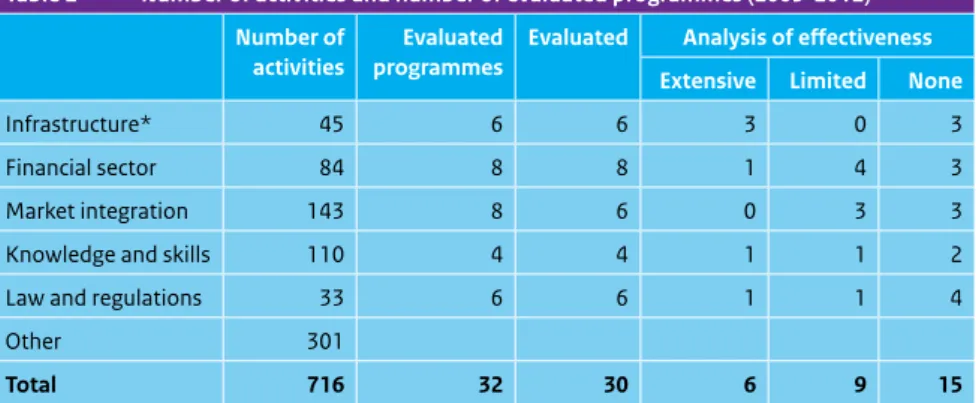
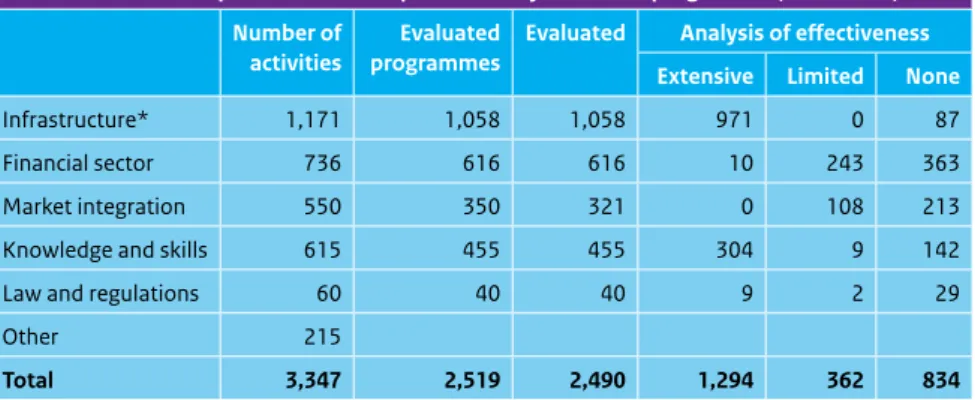
In order to determine the impact and the likelihood of achieving the ultimate objectives, it is not only important to set up a number of services (outputs) with Dutch resources, but in particular to gauge what their impact will be ultimately for entrepreneurs and households. To gain more insight into this, IOB examined 32 programmes in total. The ministry spent EUR 2.5 billion between 2005 and 2012 on these 32 programmes, which amounts to 75% of PSD expenditures. Of these 32 programmes, 30 were evaluated in one form or another.3 On
the other hand, only six programmes underwent an extensive evaluation for effectiveness.4
Evaluations of another nine programmes did devote some attention to that, but not enough to draw robust conclusions about the impact of the programmes.
Evaluations often report on the reach or the implementation by immediate beneficiaries, but only rarely about the impact on the ultimate target groups, including specific
consequences for women or the environment, for example. Only a few evaluations focused on the ultimate objectives in terms of improving incomes, reducing poverty and economic growth. When they did focus on these aspects, it was usually not based on systematic research. Notable exceptions in the area of PSD are the different impact evaluations on microfinance, which do devote attention to the impact on women. When detailed impact
3 That could include a review.
4 These figures incorporate both ORET evaluations from 2006. Strictly speaking, they are not being
considered because they are not related to expenditures during the period 2005-2012. Therefore, 20% of all expenditures have been extensively evaluated.
| 14 |
studies were conducted, the impact was often more limited than previously estimated.5 The
causes include inadequate focus, particularly on poverty, an overly optimistic appraisal of the trickle-down effects, implementation problems and inaccurately estimated behavioural responses. It usually did not concern an isolated problem.
The IOB evaluation of the infrastructure fund for least-developed countries (FMO-IDF) concluded that a slight majority of the invested resources were additional to the high impact (51%); for the remaining resources, the expenditures were non-additional (37%) or the development impact was limited (12%).6 Projects with a potentially high or actually high
development impact mainly concerned water and sanitation and energy. IOB was more critical of the enclave-like investments in a titanium mine in Mozambique. The apparent benefits for the local population turned out to be unrealistic in this case. In several other IDF projects, FMO only took over existing financing schemes. These projects did not lead to new investments.
A review of the impact that programmes for SMEs had on employment opportunities concluded that although financing is important, it is also important that it focuses on target groups and their specific problems (Grimm, 2013). Indeed, such programmes are only effective when they are sufficiently demand-driven. According to an evaluation of FMO’s SME portfolio, the instrument focuses too much on larger and well-known financing institutions and not on smaller, more specialised and less developed institutions for microfinance. The evaluation does not mention the impact of this. Impact evaluations of microcredit show that many of these programmes do not meet expectations. It is not so much the random provision of credit to households that contributes to economic growth, but more the improved access to finance for enterprises.
Evaluations of Dutch programmes that try to promote the integration of markets and increase knowledge and skills are generally highly process and output-oriented; they tell us little or nothing about the achieved effects, such as improved incomes and poverty reduction. When they do, it is not based on systematic research. A consultancy firm (Triodos Fact, 2009), for example, does indicate how many businesses used export support (CBI), but this does not necessarily mean that they would not have achieved some of these exports without this support. Scientific research on export programmes generally sees the promotion of export as having a lower level of impact. One concern with the programmes for strengthening knowledge and skills is that the kinds of expertise Dutch entrepreneurs have does not by definition dovetail with the information needs in recipient countries. There is little empirical information on the effectiveness of public-private partnerships (PPPs) in PSD programmes. One reason for this is that evaluations often devote little attention to the specific role played by the form of cooperation. Often, the public partners
5 Similarly, the ‘iron law’ of Rossi (1987) argues that the better an evaluation’s design is, the greater the
chance that the researchers will not measure an impact.
6 Additionality refers to outputs that would not have been achieved in the market without the
| 15 |
in PPPs are not permanently involved during implementation. Moreover, there are not always clear agreements about the distribution of risks and revenue. A systematic review, conducted on IOB’s request, identified six factors that are important when involving PPPs, including a permanent role with clear guidelines for the government, a common vision, mutual trust and a balanced distribution of interests (IOB, 2013c).
An increasing number of businesses are also reporting on the use and impact of international corporate social responsibility (ICSR). There has been limited independent control of the claimed results, however. The outcomes of the various interventions are difficult to compare as well because a range of different indicators were used.
The lack of systematic evaluations in the area of private sector development is not a problem specific to the Netherlands. Various international researchers describe a lack of good evaluations in this area. In general, the quality of PSD evaluations lags behind those in the social sectors (such as education, health, and water and sanitation).
The following reasons have been cited for this lack of systematic evaluation: • The development impact of PSD programmes are apparently difficult to measure; • The different programmes and funds finance a (limited) part of the projects; and • The programmes and funds finance highly heterogeneous activities.
There is no fundamental difference with the social sectors on these points. The most important reason for the limited number of impact evaluations in the area of PSD appears to be primarily because implementing organisations (and the ministry) have traditionally focused on financing and immediate outputs and much less on the development impact. Partly on the initiative of IOB, the ministry made agreements with the administrators of the PSD programmes in 2012 to improve evaluations, for example by introducing an evaluation protocol and by making available tools for systematically measuring impact. It is still too early to report on the results, however.
4. The implementation process of programmes managed centrally from The Hague often focused insufficiently on creating development relevance or achieving the objective of reducing poverty.
While the Dutch PSD portfolio may have been relevant on paper, in practice the opportunities were not always fully taken advantage of. The policy review, for example, reveals that there is no link in any of the central programmes between the use of resources and the levels of income in recipient countries. A large part of the expenditures (subsidies) for the major programmes went to higher middle-income countries such as Suriname, the Maldives, Colombia, Jamaica, and Bosnia and Herzegovina. A significant part of the expenditures used to promote export (CBI) and technical assistance to companies (PUM) supported enterprises in similar countries. Companies and institutions in these countries are often in a much better position to bear consultancy costs themselves than comparable organisations in the poorest countries. Indeed, it raises the question of whether other instruments, such as concessional loans, are not more appropriate for supporting these (higher) middle-income countries. Conversely, the programme with the greatest focus on
| 16 |
the poorest countries, namely the Infrastructure Development Fund, is precisely the one that works with loans and shares. Various evaluations reveal that programmes focused inadequately on poverty reduction and devoted too little attention to development relevance. This is not a specifically Dutch problem though. Evaluations by IEG (2008; 2011); White (2008); KfW (2010) and the Asian Development Bank (2012) reveal similar problems in areas such as electrification, roads and microfinance.
Different factors contribute to this limited development relevance. A first factor is that the agreements between the ministry and the implementing organisations do not focus on it sufficiently. Although this is the objective of the various agreements, it is barely incorporated into the conditions for financing. To achieve the anticipated impact, implementing organisations often use the information provided by applicants. A second factor is the ministry’s limited guidance of the PSD organisations (see finding 7). An extensive budget or selection according to the order in which requests were received did not mean choices were made based on the anticipated impact either. The threat of underspending resulted in pressure to spend and supply management, and it reduced the need to reflect on the development relevance. This was especially the case when new programmes were launched, and the ministry and implementing organisation underestimated teething troubles.
Another reason why implementing organisations stopped focusing on the development relevance and poverty reduction is that several organisations had a dual objective. One was to increase the involvement of the business sector in development cooperation, in part by tying aid. The old, but still valid, Tinbergen rule states that the number of policy tools should be at least equal to the number of policy objectives. The reason for this is not only that objectives can conflict with each other, but also that each objective may require a completely different kind of implementation. That is the case here too. It concerns independent objectives, which only cross paths in specific cases. One can only speak of a confluence of interests if the Dutch business community is well equipped to solve specific development problems. But this is precisely what raises the question of whether tying aid is necessary. Tying aid entails the risk of sub-optimal allocation. The economic literature generally mentions a negative impact for recipient countries, including higher prices (15%-30%). In addition, tying aid limits the number of local providers one can use. It is far from evident that the best opportunities for Dutch businesses are in the poorest countries. Dutch exports to and investments in these countries are limited and, conversely, the Netherlands is rarely an important trade partner (with the exception of the import of raw materials from several countries). The absence of a relationship between development and expenditure mentioned above points to this potential conflict.7 There is a risk that linking two
completely different objectives will not create any synergy and only provide a sub-optimal solution: recipient countries will receive a service that it would not, a priori, have chosen itself, but at the same time the resources were also used in countries where the potential for growth for the Dutch business sector is limited.
| 17 |
In practice, few companies actually benefit from the available instruments: between 2007 and 2012, half of the resources from the most comprehensive programme for infrastructure development (ORET) went to eight companies, who incidentally were not all Dutch companies. In that sense, this programme was not so much one for the (Dutch) business sector as it was a programme for a few major companies. The evaluation of this programme from 2006, and so from the previous period, concludes that the long-term impact for the Netherlands, in the sense that it strengthened trade relations and generated follow-up orders, was limited. Recent econometric research also suggests that the benefits of tying aid are very limited, if not absent, for the exporting countries.8
5. Various programmes for private sector development assume too readily that the support is additional to the market. As a consequence, the impact is overestimated.
The concepts of ‘additionality’ and ‘catalytic impact’ play a key role in PSD programmes. To begin with, funding must be additional to the market, which means that commercial parties are not prepared to finance a project on reasonable conditions because the risks are too high. The catalytic effect is the ability of funds to use the financing to generate other resources. If a public fund takes on the lion’s share of the risk, then the project will appeal to commercial entrepreneurs again. The key advantage is that public resources can have a leverage effect, which makes it possible to start large-scale projects with relatively limited financing.
The policy review reveals that additionality is too readily assumed by implementing organisations. The fact that a government or (often) an entrepreneur seeks public financing too easily leads to the conclusion that they cannot secure private financing. Various evaluations show that implementing organisations do not sufficiently investigate to what extent available resources can actually remove obstacles. Evaluations of Dutch programmes cite examples of projects that were non-additional. Moreover, the demand for revolving funds can lead fund managers to focus on less risky projects, which the market already (partly) provides for. An example is the financing of telecommunications. Spending pressure can be another factor that leads people to not adhere strictly to the demand for additionality.
Programmes that are non-additional are not effective either: after all, it concerns an activity that would be undertaken anyway, with or without the contribution of a programme. The policy review reveals that the assessment of the effectiveness of the different programmes is therefore less positive as a result. The evaluation of an incentive programme for business investment (PSOM/PSI) is an example. According to the evaluation, 21 of the 32 examined projects were effective. A number of projects, however, were non-additional or only additional to a limited extent. The latter means that on balance the programme was effective in one out of three projects and ineffective in one out of eight. Almost half of the projects were somewhere in between.
8 IOB research on the impact of development aid on Dutch exports. Forthcoming.
| 18 |
Implementing organisations and consultants overestimate the catalytic impact in similar fashion. It turns out that in cases where the organisation cites extensive leverage effects (PIDG), there is financing by a conglomerate of funds and development banks, who all contribute to the positive effects.
There is always the danger of market distortion when programmes are non-additional. The risk is even higher when there is direct support from companies (PSOM/PSI) or when companies finance provisions (ORET). This element received little attention in the assessment ex ante as well as in the evaluation.
6. The Netherlands supports specialised instruments that operate almost independently. There is little exchange between them. This does not contribute to effectiveness, because in many cases there is a more complex problem at work.
The implementation of the Dutch PSD policy is characterised by a large number of separate specialised instruments, in which central implementing organisations are highly independent. The coordinating role of the ministry and embassies is limited, and the implementing organisations hardly ever actively seek cooperation for problems that they cannot address themselves. The fragmented use of instruments encourages an approach that focuses on the solution that the instrument offers rather than the problem itself.9 It
contributes to supply management, in which the central organisations want to serve the largest number of countries and partners as possible, and that, in turn, leads to further fragmentation. There is a lack of incentive to cooperate, which comes at the expense of effectiveness.
Approaches that focus on one problem are often less effective because different
bottlenecks exist. They are often caused by a combination of factors, including inadequate physical infrastructure, insufficient access to capital and deficient knowledge and skills. The potential impact often depends on the extent to which the national climate for entrepreneurship leaves room for individual businesses and sectors to operate. For example, despite the difficulty that poor households and small businesses have in accessing credit, support from local banks is often lacking. It is therefore important to combine the financial instruments with interventions that solve other bottlenecks.
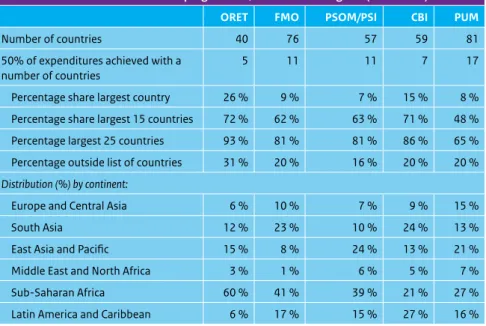
An analysis of the distribution of spending by five major programmes in different countries reveals that the current list of countries could be limited without much objection because the lion’s share of the spending goes to a limited number of countries.10 Between 2007 and
2012, more than 40% of an infrastructure programme’s resources (ORET) went to activities in three countries: Ghana, Tanzania and China. The expenditures were also very unevenly distributed with other major central programmes. This raises the question of whether the
9 The British development organisation DFID uses an alternative approach, in which the starting point is
not the instruments but the problem. This encourages a more holistic approach.
10 This analysis comprises ORET, PSOM/PSI, CBI, PUM and three government funds managed by FMO
(MASSIF, IDF and the CD programme). IOB has therefore incorporated the three FMO funds as one in its analysis, which covers the period 2005-2011.
| 19 |
Netherlands can increase the efficiency of aid by limiting the list of countries, as was the case with bilateral aid. It is easier to achieve coordination and synergy in such cases.
7. There are a limited number of available (specialised) staff members at the ministry who can offer guidance to the PSD programmes. There has been little effort to create accountability for outsourcing to independent PSD organisations or awarding subsidies.
Approximately 230 employees at the major implementing organisations in the Netherlands work on implementing the programmes, while the ministry has 17 employees who are directly involved in managing the programmes in the five PSD policy clusters. As a result, the ministry sometimes had difficulty finding sufficiently qualified policy advisors. The limited number of available FTEs, fluctuating levels of expertise and frequent transfers all played into the hand of seriously inadequate supervision.
Issue for further consideration
Based on the findings in this policy review, and in light of recent developments, IOB has identified a number of issues for further consideration for the design of Dutch PSD policy.
1. Transparency about objectives and instruments in relation to the level of development in recipient countries
From 2010 onwards, PSD policy has defined development relevance and poverty reduction, as well as the contribution to the Dutch economy, as incentives for Dutch state support. The ‘new agenda for aid, trade and investment’ aims to further integrate Dutch economic interests and support for local entrepreneurship in developing countries.
This policy review indicates that there are country-specific situations and programme activities in which both these incentives converge (PSOM/PSI, ORET). The decision to open up the PSD instruments to an extremely broad group of 66 developing countries – with strongly diverging levels of development and economic dynamics – has created several dilemmas.11
For the time being, many of the poorest countries (such as Mali, Rwanda and Mozambique) still have limited appeal for the Dutch business sector as a result of their restricted markets and high risk factor, especially when it comes to direct investment. In light of the ratio between the size of total foreign investment (FDI) and total aid (ODA), most of the added value of public support for private sector development lies in these kinds of countries.
11 The latest list of developing countries eligible for the PSD instruments consists of 66 developing
countries, whose levels of income vary from the Democratic Republic of Congo’s (GNP US$ 231 per capita in 2011) to Suriname’s (US$ 8,131 per capita). Colombia’s GNP per capita is 18 times that of Burundi’s, while Thailand’s GNP (US$ 4,972 per capita) is 10 times that of Uganda’s, and Indonesia’s GNP (US$ 3,495 per capita) is 10 times that of Ethiopia’s. In addition to 22 low-income countries (roughly < US$ 1,000 per capita), the list contains 27 low middle-income countries (US$ 1,000 - US$ 4,000 per capita), 12 high middle-income countries (US$ 4,000 - $ 12,000 per capita) and five countries for which there is no information about GNP per capita at the World Bank (generally poor countries and conflict areas).
| 20 |
In developing countries with a somewhat higher level of income, the importance of development cooperation generally decreased because some degree of foreign (and domestic) investment is often secured there without public support. In many cases, these are countries that harbour more substantial opportunities for the Dutch business sector. Some middle-income countries on the Dutch PSD list are already so developed (such as Thailand, India, South Africa and Colombia) that one could ask whether state support (Dutch) for private investments or provisions are still additional. Market distortion is a potentially greater threat in these countries, in part because of the wider availability of market-based financing. Should the Dutch government still intervene with public resources earmarked for the private sector in countries that have already experienced considerable market development? Without setting exact boundaries in advance, the policy could take more into account the relationship between a country’s level of development and the desirability of using public support for private activities, even if this support aims to benefit the Dutch economy.
The type of public financing deserves attention as well. It is generally more desirable to give grants to the poorest countries because the business risks are much higher there, and it is undesirable to build up (publicly guaranteed) debt. Concessional loans should go to countries with higher levels of development, to the extent that market-based loans on reasonable conditions are not yet available there. What would be worth considering is fine-tuning the degree of concessionality of PSD instruments to the local circumstances in order to diversify this highly focused set of instruments.
2. More harmony in order to achieve greater synergy
The Dutch PSD policy aims to concentrate on priority themes, but at the same time has a broad range of instruments, a long list of countries and activities tailored to almost every bottleneck in private sector development in the five policy clusters. The policy review has established that there is little to no synergy at the country level between the instruments, which are usually centrally implemented with little guidance from The Hague and by the implementing organisations. More focus is needed to increase policy coherence. Increasing the synergy of the PSD instruments at the country level can be promoted in several ways. Partner countries and embassies could play a more significant role during the identification and selection phase of a number of PSD programmes, especially in clusters such as infrastructure, financial sector development and market development. One condition, however, is that the ministry builds sufficient capacity and expertise in this area. An alternative is to promote far-reaching cooperation between implementing organisations in a country, in which the embassy takes on a coordinating and facilitating role. In addition, what is worth considering is using the PSD instruments more often simultaneously or sequentially to address the specific constraints that businesses face during the various development phases. Furthermore, reducing the number of instruments and concentrating the PSD resources in a limited number of countries would increase the effectiveness of Dutch efforts.
| 21 |
3. Professional commissioning and functional management
The targeted use of PSD instruments requires a great deal of information, knowledge and skills in order to adequately tailor decision making about financing conditions for the various instruments to both demand in developing countries and supply in the private sector.
Professional commissioning by the ministry would benefit from a more elaborate assessment framework for individual instruments, in which the criteria and conditions for the use of resources are more precisely specified. This would also clarify the frameworks for independent administrators of the programmes. These administrators would be judged on results achieved (results-based management) and not only on activities undertaken.
| 22 |
1
| 23 |
This chapter describes the approach used in this policy review. What was the objective? What were the main research questions? How is the policy area defined? What is the evaluation study’s methodological approach, and what are its limitations? The chapter concludes with a note on the structure of this extensive summary of the original report in Dutch.
Motivation and objective
Strengthening the private sector in development countries has been one of the objectives of Dutch development policy for a long time. The significance of this activity has increased in recent years and was an important reason for IOB to launch a study on the impact of Dutch policy on private sector development.
In addition, the ministerial decree on performance measurement and evaluation (RPE) requires that all policies be evaluated by means of a policy review with a certain amount of regularity. This kind of review has two purposes: (a) it provides an overview of the degree to which the policy area in question has been evaluated, and (b) based on that, it assesses the effectiveness and efficiency of the instruments used in conjunction with each other (Staatscourant, 2012b). In addition to increasing insight on the functioning of the policy (what works and what does not?), the study also aims to lay the foundation for accountability to the Dutch parliament.
Research questions
The main research question concerns the relevance and effectiveness of Dutch policy for private sector development in developing countries. It has been broken down into the following elements:
• Description and analysis of the problem that motivated the policy.
This element examines the bottlenecks in private sector development in developing countries and the relevance of the Dutch business sector programme.
• Description of and reasons behind the Dutch government’s involvement.
This element looks at the reasons for the Netherlands to strengthen the general entrepreneurial climate and offer support to individual companies and sectors. The additionality of the government intervention receives special attention.
• Description of the policy objectives under scrutiny.
This element analyses the policy’s division into five thematic clusters and indicates which intervention logic was used.
• Description of the instruments and analysis of their social impact.
This occurs in the study by means of an analysis of the instruments within each cluster, with special attention going to the instruments’ scope and the effectiveness. The coherence and potential overlap of the various instruments is also examined.
| 24 |
• Description of the budget that was used.
This element consists of an analysis of the distribution of the PSD budget across the various programmes and projects, and an assessment of the scope of the guidance and management of these programmes.
For easy reference, IOB has chosen to treat the research questions in conjunction with one another.
Scope and source materials
The evaluation covers the policy and expenditures of the Ministry of Foreign Affairs during the period 2005-2012 in the area of support for private sector development in developing countries. IOB has chosen to structure the study in a number of clusters, in line with the division used by the Ministry of Foreign Affairs.The five PSD clusters are infrastructure, financial sector development, market development, knowledge and skills, and laws and regulations. In addition, the report also deals with public-private partnerships (PPPs) and the theme of international corporate social responsibility (ICSR).
The policy review resembles a synthesis study: it summarises what is known about the social impact of the policy based on the outcomes of existing impact studies. Comparing outcomes to the policy objectives makes it possible to assess the degree of the policy’s effectiveness.
Preliminary research has shown that when the policy review began there were more than 100 evaluations and reviews of PSD programmes and projects available at the ministry. Most reports, however, did not contain valid (does the study actually measure what it purports to measure?) or reliable (how stable are the study outcomes?) impact assessments. As a result, IOB has conducted a number of separate, supplementary studies.
Approach and limitations
The approach is based on a combination of theory-based and evidence-based evaluation. That means, among other things, that IOB examined the policy report’s relevance and the reported results against the background of the international literature on the subject. This approach helps to increase the external validity of the findings (the likelihood that outcomes could be achieved under other circumstances).
The study consists of four parts. First, a reconstruction of Dutch policy. The report deals with PSD policy against the background of the international policy debate about the role the private sector can play in promoting growth and poverty reduction in developing countries. Second, the review also contains an overview of the expenditures (2005-2012) for each of the five policy clusters, the findings regarding the policy’s relevance and the effectiveness of the instruments. The objective of this was to gain insight into the impact of the PSD instruments.
| 25 |
Third, country studies were conducted in Bangladesh, Burundi, Ethiopia and Vietnam. These field studies contain a description of the post’s policy, an analysis of its implementation and an estimate of the perceived and achieved impact of Dutch support to the development of the private sector in the country in question. In doing so, the country studies devote attention to the coherence of the different centralised and decentralised instruments in the area of private sector development.
Fourth, IOB has conducted a systematic review of the literature on the impact of government interventions in the area of international corporate social responsibility and the results of public-private partnerships in development cooperation. IOB has published both these studies separately.
The findings from this review are based on a combination of source material, project files, field observations, interviews and international studies on the impact of similar programmes. The assessment of IOB’s impact used existing evaluations of the various instruments. IOB did not conduct its own effectiveness study. The study focuses on the more significant expenditures. Minor activities carried out by the ministry, such as activities related to increasing knowledge or international cooperation in the area of PSD therefore receive little or no attention.
Structure
This emphasis of this summary of the original Dutch report is on describing international policy (chapter 2) and the findings of the review of international literature (chapter 3). Chapter 4 contains a much-shortened version of the description of Dutch policy, PSD expenditures, the use of instruments and what is known about their impact.
| 26 |
2
Private sector development in
international development
cooperation policy
| 27 |
From import substitution to the Washington Consensus
The emphasis in many developing countries during the 1960s and 1970s lay on economic development managed by the government, with a larger role for semi-public and public companies. These countries often followed an ‘import substitution’ strategy. Backed by analyses by development economists such Raul Prebisch (1950) and Hans Singer (1950), governments in Latin America, Africa and South Asia encouraged capital-intensive industrialisation. In doing so, they protected the national business sector from competing with Western countries dominated by global trade. Countries such as former Zaire, India and Senegal set up their own car industries after independence, while Indonesia focused on shipbuilding in the 1960s and Egypt invested in steel production and chemistry (Lin, 2012b). These companies often operated on government support and were not viable in the long run.
In the early 1980s, the Anglo-Saxon neoliberal way of thinking about the role of the free market and private initiatives in economic development in developing countries began to gain currency (Estrup, 2009). The World Bank, the International Monetary Fund (IMF) and bilateral donors (led by the United States and the United Kingdom) pushed for a package of drastic reform, which became known as the Washington Consensus. It perceived government intervention as the core of the problem and advocated less state involvement in favour of allowing market forces and corporate production to overcome stagnation, especially in sub-Saharan Africa (World Bank, 1981). The 1980s and 1990s saw the introduction of the structural adjustment programme of economic and financial liberalisation, the privatisation of state companies and the rigorous reorganisation of government spending in dozens of developing countries that had approached the IMF and the World Bank for concessional loans to keep the countries running.
Reassessment of the state’s role
The growth impact of the structural adjustment programmes was disappointing, especially in the poorest countries. The privatisation of companies and government agencies often resulted in failure (Independent Evaluation Group, 2005). In many countries, the social impact of drastic government cutbacks, layoffs and the shock of privatisation and liberalisation was severe and generated increasing resentment. The UN responded by calling for ‘adjustment with a human face’ (Cornia et al., 1987). The financial crises that successively hit Mexico, the Asian Tigers, Russia and Argentina also raised doubts about the liberalisation of the financial markets, one of the pillars of the Washington Consensus (Rodrik, 2011).
Various movements within the World Bank had been struggling since the early 1990s to explain how East Asian countries such as South Korea, Taiwan, Singapore and Hong Kong could have emerged so quickly.12 After all, the strong growth of the private sector in these
countries had been achieved with a relatively large amount of government support and protection, against the grain of the Washington Consensus. Criticism increased at the World
12 See Page, 1993, The East Asian Miracle: Four Lessons for Development Policy.
| 28 |
Bank in the late 1990s. In 1998, the chief economist at the time, Joseph Stiglitz, called the Washington Consensus ‘at best incomplete and at worst misguided’ and called for a new paradigm (Stiglitz, 1998). There had to be a great deal more focus on the unique functions of the public sector for creating an ‘enabling environment’ for the private sector. Education and health care were part of that as well.
The turn of the century witnessed the gradual development of a Post-Washington Consensus that explicitly recognised the supporting role of governments and public institutions in facilitating private sector growth. In 2002, the World Bank put down on paper for the first time a detailed strategy for private sector development that emphasised the complementary functions of the state and the private sector.
The strong emergence of the BRICs (Brazil, Russia, India and China) and other non-Western G20 countries in the new millennium ate away at the global dominance of Anglo-Saxon neoliberal development philosophy – certainly following the 2008 credit crisis (Birdsall and Fukuyama, 2011). Important basic tenets, such as the liberalisation of the capital market and refraining from formulating an active industrial policy, were no longer seen as a panacea in a multipolar global economy. Former chief economist at the World Bank, Justin Lin, pointed out that none of the developing countries that posted high growth figures for years observed liberal policies closely; instead, they used a pragmatic mixture of market forces and a proactive facilitating government (Lin, 2012a). Based on this experience, Lin argues in favour of changing the growth concept for developing countries. He sees the government taking on an active role in this concept, including a coordinating role in setting up infrastructure and implementing a targeted industrial policy based on comparative advantages that are present from the start (Lin, 2012b). Market forces and private entrepreneurial production remain the basic tenets, however.
Towards a broad approach to private sector development
Direct support to companies was part of the arsenal of strategies in OECD countries in the early years. Certainly in the first decade (1950-1970), aid was often linked to provisions from the business sector or support from subsidiary enterprises in the donor countries. The World Bank was involved in operating aid because it provided loans to governments and financial intermediaries guaranteed by governments, in order to support state companies and private enterprises (IOB, 2013e). In 1956, the International Finance Corporation (IFC) was founded as part of the World Bank Group, with the specific task of financing private enterprises in developing countries.
A much broader approach to private sector development became an explicit part of the set of instruments of development cooperation from the 1990s onward (Schulpen and Gibbon, 2002). In 1995, the OECD’s development assistance committee (OECD-DAC) published
Orientations for Development Co-operation in Support of Private Sector Development. The document
discusses the reversal in thinking in many developing countries – following decades of central planning and management of production by the government – regarding private initiatives and market forces. Donors would have to respond accordingly and actively support this process of change in developing countries. Actions taken by donors would have
| 29 |
to focus on promoting an enabling environment for the private sector, financial reform, privatisation and providing support to businesses through the transfer of knowledge. The World Bank Group presented a broad strategy for PSD in 2002 (World Bank, 2002). Improving the investment climate by removing ‘unjustified obstacles to private business’ was the strategy’s core message. The International Bank for Reconstruction and Development and the International Development Association were to focus on strengthening competition policy, adapting laws and regulations, reforming the financial sector and securing property rights. The World Bank would report on progress in these areas in the annual Doing Business report, which appeared for the first time in 2003. The World Bank would continue to give direct public support to entrepreneurs via IFC, including microcredit.
The title of the World Development Report 2005, ‘A Better Investment Climate for Everyone’, further underpinned the importance of private sector development (World Bank, 2004). A major study involving tens of thousands of poor people (Voices of the Poor) revealed that they viewed a job or having their own business as by far the two best ways of escaping poverty. Private enterprises, from independent smallholder farmers to multinationals, provided 90% of all employment in the world. They were the most important source of tax revenue, necessary to finance public services such as health care and education. A flourishing business sector was crucial for growth and poverty reduction.
The investment climate – defined as ‘the location-specific factors that shape the
opportunities and incentives for firms to invest productively, create jobs and expand’ – was for a large part determined by the policy and behaviour of governments, according to the World Bank report. The report warned governments not to go too far beyond these basics of a good investment climate. Interventions to encourage specific businesses, sectors or (foreign) investment by means of tax exemptions, subsidised credit or market protection had failed too often, according to the World Bank. The experience with selective support of businesses (‘picking winners’) had fallen short and often came down to gambling with scarce public resources. If the choice were to fall on this type of support, then the objectives would have to be formulated extremely clearly with straightforward conditions for the beneficiaries, and implemented in a completely transparent way with regular impact assessments.
Pro-poor growth and employment opportunities
In the same period, OECD-DAC published a new outlook on the relation between private sector development and poverty reduction and the role played by donors (OECD, 2004, 2006). Pro-poor growth, the growth of the incomes of people with an income below the poverty line, had to be achieved by improving the conditions for private sector development and, within these conditions, promote models that create opportunities for the poorest groups. The crux of the matter was promoting pro-poor market outcomes, such as more and better jobs, higher incomes, higher yields for the products of the poorest people and more affordable essential goods and services. Donors should not focus their efforts on direct interventions for the benefit of the poorest groups (such as subsidised microcredit),
| 30 |
but encourage the market to respond to the needs of the poorest groups (mainstream microcredit in the commercial banking system): ‘changing the incentives within markets to deliver pro-poor outcomes rather than providing direct support to enterprises’ (OECD, 2006). Direct interventions often disrupted the market and were rarely sustainable. Institutional and policy reforms had to become the core of the new donor approach to private sector development.
The World Development Report 2013 approaches private sector development from the angle of employment. High unemployment (such as is North African countries, and especially among young people) and economic growth without job creation are current challenges that require more emphasis on employment policy. Jobs not only raise the living standard and increase production, but they also strengthen social cohesion. In addition to promoting the basic conditions for PSD – macro-economic stability, a good investment climate, the accumulation of human capital and legal certainty – the World Bank also believes there is a role for governments in the area of labour market policy. Indeed, the report goes one step further regarding government interventions to stimulate economic activity when the World Bank talks about a targeted investment climate, i.e. targeted government action that is sometimes necessary to tackle market failure and institutional weakness. This marked the return of the proactive government in mainstream development thinking.
| 31 |
| 32 |
3
International literature on private
sector development
| 33 |
Chapter 3 examines information in international literature about bottlenecks in private sector development in developing countries and what potential solutions the literature offers for these bottlenecks. This chapter follows the same division into five clusters used in Dutch PSD policy, namely: infrastructure, financial sector development, market development, knowledge and skills, and laws and regulations.
3.1 Infrastructure development
Infrastructure and economic growth
An increasing number of econometric studies emphasise the highly positive impact of infrastructure on economic growth (Hulten, 1996; Esfahani and Ramirez, 2003; Calderón and Servén, 2004; Willoughby, 2004; Calderón, 2009). According to Hulten, imbalances in infrastructure account for more than 40% of the growth differences between countries and 25% of the growth differences between Africa and East Asia (see also Ndulu, 2006). Lederman et al. (2005) discovered that good infrastructure is crucial for the success of measures aimed at promoting free trade and exports. Good infrastructure also has a positive impact on foreign investment (Asiedu, 2006). In particular, (mobile) telephony, roads, electricity and railway lines have a major impact on economic growth (Calderón and Servén, 2004; Calderón, 2009; Ferro et al., 2011). Calderón (2009) analysed the impact of investments in infrastructure on economic growth in Africa for the period 1960-2005. The author concludes that they had a greater impact on economic development than other structural policy measures (about 45% higher).13 Foster and Briceño-Garmendia (2010)
conclude that infrastructure, and telecommunications in particular, accounts for more the 50% of recent economic growth in Africa. Africa lags behind in other areas, however, partly as a result of what are frequently difficult geographic circumstances (see, for example, Calderón, 2009; Ndulu, 2006, 2007; Foster and Briceño-Garmendia, 2010). Improving the availability (and reliability) of electricity remains the biggest challenge. Poor infrastructure has direct consequences for the development of the private sector and therefore a negative impact on private investment, in part as a result of power outages and impassable roads (WSP International Management Consulting, 2007).
Providing the poorest people with access to infrastructure can also help to reduce income imbalances, providing the investments are targeted (Calderón and Servén, 2004; Terberger et al., 2010). Improving infrastructure has a positive impact on access to education and health care, reduces production and transaction costs, and improves labour market participation (Calderón and Servén, 2004; Foster and Briceño-Garmendia, 2010). The cost of investing in rural areas is often relatively high (as a result of diseconomies of scale; see Willoughby, 2004). The anticipated trickle-down effects of economic growth, however, often turn out to be disappointing (OECD, 2006; WSP International Management Consulting, 2007; Terberger et al., 2010).
13 Ninety per cent of this can be attributed to the expansion of the infrastructure and ten per cent to
improved quality.
| 34 |
One of the biggest bottlenecks for investing in infrastructure is a lack of capital. Partly as a result of the financial crisis, international banks have no longer been willing to finance risky infrastructure projects in sub-Saharan Africa in recent years. But a lack of capital is not always the only problem. Various reviews show that the lack of high-quality projects is often a core problem. Too many risks prevent project developers from putting time and money into projects, and as a result they never get off the ground (PIDG, 2009). Until now, private investors have really only been willing to invest in mobile telephony, power plants and container terminals.
Indeed, some of the present problems are the result of poorly allocated public resources. Foster and Briceño-Garmendia (2010) conclude that African countries can save
approximately US$ 17 billion by spending resources more efficiently. More than US$ 3 billion goes to sectors that do not need it. Several governments invest too much in ICT infrastructure, for example. The private sector can handle this investment, especially in many middle-income countries. Countries can also avoid the high costs of repair through better maintenance.
Transport
Bad roads are especially a problem in landlocked countries (Ndulu, 2006; Foster and Briceño-Garmendia, 2010). Transport costs are high in these countries, and the opportunities to engage in trade are limited (Ndulu, 2006). But other countries face these problems as well. Until recently, the Democratic Republic of Congo did not have more than 2,200 kilometres of paved roads. During the rainy season, many roads are impassable. Bad maintenance is a problem with many roads in sub-Saharan Africa. Donors have often financed road repairs, just to see these roads in disrepair again a few years later due to lack of maintenance (Oxford Policy Management, 2008). Investments (private or otherwise) in roads are often not economically viable as a result of relatively moderate use and the extremely limited resources of many users. This is especially true for railway systems, where maintenance and repair costs are high. Local contractors rarely have sufficient capital at their disposal to prefinance road building or maintenance. Ambiguous and unreliable procurement rules and exchange rate risks are factors for foreign investors. Bad roads are another obstacle for the improvement of other infrastructural facilities. For instance, the price of many infrastructural facilities in the above-mentioned example of the Democratic Republic of Congo is twice as high as elsewhere (Briceño-Garmendia & Foster, 2009). Research by the Asian Development Bank (Hettige, 2006) and DANIDA (2010) highlight the positive economic and social impact of secondary roads for rural development. ADB concludes that improving roads is a necessary, though not sufficient, condition for rural development. The DANIDA evaluation suggests that these roads increase the level of paid employment and reduce travel time to social services outside the immediate community. Comparative studies of investments in poverty reduction show that the greatest impact is in agricultural research, education and investing in roads (Willoughby, 2004). An evaluation by KfW for Zambia reveals that investing in roads in rural areas has an impact on both income and enrolment in education, especially in secondary education (Terberger et al., 2010).