Abstract²Calibration estimation is a method of adjusting the
original design weights to improve the survey estimates by using auxiliary information such as the known population total (or mean) of the auxiliary variables. A calibration estimator uses calibrated weights that are determined to minimize a given distance measure to the original design weights while satisfying a set of constraints related to the auxiliary information. In this paper, we propose a new multivariate calibration estimator for the population mean in the stratified sampling design, which incorporates information available for more than one auxiliary variable. The problem of determining the optimum calibrated weights is formulated as a Mathematical Programming Problem (MPP) that is solved using the Lagrange multiplier technique.
Keywords² Calibration estimation, Stratified sampling,
Multivariate auxiliary information, Mathematical programming problem, Lagrange multiplier technique.
I. INTRODUCTION
alibration is commonly used in survey sampling to increase the precision of the estimators of population parameter when auxiliary information is available. The method works by modifying the original design weights incorporating the known population characteristics, in practice population totals or population means, of the auxiliary variables. Deville and Särndal (1992) first used the calibration estimators in survey sampling [3]. Wu and Sitter (2001) suggested the model-calibration estimator that uses an explicit working model for E y x
i i [8]. Instead of using anexplicit parametric model, Briedt and Opsomer (2000) adopted a local polynomial regression model to derive a non-parametric regression estimator [1]. Singh, Horn and Yu (1998), and Kim, Sungur and Heo (2007) introduced the calibration estimation in stratified sampling. They suggested the calibration estimators, respectively, for combined generalized regression estimator and combined ratio estimator using a single auxiliary information [4], [7]. Chen and Qin (1993) suggested a calibrated estimator that makes an efficient use of auxiliary variables for equal probability
Dinesh Rao and M.G.M Khan are with the School of Computing, Information and Mathematical Sciences, Faculty of Science, Technology and Environment, The University of the South Pacific, Suva, Fiji Islands, and e-mail: (see
[email protected] and [email protected] ).
Sabiha Khan is with the Department of Public Health, Fiji School of Medicine, Fiji National University, Suva, Fiji Islands, and e-mail: (see
sampling by maximizing the constrained empirical likelihood [2]. Kim (2009) extended this technique to unequal probability sampling and also implemented the result in stratified sampling [5].
In surveys, when more than one auxiliary information is available, the precision of the estimate can further be increased by adjusting the design weights based on all the auxiliary information. In this paper, we propose a multivariate calibration estimator for the population mean with the aid of several auxiliary information in stratified random sampling for improving the precision of the estimate. The problem of determining the optimum calibrated weights is formulated as a Mathematical Programming Problem (MPP) that minimizes the chi-square type distance subject to
the p calibration constraints and the non-negativity
restrictions on the calibrated weights, where p is the number
of available auxiliary variables. Ignoring the non-negativity restrictions a solution procedure is developed to solve the MPP using Lagrange multiplier technique. The closed form expression for the solution of the calibrated weight is derived in the presence of two auxiliary variables for a stratified random sampling design. The MPP is solved completely if the non-negativity restrictions on calibrated weights are satisfied. If the restrictions are violated, another solution procedure is developed by extending the procedure proposed by Singh (2003) that minimizes a distance function subject to the p
calibration constraints, which guarantees the non-negativity of the weights [6]. Two numerical examples are presented to illustrate the application and computational details of the proposed techniques to determine the multivariate calibrated estimator. The examples reveal that the proposed multivariate calibrated estimator is more efficient than the usual estimator of the population mean in stratified sampling.
II. FORMULATION OF THE PROBLEM AS AN MPP
Let the population be divided into L non-overlapping
strata and nh be the number of units drawn by simple random
sampling without replacement (SRSWOR) from the hth
stratum consisting of Nh units, and L1 h
h n
¦
n and 1 L h hN
¦
N give the total sample size and the populationsize. For the hth strata, let Wh Nh N be the strata weights
and y Yh, h are the sample and population means,
respectively, for the study variable.
Dinesh Rao, M.G.M Khan and Sabiha Khan
Mathematical Programming on Multivariate
Calibration Estimation in Stratified Sampling
Let the estimation of unknown population means Y be of
interest using the information from p auxiliary variables
j
X , j 1, 2,...,p. Let
y
hi andx
hij denote the values of the ith population (sampled) unit of the study variable (Y) and the jth auxiliary variable (Xj) respectively, in the hthstratum. Assume that the strata means L1
j h h hj
X
¦
W X areaccurately known. The purpose is to estimate the population
mean L1
h h h
Y
¦
W Y by using the auxiliary information Xj.The usual estimator of population mean Y is given by
1
L st h h
h
y
¦
W y . (1)In the presence of more than one auxiliary information, we suggest a multivariate calibrated estimator of the population mean
Y
under stratified sampling given by* * 1 L st h h h y
¦
W y (2)with new weights *
h
W . When more than one auxiliary
variables Xj, j 1, 2,...,p is available, the new weights Wh*
are so chosen such that the sum of the chi-square type distances given by
2 * 1 1 p L h h j h h hj W W W q¦¦
(3) is minimum, subject to the calibration constraints* 1 L h hj j h W x X
¦
; j 1, 2,..., .p (4)Note that qhj !0 in (3) are suitability chosen weights which determine the form of estimator. One of the challenges in calibration approach of estimation is that sometimes the calibrated weights do not satisfy the desired constraint of weights being non-negative. To avoid such situation one needs to impose the restrictions
* 0
h
W t ; h 1, 2,..., .L (5)
Thus, the problem of determining the optimum calibrated
weights *
h
W may be formulated as a Mathematical
Programming Problem (MPP) as given below:
Minimize
2 * 1 L h h h h h W W Z W Q¦
subject to * 1 1 1 L h h h W x X¦
, * 2 2 1 , L h h h W x X¦
* 1 , L h hp p h W x X¦
and * 0 h W t ; h 1, 2,...,L (6) where 1 p h hj j Q¦
q .III. DETERMINING OPTIMAL CALIBRATED WEIGHTS: THE
SOLUTION PROCEDURE
Ignoring the restrictions in (5), we can use Lagrange multipliers technique to solve the MPP (6) for determining
the optimum values of *
h
W , since the constraints are equality
constraints. If the values *
h
W satisfy the ignored restrictions,
the MPP in (6) is solved completely.
To solve (6), we associate a multiplier 2 Oj with the jth
constraint in (6), Then, the Lagrangian function L is formed as:
2 * * 1 * 1 1 , 2 . L h h h j h h h p L j h hj j j h W W L W W Q W x X O O § · ¨ ¸ © ¹¦
¦ ¦
(7)The necessary conditions for the solution of the problem are * 0. j h L L W O w w w (8)
The determination of the optimum calibrated weights *
h
W
using the Lagrange multiplier technique discussed above is illustrated in Theorem 1 when information on two auxiliary variables Xj; (j 1, 2) is available.
Theorem 1: In stratified sampling, whenp 2, the
optimum solution to the MPP (6), that is, the optimum
calibrated weights *
h
W that minimize (3) subject to the
conditions (4) is given by *
1 1 2 2 h h h h h h W W W Q O x O x (9) where, 1 1 2 2 1 2 1 1 2 2 2 2 Ö Ö , Ö Ö , C X X B X X B AC B X X A X X B AC O O (10) 1 1 2 2 1 1 Ö L , Ö L , h h h h h h X¦
W x X¦
W x (11) 2 1 1 1 2 1 2 2 1 , and . L h h h h L h h h h h L h h h h A W Q x B W Q x x C W Q x¦
¦
¦
(12)Proof of Theorem 1: Using Lagrange multiplier
technique, the function to be minimized
* 2 * 1 1 1 1 1 * 2 2 2 1 2 2 . L L h h h h h h h h L h h h W W L W x X W Q W x X O O § · ¨ ¸ © ¹ § · ¨ ¸ © ¹¦
¦
¦
The necessary conditions given in (8) are
* * 1 1 2 2 2 2 2 0, h h h h h h h W W L W Q W x x O O w w (13) * 1 1 1 1 2 L h h 0 h L W x X O w § · ¨ ¸ w ©¦
¹ (14) and * 2 2 1 2 2 L h h 0. h L W x X O w § · ¨ ¸ w ©¦
¹ (15)Solving the necessary conditions (13) to (15) completes the proof.
Therefore, we obtain the new multivariate calibrated estimator of the population mean
* * 1 L st h h h y
¦
W ystated in (2), where the optimum calibrated weights *
h
W is
defined in (9).
If the calibrated weights in (9) violate the restrictions (5), we develop the following technique that minimizes a distance function given in Singh (2003) subject to constraints given in (4) [6].
The following theorem discusses a distance function which guarantees the non-negativity of the calibrated weights when information on two auxiliary variables Xj; (j 1, 2) is available.
Theorem 2: The optimum calibrated weights obtained by minimizing the distance function
* * * 1 1 1 1 ln ln L L h h h h h h Z W W W W § · § · ¨ ¸ ¨ ¸ © ¹ © ¹
¦
¦
(16)subject to the calibration constraints (4) for p 2, leads to non-negative weights.
Proof of Theorem 2: In this situation, the Lagrange function to be minimized is as follows:
* * 1 * * 1 1 1 2 2 2 1 1 ln . L h h h h L L h h h h h h W L W W W x X W x X O O § · ¨ ¸ © ¹ § · § · ¨ ¸ ¨ ¸ © ¹ © ¹
¦
¦
¦
The necessary conditions given in (8) are
* * 1 1 2 2 1 ln ln 0, h h h h h L W W W x x O O w w (17) * 1 1 1 1 0 L h h h L W x X O w § · ¨ ¸ w ©
¦
¹ (18) and * 2 2 1 2 0. L h h h L W x X O w § · ¨ ¸ w ©¦
¹ (19) From (17) we have * 1 1 2 2 exp ln 1 . h h h h W ª¬ W Ox O x º¼ (20)Using (20) and solving the equations (18) and (19), we obtain the values of O1 and O2.
Thus (20) shows that the calibrated weights are always non-negative if the distance function (16) is minimized, satisfying the calibration constraint (4). Hence the theorem.
IV. NUMERICAL ILLUSTRATIONS
Example 1: In order to illustrate and demonstrate the determination of the proposed multivariate calibrated estimator, we use a tobacco population data of N= 106
countries with three variables: area (in hectares), yield (in metric tons) and production (in metric tons). The data are obtained from the Agriculture Statistics 1999 reported in Singh (2003) [6]. The countries were divided into L 10 strata and a sample of n 40 countries using proportional allocation was selected. Suppose that an estimate of average production (Y ) of tobacco crop is of interest using the two
auxiliary variables X1 = area and X2 = yield. Assume that 1
X and X2 in different countries are known. To compute the
multivariate calibrated weights in stratified sampling and the value of the estimate of Y , we use the same sample units as
obtained in Singh (2003) [6]. Assuming h 2 1 hj 1,
j
Q
¦
qTable 1 shows the following sample information:
1 1 1 Ö L 59811.28 h h h X
¦
W x , 2 2 1 Ö L 1.56942 h h h X¦
W x , 2 1 1 14211940497.2 L h h h h A¦
W Q x , 1 2 1 80340.21 L h h h h h B¦
W Q x x and 2 2 1 2.63050 L h h h h C¦
W Q x .For this population the known population means for the auxiliary variables are:
1 34438.61 X and X2 1.5507. Using (10), 6 1 2.10924 10 O u and 2 0.0573. O Thus,
the multivariate calibrated weights *
h W in stratified sampling proposed in (9) is reduced to
* 6 1 2 2.10924 10 0.0573 h h h h h W W W u x xwhich are obtained and presented in Table 2.
The usual estimator of population mean
Y
given in (1) under the proportional allocation is1 94666.73. L st h h h y
¦
W y (21)Whereas an estimate of the average production of tobacco using the proposed generalized multivariate estimator in (2) is
* * 1 53952.56. L st h h h y
¦
W y (22)The true average production of the tobacco crop for this population is 52444.56. Thus from (21) and (22), it is evident that the proposed multivariate calibration estimator is more closed to true population mean as compared to usual estimator.
Example 2: In this illustration we use an artificial population data with the auxiliary variables X1 and X2 and
the main variable ,Y where the data were divided into L 4
strata and a sample using proportional allocation was selected. Suppose that an estimate of Y is of interest using
the two auxiliary variables X1 and X2. Assume that X1 and
2
X are known and h 21 hj 1.
j
Q
¦
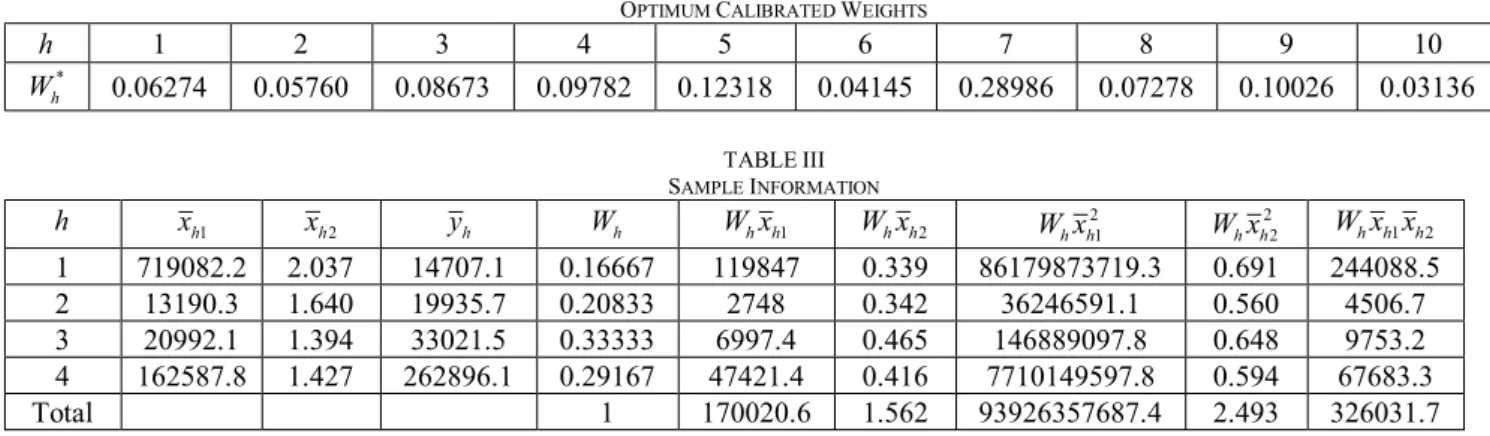
q To compute themultivariate calibrated weights in stratified sampling and the value of the estimate of
Y
, the following sample information shown in Table 3 was used.1 1 1 Ö L 170020.6 h h h X
¦
W x , 2 2 1 Ö L 1.562 h h h X¦
W x , 2 1 1 93926357687.4 L h h h h A¦
W Q x , 1 2 1 326031.7 L h h h h h B¦
W Q x x and 2 2 1 2.493 L h h h h C¦
W Q x .For this population the known population means for the auxiliary variables are
1 37453.78 X and X2 1.5671. Using (10), 6 1 2.59723 10 O u and 2 0.34163. O Thus,
the multivariate calibrated weights *
h W in stratified sampling proposed in (9) are * 1 0.02864, W W2* 0.31792, * 3 W 0.47389 and * 4
W 0.31072. These calibrated weights
violate the restrictions (5) as one of the calibrated weights is negative. Thus we use the second technique developed in Section 3 to compute the non-negative calibrated weights.
Using (20) and solving the equations (18) and (19), we
obtain the constants to be 6
1 -8.76261 10
O u and
2=1.12097.
O Thus, the proposed multivariate calibrated
weights * h W given in (20) are W1* 0.00110, * 2 0.42924, W W3* 0.48673,and W4* 0.12782.
From this data the usual estimator of population mean Y
under the proportional allocation using (1), is 94289.66. Whereas the estimate of population mean Y using the
method of minimizing distance is 58249.34. The true population mean is 49299.73. Therefore it is evident that the proposed multivariate calibration estimator is more efficient than the usual estimator of population mean.
V. CONCLUSION
In this paper, we propose the techniques of determining the multivariate calibrated estimator to improve the survey estimates when more than one auxiliary variable is available. The problem of determining optimum calibrated weights is formulated as an MPP, which is solved using Lagrange multiplier technique.
Two numerical examples are presented to illustrate the computational details of the proposed techniques and the performance of the proposed estimator. The results reveal that the proposed estimator performs better than the usual estimator.
APPENDIX TABLE I
SAMPLE INFORMATION FOR TOBACCO POPULATION
h xh1 xh2 yh Wh W xh h1 W xh h2 2 1 h h h W Q x W Q xh h h22 W Q x xh h h1 h2 1 1304.7 1.940 2592.0 0.05660 73.85 0.10981 96348.4 0.21303 143.27 2 29075.0 1.377 26763.0 0.05660 1645.75 0.07792 47850318.4 0.10728 2265.66 3 5191.7 2.793 14766.3 0.07547 391.82 0.21082 2034219.1 0.58888 1094.49 4 21700.0 1.443 29900.0 0.09434 2047.17 0.13616 44423584.9 0.19653 2954.75 5 6808.0 1.788 12462.5 0.11321 770.72 0.20236 5247041.2 0.36172 1377.66 6 1800.0 1.785 3375.0 0.03774 67.92 0.06736 122264.2 0.12023 121.25 7 24481.5 1.323 38411.8 0.28302 6928.74 0.37436 169626245.6 0.49517 9164.83 8 294809.2 1.320 473455.2 0.16038 47280.72 0.21170 13938788309.1 0.27944 62410.54 9 6303.7 1.327 7480.3 0.09434 594.69 0.12516 3748699.4 0.16604 788.95 10 350.0 1.900 822.5 0.02830 9.91 0.05377 3467.0 0.10217 18.82 Total 59811.28 1.56942 14211940497.2 2.63050 80340.21
TABLE II
OPTIMUM CALIBRATED WEIGHTS
h 1 2 3 4 5 6 7 8 9 10 * h W 0.06274 0.05760 0.08673 0.09782 0.12318 0.04145 0.28986 0.07278 0.10026 0.03136 TABLE III SAMPLE INFORMATION h xh1 xh2 yh Wh W xh h1 W xh h2 2 1 h h W x W xh h22 W x xh h1 h2 1 719082.2 2.037 14707.1 0.16667 119847 0.339 86179873719.3 0.691 244088.5 2 13190.3 1.640 19935.7 0.20833 2748 0.342 36246591.1 0.560 4506.7 3 20992.1 1.394 33021.5 0.33333 6997.4 0.465 146889097.8 0.648 9753.2 4 162587.8 1.427 262896.1 0.29167 47421.4 0.416 7710149597.8 0.594 67683.3 Total 1 170020.6 1.562 93926357687.4 2.493 326031.7 REFERENCES
[1] Briedt, F.J. and Opsomer, J.D. (2000). Local polynomial regression estimators in survey sampling. Ann. Statist., 28, 1026±1053.
[2] Chen, J. and Qin, J. (1993). Empirical likelihood estimation for finite populations and the effective usage of auxiliary information. Biometrika
80, 107-116.
[3] Deville, J.C. and Särndal, C.E. (1992). Calibration estimators in survey sampling. J. Amer. Statist. Assoc., 87, 376±382.
[4] J.-M. Kim, E.A. Sungur, and T.-Y. Heo (2007), "Calibration Approach Estimators in Stratified Sampling", Statistics & Probability Letters; Vol. 77, 1, 99-103.
[5] Kim, J.K. (2009). Calibration estimation using empirical likelihood in unequal probability sampling. Statist. Sinica., 19, 145±157.
[6] Singh, S. (2003). Advanced Sampling Theory with Applications.
Dordrecht: Kluwer Academic Publishers.
[7] Singh, S., Horn, S., Yu, F. (1998). Estimation of variance of the general regression estimator: higher level calibration approach. Survey Methodology 24, 41±50.
[8] Wu, C. & Sitter, R.R. (2001). A model-calibration approach to using complete auxiliary information from survey data. J. Amer. Statist. Assoc.,