Kent Academic Repository
Full text document (pdf)
Copyright & reuse
Content in the Kent Academic Repository is made available for research purposes. Unless otherwise stated all
content is protected by copyright and in the absence of an open licence (eg Creative Commons), permissions
for further reuse of content should be sought from the publisher, author or other copyright holder.
Versions of research
The version in the Kent Academic Repository may differ from the final published version.
Users are advised to check
http://kar.kent.ac.uk
for the status of the paper.
Users should always cite the
published version of record.
Enquiries
For any further enquiries regarding the licence status of this document, please contact:
[email protected]
If you believe this document infringes copyright then please contact the KAR admin team with the take-down
information provided at
http://kar.kent.ac.uk/contact.html
Citation for published version
Mazaheri, A. and Segaert, K. and Olichney, J. and Yang, J-C and Niu, Y-Q and Shapiro, Kimron
L. and Bowman, Howard (2017) EEG oscillations during word processing predict MCI conversion
to Alzheimer's disease. NeuroImage: Clinical, 17 . pp. 188-197. ISSN 2213-1582.
DOI
https://doi.org/10.1016/j.nicl.2017.10.009
Link to record in KAR
http://kar.kent.ac.uk/64541/
Document Version
Contents lists available atScienceDirect
NeuroImage: Clinical
journal homepage:www.elsevier.com/locate/ynicl
EEG oscillations during word processing predict MCI conversion to
Alzheimer's disease
Ali Mazaheri
a,b,⁎,1, Katrien Segaert
a,b,⁎,1, John Olichney
c, Jin-Chen Yang
c, Yu-Qiong Niu
c,
Kim Shapiro
a,b, Howard Bowman
a,b,daSchool of Psychology, University of Birmingham, United Kingdom bCentre for Human Brain Health, University of Birmingham, United Kingdom
cCenter for Mind and Brain and Neurology Department, University of California, Davis, CA, United States dSchool of Computing, University of Kent, United Kingdom
A B S T R A C T
Only a subset of mild cognitive impairment (MCI) patients progress to develop a form of dementia. A prominent feature of Alzheimer's disease (AD) is a progressive decline in language. We investigated if subtle anomalies in EEG activity of MCI patients during a word comprehension task could provide insight into the likelihood of conversion to AD. We studied 25 amnestic MCI patients, a subset of whom developed AD within 3-years, and 11 elderly controls. In the task, auditory category descriptions (e.g.,‘a type of wood’) were followed by a single visual target word either semantically congruent (i.e., oak) or incongruent with the preceding category. We found that the MCI convertors group (i.e. patients that would go on to convert to AD in 3-years) had a diminished early posterior-parietal theta (3–5 Hz) activity induced byfirst presentation of the target word (i.e., access to lexico-syntactic properties of the word), compared to MCI non-convertors and controls. Moreover, MCI con-vertors exhibited oscillatory signatures for processing the semantically congruent words that were different from non-convertors and controls. MCI convertors thus showed basic anomalies for lexical and meaning processing. In addition, both MCI groups showed anomalous oscillatory signatures for the verbal learning/memory of repeated words: later alpha suppression (9–11 Hz), which followedfirst presentation of the target word, was attenuated for the second and third repetition in controls, but not in either MCI group. Ourfindings suggest that a subtle breakdown in the brain network subserving language comprehension can be foretelling of conversion to AD.
Mild cognitive impairment (MCI) is a syndrome characterized by cognitive decline that although not interfering with daily life, is greater than expected given an individual's age. Roughly 60% of the individuals diagnosed with MCI progress to develop dementia within 5 years of MCI diagnosis (Gauthier et al., 2006; Portet et al., 2006). Identifying factors that predict conversion of MCI to dementia will lead the way to early pharmacological intervention, as well as secondary prevention by controlling risk factors such as blood pressure, inactivity, diet and cholesterol levels (Brookmeyer et al., 2016; Sjogren et al., 2006; Wiesmann et al., 2015).
The most prevalent underlying cause of dementia is Alzheimer's disease (AD). A prominent feature of AD symptomatology is a pro-gressive cognitive decline in faculties such as learning and memory, executive control, and language (Ferris and Farlow, 2013; Vestal et al., 2006). The deterioration of language abilities has been proposed to be of particular clinical relevance in terms of tracking the progression from
moderate to severe stages of AD (Ferris and Farlow, 2013). The ob-jective of the current study was to investigate if neuronal activity of MCI patients during a word comprehension task provides insight into the likelihood of conversion to AD dementia.
We examined the electroencephalogram (EEG) of MCI patients, a subset of whom developed dementia within 3 years, and healthy con-trols, while they performed a language comprehension task. In this task, patients and controls heard auditory phrases describing a category (e.g. `a type of wood’, `a breakfast food’), each of which was followed by the visual presentation of a single target word, which eitherfit (congruent, i.e. oak, pancake) or did notfit (incongruent nouns) with the preceding category statement.
Thelexical processingof a target word requires the reader to access a range of different kinds of information about the word in the mental lexicon, including phonological, morphological and syntactic informa-tion, as well as the word's semantic meaning. Early changes in EEG
http://dx.doi.org/10.1016/j.nicl.2017.10.009
Received 13 June 2017; Received in revised form 15 September 2017; Accepted 8 October 2017
⁎Corresponding authors.
1Shared
first author, alphabetical order.
E-mail addresses:[email protected](A. Mazaheri),[email protected](K. Segaert).
NeuroImage: Clinical 17 (2018) 188–197
Available online 09 October 2017
2213-1582/ © 2017 The Authors. Published by Elsevier Inc. This is an open access article under the CC BY-NC-ND license (http://creativecommons.org/licenses/BY-NC-ND/4.0/).
induced by target word presentation, irrespective of whether the word is congruent or not, have been suggested to be indicative of lexical processing (Huang et al., 2014; Ledoux et al., 2007). Lexical processing can be facilitated by repeated word presentation due toimplicit memory for properties of the earlier presented word. Throughout the experiment we presented target words once, twice or three times. Changes in the EEG for congruent compared to incongruent target words are indicative ofsemantic or meaning processing. For congruent words, properties of the target word's meaning have been pre-activated and can be integrated with the preceding phrase, facilitating meaning processing.
The data used in the current investigation was part of a previously published study (Olichney et al., 2008) using the N400 and P600 event related potentials (ERPs) to investigate memory encoding and retrieval processing deficits as predictors for conversion to AD dementia.
We focused our investigation on induced power changes in oscilla-tory activity generated by the onset of the target word. We examined oscillatory activity in theta (3–5 Hz), alpha (~ 10 Hz) and beta (15–20 Hz) frequency ranges given that prior studies have implicated these bands in various aspects of language processing, including lexical and semantic processing (Bastiaansen et al., 2005; Bastiaansen et al., 2008; Davidson and Indefrey, 2007; Hagoort et al., 2004; Hermes et al., 2014; Lam et al., 2016), as well as access to stored information and integration of information (Klimesch, 2012; Obleser and Weisz, 2012; Strauss et al., 2014; Weiss and Mueller, 2012). Finally, given that lan-guage comprehension involves the interaction of different brain regions across the cortex (Hagoort, 2013; Hermes et al., 2014), we also ex-amined cross-frequency interactions of power across different brain areas during word comprehension (Mazaheri et al., 2009; Mazaheri et al., 2010; Mazaheri et al., 2014a).
1. Methods and materials
1.1. Participants
We examined the EEG recordings of 25 patients with amnestic MCI (mean age 73.2 years, range 55–84) and 11 normal elderly controls (mean age 74.1 years, range 57–79), who were all part of a previously published study (Olichney et al., 2008) in which the patients were tested annually with a semantic judgment task that has been found to reliability elicit the N400 and P600 components (Olichney et al., 2008). In the present analyses, we focus on the initial baseline EEG session obtained after the MCI diagnosis in order to investigate patterns of responses that could be predictive of dementia conversion in the fol-lowing 3 years. The MCI patients were recruited primarily through the Shiely-Marcos Alzheimer's Disease Research Center (ADRC) at the University of California, San Diego. All participants were screened for treatable causes of cognitive impairment (e.g., vitamin B12 deficiency, thyroid dysfunction) and underwent a brain scan (generally MRI) prior to enrolment. The exclusion criteria included stroke, epilepsy, psy-chiatric conditions, as well as CNS-active medications. At the initial baseline EEG recording session, the patients all met the Petersen Cri-teria for MCI (Petersen, 2004), but not for dementia (American Psychiatric Association, 2000). Conversion to AD was defined ac-cording to the criteria set out by the National Institute of Neurological and Communicative Disorders and Stroke–Alzheimer's Disease and Related Disorders Association (McKhann et al., 1984). Fifteen patients of the 25 with MCI subsequently converted to AD within 3 years of their
initial baseline EEG recordings (mean number of years
1.62 ± 0.7 years). For more specific information of participant de-mographics, and neurocognitive testing of participants please refer to Olichney et al. (Olichney et al., 2008).
1.2. Semantic judgment task and study design
Our focus in this paper was purely on the encoding phase of the experiment. At encoding, participants were presented with an auditory
phrase describing a category (e.g.,‘a type of wood’,‘a breakfast food’) followed 1 s later by a single visual target word (300 ms, visual angle ~ 0.4°) that was either congruent (i.e., oak, pancake) or incongruent (i.e. nouns matched on word frequency and length) with the preceding category phrase. The probability of congruent versus incongruent target words was 0.5. The congruent target words were medium typicality exemplars of the selected category. The incongruent target words were incongruent with the category set by the preceding phrase but matched for frequency of usage and word length to the congruent targets. In addition, 2/3rds of the target words were repeated in a pseudorandom fashion between ~ 10 and 140 s later. These repeated target words al-ways followed the same uniquely associated category statement as on thefirst presentation (congruent or incongruent). The participants were instructed to wait ~ 3-s after the onset of the word, then read the word aloud and state if itfit the preceding category with a“yes”or a“no”
decision. Further details of this experimental paradigm have been published previously (Olichney et al., 2000; Olichney et al., 2008).
There were no differences between conditions and groups with re-spect to the behavioural accuracy of performing this task, as all parti-cipants performed near ceiling (Olichney et al., 2008). Healthy controls and patients were given as much time as required and reaction time was not recorded.
For our analyses of lexical processing associated with the pre-sentation of the target word (Section 2.1in theResultssection), as well as for our analyses of semantic congruency (Section 2.3in theResults
section), we include only thefirst presentation of the target words, thus excluding target words that have been primed previously. For our analyses of the facilitatory effects of repeated word presentation on lexical processing (Section 2.2in theResultssection), we analysed the repeated target words that occurred on 1st, 2nd and 3rd presentations within the experiment.
1.3. EEG recordings
19 to 32 channel EEG was recorded at 250 Hz, band passed 0.016 to 100 Hz, and re-referenced off-line to linked mastoids. The pre-proces-sing of the EEG data was performed upre-proces-sing EEGLAB (Delorme and Makeig, 2004). Fieldtrip (Oostenveld et al., 2011) EEG epochs were locked to the onset of the visual target words and manually inspected for non-physiological artefacts. Independent component analysis was then applied to remove eye movement artefacts (Jung et al., 2001). Our classifications of frequency bands into alpha (9–11 Hz), theta (3–5 Hz) and beta (15–20 Hz) were based on prior literature (Bauer et al., 2014; Mazaheri et al., 2014b; Slagter et al., 2016; Van Diepen et al., 2015) and word-induced changes in power irrespective of the condition or participant group.
1.4. Oscillatory analyses
Time-frequency representations (TFRs) of power were calculated for each trial (1 s prior to word onset, and 1.5 s after) using sliding Hanning tapers having a varying time window of three cycles for each frequency (ΔT = 3/f). This approach has been used in a number of previous stu-dies (Bengson et al., 2012; Van Diepen et al., 2015). Word presentation induced changes in the power of oscillatory activity, which was as-sessed in terms of change scores from baseline (ΔP) using the following formula:
= −
P P P P
∆ (t r)/r
wherePrwas the mean power during the baseline period 500 ms to 100 ms before the onset of the word andPt was the power at each specific time point.
1.5. Cross-frequency coupling between theta and alpha/beta
brain regions across the cortex. Our goal is to capture these interactions in the healthy and MCI groups by examining the cross-frequency con-nectivity between theta and alpha/beta power changes following word onset. Investigating connectivity between brain regions using EEG has been difficult due to problems associated with volume conduction, namely that nearby electrodes pick up activity from the same sources. Here, we attempt to circumvent this issue by focusing on trial-by-trial negative correlations (De Lange et al., 2008; Mazaheri et al., 2009; Mazaheri et al., 2010; Mazaheri et al., 2014a), given that it is unlikely that a common source generates a simultaneous increase and decrease in power of different frequencies at distant electrode sites. Across par-ticipants, the amplitude envelope of the theta and alpha/beta oscilla-tions at distant electrodes of interest were correlated on a trial-by-trial basis for each condition. For each participant, the correlation coeffi-cients were converted to z values using Fischer's r-to-z transform to obtain a normally distributed variable (Bengson et al., 2012; Mazaheri et al., 2010; Mazaheri et al., 2014a). The analysis of these correlations was assessed within groups, between groups, and between conditions, using a one-samplet-test of the Fisher r-to-z transformed correlations. 1.6. Statistical analysis
We used a-priori defined latencies of interest and selection of elec-trodes for our statistical tests, which were guided by previous literature looking at oscillatory changes in EEG/MEG activity induced by word onset (Bastiaansen et al., 2005; Bastiaansen et al., 2008; Hagoort et al., 2004), as well as by the aggregated grand average data of conditions and participant groups collapsed (Brooks et al., 2017).
Repeated-measures ANOVAs were used to analyze the event-related changes in theta and alpha/beta between conditions. F-ratios were tested using degrees of freedom adjusted by the Greenhouse–Geisser procedure. Post hoc comparisons were Bonferroni corrected for mul-tiple-comparisons.
The factors used wereWord type(congruous, incongruous),Group (control, MCI non-convertors, MCI convertors) and Time window (0–500 ms or 400–500 ms, and 500–1000 ms). For analyses of the ef-fects of repeated word presentation we also used Word repetition, by contrasting the 1st, 2nd and 3rd presentations. Frequency ranges as well as time windows were guided by previous research (Bastiaansen et al., 2005; Hagoort et al., 2004; Kielar et al., 2014; Strauss et al., 2014).
The justification for time windows and frequency ranges of interest can be found in each individual section of the results. In addition to using pre-defined electrodes and time windows of interest, we also used a complementary approach where we assessed the difference in oscil-latory theta power related to lexical and semantic processing between MCI convertors and non-convertors across all electrodes and time points between 0 and 1 s after the onset of words. The multiple com-parison issue here (multiple time points and electrodes) was cir-cumvented by obtaining probability values through whole-volume non-parametric permutation testing (Maris and Oostenveld, 2007). In this procedure,first a two-tailed independentt-test (MCI convertors versus non-convertors) was computed for each individual channel-time pairs and thresholded at a 5% significance level. Significant pairs were clustered by direction of effect and spatial proximity using the ‘ dis-tance’-method (which defines neighbouring sensors based on proxi-mity). A probability value of this electrode-time cluster was obtained through the Monte Carlo estimate of the permutation p-value of the cluster by randomly swapping the group label 1000 times and calcu-lating the maximum cluster-level test statistic across the whole volume. A similar procedure has been used in a number of previous studies (Van Diepen et al., 2015; van Diepen et al., 2016; Van Diepen and Mazaheri, 2017).
It should be noted that these two analysis approaches are com-plementary, with thefirst being guided by previous research (i.e. prior precedent), while the second is data driven, but controls false positive
rates by inferring maximum clusters under the null across the entire volume. To foreshadow our results,findings from the two approaches converge.
2. Results
2.1. Lexical processing
Firstly, we will focus on the oscillatory changes in the EEG asso-ciated with the lexical processing of the first presentation of single target words. During lexical processing, a reader accesses a range of different kinds of information about each word in the mental lexicon, including phonological information (e.g., segmental and metrical structure), morphological information (e.g. stems and affixes), syntactic information (e.g. grammatical class), and the word's semantic meaning. The onset of a word previously has been found to induce an early increase in theta activity over posterior regions, related to the proces-sing of word form (Bastiaansen et al., 2005; Bastiaansen et al., 2008; Hagoort et al., 2004). Later alpha suppression at posterior sites has been associated with further post-perceptual processing of sensory informa-tion (Pfurtscheller, 2001) and allocation of resources according to processing demands (Foxe et al., 1998). We were guided by the lit-erature in our analysis approach, and analysed oscillatory changes at Pz, in the theta (3–5 Hz) and alpha (9–11 Hz) range, respectively 0–500 ms and 500–1000 ms following the onset of the target word. Of particular interest are any effects of Group.
2.1.1. Theta power increase related to lexical processing was attenuated in MCI convertors
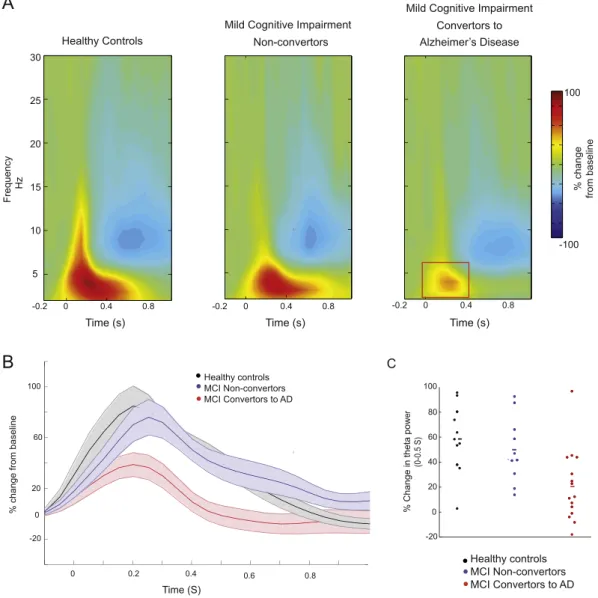
The onset of the word induced an increase in theta activity across all three groups, peaking at around 0.25 s after word onset and maximal over the midline-parietal electrode Pz (Fig. 1A and B). For this early theta increase, we found a main effect of Group (F(2,33)= 6.8, p= 0.003). MCI convertors had a significantly diminished theta in-crease compared to the MCI non-convertors (convertors: 22% inin-crease vs non-convertors 50% increase, p= 0.046) and compared to the healthy elderly control group (MCI convertors: 22% increase vs con-trols: 59% increase,p= 0.004) (Fig. 1A).
The theta increase was followed by alpha activity suppression 0.5 to 1 s after word onset (blue inFig. 1A). The alpha suppression effect did not differ between groups (F(2,33)= 0.24p= 0.78).
2.2. Facilitatory effects of lexical processing due to repeated word presentation
Repeated word presentation facilitates lexical processing, since there is implicit memory for properties of the word that are activated uponfirst presentation (Schacter et al., 1993). Thus we compared 1st to 2nd and 3rd presentations of the target words (collapsing congruent and incongruent words).
As discussed inSection 1, lexical processing is associated with an early (0–500 ms) theta increase (3–5 Hz) and a late (500–1000 ms) alpha suppression effect (9–11 Hz) at Pz. This guided our decision to examine both oscillatory signatures for the effects of word repetition.
It should be noted that we are protected here from criticisms of double dipping (Kriegeskorte et al., 2009), since under the null hy-pothesis, effects of repetition would be orthogonal to effects onfirst presentation, and the basic lexical processing effects identified in
Section 1were indeed onfirst presentations (Friston et al., 2006).
2.2.1. Alpha suppression attenuates with each word repetition, but only for healthy controls and not for either MCI patient group
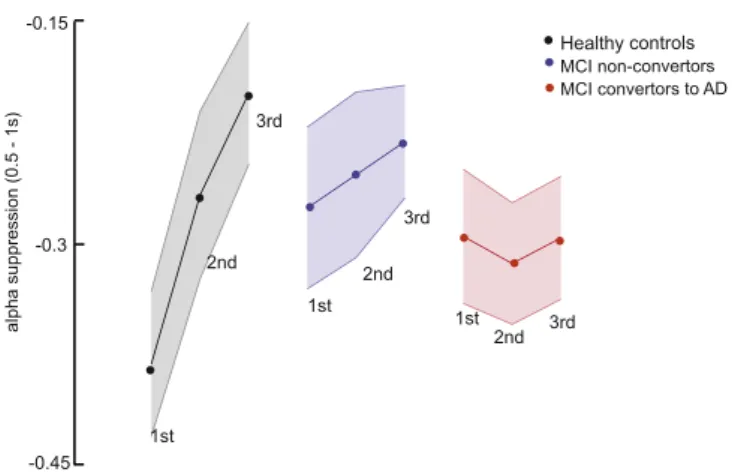
We did not observe any significant changes in the early theta in-crease as a result of word repetition (not shown). However for the alpha suppression, there was a Word Repetition by Group interaction (F(4,66)= 4.2, p= 0.005) (Fig. 2). In the healthy elderly group, the
A. Mazaheri et al. NeuroImage: Clinical 17 (2018) 188–197
alpha suppression diminished with each repetition of the word (F(2,20)= 24.1,p< 0.001; simple effects: 1st vs 2nd word presenta-tion:p= 0.008; 2nd vs 3rd word presentation:p= 0.072; 1st vs 3rd word presentation:p< 0.001). There was no word repetition effect in either the MCI non-convertors (F(2,18)= 0.45,p= 0.61) or the MCI convertors (F(2,28)= 0.24,p= 0.76).
2.3. Semantic or meaning processing
We now focus on differential oscillatory changes in the EEG for congruous versus incongruous target words. For congruous words, the preceding category description has pre-activated the category exemplar information, facilitating access to meaning information for the con-gruous target words. Moreover, it is likely that participants semanti-cally integrate the target's word meaning with the preceding phrase.
Previous research has found modulation of central theta associated with semantic processing in the classic N400 time window (note that
this is distinct from the earlier and more posterior theta peaking at around 250 associated with lexical processing, as discussed above) (Hagoort et al., 2004; Lam et al., 2016). The N400 is an ERP indicative of semantic processing of single words, as well as the meaning in-tegration of these words into context. This context can be with pre-ceding words as well as with semantic knowledge about the world (Kutas and Federmeier, 2011). The N400 is attenuated for words con-gruous with the context. For the changes in theta power (3–5 Hz) re-lated to semantic processing, we focused our analyses at Cz in the N400 time window (400–500 ms). We also investigated modulations of late alpha (9–11 Hz) at Cz 500–1000 ms following word onset, since later occurring alpha activity over central regions has been suggested to fa-cilitate access to stored information and be related to semantic pro-cessing demands (Klimesch, 2012). Additionally, changes in beta over left inferior frontal gyrus has been associated with integration of in-formation (Wang et al., 2012) guiding us to analyze beta activity (15–20 Hz) at Cz 500–1000 ms following word onset.
Fig. 1.An attenuation of theta activity associated with lexical processing of the target word in the group of MCI patients who would go on to convert to Alzheimer's disease. (A) The time-frequency spectra are locked to word onset at the midline-parietal Pz electrode. There is a theta increase 0 to 0.5 s after the onset of the word, for the healthy controls and for the MCI patients who did not convert to Alzheimer's disease. This theta increase was significantly attenuated in MCI patients who would later convert to Alzheimer's disease. For all groups, target word presentation is followed by an alpha suppression effect (0.5 to 1 s) (B) The power envelope of the theta activity during the 1 s time-period following word onset, normalized as percentage change from a baseline period−0.5 to−0.1 s prior to word onset. The shaded areas represent standard error around the mean. This illustrates the time period in which the
theta power pattern is discernibly attenuated for the MCI to Alzheimer convertors compared to the other two groups. (C) The theta modulation in all the individuals across the three participant groups, at the midline-parietal electrode Pz, averaged within the 0 to 0.5 s time window after the onset of the word. This illustrates that the attenuated theta can be observed not only at the group-level, but also at the level of individual patients. (For interpretation of the references to color in thisfigure, the reader is referred to the online version of this chapter.)
2.3.1. MCI convertors show an attenuated central theta increase at 400 ms and a late beta suppression related to processing of semantic congruency
For the differential effect between congruent and incongruent words at Cz, we found a transient increase in theta activity 400–500 ms fol-lowing word onset (F(1,33)= 17.36, p < 0.001) (Fig. 3). This con-gruency effect differed between the groups (Word Type x Group in-teraction: F(2,33)= 4.8,p= 0.014). The theta congruency effect for the MCI non-convertors significantly differed from the MCI convertors (MCI non-convertors: 37% vs MCI convertors: 1%, p= 0.014). For the
healthy elderly control and MCI convertor groups, a similar theta congruency difference was revealed but was not statistically significant (healthy controls: 23% vs MCI convertors: 1%,p= 0.205). There was no difference in the theta congruency effect between the MCI non-convertors and healthy elderly controls (p= 0.82). For alpha (9–11 Hz), the effect of semantic congruency did not differ between groups (Word Type × Group interaction: F(2,33)= 0.855,p= 0.44).
There was a suppression of beta activity at Cz for congruent com-pared to incongruent words, occurring 0.5 s after word onset and lasting until 1 s post onset (Fig. 3). While the degree of beta suppression (15–20 Hz) was not significantly different for congruent vs. incongruent words over all groups (F(1,33)= 1.37, p= 0.250), there was a clear Word Type by Group interaction (F(2,33)= 5.58,p= 0.008). Post-hoc analysis revealed that MCI convertors had significantly more beta suppression to congruent than incongruent words, unlike the MCI non-convertors (MCI non-convertors: −10% vs MCI non-convertors: 3%, p= 0.017) or the healthy controls (MCI convertors:−10% vs controls: 1%,p= 0.038).
2.3.2. Cross-frequency interactions for congruent words are only present for the healthy elderly controls, not for either MCI patient group
As mentioned above, one interpretation of the semantic congruency effect is that the meaning of the target word is integrated with the meaning established by the preceding phrase. Previous research has found the suppression of beta activity localized over the frontal cortices to be involved in semantic unification (i.e. integration) operations, with the to-be-integrated information retrieved from temporal regions (as-sociated with modulations of theta). The dynamic interaction between unification of information (frontal regions) and lexical retrieval pro-cesses (temporal regions) is thought to be critical during language comprehension (Hagoort, 2013; Wang et al., 2012).
Using repeated measures ANOVA with the factors of word-type and group, we determined if there was a difference between congruent and incongruent words with regards to the theta and alpha/beta coupling, Fig. 2.The effect of word repetition times on alpha suppression (0.5–1 s) reveals less
alpha suppression upon 2nd and 3rd presentation of the word for the healthy controls, but not for either of the MCI patient groups. Illustrated is the % change in alpha activity (9–11 Hz at Pz; 0.5–1 s after word presentation compared to baseline−0.5 to−0.1 s),
contrasting 1st, 2nd and 3rd presentation in each group. Shaded area represents standard error. There is an effect of word repetition for the healthy controls: the alpha suppression effect diminishes with each following word presentation, such that there is less alpha suppression for 2nd compared to 1st presentation and less alpha suppression for 3rd compared to 2nd presentation. No significant effects of word repeats are observed for either the MCI non-convertors or the MCI convertors to AD.
Fig. 3.An attenuation of theta activity and a late beta suppression effect associated with word congruency are both markers of imminent conversion from MCI to Alzheimer's disease. (A) Illustrated is the difference in time-frequency spectra between congruent and incongruent words at the central electrode Cz. (B) There was a late in-crease in theta activity (0.4 to 0.5 s) to congruent words (relative to incongruent) at Cz for the healthy controls and for the MCI patients who did not convert to Alzheimer's disease. This late theta increase was attenuated in MCI pa-tients who converted to Alzheimer's disease, also at the level of individual patients. (C) Only for the MCI convertors to Alzheimer's disease group was there a beta suppression at Cz (15–20 Hz, 0.5 to 1 s) following congruent words (re-lative to incongruent), which was significantly more pro-nounced than the healthy controls and MCI non-convertors, also at the individual-patient level.
A. Mazaheri et al. NeuroImage: Clinical 17 (2018) 188–197
and if this difference was observed in each group. In addition, rather than just testing for differences in cross-frequency correlations between condition and groups, we directly tested if the correlations were sig-nificant within each groups. This approach for looking at differences in cross-frequency interactions between patient populations and control groups has previously been successfully used (Mazaheri et al., 2014a). The power of the theta activity 0.4–0.5 s after word onset, at elec-trode Pz was correlated (Spearman) with the late alpha/beta (10–20 Hz) power suppression at frontal electrode Fz on a trial-by-trial basis and converted to z-values with Fischer's r-to-z transform. Here we chose to combine the alpha and beta frequency ranges. The rationale was to reduce the likelihood of harmonic frequencies inducing spurious
positive correlations between the power of the two frequency ranges. In addition, we chose to examine theta at Pz and alpha/beta at Fz (which are distant on the scalp) as locations for our cross-frequency interac-tions to reduce possible contamination and spurious correlainterac-tions arising from volume conduction.
We found a Word Type by Group interaction (F(2,33)= 4.55, p= 0.018) (Fig. 4). Consequently, we tested the significance of the correlation within each condition in each group. For the healthy elderly participants, there was a strong negative-correlation (i.e. anti-correla-tion) between theta and alpha/beta but only following congruent words (t(10)=−4.07,p= 0.002). This anti-correlation emerging in response to semantically congruent words was not significant for MCI non-con-vertors (t(9)=−0.7409),p= 0.48) and absent (i.e. a positive corre-lation) for the MCI convertors (t(14)= 1.77,p= 0.098). Furthermore, the anti-correlation did not emerge in response to incongruent words in any of the three group (all p's > 0.10). We also directly compared the correlation in congruous versus incongruous conditions: for healthy elderly individuals, congruent words induced a significantly larger anti-correlation than incongruent words (−0.62 vs 0.31, t(10)=−3.81 p= 0.003). There were no significant differences in correlation values between congruent and incongruent words for MCI non-convertors or convertors (p's > 0.2).
One could argue that any correlation emerging between the theta and alpha/beta could simply be due to certain trials being more arousing/stimulating, rather than the result of cognitive induced neural interactions. However, given that we observed a stark difference in the pattern of these correlations between congruous and incongruous words (both of which induced a theta increase and alpha suppression) we believe it is unlikely that trial-by-trial variations in arousal could account for the cross-frequency amplitude correlations observed.
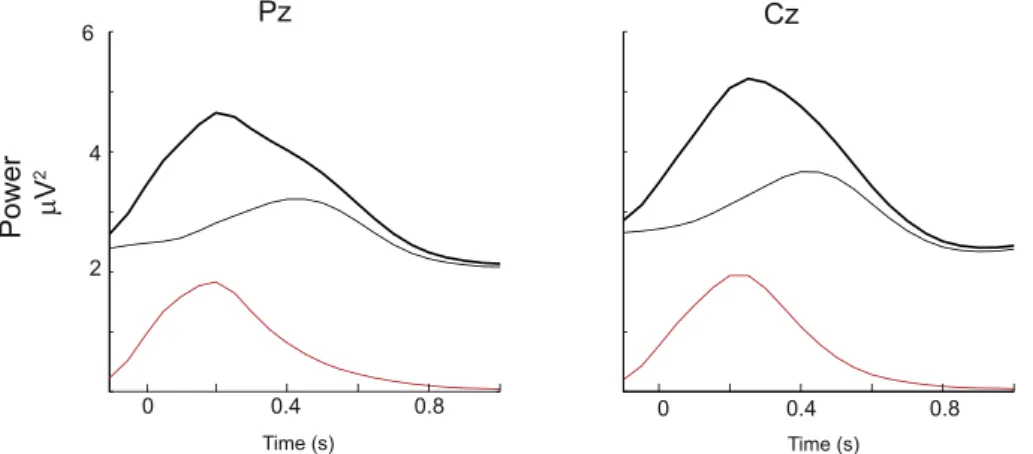
2.4. Word onset induces mostly non-phase-locked increases in theta activity Obtaining time-frequency representations of power in each EEG epoch captures both non-phase locked (i.e., induced) activity as well as the spectral representation of the word locked ERP. It is therefore possible that the increase in oscillatory activity observed after word onset could simply be due to ERPs locked to word onset. One approach used in previous work (Cacace and McFarland, 2003) has been to re-move the spectral components of the averaged ERP, from the‘total’
spectra measured in each single trial. This approach is not without caveats (Mazaheri and Picton, 2005) with one being that the latency variability in the ERP can underestimate the spectrum of the ERP on a single trial. Nonetheless, we performed this subtraction (Fig. 5) and found that the majority of the theta increase in the 0–0.5 s window after word onset is non-phase-locked. Thus, it is unlikely that ERP differences for the early word responses can account for the oscillatory differences we observed between the healthy and patient groups.
Fig. 4.The trial-by-trial cross-frequency coupling between the late theta increase (at the central parietal electrode Pz) and the late alpha/beta suppression (at Fz following gruent versus incongruent words) distinguishes healthy controls from both MCI con-vertors to Alzheimer's disease and non-concon-vertors. We correlated (Spearman) the theta power (3–5 Hz, 0.4 to 0.5 s) at Pz with the alpha/beta (10–20 Hz, 0.5–1.0 s) power at frontal electrode Fz on a trial-by-trial basis, and then converted to z-values with Fischer's r-to-z transform. The correlation of theta and alpha/beta in each individual is illustrated, separately for congruous and incongruous words. For the healthy participants, there was an anti-correlation (i.e. below zero) between the late theta increase and late alpha/beta suppression following the congruous words which was not present to incongruous words. There was no anti-correlation for congruous words in either MCI group, nor was there a significant difference in correlation values between congruous and incongruous words in either MCI group. The thick coloured lines represent the difference in mean cross-fre-quency correlation between the congruent and incongruent words, whereas the dots and thin lines represent individual participants. (For interpretation of the references to color in thisfigure legend, the reader is referred to the online version of this chapter.)
Fig. 5.Word onset induces mostly non-phase-locked changes in theta activity. The amplitude envelope of the
‘total’theta activity locked to onset of the word (obtained at a single trial level and averaged) is represented in the dark-line. The amplitude envelope of the phase-locked theta activity measured through the time-frequency transforma-tion of the ERP locked to the onset of word is represented as the grey-line. The subtraction of the phase-locked theta activity from the total theta activity shown in the red-line should consist of primarily non-phase-locked change (al-though seeMazaheri and Picton, 2005, for caveats of this assumption). We thus found the majority of the increased theta activity in the 0–0.5 s window after word onset to be primarily non-phase locked (compare the red vs grey lines).
2.5. Investigating word onset differences in theta activity between MCI groups at all time points and electrodes
In addition to using a-priori defined electrode locations and time intervals of interest, we also utilized a mass-univariate data driven approach looking at all electrodes and time points from 0 to 1 s after word onset (while correcting for multiple comparisons, i.e. controlling familywise error rates). This was to ensure that we were not over-looking any other differences between MCI convertors and MCI non-convertors, or biasing our results through our a-priori choices. For lexical processing (congruent and incongruent words collapsed), theta activity between 0.252 s and 0.752 s after word onset was significantly attenuated in the MCI convertor group relative to the non-convertor group in a cluster of electrodes consisting of: T5, O1, O2, Pz, and Cz (Monto Carlo estimatedp < 0.009,Fig. 6A). For semantic processing (congruent minus incongruent words) theta activity between 0.35 s and 0.548 s after word onset was attenuated in the MCI convertors group relative to MCI non-convertors in a cluster of electrodes consisting of: T5, O1, Pz, Cz, and Fz (Monto Carlo estimated p< 0.013 Fig. 6B). These results taken together suggest that not only are we not biasing our results by selecting individual electrodes or choosing time intervals,
the lexical and semantic theta attenuation we observe in the MCI convertors are not restricted to just electrodes Pz and Cz.
2.6. Associations between EEG measures and language and verbal memory abilities (assessed by neuropsychological testing)
In exploratory analyses across all subjects, we found that the late theta increase to either congruent or incongruent words correlated significantly with performance on the animal fluency test, in which participants named as many different animals as possible within one minute (Table 1A). Boston Naming Test (BNT) scores tended to corre-late with the early lexical theta activity (rho = 0.33, uncorrected p= 0.048). Two EEG oscillatory measures were strongly correlated with learning and memory on the California Verbal Learning Test (CVLT (Delis et al., 1987)). Both the change in the alpha suppression from 1st to 3rd presentation, as well as the strength of the anti-corre-lation between late parietal theta and frontal alpha-beta power, were correlated with learning, Delayed Recall and Recognition (Table 1B).
2.7. Classification analysis
In practice, biomarkers need to be applied at the individual level. Accordingly, we performed a leave-one-out classification to assess dis-crimination accuracy. Importantly, criticisms of over-fitting can be le-velled even if cross-validation is applied, since one can effectivelyfish in the choice of classifier or classifier hyper-parameters (Skocik et al., 2016). To guard against such problems, we just applied two very
standard classifiers: Linear Discriminant Analysis (LDA)
(Balakrishnama and Ganapathiraju, 1998) and Support Vector Machine with Gaussian kernels, i.e. radial-basis functions (SVMrbf) (Suykens and Vandewalle, 1999). Linear Discriminant Analysis is probably the most basic classifier one could use, which places a single hyperplane in the data space. We also wanted to have the capacity to classify in the presence of linear inseparability, and the most standard classifier to do this is a Support Vector Machine with Gaussian kernels.
We trained both LDA and SVMrbf classifiers to distinguish MCI to Alzheimer's convertors from the other two groups– MCI stable and Fig. 6.Investigating differences in lexical and semantic processing between MCI
con-vertors and non-concon-vertors across all electrodes and time points (0–1 s) after word onset. (A) For lexical processing (congruent and incongruent words collapsed) theta activity between 0.252 s and 0.752 s after word onset was significantly attenuated in the MCI convertor group relative to the non-convertor group in a cluster of electrodes (high-lighted with ‘*’) consisting of: T5, O1, O2, Pz, and Cz (Monto Carlo estimated
p< 0.009). (B) For semantic processing (congruent minus incongruent words), theta activity between 0.35 s and 0.548 s in a cluster (high-lighted with‘*’) consisting of left temporal, left occipital as well as midline electrodes (T5, O1, Pz, Cz, and Fz) was atte-nuated in the MCI convertors group relative to MCI non-convertors (Monto Carlo esti-matedp< 0.0129).
Table 1A
Spearman correlations between EEG and language measures across all subjects. Lexical theta (Pz, 0–500 ms) Semantic theta (Cz, congruent, 400–500 ms) Semantic theta (Cz, incongruent, 400–500 ms)
rho p rho p rho p
Animalfluency 0.30 0.078 0.44 0.007⁎ 0.43 0.009⁎ Boston naming test (BNT) 0.33 0.048# 0.21 0.22 0.21 0.23 ⁎p< 0.01. #p< 0.05. Table 1B
Spearman correlations between EEG and verbal memory measures across all subjects. Alpha suppression
(3rd–1st presentation, Pz, 500–1000 ms)
Theta (Pz) and alpha/ beta (Fz) coupling
rho p rho p
CVLT list A 1–5 0.51 0.001⁎
−0.53 0.0008⁎
CVLT long delay cued recall 0.56 0.0004⁎
−0.49 0.002⁎
CVLT discrminability 0.48 0.003⁎
−0.64
0.0000-2⁎
CVLT = California Verbal Learning Test (Delis et al., 1987).
⁎p< 0.01.
A. Mazaheri et al. NeuroImage: Clinical 17 (2018) 188–197
controls. We did this on each relevant variable in our data set, and on combinations of these variables. The relevant variables were theta power during lexical retrieval (window from 0 to 0.5 s after word onset) at electrode Pz for the Congruent and Incongruent words separately, as well as theta power during semantic processing at Cz (0.4–0.5 s after word onset) for Congruent and Incongruent words.
We will present results for all four condition-electrode combinations in order to assess how classification performance changes across ables. Note, we did also explore classifying with combinations of vari-ables, i.e. multiple predictors. However, there was no apparent im-provement in classification performance. We report sensitivity (i.e. hit rate), specificity (i.e. correct reject rate) and d-prime (i.e. overall dis-criminability).
The results of our classification analyses at the individual level are outlined inTable 2. Discriminability varies considerably across condi-tion. However, the electrode-condition combination that has the most prior precedent in the literature is Cz incongruent. For example,
Hagoort et al. (2004)identified high theta at Cz for a semantically in-congruent condition. Consistent with this, it is the inin-congruent condi-tion at Cz at which we obtain the greatest discriminability, with the highest linear discriminant d-prime of 1.752 and the highest support vector machine d-prime of 2.51. Interestingly, both the LDA and SVM have very high specificity for this condition (both 0.952) and the in-crease in d-prime gained with the SVM arises from a large inin-crease in sensitivity (from 0.533 to 0.8). The practical implication of this is that the MCI-convertor group may contain two subgroups with different patterns. This will be the subject of future investigations.
3. Discussion
In the current study, we investigated the neurophysiological dif-ferences during a language comprehension task among MCI patients who later go on to convert to Alzheimer's disease (AD) within 3 years (MCI convertors), MCI patients who remained stable (MCI non-con-vertors) and healthy elderly controls. We focused on the oscillatory changes in the EEG induced by the visual presentation of words, for which the semantic context was established by preceding category descriptions. Two critical features of language comprehension are the rapid access to the form and meaning of words (i.e., lexical processing), and the rapid integration of this information with meaning set up by the preceding linguistic context and world knowledge (i.e. semantic, or meaning, integration) (Hagoort et al., 2004). In addition, lexical pro-cessing is facilitated when words are repeatedly presented via learning and implicit memory.
We found that lexical retrieval (i.e., lexical and semantic access) during a word processing task in individuals with MCI who progressed to Alzheimer's disease elicited significantly diminished theta activity (3–5 Hz) relative to healthy controls and MCI non-converters. Theta attenuation thus provides an oscillatory signature for distinguishing those who will convert from MCI to AD. Furthermore, individuals with
more severe attenuation in this lexical theta activity tended to have poorer lexical retrieval abilities as measured by the BNT score.
Additional analyses reveal that later alpha suppression (9–11 Hz), which also followedfirst presentation of the target words, was atte-nuated for the second and even more so for the third repetition in healthy elderly controls, but not for either of the MCI groups. Thus alpha suppression attenuation provides a useful oscillatory signature for both the MCI convertors and MCI non-convertors alike, distinguishing both MCI patient groups from controls. This loss of the normal at-tenuation of alpha suppression as words repeat, may reflect an im-pairment in both implicit and explicit memory processes. The degree of alpha suppression attenuation was strongly correlated with CVLT measures of learning and declarative memory in this study, arguing that it reflects or is important for declarative memory.
MCI convertors to Alzheimer's disease also revealed a different os-cillatory signature for processing semantically congruent words. We found that, whereas a central theta increase associated with word congruency was attenuated in MCI convertors, this group exhibited a more pronounced late beta suppression over the frontal cortex. However, we did not observe any significant cross-frequency con-nectivity between theta and alpha/beta power changes in the MCI convertors, or in the MCI non-convertors. This coupling, indicative of the complex interplay between retrieving linguistic information and binding linguistic information, was only present for congruous words in the healthy controls, and also demonstrated robust correlations with verbal learning and memory on the CVLT. We discuss each of these findings in more detail below.
During lexical processing, a reader accesses a range of different kinds of information about the word in the mental lexicon, including phonological, morphological and syntactic information, and the word's semantic meaning The onset of a word has previously been found to induce an early increase in theta activity over posterior and temporal regions, related to the process of lexical retrieval (Bastiaansen et al., 2005; Bastiaansen et al., 2008; Hagoort et al., 2004). In our study, changes in the theta band associated with the lexical processing of single words served as a conversion marker for MCI patients, suggesting MCI convertors have difficulties with this basic aspect of language comprehension.
Repeated presentation of words typically results in facilitated lexical processing, given that implicit memory (and possibly also declarative memory) are activated uponfirst presentation of that word (Schacter et al., 1993). We observed in the healthy elderly group that a late alpha suppression diminished with each repetition of the word. This repeti-tion effect was absent in both MCI groups. Later alpha suppression at posterior sites has been associated with active processing of sensory information (Pfurtscheller, 2001) and allocation of resources according to processing demands (Foxe et al., 1998). The reduction in the amount of alpha suppression after each word repetition in the healthy controls suggests the emergence of implicit and/or explicit memory processes, which translates to less resource allocation required after each sub-sequent presentation. The absence of such memory processing sig-natures for repeated words in both MCI groups could represent a mediating factor of their impairments in verbal learning and memory. For semantic processing, previous research has found modulations of central theta activity in the classic N400 time window (Hagoort et al., 2004; Lam et al., 2016). This increase in theta activity has been interpreted as indexing the retrieval of semantic information (Bastiaansen et al., 2005; Bastiaansen et al., 2008). Attenuation of this central theta in the MCI convertors may reflect a breakdown in the brain networks involved in semantic processing. Our correlational analyses, which found that induced central theta activity to either congruent or incongruent words were both predictive of higher se-manticfluency, provides even stronger evidence that central theta ac-tivity is a critical neurophysiological substrate for semantic processes (cf., (Brickman et al., 2005).
MCI convertors also showed an increased beta suppression (15-Table 2
Results of leave-one-out classification analysis, to assess discriminability at the single participant level. Each row is a classification of individual's theta power during the lexical (Pz, 0–0.5 s after word onset) and semantic stage (Cz, 0.4–0.5 s) of word processing (congruent or incongruent) words for a particular classifier (Linear Discriminant Analysis (LDA) or Support Vector Machine (SVM)).
Sensitivity Specificity d prime Pz cong LDA 0.67 0.81 1.30 Pz incong LDA 0.6 0.81 1.13 Cz cong LDA 0.73 0.86 1.69 Cz incong LDA 0.53 0.95 1.75 Pz cong SVM 0.6 0.81 1.13 Pz incong SVM 0.6 0.76 0.96 Cz cong SVM 0.6 0.90 1.56 Cz incong SVM 0.8 0.95 2.51
20 Hz) for semantic congruency. Beta oscillations have been linked to binding of linguistic information, or unification (Wang et al., 2012), see review (Weiss and Mueller, 2012). In the current language compre-hension task, we assume that the meaning of the target word is in-tegrated with the meaning set-up by the preceding phrase. Following this assumption, one would expect that the suppression of beta activity (often found to be localized over the frontal cortices) is involved in semantic unification operations, with the to-be-integrated information retrieved from temporal regions (associated with modulations of theta). Whereas we did not observe any differences in beta suppression be-tween congruent vs. incongruent words in the healthy elderly group and MCI non-convertors, we did find that MCI convertors had sig-nificantly more beta suppression to congruent words. We do not believe however that we should interpret thisfinding for the MCI convertors as an index of successful binding of semantic information, given the clear deficits in the initial retrieval of lexical and semantic information, and our cross-frequency connectivityfindings across the groups, which we will discuss next.
The dynamic interaction between unification of information (frontal regions) and lexical retrieval processes (temporal regions) which is so important to language comprehension can be captured by examining the cross-frequency connectivity between theta (i.e., retrieval of in-formation) and alpha/beta power changes (i.e., binding of informa-tion). In the healthy control group, semantic processing of congruent words induced significant coupling between the posterior theta increase and frontal alpha/beta suppression, which we interpret as reflecting communication between brain regions to obtain an integrated meaning representation of the target with the preceding semantically congruent linguistic context in memory. Although the MCI non-convertors showed intact oscillatory signatures of retrieving lexical and semantic in-formation, the coupling effect was absent in this MCI group, suggesting intact retrieval processing but a breakdown in the binding process. Moreover, the MCI convertors did not show this coupling, which, taken together with the anomalous oscillatory signatures of retrieval of in-formation, suggest that the MCI convertors have difficulties with the retrieval of single word meaning as well as binding multiple words. Our finding that the strength of coupling between parietal theta and frontal alpha-beta is strongly correlated with learning and delayed memory on the CVLT suggests there may be a fundamental neurophysiological mechanism for memory ‘binding’and integration of a complex event into a single representation and/or memory trace. We also found sig-nificant correlations with verbal learning and memory for both the changes in the alpha suppression from 1st to 3rd presentation. Both of these EEG abnormalities may be responsible for the memory deficits that characterize amnestic MCI. Further replication in other cohorts is recommended and future studies would benefit from a focus on the degree to which these oscillatory changes predict trial-by-trial learning. We should note that posterior theta oscillations do not have a role tied exclusively to language processes, but also to memory recollection (Addante et al., 2011). A future investigation is needed to examine how the aberrant pattern of theta activity in the MCI patients corresponds to performance domains other than word processing. We hypothesise that the attenuated theta response we observe during the various stages of word processing is not solely tied to the language domain, and likely reflects the subtle breakdown of the neural architecture involved in several domains of cognitive processing, including recollective memory. Interestingly, work byAddante et al. (2011)has found that theta activity prior to the onset of a stimulus played a critical role in predisposing memory recollection. While in the current study, we fo-cused on the post-word change in theta activity, theta activity is also present in the EEG signal at rest. One future endeavour could be in-vestigating if the pre-stimulus theta, particularly its variability in time, could be another factor accounting for variance in MCI conversion to dementia.
A number of previous studies have investigated word processing in amnesic patients using event-related potentials (Addante et al., 2012;
Addante, 2015). The (time-domain) event related averaging approach (i.e. ERPs) is only sensitive to brain activity that is both time-locked and consistently phase-locked to the onset of an experimental event, such as a word. In contrast to this time-domain event-related averaging ap-proach, looking at the spectral changes in the EEG with respect to ex-perimental events affords the possibility to look at brain activity that is time-locked, but not necessarily phased locked to an experimental event. In addition, the neurophysiological origins of oscillatory activity might be better defined than the event-related potentials, particularly for the late occurring sustained potentials often linked to higher cog-nitive processes such as semantic processing and working memory (please refer to (Mazaheri and Jensen, 2008) for discussion on this).
In summary, ourfindings suggest that MCI patients who progress to Alzheimer's disease, as a group, have subtle deficits in language com-prehension that are revealed by oscillatory changes in the EEG during word processing. Our results suggest that the breakdown of the brain network subserving language comprehension could be foretelling of the emergence of AD as well as the underlying memory failures observed in these patients in the prodromal stage of the disease. Additionally, our leave-one-out classification analysis, with a highest d-prime of 2.51, suggests that our findings may contain a workable early-stage bio-marker for individuals facing impending conversion from MCI to AD. Future work with larger sample sizes will need to be undertaken to fully assess the effectiveness of our findings in providing individual-level markers. Another potential direction for future research would be to determine if such anomalies are also present in MCI individuals who later convert to other forms of dementia (e.g., Vascular, Frontotemporal or Lewy Body), testing if these EEGfindings enable stratification for other forms of dementia.
Acknowledgment
This work was supported by a National Institutes of Health Grant (R01-AG048252 to J.O.). We thank Professor David Salmon for the neuropsychological characterization of the participants and the Shiley-Marcos Alzheimer's Disease Research Center (ADRC) at University of California, San Diego. We would also like to thank Dr. Tom Campbell for writing the program“Rawhide”to convert the EEG data in binary format to a format readable by EEGLab.
Conflicts of interest
All the authors declare no conflict of interest.
References
Addante, R.J., 2015. A critical role of the human hippocampus in an electrophysiological measure of implicit memory. NeuroImage 109, 515–528.http://dx.doi.org/10.1016/ j.neuroimage.2014.12.069 [doi].
Addante, R.J., Watrous, A.J., Yonelinas, A.P., Ekstrom, A.D., Ranganath, C., 2011. Prestimulus theta activity predicts correct source memory retrieval. Proc. Natl. Acad. Sci. U. S. A. 108 (26), 10702–10707.http://dx.doi.org/10.1073/pnas.1014528108 [doi].
Addante, R.J., Ranganath, C., Yonelinas, A.P., 2012. Examining ERP correlates of re-cognition memory: evidence of accurate source rere-cognition without recollection. NeuroImage 62 (1), 439–450.http://dx.doi.org/10.1016/j.neuroimage.2012.04.031 [doi].
American Psychiatric Association, 2000. In: In American Psychiatric Association (Ed.), Diagnostic and Statistical Manual of Mental Disorders, 4th ed..
Balakrishnama, S., Ganapathiraju, A., 1998. Linear Discriminant Analysis: A Brief Tutorial. pp. 11.
Bastiaansen, M.C., van der Linden, M., Ter Keurs, M., Dijkstra, T., Hagoort, P., 2005. Theta responses are involved in lexical-semantic retrieval during language proces-sing. J. Cogn. Neurosci. 17 (3), 530–541.http://dx.doi.org/10.1162/
0898929053279469 [doi].
Bastiaansen, M.C., Oostenveld, R., Jensen, O., Hagoort, P., 2008. I see what you mean: theta power increases are involved in the retrieval of lexical semantic information. Brain Lang. 106 (1), 15–28.http://dx.doi.org/10.1016/j.bandl.2007.10.006 [doi]. Bauer, M., Stenner, M.P., Friston, K.J., Dolan, R.J., 2014. Attentional modulation of
alpha/beta and gamma oscillations reflect functionally distinct processes. The Journal of Neuroscience 34 (48), 16117–16125.http://dx.doi.org/10.1523/
A. Mazaheri et al. NeuroImage: Clinical 17 (2018) 188–197
JNEUROSCI.3474-13.2014 [doi].
Bengson, J.J., Mangun, G.R., Mazaheri, A., 2012. The neural markers of an imminent failure of response inhibition. NeuroImage 59 (2), 1534–1539.http://dx.doi.org/10. 1016/j.neuroimage.2011.08.034 [doi].
Brickman, A.M., Paul, R.H., Cohen, R.A., Williams, L.M., MacGregor, K.L., Jefferson, A.L., Gordon, E., 2005. Category and letter verbalfluency across the adult lifespan: re-lationship to EEG theta power. Arch. Clin. Neuropsychol. 20 (5), 561–573 (doi:S0887-6177(05)00009-0 [pii]).
Brookmeyer, R., Kawas, C.H., Abdallah, N., Paganini-Hill, A., Kim, R.C., Corrada, M.M., 2016. Impact of interventions to reduce Alzheimer's disease pathology on the pre-valence of dementia in the oldest-old. Alzheimers Dement. 12 (3), 225–232.http:// dx.doi.org/10.1016/j.jalz.2016.01.004 [doi].
Brooks, J.L., Zoumpoulaki, A., Bowman, H., 2017. Data-driven region-of-interest selection without inflating Type I error rate. Psychophysiology 54 (1), 100–113.
Cacace, A.T., McFarland, D.J., 2003. Spectral dynamics of electroencephalographic ac-tivity during auditory information processing. Hear. Res. 176 (1–2), 25–41 (doi:S0378595502007153 [pii).
Davidson, D.J., Indefrey, P., 2007. An inverse relation between event-related and time-frequency violation responses in sentence processing. Brain Res. 1158, 81–92 (doi:S0006-8993(07)01025-6 [pii).
De Lange, F.P., Jensen, O., Bauer, M., Toni, I., 2008. Interactions between posterior gamma and frontal alpha/beta oscillations during imagined actions. Front. Hum. Neurosci. 2, 7.http://dx.doi.org/10.3389/neuro.09.007.2008 [doi].
Delis, D.C., Kramer, J.H., Kaplan, E., Ober, B.A., 1987. CVLT, California verbal learning test: adult version: manual. In: Psychological Corporation.
Delorme, A., Makeig, S., 2004. EEGLAB: an open source toolbox for analysis of single-trial EEG dynamics including independent component analysis. J. Neurosci. Methods 134 (1), 9–21.http://dx.doi.org/10.1016/j.jneumeth.2003.10.009 [doi].
Ferris, S.H., Farlow, M., 2013. Language impairment in Alzheimer's disease and benefits of acetylcholinesterase inhibitors. Clin. Interv. Aging 8, 1007–1014.http://dx.doi. org/10.2147/CIA.S39959 [doi].
Foxe, J.J., Simpson, G.V., Ahlfors, S.P., 1998. Parieto-occipital approximately 10 Hz ac-tivity reflects anticipatory state of visual attention mechanisms. Neuroreport 9 (17), 3929–3933.
Friston, K.J., Rotshtein, P., Geng, J.J., Sterzer, P., Henson, R.N., 2006. A critique of functional localisers. NeuroImage 30 (4), 1077–1087 (doi:S1053-8119(05)00602-6 [pii]).
Gauthier, S., Reisberg, B., Zaudig, M., Petersen, R.C., Ritchie, K., Broich, K., Winblad, B., 2006. Mild cognitive impairment. Lancet 367 (9518), 1262–1270.http://dx.doi.org/ 10.1016/S0140-6736(06)68542-5.
Hagoort, P., 2013. MUC (memory, unification, control) and beyond. Front. Psychol. 4, 416.http://dx.doi.org/10.3389/fpsyg.2013.00416.
Hagoort, P., Hald, L., Bastiaansen, M., Petersson, K.M., 2004. Integration of word meaning and world knowledge in language comprehension. Science (New York, N.Y.) 304 (5669), 438–441.http://dx.doi.org/10.1126/science.1095455.
Hermes, D., Miller, K.J., Vansteensel, M.J., Edwards, E., Ferrier, C.H., Bleichner, M.G., Ramsey, N.F., 2014. Cortical theta wanes for language. NeuroImage 85 (2), 738–748.
http://dx.doi.org/10.1016/j.neuroimage.2013.07.029.
Huang, Y.T., Hopfinger, J., Gordon, P.C., 2014. Distinguishing lexical- versus discourse-level processing using event-related potentials. Mem. Cogn. 42 (2), 275–291.http:// dx.doi.org/10.3758/s13421-013-0356-z.
Jung, T.P., Makeig, S., McKeown, M.J., Bell, A.J., Lee, T.W., Sejnowski, T.J., 2001. Imaging brain dynamics using independent component analysis. Proc. IEEE 89 (7), 1107–1122.http://dx.doi.org/10.1109/5.939827.
Kielar, A., Meltzer, J.A., Moreno, S., Alain, C., Bialystok, E., 2014. Oscillatory responses to semantic and syntactic violations. J. Cogn. Neurosci. 26 (12), 2840–2862.http://dx. doi.org/10.1162/jocn_a_00670 [doi].
Klimesch, W., 2012. Alpha-band oscillations, attention, and controlled access to stored information. Trends Cogn. Sci. 16 (12), 606–617.http://dx.doi.org/10.1016/j.tics. 2012.10.007.
Kriegeskorte, N., Simmons, W.K., Bellgowan, P.S., Baker, C.I., 2009. Circular analysis in systems neuroscience: the dangers of double dipping. Nat. Neurosci. 12 (5), 535–540.
http://dx.doi.org/10.1038/nn.2303.
Kutas, M., Federmeier, K.D., 2011. Thirty years and counting:finding meaning in the N400 component of the event-related brain potential (ERP). Annu. Rev. Psychol. 62, 621–647.http://dx.doi.org/10.1146/annurev.psych.093008.131123.
Lam, N.H., Schoffelen, J.M., Udden, J., Hulten, A., Hagoort, P., 2016. Neural activity during sentence processing as reflected in theta, alpha, beta, and gamma oscillations. NeuroImage (doi:S1053-8119(16)00203-2 [pii]).
Ledoux, K., Gordon, P.C., Camblin, C.C., Swaab, T.Y., 2007. Coreference and lexical re-petition: Mechanisms of discourse integration. Mem. Cogn. 35 (4), 801–815.
Maris, E., Oostenveld, R., 2007. Nonparametric statistical testing of EEG- and MEG-data. J. Neurosci. Methods 164 (1), 177–190 (doi:S0165-0270(07)00170-7 [pii]). Mazaheri, A., Jensen, O., 2008. Asymmetric amplitude modulations of brain oscillations
generate slow evoked responses. J. Neurosci. 28 (31), 7781–7787.http://dx.doi.org/ 10.1523/JNEUROSCI.1631-08.2008.
Mazaheri, A., & Picton, T. W. (2005). EEG spectral dynamics during discrimination of auditory and visual targets. Brain Res. Cogn. Brain Res.,24(1), 81–96. (doi:S0926-6410(04)00351-9 [pii]).
Mazaheri, A., Nieuwenhuis, I.L., van Dijk, H., Jensen, O., 2009. Prestimulus alpha and mu activity predicts failure to inhibit motor responses. Hum. Brain Mapp. 30 (6), 1791–1800.http://dx.doi.org/10.1002/hbm.20763 [doi].
Mazaheri, A., Coffey-Corina, S., Mangun, G.R., Bekker, E.M., Berry, A.S., Corbett, B.A., 2010. Functional disconnection of frontal cortex and visual cortex in attention-def-icit/hyperactivity disorder. Biol. Psychiatry 67 (7), 617–623.http://dx.doi.org/10. 1016/j.biopsych.2009.11.022.
Mazaheri, A., Fassbender, C., Coffey-Corina, S., Hartanto, T.A., Schweitzer, J.B., Mangun, G.R., 2014a. Differential oscillatory electroencephalogram between attention-deficit/ hyperactivity disorder subtypes and typically developing adolescents. Biol. Psychiatry 76 (5), 422–429.http://dx.doi.org/10.1016/j.biopsych.2013.08.023. Mazaheri, A., van Schouwenburg, M.R., Dimitrijevic, A., Denys, D., Cools, R., Jensen, O.,
2014b. Region-specific modulations in oscillatory alpha activity serve to facilitate processing in the visual and auditory modalities. NeuroImage 87, 356–362.https:// doi.org/10.1016/j.neuroimage.2013.10.052.
McKhann, G., Drachman, D., Folstein, M., Katzman, R., Price, D., Stadlan, E.M., 1984. Clinical diagnosis of Alzheimer's disease: report of the NINCDS-ADRDA work group under the auspices of department of health and human services task force on alz-heimer's disease. Neurology 34 (7), 939–944.
Obleser, J., Weisz, N., 2012. Suppressed alpha oscillations predict intelligibility of speech and its acoustic details. Cereb. Cortex 22 (11), 2466–2477. New York, N.Y.: 1991.
https://doi.org/10.1093/cercor/bhr325.
Olichney, J.M., Van Petten, C., Paller, K.A., Salmon, D.P., Iragui, V.J., Kutas, M., 2000. Word repetition in amnesia. electrophysiological measures of impaired and spared memory. Brain : A Journal of Neurology 123 (Pt 9), 1948–1963.
Olichney, J.M., Taylor, J.R., Gatherwright, J., Salmon, D.P., Bressler, A.J., Kutas, M., Iragui-Madoz, V.J., 2008. Patients with MCI and N400 or P600 abnormalities are at very high risk for conversion to dementia. Neurology 70 (19 Pt 2), 1763–1770 (doi:01.wnl.0000281689.28759.ab [pii]).
Oostenveld, R., Fries, P., Maris, E., Schoffelen, J.M., 2011. FieldTrip: Open source soft-ware for advanced analysis of MEG, EEG, and invasive electrophysiological data. Computational Intelligence and Neuroscience 2011, 156869.http://dx.doi.org/10. 1155/2011/156869.
Petersen, R.C., 2004. Mild cognitive impairment as a diagnostic entity. J. Intern. Med. 256 (3), 183–194.http://dx.doi.org/10.1111/j.1365-2796.2004.01388.x.
Pfurtscheller, G., 2001. Functional brain imaging based on ERD/ERS. Vis. Res. 41 (10−11), 1257–1260 (doi:S0042-6989(00)00235-2 [pii]).
Portet, F., Ousset, P.J., Visser, P.J., Frisoni, G.B., Nobili, F., Scheltens, P., ... MCI Working Group of the European Consortium on Alzheimer's Disease (EADC), 2006. Mild cognitive impairment (MCI) in medical practice: a critical review of the concept and new diagnostic procedure. Report of the MCI working group of the European con-sortium on Alzheimer's disease. J. Neurol. Neurosurg. Psychiatry 77 (6), 714–718 (doi:jnnp.2005.085332 [pii]).
Schacter, D.L., Chiu, C.Y., Ochsner, K.N., 1993. Implicit memory: a selective review. Annu. Rev. Neurosci. 16, 159–182.http://dx.doi.org/10.1146/annurev.ne.16. 030193.001111 [doi].
Sjogren, M., Mielke, M., Gustafson, D., Zandi, P., Skoog, I., 2006. Cholesterol and Alzheimer's disease—is there a relation? Mech. Ageing Dev. 127 (2), 138–147 (doi:S0047-6374(05)00238-1 [pii]).
Skocik, M., Collins, J., Callahan-Flintoft, C., Bowman, H., Wyble, B., 2016. I tried a bunch of things: the dangers of unexpected overfitting in classification. bioRxiv.http://dx. doi.org/10.1101/078816.
Slagter, H.A., Prinssen, S., Reteig, L.C., Mazaheri, A., 2016. Facilitation and inhibition in attention: functional dissociation of pre-stimulus alpha activity, P1, and N1 compo-nents. NeuroImage 125, 25–35.http://dx.doi.org/10.1016/j.neuroimage.2015.09. 058.
Strauss, A., Kotz, S.A., Scharinger, M., Obleser, J., 2014. Alpha and theta brain oscilla-tions index dissociable processes in spoken word recognition. NeuroImage 97, 387–395.http://dx.doi.org/10.1016/j.neuroimage.2014.04.005.
Suykens, J.A.K., Vandewalle, J., 1999. Least squares support vector machine classifiers. Neural. Process. Lett. 9 (3), 293–300.http://dx.doi.org/10.1023/A:1018628609742. Van Diepen, R.M., Mazaheri, A., 2017. Cross-sensory modulation of alpha oscillatory
activity: suppression, idling, and default resource allocation. Eur. J. Neurosci. 45 (11), 1431–1438.http://dx.doi.org/10.1111/ejn.13570.
Van Diepen, R.M., Cohen, M.X., Denys, D., Mazaheri, A., 2015. Attention and temporal expectations modulate power, not phase, of ongoing alpha oscillations. J. Cogn. Neurosci. 27 (8), 1573–1586.http://dx.doi.org/10.1162/jocn_a_00803.
van Diepen, R.M., Miller, L.M., Mazaheri, A., Geng, J.J., 2016. The role of alpha activity in spatial and feature-based attention. eNeuro3(5) ENEURO.0204-16.2016. eCollection 2016 Sep–Oct. (doi:ENEURO.0204-16.2016 [pii]).
Vestal, L., Smith-Olinde, L., Hicks, G., Hutton, T., & Hart, J.,Jr. (2006). Efficacy of lan-guage assessment in Alzheimer's disease: comparing in-person examination and tel-emedicine. Clin. Interv. Aging,1(4), 467–471.
Wang, L., Jensen, O., van den Brink, D., Weder, N., Schoffelen, J.M., Magyari, L., Bastiaansen, M., 2012. Beta oscillations relate to the N400m during language com-prehension. Hum. Brain Mapp. 33 (12), 2898–2912.http://dx.doi.org/10.1002/hbm. 21410.
Weiss, S., Mueller, H.M., 2012.“Too many betas do not spoil the broth”: the role of beta brain oscillations in language processing. Front. Psychol. 3, 201.http://dx.doi.org/ 10.3389/fpsyg.2012.00201.
Wiesmann, M., Capone, C., Zerbi, V., Mellendijk, L., Heerschap, A., Claassen, J.A., Kiliaan, A.J., 2015. Hypertension impairs cerebral bloodflow in a mouse model for Alzheimer's disease. Curr. Alzheimer Res. 12 (10), 914–922 (doi:CAR-EPUB-71320 [pii]).