Attending to Issues of Culture and Student Understanding. (Under the direction of Dr. Allison McCulloch).
The purpose of this study is to examine the mathematics teaching cycle of two kindergarten teachers who took part in a professional development project that promoted culturally relevant pedagogy and teaching mathematics for understanding. The study aims to address the lack of research with respect to how teaching mathematics for understanding and attending to students’ cultural backgrounds can effectively be incorporated into teachers’ lesson planning practices. The present study also examines if and how the teachers’ enacted math lessons are consistent with the ideologies associated with culturally relevant pedagogy and teaching for understanding.
The participants for this study were two kindergarten teachers in North Carolina who participated for one year in a three-year professional development project called Nurturing Mathematics Dreamkeepers. The data consisted of a lesson planning interview, a lesson planning observation, video-taped math lessons, and a post-lesson reflective session.
The conceptual framework for this study considers Simon’s (1995) mathematics teaching cycle as a way to describe the planning and teaching process. Within the
mathematics teaching cycle, Ladson-Billings’ (1995a) tenets of culturally relevant pedagogy and Hiebert, et al.’s (1997) dimensions of classrooms that support teaching for understanding are both used as a lens to examine the participants’ teaching cycles.
The findings from this study suggest that the teachers attend to many things during their lesson planning, including the learning objective, classroom activities and their students’ backgrounds. Some aspects of their enacted lessons were consistent with the
meaningful for their students. Although the teachers encouraged their students to develop their own strategies for solving problems, they did not value all of the strategies suggested by their students. Overall, some aspects of CRP and teaching for understanding were evident in the teachers’ lesson planning observation and in their enacted lessons. If a goal of
mathematics instruction is to increase student understanding in a learning environment that is accessible to all students and where academic success is experienced by all students, the mathematics education community can learn from studies such as this how to make this goal a reality.
by
Cynthia Page Edgington
A thesis submitted to the Graduate Faculty of North Carolina State University
In partial fulfillment of the Requirements for the degree of
Masters of Science
Mathematics Education
Raleigh, North Carolina 2008
APPROVED BY:
_______________________________ ______________________________
Dr. Allison McCulloch Dr. Hollylynne Stohl Lee
Committee Chair
________________________________ ________________________________
iii
Cynthia Page Whitehouse was born November, 14, 1969 in Fair Haven, New Jersey. As an Army brat, Cyndi lived in many different parts of the country growing up. Upon graduating from Mater Dei High School in Santa Ana, California in 1988, Cyndi enrolled in North Carolina State University. She graduated Magna Cum Laude with a Bachelor of Science in Mathematics Education in 1992. Cyndi immediately began teaching high school math in Wake County, NC.
Cyndi spent the majority of her early teaching career at Garner Senior High School where she taught Geometry, Algebra I and Pre-Calculus. In 1998, Cyndi married David Edgington, also an NCSU alumnus. She continued teaching in Garner as the lead Geometry teacher and class sponsor for the Class of 2000. At the end of the 1999-2000 school year, Cyndi decided to leave the classroom to stay home with her family. Once her son started kindergarten, she began working on her Master’s Degree on a part-time basis and enrolled full-time when her daughter started school two years later. After receiving her Master’s Degree, Cyndi plans to pursue a Ph.D. in Mathematics Education at North Carolina State University.
iv
First, I would like to thank my husband, David, and my children, Zakary and Emilie. Without their support and sacrifice, I would not be where I am today. Thank you for always being there for me. I would also like to thank my extended family and friends who have
encouraged me and helped out whenever possible. I could not have done this without all of you.
Thank you especially to Dr. Allison McCulloch. Dr. McCulloch has been an inspiration and role model and I appreciate all that she has done for me. She has encouraged me to work to the best of my ability and always believed in me. It has been an honor to work with her.
I would like to thank Dr. Hollylynne Lee and Dr. Karen Hollebrands for their leadership and guidance. They are both exceptional educators and it has been a privilege to learn from each of them. I would like to recognize Dr. Patricia Marshall and Dr. Jessica DeCuir-Gunby. I am grateful for all they have taught me about culture and about the research process. Thank you to Dr. Ronald Fulp for his dedication to mathematics and to the teaching profession.
Lastly, I would like to acknowledge my fellow graduate students who shared the NMD experience with me. Thank you to Marrielle Myers, Ticola Caldwell, Tamara Young and Matthew Campbell. I appreciate all of your help and support and learned so much from all of you. I will not soon forget our time together.
v
LIST OF TABLES………... .. ix
LIST OF FIGURES………. ....x
LIST OF VIDEO CLIPS ... xi
CHAPTER 1- INTRODUCTION……….... ....1
Statement of Problem……… ...3
Definitions of Terms……….. ....4
Organization of Paper………... .5
CHAPTER 2- BACKGROUND……… ..6
Culturally Relevant Pedagogy………. ..6
High Academic Success ...7
Cultural Competence ...7
Sociopolitical Consciousness ...9
Teaching for Understanding……… 11
Making Connections ...12
Reflection and Communication ...14
vi
Teacher Planning………..21
Conceptual Framework for Examining Teacher Planning Practices……….. .25
Research Questions………. .29
CHAPTER 3- METHODOLOGY……… .30
Context for the Study………. ..30
Nurturing Mathematics Dreamkeepers ...30
Participants ...32
Sources of Data ...33
Analysis of Data……… ...34
Phase 1: Teacher Planning ...34
Phase 2: Teaching for Understanding and CRP ...35
Phase 3: Video-taped lessons ...37
CHAPTER 4- FINDINGS ...38
Lesson Planning ...38
Overview of Sarah’s Lesson Planning ...39
vii
Enacted Lessons ...51
Sarah’s Lesson Day 1 ...51
Sarah’s Lesson Day 2 ...55
Pamela’s Lesson Day 1 ...58
Pamela’s Lesson Day 2 ...65
Comparison of Lesson Planning Observation and Enacted Lessons ...67
Cross-Case Comparison of the Enacted Lessons ...68
Assessment ...69
Teaching for Understanding and CRP ...72
Teaching for Understanding ...72
Culturally Relevant Pedagogy ...76
CHAPTER 5- DISCUSSION ...79
Limitations ...80
Addressing the Research Questions ...81
Research Question 1 ...81
viii
Recommendations for Future Research ...91
Conclusion ...91
REFERENCES ...93
APPENDICES ...98
Appendix A – Lesson Planning Interview Protocol ...99
ix
Table 1 Features of CRP and Teaching for Understanding ...28
Table 2 NMD Retreat Interventions ...31
Table 3 Codes for Teaching for Understanding ...35
x
Figure 1 Mathematics teaching cycle (Simon, 1995) ...26
xi
LIST OF VIDEO CLIPS
Video Clip 1 Sarah’s Lesson Part 1 ...53
Video Clip 2 Sarah’s Lesson Part 2 ...54
Video Clip 3 Pamela’s Lesson Part 1 ...59
Video Clip 4 Pamela’s Lesson Part 2 ...60
CHAPTER 1 INTRODUCTION
Despite reform movements concerning the teaching and learning of mathematics, instruction in the typical mathematics classroom has not significantly changed in the last 100 years (Hiebert, 2008). Simon and Tzur (1999) recognize that reform efforts to improve mathematics education require change in teachers’ views on the teaching and learning of mathematics and that one means to this end is through professional development. Hiebert, Gallimore, and Stigler (2002) claim that to improve mathematics teaching in a lasting way, teachers need to take part in professional development that is long term, collaborative in nature, and emphasizes students’ learning. Regardless of how the transformation takes place, teachers are at the core of creating change in the mathematics classroom.
One of the overarching themes of NCTM’s (2000) Principles and Standards for School Mathematics is that of equity. The Equity Principle emphasizes that “all students should have access to an excellent and equitable mathematics program that provides solid support for their learning and is responsive to their prior knowledge, intellectual strengths, and personal interests” (NCTM, 2000, p. 12). However, reports such as the National Assessment of Educational Progress (2007) continue to show discrepancies between achievement in mathematics by white American students and students of color, particularly African Americans and Hispanic Americans. This achievement gap has driven many
researchers to explore issues related to culture in education (Gutstein, Lipman, Hernandez, & de los Reyes, 1997; Howard, 2001; Ladson-Billings, 1994; Leonard & Guha, 2002; Malloy & Malloy, 1998; Tate, 1995; Villegas & Lucas, 2002).
One explanation for the achievement gap is that students who are not from the dominant culture often experience a disconnection between their home culture and the culture of the traditional classroom (Howard, 2001; Ladson-Billings, 1995; Leonard & Guha, 2002; Malloy & Malloy, 1998). Research has emerged to examine the pedagogy of teachers that are successful at teaching students of color without disregarding their home culture. Ladson-Billings (1994) has coined the term culturally relevant pedagogy (CRP) and defines it as “a pedagogy that empowers students intellectually, socially, emotionally, and politically by using cultural referents to impart knowledge, skills, and attitudes” (p. 17-18).
As a research assistant, this researcher was involved in a study associated with the professional development project entitled Nurturing Mathematics Dreamkeepers (NMD), funded by the National Science Foundation. One goal of the project was to lessen the
achievement gap in mathematics for African American students of the kindergarten, first and second grade teachers who participated in the project. In addition, the project aimed to acquire a knowledge base for how, if at all, teachers develop a culturally relevant pedagogy and adjust their instruction toward teaching mathematics for understanding as a result of taking part in the professional development activities. Part of this researcher’s participation in the project involved video-taping project teachers’ math lessons and facilitating
discussions on the effectiveness of the teachers’ lessons and how culture may have played a part in the lessons. After observing several math lessons, the researcher began to
contemplate how the project teachers were planning for their lessons and how the
interventions they participated in during NMD retreats impacted the construction of their mathematics lessons. What do teachers attend to in constructing their math lessons once they
have been exposed to the tenets of culturally relevant pedagogy and what it means to teach for understanding?
Statement of the Problem
Literature on the nature of teacher planning in light of reform efforts to change the teaching and learning of mathematics is sparse (John, 2006; Simon, 1995; Simon & Tzur, 1999). The majority of research on teacher planning is not specific to mathematics nor does it address how teachers attend to the cultural aspects of teaching and learning or what teachers need to do to promote learning mathematics for understanding (Decker & Ware, 2001; Leinhardt, 1989; McCutcheon, 1980; Yinger, 1980; Zahorik, 1975). Additionally, research has not addressed how teaching mathematics for understanding and attending to students’ cultural backgrounds can effectively be incorporated into teachers’ lesson planning practices (Eisenhart, et al., 1993; Gutstein, Lipman, Hernandez & de los Reyes, 1997; Ladson-Billings, 1995b; Putnam, Heaton, Prawat & Remillard, 1992; Putnam & Reineke, 1993).
This thesis intends to fill this gap in research on teacher planning. The present study will examine specifically what two kindergarten teachers attend to throughout the teaching cycle as well as the ways in which their attention to culture and teaching for understanding impact their lesson planning and teaching processes.
Definitions of Terms
At this point, it is important to define several terms that will be used throughout the study. First, since a main focus of this research has to do with culturally relevant pedagogy, it is necessary to clarify what is meant by culture. As a principal investigator with the NMD project, Dr. Patricia Marshall used the following definition as a basis for her work with the project participants. Marshall (2002) defines culture as “the consistent ways in which people experience, interpret, and respond to the world around them” (p. 8). Culture includes
attitudes about food, music, religion, and human nature in general.
With respect to teacher planning, the term objective is defined as a specific behavior that students should be able to accomplish after a lesson. Explicit student learning is characterized in such a way so that it can somehow be measured (Yinger, 1980). The term learning goal is synonymous with objective. In the context of this study, the term activity describes the learning experiences that the students and teacher engage in throughout the course of a lesson. It includes instructional processes and strategies and is influenced by content and materials (Yinger, 1980, Zahorik, 1975). For this study, the term activity is defined as something different from a task. According to Heibert, et al (1997), mathematical tasks should offer problematic mathematics that requires students to reflect on and
communicate ideas about the mathematics involved. In addition, tasks should permit students to utilize various tools to solve problems and offer students opportunities to build understanding that they can take with them. The term content refers to the specific subject matter attended to in a lesson.
Organization of Paper
The next chapter contains a review of the literature on the three aspects of the current study: culturally relevant pedagogy, teaching mathematics for understanding and finally, teacher planning. The chapter concludes with a description of the conceptual framework used for the current study and the specific research questions. Next, the methodology is described, followed by how the data was analyzed and a discussion of the findings from this research. The paper concludes with a summary and implications for further research.
CHAPTER 2 BACKGROUND
Because the nature of teaching is so complex, it is important to examine how teachers go about planning their instruction (Clark & Lampert, 1986; Fernandez & Cannon, 2005; Leinhardt, 1989; Leinhardt & Greeno, 1986; Leinhardt, 1989; Yinger, 1980). Specifically considering math lessons, there are many aspects teachers can attend to, including but not limited to, what the learning goals are for the lesson, how instruction can be relevant and accessible to all students, and what is necessary in order to teach mathematics for
understanding. In light of the intervention the teachers took part in as a part the Nurturing Mathematics Dreamkeepers project, literature will be reviewed with respect to culturally relevant pedagogy, teaching for understanding, and finally teacher planning. Because the conceptual framework for this study is tied closely to the literature, it is presented after the literature review. The specific research questions explored in the present study are listed at the conclusion of this chapter.
Culturally Relevant Pedagogy
Research has recently developed to describe the pedagogy of teachers that are successful at teaching students of color without disregarding their home culture known as culturally relevant pedagogy (CRP). CRP does not adhere to an explicit list of behaviors that if performed will ensure the success of all students, but rather is an ideology that may look different in different classrooms. CRP is supported by three general tenets: (1) Academic success is experienced by all students; (2) Students nurture and sustain cultural competence;
and (3) Students develop critical sociopolitical conscientiousness (Ladson-Billings, 1995a). Each tenet will be discussed in the review of the literature that follows.
High Academic Success
Several studies that examine the practices of culturally responsive teachers note that these teachers expect high academic achievement from all students (Gutstein, et al, 1997; Howard, 2001; Ladson-Billings, 1994; Ladson-Billings, 1995a; Ladson-Billings, 1995b; Tate, 1995). In her 1994 study, Ladson-Billings describes the teaching philosophies and practices of eight teachers that she deems as successful teachers of African American
students. Ladson-Billings (1995b) found that all eight of the teachers drew on the individual strengths of their students to help develop academic skills and saw student excellence as something that is not restricted to standardized test scores. Ladson-Billings (1995a)
emphasizes that culturally relevant pedagogy is not simply encouraging students to feel good about themselves, but it uses contexts that are meaningful to students to motivate them to want to excel and take pride in their academic achievement. In addition, CRP uses students’ cultural experiences and out of school knowledge to further their learning and provide opportunities for students to experience excellence in the school setting (Gutstein, et al., 1997; Howard, 2001; Ladson-Billings, 1994; Tate, 1995).
Cultural Competence
The second tenet of CRP refers to cultural competence which means maintaining the identity of one’s own culture while at the same time having the ability to effectively interact with individuals of other cultures (Ladson-Billings, 1995a; Ladson-Billings, 1995b). By using students’ cultural experiences as a spring board to learning, teachers are also validating
students’ cultural identities and encouraging students to become culturally competent. Ladson-Billings (1995b) described how one teacher used a student’s cultural competence in his language and pride in his heritage to become a school leader both socially and
academically. The student was encouraged to use the language and dress he was comfortable with while at the same time experiencing scholastic achievement, becoming an academic role model for students who related to him culturally. Similarly, by involving parents and
individuals from the community in classroom activities, the teachers in Ladson-Billings’ (1995a) study acknowledged the importance of the cultural knowledge that these individuals hold. One teacher in particular initiated a program in which parents and relatives were invited into the classroom to teach or demonstrate a skill that the teacher would later build upon to explore different academic areas such as science and mathematics (Ladson-Billings, 1995a).
Through a three year study of teachers from an urban public school whose student population is ninety-nine percent Latino, Gutstein, et al. (1997) described the orientation effective teachers of Mexican Americans have towards their students’ culture and experience which promotes cultural competence in their students. The authors illustrated how a teacher can be informed of a student’s culture but see it as a limitation as opposed to using the student’s culture to draw from and build upon. When teachers use their knowledge about students’ culture to empower and encourage students, they are seen as “in solidarity” (Gutstein, et al., 1997, p. 728) with the students. Teachers in their study were described as having shared aims with their students and their students’ families. That is, the teachers believed they were equals with parents, whom they can learn from and work together with
for positive change, as opposed to thinking they were superior to parents, who along with their children were victims of society (Gutstein, et al., 1997). By creating an empowering orientation towards students’ cultures, teachers helped students build on the strengths of their culture while at the same time acknowledging the culture’s imperfections.
Another means by which CRP encourages cultural competence is through language. Research has shown that students experience less discontinuity between their home culture and the classroom culture when the forms of communication used in the classroom are consistent with students’ cultural ways of expression (Gutstein, et al., 1997; Howard, 2001; Ladson-Billings, 1995a; Ladson-Billings, 1995b; Malloy & Malloy, 1998). The teachers in Gutstein, et al.’s 1997 study consistently used both English and Spanish (the native language of the majority of their students), using informal means of communicating with students, but also encouraging proper translations and correct use of mathematical terms. In his study of four elementary school teachers, Howard (2001) described teachers who have open
conversations with their students about the use of Ebonics and Black English Vernacular whereby teachers do not degrade students for using such language, but help them to
understand its appropriate and contextual use. In addition, teachers explained how the use of the standard code of English can help students navigate social, political, and financial
opportunities (Howard, 2001). Sociopolitical Consciousness
Not only does CRP validate students’ cultural identities, but it also encourages students to develop critical sociopolitical consciousness. That is, teachers “must help students to recognize, understand, and critique current social inequities” (Ladson-Billings,
1995b, p. 476). Howard’s 2001 study illustrated the “holistic instructional strategies” (p. 186) of effective teachers of African American students whereby teachers emphasize students’ social, emotional and ethical development as well as their academic growth. The teachers in his study were concerned with helping African American students realize their ability to use knowledge as power to address inequities they see in their communities
(Howard, 2001). One teacher in particular used trips to soup kitchens, homeless shelters, and nursing homes to teach her students about character, values and citizenship (Howard, 2001).
Specifically with respect to mathematical ability, Tate (1995) highlighted the importance of supporting African American students to “use mathematics as an agent to change their out-of-school realities” (p. 169). In his 1995 study, Tate described how a teacher led her classes through a project to relocate liquor stores that were in proximity to their school. The students used research on local laws and the economics of their community and compared maps to actual measurements to make their case against the locations of the liquor stores. They used fractions, decimals and percents to communicate their findings to local newspapers and government agencies, resulting in real change in their community. Similarly, Ladson-Billings (1994, 1995a) gave an example of teachers who used out-dated textbooks as a springboard to encourage students to critique the textbook material and also exposed them to other perceptions of the topics being covered (other than those in the out-dated textbooks). In addition, the teachers took these opportunities to discuss the
disproportion in education that allow some students to have more current textbooks while others do not (Ladson-Billings, 1995a). Both examples show how teachers who practice
CRP use the classroom to have open, honest discussions about inequities in the students’ communities and how students can use their abilities and knowledge to illicit change in their society.
The current research aims to examine how kindergarten teachers who have been exposed to the tenets of CRP through a professional development project plan for instruction. A critical component of CRP is that the teacher has knowledge of the students’ culture and the culture of the community (Gutstein, et al., 1997; Howard, 2001; Leonard & Guha, 2002; Malloy & Malloy, 1998). The teacher is willing and able to use this knowledge to increase the academic achievements of students and at the same time facilitate students’ development and maintenance of strong cultural identities. The research discussed above describes the pedagogy and practices of teachers who are previously known to be effective teachers of students of color. However, there is a lack of research examining how exposing teachers to the principles of CRP influences their knowledge, lesson planning and instruction.
Teaching for Understanding
In addition to CRP, the NMD professional development that the participants in this study took part in also promoted teaching mathematics for understanding. Recent
developments in mathematics education stress the importance of teaching mathematics for understanding. NCTM’s Principles and Standards for School Mathematics (2000) highlight the importance of conceptual understanding in addition to factual knowledge and proficiency with procedures when it comes to increasing students’ mathematical sense making.
Nevertheless, describing what it means to teach for understanding or learn mathematics with understanding can be a complex task (Eisenhart, et al., 1993; Putnam, Heaton, Prawat, &
Remillard, 1992; Putnam & Reineke, 1993). As often is the case with teaching
computational algorithms, it is uncomplicated to assess whether students have learned the algorithms or not; when the goal of instruction is to increase students’ understanding,
however, the evidence of what students have learned may not be as clear (Hiebert & Grouws, 2007; Putnam & Reineke, 1993). As we learn more about how students think and learn, we are better able to express what it means to understand mathematics. Hiebert, et al. (1997) state that understanding is formed when we are able to make sense of new knowledge by relating it and connecting it to what we already know.
Making Connections
Research exists in support of the idea that making mathematical connections has a positive impact on increasing understanding (Carpenter, Fennema, Peterson, Chiang, & Loef, 1989; Carpenter & Lehrer, 1999; Hiebert & Grouws, 2007; Smith, 2000; Wearne & Hiebert, 1989). Useful connections can be between new knowledge and prior knowledge as well as between various mathematical representations. In their synthesis of research on the effects of classroom instruction on students’ learning, Hiebert and Grouws (2007) found that despite the form of instruction (expository or discovery), students’ understanding can develop when mathematical connections are explicitly made. One study is specifically noted where clear connections were made between physical objects and written representations which resulted in higher student performance (Hiebert & Grouws, 2007). In this study, different
instructional strategies such as teacher demonstration and small group work were used to teach whole number addition and subtraction utilizing base-10 blocks. It was concluded that the high levels of achievement found across the sample of students in the study were due to
the clear connections made between the manipulatives and the written representations and not by the instructional strategies used (Hiebert & Grouws, 2007).
Likewise, in order to facilitate students’ understanding of written symbols associated with decimal numbers, Wearne and Hiebert (1989) designed studies to aid students in connecting written decimal symbols to concrete manipulatives. Fourth grade students were engaged in what the researchers call Conceptually Based Instruction whereby students developed connections between base-10 blocks and written decimal symbols and then were able to use the manipulatives to create procedures for adding and subtracting decimal numbers. Students were encouraged to use written representations for the actions on the base-10 blocks. The results of the studies showed that students of all ability levels were able to make connections between concrete manipulatives and written decimal symbols and use that meaning to develop procedures for operating with decimals (Wearne & Hiebert, 1989).
In an effort to develop a pedagogical framework that promotes mathematical understanding, Smith (2000) studied practices of six primary grades classroom teachers whose focus was to teach for understanding. An element of classroom instruction found throughout the study was teachers having information about students’ prior knowledge and subsequently connecting that to new concepts. Through their research on how students develop mathematical meaning, Carpenter and Lehrer (1999) noted how young children have already begun to develop informal mathematical relationships prior to formal schooling. By building on these experiences, teachers can help students develop more sophisticated
mathematical concepts (Carpenter, Fennema, & Franke, 1996; Carpenter & Lehrer, 1999). Teachers can help foster their students’ mathematical understanding by allowing students to
make connections to prior knowledge and experiences as well as encouraging connections between mathematical representations.
Reflection and Communication
The literature on teaching mathematics for understanding identifies two processes that influence our ability to make connections: reflection and communication (Carpenter &
Lehrer, 1999; Hiebert, et al., 1997; Simon, 1995; Smith, 2000). Reflection is identified as a cognitive process whereby one is consciously thinking about experiences and carefully examining the “why” of those experiences. Communication, a social process, incorporates verbal, non-verbal, and written forms of interaction that allow us to share ideas and listen to ideas of others (Hiebert, et al., 1997). Effective communication encourages us to think about our ideas more thoroughly in order to give clear explanations or justifications to others. By reflecting and communicating on and about mathematics, relationships may be created between new and prior knowledge, forming connections which have the potential to increase understanding (Carpenter & Lehrer, 1999; Hiebert, et al., 1997).
In considering a constructivist viewpoint of learning, Simon (1995) promoted the use of problems and tasks that encourage reflection on the part of the learner in order to change or build upon current conceptions of knowledge. Through exploration and reflective inquiry, students are able to become active participants in their construction of knowledge.
Thompson, Philipp, Thompson, and Boyd (1994) contrasted the teaching orientations of two middle school math teachers. They described teachers that teach for understanding as having a conceptual orientation to teaching; that is, they focus on relationships among ideas and representation as well as conceptual explanations as opposed to only focusing on procedures
and explanations of algorithms. Their findings showed that a teacher with a conceptual orientation to teaching more consistently encouraged classroom discourse where students often communicate about each others’ ideas and strategies. Also, a teacher with this type of orientation aimed to provide students with opportunities to reflect on their reasoning as a goal of instruction (Thompson, et al., 1994).
By using pre- and post-lesson interviews with teachers in her project, Smith (2000) characterized the instruction of six primary grades math teachers. Patterns found among all of the teachers in the study included fostering student communication both verbally and in writing as well as providing opportunities for students to self-assess and reflect on their own thinking. The social nature of the classrooms observed permitted students to verbalize their thoughts and “students often self-corrected themselves as they explained and monitored their solutions” (Smith, 2000, p. 12). Carpenter and Lehrer (1999) described how reflecting on and communication about mathematics contribute to students’ learning with understanding. By reflecting on their learning, students can examine how new knowledge relates to what they already know. This reflection, too, is necessary in order to communicate ideas
effectively in that it helps students identify the meaningful aspects of an activity or task that need to be conveyed (Carpenter & Lehrer, 1999).
Teacher Knowledge
To teach for understanding, it is essential to understand the role that making
connections through reflection and communication plays in the mathematics classroom. It is also important to think about what knowledge is necessary on the part of the teacher in order to effectively provide instruction that promote these practices in the classroom. Shulman
(1986) describes three types of teacher knowledge: content knowledge, pedagogical content knowledge and curricular knowledge. Content knowledge describes a teacher’s knowledge and understanding of a subject such that the teacher can explain why a subject is worthy of being studied and how it relates to other areas. Pedagogical content knowledge includes the methods a teacher uses to make content knowledge understandable by others. Too, it encompasses knowing conceptions and misconceptions students have and knowing
successful strategies to further a student’s understanding. Curricular knowledge is described as knowledge of different instructional materials and curricula available for instruction (Shulman, 1986).
By studying the beliefs and practices of four elementary school teachers, Putnam, et al. (1992) found that although the teachers in their study attempted to teach for
understanding, their lack of mathematical content knowledge limited their facility to provide students with rich mathematical experiences. Too, the teachers believed students could not learn for understanding until they had mastered procedural skills. Although content
knowledge is certainly necessary, research shows that mathematical content knowledge is not enough to effectively teach for understanding (Ball, 1993; Eisenhart, et al., 1993; Putnam & Reineke, 1993).
Putnam & Reineke (1993) examined the practices of a teacher whom they identify as a teacher with a deep understanding of the mathematical content she teaches. They found that although she had a strong content knowledge, it was “not clear how accessible this content was to all students” (Putnam & Reineke, 1993, p. 31). Instead of focusing on
on making sure the correct mathematics was being covered. Additionally, Eisenhart, et al (1993) conducted a study of 8 preservice teachers to examine the practices for teaching procedural knowledge compared to teaching conceptual knowledge. Through interviews and classroom observations of one preservice teacher, the researchers concluded that the
teacher’s lack of content and pedagogical knowledge restricted her ability to communicate how she would teach for understanding and that because she was more confident in her procedural knowledge, she actually taught with that type of orientation most often (Eisenhart, et al, 1993).
Along with content knowledge, Thompson, et al. (1994) also recognized the
importance of teacher knowledge about how students think about mathematics (pedagogical content knowledge) in order to facilitate understanding. This is not just knowing multiple solution methods that students may come up with in solving problems, but it requires having a thorough understanding of the situation in order to “orient student thinking in productive ways” (Thompson, et al., 1994, p. 13).
In what ways can teachers’ content knowledge, pedagogical content knowledge and curricular knowledge provide students with opportunities to communicate and reflect, therefore increasing understanding? Cognitively Guided Instruction (CGI) is a program that aims to answer this question. CGI, based on the idea that students learn by constructing their own knowledge, is a framework to help teachers understand how students develop
mathematical ideas and how teachers can use that knowledge to inform instruction
(Carpenter, et al., 1989). In a study that compared classrooms that used CGI to classrooms that did not, Carpenter, et al., (1989) found that “providing teachers access to explicit
knowledge derived from research on children’s thinking did influence their instruction and their students’ achievement” (p. 529). In addition, the teachers who experienced the CGI training were able to regularly assess student thinking in order to plan for future instruction. One of the goals of CGI is “to help the teachers understand the ways students intuitively solve problems, so that they can help students build on that knowledge” (Carpenter, et al., 1996, p. 15). In this way, CGI focuses not only on teachers’ content knowledge, but also on knowledge of representations and explanations and knowledge of students’ thinking.
Dimensions of Classrooms that Support Teaching for Understanding
In order to help the field come to a consensus on how to effectively teach
mathematics for understanding, Hiebert, et al. (1997) characterized the “essential features of classrooms that are designed to support students’ understanding” (p. 13). The book, Making Sense: Teaching and learning mathematics with understanding (1997) draws on the research of four large projects that focus on students’ conceptions of multidigit addition and
subtraction: Cognitively Guided Instruction, Conceptually Based Instruction, Problem Centered Learning, and Supporting Ten-Structured Thinking. By examining commonalities found in the classrooms across all four studies, Hiebert, et al., (1997) were able to
characterize classrooms that use reflection and communication as a means to make
connections which assist in promoting students’ mathematical understanding. Hiebert, et al. (1997) calls these critical characteristics dimensions of classrooms that support mathematical understanding.
There are five dimensions identified to describe classroom instruction, each with a subset of core features that highlight the important aspects of each dimension. The first
dimension is the nature of classroom tasks. According to Hiebert, et al. (1997), to teach for understanding, teachers should choose tasks that allow students to communicate about meaningful mathematics. Tasks should engage students in such a way that they are interested in solving a mathematical problem as well as making connections and reflecting on the importance of the mathematics involved. In addition, tasks should “leave behind important residue” (Hiebert, et al, 1997, p. 22). That is, the mathematical understanding that students take with them by experiencing classroom tasks should be something of value to students.
The second dimension of Hiebert, et al.’s (1997) framework is the role of the teacher. The teacher should select tasks based on students’ current knowledge in addition to what the teacher knows about student learning and the mathematical goals intended for the students. Teachers should provide pertinent information that encourages students to solve problems as long as it does not deter students from reflecting on and communicating about the
mathematics involved. When students communicate what they already know both verbally and in writing, teachers can share mathematical conventions such as symbols and
terminology to help students become more efficient in their ability to solve problems. In addition, teachers can create a classroom that supports reflection and communication by focusing on strategies for solving problems and allowing students to share their methods. The social culture of the classroom characterizes the third dimension of classrooms that promote teaching and learning with understanding. A mathematical community where all students work towards a common goal of solving problems and understanding methods encourages collaboration and hence requires communication. In the context described by Hiebert, et al (1997), the culture of the classroom values students methods and ideas as well
as provides opportunities for students to choose methods that are meaningful to them. Additionally, students’ mistakes should be expected and used as opportunities for reflection and growth. Lastly, correctness should reside in the logic of the mathematical argument and not just because the teacher said it was so. Teachers can step back from the position of authority on knowledge to allow students to reflect on the soundness of their own justifications and those of their classmates.
The fourth dimension is mathematical tools as learning supports. Tools are defined to include “oral language, physical materials, written symbols, and skills students have already acquired” (Hiebert, et al., 1997, p. 53) that are used to solve problems. Tools become valuable aids in understanding mathematics when students are able to construct their own meaning for tools and use them to communicate about mathematics. When words, symbols or physical materials are used purposefully to solve problems and to record and communicate ideas, important connections can be made between them which can lead to understanding.
The fifth and last dimension is equity and accessibility. According to Hiebert et al. (1997), classrooms that promote teaching for understanding ensure that each student grows in his or her understanding of mathematics. These classrooms build an environment where the individuality of each child is valued and where all students share in the responsibility of communicating and explaining their ideas. By posing tasks that are contextual in nature and relevant to students’ interests or backgrounds, teachers can make tasks accessible to all students.
Connections can be made between the dimensions of classrooms that support teaching for understanding and CRP. For example, choosing tasks that are relevant to
students’ lives supports the idea of making connections to students’ cultures in the classroom. In addition, creating a classroom culture that is equitable and accessible can promote
academic success among all students. This thesis intends to fill the gap in research related to how teachers incorporate the ideologies associated with teaching for understanding and CRP throughout the teaching cycle.
Teacher Planning
The literature in this section describes what we know about what teachers attend to during lesson planning. Research that has investigated teacher planning ranges from studies that examine how teachers spend their planning time (Decker & Ware, 2001; Yinger, 1980) to studies that examine what teachers attend to in their lesson planning (Clark & Lampert, 1986; Fernandez & Cannon, 2005; John, 2006; McCutcheon, 1980; Yinger 1980; Zahorik, 1975). Because planning is a topic that is often emphasized in pre-service teacher education programs, much of the research examines planning models that teachers can follow as they think about designing lessons (John, 2006; McCutcheon, 1980; Yinger, 1980).
One focus of research on teacher planning has identified different levels of planning: yearly planning, unit planning, weekly planning, and daily planning (Yinger, 1980).
McCutcheon (1980) noted that because many teachers use textbooks as a source of long term sequencing of concepts, they do not engage in long range planning. In addition, teachers perceived long range planning as inflexible and therefore not a productive way to spend planning time. Much of teachers’ day-to-day planning is done mentally or as notes jotted down in a plan book with textbook pages listed (John, 2006; McCutcheon, 1980). With respect to how specific planning time is spent, a study by Decker and Ware (2001) revealed
that very little time is “actually devoted to the tasks that enhance the form of teacher delivery of instruction” (p. 8) and that specific planning time during the school day is more likely to be spent doing other tasks such as photocopying, running errands, or interacting with other teachers. Although levels of planning and time are important factors when considering teacher planning, this thesis will focus more specifically on what teachers attend to in their lesson planning.
A common practice in any teacher preparation program is to exercise the craft of writing detailed lesson plans (John, 2006; McCutcheon, 1980). However, such a craft is not always easy to teach or to learn. Since the 1950’s, a model for planning that is commonly taught to preservice teachers and used universally is the rational model, or objectives-first model (McCutcheon, 1980; Yinger 1980; Zahorik, 1975). This model is expressed as a linear model where planning begins with formulating an objective that describes a desired student behavior. Next, the teacher selects learning activities, organizes the lesson around these activities, and finally chooses some form of assessment (John, 2006; Yinger, 1980; Zahorik, 1975).
What little research exists on teacher planning has shown that most teachers do not follow the dominant model of planning; that is, they do not specifically attend to behavioral objectives first, then activities and finally assessment (Clark & Lampert, 1986; John, 2006; McCutcheon, 1980; Yinger, 1980; Zahorik, 1975). Studies on what teachers attend to in planning their lessons indicate that teachers focus on ideas such as content, activities or tasks, materials, textbooks, routines, as well as students’ needs and backgrounds (Clark & Lampert, 1986; Fernandez & Cannon, 2005; McCutcheon, 1980; Yinger, 1980; Zahorik, 1975). In his
1975 study of teacher planning, Zahorik surveyed 194 teachers from various fields to determine what teachers attended to most often in their lesson planning. The teachers were asked to list what they focused on before teaching a lesson. Their responses were classified as to what they attended to such as objectives, content, activities, materials, and assessment, as well as the order in which they attended to each item. The results of the study showed teachers attended to content more often and attended to content first more often than objectives. Also, although they were not always attended to first, activities were thought about by the majority of teachers in the study (Zahorik, 1975).
Similarly, in a 1980 case study, Yinger found that instructional activities were the predominant feature of lesson planning for one teacher. By studying the lesson planning practices of one elementary school teacher for five months, Yinger (1980) concluded that in addition to instructional activities, the teacher also attended to content and materials as they aided the teacher in clearly defining activities that form lessons. As well, it is noted that students’ “background characteristics” (Yinger, 1980, p. 124) were attended to as a way to guide the teacher’s planning processes.
In a study contrasting U.S. and Japanese teacher construction of math lessons, Fernandez and Cannon (2005) interviewed 61 Japanese and U.S. teachers to analyze what these teachers thought about when constructing lessons. The results highlighted that although both U.S. and Japanese teachers attended to mathematical content, Japanese teachers were more likely to attend to how students learn such content. The researchers suggested that this was due to the fact that Japanese teachers were more likely to allow students to guide the direction of a lesson, typically through discovery, and therefore were
more interested in how students think about the mathematical concepts. Conversely, the U.S. teachers in the study were more focused on constructing lessons that teach the content
successfully and less focused on how the students learned the content. Moreover, the
Japanese teachers saw the planning process as more complex and involved than U.S. teachers (Fernandez & Cannon, 2005).
Though it has been shown that an objectives first model for planning is the most prominent model taught in teacher education programs (John, 2006; McCutcheon, 1980; Yinger 1980), none of the aforementioned studies support the notion that teachers first attend to forming objectives in their lesson planning. One reason for this could be that many
teachers have district or state objectives that are already in place and teachers form activities around these already present objectives (Yinger, 1980). Similarly, it is often noted that many teachers do not attend to aspects of assessment in their lesson planning (Yinger, 1980;
Zahorik, 1975). It is suggested that one reason for this is that often a teacher’s assessment procedures are routinized in the form of graded homework or in-class work, for example (Yinger, 1980).
In light of recent reform movements to improve the teaching and learning of mathematics (NCTM, 2000), one may question what should be the focus of planning for a teacher who aims to teach mathematics for understanding and adhere to culturally relevant pedagogy. Specifically with respect to mathematics lesson planning, Ainley and Pratt (2006) state, “If teachers plan from tightly focused learning objectives, the tasks they set are likely to be unrewarding for the pupils, and mathematically impoverished. If teaching is planned around engaging tasks the pupils’ activity may be far richer but it is likely to be less focused
and learning may be difficult to assess” (p. 24). This quote describes a complex planning paradox that teachers must learn to resolve in order to teach for understanding. This thesis aims to fill the gap in research on teacher planning specific to mathematics instruction and how teaching for understanding and CRP can be incorporated into teachers’ planning practices.
Conceptual Framework for Examining the Mathematics Teaching Cycle The conceptual framework for this study comes directly from the previously discussed research. Due to the nature of the NMD interventions, this study is framed theoretically by tenets of CRP and Hiebert et al.’s (1997) dimensions of teaching for understanding. Since the focus is on teacher planning in addition to classroom practices, Simon’s (1995) mathematics teaching cycle will be used as a lens through which to view this phenomenon. The mathematics teaching cycle was chosen because it is grounded in the constructivists’ view of learning, and as such, is consistent with CRP and teaching for understanding. This section will describe how the mathematics teaching cycle together with CRP and teaching for understanding frames the design of this study.
Simon (1995) offers a framework for teaching, referred to as the mathematics
teaching cycle that supports the constructivists’ view of learning. Constructivists believe that students learn when they are able to construct their own knowledge. Therefore, activities where students practice problems and then discuss them are not adequate for promoting learning mathematics with understanding (Simon, 1995). Instead, planning for mathematical activities or tasks should be informed by how students think about mathematics. In other
words, it is not enough for teachers to attend solely to objectives, content, activities, or assessment; student thinking is an equally important component.
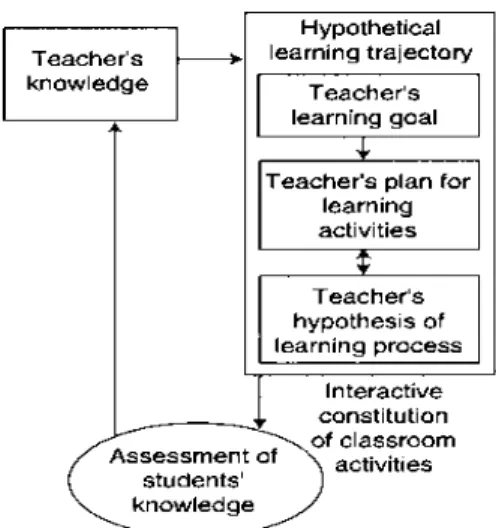
Simon (1995) suggests that the mathematical teaching cycle (see Figure 1) can describe the teacher decision-making process whereby teacher’s knowledge of learning goals and activities or tasks, as well as their predictions about how students learn should all be a part of the lesson planning process. Using pedagogical knowledge and knowledge of how students construct knowledge of concepts, the teacher can choose learning goals that inform the plans for a lesson. This begins what Simon (1995) refers to as the hypothetical learning trajectory (HLT); that is, anchored in the chosen goals, the teacher selects learning activities or tasks based on how the teacher best believes learning will proceed. The teacher uses information about students’ current knowledge, the specific content, and pedagogical content knowledge on how students’ best learn the content in designing a lesson (Simon & Tzur, 2004). This requires the teacher to have the ability to identify classroom tasks that can lead to the intended concepts.
Once the lesson is enacted, the classroom experience modifies the teacher’s
knowledge in several ways. First, in the mathematics teaching cycle, student knowledge is continually assessed. Therefore, a completed lesson will influence a teacher’s knowledge of students’ mathematical understanding. In addition, the classroom experience adds to the teachers’ knowledge of student learning as well as the teacher’s own knowledge of mathematics. These domains of knowledge then, in turn, allow the teacher to create new learning goals and trajectories for learning. As the teacher’s knowledge is enhanced, modifications to a lesson design will take place either in the goals, the activities, or the hypothesized learning.
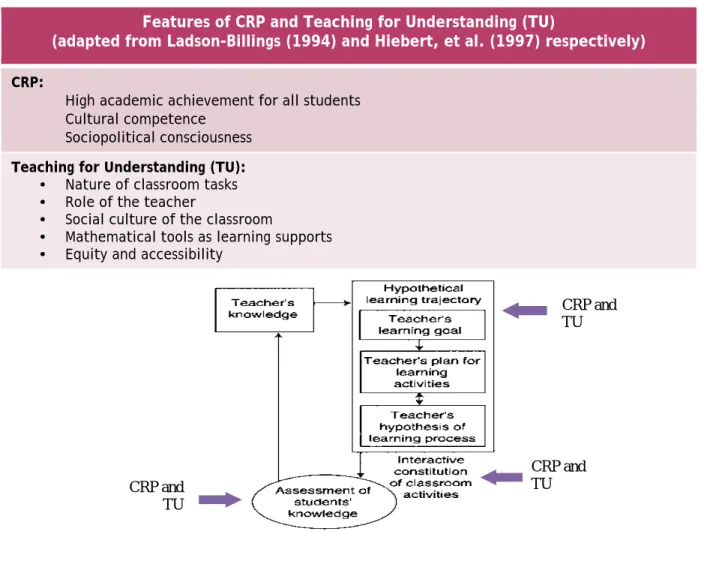
The framework design for this study utilizes the three major components of the mathematics teaching cycle: planning (drawing on teacher knowledge and the creation of a HLT), teaching (the enactment of classroom activities) and assessment (formative). In each of these components, the researcher will use tenets of CRP and dimensions of teaching for understanding as the lens through which to analyze the data (see Table 1 and Figure 2). Teachers whose beliefs are consistent with CRP and teaching for understanding will draw on these constructs during each phase of the mathematics teaching cycle. For example, during the planning phase, one might expect that a teacher would draw on students’ prior
knowledge, students’ out of school knowledge as well as the teachers’ own mathematical knowledge. During the teaching phase, one might expect to see a classroom culture where students are encouraged to choose and share their own methods for solving problems and where those methods are valued. In addition, there would be evidence of high academic success by all students and students would be communicating about mathematics in ways
that are consistent with their cultural ways of expression. During the assessment phase, one might expect to see teachers’ attend to how students are communicating and reflecting on mathematics and how student learning informs the teachers’ own knowledge. This
framework was used to drive the design of the study as well as direct the analysis of the data to answer the research questions.
Table 1: Features of CRP and Teaching for Understanding
Features of CRP and Teaching for Understanding (TU)
(adapted from Ladson-Billings (1994) and Hiebert, et al. (1997) respectively) CRP:
• High academic achievement for all students
• Cultural competence
• Sociopolitical consciousness Teaching for Understanding (TU):
• Nature of classroom tasks • Role of the teacher
• Social culture of the classroom
• Mathematical tools as learning supports • Equity and accessibility
Figure 2: Conceptual Framework
CRP and TU CRP and TU CRP and TU
Research Questions
This study investigates two kindergarten teachers’ mathematics teaching cycles and if there is evidence of CRP and teaching for understanding in any parts of each teacher’s cycles. Ladson-Billings’ (1994) tenets of CRP and Hiebert, et al.’s (1997) dimensions of classrooms that promote teaching for understanding will be used as a lens for analyzing the teachers’ mathematics teaching cycle using Simon’s (1995) model. In the context of the NMD professional development project that promoted teaching for understanding and CRP, these questions are of interest:
1) What does a kindergarten teacher attend to in each phase of the mathematics teaching cycle?
2) Is there evidence of the ideologies associated with CRP and teaching for understanding with in each phase of the teaching cycle?
CHAPTER 3 METHODOLOGY
This study is a case study of two teachers who were involved in a professional
development project in North Carolina. The purpose of this section is to describe the context for the study, the participants, the sources of data, as well as the methods of analyzing the data.
Context for the study Nurturing Mathematics Dreamkeepers
Participants in the current study are involved in the Nurturing Mathematics Dreamkeepers (NMD) project, a local professional development project for kindergarten through second grade elementary school teachers. Funded by the National Science
Foundation, the NMD project spans five years and involves over 50 teachers. Motivated by the nation’s achievement gap between White American students and African American students as well as the No Child Left Behind legislation, the project’s goals are to study how early elementary teachers develop culturally relevant pedagogy that promotes conceptual understanding of early number concepts in their classrooms. Three cohorts of teachers from six local elementary schools were chosen to participate in the project. Schools were selected based in part on their Adequate Yearly Progress and the fact that their student populations were at least 30% African American and 30% White American.
Each cohort of teachers attended professional development retreats for varying lengths of time (cohort I for three years, cohort II for two years, and cohort III for one year). Each retreat lasted either one or two days and took place throughout the school year with two
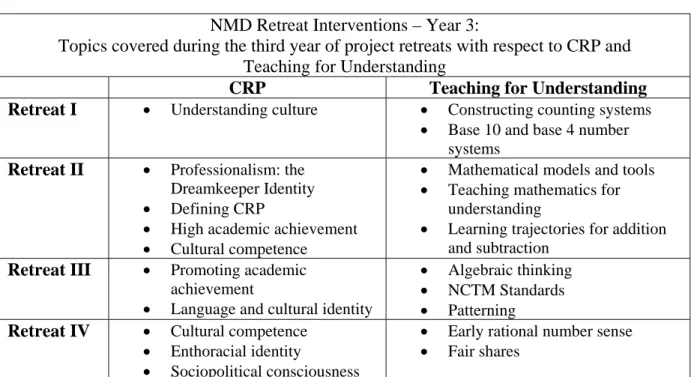
retreats held in the fall and two in the spring. During the retreats, teachers took part in various mathematical tasks aimed at improving not only their content knowledge and own mathematical understanding, but also their pedagogical content knowledge. In addition, teachers participated in a variety of activities where they were asked to engage in critical reflection on issues related to culture in the teaching-learning process. The overall themes for each retreat that the participants took part in appear in Table 2. For data collection purposes, teachers were organized in groups called “buddy pairs” where teachers from the same school and often the same grade, observed each others’ math lessons. Additionally, buddy pairs participated in a video-taped post-lesson “reflective session” where they were asked to reflect on their math lessons with respect to culture as well as the ways in which their mathematics instruction might have promoted or hindered their students’ understanding.
Table 2: NMD Retreat Interventions
NMD Retreat Interventions – Year 3:
Topics covered during the third year of project retreats with respect to CRP and Teaching for Understanding
CRP Teaching for Understanding
Retreat I • Understanding culture • Constructing counting systems
• Base 10 and base 4 number systems
Retreat II • Professionalism: the
Dreamkeeper Identity • Defining CRP
• High academic achievement • Cultural competence
• Mathematical models and tools • Teaching mathematics for
understanding
• Learning trajectories for addition and subtraction
Retreat III • Promoting academic
achievement
• Language and cultural identity
• Algebraic thinking • NCTM Standards • Patterning
Retreat IV • Cultural competence
• Enthoracial identity
• Sociopolitical consciousness
• Early rational number sense • Fair shares
Participants
This thesis is a study of two kindergarten teachers who were participants in the third cohort of teachers. As a research assistant for the professional development project, this researcher was assigned to eight teachers for data collection purposes. Two of these teachers were asked to participate in the current research on lesson planning and each was given a pseudonym. Sarah is a white female in her twenty-ninth year of teaching kindergarten and pre-kindergarten. Pamela is a white female who has spent both of her two years of
experience teaching kindergarten. Sarah and Pamela worked together as a buddy pair during the 2007-2008 school year. Both teachers hold undergraduate degrees in elementary
education and have not received any specific training in mathematics instruction other than the curriculum training that is required by the county in which they teach. The school where they teach is a magnet school with a Center for Spanish Language where students receive Spanish instruction daily and the core curriculum is emphasized and broadened in the second language.
Since the teachers in this study taught in the state of North Carolina, they were provided with a Standard Course of Study (NC DPI, 2003) that guided the curriculum they taught. The objectives for kindergarten were divided among four quarters where each quarter lasted approximately nine weeks. The teachers were supplied with math cards that list the objectives that should be covered each quarter. In addition, the county where they teach adopted the Math Trailblazers curriculum based on the notion that this program is aligned with the North Carolina Standard Course of Study and provides students with both problem solving and computational practice.
Sources of Data
For this study, four sources of data were collected: a lesson planning interview, an observation of a lesson planning session, video-recordings of two consecutive math lessons, and a post-lesson reflective session. Each source of data will be described and data protocol can be referenced in the appendix.
The lesson planning interviews (see Appendix A for the interview protocol) as well as the lesson planning observation were audio recorded and transcribed. The lesson planning interview questions asked the teachers to describe and discuss what they attend to when planning their mathematics lessons. Questions were specific to content, types of activities, resources, assessment (both formative and summative), and student knowledge. The teachers were also asked if they planned alone or in collaboration with other teachers and how far in advance they planned (i.e. daily, weekly, monthly, etc). During the lesson planning
observation, the researcher was able to observe the teachers’ planning and then immediately ask questions regarding motivation and clarification of planning decisions. The researcher was then able to video tape the math lessons that were planned during the lesson planning observation.
The math lessons and post-lesson reflective session were video recorded. The math lessons were described in five minute increments and portions were transcribed. The post-lesson reflective session was transcribed verbatim. The videotaped math post-lessons took place in the teachers’ classrooms during their regularly scheduled math times for two consecutive days. On the first day, Sarah’s math lesson was recorded first while Pamela observed, and then Pamela’s math lesson was recorded while Sarah observed. On the second day, Pamela’s
math lesson was recorded while Sarah observed and then Sarah’s math lesson was recorded while Pamela observed. The reflective session (see Appendix B for reflective session protocol, which is a modification of the questions used in the larger NMD study) took place four days after the second videotaped lesson. In the reflective session, the teachers discussed how their lessons supported or hindered their students’ conceptual understanding of the mathematics and were asked questions regarding their students’ out-of-school and in-school knowledge as well as if their enacted lessons followed the lessons they had planned.
Analysis of Data
The data was analyzed to describe what the teachers attended to in their lesson planning and what parts, if any, of their lesson planning and enacted lessons were consistent with culturally relevant pedagogy and teaching for understanding. In addition, the enacted lessons were compared to the lesson planning observation to determine if the lessons were consistent with what was planned. The four sources data were analyzed in three separate phases. The phases are described below.
Phase 1: Teacher planning
First, the three transcribed sources of data (interviews, observation, and reflective session) were organized with respect to Simon’s (1995) Mathematics Teaching Cycle and each piece of data was coded for instances of teacher knowledge, HLT, and assessment. Any parts of the data relating to teacher knowledge were then combined into one document. Similarly, new documents were created for parts of the data pertaining to HLT and assessment. The researcher then analyzed and coded each new document for what each
teacher focused on in their lesson planning such as objectives, content, activities, materials, etc.
Phase 2: Teaching for Understanding and CRP
During the second phase, each new document was analyzed for teaching for
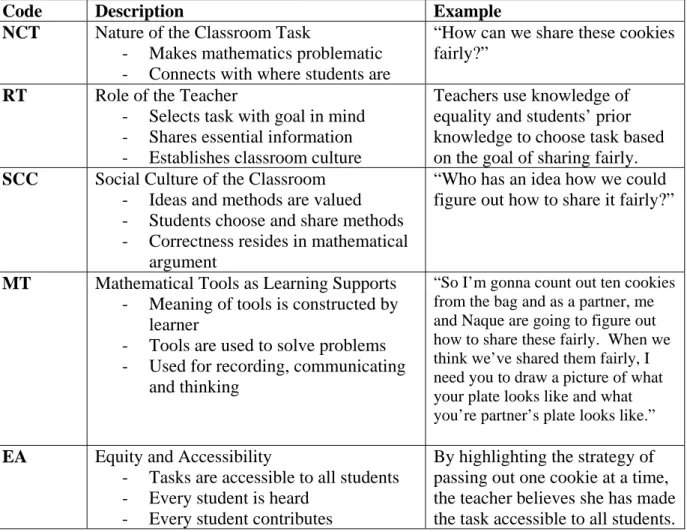
understanding and CRP. First, the documents for teacher knowledge, HLT and assessment were coded for evidence of teaching for understanding. Table 2 describes the codes used with respect to Hiebert et al.’s dimensions of teaching for understanding.
Table 3: Codes for Teaching for Understanding (adapted from Heibert, et al., 1997)
Code Description Example
NCT Nature of the Classroom Task
- Makes mathematics problematic - Connects with where students are
“How can we share these cookies fairly?”
RT Role of the Teacher
- Selects task with goal in mind - Shares essential information - Establishes classroom culture
Teachers use knowledge of equality and students’ prior knowledge to choose task based on the goal of sharing fairly.
SCC Social Culture of the Classroom - Ideas and methods are valued - Students choose and share methods - Correctness resides in mathematical
argument
“Who has an idea how we could figure out how to share it fairly?”
MT Mathematical Tools as Learning Supports - Meaning of tools is constructed by
learner
- Tools are used to solve problems - Used for recording, communicating
and thinking
“So I’m gonna count out ten cookies from the bag and as a partner, me and Naque are going to figure out how to share these fairly. When we think we’ve shared them fairly, I need you to draw a picture of what your plate looks like and what you’re partner’s plate looks like.” EA Equity and Accessibility
- Tasks are accessible to all students - Every student is heard
- Every student contributes
By highlighting the strategy of passing out one cookie at a time, the teacher believes she has made the task accessible to all students.
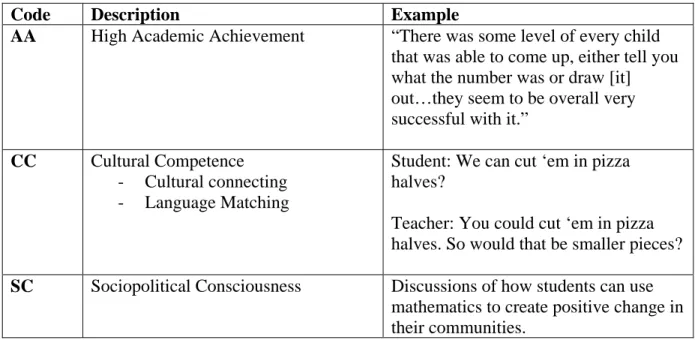
In order to analyze the data for evidence of CRP, the researcher initially coded with respect to the three tenets of CRP: high academic achievement, cultural competence, and sociopolitical consciousness. Once the data were coded, the initial codes did little to answer the research questions. More specific codes were created as sub-codes of the three tenets of CRP. Table 3 provides a description of these codes. The sub-codes were adapted from a rubric developed to code NMD project data by the principle investigators of the project, Dr Patricia Marshall, Dr. Jessica DeCuir-Gunby, and Dr. Allison McCulloch. These particular codes were chosen because they helped to identify aspects of CRP that where otherwise not visible in the lessons. Since CRP is an ideology, it may not be readily observable in a kindergarten classroom.
Table 4: Codes for Culturally Relevant Pedagogy (CRP)
Code Description Example
AA High Academic Achievement “There was some level of every child that was able to come up, either tell you what the number was or draw [it] out…they seem to be overall very successful with it.”
CC Cultural Competence - Cultural connecting - Language Matching
Student: We can cut ‘em in pizza halves?
Teacher: You could cut ‘em in pizza halves. So would that be smaller pieces?
SC Sociopolitical Consciousness Discussions of how students can use mathematics to create positive change in their communities.
Phase 3: Video-taped Lessons
In addition to the documents, the video-taped lessons were also coded for teaching for understanding and CRP. According to Powell, Francisco, and Maher (2003), one method for video analysis involves seven, nonlinear, interactive phases. The phases are as follows: viewing the video attentively, describing the video data, identifying critical events,
transcribing, coding, constructing a storyline, and composing a narrative. This model was adapted by the researcher to analyze the video-taped lessons for the current study.
First, the four video-taped lessons were transferred to DVD. The lessons were viewed several times and then they were described in five minute increments. The lessons were viewed again and critical events were identified and transcribed. Then, the lessons were coded for evidence of teaching for understanding and CRP. The transcriptions included dialogue by the teacher and students as well as a description of any actions that were visible on the video recording. Lastly, the video-taped lessons were compared to the lesson planning observation to determine if the enacted lessons were consistent with what was planned.