Tampereen teknillinen yliopisto. Julkaisu 1237 Tampere University of Technology. Publication 1237
Juha-Matti Vanhatupa
Tool Support for Computer Role-Playing Game
Programming: Foundations, Guidelines and Applications
Thesis for the degree of Doctor of Science in Technology to be presented with duepermission for public examination and criticism in Tietotalo Building, Auditorium TB222, at Tampere University of Technology, on the 17th of October 2014, at 12 noon.
ISBN 978-952-15-3341-9 (printed) ISBN 978-952-15-3393-8 (PDF) ISSN 1459-2045
Abstract
Computer role-playing games (CRPGs) are a genre of computer games, which aim at providing similar player experience than their ancestors, paper-and-pen role-playing games. For a type of digital games, their evolution is already rather long, as the first ones were created in 1980s. Typically CRPGs em-phasize character development and to support this huge fantasy worlds and sophisticated storylines are also present. CRPG development has unique challenges, which derive from these typical features. Content creation is a continuous issue, since huge virtual worlds and long storylines must be filled with content. Personalization is also an important issue, because all fun of creating personalized character is lost if it has no effect into the game.
Low starting threshold is important for successful game. It is becoming essential that the player can start playing quickly and she is not required to spent time waiting the installation to be completed. This can be achieved by web-based approach, since web-based games do not require installations. There are also other benefits, such as instant distribution, platform inde-pendence, and instant upgrades. As it is likely that in the future CRPGs are web-based, software tools for developing browser-based games are even more important in the future. However regardless of the platform the unique challenges of CRPG development remain the same.
This dissertation addresses these unique challenges and simplifies CRPG development with software tool support. The software tools presented in this dissertation begin with construction of a novel game engine called CAGE. We used this game engine in the game programming course of Department of Software Systems in Tampere University of Technology as a software plat-form, and students developed their games using it. Several content generators
were created during the research to tackle this challenge. Using those, con-tent, objects, non-player characters, and even quests can be generated into a game world. The last phase of the research targeted browser-based envi-ronment, and this dissertation includes surveys of browser-based games and technologies. In this part, we define attributes of a game engine for browser-based games. Finally, we present a prototype browser-browser-based CRPG using content generation.
Preface
This thesis has truly been a quest, a journey across a symbolic, fantastic landscape, an opportunity to overcome challenges and achieve a meaningful goal. Luckily I didn’t had to go through it alone and I would like to thank the following people.
First of all, I would like to thank my supervisor Professor Tommi Mikkonen for making this thesis possible in the first place. I thank the pre-examiners of this thesis, Associate professor Julian Togelius and Professor Ian Parberry. I also thank my opponents Senior Lecturer Ian Kenny and Professor Markku Turunen. I like to thank my co-authors Teemu J. Heinim¨aki and Janne Lau-tam¨aki for their excellent work. In addition, I like to thank Professors Kari Syst¨a and Mikko Tiusanen for proofreading and valuable feedback.
I would like to express my gratitude to my wife Laura, and our army of cats. In addition, I like to thank family and friends for their support.
The work has been funded by Graduate School on Software and Systems Engineering (SoSE), Ulla Tuominen Foundation, the Nokia Foundation, The Finnish Foundation for Technology Promotion and Science Foundation of the City of Tampere.
Now at the bottom level of the Dungeon I am ready to encounter the final opponents.
Juha-Matti Vanhatupa Tampere, August 18, 2014
Contents
Abstract iii
Preface v
Contents v
List of Included Publications xi
1 Introduction 1
1.1 Motivation . . . 2
1.2 Deriving Research Questions . . . 4
1.3 Research Methodology . . . 6
1.4 Contribution . . . 7
1.5 Structure of the Thesis . . . 7
2 Computer Role-Playing Games 9 2.1 Paper-and-Pen Role-Playing Games . . . 9
2.2 Other Game Types Close to PnP RPGs . . . 11
2.3 Origins of Computer Role-Playing Games . . . 14
2.4 Elements and Nature of CRPG . . . 15
2.5 Storyline and Quests . . . 17
2.6 Game Development Teams . . . 19
2.7 Game Components . . . 21
2.8 Special Characteristics of Computer Role-Playing Games . . . 22
2.8.1 Content Creation Problem . . . 22
3 Software Tools in Game Development 25
3.1 Game Engines . . . 26
3.2 Scripts . . . 29
3.3 Related Work: Game Engines . . . 30
3.4 Software Engineering and CRPGs . . . 32
3.5 Game Design and Tool Support . . . 33
3.6 Content Generation Tools . . . 34
3.7 Related Work: Other Software Tools Specific for Computer Role-Playing Games . . . 38
4 Run-Time Environment 39 4.1 Multiplayer Internet Games . . . 40
4.2 Development Technologies of Browser-Based Games . . . 44
4.3 Game Engines for Browser-Based Games . . . 46
5 Introduction to Included Publications 49 5.1 Publication I: Scriptable Artificial Game Engine for Game Programming Courses . . . 49
5.1.1 The CAGE Game Engine . . . 49
5.1.2 Game Programming Course . . . 51
5.2 Publication II: Guidelines for Personalizing the Player Expe-rience in CRPGs . . . 54
5.3 Publication III: Generative Approach for Extending CRPGs at Run-Time . . . 55
5.4 Publication IV: Personalized Side-Quest Generation for CRPGs 56 5.5 Publication V: Browser Games for Online Communities . . . . 56
5.6 Publication VI: On the Development of Browser Games – Cur-rent Technologies and the Future . . . 57
5.7 Publication VII: Content Generation in a Collaborative Browser-Based Game Environment . . . 58
6 Conclusions 61 6.1 Summary . . . 61
6.2 Research Questions Revisited . . . 62 6.3 Future Work . . . 64
List of Included Publications
[I] J-M. Vanhatupa and T. J. Heinim¨aki. Scriptable Artificial Game Engine for Game Programming Courses. In Proceedings of 4th Informatics Education Europe (IEE IV), pages 27–32. University of Freiburg, November 2009.
[II] J-M. Vanhatupa. Guidelines for Personalizing the Player Experience in Computer Role-Playing Games. InProceedings of 6th International Conference on the Foun-dations of Digital Games (FDG’11), pages 46–52. ACM, June/July 2011.
[III] J-M. Vanhatupa. Generative Approach for Extending Computer Role-Playing Games at Run-Time. InProceedings of 11th Symposium on Programming Languages and Software Tools and 7th Nordic Workshop on Model Driven Software Engineering (SPLST’09), pages 177–188. Department of Software Systems, Tampere University of Technology, August 2009.
[IV] J-M. Vanhatupa. Personalized Side-Quest Generation for Computer Role-Playing Games. InProceedings of 12th Symposium on Programming Languages and Soft-ware Tools (SPLST’11), pages 196–206. Institute of Cybernetics at Tallinn Univer-sity of Technology, October 2011.
[V] J-M. Vanhatupa. Browser Games for Online Communities. In International Journal of Wireless & Mobile Networks (IJWMN), vol. 2, no. 3, 2010, pages 39–47. August 2010.
[VI] J-M. Vanhatupa. On the Development of Browser Games – Current Technologies and the Future. In International Journal of Computer Information Systems and Industrial Management Applications (IJCISIM), vol. 5. 2012, pages 60–68. June 2012.
[VII] J-M. Vanhatupa and J. Lautam¨aki. Content Generation in a Collaborative Browser-Based Game Environment. InHandbook of Digital Games, pages 92–110. Wiley-IEEE Press, May 2014.
The permissions of the copyright holders of the original publications to reprint them in this thesis are hereby acknowledged.
Chapter 1
Introduction
The history of computer games begins with early games like OXO (1952) and Spacewar! (1962). During their evolution, computer games have evolved from these simple games to rich and complex creations. As games have be-come more complex, the amount of required software has constantly grown. Similarly, the sizes of developer teams have grown constantly in computer game projects. A typical time span of development from an idea to a com-pleted product is about two years and requires work contribution of 20–50 persons [67].
Already in early days of computer game development, software tools were developed to assist in the creation of computer games. Nowadays, different kinds of software tools, such as game engines, modelling tools, and code generators, are an essential part of game development. Tools created for developing a particular game can also be reused when making other similar games.
This thesis focuses on computer role-playing game (CRPG) genre. Games of this genre have unique software development challenges, which derive from huge game worlds and sophisticated storylines. Therefore, software tools are especially important in the development of computer role-playing games (CRPGs). In addition, the border between CRPGs and strategy games can be a shallow one, and term strategic role-playing game is also used for games not clearly belonging to only one of the groups, and many strategy games
contain role-playing elements. For example, it is common that individual heroes in player armies can gain experience.
The background part of this thesis presents the history and origins of the CRPG genre. CRPGs derive from their ancestors paper-and-pen role-playing games (PnP RPGs); and aim at providing similar personalized player experiences as those. Emulating the personalized player experience of PnP RPGs is a unique challenge of the genre, since in PnP RPGs human game master controlling the game can easily create personalized adventures and also apply game rules as needed to support a fluent game flow. However, for a computer program this is a much harder task, as the program requires explicit instructions. CRPG have also similarities to modern board games, miniature war games, and collectible card games. Many themes, characters, and rules used in CRPGs are familiar to the players of those games.
Early CRPGs were often developed by a single programmer and equipped with ASCII graphics. Although these games were competing with games like Pac-Man and Space Invaders, an early CRPG Rogue, for example, was very popular at 1980s, and in a university a network-wide analysis of system usage revealed that Rogue was consuming more CPU cycles than anything else [73]. Through their over three decades long history CRPGs have retained their popularity and gathered enthusiastic players. They have evolved into huge software projects. The use of sophisticated computer graphics and advanced artificial intelligence (AI) is also common in modern CRPGs.
1.1
Motivation
Throughout their history CRPGs have gathered enthusiastic players. The best CRPGs require a diverse set of skills, such as tactics, long-term planning, problem solving, teamwork, and resource management [7].
The soul of any role-playing games (RPGs) is a personalized player char-acter. Depending on the platform of RPGs PnP RPGs, CRPGs, or live action role-playing games (LARPs), the character is created and controlled differently [82], but all together one of the main ideas of the game is to ex-perience adventures in a fantasy game world by controlling this imaginary
character. Many RPGs are collaborative games and players work together to accomplish their goals. Although in a single player CRPG other characters are controlled by the game, it still creates an illusion of collaborative game through computer controlled non-player characters (NPCs).
CRPGs can offer the player experience of PnP RPGs for players that do not have suitable friends to form a play group or who do not have regular hours to spend on playing. Organizing a traditional role-playing session can be very difficult for working adults, since those last for hours and everybody in the group should be able to participate at the same time. Multiplayer CRPGs played on the Web help players find player groups ignoring physical locations, and many support building ad hoc player groups or solo playing. Some people are also interested in game worlds and fantasy present in role-playing games, but lack interest in the social side of the games. Therefore playing a single player CRPG can be the best option for them. CRPGs also allow the player to concentrate on management of the player character as much as he or she wants, even though in PnP RPGs that would annoy other players and disrupt the game flow.
Similarly to their precursors PnP RPGs, CRPGs contain huge fantasy worlds inhabited by hundreds of non-player character. In addition, long, sophisticated storylines are typical for both game types. However, in CRPGs these fantasy worlds are presented as a game artefact, a virtual world, instead only imagining them.
Building the fantasy worlds and sophisticated storylines present in CRPGs is an enormous task for game developers. In addition, software sizes of CRPGs have grown since the birth of the genre and this development contin-ues. While the first CRPGs were text-based games programmed by a single programmer, modern CRPGs contain of rich game world presented with com-puter graphics and video, and also over forty hours of game time [13].
Software tools are the main weapon in the battle against the enormous burden of software developers. Tools can either save time in producing game code, enabled by different kinds of code generators, or by using tools reuse of existing code can be achieved, as by using game engines.
to build computer games, are currently the most important tools in game development. Modern computer games are very rarely created from scratch, but a game engine is used as a basis instead. Parts of previous games de-veloped by the same company can also be used, especially if the games are created using the same game engine. Reuse can also be achieved if the used tools output a general format, for example XML [23], and resources created using these are used in several games.
In the field of software engineering, programming languages, tools, and methods used to develop software are always changing. Currently, we are experiencing a paradigm shift towards web-based software [71] where appli-cations live on the Web. They are accessed using browser and their resources can be located anywhere in the world. They do not need any installation, or manual upgrades. In addition, the model also allows user collaboration, multiple users accessing the same resources, interacting together. It is most likely this paradigm shift will also affect computer games as well. Many of these new features are very advantageous for computer game development. For example, instant upgrades allow adding new content to the game over the network and the described user collaboration model allows building mul-tiplayer more easily.
This paradigm shift requires also creation of new kind software tools for
building computer games. For example, game engines for browser-based
games have just appeared. This ongoing development will bring interest-ing times for game programmers and game designers as well.
1.2
Deriving Research Questions
Creating a modern CRPG is a long and complex project requiring a large development team with experts of many different professions. In addition the development requires different kind of software tools. Consequently, the first research question this thesis addresses is the following:
RQ1. What kind of tool support is advantageous to support software devel-opers’ work when implementing CRPGs?
In addition, to development challenges derived from the substantial size of developed software and development project, there are unique software development challenges that are specific to the CRPG genre. CRPGs con-tain large virtual worlds with numerous NPCs, which means that a lot of application developers’ time must be spent on implementing the game world and its characters.
Also creation of personalized player experiences emulating PnP RPGs take also lot of application developers’ time. CRPGs aim at providing sim-ilar personalized player experience as PnP RPGs. The personalized player experiences are one of the most difficult properties of PnP RPGs for CRPGs to emulate. In PnP RPGs the human game master controlling the game is familiar with player characters and can apply rules as needed to create personalized player experiences. However, a computer requires explicit in-structions. This challenge of creating personalized player experiences is the concern of RQ2.
RQ2. How to simplify and support the creation of personalized player ex-periences in CRPGs?
Since the whole software industry is experiencing the paradigm shift to the Web, most likely the browser will be also the main environment of CRPGs. New kinds of tools are needed in the browser environment. Consequently the third research question is the following:
RQ3. What kind of tool support can be used to assist in the development of CRPGs for the browser-based environment that is constantly alive online?
The research questions are addressed in the included publications as fol-lows. RQ1 is addressed in Publications [I], [III] and [IV]. RQ2 is addressed in Publications [II], [IV] and [VII]. RQ3 is addressed in Publications [V], [VI] and [VII]. Table 1.1 summarizes how publications address different research questions.
Table 1.1: Publications addressing research questions. 1 2 3 4 5 6 7 RQ1 X X X RQ2 X X X RQ3 X X X
1.3
Research Methodology
This research has been carried out as a constructive research [38]. Construc-tive research tests theories and proposes solutions to a problem or question. The term construct refers to the new contribution being developed. In com-puter science these constructions can be theories, algorithms, models, soft-ware or frameworks. Commonly a solution is proposed by building prototypes with preconditions.
In the artifact building and evaluation we have carried out action design research (ADR) [46], which includes the following phases: 1) problem formu-lation, 2) building, intervention, and evaluation 3) reflection and learning, and 4) formalization of learning [46]. At first the problem to be solved is de-fined. The premises created in the first phase, provide a platform for building software artifact in the second phase. The built artifact is also evaluated in this phase. In the third phase solving the problem moves conceptually from building a solution to particular problem instance to applying that learning to a broader class of problems. The problem and solution are continuously reflected. This state is executed parallel to first two stages. The purpose of the fourth stage is to formalize the learning. When we have the solution to a particular problem, both of these are generalized, to create generalized outcomes.
In this thesis we have built software artifacts and evaluated these to de-termine if requirements for the built artifacts are fulfilled. In publications included in this thesis we present these software artifacts as solutions to problems presented in the introductory part. Instead of completely solving these problems, presented prototype tools are useful accessories which
par-tially solve the problem or assists the application developer dealing with the problem. The usefulness and benefits of tools are presented in particular publications.
1.4
Contribution
The main contributions of this thesis are:
1. The constructive design of the CAGE game engine [I], an experimental research artefact
(a) to be an easily understandable platform for students building their game projects, and
(b) its evaluation in a classroom environment.
2. Software tools to simplify and speed up development and deployment of CRPGs.
3. A model how these tools should be used.
Tools presented in this thesis began from a single player game engine and advanced to describing a prototype game engine for browser-based games. In the last publication [VII] of this thesis, a prototype browser-based multiplayer game using content generation is presented. The examples of game design and content generation chapters can be applied to computer games built on both binary and browser-based platforms.
One of the main principles of this thesis is to give practical support and new ideas for game developers. Ideas of developed tool support presented in the publications should be usable by reading those publications. Game programmers using different platforms can benefit from this thesis.
1.5
Structure of the Thesis
The introductory part of this thesis is organized as follows. Chapter 2
CRPGs, such as PnP RPGs and LARPs, presents origins of CRPGs, and in-troduces fundamental elements of CRPGs and development process of them. Chapter 3 discusses software tools used in game development. Chapter 4 deals with run-time environments of CRPGs. Chapter 5 is an introduction to the included publications. Chapter 6 presents conclusions, and revisits presented research questions.
Chapter 2
Computer Role-Playing Games
This chapter discusses the CRPG genre and presents special challenges re-lating to the development of CRPGs. These special challenges derive from the unique nature of CRPGs. These include the burden of content creation and the problem of personalizing game content.CRPGs are computer games that aim at offering similar gaming experi-ence as their precursors, PnP RPGs. First CRPGs were developed at late 1970s, and thus the genre has already had a long evolution for a type of digital games, [7]. Important elements of a CRPG include storyline, virtual world inhabited by characters, and the fact that the results of character actions are resolved using game mechanics (rules).
2.1
Paper-and-Pen Role-Playing Games
Paper-and-pen role-playing games evolved from war games during 1970s. When in war games players controlled entire armies represented by figures or other markers, in PnP RPGs each player controls a single character. All times best-known PnP RPG Dungeons & Dragons (D&D) was originally published in 1974 [81]. D&D is a heroic fantasy game, where players are heroes seeking adventures in a medieval fantasy world that contains mon-sters and magic. The game introduced many important factors, such as attribute scores: strength, intelligence, wisdom, dexterity, constitution, and
charisma, which are used in several contemporary games, four decades later. Today D&D is still very popular, and new versions of the game are published. Another famous early product was a science fiction PnP RPG Traveller [79] published in 1977. New versions of Traveller are still published. Today there are hundreds of PnP RPGs, and new ones are published each year.
There are PnP RPGs from almost all the themes that can be imagined. Two particular themes have been especially popular, fantasy and science fiction. Many fantasy themes feature similar settings as in Tolkien’s books. In science fiction, different space opera themes, the contrary of hard science fiction, have been popular.
Terms paper-and-pen role-playing games or tabletop role-playing games are normally used to distinguish these actual role-playing games from other forms of RPGs, such as CRPGs and LARPs. In fact, neither a pen, paper, nor table are mandatory for playing a role-playing game. PnP RPG is played by a group, normally from two to six players. Each player except the game master controls his own character.
The player character is an avatar of the player in the imaginary world of the game. The player character is a main aspect of RPGs. Depending on the game its creation can be done very quickly or it can be an even hours long, complex process, including writing a background story for the character. The character creation process is done jointly by the player and the game master, and usually this does not happen during a regular game session but before it. The player has usually only partial control over what kind of character he or she can create, as part of the details are defined in the game mechanics and part by the game master. It is a duty of the game master to ensure that the characters are a suitable for the game campaign and also that the player group has suitable combination of characters from different professions. The character creation process usually involves throwing dice to give values to attributes and other factors, and also selection careers and skills. In Classic Traveller PnP RPG the player character could even die during the character creation process.
A core characteristic of PnP RPG is the freedom to choose the actions and attitudes of the characters, which they control. This freedom of actions
is also difficult to emulate in CRPGs. Although freedom of movement in game places is easy to implement, things get complicated for implementing this freedom for example in dialogues, since usually conversations must be pre-scripted.
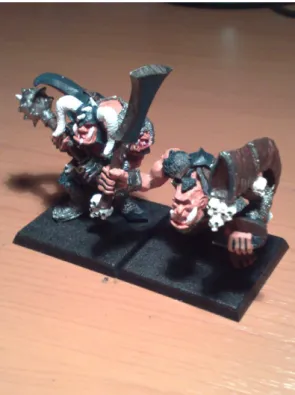
Instead of an individual character, the game master controls the game. He or she acts as a narrator and presents the scenario to the players. The game master interprets game rules and can also disregard some rules if those do not support a fluent game flow. The game master has wide range of re-sponsibilities, and he or she is also the supporting force behind the game group [26]. The game system in PnP RPGs is only as good as the ability of the game master to understand and present it to the players. The results of the character actions are resolved using game mechanics, different kinds of dice are commonly used in the process. In addition, miniature figures are sometimes used to present characters and monsters. Those can especially useful in representing combat situations. Figure 2.1 presents miniature fig-ures from war game Warhammer Fantasy Battle [91].
Although normally a computer takes care of the responsibilities of the game masters in CRPGs, a human game master can be used in some CRPGs. Game masters have different kinds of responsibilities depending on game media (PnP RPGs, CRPGs, LARPs) [83]. However, the lack of proper tools limits the use of human game masters in CRPGs. They are, for example, limited to pre-created content and cannot create adventures dynamically at run-time, although dynamic game-time content creation is one of the main functionalities of PnP RPGs game master.
2.2
Other Game Types Close to PnP RPGs
LARPs are another form of RPGs. In a LARP the players dress and act as their characters. LARPs require larger player groups, the size of which can vary from a handful to hundreds. LARPs can happen in public or private areas. Although there are usually no spectators present, for example in games with agent theme, the presence of real people and public places are a common
Figure 2.1: Miniature figures
aspect. There can be limitations; for instance the players can be required to avoid combat in public. A single LARP can last for hours or days.
In LARPs the game master cannot control all events as many are hap-pening simultaneously, and the role of the game master is more focused on organizing the event. The game masters can also play some character at the same time. The game mechanics of LARPs determine how the players can affect the game world, for example, how the combats are resolved. This can include battling with foam weapons, pausing the game play for dice rolling, comparing the character attributes, or determining the winner of the battle in some other method.
Collectible card games are also games that relate to the history of RPGs. These games are played using special decks of cards that the players build before the game, according to precise rules. The deck building process, design and gathering the cards, by trading them with other players or buying them, is a considerable part of the game. Magic: The Gathering [78] is one of the
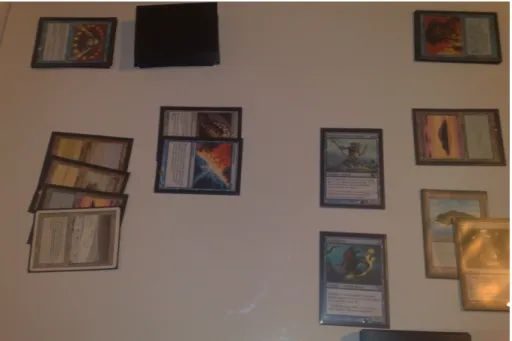
first collectible card games. It was introduced in 1993, and it had over twelve million players 2011 [44]. Notable Magic cards can be worth of hundreds of dollars. Although these games are not RPGs, there are many common elements, for example, fantasy themes and characters. Figure 2.2 presents Magic: The Gathering game in action.
Figure 2.2: Magic: The Gathering game
Many board games also feature fantasy themes, and in those player control individual characters similarly to PnP RPGs. However, a game master is rarely used in board games, although in some board games one of the players controls the enemies or opponents of the players. Examples of such board games are Doom: The Boardgame [20] and Space Hulk [68]. In addition, character creation is rarely present at all. Instead, all players have the same attributes or the characters are premade and chosen or distributed randomly to the players. Some board games also include scheming and betrayal of other players. For example, in Shadows over Camelot [65] the players control knights in medieval England and work together to protect Camelot. However, one or more of the players are traitors who are secretly playing against the group.
2.3
Origins of Computer Role-Playing Games
First CRPGs were developed late 1970s. Although the influence of PnP RPGs and war games are vital, Barton lists also other sources that have contributed to the birth of CRPGs: sport simulation games, writings of J.R.R. Tolkien and Colossal Cave Adventure, the first true computer adven-ture game [7]. Early simulation games that were popular 1960s and 1970s used combinations of cards and dice to simulate sports. Those games had many common elements with PnP RPGs, including attributes and statistics of the player. Books of J.R.R Tolkien, published in 1950s, became widely available to mass market in 1960s, were more detailed and complex than earlier fantasy novels. The popularity of Tolkien’s books created room for both PnP RPGs and CRPGs. Colossal Cave Adventure by Will Crowther was the first adventure game [7]. The game consisted entirely of text and was played by typing textual commands. Although Colossal Cave Adventure was not CRPG, it included several features that later became important for CRPGs, such as exploring a virtual world, magic, and monsters. Later, multi-user dungeons (MUDs) offered the players a chance to explore virtual worlds together [7].
One of the most famous mainframe CRPGs, Rogue was implemented in early 1980s. The graphics consisted entirely of text, using the alphabet and different symbols to mark different items and monsters. Perhaps the most important feature of Rogue was that the game used randomized dungeons: the game world is different each time the player starts the game. This intro-duces replayability value that modern CRPGs players only dream of. Based on Rogue, hundreds of roguelike CRPGs have been created. Nethack, a later version of Rogue published in 1987 is still being developed, although new versions are published at a slow pace.
Different tools were developed to support legendary CRPGs. When the first multiplayer dungeon crawl arcade game Gauntlet was developed, the System I of Atari needed to be modified to support four-level circuit boards. The original extension board of Gauntlet threatened to be 28 x 20 inches, which could not be fitted inside a video arcade machine. At the time Gauntlet
was published in 1985, current software engineering electronics could not draw boards of that size, since regular extension board size was 18 x 18 inches [32].
Late eighties, 1987, a real-time game Dungeon Master was published. It was the time when turn-based game flow was almost a standard in CRPGs. It remains the most successful game released on Atari ST platform. Dungeon Master success can be explained by the storyline, which was made by a pro-fessional novelist Nancy Holder. She based it on the base scenario suggested by game designers. In addition the game featured a 3D interface combined with real-time game play [7].
Although the beginning of the nineties was a difficult time for the CRPG genre, many classic first person view dungeon exploration CRPGs were pub-lished. For example, Eye of the Beholder trilogy (Eye of the Beholder, Eye of the Beholder II: The Legend of Darkmoon, and Eye of the Beholder III: Assault on Myth Drannor) has been popular [7].
At late nineties, one of the most famous titles of CRPGs, Baldur’s Gate, was published by BioWare. It used Advanced Dungeons & Dragons’ 2nd edition rules, and it was a successful transformation of a classic PnP RPG into a sophisticated CRPG. It was also a quality CRPG published at time when the whole CRPG genre was in ebbing spirits. Baldur’s Gate featured especially long game play, over 100 hours. Baldur’s Gate was followed by Baldur’s Gate II and also extensions packages for both games were released. Baldur’s Gate was also a notable release when considering software tools, since it used the Infinity engine, later used by eight other CRPGs. Moreover a first person shooter (FPS) Quake had used a game engine few years earlier.
2.4
Elements and Nature of CRPG
Important elements of a CRPG include a storyline, a virtual world inhabited by characters, and the fact that results of character actions are resolved using game mechanics (rules) [II]. In most modern CRPGs the player controls a single character. However, he can hire or otherwise collect other members to the party.
CRPGs emphasize character development, which is often referred to as the main characteristic of CRPGs. When the player advances in the game storyline, the player character becomes more experienced, gains more abili-ties or skills, and possesses better items. Experience points are a common method to model character development; each time the player character wins an enemy or succeeds in performing some other meaningful task, he gains ex-perience points. When enough points are gathered, a new level is gained. With each new level the character gains new abilities, skills or other bene-fits. Some CRPG also include skill trees, where the skills are bought. Often, all possible skills cannot be picked, and the player must choose on what to specialize.
CRPG genre definition is somewhat overlapping with strategy games, and these two genres have many similarities in themes and other characteristics. Many strategy games also use experience points and experience levels. In those, individual units can gather experience and therefore become more efficient by gaining levels. In addition, many CRPGs are party-based: the player controls several characters and the player can hire or remove new members. Therefore, these games totally lack the main character whom the player should identify himself with.
CRPGs are a difficult genre for game developers, since the genre has huge player expectations. In a regular first-person shooter game, the player does not expect to be able to talk to the enemies [62]. Usually he does not even expect to be able to buy items in a game. However, from a CRPG the player expects an epic story that happens in a live fantasy world. He wants to have an effect to the story instead of just walking through it also. Talking to NPCs and buying items from shops have been basic features of CRPGs since 1980s! The game worlds of CRPGs are huge, and inhabited by different NPCs. Therefore, implementing realistic and believable characters is a demanding task for application developers. CRPGs do not always succeed fully in cre-ating believable characters [40]. Believable behaviour of NPCs is also an important aspect of personalization of the game, since NPCs should treat the player character in an appropriate manner. These personalization as-pects are discussed in Publication [II].
The desire to mimic PnP RPGs can be spotted from several factors in CRPGs. For example, damage inflicted by different weapons or spells are commonly described by the sums of different dice, like D4, D6, D8 or 2D6 (1-4,1-6,1-8 and 2-12), although the possible physical shapes of dices do not limit the numbers that could actually be used in CRPGs. Also the fantasy settings of CRPGs are usually very typical for the genre, with the same races (e.g., humans, orcs and elves) and professions (e.g., warriors, wizards and knights) as in RPGs, because the players are already familiar with those.
2.5
Storyline and Quests
The storyline of CRPG contains quests. Quests are individual tasks for
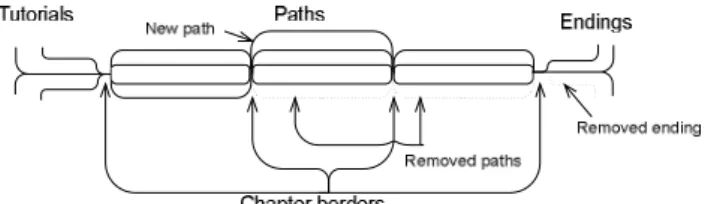
the player character to solve. By completing quests the player character can advance in the game storyline. Some of the quests are optional (side-quests) and do not relate to the game storyline. By completing side-quests the player character can gather experiment points, better equipment, or meet new NPCs. Completing some of these side-quests can even hinder advancing in the game storyline, although the reward from completing those can be so valuable that the player character decides to complete them anyway. Side-quests can also offer important information regarding the game world, and therefore they can be used to support the storyline of the game [27]. For example in Dungeon Siege the main theme of the game are the battles raging across the kingdom, and through quests the game designers try to show to the player how the battles affect the lives of both soldiers and commoners [27]. In addition to the quests, the storyline of CRPG includes tutorials and endings. Quests that are mandatory to solve for completing the game belong to critical paths. Originally CRPGs contained only a single critical path, but modern CRPGs can contain several. Figure 2.3 shows a CRPG storyline structure with a single critical path. Using multiple critical paths increases replayability, since part of the game is completely unplayed in the second playtime. Figure 2.4 shows a storyline structure with multiple critical paths.
Chapters Endings Tutorials
Side-quests Critical path
Figure 2.3: CRPG storyline structure with a single critical path
Chapters Endings
Tutorials
Side-quests Critical paths
Figure 2.4: CRPG storyline structure with multiple critical paths
the player character through the story [33]. In a personalized CRPG quests and even critical paths are opened and omitted based on the player character decisions and also based on his or her player character. Different attributes of the player character, such as character class, feats, or even gained special equipment, can open or omit new quests.
Quests can be linear missions, or include complex puzzle solving [1]. Since combat systems of CRPGs are robust and combat-based quests are easy to implement, CRPGs rely mostly on those [70].
Although quests are present also in PnP RPGs, they are usually not as clearly defined, since players gain different kinds of tasks to solve. In an individual game scenario, the players have goals and they also have some long-term goals. A scenario of PnP RPGs usually lasts for one or more playtimes. The long-term goals of the players can relate to the campaign or a player character can have personal motives.
There are certain PnP RPGs where quests are strictly defined. For ex-ample in Paranoia [58] the objectives for each playtime are given by a
high-ranking NPC at the beginning of the playtime, although there these quest objectives are usually secondary as the players try to kill each other without getting caught. Another difficult task in the world of Paranoia is survival, as player characters are easily killed and the game world is extremely hostile. Although there are five copies (clones) of each player character to be used when the original character dies; some editions also let the player character to purchase new copies.
2.6
Game Development Teams
Computer game development teams contain wide range of professionals of different kinds. Usually a game development team contains 20 - 50 persons with various responsibilities [67]. The core of a game development team is formed by professional game programmers, whose job is to implement the game and software tools that are used to build the game. In addition to game programmers, game development teams contain game designers, artists, plot writers and testers to name some common activities.
Game programmers are responsible of implementing game software and tools used to build the game. Game programmers are specialized in imple-menting a certain part of the game, like AI, user interface (UI), software tools, or gameplay (game mechanics and other features relating playing the game). Senior game programmers can also have management responsibilities, like time scheduling, in addition to code writing [25]. Some companies have also one or more technical directors, who supervise one or more projects at the high level [25].
Game designer is responsible of creating game rules and imaging the virtual world where the game takes place. He or she is already involved before the game implementation is launched by writing the presentation documents. All game designers are not programmers, and game design itself does not require programming skills, only the understanding of what can be done with the current technology and how long time and how much other resources it takes to create it.
of a game designer; however, they are not involved in the game mechanics. They write character backgrounds, dialogue, and game plot. Their work is quite similar to that of a scriptwriter of a film.
Artists are responsible of creating the visual image of the game. The artist team is usually led by an art director whose responsibility is to maintain the overall vision and ensure it is followed by the artist team. A job of an individual artist can be 2D or 3D oriented. A 2D oriented artist creates sprites, textures, concept art, background images, or user interface elements. A 3D oriented artist can create 3D models, 3D environment, animations, cut scenes (video episodes inside the game) or take care lightning of the game world. A 3D artist creating 3D models used in the game can also be called modeller. A part of 3D oriented art work, for example, creating the cut scenes, can also be subcontracted.
Level designer creates game levels using specific tools. Since these sophis-ticated tools are used in level design, level design does not require advanced programming skills. Level design can also include testing AI of NPCs moving in the level.
Sound engineer orcomposer is responsible for creating sound effects and positioning sounds into the game. They can also have responsibilities in managing characters’ voice acting.
Testersare an important part of any software development project. Testers verify that the end product meets the requirements. In modern CRPGs huge code base and graphical user interface (GUI) complicate testing pro-cess. In addition, use of content generation complicates the situation even more, since it is impossible to test all the possible combinations. However, when using content generation, comprehensive testing should be performed. Many CRPGs are also deployed to several platforms, e.g., PC and console version are developed simultaneously. Naturally this leads to more extensive the testing, since all product versions must be tested.
2.7
Game Components
As stated earlier, important elements of CRPG are the storyline, the virtual world inhabited by characters, and the game mechanics that act as the laws
of nature in the game. In addition to these, CRPGs contain also other
components.
Game world is an imaginary place where the events of the game occur [2]. In CRPGs the game world is usually shown to the player as a 3D virtual world, although some CRPGs do use 2D perspective. In a good CRPG the player can feel being a part of a living world and can also imagine that there are more areas and events than are present in the game.
NPCs of the game world are controlled by AI. CRPGs are fairly AI in-tensive, since they contain lots of NPCs. In general, CRPGs also require advanced behaviour from game characters than games of other genres. Mis-takes in game AI have more time to irritate player since they reapperar more times, because CRPGs are long games with a game time over forty hours [13]. Game mechanics are the artificial laws of nature in the game world. Com-monly combat mechanics are important in CRPGs, since the player spends a lot of time in combat or preparing for those. Game mechanics should be tested carefully, since bugs there can ruin the player experience.
UI in a CRPG is the part used for controlling the player character. It also displays information, for example health and weapon in use, to the player. Many CRPGs allow the player to configure UI of the game, e.g., by defining which commands are placed to shortcut icons. Some games take this even further: World of Warcraft [95] lets the player program the UI of the game using Lua scripts [37].
The player character is the main character of the game and one point of the game is to get the player to identify with him. In the beginning of a CRPG, the player character is usually weak and impecunious. The player has to advance in the game to build the character up and finally complete the game. Management of items, spells, and other configuratable assets of the player character is an important part of the game. Character management can be a very sophisticated task, requiring long-range planning. For example,
character classes can have different kind of skill trees (or feat trees) and advancing in some skill can prevent advancing in another one. Usually this advancement in the skill tree is performed by gaining experience, and skill levels are upgraded when enough experience is gathered to reach a new level. When character advances into a new level the player may be able to select new skills or features. Skill trees in CRPGs are very similar structures to technology trees used in strategy games [29]. In some CRPGs the player controls a whole party of characters instead of only a single main character, which increases the number of management tasks and also possible strategies in combats.
2.8
Special Characteristics of Computer
Role-Playing Games
When sizes of CRPGs have grown to their current forms, the authorial bur-den to create game content has also reached unequalled limits. Special rea-sons why CRPGs generally need more content development time than games from other genres include huge game worlds with dozens of NPCs and long, branching game storylines. Personalization of the game content is also typ-ical only for CRPGs, since the desire for a personalized gaming experience originates from PnP RPGs.
2.8.1
Content Creation Problem
Content is most of what is contained in a game: levels, maps, game rules, textures, stories, items, quests, music, weapons, vehicles, characters etc. However the game engine itself is not considered to be content. Further, non-player character behaviour – NPC AI – is not considered to be content either [76].
Personalization of CRPG increases the application developers’ work for creating CRPGs. This is understandable as even a simple branching of the storyline multiplies the needed development input by the number of branches. Modern CRPGs have often multiple endings and sometimes also separate
tu-torials for different character classes. Instead of complete branching or cre-ating different quests, intermediate forms can also be used, where some parts of the quests are modified based on the player character. These intermediate forms require less development work than branches, because part of content can be reused.
Content generation is a method for reducing the application developer work when developing CRPGs. Term procedural generation is used to refer content generation taking place algorithmically. Content generation tool or algorithm can use an initialisation file as the basis of the generation. If attributes or other data of the player character are used in the generation process, these tools can also produce personalized content.
Generally content of the game can be generated either at development time or at run-time. Both of these methods have their advantages. Content generated at development time can be evaluated by game developers and the process can be run again until the outcome is the desired one. When using run-time generation the content is generated only when it is needed in the game (it does not need to be shipped with the game), and in theory new content can be created endlessly.
2.8.2
Personalization Problem
A main reason why people play any kind of role-playing games is to have a personalized character, which the player can identify with. The creation of this character can vary from rolling the dice and writing the background story for character (PnP RPGs) to sewing character’s cloths (LARPs). In CRPGs the player has usually some control in creating his or her character, but not as much as in other formats.
The fun of having a personalized character is lost, however, if it has no effect in the game. Personalizing the player experience is a key factor to make the player feel involved in the virtual world of the game [84]. Unfortunately, the personalized player experience of PnP RPGs is one of the most difficult properties for CRPGs to emulate. Computers need explicit instructions to create similar personalized playing experience that human game masters in
PnP RPGs create. In PnP RPGs a human game master is familiar with the player character, and can create personalized adventures on the fly. To a computer, the player character is a bunch of numbers, and this data collection is what game programmers must use to when giving explicit instructions for creating personalized adventures to a computer.
The lack of personalization is also discussed in [69], where Sullivan et al. point out that CRPGs have general lack of density of interesting and meaningful choices for the player character within the story. They also point out that complex character creation systems of CRPGs have no effect on the story beyond a few word replacements.
If a storyline of CRPG adapts to the player actions, the player is given these meaningful choices. This adaptation is done by opening quests and thus new storyline branches based on the 1) explicit choices the player character makes during the storyline and 2) implicit choices that the player character has made during the storyline or in the character creation. An example of an implicit choice could be choosing a special ability or skill when gaining a new level.
Individual quests are basic building blocks of the storyline, so personal-ization of quests is important. Special quests for different character classes can take advantage of special skills of the class. In all, personalized quests shift the game towards the same player experience as PnP RPGs offer, which is one purpose of CRPGs.
Publication [II] presents guidelines for personalizing the player experience in CRPGs. It is divided into three parts covering personalizing: 1) the game storyline, 2) game characters, and 3) game difficulty. We present that use of these guidelines can improve the personalized player experience offered in CRPGs. However, as presented in the paper, when the guidelines are used and more personalization is gained, also the authorial burden to create these personalized stories is increased. Correspondingly, tool support for content generation can be used to used reduce this authorial work.
Chapter 3
Software Tools in Game
Development
Human history is a history of tool usage. From the days of first agricultur-alist people, tools have played a significant part in human civilization. It is generally accepted that the versatile use of tools is specific to humans, al-though many animal species are able to use primitive tools [41]. Modern tools are not always concrete physical instruments and different kinds of software tools are an important part of software development. In software develop-ment generally, term software tool is used to refer to a piece of software used to assist in the development of other software being build [39].
Software tools play a very important role in game programming. Mod-ern computer game development projects are enormous software projects, typically including 20–50 professionals and lasting two years to be a com-plete product [67]. In addition to common software development tools such as compilers, debuggers, and integrated development environments (IDEs), there are also numerous specific tools used in game programming. For exam-ple, game engines, code generators, modelling tools (referred also as digital content creation (DCC) applications [25]), and physics engines are available. On top of ready-made game programming tools, new special tools, e.g., spe-cific level editors or AI tools are implemented in many game projects. These
tools can later be reused to implement similar games. Figure 3.1 shows software tools commonly used in CRPG project.
Game Engine Script File Script File Script File Modeling Tool
Game Specific Part of CRPG AI Engine
Scripting Engine Content
Generator
Game World
Figure 3.1: Common software tools in CRPG
3.1
Game Engines
Game engines [25], software product-lines [12], [16] to build computer games,
are the most important tools used to build computer games. A term game
engine refers to a software system designed for creation and development of computer game. They enable reuse of software code and sophisticated software components, therefore development of a new game is speeded up rabidly. Especially when developing CRPGs, new games are nearly always build on top of a game engine. Even if the game engine is developed for a certain game, it is most likely used to build several similar games later on.
Features present in game engines vary a lot. Major components of a modern game engine usually include the following:
• Rendering engine. Rendering engine is responsible for producing three-dimensional graphics. It transform data of location and appearance of game world objects into 3D virtual world.
• Physics engine and collision detection. Physics engine is responsible for behaviour of game world objects. It ensures objects cannot overlap or acts otherwise unnaturally. Ready-made collision detection also very useful feature, since game objects can have very complicated shapes.
• AI engine. AI engine controls NPCs in the game. The required func-tionality for game AI varies depending the game genre [13]. Typically in CRPG at least path finding, and combat behaviour are essential.
• Networking. Networking component is responsible for handling
re-quired network connections.
• Sound. Sound component plays sound effects of the game. It is also responsible for playing background music.
• Scripting engine. Scripting engine runs scripts used in the game. De-pending on the game, different parts of the game can be implemented using scripts, commonly they are used, for example AI and conversation dialogues.
• Support for IO, threading, and memory management. A game engine
requires low-level functionality, such as support for IO, threading, and memory management. CRPGs are massive software with a lot of code lines, and it is important they do not leak memory, and file operations run smoothly.
Some game engines offer IDE, where software tools are included, and IDE works as the user interface for the game developer using the game engine, while others are used through common IDEs, for example, Microsoft’s Visual Studio [49].
In addition to the features present, the programming paradigms in game engines vary. Depending on the game engine, most of the game can be imple-mented by programming through IDE. Models and other parts are created using external tools and loaded into the game in the source code. The other possibility is that the game engine uses integrated graphics environment as the primary method of development. In this approach the game develop-ment is mostly done by modifying properties of graphical objects present in the environment. In addition, scripts are written if more complex behaviour is needed for some object. Examples of such game engines are Unity [85], Blender Game Engine [10], a component of Blender 3D content creation suite, and Torque 3D game engine [77].
Before game engines, the game code was written as a single entity, con-sisting of game logic and game data. The termgame engine was introduced in mid-90’s, with first person shooters (FPSs) like Id Software’s Doom [35] and Quake [36]. Quake was also one of the first games open for user modifi-cations (mods). When used with a game upgrade called QuakeWorld, it was possible to program the game using compilable QuakeC programming lan-guage. QuakeC enables the makers of modifications to publish their creations in a single bytecode file, therefore without revealing the source code [96].
Nowadays, scripting languages are often used to make modifications for games, and those are not compiled. Scripting interface is sometimes left open on purpose to allow community made modifications for the game, al-though there are several other ways for making modifications. For example, initialization files can also be modified to change graphics or other features in the game. Existence of mods can extend the lifespan of the game signif-icantly. Famous examples of games with wide moding communities include Civilization IV [15] and The Elder Scrolls IV: Oblivion [72].
Especially AI support of game engines has been improved in recent years. Nowadays, there is an increasing tendency to have general AI routines in the game engine, which allow characters to be designed by the level editors or technical artists [51]. A termAI engine is used to refer to the part consisting the AI routines.
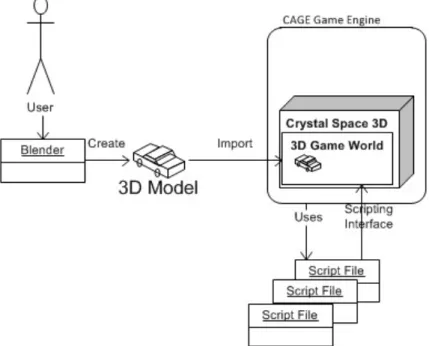
Publication [I] of this thesis presents a novel game engine implemented to be used in game programming education. The implemented game engine CAGE includes a C++ core and a scripting interface. The C++ part can be called through the interface using Lua scripts. In addition, CAGE includes an AI framework, which allows easily implementing NPCs using state machines. Students used CAGE as a platform in programming assignments of game programming course.
Recently some game engines have appeared that can be used for imple-menting browser-based games. These tools require different kind of features than game engines functioning in traditional environment. Today most game engines are implemented for binary environment. However, this might well change in the future. More and more browser-based games are developed
and many games that previously would have been implemented as instal-lable software are nowadays deployed onto the Web.
3.2
Scripts
Different types of scripts are important part of modern CRPGs. The game engine may offer its own scripting language, use a common one, or game developers can implement their own scripting language. Currently Lua [42] is a popular scripting language in game development. It is used also in many famous CRPGs, for example Baldur’s Gate and The Witcher [74].
Scripting languages can assist the development process in many ways [14]:
1. They can be used as a quick and easy way of reading variables and game data from initialization files.
2. They can save time and increase productivity, since modifications to the code can be done without recompiling.
3. They can increase creativity, since non-programmers may be able to participate in the development.
4. They provide extensibility, as the scripting interface can be left open for player’s mods.
Script code is not compiled before running it. Therefore, in the develop-ment phase it is easy and fast to test features impledevelop-mented using a script-ing language. Scriptscript-ing language can be used for almost everythscript-ing in the game, although graphic-intensive parts are seldom implemented with scripts. For example, AI features, such as path finding, can be written using scripts. Later, if more efficiency is required, scripts can be converted to compiled pro-gramming language. A well-known example are user interface scripts used in World of Warcraft [95]. The World of Warcraft game client consists of two major parts, the game world and the user interface. The game world part cannot be modified through scripting, whereas the user interface part can be affected. The game lets the player to write scripts that modify it. The
user interface part includes action buttons, unit frames, maps, and options windows. Add-ons can be written to add or modify existing elements to add functionality or to show information in a different way [37]. These configu-rations can allow the player to perform actions faster, there possibly gaining advantage in the game.
The syntax of a scripting language is usually much easier to learn than that of a compiled programming language. A scripting language can help non-programmers like game designers and artists to participate in game de-velopment, if they are able to write some of needed scripts themselves. There are also tools and pattern catalogues for assisting non-programmers to partic-ipate using scripting language. For example, ScriptEase [47] can be used. It allows designers quickly build complex NPC behaviours without performing explicit programming.
A scripting language separate from a programming language is usually used only in installable computer games. However, in browser-based games the whole game can be implemented using a scripting language, such as server-side JavaScript [17]. In this approach the game functionality is divided into the server and clients. For example, the prototype browser-based game implemented in Publication [VII] was implemented using JavaScript on both client and server side. A termscripting engine [61] is sometimes used for the part running the scripts in CRPG.
3.3
Related Work: Game Engines
Designing a new game engine is a demanding task. Therefore we inspected a number of other game engines before deciding to implement a new one.
Unity [85] is a game development tool by Unity Technologies. Unity is programmed by scripts, written in either JavaScript, C#, or a dialect of Python named Boo. All three can use .NET libraries. Unity supports multi-ple platforms, Windows, Mac, iOS, Android, Nintendo Wii, Play Station 3, and Xbox 360. However licences for Play Station 3, Xbox 360 and Wii must be negotiated separately.
a possible tool for based games, too. For example, a popular browser-based game Battlestar Galactica online [8] is implemented using Unity web player.
Some student groups used Unity in our game programming course with very good results, producing high-quality games. However most of these students had prior experience with the engine. The documentation of Unity is massive and the learning curve to use it is pretty steep. We consider that Unity is not a good selection to be a game engine for students trying learn the basics of game programming because using Unity efficiently requires a lot of time spent studying it.
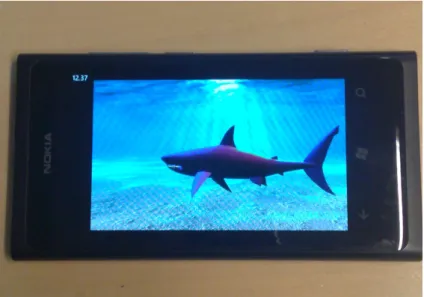
XNA [98] from Microsoft is a set of tools with a runtime environment. XNA is a framework that can be used to build games for Windows [50], Windows Phone [93] and Xbox360 [97], and the framework encapsulates the differences between platforms. This encapsulation allows game developers to concentrate on game programming and content creation instead of configu-ration problems. It supports games with 2D and 3D graphics. Especially current Windows Phones seem to be an excellent platform for games build using XNA. Since it enables rabid development process and easy deployment of games. Figure 3.2 shows an XNA application running on a Lumia 800 Windows phone.
At the time we designed the game programming course, XNA was not as mature as today and current Windows Phone did not exist. Also, the lack of scripting engine and the fact that there was no possibility to easily add a scripting language to the game project made it less suitable for the course.
Panda3D [57] is an open source game engine implemented in C++. How-ever, the game development language of the engine is Python. Typically, a developer using Panda3D writes a Python program, but he can also directly access the engine with C++ code. Features of Panda3D include graphics, audio, collision detection, built-in physics engine, and particle system.
Since the approach of Panda3D, a C++ core with a scripting language, was close to the idea of our game engine, Panda3D was a worthy candidate for the game programming course. However, Lua is a much more popular game programming language than Python. In addition, the open source
Figure 3.2: Lumia 800 Windows Phone running XNA application.
community of Panda3D was pretty small, and at the time the engine was not very mature.
Since none of the existing game engines seemed suitable, we decided to implement a new one. However we used ready-made graphic engine Crystal Space 3D [18]. Using a lower level graphic application programming interface (API) instead of a ready-made graphic engine would have increased the work-load. Crystal Space 3D also offered the important tool chain for importing 3D models into the game world.
3.4
Software Engineering and CRPGs
The design of computer games differ from traditional applications in many ways. When designing games, the end result often resembles work of art rather than engineering - it is even treated as such by the public [55]. How-ever, the software tools and methods used in the development are similar to traditional applications. It is stated that software engineering for com-puter games is a field that embraces many techniques and methods from conventional software engineering and adapts them to so as to fit the specific requirements of game development [3].
Prototyping can be beneficial in CRPG development projects. It allows gaining player feedback from the game, in early phase of the development. For example, functionality or playability of the game can be tested with prototype.
Games are typically tested with experts, and players who belong to the target group of the game [56]. These experts are especially useful in the be-ginning of the game development process, as they can spot obvious problems in the game and can also benefit their experience when testing a game, which is still incomplete. These experts can be, for example, game developers who have not been involved in the development of the game. Players of the target group, who are not previously exposed to the game, are very useful when doing playability testing [56]. They provide realistic feedback, because they are in a similar situation as a new player who has just bought the game, and does not know much in advance.
There are other uncommon methods that can be used in game develop-ment. For example, there are research that presents formal specifications can be useful in game development, especially in the design phase [54].
3.5
Game Design and Tool Support
Adams [2] defines game design as a process of
1. imaging a game,
2. defining the way it works,
3. describing the elements that make up the game (conceptual, functional, artistic, and others),
4. transmitting information about the game to the team who will build it.
This kind of a flow treats game design as a creative process, totally sep-arate from the tools used to build the game, at least until to the last phase where the team will build the game. However, even if a game designer is
no programmer or has no experience on the actual tools used, it is very important he or she understands what can be done with current tools and technology, and how difficult this is. Otherwise it is probable that game designer has unrealistic expectations.
In the second phase of Adams’ game design process, game mechanics are created. The game mechanics is one of the most important factors of game success, as the players quickly quit playing good-looking games with poor mechanics. Countless hours may be needed when balancing the game mechanics, and it is also common to release updates or patches, which correct bugs in the game mechanics.
In addition, allowed breaking the game mechanics can offer interesting opportunities in games. For example, in Magic: The Gathering [78] and its digital conversions, each new card set offers the player cards with mechanics that somehow break the existing game rules. The players must continuously think using new rule patterns. As an example of the difficulty of game me-chanics balancing, there has been several situations, where some new cards from a released set have been too powerful when combined with some other card, and those have been banned from game tournament formats [6]. Some of these problems originate from the fact that it is impossible to test all card combinations of thousands of different Magic: The Gathering cards. While currently cards are tested more carefully, ten years ago it was not rare that some new card broke the rules entirely and some errata were added. Elabo-rating rules are also used nowadays, but overall rules of the game rarely need to be modified.
3.6
Content Generation Tools
Special reasons why CRPGs require so much application development time for creating their content include huge game worlds with dozens of NPCs and long, branching game storylines. In addition, adding personalization to the game increases the need even further. Content generation tools can be used to create parts of game content, there reducing the authorial burden.
game Rogue was released in 1980, and it used procedural content generation to create levels. Each level contains grid of three rooms by three rooms or dead ends where rooms should be. However, later levels contain mazes in place of rooms also. Already in 1980s several rogue-like games, for exam-ple Hack and its successors, like Nethack, generated game levels (dungeons) randomly, with far more complex structures than those of original Rogue. Level generation is perhaps the most common case of content generation in CRPGs. There are various methods for procedural content generation and these have strengths and drawbacks [75]. Methods can also be combined for better outcome. A good example of modern game using level generation is the action CRPG Diablo III released in May 2012 [19]. The game uses a random level generator, and also a random encounter generator for providing different player experience for each playtime.
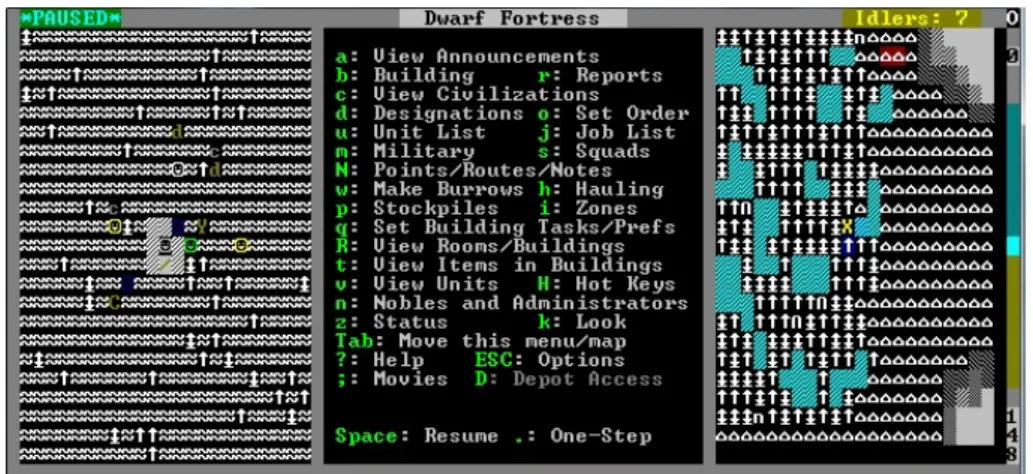
In some games, variety gained from random content can be one of the key features. For example, Slaves to Armok: God of Blood Chapter II: Dwarf Fortress [22] is in part a rogue-like CRPGs and in part a city-building game, where the game world is generated randomly from scratch for each game. Although the game is known from its extremely steep learning curve and use of only ASCII graphics, variety of the game, rich content, and sophisticated game play makes for an excellent completeness. Figure 3.3 shows Dwarf Fortress II game in action.