Students as creators of educational games: learning to use simple frameworks
and tools to empower students as educational game designers
Ana Rute Martins, Lia Raquel Oliveira Research Centre on Education, Institute of Education
University of Minho Portugal
[email protected], [email protected]
Abstract: The design of educational games is a powerful pedagogical strategy that can only enter schools if teachers are given the necessary training and support. In this paper we present a training action course for teachers interested in learning how to use simple frameworks and tools to be able to either design educational games themselves or facilitate educational game design by their students. We propose a syllabus, a design framework, and a software solution for digital game creation. This approach has been used in Portugal with middle school teachers and students and has been shown to be effective, resulting in the production of functional educational games (digital and non-digital), with preliminary results showing positive outcomes in learning and engagement.
Introduction
New pedagogical strategies are needed to motivate and teach middle school students, to involve them in their learning process and with the school community. Several studies have highlighted the potential of games as vehicles for learning, motivation and engagement (Connolly et al., 2012; Perrotta et al., 2013). Placing students in the role of game designers is one of the possible approaches to integrate games in education, supported by the learning theory of Constructionism (Papert, 1980; Kafai, 2006), with reports of positive outcomes (Akcaoglu, 2014; Earp, 2015). The design of games by students can be directed to incorporate specific contents of the curriculum. When introducing this extra layer, in addition to the advantages of learning-by-design (Resnick & Cooke, 1998), learners can also build knowledge of particular subject domains (Prensky, 2008).
Many teachers are not familiar with those pedagogical opportunities or with the technologies that support them (Li et al., 2013). We propose a training course to equip participants with basic knowledge, frameworks, and tools to facilitate the design of educational games.
Course Content and Structure
The course was designed with the following learning objectives: 1. to reflect on the possibilities of pedagogical uses of games, 2. to understand the main components of a game, 3. to be able to apply a set of steps for creating an educational game and 4. to be knowledgeable of tools and resources for creating games.
The course is pertinent for digital and non-digital games. Participants learn about the main elements of a game, understand the different phases of game design, and get acquainted with a framework that supports educational game design. Additionally, they acquire practical knowledge in an authoring environment that allows users to create games without having to type in code or drag-and-drop code blocks. During the course, attendees are exposed to games and real cases of game design by students, are involved with hands-on exercises and have the opportunity to reflect on the potential uses of game design activities in education. The course design is aligned with the TPACK (Technological, Pedagogical and Content Knowledge) framework (Mishra & Koehler, 2006), addressing the pedagogical potential of games, exploring technological tools, and integrating participants’ specific content knowledge.
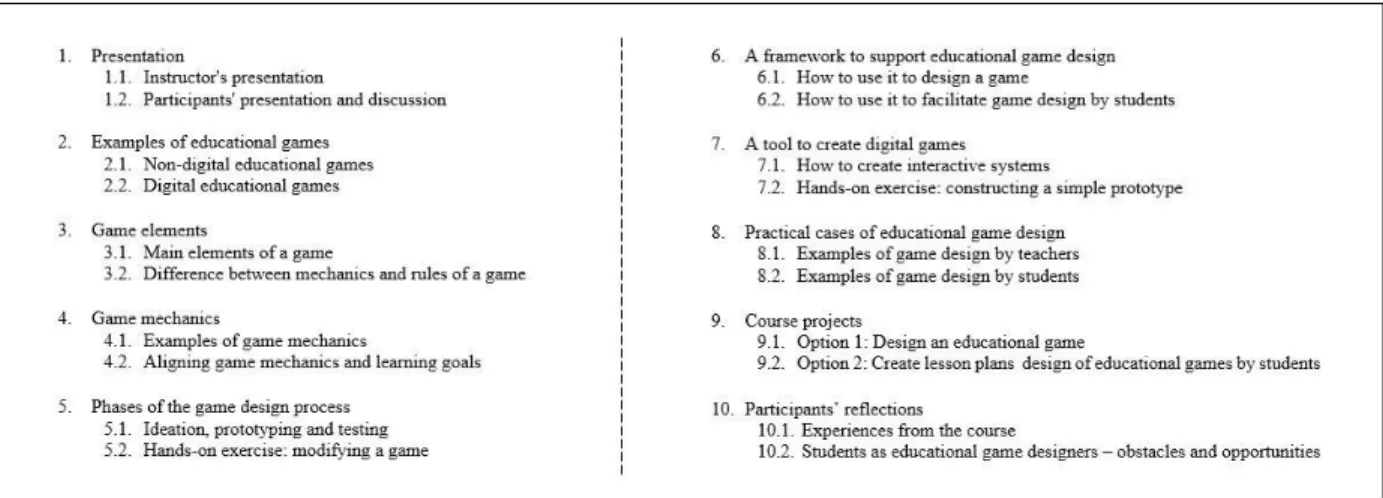
The course duration can range from 3 hours (workshop) to 30 hours (accredited Continuous Professional Teacher Development action), depending on available time, depth of exploration and amount of commitment from the participants. The course follows a 10 step structure, as is shown in Figure 1.
Figure 1: Syllabus of the Educational Game Design Course
Step 1 serves as an introduction where participants talk about their experiences with games in and outside school, sharing their opinions and attitudes towards game-based learning. Step 2 showcases examples of educational games and places to find good games for teaching. Step 3 explores what a game is and the main elements of a game, such as goal, rules, components, mechanics, space, and obstacles, using well-known games as illustrations. Step 4
addresses game mechanics more in-depth and facilitates reflection on the use of mechanics for learning purposes. In
step 5 participants get acquainted with different phases of the design process and are challenged to modify an existing game by focusing on changing one of the core elements learned about before. In step 6, a framework, in the form of a game design map with guiding questions, is explored and it is discussed its utilization in school contexts. Step 7
introduces an authoring tool to create digital games, presenting its basic functioning and inviting participants to try it by means of short exercises. In step 8 examples of educational games designed by teachers and students are shown.
Step 9 consists of a project assignment where participants have the option to choose between designing an educational game or creating lesson plans to facilitate educational game design by their students. After the project conclusion, the course ends with reflections by the attendees in step 10.
Tools and Frameworks
Game Repositories
In order to design educational games, it is important to study existing games. In this course, we ask participants to playtest and examine different games for learning. For that, we encourage exploration of websites and repositories dedicated to educational and serious games such as BrainPop (https://www.brainpop.com/), Center for Games Science (http://centerforgamescience.org/), Serious Games Studies (http://studies.seriousgamessociety.org/), Serious Game Classification (http://serious.gameclassification.com/), Games for Change (http://www.gamesforchange.org/) and SpongeLab (http://www.spongelab.com/browse/). It is easier to suggest places to find digital games than non-digital ones. In the non-digital category, we recommend looking at games produced by the Institute of Play (https://www.instituteofplay.org/learning-games).
Game Design Map
To guide participants through the game design process we have created a game design map. The map, or framework, content is based on the work of different authors and researchers, such as Deen (Deen, 2015) and Ahmad, Rahim and Arshad (Ahmad, Rahim & Arshad, 2015), as well as on the lectures and resources provided by a massive online open course by the Massachusetts Institute of Technology (Design and Development of Games for Learning) and by a teacher training program by the Institute of Play (Teacher Quest Summer Online Program). The framework structure is inspired in the Business Model Canvas, a visual chart by Osterwalder that comprises in one page the main building blocks for creating a business model.
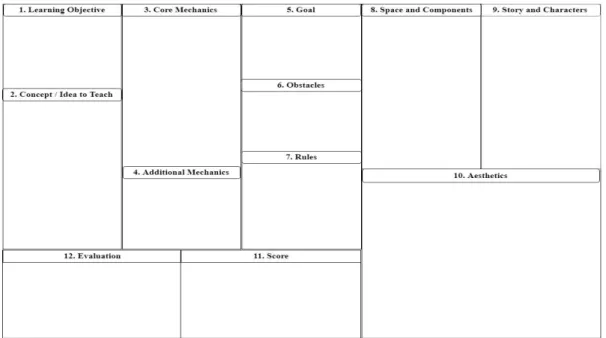
The proposed framework (see Figure 1) includes 12 sections, each representing one of the main building blocks to scaffold the process of educational game design: 1. Learning objective, 2. Concept or idea to teach, 3. Core
mechanics, 4. Additional mechanics, 5. Goal, 6. Obstacles, 7. Rules, 8. Space and Components, 9. Story and Characters, 10. Aesthetics, 11. Score, and 12. Evaluation.
Figure 2: Educational Game Design Framework
Participants have to fill the educational game design map while planning their games, and for each section there is at least one question to orientate the thinking process. In section 1 (learning objective) educational game designers have to fill in the sentence “after playing your game, players should be able to…” In section 2(concept or idea to teach) they have to think about what is the core concept or idea they want to teach, what are the different parts that constitute that concept/idea, how can it be illustrated or represented, and what can be fun or interesting about it. In section 3(core mechanics) participants are asked to think about what actions the player must perform in order to understand the concept/idea and achieve the learning objective. In section 4(additional mechanics) they are prompted with the question “what other actions or mechanics can be added to the game to increase engagement and fun?” In
section 5 (goal) game designers have to describe what players need to do in order to win the game, and in section 6 (obstacles) what makes it difficult or challenging to achieve the game’s goal. In section 7 (rules) course participants need to describe how someone plays the game and what happens in response to every different player action. In section 8 (space and components) the guiding questions are “where does the game take place?” and “what pieces make up the game?” In section 9 (story and characters) course participants are asked if there is a narrative that contextualizes the game, if there is a metaphor between the concept to teach and its representation in the game, and if there are characters in the game and what their characteristics are. Section 10 (aesthetics) has space for sketching and asks designers about the visual environment of the game and the experience they want the player to have. In section 11 (score) course participants have to describe how the score is attributed in the game and how it is possible for players to know the game state in any given moment. Finally, in section 12 (evaluation) designers have to think about how they can evaluate their game regarding both engagement and delivery of the learning goal.
Software
For digital game creation, the course uses BlockStudio (https://www.blockstud.io/bsp), an authoring environment developed at Center for Game Science, University of Washington, based on two central design principles: it is text-free and visually concrete (Banerjee et al., 2016 & 2018). BlockStudio avoids using text in the coding interface, based on a programming-by-demonstration paradigm where users provide examples of behaviours they would like the system to execute, and then the software synthesizes a general rule from those examples (Banerjee et al., 2016 & 2018). From previous research and collaboration with the software developer, we know it is easy and fast to learn BlockStudio’s basic functioning, allowing novices to understand it and create a simple digital artefact in less than 90 minutes, so we decided to use it in the educational game design course.
Participants’ Creations
During the course, teachers created educational games for their elementary and middle school students, with learning objectives from disciplines such as Portuguese, Mathematics, Natural Sciences, and French, following the methodology proposed in the course. Figure 3 shows screenshots from four games created during the course.
Figure 3: Digital games created by teachers
The first image (top left corner) is a screenshot from a game created by a teacher of Portuguese over four 90-minute sessions. The game is aimed at students from grades 5 and 6. The learning objective is to distinguish between different word classes, namely prepositions, adverbs, and conjunctions. The game has three levels and uses movement and selection as core mechanics. The player must move a sprite with the image of a boy, using the directional arrows of the keyboard, and select the correct answer by collision, within a time limit.
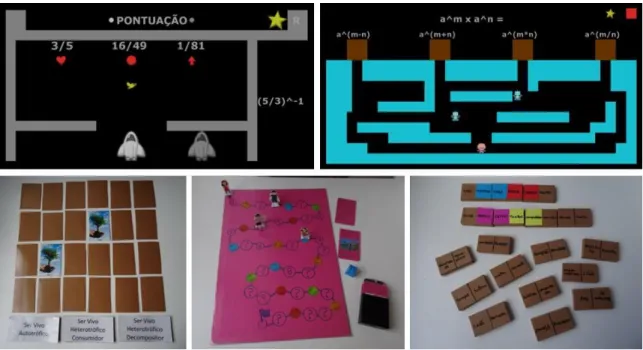
Figure 4 shows five games created by students whose teachers attended the course, and that were also taught about educational game design with our course methodology. Students created games for learning contents of numerous disciplines, both in digital and non-digital formats.
The first image in Figure 4 (top left corner) is a screenshot from a digital game created by a team of two 8th grade students over the course of eleven 45-minute sessions. The game was designed with the purpose of teaching rules of operations with bases and exponents (Math powers) to their colleagues. It is a two-player, two-level game that features diverse game mechanics, such as movement, selection, calculation, avoidance, shooting, elimination, racing, and competition. Various questions appear and disappear on the same game screen as a result of a large set of rules created by the students. In the first mini-game, the one shown in this image, players have to move a sprite with the image of a spaceship to place it in a position that allows them to shoot at the block below the correct answer. The player who can do it first gets a point (in the form of a yellow star type block).
Conclusions and Future Work
The design of educational games is a powerful pedagogical strategy that can only enter schools if teachers are given the necessary training, time and tools. We propose a course on educational game design to support the creation of educational games by students.
Teachers that attended the course were able to create functional educational games. Some of the participant teachers applied the proposed strategy with their students, which were able to create games, both digital and non-digital, that represented their understanding of the subject contents approached.
We are conducting research to examine teachers’ experiences of learning through educational game design, during a continuous professional development course. Preliminary results show that most participants have low levels of previous exposure to games (both professionally and personally) and that the game design experience impacts positively their confidence in technological knowledge and technological pedagogical knowledge. Ongoing research with those teachers’ students is showing positive outcomes in terms of motivation (e.g. students work during their free time) and learning (in curricular contents, as well as in game design, technological skills, and soft skills). We are currently treating and analysing data and will soon publish an article reporting this qualitative research.
We believe the proposed methodology is relevant for the design and development of improved training programs and strategies to scaffold teachers’ knowledge and advance the practical application of game-based learning. With this paper we intend to contribute to the use of educational game design by students as a pedagogical strategy, hoping to encourage its use by teachers and its sponsorship by school decision-makers.
Acknowledgements
This paper reports research developed within the Ph.D. Program Technology Enhanced Learning and Societal Challenges, funded by Fundação para a Ciência e Tecnologia, FCT I.P. – Portugal, under the contract PD/BD/127783/2016. This work is also funded by CIEd – Research Centre in Education, Institute of Education, University of Minho, through national funds of FCT/MCTES-PT.
We would like to thank the D. Sancho I School Group Direction for accommodating the study and making it logistically possible, with special recognition to the partaking teachers and students. Thank you also to Rahul Banerjee, a researcher at the Center for Game Science, University of Washington, and creator of BlockStudio, for discussions on the software potential and development of new software features during our research.
References
Ahmad, M., Rahim, L. A., & Arshad, N. I. (2015). An Analysis of Educational Games Design Frameworks from Software Engineering Perspective. Journal of Information & Communication Technology, 14.
Akcaoglu, M. (2014). Learning problem-solving through making games at the game design and learning summer program. Educational Technology Research and Development, 62(5), 583–600.
Banerjee, R., Liu, L., Sobel, K., Pitt, C., Lee, K.J., Wang, M., Chen, S., Davidson, L., Yip J.C., Ko, A.J. & Popovic, Z. (2018). Empowering Families Facing English Literacy Challenges to Jointly Engage in Computer Programming. In Proceedings of the 2018 CHI Conference on Human Factors in Computing Systems (p. 622). ACM.
Banerjee, R., Yip, J., Lee, K.J., & Popović, Z. (2016). Empowering children to rapidly author games and animations without writing code. In Proceedings of the 15th International Conference on Interaction Design and Children (IDC '16), 230-237.
Connolly, T. M., Boyle, E. A., MacArthur, E., Hainey, T., & Boyle, J. M. (2012). A systematic literature review of empirical evidence on computer games and serious games. Computers & Education, 59(2), 661-686.
Deen, M. (2015). GAME Games Autonomy Motivation & Education: How autonomy-supportive game design may improve motivation to learn (Doctoral dissertation, Ph. D Dissertation, Technische Universiteit Eindhoven, Eindhoven, NL).
Earp, J. (2015). Game making for learning: A systematic review of the research literature. In Proceedings of 8th International Conference of Education, Research and Innovation (ICERI2015), pp. 6426-6435.
Hava, K., & Cakir, H. (2017). A systematic review of literature on students as educational computer game designers. In EdMedia: World Conference on Educational Media and Technology, pp. 407-419. Association for the Advancement of Computing in Education (AACE).
Kafai, Y. B. (2006). Playing and making games for learning instructionist and constructionist perspectives for game studies. Games and culture, 1(1), 36-40.
Li, Q., Lemieux, C., Vandermeiden, E., & Nathoo, S. (2013). Are you ready to teach secondary mathematics in the 21st century? A study of preservice teachers’ digital game design experience. Journal of Research on Technology in Education, 45(4), 309-337. Mishra, P., & Koehler, M.J. (2006). Technological pedagogical content knowledge: A framework for integrating technology in teacher knowledge. Teachers College Record, 108(6), 1017-1054.
Papert, S. (1980). Mindstorms: Children, computers, and powerful ideas. Basic Books, Inc.
Perrotta, C., Featherstone, G., Aston, H. & Houghton, E. (2013) Game-based Learning: Latest Evidence and Future Directions. NFER Research Programme: Innovation in Education. Slough: NFER.
Prensky, M. (2008). Students as designers and creators of educational computer games: Who else?. British Journal of Educational Technology, 39(6), 1004-1019. Blackwell Publishing.