Edith Cowan University
Research Online
EDU-COM International Conference
Conferences, Symposia and Campus Events
2008
A New Perspective for Quality Improvement in
Teaching and Learning Processes
Boon Han Yeap
Monash University, Sunway Campus in Malaysia
Originally published in the Proceedings of the EDU-COM 2008 International Conference. Sustainability in Higher Education: Directions for Change, Edith Cowan University, Perth Western Australia, 19-21 November 2008.
This Conference Proceeding is posted at Research Online. http://ro.ecu.edu.au/ceducom/53
583 Yeap, B.H., Monash University, Malaysia
A New Perspective for Quality Improvement in Teaching and
Learning Processes
Boon Han Yeap
School of Information Technology
Monash University, Sunway Campus in Malaysia E-mail: [email protected]
ABSTRACT
Education has always been facing the challenge in ensuring that the quality of teaching and learning takes place effectively. One possible path for improving the quality of education lies in the application of a Quality Management approach as has been used in Industries, to the teaching and learning process. This paper adopts and uses the principles from one of the Quality Management methods, Total Quality Management as the pedagogical methodology and improved framework in managing, scrutinizing and enhancing the quality of teaching and learning practices in higher education. The paper focuses on the limited application areas of specific key components of a Total Quality Management tool on managing the needs, expectations and problems of the students, and on collecting feedback information for continuous improvement in teaching and learning process. Employing these Quality Management attributes into the education equation create values for educational institutions, employers, and students.
Keywords: Quality Improvement, Teaching and Learning
INTRODUCTION
The participative management philosophy of TQM that makes use of a set of techniques and procedures for transforming products and services has been extensively and successfully used by various organizations to improve the effectiveness, efficiency, cohesiveness, flexibility and competitiveness of a business as a whole (Glenn, 1991; Labovitz, 1991; Marchese, 1992; Zentmyer and Zimble, 1991). TQM philosophy that focuses on quality is founded and developed by several quality gurus such as W. Edwards Deming, Joseph Juran, Philip Crosby, Genichi Taguchi and Kaoru Ishikawa. For example, the key ingredients of quality are defined as fitness for use by the customer (Juran, 1989); quality aimed at the present and future needs of the customer, (Deming, 1986); conformance to requirements set by consumers (Crosby, 1979); the totality of features and characteristics of a product or service that bears on its ability to satisfy stated or implied need (BSI, 1994); the value a product imparts to customer from the time the product is shipped (Taguchi & Clausing, 1990); and quality product as most economical, most useful, and always satisfactory to the consumer (Ishikawa, 1992). Extending TQM principles, Seymour (1992) adopts and embraces the improvement strategy based on the plan-do-check-act (PDCA) cycle of Deming (1986), to coordinate on continuous improvement efforts especially for optimizing process model or production line. Hence, based on these literatures, TQM main principle and driving force is basically founded on the importance of customer satisfaction (i.e., customer-centered culture), leadership and continuous improvement effort by all involved within the system.
As with all industries, the need for quality improvement such as innovation and change is important for education. Today education is becoming more and more competitive just like commercial enterprises imposed by economic forces (Seymour, 1992). According to Freeman (1993), this competition between various academic institutions is the result of the development of global education markets and the decreasing pool of money for research and teaching, with only the more reputable
584
institutions getting a bigger pie from government and industry funding. Hansen (1993) asserted the rationale for adopting the participative TQM principles in universities, which is seen by many as having enormous potential to respond to the educational challenges. Cowles and Gilbreath (1993) contended that TQM principles could be applied as a means for improving student/staff morale, increasing productivity, and delivering higher quality services to customers. In an ASQC survey of American universities and community colleges, Horine et al. (1993) reported valuable benefits from the use of TQM, which includes: increased employee empowerment; customer satisfaction; teamwork; and culture change.
But in academia, who is the customer? Can we recognize students who are the direct recipients of the educational output as the customer or the government and private industries that hire the graduating students as customers? Should students be involved as customer in shaping the educational system? Some authors (Brower, 1991; Cloutier and Richards, 1994; Helms and Keys, 1994) argue that by satisfying students, institutions might risk compromising the needs of society as a whole; these authors preferred a process that modelled a fitness centre where students define their long-term goals and the institution prescribed the program for meeting those goals. However, others (Brigham, 1993; Rubach and Stratton, 1994) believed that both students and businesses needed to be treated as customers and they employed the concept of co-production that required the involvement and cooperation of educators, students, parents or businesses to achieve the quality outcome of the educational service. Universities focused students as internal customers and their needs appeared to attract the best recruits and in large quantities, thus enabling them to achieve superior competitive standards.
TQM MODEL FOR TEACHING AND LEARNING
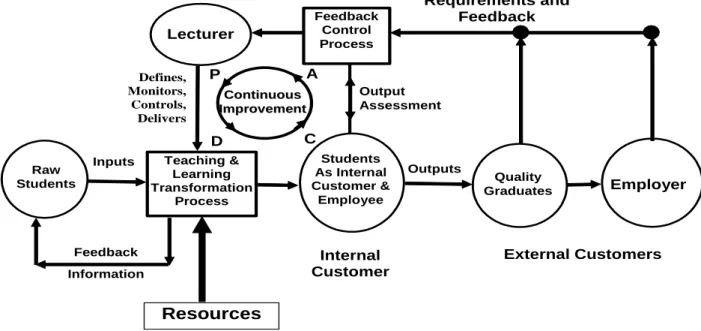
Realizing the importance of the TQM concept in improving quality and productivity in industries, an attempt has been made in this study to discuss the key features of TQM principles in achieving the teaching and learning (T&L) goals for students. It is hoped that by applying particular aspects of the TQM techniques on education would result not only in resource savings but also greater learning satisfaction and achievement from students. The authors have developed a simplified TQM model for improving T&L processes, based on and similar to industrial TQM application. In this simplified TQM model, the pattern of information flow and its activities in the T&L process is shown in Figure 1. The aim is to fulfil or exceed the expectations of all affected parties involved in the T&L transformation process.
This theoretical model perceives students as both customer and employee, and satisfies them in all the T&L processes in accordance to the TQM view that a satisfied student/employee will learn more and better than a dissatisfied student/employee. In here, students acting as the immediate and internal customer as well as direct users of the education services are being transformed into valuable manpower for the future external customers (employers of university graduates). As internal customer with raw and unprocessed skills initially, students may not be able to specifically outline on how the T&L practices should be performed. Instead, they are treated as co-workers or internal employees guided by lecturers (as managers) in improving the T&L processes, and encouraged to provide their collective opinions and feedbacks, which are important to establish the requirements for any continuous improvement efforts. Their level of involvement and influence should increase with increasing level and maturity of their studies.
585 Raw Students Teaching & Learning Transformation Process Quality Graduates Inputs Outputs Feedback Information Requirements and Feedback Information Employer s Internal Customer s External Customers Lecturer s Feedback Control Process Students As Internal Customer & Employee Resources (Site, technology, human, costs) Output Assessment Defines, Monitors, Controls, Delivers A D C P
C Coonnttiinnuuoouuss I ImmpprroovveemmeennttFigure 1: Simplified TQM model applied to the T&L processes in the classroom environment
In the model, the output assessment for the effectiveness of the T&L process flows into the feedback control process, which monitors and determines the corrective actions required for the next improvement stage. The model also contained an infinite inner-loop process (i.e., Deming‘s plan-do-check-act (PDCA) cycle), which drives the continuous assessment and improvement of the T&L process. This continuous improvement process with on-going feedback provides the framework for evaluating objectives, assess outcomes, and improve the T&L programs and strategies that are critical to attaining and exceeding T&L goals. The lecturer job is to manage, monitor, control and deliver the T&L improvement process, and work continuously to improve the T&L processes in incremental steps (e.g., content, delivery, competency, management, assessment, attitude, services, etc) by soliciting feedback from the students and drive the students to learn. In this approach, the T&L process transforms first year students (internal customers) into knowledgeable and skilled students to employers (external customers) over a period of 3 to 4 years in which the students slowly increase his/her self worth or value through their education experience. We propose that the output product is not the student but the education of the student, and this definition requires the students to take an active role in the development of the product (education) and eventually transform this output product (e.g. academic achievement, skill, experience, knowledge, and competency) into a lifelong learning education process. Only through such a strategy will eventually better prepare them for the complex challenges of the engineering field as well as enables them to react quickly to any changes in new emerging knowledge and tools. For ensuing success, this transformation process requires the support and the simultaneous working together of several resources from academic and supportive staff, departments and faculties, student affairs, resource centres, and financial services.
In reality, the input designated in a TQM system can be students, faculty and staff, funding, facilities, and university goals but for this model we simplify the input to signify students. The selection of inputs on students entering into the universities and the type of processes/tools used can influence the output quality. Therefore, performing the basic quality control techniques by marketing function on the recruitment of entry-level students may result in the type of expected quality output level.
Correspondingly, the model also shows that feedback from students and employers can help in the continuous improvement effort in refining, designing and redesigning the T&L process. However, this improvement can only happen when both lecturer and student work together to identify, analyse and make improvements to the T&L process.
586
This model also aims to improve student learning that results in lowering student failure rates and in graduating students on time by maximizing opportunities for learning in every lessons. This type of improvement reduces wastage of university resources such as time, effort and money by producing students with the correct specifications in terms of the essential & desired skills and knowledge that delight the employers. In TQM terms, wastage is the cost of non-conformance or doing things wrong, and this may include student dropouts, student failures in mastering any subject or class, retention of students in a grade or year, etc. If university has the right quality of lecturers, students‘ inputs and technological resources in the system, then the quality of the output produced should naturally be dependent on the effectiveness of the T&L practices. In order to know that we are doing things right or reaching the required level of quality, we can assess this by applying Deming (1986) TQM philosophy to keep cost down and increase student satisfaction. Such measures can be drawn from the feedbacks given by students, employers and colleagues, in which continuous corrective actions can be quickly taken to improve its content, mode and method of delivery, programs, teaching, and assessment methods.
Because the scope of education process is so broad, we will attempt to discuss the application elements of TQM method, which focuses only on the limited areas of T&L strategies in classroom with a commitment to continuous improvement by collecting quality feedbacks from students. The students are considered as both the employee, and internal and immediate customer of the university. The objective is to use TQM principles to drive T&L towards excellence by working towards a continuous improvement effort or performance breakthrough of such practices. Adopting this model requires lecturers to be more open to change in the method of teaching and delivering course materials to students through the use of innovative teaching strategies and technologies.
TQM APPLICATION IN CLASSROOM ENVIRONMENT
The T&L model focuses on building quality relationships among lecturers (as managers), students (as doers of work), and content (as learning materials). Knowing how this relationship work will allow one to organize and choose appropriate T&L tools and methods to make effective learning happens. Lecturers as managers must effectively manage and organize the efforts of students so that they in turn can approach their learning with enthusiasm and participative mood. Therefore we need to insist on quality in everything, by focusing on improving the quality of every action and interaction in the T&L processes such as total quality improvement in teaching, subject design and objectives, course notes & books, resources, staff-student interactions, assessment, subject evaluation, etc.
Recognizing that not all students are willing to go extra mile in their learning, this model suggests that one should guide and motivate those who are less likely to work extra hard and persevere towards a goal, for example by adopting Maslow pyramid model to develop learning motivation for students (Maslow, 1970). This model requires one‘s passion or burning desire that teaches student with conviction. In this context, it is a lecturer‘s responsibility to motivate and cause student to learn but students is required to take responsibility in their learning. We need to get the feedback and listen to students to see what we may need to change to become more effective – e.g. changed lesson plan, style, appropriate humour, gently confronted problem student. The fact that we have almost full control over every major element in the T&L process such as control over subject (spoken words, depth of topic, make changes, jokes, illustrations), and style (mode of delivery, tone of voice, facial expressions, movement, actions, using groups, discussion or debate), makes us even more responsible for our students. So knowing these factors, the challenge is to immediately recognize any learning problems and then implement the corresponding solution with the correct and appropriate use of the subject, style and technology.
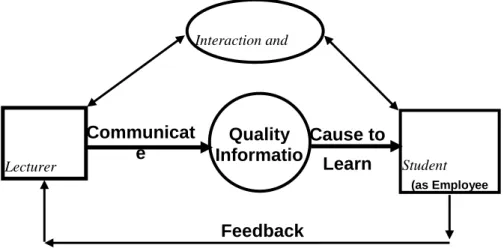
Figure 2 is a simplified interaction model developed by the authors, to show how lecturer and student interactions should take place in the T&L process. A feedback loop is included in which the lecturer listens to the students so as to make continuous improvement to the delivery of information that is able
587
to cause student to learn continuously in the acquisition of knowledge, experience, know-how, wisdom and character. The moulding of characters should form part of the teaching strategies that give value to employers. This interaction model requires the lecturer total commitment in teaching who takes full responsibility by actively causing the student to learn. In here, the lecturer communicates the information of the subject matter to the students by simultaneously focusing and interacting with the students to motivate and get their attention.
Figure 2: Teacher-student interaction model
The interaction model ensures that every student involved in the learning process is assiduously meeting out their learning requirements, and in providing them with satisfaction in their educational experience. This total commitment involves investing our time and energy that we are professionally responsible and accountable to develop the students in the total quality environment. Some examples of the learning requirements can be more personal attention; using more multimedia and visual application rather than all lecture; more lecturer-student interaction; having more interesting, meaningful and practical or real life lecture contents that are presented with the latest technology; mark and return all student submitted coursework quickly; teach materials on the student‘s level; give more demonstrations or hands-on approach to certain topics; timeliness and accuracy in the provision of information and services; and more group activities.
For any continuous improvement efforts to occur, we must determine what corrective actions need to be taken to produce the desired changes in efficiency, quality and satisfaction. For an application example, continuous improvement can be achieved by receiving feedback from students at the end of each lesson. Students are prompted to see what important things that have been learned in class, and what outstanding issues that have not been resolved or answered. Any lecture contents that have not been explained clearly or understood as intended can be either clarified during the last few minutes or at the beginning of the next class session. This type of feedback keeps one knowing what action and improvement need to be made or what points need to be reviewed, reiterated and recapitulated so as to make the learning experience in classroom better.
Our interaction model requires students to participate throughout their learning effort. This practice is important because quality of teaching and learning is linked together. For example, to make students learn, retain and use the information and material better, the subject topics should be taught by combining presentation with activities and interaction. This requires us to design relevant materials/activities for maximum student participation that leads to dynamic and interactive exchanges in the classroom environment. This building of relationship with students involves care, respect, trust and openness. We find that one of the best ways to build relationships is to ask many questions as well as encouraging students to ask questions. Asking relevant questions and carefully listening to student‘s answers allow one to determine the level of knowledge and maturity of the student, and what areas need further emphasis. For example, we can arrange them in teams to let them think, discuss and solve
Lecturer (as Manager) Student (as Employee & Internal Customer)
Communicat
e
(Words, Actions)Quality
Informatio
n
Feedback
(Listen)
Cause to
Learn
Interaction and Participation588
the problems with or without hints provided. We know that learning is taking place when students think and ask questions that give insight into it. This method leads to the development of new ideas and solutions to complex problems.
EVALUATION AND ASSESSMENT PROCESS
Our models adopt the evaluation and assessment as continuous improvement process that contributes to the enhancement of quality. Producing quality graduates requires identifying activities that need to be controlled, monitored and overseen throughout the complete cycle of the T&L process. One of the important features in our model is the measurement of performance to ensure conformance to customers' expectations. One cannot make any effective and efficient changes or know what exactly need to be changed without clear analysis and understanding of the feedback results. For example, to be ―fit for use‖, the collected feedback must produce quality information that can guide the designing and redesigning T&L process.
Getting reliable feedback information of one‘s action is essential to continuing the incremental improvements process especially made for every semester otherwise we will not know how well the students are learning or how students respond to specific T&L approaches. Course grades, marks, syllabus, examination/test papers, in-class activities, student performance on tutorial problems, suggestion boxes, student critiques, peers & students feedback, surveys and evaluations form parts of the TQM teaching processes to establish the quality standards. For example, lecturers can examine set of graded papers for common error patterns, talk and listen to students about the graded papers, and check on their verbal understanding and skills of specific concepts that reflected in their submitted work. With this feedback information, students can have a clear indication of how well they are meeting the subject outcomes at that time, understand the quality of their work, what they need to change, modify, adapt and improve their work and/or performance. The process of course improvement and delivery (Zaciewski, 1994; Smith et al., 1993) can be based on Deming's plan-do-check-act (PDCA) cycle that includes: identify gaps and variations from students' feedback; analyse instructional process; plan actions to improve quality; implement actions; and evaluate customer satisfaction surveys. For example, unlike in traditional classrooms where lecturers often follow this sequence: Plan Teach Test, but in the continuing, never-ending nature of process improvement model, we can use a Plan Teach (Do) Check and determine which learning outcome students have missed (Check) Revised T&L (Act) Test, with each cycle producing improvement.
Class interview techniques are another source of feedback for T&L improvement. This may include standardized questionnaires that probe students about what they like best and like the least, suggestions they have for the teaching process, specific areas of concern. Additionally, lecturers can encourage students to form a class committee at the start of the semester that is composed of students charged with collecting and providing feedback on the course and teaching performance from the student point of view. Lecturers can also ask students to comment on a blank sheet of paper towards the end of the lesson about T&L problems they faced in class, suggesting whatever changes to improve their learning.
Feedback information obtained from peers can be used to refine and improve the course goals, the way course and activities and tests/examinations are structured, and the accuracy and quality of printed and distributed materials with clarity of explanations in all content specifications. In the observation of teaching, peers can use a pre-established rating questionnaire for recording information. Better and more accurate feedback information can be received using multiple observations per peer, and using many skilled observers.
Here at Monash University, there are various methods of evaluation available to assess the teaching and materials quality of lecturers that are conducted by MonQueST. For example, these survey questionnaires for teaching solicit information concerning: the organization and structuring of the lectures; effects on one learning and understanding; levels of interest and motivation; lecturer‘s
589
interaction and support; and physical aspects of presentation. Whereas the feedback questions for subject course materials solicit information concerning: subject organization; reference materials; workloads; assessment specifications; and assignment or submitted work.
CONCLUSION
Good teaching matters as quality teaching produces quality learning that creates quality students and makes customers satisfied. As such, TQM is one useful tool in the T&L practices at university even though it was developed initially for the manufacturing industries. Our models adopt a view that quality teaching that actively involves interactions and participations with the students can make a significant difference to cause student to learn. The challenge is to ensure every student can be benefited from the T&L process by giving them enough time, support, motivation, resources and opportunity to learn to reach the agreed standard of excellence in education in a total quality environment. To implement these TQM strategies, it requires us to have the correct attitude and approach with the ultimate aim to continuing striving to improve all areas of entrusted responsibilities. The models adopt specific TQM tools and principles to enhance T&L quality that allows one to follow clear aims and objectives; makes continuous improvement in teaching, learning and assessment methods; and is willing to be judged by others. For any continuous improvement effort to be effective, quality and reliable feedback information is essential and important in the evaluation procedure of T&L with the output clearly defined and measured. It involves processes that continuously collect, analyse, and act on customer information.
REFERENCES
Brigham, S. (1993). TQM lessons we can learn from industry. Change, May-June, 42-8.
Brower, M. (1991). The paradigm shifts required to Apply TQM and teams in higher education. Readings in Total Quality Management, 485-97.
BSI - British Standards Institution, Quality Systems (1994). London: BS EN ISO 9002, BSI.
Cloutier, M., Richards, J. (1994). Examining customer satisfaction in a big school. Quality Progress, September, 117-19.
Cowles, D. & Gilbreath, G. (1993). Total quality management at Virginia Commonwealth University. Higher Education, 25(3), 281-302.
Crosby, P.B. (1979). Quality Is Free. New York, NY: McGraw-Hill.
Deming, W.E. (1986). Out of Crisis: MIT Center for Advanced Engineering. MA: Cambridge. Freeman, R. (1993). Quality Assurance in Training and Education. London: Kogan Page. Glenn, T. (1991). The formula for success in TQM. The Bureaucrat, 17-20.
Hansen, N.L. (1993). Bringing total quality improvement into the college classroom. Higher Education, 25(3), 259-79.
Helms, S., Key, C. (1994). Are students more than customers in the classroom?. Quality Progress, September, 97-9.
Horine, J.E., Hailey, W.A. & Rubach, L. (1993). Shaping America's future. Quality Progress, October, 41-45.
590
Ishikawa, K. (1992). What Is Total Quality Control? The Japanese Way. Englewood Cliffs, NJ: Prentice-Hall.
Juran, J.M. (1989). Juran on Leadership for Quality: An Executive Handbook. New York, NY: Free Press.
Labovitz, G.H. (1991). The total-quality health care revolution. Quality Progress, 45-47. Marchese, T. (1992). Getting a handle on TQM. Change, 48-51.
Maslow, H.A. (1970). Motivation and Personality. 2nd ed., New York, NY: Harper and Row.
Rubach, L. & Stratton, B. (1994). Teaming up to improve US education. Quality Progress, February, 65-68.
Seymour, D.T. (1992). On Q: Causing Quality in Higher Education. New York, NY: Macmillan. Smith, J.A., Baker, K. & Higgins, S. (1993). The assessment of customer satisfaction in higher education - a quality function deployment approach. EOQ 1993 World Quality Congress Proceedings, Helsinki, Finland.
Taguchi, G. & Clausing, D. (1990). Robust Quality. Harvard Business Review, Vol. 68, (January-February).
Zaciewski, R. (1994). Improving the instructional process. Quality Process, April, 75-80.
Zentmyer, R.K. & Zimble, J.A. (1991). The journey from bureaucracy to TQM. Quality Progress, 61-66.
COPYRIGHT
[Boon Han Yeap] ©2008. The author/s assign Edith Cowan University a non-exclusive license to use this document for personal use provided that the article is used in full and this copyright statement is reproduced. Such documents may be published on the World Wide Web, CD-ROM, in printed form, and on mirror sites on the World Wide Web. The authors also grant a non-exclusive license to ECU to publish this document in full in the Conference Proceedings. Any other usage is prohibited without the express permission of the authors.