Turkish Online Journal of Distance Education-TOJDE April 2008 ISSN 1302-6488 Volume: 9 Number: 2 Article 9
COMPUTER-MEDIATED COMMUNICATION IN FOREIGN
LANGUAGE EDUCATION:
Use of Target Language and Learner Perceptions
Assist. Prof.Dr. Nesrin OZDENER Marmara University, Atatürk Faculty of Education, Department of Computer and Instractional Technologies, Goztepe Istanbul,Turkey.
H. Muge SATAR The Open University
Milton Keynes, UK
ABSTRACT
Among the challenges many teachers face in facilitating the improvement of speaking skills are sparing sufficient time for practice to enable students to achieve fluency in speaking through internalizing the structures, and establishing a balance between fluency and accuracy. This study aimed to seek an answer to the question as to whether Computer-Mediated Communication Technologies be a solution for overcoming these problems. The study was conducted as additional practice to the foreign language lessons with the participation of 60 students. Task-based language teaching principles were taken as basis in preparation of the teaching materials in the study, in which text and voice chat applications among the Computer-Mediated Communication Technologies were used. During the applications data were collected in several ways: participants’ perspectives regarding their changing experiences and the types of tasks used were investigated through the use of open-ended questionnaires after each session; a general insight was obtained into the students’ experiences with close-ended questionnaires given at the end of the study; and the use of the target language in communications among students were determined by investigating the text communication logs. From a user-oriented perspective, the results of the study shed light on the strategies that can be used in computer-mediated communication technologies valuing the experiences and perceptions of the learners.
Keywords: Text and voice chat; foreign language education. INTRODUCTION
The theoretical basis for the use of synchronous and asynchronous communication technologies in computer-mediated foreign language education is found in the interactionist theory among second language acquisition (SLA) theories and in communicative approach to foreign language teaching. Communicative approach values time spent on learner talk and supports the use of a variety of functions of language. Language learning is believed to take place through conversation (Hatch, 1978) and learners are encouraged to use the target language in communicative exchanges. Similarly, the interactionist theory investigates interaction among learners and aims to find the ideal conditions for SLA (Chapelle, 1997). The theory assumes that language learning takes place in the course of interaction, because interaction provides input, promotes output and allows for feedback and modified output. (For more information on interactionist theory see Long, 1983-Interaction Hypothesis; Krashen, 1985-Input Hypothesis; Swain, 1985-Output Hypothesis and Chapelle, 1997 for a discussion of these in the context of Computer Assisted Language Learning.)
Recently in Turkey there has been a steep increase in the importance attached to the use of computers and to the improvement of oral skills in foreign language teaching. However, various difficulties are experienced in the teaching of, particularly, the speaking skills. The scarcity of individual speaking time per student in the classroom environment constitutes the main challenge. Therefore, in order to improve their speaking skills, students in Turkey would benefit from more practice time and a chance to use the foreign language out of the classroom.
Another challenging context for the promotion of foreign language oral skills seems to be distance language teaching. The main and biggest institution that provides distance language teaching in Turkey is Eskisehir Anadolu University, Open Education Faculty with 1.100 thousand students and with 24 years of history (http://www.anadolu.edu.tr/en/aos/aos_tanitim/aos.aspx). Although a number of online programs, VCD/DVDs and face-to-face tutorials have recently been offered by the faculty (including the blended bachelor’s degree program in English Language Teaching), foreign language teaching had mainly been limited to text-based materials and television broadcasts which do not allow interaction among learners.
LITERATURE
Literature on the use of Computer-Mediated Communication (CMC) for foreign language teaching purposes mainly reflects research in the areas of foreign language learning anxiety and participation, transfer of skills from text-based CMC to oral language skills, the effects of synchronous and asynchronous communication, amount of target language produced, native speaker (NS)-non-native speaker (NNS) interactions and some research emerging on the use of voice communication. Research in these areas will be respectively exemplified below. The use of CMC in distance language learning contexts will then be illustrated with three cases: The Open University, UK; Universitat Oberta de Catalunya, Spain and Eskisehir Anadolu University, Open Education Faculty, Turkey. There also exists relatively recent research on the use of video in CMC and virtual environments. However, these are not included in this paper regarding the scope of this research.
Language Learning Anxiety and Participation
One of the obstacles encountered in improvement of oral skills is the foreign language anxiety resulting from the students’ concern about making mistakes particularly in front of their friends. Language anxiety results in a dominance of the teacher and confident students during discussions. Thus, even if sufficient time is allocated to oral student interaction, shy and highly anxious students cannot benefit the opportunities arising from the context. At this very point, computer-mediated communication (CMC) emerges as a feasible solution particularly for improvement of speaking skills and decreasing the level of foreign language anxiety by raising self-confidence of the students within the scope of both formal and distance education. Many studies indicate that CMC can lower foreign language learners’ anxiety levels (Perez, 2003; Warschauer, 1996; Roed, 2003).
Studies investigating the effects of CMC on foreign language improvement also demonstrate that participation is more equal in written communication in these environments (Warschauer, 1996) and that the dominance of teachers and more confident students in discussions is decreased with greater participation of shy students in the text chat environment (Kern, 1995).
Transfer of Skills
Other research in CMC focused on and evidenced transfer of skills from text chat to oral production based on the assumption that synchronous text chat triggers the same cognitive mechanisms involved in speech production (Beauvois, 1997, Payne and Whitney 2002). Another study on text-based synchronous CMC was carried out by Tudini (2003) who pointed out that negotiation of meaning, which is accepted as evidence of language
improvement by the interactionist theory, occurred in CMC context especially around vocabulary and grammatical items.
Synchronous and Asynchronous Communication
Abrams (2003) compared the effects of synchronous and asynchronous text-based communication on the quality and quantity of language produced and did not find significant differences between the two modes (Abrams 2003). However, in some instructional contexts, student learning outcomes are reportedly superior in asynchronous online discussion rather than face-to-face discussion (Wang 2004; Koory, 2003). In this regard, synchronous chat, with attempts to emulate face-to-face discussion, is often viewed as inferior to asynchronous online communicative exchange (McDonald, 2002)
Target Language use in NNS/NNS Interaction
The results of the study conducted by Beauvois (1998) indicate that participants, who share the same native language (L1), tend to rely on the target language more often in text-based CMC discussions. Likewise, Gonzalez-Lloret (2003) emphasized that an average of 80% of the interactions in text- based CMC were performed in the target language among students with same L1. Obtaining similar results, Chun (2003) emphasized that students enjoyed the chat environment greatly and, unlike the classroom environment, they used the target language to a large extent to complete the tasks.
Native speaker involvement
Even though enabling the students to communicate with the native speakers of the target language is a significant opportunity provided by CMC tools, Lee (2004) pointed out that some students experienced difficulties in understanding and communicating due to the discrepancy between the learner language and the native language. Students described their experience in this situation negatively, stating that they felt anxiety and were concerned about making mistakes.
Voice-based CMC
Despite the large number of studies on text-based computer-mediated communication, there is limited number of research on voice-based communication. In a study conducted by Hampel and Baber in 2003, it was observed that students participated in voice-based online sessions more actively. Hampel and Hauck (2004), in addition to demonstrating the benefits of voice-based CMC, observed that it was easy for quieter students to hide and not participate in the discussions, allowing the dominant students to take control of the conversations. They pointed out that, from this point of view, voice-based CMC may not support equal participation as much as text-based CMC.
Distance Language Education
In the context of distance language teaching, CMC takes on a much more prominent role than the on-site (classroom) setting, apparently because the learners study in isolation from a variety of physical/geographical places. CMC in such a context accommodates ‘anywhere and anytime’ interaction among learners and is usually observed in the form of asynchronous CMC realized via email, voice mail, forum and discussion boards, blogs and wikis. Although synchronous CMC is very promising in the promotion of spoken/conversational skills, it is not always the very first choice because it facilitates ‘anywhere’, but not ‘anytime’ interaction. The learners need to be online concurrently which could be quite difficult in cases where the learners have different commitments in terms of time. And also in cases where the learners are spread on a large geography, time differences might make synchronous interaction inconvenient. However, even if it is the less preferred CMC alternative, there are institutions who offer synchronous CMC in addition to asynchronous as part of their distance language courses. Consequently, there appears to be different modals of incorporating CMC to the distance language course, which will be exemplified below via the cases of the Open University, UK; Universitat
Oberta de Catalunya, Spain and Eskisehir Anadolu University, Open Education Faculty, Turkey.
The Open University, UK was founded in 1969 with a ‘commitment to social equity’ with government support and “most of the teaching and learning in the language courses is structured around the in-house-produced self-study language materials.” (Solé and Hopkins, 2007) These include books with supplementary DVDs, audio CDs, a variety of computer-based materials and broadcast television supported with face-to-face tutorials and residential summer schools. However, as outlined by Hampel and Hauck (2004), not until February 2002 was CMC introduced into the language courses (namely German, French, and Spanish). With an increase in ‘robustness of Internet audio technology’ an “in order to respond to learners’ need for more flexible speaking opportunities and to overcome the geographical challenge of students” internet-based, synchronous (real-time) audio conferencing was introduced. Since then, “language courses have been offered using Lyceum, an Internet-based audio-graphics conferencing tool developed in house” (Hampel and Hauck 2004).
Solé and Hopkins (2007) contrast distance education language courses at the Open University, UK with the ones at the Universitat Oberta de Catalunya (UOC), Spain. They provide similar information on how language courses are run at the Open University, UK and they go on to explain language courses at UOC, Spain. According to their outline, “UOC, based in Barcelona, Spain, was established in 1995” and a “distinguishing characteristic of the UOC is that teaching and learning activities have taken place exclusively online, via a purpose-built virtual campus, ever since the university’s inception”. English as a Foreign Language courses at the UOC, Spain make extensive use of ‘one-way’ (web-based materials) and ‘two-way’ (asynchronous CMC) communication technologies. Although the courses are skills-based, speaking is the least encouraged skill apart from “pronunciation exercises and controlled dialogue practice”. Currently synchronous (real-time) interaction, neither written nor oral is being offered.
After an analysis of the different modes of interaction offered in distance language courses at the Open University, UK (synchronous voice-based CMC) and UOC, Spain (asynchronous written CMC), Solé and Hopkins (2007) conclude that both institutions “a facing a similar challenge; namely, to provide student with quality language courses at a distance, given the technology available, student’s access to this, institutional policies, and economic resources”. They suggest that flexibility in program design should be considered so that emerging CMC technologies could be incorporated in the future according to changing requirements.
As briefly mentioned in the introduction, within the Turkish context, Anadolu University, Open Education Faculty, Turkey (AUOEF, Turkey) is the leading distance education institution in Turkey with 24 years of history. Although the main mode of course delivery (including foreign language courses) had been by means of printed materials and TV broadcasts in the past years, recently the faculty has undergone a development of new materials and new technologies, such as CDs/DVDs, web-based materials, an online learning system and online TV, as well as offering face-to-face contact with the academics. Currently there are 15 associate degree programs and 5 bachelor’s degree programs offered all of which have a foreign language strand. Out of the 20 programs available 18 include English I, German I and French I, one includes additional English, German and French for specific purposes courses and one includes only Arabic I and II. (http://www.anadolu.edu.tr/aos/program_brosurleri/on_lisans_ve_lisans.aspx) (Please note these are the courses offered at university level. AUOEF, Turkey also provides language courses at secondary school level which are not included here.)
However, the use of CMC at AUOEF, Turkey is, most of the time, limited to non-academic purposes. Mutlu, Korkut and İşeri (2005) exemplified the use of audio-video chat software as part of the programs in English Language Teaching (bachelor’s degree) and in Information Management (associate degree). The system, that was put into practice by
the beginning of the 2004-2005 academic year, was used to strengthen the social dimension required for “meeting the non-academic communication needs” of the distance learning students. While the results of the study indicated that students enjoyed using it, they were disturbed by outsiders who could access the system. The students also complained about some students who took advantage of the anonymity allowed by the system and displayed disturbing behaviour.
At this point, the authors would like to mention a little bit more of the distance education program in English Language Teaching (bachelor’s degree): ‘Distance English Language Teacher Training Program’ offered at AUOEF, Turkey. Özkul and Mutlu (2005), who provides a detailed account of the program, reports that it was established in the 2000-2001 academic year using a blended teaching approach to supply the demand for English Language teachers at primary and secondary schools as a joint project between AUOEF, Turkey and the Turkish Ministry of Education. The blended system is composed of face-to-face on-site learning in the first and second years of the program and is fully online in the third and fourth years. As part of the online component, students in the program are offered interactive online content, asynchronous academic consultancy/tutorials (forum discussions) and technological support via web-based audio-video conferencing (Özkul and Mutlu, 2005).
The program has been an innovative initiative in distance education in Turkey with the inclusion of a virtual classroom where synchronous tutorials are offered to students. As explained by Aydın and Yuzer (2006), the virtual classroom is composed of six main parts: 1. content provider interface (slides, whiteboard, questions, video, images, web page director and break-out rooms for learner interaction), 2. learner interface (lesson content, file sharing, instructor-learner interaction [question and answers either in voice or text-chat], instructor’s video and tabs that present the content), 3. instructor interface (with control facilities), 4. management interface (scheduling and login purposes), 5. recorded lesson interface (lessons archive accessible to students for review) and 6. database (records of activity per student – attendance, oral/written participation rates, number of questions answered correctly and topic initiation rates). Yuzer (2007) also discusses the virtual classroom project with a focus on the use of video-conference in generating virtual eye contact. He proposes that virtual eye contact has several benefits including increased attention, better retention rates, community building, non-verbal communication and social presence among the participants. (Please see Bıyık, 2007, for an evaluation of the success of the program.)
To summarise; despite the inclusion of new materials and technologies at AUOEF, Turkey, CMC technologies to promote oral production and interaction among students are currently not employed as part of foreign language courses in associate and bachelor’s degree programs. The use of asynchronous CMC (forum) and synchronous CMC (videoconferencing) is typically limited to non-academic purposes of socialization and technical support; the only exceptional case being the blended program in English Language Teaching: Distance English Language Teacher Training Program where a virtual classroom is being piloted in pedagogy related courses.
METHOD
Emerging from the lack of research on the use of CMC for foreign language teaching in the Turkish context, this study was conducted at a vocational high school as additional practice to foreign language (English) lessons during the 2005-2006 spring term. A total of 60 students (in groups of 30) participated in the study in which text and voice CMC technologies were used. The research questions were as follows:
1. How much of the communication via text chat is carried out in the target language? 2. What are the learner perceptions on the use of text and voice chat applications with
3.
¾ features of the sessions, ¾ tasks,
¾ matching of dyads, ¾ computer skills, and ¾ help provided?
During the study that lasted four weeks, participants’ perspectives regarding their changing experiences and the different types of tasks used were investigated through open-ended questionnaires administered after each session; and a general insight was obtained into the students’ experiences with three-point Likert type close-ended questionnaire given at the end of the study. Furthermore, the rate of target language use in interactions between students was determined through an investigation of text chat logs.
The chat environment used in the study was developed using Macromedia Flash 8 and Flash Media Server 2 software packages. Chat logs were kept by the chat software as a system to prevent the use of native language by the participants as they all participants shared the same native language. The participants were not allowed to add new users to the chat software so that others outside the study could not sign in. Conversation tasks and chat plug-ins were displayed on a single URL/web page.
Task-based language teaching principles were taken as a basis in the preparation of teaching materials to be used in text and voice-based CMC sessions. Tasks are “activities where the target language is used by the learner for a communicative purpose in order to achieve an outcome” (Willis, 1996: 234). The first four types of the tasks defined by Pica, Kanagy and Falodun (1993) were used in
Table: 1
Description of the tasks for each week
Weeks Task 1 Task 2
1. Information gap
Meet your friend:
Both students had information of a famous person (age, nationality, colour of eyes, colour of hair, favourites, job, etc). They took turns in describing the person they could see and guessing the other student’s description. They then talked about themselves and their families.
Guess who:
Each student had the picture of the same house and some people in the rooms and some people out of the picture. A could see where the people were whom B, then, had to drag and drop from outside the picture into the right room and vice versa. They needed to use what the people were doing in which room.
2. Problem Solving
My room:
Both students had the same pictures for three different rooms. They tried to find 5 similarities and 5 differences among the pictures. They needed to use basic
vocabulary, prepositions and there is/are. They, then, talked about their own rooms to find similarities and differences.
In the future:
Both students had the same three pictures for different future habitations. They also had 9 statements describing the pictures – 3 each. They were asked to find the statements that match the pictures. They, then, talked about their own predictions about future life.
3. Jigsaw
Everyday:
The students were given the 10 jumbled sentences and 10 time expressions which describes one day of a mother. They also had 5 pictures (each different) showing what she does at what time. By sharing the information they had, they tried to make up 10 sentences describing the mother’s one day.
The thief:
Each student was given half of a picture story and they worked together to put the story in order. They were then asked to tell their own story to each other.
They were then asked to talk about their own everyday life.
4. Decision Making
Birthday party:
Both students held the same information – amount of money, pictures of gifts and cakes to choose from for their friend’s birthday party. They were then asked to decide which gift and cake to buy and which music to listen to at the party using a guided dialogue.
The weekend:
Both students held the same information – pictures of movies, places and times to meet. They were then asked to decide which film to see, where and when to meet using a guided dialogue.
the study: jigsaw, information gap, problem solving, decision making and discussion. A total of 8 tasks (Table 1) were prepared with 2 different tasks for each week to be used in dyadic interaction distributed over a period of four weeks.
Taking into consideration the fact that the proficiency levels of the participants were low, they were enabled to see the Turkish explanations of the instructions regarding the activities. For the same reason, the participants were also provided with a help page containing the words and expressions they could use. The participants were asked to have a look at these pages before the session, and they were allowed to access the help page during the chat sessions.
FINDINGS
Target Language Use
The percentage of English, Turkish and total number of words used by the participants in text chat are given in Table 2. These numbers were obtained by an analysis of the data from the text chat logs automatically kept via Flash Media Server. The findings provided in the table demonstrate that 91% of the communication took place in the target language, and that use of the native language was 8.9 %.
Table: 2
Percentage of words generated in all applications (%)
Types of tasks Number of Words in English (%) Number of Words in Turkish (%) Number of Words in Total (%) information gap 96.7 % 3.3 % 25.6 % problem solving 90.6 % 9.4 % 27.2 %
jigsaw 84.8 % 15.2 % 30.0 %
Decision making 92.5 % 7.5 % 17.2 %
Average (%) 91.2 % 8.9 % 100 %
Students’ Perspective on the Tasks Used in CMC Sessions
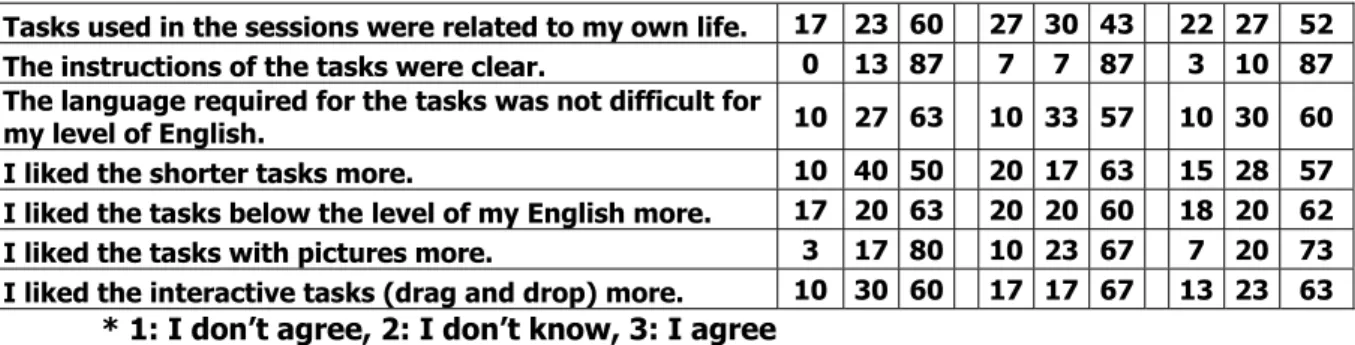
Views of the students that participated in the study regarding the conversation tasks are given in Table 3. 65 % of all participants found the tasks interesting, and 52 % stated the tasks were related.
Table: 3
Views of the students that participated in the study regarding the tasks used in the sessions
Subjects: voice (%) text (%) total (%) *1 2 3 1 2 3 1 2 3 Tasks used in the sessions were interesting. 20 27 53 13 10 77 17 18 65
Tasks used in the sessions were related to my own life. 17 23 60 27 30 43 22 27 52 The instructions of the tasks were clear. 0 13 87 7 7 87 3 10 87 The language required for the tasks was not difficult for
my level of English. 10 27 63 10 33 57 10 30 60 I liked the shorter tasks more. 10 40 50 20 17 63 15 28 57 I liked the tasks below the level of my English more. 17 20 63 20 20 60 18 20 62 I liked the tasks with pictures more. 3 17 80 10 23 67 7 20 73 I liked the interactive tasks (drag and drop) more. 10 30 60 17 17 67 13 23 63
* 1: I don’t agree, 2: I don’t know, 3: I agree
The students were asked to specify the tasks they enjoyed the most (Figure 1) and the least (Figure: 2). As can be seen in Figure 1, the tasks that the students enjoyed the most were “My Room”, “Everyday” and “Birthday Party”. Their comments as to why they enjoyed these tasks the most were that they were more enjoyable, amusing and easy. Furthermore, one of the most important reasons why they enjoyed these tasks was that they had the opportunity to tell something related to their own lives and that they used them frequently in their daily lives (“To be able to use the words and to explain our experiences in our daily lives”; “It was enjoyable to explain something that belongs to me.”) While explaining the reason why he enjoyed the “Birthday Party” task the most, one of the students said, “It was both enjoyable and amusing to make a decision jointly with my friend”.
Figure: 1
Distribution of tasks that the students enjoyed the most
Figure 2 illustrates the distribution of the tasks that the students enjoyed the least. A significant result here is that “The Thief” was the least enjoyed task. When we investigate the reason why they did not like it, the most frequent answer was that the task was too difficult for them. This difficulty arose from the language level as typically expressed by the students: “It was difficult to formulate sentences, I was demoralized”. Likewise, most of the students stated that they found this task boring.
0 2 4 6 8 10 12 14 Nu m b e r o f s tu d e n ts Meet Yo ur F riend Gues s Wh o My R oom In th e F u ture E very day The Thief B irthd ay P a rty The We eken d All o f the m No An swer T as ks
Figure: 2
Distribution of the tasks that the students enjoyed the least Students’ Perspective on the Matching of Dyads
The findings given in Table 4 show that, 53 % of the students involved in voice chat thought that their anxiety decreased for they had the sessions in pairs. 20% of those involved in text chat shared the same view. 93% of the students involved in voice chat and 77% of those involved in text chat stated that they communicated more easily for they knew the person they were chatting with. Particularly 70 % of the students that involved in voice chat stated that they would be worried of not being able to understand the person they had the chat with, if he/she was a foreigner. It is seen that the students are rather hesitant as to whether they would prefer to chat with a native English speaker or not.
Table: 4
Views of the students that participated in the study regarding the matching of dyads
Matching of dyads: voice (%) text (%) total (%) *1 2 3 1 2 3 1 2 3 Chatting in pairs decreased my anxiety. 27 20 53 60 20 20 43 20 37 Because I knew the person I was chatting with, I was
able to communicate more easily. 3 3 93 23 0 77 13 2 85 If the person I had the chat with was a foreigner, I
would be worried of not being able to understand the
person. 17 13 70 20 23 57 18 18 63 I’d have preferred to chat with a native English
speaker 27 43 30 37 40 23 32 42 27 * 1: I don’t agree, 2: I don’t know, 3: I agree
Students’ Perspective on the Chat Sessions
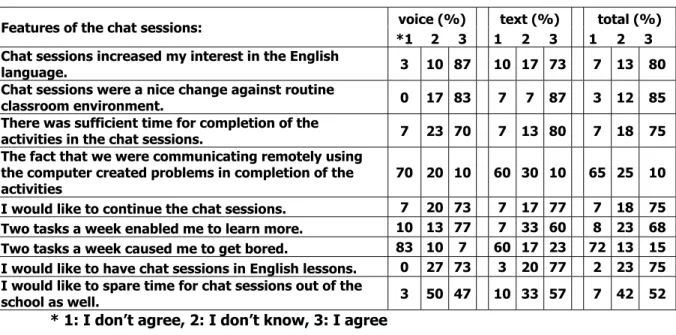
Views of the students that participated in the study regarding the features of the chat sessions are given in Table 5. The findings presented in Table 5 show that most of the students (85 %) thought that the sessions were a nice change against routine classroom environment, and 75 % would like to continue the sessions. While 75 % of the participants stated that they would like to have chat sessions in English lessons, the rate of those who would like to spare time outside the school as well was 52 % (voice 47 %, text 57%). 80 % of the students that participated in the study stated that the chat sessions increased their interest in English language and 10 % thought that communicating via computers created problems in completion of the activities.
Table: 5 0 2 4 6 8 10 12 14 16 18 20 N u m b e r o f s tude nt s Meet You r Frien d Gue ss W ho My R oom In th e Fut ure E ver yday The Thief B irthda y P a rty The Wee kend All o f them No A nswe r T as ks
Views of the students that participated in the study regarding the features of the chat sessions
Features of the chat sessions: voice (%) text (%) total (%) *1 2 3 1 2 3 1 2 3 Chat sessions increased my interest in the English
language. 3 10 87 10 17 73 7 13 80 Chat sessions were a nice change against routine
classroom environment. 0 17 83 7 7 87 3 12 85 There was sufficient time for completion of the
activities in the chat sessions. 7 23 70 7 13 80 7 18 75 The fact that we were communicating remotely using
the computer created problems in completion of the activities
70 20 10 60 30 10 65 25 10 I would like to continue the chat sessions. 7 20 73 7 17 77 7 18 75 Two tasks a week enabled me to learn more. 10 13 77 7 33 60 8 23 68 Two tasks a week caused me to get bored. 83 10 7 60 17 23 72 13 15 I would like to have chat sessions in English lessons. 0 27 73 3 20 77 2 23 75 I would like to spare time for chat sessions out of the
school as well. 3 50 47 10 33 57 7 42 52 * 1: I don’t agree, 2: I don’t know, 3: I agree
Students’ Perspective on IT Skills
Table 6 shows the participants’ views regarding the computer skills. In total, 83 % of the students thought that the use of the web site was easy, but 47 % stated that they would need someone from whom they could get technical support, if they were having the sessions alone at home.
Table: 6
Views of the students that participated in the tudy regarding the computer skills
voice (%) text (%) total (%) Computer skills: *1 2 3 1 2 3 1 2 3 1. I experienced difficulties in the sessions for I am
not good at using computers. 70 20 10 67 17 17 68 18 13 2. If I were having the sessions alone at home, I
would need someone from whom I could get technical
support. 27 30 43 20 30 50 23 30 47 3. Use of the web site was easy. 7 10 83 3 13 83 5 12 83
* 1: I don’t agree, 2: I don’t know, 3: I agree
Students’ Perspective on the Language Help Provided
Table 7 shows the views of the participants regarding the language help pages. 62 % of the students stated that they studied the help pages before the sessions and 88 % said being allowed to look at the help pages during the sessions relieved them. 83 % of all students stated that the help pages were not complicated, and 62 % said being allowed to look at the help pages during the session did not prevent them from thinking on the subject. Rate of the students thinking that they would experience difficulties if they were not allowed to look at the help pages was 58 %. While 60 % of the students that were involved in text chat thought they would not study harder if they were not allowed to look at the help pages, those who were involved in voice chat were rather hesitant (33%).
Table: 7
Views of the students that participated in the study regarding the help pages
voice (%) text (%) total (%) Help Pages: *1 2 3 1 2 3 1 2 3 1. I studied the help pages provided before the 13 23 63 17 23 60 15 23 62
sessions.
2. Being allowed to look at the help pages during the
sessions relieved me. 0 17 83 3 3 93 2 10 88 3. Being allowed to look at the help pages during the
sessions prevented me from thinking on the tasks. 57 27 17 67 17 17 62 22 17 4. The help pages were complicated. 80 7 13 87 3 10 83 5 12 5. I would work harder, if we were not allowed to look
at the help pages. 33 33 33 60 17 23 47 25 28 6. I would experience more difficulties, if we were not
allowed to look at the help pages. 7 37 57 17 23 60 12 30 58 * 1: I don’t agree, 2: I don’t know, 3: I agree
Students’ Perspective Prompted by Open-ended Questions:
Views of the students were also elicited by open-ended questionnaires administered at the end of each session as well as the close-ended questionnaire the results of which were mentioned above. The first of the open-ended questions required the participants to state what they enjoyed the most in the sessions and the reasons for their answers. Among the answers given by the students were:
¾ To be able to chat with their friends / with a person they know in English (“Because I did it with a friend of mine from my own classroom, my anxiety decreased slightly. My self confidence in learning English increased.”; “I enjoyed speaking English very much. Because, I have never spoken English for 40 minutes before.”; “We communicated with each other without speaking Turkish, that was very nice.”; “I understood that speaking English is nice.”; “I enjoyed being able to understand much better each day.”; “It willingly or unwillingly shifts your attention to the lesson.”; “My interest in English increased.”)
¾ using keyboard / headphones (“Chatting in English and wearing headphones. I like headphones very much.”; “Using the Internet site and communicating with microphone.”; “Chatting in writing, because it is very enjoyable.”)
¾ sessions were enjoyable and amusing (“It was nice to chat. Because it is enjoyable.”; “Chatting in English for the first time was enjoyable.”; “It was the voice chat, because it was very enjoyable.”; “I enjoyed being in front of a computer.”)
¾ more rapid recall of words (“For the first time I remembered the English words without repeating too much.”; “I enjoyed writing to each other the most. Because I wrote the words, I remembered them more easily.”)
Another question addressed to the students in the open-ended questionnaires required the students to state what they enjoyed the least or did not enjoy in the sessions. When the answers given at the end of each session during 4 weeks were examined, it was seen that the things which the participants enjoyed the least were the pronunciation anxiety (“I was afraid of pronouncing incorrectly”), feeling themselves insufficient in terms of the level of foreign language proficiency (“Not being able to put together the sentences.”; “It was difficult, I was afraid of being unable to do it, and I think I couldn’t do it.”; “I cannot formulate the sentences, I got tense”), and complexity of the tasks and pictures (“Pictures were very complicated, they were not so clear”; “The task was boring and it was in English”; “3rd and 4th tasks were more difficult compared to the other tasks. I did not like these tasks. The previous ones were both more enjoyable and easier.”; “It was very boring to find the similarities and differences.”).
The participants also expressed a variety of challenges they faced in the sessions regarding the use of English (“Because our vocabulary is limited, we sometimes had to speak in Turkish.”; “Sometimes, we cannot express ourselves, I mean we cannot fully express what we want to express, and this situation puts us under pressure.”), the technology (connection – use of keyboard/microphone – Internet site) (“Sometimes the sound was distorted” ; “In the beginning, I had difficulties in using the keyboard, but it became easier in the third week.”; “My friend’s voice reached me with a delay and so it was difficult to communicate.”) and regarding the person they were talking to and their
communication (“My friend’s understanding me late made me a bit tired”; Sometimes I couldn’t understand him/her.”).
The views and opinions of the students regarding the tasks used in the chats each week were also deduced from these open-ended questionnaires administered at the end of each session. In general, the students stated that they found the sessions interesting and enjoyable particularly because they chatted in English for the first time, and that most of the tasks were open to discussion/sharing. While most of the participants found the instructions understandable, they were of the opinion that the time provided particularly for the 5th and 6th tasks could have been longer. The participants stated that chat sessions made various contributions to their foreign language (English) skills, and that they made noticeable improvements particularly in their reading/writing, pronunciation/speaking skills. Some of the students said they believed that their English vocabulary knowledge had increased and that their practical skills in English were developed. Some stated that they did not experience difficulties in spelling English words anymore. (“It was good for spelling. Even though you could look at the help page, you develop a kind of confidence. It was good for my pronunciation. Even though I chatted in writing, you repeat it in your mind while writing, and it facilitates your pronunciation.”; “I learned something that I did not know. I learned to be faster and more active.”; “I learned new vocabulary, and I became more practical in writing English.”; “I can now write the words, whose spelling I don’t know.”).
In open-ended questionnaires, students provided a variety of recommendations that could improve the chat sessions: “It would be quite beneficial if it were done between schools and classrooms.”; “It would be better if everyone, not certain students, participated.”; “Different tasks can be added to the site.”; “It can be done with more participants, it can also be done continuously.”; “It can be improved by enabling the participants to chat with different individuals, not with the same ones.”; “Pictures could be clearer and brighter, and explanations could be more detailed.”; “More pictures and sessions can be used”; “Number of example sentences can be increased.”
DISCUSSION
Recent research shows that learners who share the same native language use the target language more in computer-mediated communication then they do in classroom situations (Beauvois, 1998; Chun, 2003; Gonzalez-Lloret, 2003). The results of this study on the amount of target language use also demonstrate that 91% of all synchronous text chats were in the target language. This result is consistent with the findings of the previous studies. It suggests that in CMC the belief that ‘students should chat with people whose native language is not the same, otherwise they will prefer to use their native language’ is not valid. It also illustrates that with a correct methodology, participants would use the target language, even though they share the same native language.
Responses given by the students to the questions in the open-ended questionnaires also support this result; most of the participants stated that they enjoyed speaking English with a familiar friend. 70 % of the students that took part in voice chat stated that they would be worried of not being able to understand the person they had the chat with if he/she was a foreigner. While 27 % of all students wanted to chat with a person who is a native English speaker, 32 % did not want to do so. Lee (2004) pointed out that some students may feel uncomfortable and experience difficulties in understanding and communicating during synchronous text chats with native speakers of the target language. Students that participated in this study made the following recommendations aimed at improving the chat sessions:
1. increasing the time allocated for the chat sessions, 2. participation of more individuals in the chat sessions,
3. collaboration between schools/classrooms,
4. allowing the participants to chat not with the same person but with different persons as well,
5. regular use of the chat sessions over a longer period of time, 6. the use of different, enjoyable and pictured tasks,
7. and an increased number of example sentences on the help page.
Undoubtedly, it is inconceivable and probably undesirable for computer-mediated communication to replace on-site language learning activities performed in the classroom. However, it is also an undeniable fact that CMC could provide an exceptional context for the students with low proficiency and high foreign language anxiety levels to improve their language skills. CMC technologies will also create significant opportunities in cases where sufficient time cannot be allocated for communicative activities within the classroom due to limited teaching time. Therefore, it is argued that raising awareness of foreign language teachers in the Turkish education system on the appropriate use of CMC technologies and equipping them with necessary skills would be crucial in preparing the next generation to the linguistic challenges of international settings.Although the present study was carried out within the classroom context as additional practice outside the class time, there is no reason why the results could not be transferred to distance education settings. In distance foreign language teaching where face-to-face communication is not feasible, use of CMC will not only act as a tool to promote community building among isolated students, but also could have a very important role in developing oral foreign language skills. By illustrating cases of distance language courses offered in the UK, Spain and Turkey, the study highlights the lack of academic uses of CMC (especially synchronous CMC) to promote language learning in the Turkish context. Therefore, the results of this article are expected to provide guidance to and assist the institutions, which currently provide distance language courses or have plans to do so, in improving / developing the quality of their courses.
To conclude with, the authors maintain that computer-mediated communication could be an invaluable alternative to face-to-face interaction in dealing with the challenges of speaking a foreign language faced by the Turkish students in both traditional classrooms and distance education contexts alike.
BIODATA and CONTACT ADDRESS of the AUTHORS
Nesrin OZDENER is assistant professor at the Atatürk Faculty of Education at the University of Marmara. In 2001 she recived the PH.D. grade in Physics at Marmara University. She has been teaching at Computer and Instructional Technologies Department since 1998. Her main research interest concerns, educational software design and simulations.
Marmara University, Atatürk Faculty of Education
Department of Computer and Instructional Technologies Istanbul, TURKEY
Phone: +(90) 216 345 47 05 # 254 [email protected]
H. Müge SATAR received her BA from Istanbul University, Turkey in English Language Teaching and her MA from Marmara University, in Computer and Instructional Technologies. She’s now a full-time PhD student at the Open University, UK and her main interests are CMC, task-based language learning and video conferencing technologies.
The Open University, Faculty of Education and Language Studies, UK Phone: + (44) 1908 655221
Email: [email protected]
Financial Support
This research was funded by the Marmara University Scientific Research Projects Board. REFERENCES
Abrams, Z. (2003). The effect of synchronous and synchronous CMC on oral performance in German, The Modern Language Journal, 87(2), 157-167.
Aydın, B. and Yuzer, T.V. (2006). Building a synchronous virtual classroom in a Distance English
Language Teacher Training (DELTT) Program in Turkey, Turkish Online Journal of Distance Education-TOJDE 7(2), Retrieved January, 26, 2008 from http://tojde.anadolu.edu.tr/tojde22/articles/aydin.html
Beauvois, M. H. (1997). Computer-Mediated Communication (CMC): Technology for Improving Speaking and Writing, In Bush, Michael, D. (Ed.) Technology-Enhanced Language Learning, National Textbook Company, Illionis.
Beauvois, M. H. (1998). Conversations in Slow Motion: Computer-mediated Communication in the Foreign Language Classroom, Canadian Modern Language Review, 54(2).
Bıyık, Ç, Ö (2007). A preliminary evaluation of the Distance English Language Teacher Training Program (DELTTP) in Anadolu University, Turkey, Turkish Online Journal of Distance Education-TOJDE, 8(1), Retrieved January 26, 2008 from http://tojde.anadolu.edu.tr/tojde25/articles/Article_12.htm
Chapelle, C. (1997). Call In The Year 2000: Still In Search Of Research Paradigms?”, Language Learning & Technology, 1(1), 19-43.
Chun, H. (2003). The Viability of Computer Mediated Communication in the Korean Secondary EFL Classroom, Asian EFL Journal, 5(1).
Gonzalez-Lloret, M. (2003). Designing Task-Based Call To Promote Interaction: En Busca De Esmeraldas, Language Learning & Technology, 7(1), 86-104.
Hampel, R. & Baber, E. (2003). Using internet-based audio-graphic and video
conferencing for language teaching and learning. In Felix, U. (Ed.) Language Learning Online: Towards Best Practice, Swets & Zeitlinger B.V., Lisse, The Netherlands.
Hampel, R., & Hauck, M. (2004). Towards an effective use of audio conferencing in distance language courses. Language Learning & Technology, 8(1), 66-82.
Hatch, E. (1978). Discourse analysis and second language acquisition. In E. Hatch (Ed.), Second language acquisition: A book of readings. Rowley, MA: Newbury House.
Kern, R. (1995). Restructuring classroom interaction with networked computers: Effects on quantity and characteristics of language production. The Modern Language Journal, 79, 457-476.
Koory, M. A. (2003). Difference in learning outcomes for online and F2F versions of “An Introduction to Shakespeare.” Journal of Asynchronous Learning Network, 7. Retrieved October 20, 2006 from http://www.sloan-c.org/publications/jaln/v7n2/v7n2_koory.asp Krashen, S. (1985) The Input Hypothesis, London: Longman.
Lee, L. (2004). Learners' Perspectives On Networked Collaborative Interaction With Native Speakers Of Spanish In The Us, Language Learning & Technology, 8(1), 83-100. Long, M. (1983) Native speaker/Non-native speaker conversation in the second language classroom. In M. Clarke and J. Handscombe (eds.), ON TESOL ’82: Pacific perspectives on language and teaching, Washington D.C.: TESOL.
McDoland, J.(2002) Is “as good as face-to-face” as good as it gets? Journal of Asynchronous Learning Network, 6. Retrieved October 20, 2006 from http://www.sloan-c.org/publications/jaln/v6n2/v6n2_macdonald.asp
Mutlu, M.E., Beyaz, M. & İşeri, P. (2005). Use of Audio-visual Communication Media in the Internet Based and Internet Assisted Open Education Programs, X. Internet Conference in Turkey Inet-tr ’05:December 9-11, Istanbul, Retrieved November 29, 2005, from http://inet-tr.org.tr/inetconf10/bildiri/27.pdf
Özkul, A.E & Mutlu, M.E. (2005) İnternet Destekli Açıköğretim Modeli: İngilizce Öğretmenliği
Lisans Programı Retrieved January 25, 2008 from
http://www.bilgi.aof.edu.tr/yayinlar/2005/Internet% 20Destekli%20Acikogretim%20Modeli.pdf
Payne, J. S, & Whitney, P. J. (2002). Developing L2 oral proficiency through synchronous CMC: Output, working memory, and interlanguage development. CALICO Journal, 20(1), 7-32.
Perez, L.C.(2003) Foreign language productivity in synchronous versus asynchronous computer-mediated communication , CALICO Journal, 21(1),89 -104.
Pica, T, Kanagy, R & Falodun, J. (1993). Choosing and using communication tasks for second language instruction. In Crookes, G. & Gass, S.M. (Eds), Tasks and Language Learning: Integrating Theory and Practice. (pp. 9-34), Clevedon, Avon: Multilingual Matters.
Roed, J.,(2003). Language learner behaviour in a virtual environment. Computer Assisted Language Learning 16(2-3), 155-172.
Solé, C.S. & Hopkins, J.(2007). Constructing two approaches to distance language learning, Distance education, 28(3),351-370.
Swain, M. (1985). Communicative competence: some roles of comprehensible input and comprehensible output in its development. In S. Gass and C. Madden (eds.). Input in Second Language Acquisition, Rowley, MA: Newbury House, pp.235-252.
Tudini, V. (2003). Using native speakers in chat, Language Learning & Technology, 7(3), 141-159.
Warschauer, M. (1996). Comparing face-to-face and electronic discussion in the second language classroom, CALICO Journal, 13(2-3), 7-26.
Wang, H.L.(2004). Correlation analysis of student visibility and performance in online learning. Journal of Asynchronous Learning Network, 7. Retrieved October 20, 2006 from http://www.sloan-c.org/publications/jaln/v8n4/index.asp
Willis, J. (1996). A Framework for Task-Based Learning. Harlow, UK: Longman Addison-Wesley.
Yuzer, T.V. (2007). Generating virtual eye contacts through online synchronous communications in virtual classroom applications, Turkish Online Journal of Distance Education-TOJDE, 8(1), Retrieved January 26, 2008 from http://tojde.anadolu.edu.tr/tojde25/articles/Article_3.htm
http://www.anadolu.edu.tr/en/aos/aos_tanitim/aos.aspx (offical website of Eskisehir Anadolu University, Open Education Faculty), Retrived January, 25, 2008
http://www.anadolu.edu.tr/aos/program_brosurleri/on_lisans_ve_lisans.aspx (offical website of Eskisehir Anadolu University, Open Education Faculty), Retrived January, 26, 2008