UC Santa Barbara Electronic Theses and Dissertations
TitleMulti-Version Search and Cache-Conscious Ranking Optimization Permalink https://escholarship.org/uc/item/6c9477tt Author Jin, Xin Publication Date 2017 Peer reviewed|Thesis/dissertation
Multi-Version Search and Cache-Conscious
Ranking Optimization
A Dissertation submitted in partial satisfaction
of the requirements for the degree of
Doctor of Philosophy
in
Computer Science
by
Xin Jin
Committee in Charge:Professor Tao Yang, Chair Professor Jianwen Su Professor Xifeng Yan
Professor Jianwen Su
Professor Xifeng Yan
Professor Tao Yang, Committee Chairperson
Copyright c 2017 by
First of all, I would like to express my most sincere thanks to my Ph.D. advisor, Prof. Tao Yang, for his continuous guidence, support and endless help during my Ph.D. study. I am amazingly lucky to have an advisor who is so great! He is always there to provide insights and help both in research and in my daily life. In the past five years, Tao has taught me how to conduct good research with his patience, enthusiasm and immense knowledge. Specifically, he gives me so much freedom in pursuing my personal interest in research fields, which makes me enjoying my projects so much. Also, Prof. Tao Yang has lots of fruitful experience in both academia and industry. Guided by him as my advisor, I believe the things I learned during my Ph.D. study will benefit a lot for my entire life. His continous guidence, care and support is so essential to help me complete my Ph.D.
Secondly, I want to give my sincere thanks to my Ph.D. committee members Prof. Jianwen Su and Prof. Xifeng Yan for their continuous guidence throughout my Ph.D. Jianwen and Xifeng have been my committee members for the MAE (Major Area Exam), proposal and defense. They have given me a lot of valuable feedback and insightful suggestions on my work. I am deeply grateful to them.
I benefitted a lot from the three internships at different companies. I worked with Dr. Wei Wang and Dr. Gang Zhao at Electronic Arts on a user-player relationship system optimization project, collaborated with Dr. Yun Xiao and Dr. Xingjian Zhang at Yahoo! search team on a second-phase ranking project, and worked with Dr. Srinath Rao and Kelvin Lim at Google Express search team on a merchant query redirection project and a search results deduplication project. I feel so lucky to have a chance to work with so many talented engineers and researchers and l really learned a lot from them.
My sincere thanks also go to all members in our great laboratory. I was having a wonderful time with you all, and greatly appreciate the collaboration with Xun Tang, Michael Daniel Agun, Qinghao Wu, Yifan Shen, Susen Zhao, Jiyu Chen, Nimisha Srinivasa and Lin Chai. Thanks for our discussion and debates on the projects, where a lot of new ideas coming up and problems solved. I am also grateful to other previous and current labmates and my friends at UCSB: Wei Wang, Maha Alabduljalil, Jinjin Shao, Kun Wan, Olaoluwa Osuntokun, Fangqiu Han, Yang Li, Huan Sun, Nan Li, Shengqi Yang, Shenghao Li and Jing Hao. Thanks for your encouragement and sharing along the way, which fullfills my memories during my Ph.D. study.
I also want to express my great thanks to all my colloborators. It is so good to be able to work with all these outstanding researchers in the world. I would like to thank Prof. Stefano Tessaro for your great suggestion and discussion, Dr. Claudio
I own my deepest thanks to my families and closest friends. Thanks for my dear grandparents Qingxian Ma and Tianen Chen, you have taught me how to be a great person and how to love. Thanks for my dear parents Yi Chen and Jimin Jin for your endless support, encouragement and care. Thanks for your unconditional love in my life. And Qingyun, my dear wife, you are always there listening to me, caring me and sharing happiness and sadness with me. It is so great to have your support by my side all the time. Finally, I want to thank my closest friends. Thanks for accompanying me along the journey and provide helps whenever it is and wherever we are. Thank you all, for letting me feel that I am the luckist person in the world.
This dissertation study was supported in part by NSF 1528041 and IIS-1118106. Any opinions, findings, and conclusions or recommendations expressed in this material are those of the authors and do not necessarily reflect the views of the National Science Foundation.
Xin Jin
Education
2011-2017 Ph.D. in Computer Science (Expected), University of California, Santa Barbara.
2010-2011 One year of graduate study at School of Computing, National University of Singapore, Singapore.
2006-2010 B.S. in Computer Science, Peking University, Beijing.
Field of Study
Major Field Computer Science with Professor Tao Yang.
Professional Experience
09/2011-03/2017 Research Assistant, University of California, Santa Barbara. 06/2016-09/2016 Software Intern, Google, Mountain View, CA.
06/2015-09/2015 Software Intern, Yahoo!, Sunnyvale, CA.
06/2014-09/2014 Software Intern, Electronic Arts, Redwood City, CA.
Publications
Xin Jin, Tao Yang, and Xun Tang, Comparison of Cache Blocking Methods for Fast Execution of Ensemble-based Score Computation,in Proceedings of the 39th International ACM SIGIR Conference on Research and Development in Informa-tion Retrieval (SIGIR 2016).
Xin Jin, Daniel Agun, Tao Yang, Qinghao Wu, Yifan Shen, and Susen Zhao, Hybrid Indexing for Versioned Document Search with Cluster-based Retrieval,
in Proceedings of the 25th ACM International Conference on Information and Knowledge Management (CIKM 2016).
Xun Tang, Maha Alabduljalil, Xin Jin, and Tao Yang, Partitioned Similarity Search with Cache-Conscious Data Traversal,in journal of ACM Transactions on Knowledge Discovery from Data (TKDD 2015).
Xun Tang, Xin Jin (equal contribution with the first author), and Tao Yang, Cache-Conscious Runtime Optimization for Ranking Ensembles, in Pro-ceedings of the 37th International ACM SIGIR Conference on Research and De-velopment in Information Retrieval (SIGIR 2014).
SIGIR Conference on Research and Development in Information Retrieval(SIGIR 2014).
Junjie Yao, Bin Cui, Yuxin Huang, and Xin Jin, Temporal and Social Context based Burst Detection from Folksonomies, in Proceedings of the Twenty-Fourth AAAI Conference on Artificial Intelligence (AAAI 2010).
Daniel Agun,Xin Jin, Jinjin Shao, and Tao Yang, Efficient Privacy-Preservation Top K Search with Multi-Keyword Ranking, to be submitted for publication.
Xin Jin, Lin Chai, and Tao Yang, Cache-Conscious Ranking Optimization with Fast Parameter Selection for Ensemble-based Score Computation, to be submitted for publication.
Multi-Version Search and Cache-Conscious Ranking
Optimization
Xin Jin
Organizations and companies archive many versions of digital data such as web pages, internal emails and so on. Such data is critical for internal investigation, regulatory compliance, and electronic discovery. It is estimated that electronic discovery market that leverages archival data will reach $9.9 billions globally in 2017. It is not uncommon for many businesses to retain archived collections for 10 to 15 years. How to archive these versioned data is worth to study and we are facing many challenges including 1) traditional index occupies too much space for versioned data, 2) traditional search is too slow on versioned data, and 3) how to guarantee high accuracy when improving efficiency in new architecture.
In this dissertation, we take the opportunity of the fast developement of infor-mation retrieval and tackle the problem by proposing a new multi-version search architecture with cache-conscious ranking optimization framework. Specifically, we will first discuss our new versioned search architecture. Then, we will talk about a cache-conscious online ranking algorithm to improve the online part. Fi-nally, we will describe a framework to select best blocking methods and parameters for our algorithm to achieve best performance.
an approach that uses cluster-based retrieval to quickly narrow the search scope guided by version representatives at Phase 1 and develops a hybrid index structure with adaptive runtime data traversal to speed up Phase 2 search. The hybrid scheme exploits the advantages of forward index and inverted index based on the term characteristics to minimize the time in extracting positional and other feature information during runtime search. We compare several indexing and data traversal options with different time and space tradeoffs and describe evaluation results to demonstrate their effectiveness. The experiment results show that the proposed scheme can be up-to about 4x as fast as the previous work on solid state drives while retaining good relevance.
Secondly, we talk about our 2D blocking algorithm to optimize the online ranking part of the system. Multi-tree ensemble models have been proven to be effective for document ranking. Using a large number of trees can improve accuracy, but it takes time to calculate ranking scores of matched documents. We investigate data traversal methods for fast score calculation with a large ensemble and propose a 2D blocking scheme for better cache utilization with simpler code structure compared to previous work. The experiments with several benchmarks show significant acceleration in score calculation without loss of ranking accuracy.
rameters for our 2D blocking algorithm with the help of a full cache analysis. 2D blocking method is very helpful to improve online search efficiency. However, different traversal methods and blocking parameter settings can exhibit different cache and cost behavior depending on data and architectural characteristics. It is very time-consuming to conduct exhaustive search for performance comparison and optimum selection. We provide an analytic comparison of cache blocking methods on their data access performance for an approximation and propose a fast guided sampling scheme to select a traversal method and blocking parameters for effective use of memory hierarchy. The evaluation studies with three datasets show that within a reasonable amount of time, the proposed scheme can identify a highly competitive solution that significantly accelerates score calculation.
In summary, we have proposed a new multi-version search architecture with cache-conscious ranking optimization for the online search part and a framework to help fast select best blocking methods and parameters with full cache analysis for the 2D blocking method. By proposing this new versioned search system, we can meet challenges from scalability, efficiency and accuracy in multi-version search, and we believe this work would be useful to future researchers in this direction.
List of Figures xv
List of Tables xvii
1 Introduction 1
1.1 Dissertation Overview . . . 4
1.2 Multi-version Search System . . . 5
1.3 Cache-Conscious Runtime Optimization for Ranking Ensembles . 6 1.4 A Comparison of Cache Blocking Methods . . . 8
1.5 Contributions . . . 9
1.6 Thesis Organization. . . 10
2 Multi-version Search System 13 2.1 Introduction . . . 13
2.2 Background and Related Work. . . 17
2.2.1 Multiversion Data Index . . . 17
2.2.2 Traditional Search . . . 21
2.2.3 Multiversion Data Search . . . 22
2.2.4 Documents Clustering . . . 26
2.3 Cluster-based Retrieval with Representatives . . . 27
2.3.1 Design Considerations . . . 27
2.3.2 Cluster Representatives. . . 32
2.4 Hybrid per-cluster Indexing and Traversal . . . 35
2.4.1 Indexing and Search Options for Phase 2 . . . 36
2.4.2 Term-version Posting Intersection . . . 43
2.4.3 Index Storage Layout and Cost . . . 45
2.5.3 A Comparison of Phase 2 Indexing and Traversal Options 62
2.5.4 A Comparison on Relevance Scores . . . 66
2.6 Summary . . . 70
3 Cache-Conscious Runtime Optimization for Ranking Ensembles 72 3.1 Introduction . . . 72
3.2 Background and Related Work. . . 75
3.2.1 Learning to Efficiently Rank . . . 76
3.2.2 Traversal Patterns . . . 78
3.2.3 Search Engine Caching Techniques . . . 81
3.3 2D Block Algorithm . . . 82
3.4 Evaluations . . . 89
3.4.1 Datasets and Experiment Settings . . . 89
3.4.2 A Comparison of Scoring Time . . . 90
3.4.3 Cache Behavior . . . 93
3.4.4 Branch Mis-prediction . . . 96
3.5 Summary . . . 97
4 A Comparison of Cache Blocking Methods 98 4.1 Introduction . . . 98
4.2 Background and Related Work. . . 101
4.3 Design Consideration and Cost Model. . . 104
4.4 Cost Analysis and Comparison. . . 109
4.4.1 Time Cost for DSD . . . 109
4.4.2 Time Cost for SDS . . . 116
4.4.3 Time Cost for DSDS . . . 120
4.4.4 Time Cost for SDSD . . . 130
4.4.5 Cost Comparison of the Four Methods . . . 139
4.4.6 Discussions . . . 142
4.4.7 Proof for Proposition 1 . . . 143
4.5 Evaluations . . . 145
4.5.1 Settings . . . 145
4.5.2 A Comparison of Cache Blocking Methods . . . 148
4.5.3 Selective Cache Blocking for QuickScorer . . . 156
4.5.4 Batched Query Processing . . . 158
5.2 Lessons . . . 164
5.3 Future Work . . . 168
5.3.1 Multi-Version Search Extension . . . 168
5.3.2 Cache-Conscious Method on Other Models . . . 169
5.3.3 Secure Versioned Search . . . 170
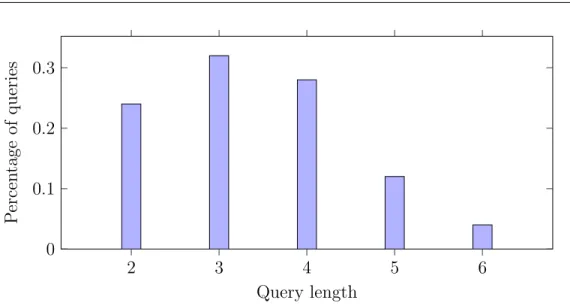
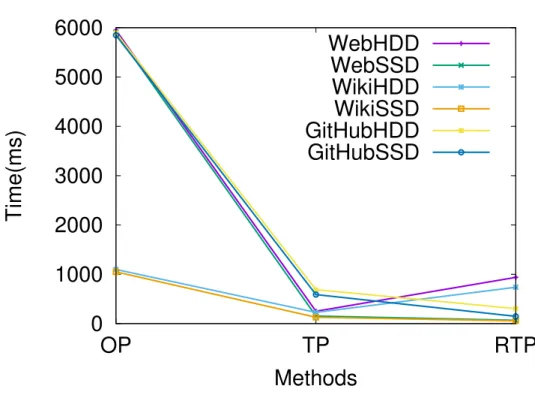
2.1 The ratio of the total number of fragments over the unique frag-ments in a GitHub dataset . . . 15 2.2 (a) Term-fragment inverted index. (b) Fragment-version reuse ta-ble that lists versions sharing each fragment. . . 24 2.3 Representative-guided search workflow for query processing . . . . 30 2.4 An example of data traversal in Option C that selects the Option A or Option B approach for each query word at each cluster. . . 39 2.5 Percentage of queries for different query length . . . 55 2.6 Query processing time of different search methods when the index is on SSD or HDD. . . 58 2.7 Query processing time of different search methods when the index is on SSD . . . 59 2.8 Query processing time of different search methods when the index is on HDD . . . 60 2.9 Impact of representative selection on vNDCG1@10 relevance scores 68 3.1 Data access order in DOT (a) and SOT (b). . . 80 3.2 Data access order in the SDSD blocking scheme. . . 84 3.3 Scoring time per document per tree in nanoseconds when varyingm
(a) andn(b) for five algorithms, and varyingsanddfor 2D blocking (c). Benchmark used is Yahoo! dataset with a 150-leaf multi-tree ensemble. 91 3.4 L3 miss ratio when varyingn(a), varyingm(b) for four algorithms, and when varying s and d for 2D blocking (c). . . 94 4.1 Data traversal order of cache blocking methods during execution . 105 4.2 Data access flow of CPU with memory hierarchy. . . 107 4.3 Performance under different values of d. . . 110 4.4 Range cases of d considered under different scenarios for DSD. . . 112
4.7 Scoring time per vector per tree whenn changes. . . 154 4.8 Scoring time of a vector per tree when varying the number of BWQS scorers. . . 155
2.1 Data structure choices for three options. . . 49
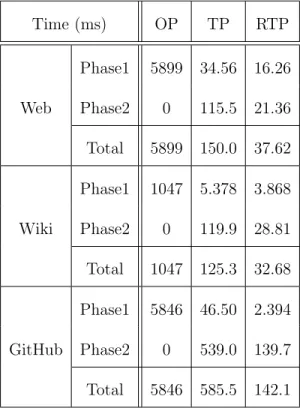
2.2 Query processing time in milliseconds when the search index is preloaded to memory. . . 56
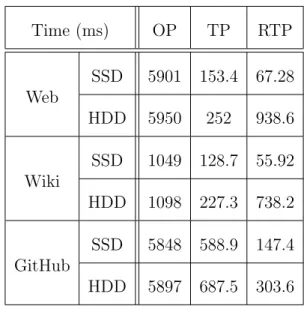
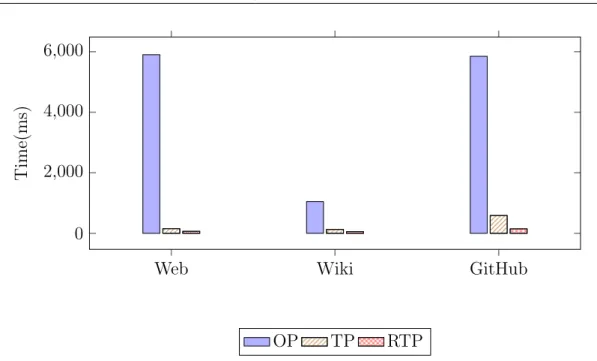
2.3 Query processing time in milliseconds including the index load cost from an SSD or HDD. . . 57
2.4 Cost distribution of RTP at Phase 2 . . . 62
2.5 In-memory search time with different options for Phase 2.. . . 62
2.6 Phase 2 index size of different options . . . 64
2.7 Phase 2 index size of different structures . . . 64
2.8 Relevance scores of RTP compared with the other methods in terms of vNDCG@10 for different k values and K=k*V . . . 67
2.9 Word coverage of the four representative selection methods . . . . 69
3.1 Cases of cache miss ratios for areaSandDwhen fit different levels of cache. . . 87
3.2 Scoring time per document per tree in nanoseconds for five algo-rithms. Last column shows the average scoring latency per query in seconds under the fastest algorithm marked in gray. . . 92
4.1 Cost of DSD when 1 scorer fits in L1. . . 115
4.2 Cost of SDS when 1 feature vector can fit in L1. . . 120
4.3 Cost of DSDS when 1 feature vector fits in L1. . . 129
4.4 Cost of SDSD when 1 score fits in L1.. . . 138
4.5 The vector counts for fitting in differnt cache levels. . . 146
4.6 The tree counts for fitting different cache levels. . . 147
4.7 Scoring time of one vector per tree in nanoseconds for different cache blocking range cases. . . 151
Introduction
Organizations and companies archive many versions of digital data such as web pages, internal emails, source code, test data, and multimedia documents. Such data is critical for internal investigation, regulatory compliance, and electronic discovery [40]. For example, it is estimated that electronic discovery market that leverages archival data will reach $9.9 billions globally in 2017 [90].
It is not uncommon for many businesses to retain archived collections for 10 to 15 years and in some industries the retention periods may be as long as 100 years or more [42]. A long period of data retention implies many versions may have to be maintained. The size growth of an archival dataset also becomes rapid with advancements in cloud computing, content authoring, media sharing, and low-cost computer devices. Organizations also frequently backup their data. One
of the largest archival databases is Internet Archive [64] which has collected and preserved more than 376 billion web pages in the last decade with tens of petabytes of data.
Can backup files be used as an archive - all the information is in there, isn’t it? It is; however there is a big difference between backup and archiving [63]. Backups are designed for recovery while archives require a sophisticated support for information retention, discovery and search. Discovery requirements grow every year, and backups simply cannot meet them. Archives are critical for some unanticipated legal or regulatory event and help discover details of information.
Recently several companies have been developing an integrated backup and archiving solution. For example, EMC data domain [41], NetApp [82], HP [61] and IBM SmartCloud Archive [94] are developed to consolidate backup, archive, and disaster recovery with high-speed, inline deduplication. However, still efficient support for complex search and analysis on archival data is not extensively studied and there are limited progress in this field.
To meet the above challenge, we present a representative cluster-based two-phase framework as the new versioned search architecture. Also, among the dif-ferent pieces of a search architecture, one of the most important components that we take into attention is the online ranking part. Ranking is the key component
because it is the core of online service and online service is the one that faces users directly.
Ensemble-based machine learning techniques have been proven to be effec-tive for dealing data-intensive applications with complex features and document ranking is a representative application benefiting from use of the large number of ensembles. For example, in the Yahoo! learning-to-rank challenge [33], all winners have used some forms of gradient boosted regression trees, e.g. [48]. The total number of trees reported for ranking can be upto 3,000 to 20,000 [52, 24, 53], or even 300,000 or more using bagging method [87]. Ranking for large ensembles is expensive. As reported in [99], it takes more than 6 seconds to rank the top-2000 results for a query processing a 8,051-tree ensemble and 519 features per docu-ment on an AMD 3.1 GHz core. If such an algorithm is used to compute scores for a large number of vectors in applications such as classification, the total job is also very time consuming. It takes even more time for a larger ensemble or for more candidate documents. The ranking process can be parallelized and the time can be reduced. However, it does not help for improving query throughput because less queries are processed in parallel. To tackle this problem, we pro-pose a cache-conscious ranking framework to improve query throughput without affecting ranking accuracy.
1.1
Dissertation Overview
My research work aims to address the above challenges in multi-version search and cache-conscious ranking optimization, and the statement of the dissertation is as follows:
By proposing a versioned data search framework combined with cache-conscious ensemble ranking, we can build new systems to meet challenges from scalability, efficiency and accuracy.
Driven by the statement, the following are the three goals of this dissertation. Firstly, we take an overall look at the whole multi-version search problem, and pro-pose a solution to versioned search using a hybrid indexing representative-guided two phase architecture. Then, we look into the ranking component of the online part of the search architecture by proposing a cache-conscious 2D method, which can improve ranking speed significantly comparing the state-of-the-art baseline method. Finally, since parameter setting in our 2D algorithm is huge important but it takes too much time using a brute force method, to guide our parameter setting, we propose a cache-analysis framework to help sample and select the best parameters efficiently. In the following, we briefly introduce the work included in this dissertation.
1.2
Multi-version Search System
The previous work on versioned data has studied the compression algorithms to identify shared data fragments among different versions [118]. Even though the index space for a versioned data collection can be compressed dramatically through fragmentation and deduplication, it is still time consuming to search the full index structure because a search procedure still has to deal with a large number of documents with many versions. A two-phase approach [56, 89] has been proposed to find top results first using a non-positional index and then rerank the selected top results with a positional index. Still there is a large number of versions to go through in Phase 1 even without a positional index.
This work is focused on processing conjunctive keyword queries on versioned datasets and our key idea is to extend the concept of cluster-based retrieval [4, 73, 75, 106] for representative-guided two-phase search and develop a per-cluster hybrid index to localize data access at Phase 2. Using representatives of docu-ment versions with full positional information reduces the number of top clusters needed to retain a good relevancy. The tradeoff is that Phase 2 requires mem-ory caching of index or the use of solid state drives (SSD). To speedup Phase 2 search, we develop hybrid per-cluster indexing with adaptive traversal of forward and inverted structure. Our evaluation shows that the proposed scheme is up-to
about 4x as fast as the two-phase approach [56] when the search index is available from memory or from an SSD.
1.3
Cache-Conscious Runtime Optimization for
Ranking Ensembles
Computing scores from a large number of trees is time-consuming. Access of irregular document attributes along with dynamic tree branching impairs the effectiveness of CPU cache and instruction branch prediction. Compiler optimiza-tion [13] cannot handle complex code such as rank scoring very well. For example, processing a 8,051-tree ensemble can take up to 3.04 milliseconds for a document with 519 features on an AMD 3.1 GHz core. Thus the scoring time per query exceeds 6 seconds to rank the top-2,000 results. It takes more time proportionally to score more documents with larger trees or more trees and this is too slow for in-teractive query performance. Multi-tree calculation can be parallelized; however, query processing throughput is not increased because less queries are handled in parallel.
Tradeoff between ranking accuracy and performance can be played by us-ing earlier exit based on document-ordered traversal (DOT) or scorer-ordered traversal (SOT) [26], and by tree trimming [11]. The work in [12] proposes an
architecture-conscious solution called VPred that converts control dependence of code to data dependence and employs loop unrolling with vectorization to reduce instruction branch mis-prediction and mask slow memory access latency. The weakness is that cache capacity is not fully exploited and maintaining the lengthy unrolled code is not convenient.
Unorchestrated slow memory access incurs significant costs since memory ac-cess latency can be up to 200 times slower than L1 cache latency. How can fast multi-tree ensemble ranking with simple code structure be accomplished via mem-ory hierarchy optimization, without compromising ranking accuracy? This is the focus of this work.
We propose a cache-conscious 2D blocking method to optimize data traversal for better temporal cache locality. Our experiments show that 2D blocking can be up to 620% faster than DOT, up to 245% faster than SOT, and up to 50% faster than VPred. After applying 2D blocking on top of VPred which shows advantage in reducing branch mis-prediction, the combined solution Block-VPred could be up to 100% faster than VPred. The proposed techniques are complementary to previous work and can be integrated with the tree trimming and early-exit approximation methods.
1.4
A Comparison of Cache Blocking Methods
The previous work addressed the speedup of runtime execution for ensemble-based ranking in several aspects including tree trimming [11] for a tradeoff of ranking accuracy and performance, earlier exit [27], and loop unrolling [12], and ensemble restructuring for a tree-based model [76]. Memory access can be 100x slower than L1 cache and un-orchestrated slow memory access incurs significant cost, dominating the entire computation. The work shown in [99, 76] proposes a cache-conscious blocking method for better cache locality. However, there are other block methods to select and it is an open problem how to identify the best cache blocking method and parameter settings given different data and architec-ture characteristics.
Experimentally determining this choice can be extremely time-consuming and the comparative result may not be valid any more with a change of underlying feature vector structure or architecture. This work provides an analysis of multi-ple blocking methods with different data traversal orders, which provides better insight on program execution performance and leads a fast approximation to select the optimized structure.
Here, we consider the fast computation of ensemble-based scoring that ag-gregates and derives final scores for n feature vectors using m ensembles. For testing and comparing performance in ranking q sampled queries, the time cost
for searching through all combinations can be as high asO(m2∗n2∗q). The main
contribution of this work is to develop an analytic framework to compare memory access performance of data traversal under multi-level caches to find the fastest program execution with effective use of memory hierarchy. Our scheme results in a much smaller complexity withO(m∗n∗q). Our experiments with three datasets corroborate the effectiveness of search cost reduction while the guided approxi-mation identifies a highly competitive blocking choice. We also demonstrate the use of this scheme with QuickScorer [76] and for batched query processing.
1.5
Contributions
In this dissertation, there are three key contributions to the study of multiver-sion search with cache-conscious ranking optimization.
• Firstly, we design and propose a hybrid indexing representative-guided two phase architecture. In particular, the main constribution is a hybrid index-ing method with adaptive runtime traversal in supportindex-ing fast two-phase versioned data search and an integration with cluster-based retrieval using guided representatives. Our evaluation with a prototype implementating using three datasets shows that we can be up-to 4.12x as fast as the baseline method.
• Secondly, we propose a cache-conscious design for computing ranking scores with a large number of trees and/or documents by exploiting memory hier-archy capacity for better temporal locality. Multi-tree score calculation of each query can be conducted in parallel on multiple cores to further reduce latency. The 2D method proprosed increase efficency tremendously but do not affect accuracy. Our experiment results show that we can be 50% faster than VPred, which is the state-of-the-art method in this field.
• Lastly, we develop a fast comparison and selection scheme to find an opti-mized cache blocking method for the 2D method we proposed with guided sampling. Our analysis estimates the data access cost of different meth-ods approximately, which provides a foundation to select sampling points in comparing different methods and in narrowing search space. By using this selection framework, we can reduce the parameter finding time from thousand of years using brute force or tens of days using naive sampling to several hours.
1.6
Thesis Organization
In Chapter 2, we describe the design of the multi-version search system. We begin with the background of fragment-based index and introduce the necessity of using it. Then, we talk about our design considerations and present the cluster-based two-phase versioned search framework. After that, we elaborate our al-gorithm on choosing representatives, and we talk about our hybrid per-cluster indexing and traversal methods in detail. Finally, we give evaluations results on three datasets to show the advantage of our two-phase search architecture.
In Chapter 3, we present the 2D cache-conscious runtime optimization algo-rithm for ranking ensembles. We begin with the state-of-the-art famous learning-to-rank algorithm Gradient Boosted Regression Tree, and point out the possiblity to increase ranking efficiency by exploiting data/model cache locality. Then, we introduce different traversal patterns and talk about their data access difference. After that, we present our 2D block algorithm which can achieve much better cache locality by partitioning data and model into small blocks. Finally, we give our evaluation results to show the significant speedup of the proposed algorithm. In Chapter 4, we elaborate our efforts in introducing a comparative analysis framework on different blocking methods. We begin with the design considerations and introduction of different blocking methods: DSD, SDS, SDSD and DSDS. Next, we give thorough cost analysis on each method under different scenarios. Then,we do a cost comparison and present our algorithm in choosing best method
and parameters. Finally, we show in the experiments that our analysis is indeed helpful in choosing parameters efficiently. We also provide evidence that our framework is a generatic one: it not only fits our 2D block algorithm, but also can be used on other algorithms like QuickScorer.
At the end of the dissertation, we conclude the work, and discuss future direc-tions.
Multi-version Search System
2.1
Introduction
Organizations and companies archive many versions of digital data such as web pages, internal emails, source code, test data, and multimedia documents. Such data is critical for internal investigation, regulatory compliance, and electronic discovery [40]. For example, it is estimated that electronic discovery market that leverages archival data will reach $9.9 billions globally in 2017 [90]. It is not un-common for many businesses to retain archived collections for 10 to 15 years and in some industries the retention periods may be as long as 100 years or more [42]. A long period of data retention implies many versions may have to be maintained. The size growth of an archival dataset also becomes rapid with advancements in
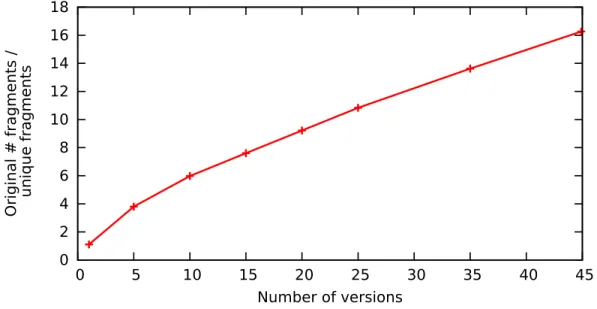
cloud computing, content authoring, media sharing, and low-cost computer de-vices. Organizations also frequently backup their data. One of the largest archival databases is Internet Archive [64] which has collected and preserved more than 376 billion web pages in the last decade with tens of petabytes of data. Can backup files be used as an archive - all the information is in there, isn’t it? It is; however there is a big difference between backup and archiving [63]. Backups are designed for recovery while archives require a sophisticated support for informa-tion reteninforma-tion, discovery and search. Discovery requirements grow every year, and backups simply cannot meet them. Archives are critical for some unanticipated legal or regulatory event and help discover details of information. Recently sev-eral companies have been developing an integrated backup and archiving solution. For example, EMC data domain [41], NetApp [82], HP [61] and IBM SmartCloud Archive [94] are developed to consolidate backup, archive, and disaster recovery with high-speed, inline deduplication. Efficient support for complex search and analysis on archival data is not extensively studied and there are limited The pre-vious work on versioned data has studied the compression algorithms to identify shared data fragments among different versions [7, 19, 22, 34, 56, 57, 58, 60, 118]. Figure 2.1 depicts the original number of fragments divided by the number of unique fragments for a GitHub dataset we have tested when varying the number of versions per document. The result shows that the majority of fragments can be
removed in the search index since they are duplicates and this corroborates the importance of exploiting fragment-based compression.
0 2 4 6 8 10 12 14 16 18 0 5 10 15 20 25 30 35 40 45 Original # fragments / unique fragments Number of versions
Figure 2.1: The ratio of the total number of fragments over the unique fragments in a GitHub dataset
Even though the index space for a versioned data collection can be compressed dramatically through fragmentation and deduplication, it is still time consuming to search the full index structure because a search procedure still has to deal with a large number of documents with many versions.
A two-phase approach [56, 89] has been proposed to find top results first using a non-positional index, which represents a tradeoff of relevance and search cost, and then rerank the selected top results with a positional index. The weakness of
the existing work on versioned data is that still there is a large number of versions to go through in Phase 1 even without a positional index.
This chapter is focused on processing conjunctive keyword queries on ver-sioned datasets and our key idea is to extend the concept of cluster-based re-trieval [4, 73, 75, 106] for representative-guided two-phase search and develop a per-cluster hybrid index to localize data access at Phase 2. Using representatives of document versions with full positional information reduces the number of top clusters needed to retain a good relevancy. The tradeoff is that Phase 2 requires memory caching of index or the use of solid state drives (SSD). To speedup Phase 2 search, we develop hybrid per-cluster indexing with adaptive traversal of for-ward and inverted structure. Our evaluation shows that the proposed scheme is up-to about 4x as fast as the two-phase approach [56] when the search index is available from memory or from an SSD.
The rest of this chapter is organized as follows. Next, we describe the back-ground information and related work. Section 2.3 discusses design considerations in adopting cluster-based retrieval for searching versioned documents with repre-sentative guidance. Section 2.4 discusses the hybrid indexing and search options for fast Phase 2 query processing. Section 2.5 presents our experimental results on three real datasets which shows the accuracy and efficiency of the proposed techniques. Finally, Section 2.6 concludes the chapter.
2.2
Background and Related Work
In this section, we will provide background and related work. Firstly, we will discuss multiversion data index, which is on how to create index on archival data. Specifically, we will discuss non-positional index and positional index. Then, traditional data search and multiversion data search will be discussed, which is about how to retrieve search results on archival data. Fragment-based index will also be introduced here, which is the data structure we will work on in this chapter. Finally, we provide background information on documents clustering because it is highly associated with our cluster-based index.
2.2.1
Multiversion Data Index
The key data structure of document search is the inverted index. [121] is a detailed survey of related research work on inverted indexing. Given a data collection with n documents, the non-positional inverted index stores a posting for each term which is a list of document IDs that contain this word. When each posting also contains the position information of a term in each appeared document, this inverted index is called positional inverted index. Otherwise, it is called a non-positional inverted index. The index can also contain other weight information such as term frequency and document frequency. Here in our work,
we will use positional index which includes both frequency and offset for each word.
Since there is such high redundancy among versioned documents and such a large volume of data, compression is necessary for efficient index storage. For example, our experiment shows that the redundancy ratio can be more than 99.3% for large archival data such as the Linux kernel code on GitHub with 439 versions. Thus there is an up to 143:1 or more storage reduction with the deployment of advanced compression techniques.
Recent researches on multiversion data indexing can be divided into two cat-egories: non-positional indexing and positional indexing. We will discuss about them separately as below.
Non-positional multiversion data indexing: There are a number of pre-vious research work on non-positional index which only includes non-positional information. Comparing positional information, non-positional information dicates if a text word appears in a document or not while the positional in-formation further captures the location of text words appeared in a document. The use of positional information is critical when query relevancy is sensitive to the proximity of query words matched in a document, but it incurs signifi-cant search cost. Non-positional indexing for searching versioned data is stud-ied in [7, 19, 22, 34, 57, 58, 60]. Numbers in the index are compressed
fur-ther [6, 92, 113, 122]. One approach for the versioned compact index by Broder et al. [22] considers content sharing patterns among versioned documents with a tree structure and this work is further extended by Herscovici et al. [60] based on multiple sequence alignment. While this work does not address the positional information, some of their ideas can be leveraged in our work in computing the posting intersection within each document version cluster.
Another approach by Claude et al. is based on run-length, Lempel-Ziv or grammar-based compression with self-indexing [34] and the grammar-based com-pression such as re-pairing is also used for the document listing problem which searches substrings or phrases in versioned documents [35, 45, 50]. Most of these methods use index compression algorithms like OPT-PDF in [114], PForDelta in [59, 123] and so on [6, 93, 110].
Positional multiversion data indexing: Positional versioned data indexing is studied in [118, 34, 56]. The work of Zhang and Suel [118] uses the content-dependent partitioning method such as Winnowing [91] and 2MIN [101] to divide a versioned document into fragments and then each unique fragment after duplicate detection is only indexed once. The above partitioning technique is related to landmark-based indexing proposed by Lim et al. [74] for efficient index update when document content is changed. Duplicate detection is done by computing a
hash value for each fragment and comparing it with those of the already indexed fragments.
In [118], the idea is that firstly using a content-dependent string partitioning method to partition a whole document into several substrings; then, positional index is built on each fragment instead of the whole document. Using the stored information related between fragments and documents, the algorithm can easily infer the docID, frequency and offsets of a given term. The benefit of partitioning a whole document into substrings is that for multiversion data, documents between versions have lots of content overlapping. Therefore, a large number of substrings can be reused by many documents/versions, which saves both indexing space and time. As to the content-dependent string partitioning method, there are a number of related work [91, 62, 72, 81, 96, 97, 101] in OS, networking and many other fields. In [118], the author uses the Winnowing approach in [91] and 2MIN method [101] is used in [56] to do the content-based partition. The advantage of these partition methods is that in a large probability, a random insertion or deletion in the document will only affect one fragment. Thus, there will be a large number of common substrings between versions. An improved content partitioning and compression method is discussed in [56, 34].
A later work in [56] describes a complete framework for full-text positional in-dexing. Inheriting from [118], they develop several improved partition algorithms
by exploiting knowledge of the edit history of a document. The results show significant improvement compared to previous work.
On the other hand, the related work in [34] uses different methods such as run-length, Lempel-Ziv or grammar-based compression to reduce positional index size and indexing time.
2.2.2
Traditional Search
User experience is largely dependent on searching accuracy and the overall time consumed in the searching phase. Compared to the indexing phase which is offline, the online searching phase plays an important part in user experience. The searching problem is that given a query q={t0, t1, ..., tn} which is composed
of n terms, how to return the top m documents which are most relevant to the query. A function F(d, q) which accepts one query q and one document d at a time and returns a relevance score is called aranking function. Ranking functions vary from simple ones like BM25, Cosine, Okapi to some complex learning models such as AdaRank, Rankboost, and LambdaMART. However, no matter what ranking function is, it needs to use information from inverted index such as docID, frequency and positions. We refer to [121] as an overview of traditional searching methods.
Simple ranking functions like Cosine and BM25 is based on non-positional inverted index. Only information such as docID, term frequency and document length is needed to compute ranking score. For each document, after the score of each term is calculated, an intersection step will combine all the scores of all terms in the query and provide the final score. An early work [71] presents a DAAT algorithm to do fast intersection. However, it is proved that considering positional information in the searching phase, more accuracy ranking results can be achieved [79]. Thus, in this work, we develop our searching algorithm based on positional index.
2.2.3
Multiversion Data Search
According to our investigation, although there are several recent papers on range query and query operations on versioned data [5, 54, 104], only a few amount of work is about standard ranking problem in multiversion positional data [89, 118, 56].
We adopt the fragment-based redundant content compression [118, 56] because fragments explicitly capture positional information and also because the work by He et al. [56] shows that it has a higher compression ratio than that of [34]. Grammar-based compression techniques [34, 50, 45, 35] have been used for phrase queries and we are more interested in exploiting more general positional
infor-mation. It is possible to adopt some of such techniques in version cluster index compression and this can be considered in the future work. While the tree-based compression or sequence alignment technique for content sharing [22, 60] does not address the positional information, some of their ideas are leveraged in our work for computing the posting intersection within each document version cluster.
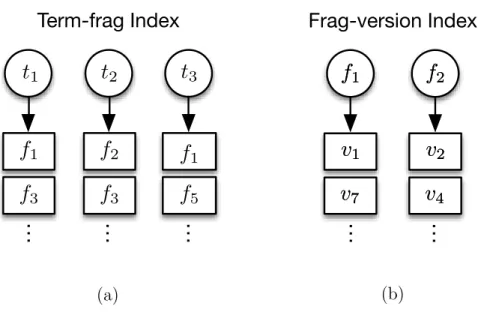
We illustrate the fragment concept in more details as follows. Once a page is represented by a set of fragments instead of terms directly, the inverted index contains fragments in its compressed data layer. The posting for a term is a set of fragments instead of a page list and there is another data structure that maps a fragment to a set of page IDs that use this fragment. This data structure is causedfragment-page reusetable [118]. Noted that the above index structure can be augmented with term frequency information. Figure 2.2(a) is an example of the term-to-fragment index, following the compression scheme in [118, 56]. Each document version is divided into a set of fragments. The inverted index shows a list of fragment IDs that contain a term represented by a term ID. In this example, term “t1” is in fragments f1, f3, and others. Figure 2.2(b) shows an example of the fragment-to-version reuse table which is the list of page IDs that use this fragment. In this example, fragment f1 is used by document versions v1, v7, and so on.
t
1f
1f
3…
t
3f
1f
5…
t
2f
2f
3…
Term-frag Index
(a)f
2f
2v
2v
2v
4v
4…
f
1f
1v
1v
1v
7v
7…
Frag-version Index
(b)Figure 2.2: (a) Term-fragment inverted index. (b) Fragment-version reuse table that lists versions sharing each fragment.
The above compression for versioned data does make inverted indices more complex and its data layout increases the cost of data traversal during document matching. In [118], the search algorithm first identifies a set of fragments that con-tain a query term and then uses the fragment-page reuse table to locate versions containing each term and the offset of each occurrence within the versions. The in-tersection for processing multiple conjunctive query words is arranged accordingly and those version pages which contain all the query terms are scored and ranked. The advantage of using the compact page-fragment-term structure is a substan-tially smaller index compared to the standard document-term inverted index. On the other hand, the intersection of multiple postings takes more resources by going
through the term-fragment-page mapping. For example the tradition intersection algorithm can take advantges of sorted document IDs by employing skipper or other posting auxiliary data structure while the fragment index cannot. Compar-ing searchCompar-ing on the index which is directly built on full versions of all pages, this method is much faster because the index is much smaller by exploiting content redundancy. However, this algorithm still cannot satisfy user’s needs because the job of searching on position data itself is too expensive.
Instead of fetching on all the data D, [89] proposes a method of using a non-positional index in the first phase and then search on the non-positional index of a much smaller dataset Dsmall. In the first step, a simple ranking function is used
to retrieve a top-k0 results. After that, a complex ranking method is applied but only on the positional data of the top-k0 results from the previous step. Finally, the top-k results are generated.
The work by He and Suel [56] extends the fragment-guided two-phrase search based on [89, 118]. Phase 1 uses non-position index while Phase 2 contains de-tailed position information. In their first phase, they implemented a two-level index structure called 2R-MSA from [58]. Runtime query processing searches non-positional inverted index first to retrieve the top K results and then re-rank these top K results by accessing the full positional index of these versions. The above two-phase search is motivated by the earlier research on cluster-based
re-trieval [4, 106, 75] for non-versioned documents. Using a non-positional index at Phase 1 is also motivated by relevancy studies [9, 10] and the argument is that having a sufficiently large number of top K at Phase 1 without positional infor-mation can still deliver a good relevancy. Still there is a large number of versions to go through even without positional index.
2.2.4
Documents Clustering
Since our method uses document clustering to choose representative, at the last part of this section we briefly discuss some recent work on documents clustering here.
Document ranking using cluster-based retrieval and language models is studied by Liu and Croft [75], and cluster ranking is addressed by Kurland and Krikon [73]. Index optimization for cluster-based retrieval for traditional disk storage is studied in Altingovde et al. [4]. We revisit the cluster-based retrieval techniques as the storage seek overhead of random access has been reduced significantly with today’s SSDs. The recent work for searching non-versioned data in Bai et al. [18] considers the use of flash-memory drives to store the per-document forward index. We exploit adaptive use of hybrid cluster-specific index structure.
2.3
Cluster-based Retrieval with
Representatives
Deduplication reduces the storage demand significantly in archiving raw doc-uments and creates opportunities for highly efficient versioned data search since there are highly repetitive content among different versions of documents. To maintain the efficiency of search, our proposed algorithm continue uses a two phase design while using the positional index in both phases to improve the relevance for conjunctive queries. In this section, we first discuss our design considerations. Then, we talk about how to choose cluster representatives in detail.
2.3.1
Design Considerations
Our objective is to develop a faster search scheme with much faster query processing time, especially when there is a large number of versions. Our design considerations are discussed as follows.
• Since versions of documents have highly repetitive content, most likely there exists a version or a composed version that could capture the majority of text features for many versions of each document. Our work is motivated by the cluster-based retrieval [106, 75, 73, 4] which was proposed to rank non-versioned data by exploiting document similarity in clustered results.
For versioned datasets, exploiting document similarity can be more impor-tant to reduce search time because of high similarity among versions of documents. Thus we adopt the concept of the cluster-based retrieval and consider versions of a document as a group. We compose a representative which captures positional and non-positional information for each version cluster to facilitate cluster ranking. A phased search can start with a set of representatives instead of the entire document collection. The clustered index with representative-guided search can quickly narrow the search scope and results in a big reduction of search time, even there are a large num-ber of versions with similar content. Since the numnum-ber of representatives is modest after removing the versioning effect, it is not necessary to avoid positional information in Phase 1 index and save index space cost. This ap-proach can also improve the diversity of ranking results so that results from one document with many versions will not dominate the entire ranking.
• There is a storage access cost to retrieve cluster-specific information for each selected cluster at Phase 2. For non-versioned data, the work in [4] studies a per-term cluster posting so that the number of disk seeks is controlled as the number of query words. We can extend this work to build per-term index structure for versioned documents, but the repetition of cluster information from one term to another becomes extremely large. Consider
the SSD storage with low seek time (e.g. 0.1 ms) is getting popular, we can afford to access a modest number of clusters dynamically.
• Fragment-based index compresses versioned data significantly while runtime index traversal becomes slow in order to fetch positional information access during Phase 2. This gives opportunities for optimization and we will present a hybrid indexing solution that combines the strength of forward and in-verted index. This follow-up phase can be conducted to identify the individ-ual document versions with a high rank within each selected group. Noted that the two-phase search for a general non-versioned dataset [9, 10] consid-ers the tradeoff of performance and relevancy by deploying non-positional index in the first phase of search. While it is true, choosing a large top
k number in first phase exposes most of relevant documents for Phase 2 search. But using popular words in a query can match most of documents in a collection, as a result, Phase 1 narrowing without using positional in-dex becomes meaningless for a large data collection when a very large k
is selected. The relevancy impact without using positional index in Phase 1 is more serve for versioned datasets because of highly repetitive content. The representative-guided approach with a small core index supports more flexibility for obtaining better relevancy.
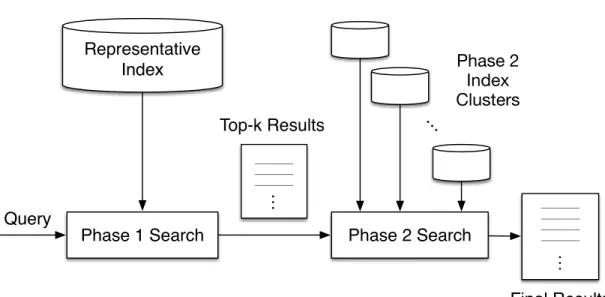
Phase 1 Search Phase 2 Search Representative Index Query … Phase 2 Index Clusters Top-k Results Final Results ________ ________ ________ … ________ ________ ________ ________ …
Figure 2.3: Representative-guided search workflow for query processing
• Clustering of similar content and the construction of a representative for a group deserves careful research studies. We would like this representa-tive document to catch terms that appear in different versions of the same document. We will elaborate this in the next subsection in detail.
The two-phase query processing workflow is depicted in Figure 2.3. The first phase is going through the representative index and retrieving the top k rep-resentatives. The second phase is searching on the related index clusters and aggregating the matched results from these clusters. Both phases use positional information. Algorithm 1 lists the search procedure. Since each document has many versions, to ensure diversified results, we restrict the number of versions
shown for each document in the final result list and a user can select a document and view more versions of the same document if interested.
1 Phase 1
2 Find top k document clusters that match queries. 3 Phase 2
4 Fetch k cluster-specific index. 5 for each selected cluster do
6 Find document versions that contain conjunctive query terms.
7 Fetch positional and non-positional information to form rank features
and scores.
8 end
9 Select top document versions from all clusters based on ranking scores Algorithm 1: Two-phase search with cluster-base retrieval for versioned documents.
Representative and final result ranking. For a standard text document search system, there are many ranking signals that can be extracted or charac-terized for each matched document in processing a query [3, 88, 115]. Those signals need to be aggregated, and their weights can be imposed empirically or derived using a machine learning method (e.g. LambdaMART [111]). We follow the previous work in text ranking with proximity (e.g. [17, 25, 68, 98, 100, 120,
119, 111, 116, 112, 75, 73]). Our study focuses on the construction of index that can provide basic ranking features which can be used to compose scores for these ranking schemes. The text features for ranking include BM25, query word span, query word co-occurrence, and query word minimum distance based on the previ-ous work in text document ranking with proximity [17, 25, 68, 98, 100, 120, 119]. Weights of non-positional text features and proximity features are differentiated by where matched query words appear in the fields of a document like title or body. Since each document has many versions, to ensure diversified results, we restrict the number of results shown for each document version group in the final result listing and a user can select a group and view more versions of the same document if interested.
2.3.2
Cluster Representatives
To aid the top k ranking of clusters at Phase 1, we compose a representative for each cluster to provide essential ranking features. The representative for each version group is a superdocument that is artificially composed from a specific version of a document. Our objective here is to create a superdocument that includes terms that appear in all versions of a document while capturing the majority of distance relationship among these terms.
The position information of a representative superdocument is built based on the longest version. More specifically, letsi be the super document for document
di with m versions. Denote these versions as vi,1, vi,2 ... vi,m. Let vi,l be the
longest version for di. Let T(si) be the set of terms included in super document
si. Let P os(t, si) be a position information set for term t inT(si). The index for
representatives with the longest version is defined as
t∈T(si) if ∃j,1≤j ≤m and t∈T(vi,j). P os(t, si) = P os(t, vi,l) if t∈T(vi,l) ∞ if t∈T(si)−T(vi,l).
Namely for the extra terms in set “T(si)−T(vi,l)” added to the superdocument we
will treat the appearance of these terms in an unknown position with the∞offset value. In the ranking process for document retrieval, a position with the∞value will not contribute to the position related weight in the final score aggregation. We can also consider other options to form a superdocument, for example, based on the latest version.
A representative contains terms from all versions, and thus there is a false positive error occurred during Phase 1 keyword matching. Some positional infor-mation is not precise because some sentences are obtained from various versions. Based on our experiment results, we observe that representatives do not introduce significantly more new words. The false positive error introduced in Phase 1 is
fairly small. In the second phase, the search algorithm makes an accurate as-sessment of term appearance in all versions for the matched representatives from Phase 1 to correct errors if there is one.
The above method tries to capture positional information as much as possible from all versions while using a reasonable amount of space. There is a tradeoff here that it cannot capture all positional information. A future study includes the con-sideration of clustering of similar versions from the same or different documents. We expect a good similarity clustering with proper representative construction can improve the accuracy.
During offline data processing, each document version is divided into frag-ments using a content partitioning algorithm called TTTD (Two Thresholds Two divisors) based on the work of [43, 80], which is a similar but faster method comparing the ones used in [118, 56]. Since content redundancy among represen-tatives is modest or less significant, we can use the traditional index structure for representatives without using fragments for simplicity and efficiency.
Note that the meta information for each version of a document also contains a timestamp. The time data will be useful for user queries containing temporal constraints. The offline index may also be partitioned based on a coarse-grained time interval to optimize the index search if that matches the users’ query pattern. Studies on versioned data search with a time range are in [19, 55, 105]. This work
focuses on conjunctive query processing and the time range can be added as a filter in the search process.
2.4
Hybrid per-cluster Indexing and Traversal
Phase 2 query processing needs to identify document versions from selected clusters that really match required keywords, and compute a ranking score. It would be more expensive to compute scores for all versions and then filter out those that do not contain all conjunctive keywords. We discuss how to gather basic feature data from the index for intersection and scoring below. The basic feature data includes the positional information of each term in a version and frequency information can be derived from this process if it is not explicitly stored. As we adopt the fragment-based compression in the per-cluster index with the positional information, one option is that an intersection algorithm uses the term-fragment list and looks up a term-fragment-version reuse table dynamically to determine if all conjunctive query words included in an version. From our experiments, we find the dynamic conversion is very time-consuming. The versions derived from the fragment-version reuse table do not follow a sorted relationship. It is much faster to construct the term-version posting first before performing the intersection operation and how to optimize the traversal of index data structure is the key to accomplish a low search time.
2.4.1
Indexing and Search Options for Phase 2
We discuss two indexing options first with different time and space tradeoffs in considering the traversal of cluster-specific inverted index or forward index and then design a hybrid option.
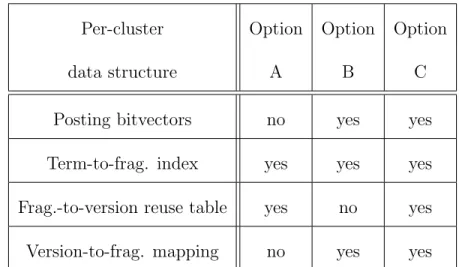
• Option A: Each posting list of a term in a version cluster index is composed of fragments and the positions of this term in each fragment. The runtime search process extracts this list from the term-fragment index and traverses a per-cluster fragment-version reuse table to reconstruct a term-version post-ing with positions for each term. This derived term-version postpost-ing includes the positional and frequency information and after that, a multi-keyword intersection is conducted using such postings.
In detail, we extract the term-posting with positional information from the inverted term-fragment index and fragment-version mapping. There is a performance challenge in utilizing the fragment-based index in each docu-ment group for posting interestion. From the term-fragdocu-ment index, we can get a list of fragments which contain the query term. After a set of docu-ment versions that contain the matched query words is derived, each group uses the term-fragment index to obtain a list of fragments that contain a
word. Then we use the fragment-version mapping to obtain the positional information for these matched versions.
For example with query “arabic number”, we will get two fragment lists: one for “arabic” and the other for “number”. Then by checking the fragment-version reuse table, we reconstruct a term-fragment-version positing with positions for both “arabic” and “number”. After that, a multi-keyword intersection is conducted and ranking is done as the last step to return the final top k results.
• Option B: Compared to Option A, this option adds the extra storage space overhead to explicitly store the term-version posting of each term, and a version-fragment forward index, but it does not need to maintain the local fragment-version reuse table. As the version posting of each term with-out positional information is available in advance, the intersection of term postings can be conducted quickly first without a need to dynamically re-construct such postings. Once a set of matched versions is derived through the intersection, the query-time process derives positional information by finding all fragments included in these versions through the forward index, and then by using a binary search on a term-fragment posting to extract the positional information of each term at each document version.
For example, given query “Marine Science”, for each version cluster derived from Phase 1, we directly use the term-version postings of “Marine” and “Science” to conduct an intersection. Assumev1 and v2 contain both terms,
then we use the version-fragment forward index to identify possible frag-ments and their positions in v1 and v2 that may contain each term. Finally
a binary search using the term-fragment postings of “‘Marine” and “Sci-ence” identifies the text positions in real fragments that truly contain these two words.
A detailed discussion of data structure choices of above two options is in Sec-tion 2.4.3 summarized in Table 2.1. There is a time and space tradeoff between Option A and Option B. Option B can be faster than Option A in many cases while it does use slightly more space. On the other hand, Option A can outper-form Option B some time, for example, queries using rare terms. We model the time cost of Options A and B as follows.
T imeCostA=k·(Γ + q X i=1 fi·µi·ρi·τ + Π), and T imeCostB =k·(Γ + Π + q X i=1 m·γ·(log(fi) +ρi)·τ) where
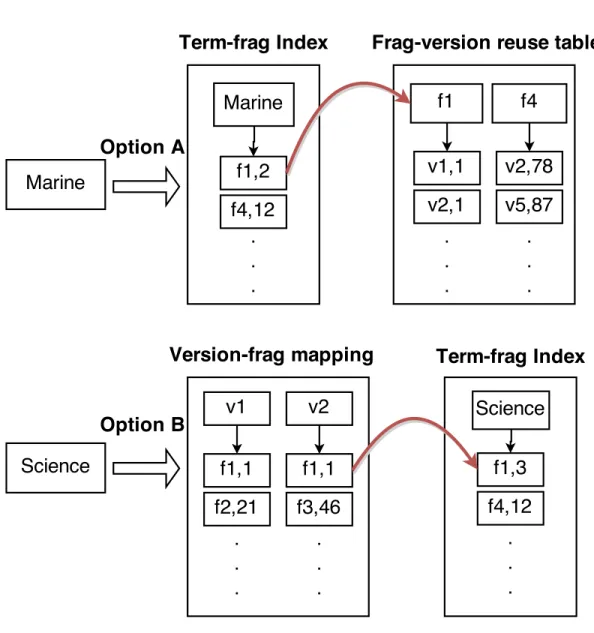
Figure 2.4: An example of data traversal in Option C that selects the Option A or Option B approach for each query word at each cluster.
• q is the number of query terms;
• fi is the number of fragments for term ti’s posting at a cluster;
• m is the number of matched document versions after query intersection;
• Γ is the average cost of loading a cluster index to memory from a fast storage;
• Π is the average cost of posting intersection for conjunctive keywords;
• µi is the average number of document versions using a fragment that contains
term ti;
• ρi is the average number of positions of termti in one fragment;
• γ is the average number of fragments included in one version.
• τ is the average memory access time.
The index data for each cluster is organized separately and the runtime system loads the datak times for the selected top k clusters from a fast solid state drive. For our tested applications, the data size for each cluster to be load is less than 5KB and the per-cluster index I/O time Γ is about 0.28 milliseconds or less using SSDs. The overhead is not overwhelming when fetching the index data for top few hundred clusters. Π represents the cost of intersection and we discuss this part in next subsection.
The cost of rank score computation is not explicitly included in the above formula. Different ranking methods deploy different features which can incur a different amount of time [36, 98, 100, 25, 17, 119], while we expect such a cost is in an order subsumable under the above cost formula. (e.g. [21, 49, 47, 67, 111, 116, 112]). Our experiment uses a model of query word span [98] and frequency-based BM25 score and the calculation cost is proportional to the number of query word positions appeared at each version.
From the cost model of options A and B, one can infer that if a query term
ti is rare, and fi is very small, this case favors the use of Option A. On the other
hand, if ti is a popular word, and fi is very large, this case favors Option B.
Theoretically, Option A and Option B give better performance under different scenarios depending on the value of the parameters, which differs for different datasets and different query terms. We are devising Option C that compares the relative cost ratio of Options A and B for extracting positional information and adaptively select one of them based on the characteristics of each term ti
searched in each cluster. The query-time work flow of Option C is summarized in Algorithm 2.
Figure 2.4 illustrates an example of Option C in processing the query “Marine Science”. First, the intersection finds v1 and v2 contain “Marine” and “Science”. For keyword “Marine”, the threshold condition leads to the use of Option A
traver-1 Load the cluster index and accumulate statistics.
2 Perform the intersection of version postings.
3 for each query word ti do
4 Iffi·µi·ρi ≤m·γ·(log(fi) +ρi),
5 Use the term-fragment posting of ti to get fragments and term
positions within fragments.
6 Convert into term positions within all versions by accessing the
fragment reuse table.
7 Else
8 If needed, set L as a list of fragments for all matched versions.
9 Search ti’s fragment posting to find term positions for the fragments
in L.
10 Derive term positions within matched versions.
11 end
Algorithm 2:Option C that extracts position and other meta informa-tion of the matched versions within each cluster.
sal. From the fragment posting of “Marine”, a list of fragments are found and they correspond to versions v1, v2, v5 and so on. Only v1 and v2 are acceptable from the intersection results, then the position at v1 is computed as 3 and the position at v2 is computed as 78+12 which is 90. For keyword “Science”, a different path is taken: from version-fragment mapping, v1 contains a list of fragments, such as f1 and f2. By doing a binary search on the Term-frag list of “Science”, we know in version v1 only f1 contains “Science” and position 4 is derived at version v1. We do the same procedure with v2 and position 4 is derived at version v2.
It should be noted that Option C’s decision path is cluster dependent. Namely this method selects Option A or B based on the difference of fi ·µi · ρi and
·m·γ(log(fi) +ρi) for each cluster. Thus for the same query word, one cluster
can make a selection different from another cluster. The time cost of Option C can be modeled as k·(Γ + Π + q X i=1 min(fi·µi·ρi, m·γ(log(fi) +ρi))·τ)
which is usually smaller than that of Option A or Option B.
2.4.2
Term-version Posting Intersection
Term-version posting intersection without position information is used in Op-tions B and C and we can leverage the ideas of the work in [22, 60]. When the number of versions is modest for each version cluster, the intersection to identify