Errors and misunderstandings
among novice programmers
Assessing the student not the program
Mathias Johan Johansen
Errors and misunderstandings among novice
programmers
Mathias Johan Johansen November 2, 2015
Abstract
Novice programmers make a lot of programming errors as they strive to become experts. This is a known fact to teaching faculty in introductory programming courses. The errors play a major role in both formative and summative assessment of the students. The Computer Science research of today trends towards focusing on automatic assessment of program, becoming more remote from the student who wrote the program.
In an attempt to create a better understanding of the novice program-mers and the errors they make, this thesis takes a look at the errors novice programmers produce in programming assignments and the misunder-standings that may have caused them.
We use a qualitative approach to analyze assignments, interviews and observations with 23 students of a second semester course in object-oriented programming, using Java, at the University of Oslo. 33 solutions to mandatory assignments were analyzed to identify errors. 14 students were interviewed about their solutions to identify the misunderstandings that caused the errors we identified. Nine students participated in think-aloud observations to add further insights into how students of the targeted course approach problem solving. Finally the misunderstandings are analyzed to review the feasibility of using misunderstandings to guide formative and summative assessment.
We have identified multiple student errors in both result and design. Multiple errors and misunderstandings revolved around generic class parameters, a topic that not much existing research covers.
Our findings suggest that misunderstandings considering the princi-ples of object-oriented design lead to further misunderstandings about the important aspects that must be considered to write good programs.
We did not find a feasible way to use pre-identified misunderstandings as a sole metric for assessment but believe our research may be used to help create a statistical analysis of the frequency of misunderstandings causing errors. With a larger amount of participants a study could supply examiners with an additional tool to help them gain insight into the understanding of the students they assess.
Acknowledgments
I want to thank my supervisor Ragnhild Kobro Runde for her patient guidance the past year. Thank you for all our interesting meetings where we seem to never stay on topic.
I want to thank Stein Michael Storleer, Stein Gjessing and the rest of the teaching staff of INF1010 for the spring of 2015 for helping me with questions regarding mandatory assignments, expected errors and a whole lot more. I also want to thank Kristin Broch Eliassen for her patience and help giving me quick access to assignment solutions as soon as they were delivered.
I want to thank Kristin Brænden taking the time to read my thesis and give feedback on my writing. I want to thank my family and friends for support on the days when the work with this thesis seemed to have no end. I want to give special thanks to my mother for all the feedback on a lot of the many typographic errors I have produced the last year.
Finally I want to thank everyone at the Department of informatics, especially all the awesome people in the many student associations. Thanks to you most days have been filled with laughs and funny moments. The last five and a half years have been amazing for me.
Contents
Abstract iii Acknowledgments v Preface xv 1 Introduction 1 1.1 Our goals . . . 21.2 The scope of the study . . . 3
1.3 Thesis overview . . . 3 2 Background 5 2.1 Related research . . . 5 2.1.1 Identifying errors . . . 5 2.1.2 Identifying misunderstandings . . . 5 2.1.3 Assessing programs . . . 6
2.2 Defining errors and misunderstandings . . . 6
2.2.1 Defining an error . . . 6
2.2.2 Categorization of errors and flaws . . . 7
2.3 Elements of a university CS course . . . 9
2.3.1 Learning objectives . . . 9
2.3.2 Teaching activities and learning activities . . . 10
2.3.3 Assessment . . . 10
2.4 The targeted course . . . 12
2.4.1 Intended learning objectives . . . 12
2.4.2 Course prerequisites . . . 13
2.4.3 Teaching activities and assessment . . . 13
2.5 Object-oriented programming . . . 13
2.5.1 Approaches to OOP . . . 14
3 Method and methodology 17 3.1 Possible sources of data . . . 17
3.2 Designing a qualitative study . . . 18
3.2.1 Work-logs . . . 19
3.2.2 Interviews . . . 19
3.2.3 Observations . . . 19
3.3 Methods used in this study . . . 21
3.3.2 Supplemental data collection using observations . . . 22
3.4 Interviews . . . 22
3.4.1 The choice of assignments . . . 23
3.4.2 Preparations . . . 24
3.4.3 Using retrospection . . . 24
3.4.4 Initial interviews . . . 25
3.4.5 Tools and location . . . 25
3.5 Observations . . . 25
3.5.1 The think aloud method . . . 25
3.5.2 Tools and location . . . 26
3.6 Data analysis . . . 27
3.7 Measurements for statistical analysis . . . 27
3.8 The subjects . . . 27
3.9 Handling subject privacy rights . . . 28
3.9.1 Independence from the targeted course . . . 29
3.9.2 Formal approval of the study . . . 29
3.10 Overview of the timeline . . . 30
4 Initial interviews 33 4.1 State of the targeted course . . . 33
4.2 The assignment we reviewed . . . 33
4.3 Expected student errors . . . 34
4.4 The participants . . . 36
4.5 The errors we experienced . . . 36
4.6 Issues and points of improvement . . . 37
4.6.1 Too long interviews . . . 38
4.6.2 Errors that escaped our review . . . 38
4.6.3 Too much time elapsed before the interviews . . . 38
4.6.4 The assignment was too long . . . 38
5 Second round of interviews 39 5.1 Experience from the initial interviews . . . 39
5.2 State of the targeted course . . . 40
5.3 The assignment we reviewed . . . 40
5.4 Expected student errors . . . 40
5.5 The participants . . . 41
5.6 The errors we experienced . . . 42
5.7 Issues and points of improvement . . . 43
5.7.1 The time elapsed could have been improved further . 43 5.7.2 The assignment may have been a bit too easy . . . 43
6 Think-aloud observations 45 6.1 State of the targeted course . . . 45
6.2 The exercises . . . 45
6.2.1 Limitations from the think-aloud method . . . 46
6.2.2 Limitations due to the subjects’ skill levels . . . 46
6.2.3 The chosen set of exercises . . . 48
6.4 Supplemental data collected . . . 50
6.5 Issues and points of improvement . . . 51
6.5.1 Method . . . 51 6.5.2 The subjects . . . 51 6.5.3 The exercises . . . 51 6.5.4 Tools . . . 52 7 Results 53 7.1 Omitted errors . . . 54
7.1.1 Most design flaws are omitted . . . 54
7.2 Exception errors . . . 56
7.2.1 A method throws or catches the Exception super class 56 7.3 Linked list errors . . . 63
7.3.1 The insertion-method in a linked list fails to properly update pointers . . . 63
7.4 Array-errors . . . 66
7.4.1 A method expands existing storage array but does not update the original array-pointer . . . 66
7.5 Errors in generic classes . . . 69
7.5.1 A method compares generic objects using the result from toString . . . 70
7.5.2 A private inner class is declared as generic without any reuse . . . 72
7.6 Poor choice of data structure . . . 75
7.6.1 An ArrayList is used instead of an array for storage when indexes and number of elements are known . . 75
7.6.2 An object use "tags" to define which other objects it "belongs" to instead of being pointed to by a field in the other objects . . . 80
7.7 Data and functionality distribution errors . . . 83
7.7.1 Almost identical classes are defined without using heritage from a super class . . . 83
7.7.2 Functionality is located in another class than the one it should be in . . . 85
8 Discussion 89 8.1 Misunderstandings concerning technical aspects of pro-gramming . . . 89
8.1.1 The importance of misunderstandings concerning arrays . . . 91
8.1.2 Other technical misunderstandings . . . 91
8.2 Misunderstandings concerning object-oriented practice and the importance of program design . . . 92
8.2.1 Misunderstandings causing errors in program result or compilation . . . 93
8.2.2 Misunderstandings causing design errors and flaws . 93 8.3 Assessing the misunderstandings . . . 96
8.3.2 Supplementing with misunderstandings . . . 97
9 Conclusions and future work 99 9.1 Conclusions . . . 99
9.1.1 Errors . . . 99
9.1.2 Misunderstandings . . . 100
9.1.3 Assessing the misunderstandings . . . 100
9.2 Suggestions to remedy the misunderstandings . . . 101
9.3 Future work . . . 101
Bibliography 103
Appendices 109
A Participant Information Sheet 111
B Interview Guide 115
C Approval letter from the Data Protection Official for Research 119
D INF1010 Mandatory Assignment 5 123
E INF1010 Mandatory Assignment 6 127
F INF1010 Mandatory Assignment 9-11 131
List of Figures
3.1 Model of our approach to data collection . . . 32 6.1 Score distribution of students failing the INF1010 June 2015
exam . . . 48 7.1 Code example:catch-blockused to handle a single subclass
of theExceptionsuper class . . . 57 7.2 Code example: catchblock used to handle instances of the
Exceptionsuper class . . . 58 7.3 Code example: Auto-generatedcatchblock made by an IDE 62 7.4 Code example: Pointer error a LIFO-queue . . . 64 7.5 Code example: Pointer error in LIFO linked list . . . 64 7.6 Code example: Array pointer error . . . 67 7.7 Code example: Comparison of generic objects using
toString . . . 70 7.8 Code example: Generic class with generic inner classes . . . 73 7.9 Code example:ArrayListchosen over an array . . . 77 7.10 Code example: An implementation of the abstract method
in Figure 7.9 . . . 77 7.11 Code example: Comments indicating the task premises are
ignored . . . 80 7.12 Code example: Intended container class don’t encompass
any objects . . . 81 7.13 Code example: Ineffective search method that use the class
from Figure 7.12 . . . 81 7.14 Code example: Almost identical classes without a proper
super class . . . 84 7.15 Code example: Container class lacking proper methods . . . 86
List of Tables
3.1 Pros and cons of proposed data collection procedures . . . . 20 3.2 Statistical measurements used in this study . . . 28 6.1 INF1010 June 2015 exam overview . . . 47 6.2 Statistical analysis of the INF1010 June 2015 exam scores for
students with failing grades . . . 47 7.1 Errors and flaws we identified that considers exceptions . . 56 7.2 Errors and flaws we identified that considers linked lists . . 63 7.3 Errors and flaws we identified considering erroneous use of
arrays . . . 66 7.4 Errors and flaws we identified that considers generics and
class parameters . . . 69 7.5 Errors and flaws we identified that considers choice of data
structures . . . 76 7.6 Errors and flaws we identified that considers distribution of
functionality and data between classes in a program . . . 83 8.1 Misunderstandings we identified regarding technical
as-pects of Java and programming languages in general . . . . 90 8.2 Misunderstandings we identified regarding object-oriented
Preface
Computers and software have become a vital part of the daily life of most people in developed countries, whether they are aware of it or not. We live in a society where almost every single object we interact with either has or will have a computer or network interface included. The need for experts in the field of computer science shows no sign to stop growing.
The field of computer science may trace its origins all the way back to the abacus invented some time between 2700-2300 BC. But one of the most important pieces of any computer today is the software it runs and that is a far younger invention. The first outline to a computer program was made by Ada Lovelace in the 19th century. But neither it nor the computer it was supposed to run on was ever created. It was not until 1936 when Alan M. Turing published his article, “On computable numbers, with an application to the Entscheidungsproblem,” that any theories about software was ever proposed. And still it was first after 1946, and the appearance of the first electronically coded computer, we started to see higher level (non-machine code) programming languages appear.
For this reason the field of Computer Science Education and more specifically Programming Education have only had a few decades to develop. There is a growing number of students in the field of Computer Science. Therefore the field requires much research on how to more effectively teach students how to write program code and engineer large pieces of code.
The last three years I have been a teaching assistant in different programming courses at the University of Oslo. I have had the privilege and responsibility to help students gain proper knowledge to become better programmers. After having seen the effect my own teaching, sometimes good and sometimes bad, I have developed a great interest in how to improve upon it.
This interest lead me to write my master thesis about Computer Science Education. Through my experience with assessing students assignments and exams I learned a lot about what challenges the examiner face. These experiences lead me to want to look at the programming errors made by novice programmers. I have experienced the need for better ways to gain insights into the understanding of a student and saw my thesis as a way to help towards such a goal. My greatest wish for my work would be for it be part of something that makes it easier for new students to learn how to become an expert programmer.
Chapter 1
Introduction
All novice programmers will inevitably make a lot of coding errors as they stumble to become experts. Some of the errors are weeded out immediately as the novices continuously learn how to detect and fix errors in their code. But for programming students some errors persist and will show up in their solutions to assignments and exams. From that point those errors are instrumental in the work of teaching staff and examiners. They are tasked with either helping the students avoid the errors in the future or give the students grades based on their performance.
Unlike an essay or an oral report, program code contains few, if any, direct answers to the authors intentions in writing them. Sometimes the student provide the examiner with comments in the code or a README-file to aid in understanding the program. But that is often limited to explaining the functionality of entire methods, not the intention behind single lines of code. The program code is written in a formal language used to describe a sequence of instructions required to make a computer complete a task. Unfortunately the novice may have misunderstood the syntax or semantics of the language in a multitude of ways and may not even be aware an error exists at all.
In an ideal situation all the feedback a student is given on their work should have the sole goal to help the student improve upon his skill with the topics at hand. That means the person tasked to review the code of the student has to figure out the reason that error is made. It is not always enough to say what parts of a program is erroneous and how it would look like if it was correct. That type of response address the error, but not necessarily the misunderstanding. The response should address the misunderstanding instead and try to correct it. After the misunderstanding is corrected the student should no longer make the same error. But experience shows that due to limited time and skill in reviewing the code of novices the error is addressed and the misunderstanding lives on.
The grades given a student is supposed to reflect his proficiency of the topics in a course. We assess computer programs written by the students to assess the student, not the program itself. What we really wish to assess is the understanding and the mindset that has been used to create the program, not simply whether it produces the correct result or not.
In that regard knowing and understanding the misunderstanding behind the error is key. The error itself is only a symptom of something the student is not suitably proficient at. An examiner needs to know what the misunderstanding is to be able to judge whether the error is relevant to the scoring system or not. Based on this we can assume that identifying the source of errors in program code should have quite an impact on the grade a student is given. Yet examiners do not have a good enough way of doing this today.
Score are therefore often set based on criteria that consider the program instead of the programmer. The last 15 years a lot of research has been made into automatic assessment methods for programming assignments[8, 9, 18, 19, 22, 26, 47, 56]. Many universities now include automatic assessment in their courses to reduce the load on faculty. What we see is an increasing trend where the students are assessed by strict formal demands that the assessment software are given.
1.1 Our goals
The intention of this study is to look for possibilities to to re-humanize assessment of assignments. We want to analyze students solutions to assignments to identify errors and the misunderstandings that cause them. These errors differ from errors that occur while the student is working by not being fixed before they hand in their solutions. The student either believes the program to be complete or have not had the skill or time to improve more upon it. In this thesis our main goal is to answer three questions:
• Which programming errors do students of a first year programming course make in their solutions to assignments?
• Which misunderstandings may have caused these errors?
• Is it feasible to use these misunderstandings as an aid in assessing students?
– In formative assessment?1 – In summative assessment?
In this thesis the scope of misunderstandings extend beyond that of misconceptions of certain concepts. It also extends to concepts and principles the students simply do not understand or know of.
Additionally we will consider some aspects of the learning situation that may effect the reasons certain errors are made such as how a course is organized.
1Formative and summative assessment are two approaches to assessing students that
lead to different outcomes[29]. One aim to identify problem areas to help improve understanding for the students. The other aim to evaluate the students proficiency in the course an provide marks on his performance.
1.2 The scope of the study
We will focus on students learning to program in Java. All the participants in this study are students in a second semester course in object-oriented programming at the Department of Informatics at the University of Oslo in the spring semester of 2015. A further description of the course can be found in section 2.4.
This master thesis was written and conducted as an independent study. Its goals and intentions was developed by the master student and not designed to fit those of the targeted course or the Department of Informatics in general.
The students we take a look at are at a level where preexisting research on their errors is scarce. Their skill level is somewhere between what is typical for students of CS1 courses and students of CS2 courses.2 The students have become skilled enough to avoid most syntax errors and the simpler types of semantic errors that is common among students of CS1 courses. Yet they are not yet on the level of considering proper algorithmic design in the way CS2 students should be.
1.3 Thesis overview
This thesis is divided into the following parts: In chapter 2 we present some related research in the field of Computer Science Education Research and discuss and customize the terms, measures and definitions used in this thesis. In chapter 3 we discuss our choice of methods, give an overview of what was done to gather data for the study and present the methods used to attain that data. In chapter 4 and 5 we take a look at the errors identified in interviews made with a total of 14 students. Then in chapter 6 we supplement the data found in the interviews through individual observations of nine students solving programming tasks. In chapter 7 we review the errors we identified and take a look at which misunderstandings may have cause those errors. In chapter 8 we attempt to place those misunderstandings into the scope of the course and discuss possible causes and what we may learn from them. In chapter 9 we conclude our findings and take a look at possible future work and improvements of the targeted course.
2CS1 and CS2 are terms used by the ACM Computing Curricula to designate the first
Chapter 2
Background
In this chapter we take a look at some existing research and frameworks from the field of Computer Science Education Research as well as terms and constructs used in this study. We will also adapt some of these terms to suit our needs better, creating the base knowledge upon which this study rests. We will also present the university programming course in which this study focus on.
2.1 Related research
2.1.1 Identifying errorsThere has been done a lot of research on identifying programming errors made by novice programmers. Several researchers have attempted to identify the most common programming errors students taking CS1-courses make [1, 6, 7, 15, 33, 34]. Many of them focus on how students attempt to fix the errors or how long time they spend on fixing specific errors[1, 15, 35]. Unlike this thesis the research mentioned above tend to focus on the errors that arise in code as the novice is working to complete some task, at the compilation of the code. This differs from the errors that are part of a handed in solution as novices are likely to manage to fix most errors that cause compiler-errors before they hand in an assignment. 2.1.2 Identifying misunderstandings
Some research has been done to identify different misunderstandings that novice programmers have about different topics in introductory level programming courses. Ragonis and Ben-Ari[45] study misunderstandings about object-oriented programming that arise in a course that use the "objects-first" approach to teaching programming. Turner et al.[53] take a look at misunderstandings regarding design principles in object-oriented programming. Danielsiek, Paul, and Vahrenhold[14] and Karpierz and Wolfman[36] attempt to identify algorithmic misunderstandings among students of CS2 courses and link them to specific topics and algorithms and data structures such as binary heaps, hash tables and dynamic
programming. That is not something the novices we take a look at handle yet. Unlike these studies we connect the misunderstandings we identify to specific errors that are common for the students we take a look at.
2.1.3 Assessing programs
A lot of research has been done to improve assessment of programming assignments. We can see a mix of research into ways of manually and automatically assessing programs.
As for manual assessment Ginat and Menashe[27] attempt to use the SOLO-taxonomy1 to classify algorithmic components and assess the algorithmic design of CS2-students. Fitzgerald et al.[24] take a look at how the examiner’s view of his role affects what methods are used to give scoring to a program. Olson[44] shows that different attributes of a student’s program code is measured by using either a holistic or an analytic method of scoring computer programs.
On the side of automated assessment a lot of case studies has been made into testing specific automated assessment tools[13, 20, 31]. Carter et al.[9] take a look at the extent of Computer Aided Assessment2 across different universities and how course planners and teaching staff experience its use and benefits. Wilcox[56] review the benefits and drawbacks of using automated assessment. They experience that student learning may sometimes be impaired by the rigidity of the assessment scheme.
2.2 Defining errors and misunderstandings
In this thesis we focus mainly on errors in program code and the misunderstandings that cause them. Before we go further we need to make a formal definition of the use of the words error and misunderstanding. 2.2.1 Defining an error
The following definition of an error in program code and its relation to other concepts is taken from McCall and Kolling[41]:
• The error is the nature of the problem in the source code that causes the compilation or execution to fail.
• The diagnostic message is the human-readable message presented to the programmer when execution or compilation fails.
• The programmer misconception is the nature of the misunderstand-ing that resulted in the erroneous code bemisunderstand-ing written.
1Learning taxonomies, such as SOLO, are explained in section 2.3.1
2Carter et al.[9] defines Computer Aided Assessment as any activity in which computers
are involved in the assessment process as more than just an information storage or delivery medium
Our adapted definition
The definition by McCall and Kolling[41] suits our needs quite well. But it does not fit completely. We discovered two types of errors that are important in this thesis but not included in their definition:
• Logic errors in code that do not produce a compilation or execution failure but ends up creating a faulty result.
• Design errors or flaws where either the efficiency, scalability or safety of the program is reduced creating sub-optimal code.
With the new types of errors and flaws in mind the revised definitions to be used in this thesis are as follows:
• The error or flaw is the nature of the problem in the source code that causes the compilation or execution to fail, the program to give an incorrect result or perform in a sub-optimal way.
• The diagnostic message is the human-readable message presented to the programmer when execution or compilation fails.
• The programmer misconception is the nature of the misunderstand-ing that resulted in the erroneous or flawed code bemisunderstand-ing written. As we can see here the diagnostic message only covers some of the errors and flaws a programmer can may have in his code. This is the most important reason why we will not focus on the diagnostic message at all in this thesis.
The definition of a programmer misconception helps us see the relation between misconceptions and misunderstandings. Misconceptions only cover erroneous understandings of topics or concepts. In this thesis we will focus on the broader perspective that misunderstandings provide such as the lack of any understanding at all.
2.2.2 Categorization of errors and flaws
In addition to an exact definition of what an error or a flaw is we need proper definitions of different classes of errors and flaws.
Categories from existing research
In an experiment to identify and help novices programmers understand some of the most common errors made when writing Java code, Hristova et al.[33] categorizes errors into syntax errors, semantic errors and logic errors. They consider the first to be caused by spelling mistakes, bad punctuation or order of words in the program. Semantic errors refers to errors that deal with meaning of the code such as mistaking how certain instructions works. Logic errors are the ones that arise from faulty thinking by the programmer. These may also manifest as bad syntax or semantics.
So the border between them is not completely clear cut. Hristova et al.[33] encountered the problem as some errors seemed to belong to sometimes two and even all three categories. These categories have also been used by other researchers[1, 6].
In their work to identify the most common syntax errors and time spent solving them both Denny, Luxton-Reilly, and Tempero[15] and Jackson, Cobb, and Carver[34] choose to only use a narrower classification usually linked to either the diagnostic message from the compiler or the "reason" the compilation failed. Examples of categorizations are: Cannot resolve identifier,Missing ;andUsing.length as a field.
Our adapted categories
The set of categories that fit our work best was the one made by Hristova et al.[33]. It provides us with broader categories that can be applied to our needs quite well. In their work Hristova et al. say they made the classifications as an attempt to separate errors based on the thought process of novice Java programmers. Others have used those definitions to analyze programs. But those studies focus on simpler errors made while writing and compiling code. The code we analyze is from solutions to assignments. Our method involves classification of errors in code with consideration to how they are detected and the impact they have on the Java program. To fit those needs we made some adjustments to the categories of Hristova et al. Modified to match our needs the definitions are more explicit and make a clearer distinction between the three categories that cause a program to not compile or give an incorrect result. We also include the definition of design errors and design flaws included in the definitions of errors and flaws in section 2.2.1.
It is important to understand that the line that separates design errors and design flaws is highly context sensitive. Different courses and teaching staff can place that line at different places.
• Syntax errors: spelling mistakes, punctuation and the order of words in the program causing compiler failure.
• Semantic errors: non-syntactic errors ending in either compiler failure or failure of the runtime execution.
• Logic errors: errors that result in an incorrect result at runtime. • Design errors: errors that arise from bad choices considering program
efficiency, scalability and robustness, that students of the course are expected to know based on the learning objectives of the course. • Design flaws: errors that arise from bad choices considering program
efficiency, scalability and robustness, that are outside the scope of the course but more experienced programmers would avoid.
Classifying errors within the first three categories is now quite easy. The hard part is to decide whether an issue with design is an error or a flaw. It
requires good insight in the targeted course and how it is taught. In this study we had the help of some of the teaching staff of the targeted course to aid us in reviewing the classifications we use in chapter 4, 5, 6 and 7.
2.3 Elements of a university CS course
To understand the importance of errors and understandings in a CS course we need to know which elements a course is based on. The elements given below are in themselves not tied directly to any specific principles for course design. But the interaction between them follows the principle of Constructive Alignment[2].
2.3.1 Learning objectives
The very first thing a student should be presented with when starting a new course should be the course learning objectives. A learning objective is a short description of what the students should know or be able to do at the end of the course that they were unable to do before. The learning objective should be covering both what topic it covers (e.g stacks or binary search trees) and to which extent the student should be familiar with the topic (e.g be able to use a stack in different algorithms, or understand how binary search trees improve search speeds in comparison to list structures). Learning objectives should be used by course designers to help deciding which topics should be included in the teaching activities of the course, what should be included in the curriculum and also which teaching activities are appropriate.
Learning taxonomies
To be able to formulate good learning objects course designers need to be able to classify and formulate the depth of understanding required for an action.
Learning something new is all about understanding a topic and the concepts it is based upon. But the word is somewhat problematic when used to describe wanted outcomes from a university course. ’Understanding’ may have different meaning to different people and in different contexts. Entwistle, Entwistle, et al.[21] show that understanding can be separated into different levels based on the subjects’ ability to structure their answers about a topic.
Over the years a lot of different learning taxonomies have been pro-posed. The most popular ones today are possibly Bloom’s Taxonomy[5] and the Structure of the Observed Learning Outcomes (SOLO)[3]. They share similarities by being hierarchically built as the higher levels encom-pass all understanding of a lower levels. But they differ in both number of levels and how the levels are designed. Both taxonomies are highly de-pendent upon the learning context when it comes to classifying a certain action or task based on the understanding required. Something that merely
requires recollection from someone who has seen that very example before may require more analytical thought from someone who knows only the concept used to complete the task.
Learning taxonomies are tightly bound to classifying learning objec-tives and assessment. Yet they are often difficult to apply and require the learning objectives to be well defined and understood. This difficulty cre-ates possible discrepancies between how topics are taught and how they are assessed.
While these general taxonomies have been used in the design of courses for decades, they have not been adopted as wholeheartedly by Computer Science educators. A lot of research has been done in attempting to use the taxonomies in both writing learning objectives and assessing students and their understanding [10, 28, 38, 48, 50, 51]. But some researchers in the field of Computer Science Education feel these are inadequate to describe learning outcomes in Computer Science. Fuller et al.[25] attempts to change the taxonomies to adapt them to Computer Science by splitting Bloom’s Taxonomy into two dimensions, Producing and Interpreting but are not completely happy with the result.
2.3.2 Teaching activities and learning activities
It is common to separate between the concepts of learning activities and teaching activities. Teaching activities are the activities the teachers do to communicate knowledge to the students, such as lectures, lab sessions and even private conversations. Learning activities are the activities done by students in which they acquire knowledge and understanding about the topic at hand. Biggs and Tang[4] states that teaching activities should be chosen to stimulate the right kind of learning activities for as many students as possible.
The learning objectives should be used to decide which learning activities are relevant for the students to engage in to acquire proper understanding of a topic. Based on this a decision can be made on which teaching activities are best suited to engage the student in those learning activities.
2.3.3 Assessment
The learning objectives should guide exam writers and others who create assessments schemes - from now on denoted instruments of assessment - for the course in how to assess the proficiency of the students. The instruments of assessment should be able to give a reflection of the proficiency of students compared to the intended learning objectives. This should also in the end be reflected in how grades are given by examiners.
The intended learning objectives are the learning objectives presented to the students. The actual learning objectives are the learning objectives used to assess the qualities of the students. These are usually not written and presented to students. They are the result of how writers of
instruments of assessment and the staff grading the students choose to prioritize different elements of the curriculum.
Because of this most courses will have a certain discrepancy between the intended and the actual learning objectives. This may be caused by difficulty in assessing the complexity and difficulty of different parts of an instrument of assessment. It may also be that the intended learning objectives are too poorly written, not up to date or that exam writers do not consider them when grading.
Summative assessment vs. formative assessment
There are mainly two different ways to assess students, formative and summative assessment.[29]
• Formative assessmentis used for two reasons. To help students identify their strengths and weaknesses and target areas that need more work. To help teaching staff recognize where students are struggling and address those problems.
• Summative assessmentis used to evaluate student learning by compar-ing it against some standard or benchmark and give marks on how proficient they are.
The reasons for using these different methods should be considered by course planners when they design which instruments of assessment are to be used in the course. Research into the use of different types of instruments of assessment show that an instrument should do either or the other and not attempt to do both. Lauvås[37] explains how mixing them cause the instruments to achieve less towards at least one of the goals, student learning or grading properly. But in practice we see a lot of courses having hybrids between the two. Whether this is due to time limitations or poor course design is hard to say.
The reason the two should be used separately is the fact that students prepare and work different when the goal is to get as good grades as possible. Students tend to prepare for summative assessment using so called surface approaches to learning, focusing on remembering facts and details in anticipation of the questions they will be asked. Using such methods may cause a lesser level of understanding than using the deep approaches to learning which focus on understanding a topic in depth. The examiner and methods of assessing programs
Fitzgerald et al.[24] show that different examiners have different ap-proaches towards grading summative instruments of assessment depend-ing on what they see their purpose as examiners to be. Some see them-selves as gatekeepers tasked with ensuring only students with satisfactory proficiency advance to later courses. Others see their task as making sure the correct score is given based on the instrument of assessment. Their re-search show that this can impact how they grade students with solutions
in the middle range. The best and poorest students are shown to be treated very similarly not matter the approach used.
The examiner usually fall to one of two methods to analyze an answer to an instrument of assessment. The examiners using a holistic method grade the students based on their overall impression of the student’s answer. The examiners using an analytic method bases the score on an analysis of the constituent parts of the answer assigning them different priorities and weights.
Formative assessment faces the same issue to a lesser extent. As the goal of formative assessment is not to give some metric of student proficiency the focus of the examiner is how to give proper feedback. But due to large classes and limited time to review code the examiner is required to prioritize different aspects of a program as well.
2.4 The targeted course
The subjects for this study are students from a second semester course in object oriented programming, called INF1010, held by the Department of Informatics at the University of Oslo. The programming language used in the course is Java. From now on INF1010 is denoted ’the targeted course’. 2.4.1 Intended learning objectives
The following points are the written learning objectives stated on the course web page[16]:
After completing this course you will have a thorough knowledge about, and be able to use yourself when you program:
• subclasses, abstract classes, interfaces, virtual methods, abstract data types and alternative implementations
• cooperation between objects, including programming with server-clients and peer-to-peer programming.
• some important data structures such as one way and doubly linked lists and binary trees with associated algorithms
After completing this course you will have a good knowledge about, and be able to use yourself when you program, simpler versions of:
• recursion
• graphical user interfaces with event programming
• parallel programming, shared data, synchronization and threads • the Java class library
2.4.2 Course prerequisites
The students attending the targeted course have some prior experience with programming. Either through the course INF1000, which includes Java programming and a simple introduction to some object oriented principles, or through the course INF1100, which is a mathematics oriented course using Python as programming language.
Because of the different backgrounds, some students have less experi-ence with Java than others. But the assignments we have reviewed were solved over halfway through the semester. The course is set up to allow the Python students to catch up with the others. But they do have a slightly more difficult start to the course. So whether all the students do catch up is hard to know.
This may be a factor to why some students have certain misunderstand-ings but is outside the scope of this study as we do not compare the back-ground of the subjects.
2.4.3 Teaching activities and assessment
The teaching activities in the course include weekly lectures with the professors, plenary programming sessions and seminars in smaller groups (up to 40 students) with the teaching assistants. None of these activities are compulsory.
The course includes 11 mandatory programming assignments through-out the semester. All students are graded with a numerical score on each task. To be allowed to attend the final exam a student must achieve a scor-ing of minimum two thirds of the total possible score for all 11 assignments. The final grade is decided by the final exam only, not the mandatory assign-ments.
2.5 Object-oriented programming
As object-oriented programming (OOP) is an essential part of the targeted course we take a quick look at the background and concepts that make up the paradigm.
Object-oriented programming is a programming paradigm based on the concept of "objects". Objects are data structures containing fields of data and methods defining the behavior of the object.
A programmer using OOP utilize four concepts to design and write object oriented programs. These are the simple, yet very powerful, concepts encapsulation, composition, inheritance, and delegation of data between the objects.
• Encapsulationof functionality and data within a class protecting the data and implementation from the rest of the "world".
• Compositionof objects as some objects contain other objects in their instance variables.
• Creating specialized classes throughinheritanceof attributes from an encompassing concept.
• Delegationof data and functionality as one object relies on another to provide a certain set of functionalities.
These concepts make up the core of object-oriented programming and design independently of which programming language is used.
2.5.1 Approaches to OOP
Object oriented programming started out with the creation of the first object-oriented programming language, SIMULA[43], and has since the 1970s been the dominant paradigm used in software development. But the paradigm has developed with two different views on what is important when we are designing a program. The views are not always mutually exclusive and share many traits yet programs may differ a bit in design when considering the two different goals.
The separation between the concepts and the approaches may be a bit unclear when we consider them in object-oriented design (OOD). In this thesis we talk both about applying the concepts but also why they are applied. The targeted course do mainly base itself upon the Scandinavian approach, but it does not express this explicitly. Therefore students’ motivation behind their design may follow the Scandinavian approach. The Scandinavian approach
The Scandinavian approach[43] is an many ways flavored by the way SIMULA developed. The first version,SIMULA I, was created to be a simulation language. But many of the concepts used in SIMULA I was refined in SIMULA 67 that was a full fledged object-oriented programming language.
The approach that was used in developing SIMULA 67 and has become the standard Scandinavian approach to OOP focus on mirroring the part of the world that is relevant to your program. This includes how the constituent parts can be divided into concepts with specific actions and attributes in common and how instances of the concepts communicate to make up the world as a whole. A program designed using the Scandinavian approach tend to follow rather strict rules of how classes are designed and what traits need to be inherited and which can be rewritten by the specialized classes.
The American approach
The American approach[40] started out with the concepts developed with SIMULA but has a different goal than the Scandinavian approach. The goal is more focused on the practical aspect of reducing the amount of code written. This make the limitations to inheritance fewer. Programs written using this approach tend to be more open to contain alternatives to
the "natural" concepts that the Scandinavian approach prefers. Alternative structures are created with the programmer and his work in focus rather than the world.
Chapter 3
Method and methodology
In this chapter we discuss the choice of methods used in the study. We also describe those methods and how they may affect the validity of our results. We also take a look at the time schedule of the study and how we dealt with some of the practical requirements of running a study where you gather personal information.
3.1 Possible sources of data
There are multiple ways to gain insights about novice programmers and the errors their code contain. Common for them all is that we somehow need to assess their assignments.
Looking at our possible sources for data we have several to choose from. We can use code written in students’ solutions to assignments, the error messages they produce or other information from the students who wrote them.
Looking at the error messages we do not find them suitable for our needs. Not all errors that are covered by our definition of errors and flaws will output an error message. In addition McCall and Kolling[41] concludes that a single error may, in different context, produce different messages and the same diagnostic message may be produced by entirely different and distinct errors. This all depends on the compiler and run-time environment. The diagnostic messages do not get us any closer to gaining any insights into the reasons why a student ends up with a certain error in his program. It may be a reason for the error in itself as some students may have issues with bad diagnostic messages, but they do not help us identify misunderstandings. For that reason the diagnostic messages are a poor source of data for our study.
Our main goal for the study is made up of three parts. The first is to learn more about which errors students make in their assignments. The second is to learn about the reasons why they make those errors. The third is to attempt to answer whether it would be feasible to use misunderstandings as an assessment metric in the two types of assessment. The first of these is quantitative of nature, but the second is qualitative. The second goal is by far the most important in this study. The
misunderstandings that are identified would answer our second research question and an analysis of them can possibly answer the last question. For that reason the study was designed with more weight on the qualitative data collection than the quantitative. This makes it a qualitative, not mixed method, study[12].
Fincher and Petre[23] states that the granularity of your data sources must match the level of resolution of the data you need. We need data from individuals so we can study their method of solving a programming task. We have quite a few rich data sources available, such as student solutions to assignments as well as the students themselves.
3.2 Designing a qualitative study
According to Creswell[12] the traits of methods for collecting qualitative data is open ended in nature. That means it cannot be captured through any standardized questionnaire or other non-flexible extraction method. The data may take an unexpected turn and requires a certain amount of flexibility of the method used. The questions asked or setting the subject is put into need will usually adapt as new knowledge is gained about the subjects’ behavior.
That reduces the different methods available to us. According to Creswell[12] data collection procedures adapted for qualitative research involve at least one of four basic types. Creswell describes these in the following way[12, p. 185]:
1. Observations, in which the researcher takes fieldnotes on the behavior and activities of individuals at the research site. On these fieldnotes, the researcher records, in an unstructured or semistructured (using some prior questions that the inquirer wants to know) way, activities at the research site. The qualitative observer may also engage in roles varying from a non-participant to a complete participant.
2. In interviews, the researcher conducts face-to-face interviews with participants, interviews participants by telephone, or engages in focus group interviews with six to eight interviews in each group. These interviews involve unstructured and generally open-ended questions that are few in number and intended to elicit views and opinions from the participants.
3. During the process of research, the qualitative investigator may collectdocuments. These may be public documents (e.g., newspapers, minutes of meetings, official reports) or private documents (e.g., personal journals and diaries, letters, e-mails).
4. A final category of qualitative data consists ofaudio and visual material. This data may take the form of photographs, art objects, videotapes, or any forms of sound.
Some of these definitions may be a bit strict and out of date. E.g. interviews may involve semi-structured questions instead of unstructured ones. New technology and use of the Internet has also introduced a lot of new communication tools which can be used for observations and interviews.
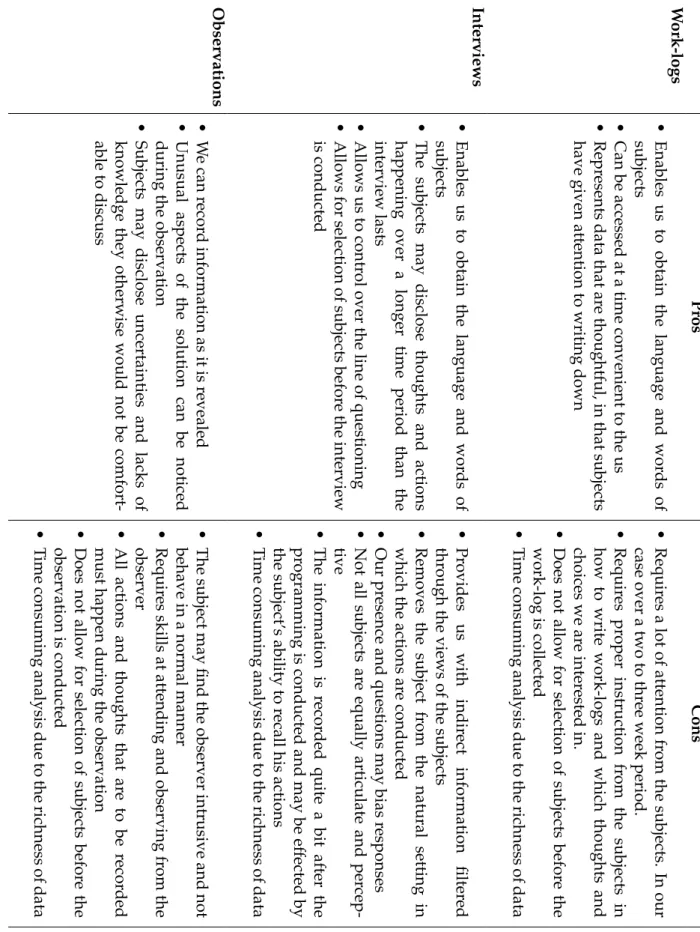
From the basic building blocks described above we devised three possible strategies that could be used. The strategies are described below and pros and cons are given in Table 3.1 on the following page. Some of them are general, taken from Creswell[12] and Fincher and Petre[23], others consider issues specifically related to our study.
3.2.1 Work-logs
With this strategy the subjects are tasked to log their work process as they work on an assignment we want to review. The logs serve as written reports that describe the subject’s thought process as he completes different programming tasks. It would list the subject’s progress, issues and why he believes those issues appear. Together with the subject’s solution to the assignment the work-log provides the entire data set.
3.2.2 Interviews
With this strategy the researchers review solutions to programming assignments to identify errors and interesting parts of the solution. The subjects with interesting errors in their solutions to the assignment are invited to an interview where they explain their process of solving that assignment. The interviewer allows the subject to control the conversation but ensures the interesting areas of the solution is explained. The conversation covers all interesting parts of the subject’s solution to the assignment and his reasons for choosing solution method. The interview audio is recorded to allow the researcher to revisit the interview in detail. Together with the subject’s solution to the assignment and the interviewers notes, the audio provides the entire data set.
3.2.3 Observations
With this strategy the subjects participate in individual observations of them as they solve either parts of, or an entire programming assignment. The observation reveals the choices made by the subject step by step. The observer can either be passive or active, by choosing whether to ask questions or not, but does not participate in solving the assignment. The observation audio is recorded to allow the researcher to revisit the observation in detail. Together with the subject’s solution to the assignment and the observer’s notes, the audio provides the entire data set.
Pros Cons W ork-logs • Enables us to obtain the language and wor ds of subjects • Can be accessed at a time convenient to the us • Repr esents data that ar e thoughtful, in that subjects have given attention to writing down • Requir es a lot of attention fr om the subjects. In our case over a two to thr ee week period. • Requir es pr oper instr uction fr om the subjects in how to write work-logs and which thoughts and choices we ar e inter ested in. • Does not allow for selection of subjects befor e the work-log is collected • Time consuming analysi s due to the richness of data Interviews • Enables us to obtain the language and wor ds of subjects • The subjects may disclose thoughts and actions happening over a longer time period than the interview lasts • Allows us to contr ol over the line of questioning • Allows for selection of subjects befor e the interview is conducted • Pr ovides us with indir ect information filter ed thr ough the views of the subjects • Removes the subject fr om the natural setting in which the actions ar e conducted • Our pr esence and questions may bias responses • Not all subjects ar e equally arti culate and per cep-tive • The inf ormation is recor ded quite a bit after the pr ogramming is conducted and may be ef fected by the subject’s ability to recall his actions • Time consuming analysi s due to the richness of data Observations • W e can recor d information as it is revealed • Unusual aspects of the solution can be noticed during the observation • Subjects may disclose uncertainties and lacks of knowledge they otherwise would not be comfort-able to discuss • The subject may find the observer intr usive and not behave in a normal manner • Requir es skills at attending and observing fr om the observer • All actions and thoughts that ar e to be recor ded must happen during the observation • Does not allow for selection of subjects befor e the observation is conducted • Time consuming analysi s due to the richness of data Table 3.1: Pr os and cons of pr oposed data collection pr ocedur es
3.3 Methods used in this study
In the introduction we stated that one of our goals is to learn which errors students make in their solutions to assignments or exams. Choosing mandatory assignments as the instruments of assessment that we are to review gives us a huge benefit. The mandatory assignments are solved in a setting equal to the one we wish to analyze. There is no need to pay special attention into designing a task or experiment to ensure the students work in the way we wish to capture.
The students are given between two and three weeks to solve each assignment. That makes them fairly long and time consuming. With that in mind we had a good basis to make a choice between the different strategies we had proposed. We used the list of pros and cons given in Table 3.1 on the preceding page together with the practical limitation given by our goal to choose a strategy.
Since we do not look at shorter assignments such as classroom exams our data will only be applicable to longer assignments such as the ones we review.
Considering that the errors we were looking for are errors present in solutions to assignments the choice of subjects became important. We did not expect all students to have enough if any of these errors. This makes the opportunity to weed out the students with no interesting errors a valuable trait of the interview strategy.
We wish to explain one particular weakness with using observations mentioned in Table 3.1 a bit further. The fact that the subject may find the observer intrusive is something that may lead to a huge bias from the very nature of someone knowingly being observed. The bias comes from a reactivity called the Hawthorne effect, sometimes also called the observer effect. It is a type of reactivity in which individuals modify or improve an aspect of their behavior in response to their awareness of being observed[39]. For example this may cause the participants to attack a problem from more angles before choosing a solution than they normally would.
The size of the assignments also made observations of the assignments as a whole unfeasible. It would take too much time, both for us and the students. It would also be unlikely that either observer or student could remain alert for a long enough time period. Work-logs could provide good data. But we were not confident in being able to train the students properly in writing them. It may also have affected our ability to recruit participants as it requires a bit more work than an observation or interview.
3.3.1 Interviews about solutions to assignments
Considering the nature of the assignments interviews proved most promis-ing for our study. Many of its advantages could be exploited in the data collection. We are able to choose our subjects based on criteria that mark them as interesting for our study before we commit to interviewing them. It enables us to obtain the language and words of subjects, giving us
in-sight into how they think about problem solving when writing computer programs. The subjects may disclose thoughts and actions happening over a longer time period than the interview lasts. This allows us to possibly gain access to all they have done to solve an assignment in the targeted course. It also allows us to control over the line of questioning to minimize the amount of work in analyzing the results and avoiding topics that are not interesting.
The most important cons, such as possible bias from the interviewers’ questions, can be reduced by carefully planning the interview. The cons of not getting data in real time can be reduced as much as possible by ensuring the interviews are conducted as soon as possible after the assignment is handed in. We cannot, however, ensure that the subjects will always speak truthfully.
The methods used in the interviews will be explained in section 3.4. Details of how the interviews were conducted are provided in chapter 4 and chapter 5.
3.3.2 Supplemental data collection using observations
To supplement the results from the interviews with data without the loss of detail that may arise from interviews being held after the assignment was handed in we decided to conduct some observations as well. The data from the interviews requires us to guess at their misunderstandings based on statements given as much as a couple of weeks after they worked on a particular problem in an assignment.
The observations allows a more detailed view of how they work and may support our belief on certain misunderstandings students may have. It is important to remember the biases caused by the Hawthorne Effect mentioned in section 3.3. For that reason we cannot be sure if the students do not change their method of problem solving as they are being observed. So we will avoid making conclusions that discard certain misunderstandings or issues the students show signs of in the interviews.
We designed a shorter set of tasks for the observations, solvable within a time frame that is suited for the format. The methods used in the observations will be explained in section 3.5. Details of how the observations were conducted are provided in chapter 6.
3.4 Interviews
The interviews make up the main bulk of our data collection. They are focused on errors made in assignments in the targeted course. This helps us reduce the possible biases considering the main goal with this study. We wish to identify errors and misunderstandings in the solutions students submit to instruments of assessments such as programming assignments and exams. Mandatory assignments fits that description so we know the students work in the way that is natural for them in that kind of situation.
An added benefit is the targeted course requires students to complete them. This makes recruiting subjects for the study easier. No additional work had to be done by the subjects unless they were invited to participate in an interview.
3.4.1 The choice of assignments
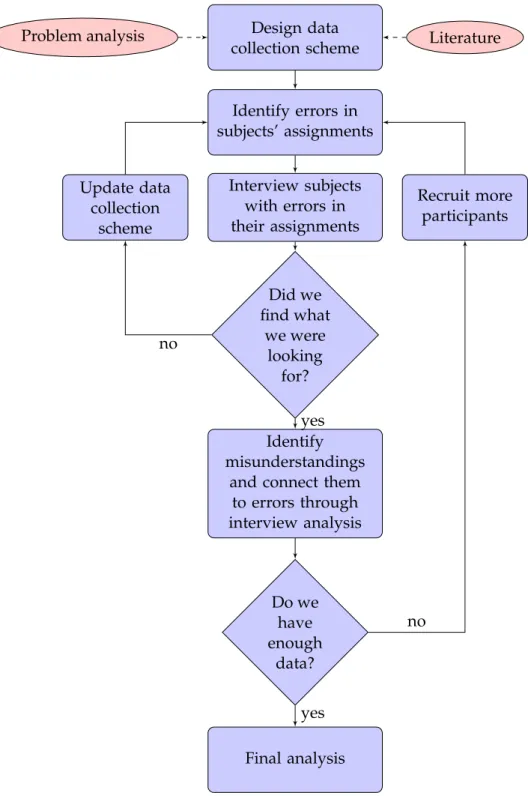
We wanted to review two different assignments giving us an opportunity to test our methods before we committed to it. For that reason the interviews are done in two rounds. The first round consists of only four interviews. Yet the data we acquired in that round is usable in our results. The subjects are the same in both rounds of interviews, though some were recruited to the study after the initial interviews were conducted. So the data from both rounds are applicable in the study. The assignments that are reviewed include different topics so the two rounds will mostly result in identifying different errors. But the misunderstandings causing those errors may overlap.
The assignments are both "take-home" assignments spanning two to three weeks. They are mandatory and students need a certain amount of them approved to be allowed to attend the final exam. They are not part of the grade the students are given. This may have an effect of how students work to complete these assignments. Our results may be affected by this and the errors and misunderstandings we identify are not necessarily the same as in a four our written classroom exam. In shorter exams the students are likely to make more serious mistakes and not have time to fix them. Similarly the longer assignments may include more difficult tasks than a short exam that challenge the students on different skills.
As the study required some preparations (see section 3.9.2 and 3.10) we chose from assignments planned for the latter half of the course. It was important that the topics being tested included topics that are core in this course and likely to be part of most introductory programming courses. That removed an assignment being solely about graphical user interfaces.
We wanted to optimize our chances of getting as many participants as possible. Therefore we discarded using assignments due just before holidays and too close to the final exam. The timing would have made it harder to have the students participate in interviews. Also considering the time needed to analyze and process the results between the two rounds of interviews we made a good choice of assignments. The assignments themselves are summarized in section 4.2 and 5.3. The assignment texts can be found in Appendix E and F
Assessment method of the assignments
From talking to the professors responsible for planning the targeted course we were told the intention with the assignments is to make the students work with the topics in the curriculum throughout the entire semester and give feedback to what their problems are. That would make the assignments instruments of formative assessment.
But before we take that for granted we need to consider the scoring system and the points requirement described in section 2.4.3. A scoring system is a trait often seen in summative assessment. The fact that students can fail the course based on their scores make it possible to argue that the assignments are part of the material that is used in their final grade. Failing to get the required score will technically give them a failing grade, even if they do not get to take the final exam. From that we concluded that assignments are hybrids between formative and summative assessment.
That may have an effect on how students work with the assignment. According to Lauvås[37] students may cope with continuous summative assessment using lesser learning activities such as copying and pasting code from the Internet and blind trial and error to achieve the output they want. This may cause long term learning to be reduced.
3.4.2 Preparations
Before we stated identifying errors in the students’ assignments we analyzed the assignment given to them. As the mandatory assignments in the targeted course are rather large, we chose to review the students’ solutions first and identify errors in their code as well as classifying them according to the categories we created in section 2.2.2. The students whose assignments contain errors that are interesting were invited for an interview.
3.4.3 Using retrospection
The method chosen for the interviews is called retrospection[54]. When using retrospection the subject for the interview is questioned about the thought processes during the solving of a problem he has solved. For example he may be asked: "How did you ensure the linked list do not contain any duplicates?"" The questions may also be more detailed, like "Which data structure did you use?". This method was chosen over methods such as prompting and questioning to ensure the subject was asked as few questions as possible. This consideration was made as the questions themselves may be leading and several key points may be lost due to the way the questions are formulated.
Retrospection has some weaknesses. The subject may not always remember exactly what he did, especially if some time has passed after completing the task. The subject may not even be aware of what he is doing as he may not have a conscious process for solving the problem. The subject may also present his thought process as more coherent and intelligent than it originally was. This may happen both intentionally and unintentionally as the subject may not remember his original process. His memory may by guided if his knowledge of the problem has changed since the he solved it. This may cause some misunderstandings to be lost. But any positive proof of misunderstandings should not be impacted by this.
At the time the interviews were planned it was not certain how many from the research group would interview the students. A detailed
interview guide was written to ensure all interviewers followed the same procedure. It can be found in Appendix B1. In the end all the interviews were performed by the author of this thesis, but the interview guide was still used in all the interviews to ensure the author followed the same procedure in all the interviews.
3.4.4 Initial interviews
Trying to ensure our interview methods would give the best possible results, the interviews were split into two rounds. The first round was intended as a trial run with a smaller amount of participants. The second round included more participants and revolved around a different mandatory assignment than the first. Yet we still managed to get good results from the initial interviews.
3.4.5 Tools and location
To complete the interviews we used an audio recorder and post-processed all the interviews using the audio playing software VLC.
All interviews were conducted at the university with only the inter-viewer and the participant present.
3.5 Observations
To supplement the data from the interviews our goal with observing students work became to learn as much as possible of how the students were attempting to solve a problem. More specifically we really wanted to get a feeling of the level of understanding they had of the different topics involved in the tasks.
For that reason we could not rely on the visual aspect of watching them write code. The reasons behind their choices may still be uncertain even if you know their choices and actions. Therefore we had to involve the student in a different manner. To get insights into their thoughts we wanted them to speak of their actions and choices while they were making them. 3.5.1 The think aloud method
The observations were conducted according to the think aloud method[54]. This method requires the subject to continually speak out loud everything they are thinking as they are working. The observers job is to make sure the subject does not stop verbalizing their thoughts using questions such as "What are you thinking now?", "What are you doing right now?", "Why did you do that just now?". The questions are there just to keep the subject talking throughout the observation.
1The interview guide in Appendix B is the one used for the initial interviews. The errors
The think aloud method was chosen over other observation methods such as retrospection, introspection and questions and prompting because of its strengths in letting the data gained remain unbiased by the observer’s questions and at the same time not lose any details from the subject forgetting what he though about.
Pros
• The think aloud methods does not require waiting until the subject has completed at least a part of the task like retrospection and introspection do.
• The think aloud methods does not require the observer to choose when the right time is to have the subject explain their actions like introspection and questions and prompting do.
• The think aloud method keeps the questions asked by the observer to a minimum avoiding leading questions that create biased data or questions that lead to false answers as the subject may answer what he believes the observer wishes to hear.
• The think aloud method avoids the subject unconsciously cover up their mistakes as soon as he has figured out what he had though wrong as the human brain has a tendency to also forget what we though wrong as soon as we figure out what was truly correct, creating false memories[54, p. 44].
There are some weaknesses to the think aloud method mainly regarding the importance of choosing good tasks and having subjects that are good at verbalizing their thoughts.
Cons
• The think aloud method requires the subject to be good at verbalizing their thoughts and actions. Those who are bad at it simply do not fit the method and leaves you with little data gathered.
• The think aloud method requires the problem solved by the subject to not be too easy or too hard. Too easy tasks are solved on an unconscious level and such thoughts are impossible to verbalize. Too hard tasks cannot be solved at all and will yield few results.
3.5.2 Tools and location
The observation audio was recorded using an audio recording device. The observer was taking notes and the recording was later reviewed by the observer using the notes as backup.
All observations were conducted at a meeting room at the university with only the observer and the participant present. The students were allowed to write the code on a computer of their choosing. For most