doi: 10.11648/j.eas.20180304.12
ISSN: 2575-2022 (Print); ISSN: 2575-1468 (Online)
High-speed BEV Reducer NVH Performance Optimization
and Experimentation
Liu Xianghuan
1, Liu Defu
1, Sun Yincheng
1, Li Chao
21
College of Mechanical and Electrical Engineering, Central South University, Changsha, China 2Zhuzhou Gear Co., Ltd., Zhuzhou, China
Email address:
To cite this article:
Liu Xianghuan, Liu Defu, Sun Yincheng, Li Chao. High-speed BEV Reducer NVH Performance Optimization and Experimentation.
Engineering and Applied Sciences. Vol. 3, No. 4, 2018, pp. 103-112. doi: 10.11648/j.eas.20180304.12 Received: August 8, 2018; Accepted: October 4, 2018; Published: October 29, 2018
Abstract:
To solve the common rattle and whine issues in high-speed BEV reducer, this article aims to calculate and analyze the NVH performance of the reducer by using MASTA. By optimizing gear macro geometry and micro geometry to reduce the transmission error of gear pair which plays a decisive role in the common rattle and whine. By using MASTA, import the macro and micro geometry parameters of the gear pairs of the reducer. And using ABAQUS/CAE to preprocessing reducer housing, differential housing etc. and import them to MASTA. And then, assembly those components together to simulate the reducer as precise as possible. The system stiffness matrix and mass matrix are calculated which is strongly concerned to the NVH performance of the reducer. This article analyzed the assembly vibration model by calculating the assembly stiffness matrix and mass matrix and optimized the gear pairs’ parameters to reduce the transmission error of the gear pairs. And compared the optimized reducer with the original reduce in the same conditions, to make sure that the optimization is work. And so get the experience to control the NVH performance from the research. And according to these experiences, instruct engineers to design reducers that meet the harshness requirements of NVH to optimize the performance of speed reducer assembly.Keywords:
High-speed Reducer, NVH, MASTA, FEA, Transmission Error1. Introduction
With the development of China's economy, car ownership continues to go high. Vigorously develop electric vehicles, can speed up the alternative fuel, reduce vehicle emissions, to energy security, promote energy conservation and emissions reduction, prevention and control of atmospheric pollution. Compared with the developed countries, there is no consensus on the development of BEV or hybrid electric vehicle technology routes. China is weak in the aspect of design development, key parts and components manufacturing is relatively un-advanced, especially in the areas such as the key technology of BEV’s NVH ability (noise, vibration and harshness), will become a big obstacle of the industrialization of new energy vehicles.
As the requirement of local laws and regulations of the vehicle NVH is becoming stricter, and demand of vehicles’ comfortability and safety from consumers is higher and higher, NVH has become one of the key indicators of
performance. Compared with traditional vehicle, BEV’s power source is changed from engine to motor, and the noise of the transmission will become more and more obvious, which will become an important source of noise.
2. High-speed Reducer NVH
Performance Analyzing
The BEV’s powertrain is usually composed of motor and transmission system, and the combination of permanent magnet synchronous motor and two-stage reducer is mostly adopted [7-10]. The motor system is mainly electromagnetic noise, and the radial electromagnetic force is the main excitation source of electromagnetic noise. The noise sources of transmission system are mainly gear rattle, whine and low frequency resonance. For BEV reducer, and the main affect its harshness (NVH) is the performance of whine and the system of low frequency resonance problem. This article mainly uses MASTA and ABAQUS, through calculation and analysis of stiffness matrix, mass matrix and intrinsic mode, to optimize the design of the reducer gear pair, therefore, to achieve the goal of optimal reducer NVH performance.
2.1. Calculation of Dynamic Meshing Stiffness
Dynamic meshing stiffness refers to the displacement of tooth mesh place by a certain frequency unit (torsional angular displacement) under the periodic vibration, mesh in the space needs to exert the same frequency method to the size of meshing force (torque).
According to the definition of dynamic meshing stiffness and the vibration analysis model of gear transmission system, the dynamic meshing stiffness of gears is determined by the torsional flexibility of the driving and driven gears [11-13].
( )
( )
1( )
m
pt gt
K
R R
ω
ω ω
=
+ (1)
In the formula (1): Km
( )
ω is dynamic meshing rigidity,( )
pt
R
ω
, Rgt( )
ω
are the torsional flexibility of the drivingand driven gears, and ω is the frequency of the gear meshing excitation.
Figure 1. Dynamic meshing analysis model of gears.
2.2. Calculation of System Mass Matrix
In calculating the vibration response of the system, a one-dimensional finite element model of the full degree of freedom needs to be established [14-15], as shown in Figure 2.
Figure 2. One-dimensional finite element model of shaft system.
[ ]
[ ]
1 p1 p2 p p3 p4 m (6n,6n) . . k k k k . K K K (2)Among them: Mpfor the No. paxis mass matrix in the
shaft system, mp1for the plane xozall the nodes in the No.
p axis mass matrix (x,θy),mp2 for the planeyoz all the
nodes in the No. paxis mass matrix (y,θx), mp3for all the
nodes on the No. p shaft axial (z) mass matrix, mp4 to
the No. p axis on the torsion (
φ
) mass matrix of all nodes. The system stiffness matrix is extracted from the model:Among them: Kpfor the No. paxis stiffness matrix in
the shaft system, kp1for all the nodes of plane xoz in the
No. p axis stiffness matrix (x , θy), kp2 for all the
nodes of plane yoz in the No. paxis stiffness matrix (y,
x
θ ), kp3for all the nodes on the No. p axial (z) stiffness matrix, kp4 for all nodes on the No. p shaft to the torsion
(
φ
) stiffness matrix.System mass matrix and stiffness matrix are very important NVH performance indexes, the calculation formula is complex, the accuracy of the calculation directly affect the NVH results of the analysis, the mass matrix and stiffness matrix in this article mainly adopts FE analysis software.
3. FE Analysis Model
The noise map in a certain type of gear reducer is shown in the figure below:
Figure 3. Noise map before optimization.
As we can see from the test results in the Figure 3, there are multiple resonant noise zones within the range of 2500Hz~6000Hz.
3.1. Model Analysis
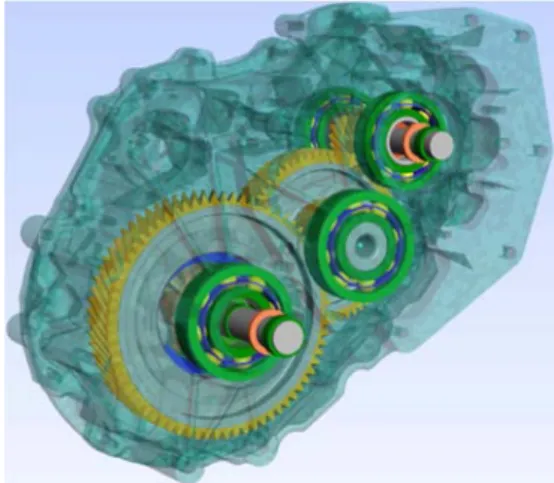
MASTA analysis model as shown below:
Figure 4. 2D MASTA model.
Reducer’s housing is meshing by ABAQUS/CAE, setting bolt connection, mounting points and mass attributes, and the housing model is imported into the MASTA software, which is shown in Figure 5.
Figure 5. MASTA model.
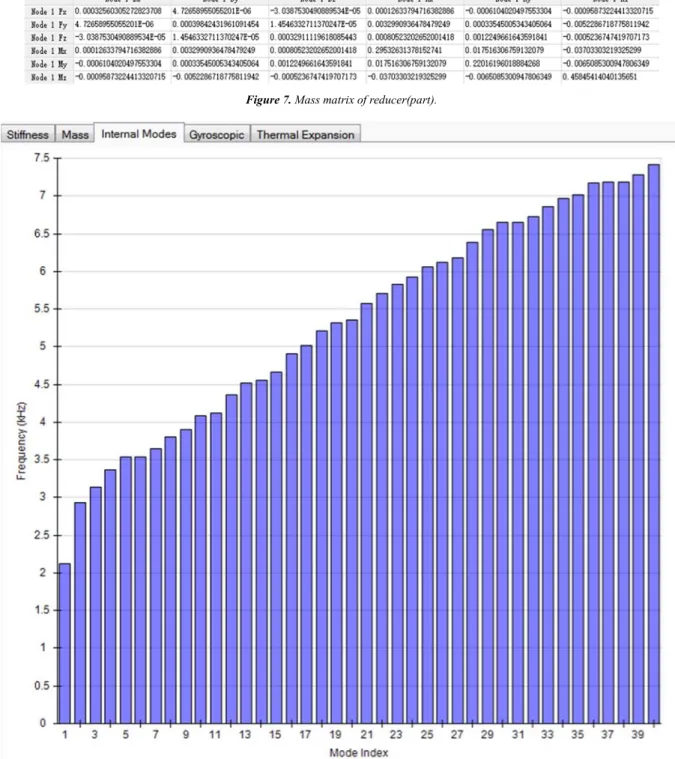
Figure 6. Stiffness matrix of the reducer(part).
Figure 7. Mass matrix of reducer(part).
Figure 8. First 40 order mode of the reducer.
Table 1. Macro parameters of high-speed gear.
Basic parameter Pinion Gear
Teeth 21 62
Normal module(mm) 2.012 2.012
Width(mm) 35 31
Normal pressure Angle(°) 19.5 19.5
Center distance (mm) 95
Modification coefficient -0.03 -0.5892
Hand Right Left
Top width coefficient of normal tooth 0.746 0.843
Table 2. Macro parameters of low-speed gear.
Basic parameter Pinion Gear
Teeth 23 71
Normal module(mm) 2.414 2.414
Width(mm) 42.5 37.6
Normal pressure Angle(°) 19 19
Center distance (mm) 125
Modification coefficient 0.13 -0.144
Hand Right Left
Top width coefficient of normal tooth 0.662 0.796
The noise map of NVH test is shown in the Figure 3 above.
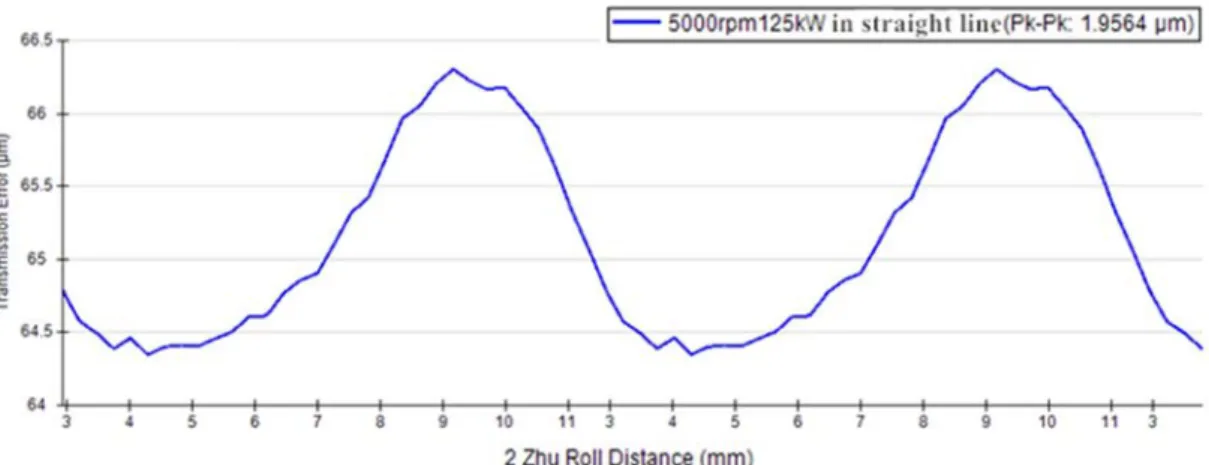
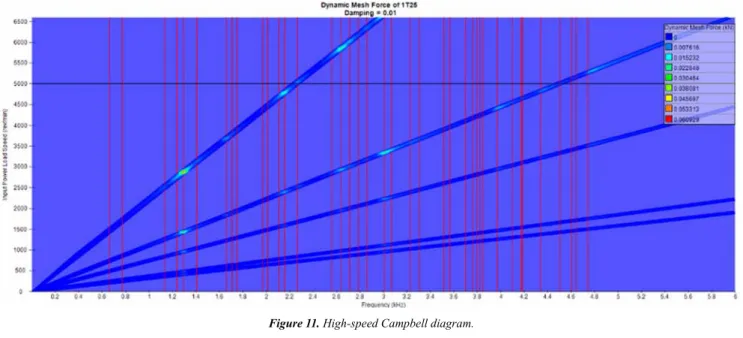
After entering modification of parameters, through MASTA simulation, the input torque of 240 Nm transmission errors are shown in Figure 9 and Figure 10, and Campbell diagrams are shown in Figure 11 and Figure 12.
Figure 9. Transmission error of high-speed gear (peak: 0.5186µm).
Figure 11. High-speed Campbell diagram.
Figure 12. Low-speed Campbell diagram.
As can be seen from the Campbell diagram of the assembly, there are multiple resonance points in the range of 2500Hz~6000Hz.
3.2. Parameter Optimization
By optimizing the gear parameters for MASTA, the macro parameters of the optimized gear pair are shown in the table below.
Table 3. Macro parameters of high-speed gear after optimization.
Basic parameter Pinion Gear
Teeth 27 80
Normal module(mm) 1.552 1.552
Width(mm) 30 30
Normal pressure Angle(°) 16.2 16.2
Center distance (mm) 95
Modification coefficient 0.155 -0.9494
Hand Right Left
Table 4. Macro parameters of low-speed gear after optimization.
Basic parameter Pinion Gear
Teeth 21 65
Normal module(mm) 2.658 2.658
Width(mm) 45.2 45.2
Normal pressure Angle(°) 17.28 17.28
Center distance (mm) 125
Modification coefficient 0.3553 -0.4184
Hand Right Left
Top width coefficient of normal tooth 0.4058 0.7527
After receiving modification of parameters, through MASTA simulation, the input torque of 240 Nm transmission errors is shown in Figure 13 and Figure 14, and Campbell diagrams are shown in Figure 15 and Figure 16.
Figure 13. Transmission error of high-speed gear (peak:0.5782µm).
Figure 14. Transmission error of low-speed gear (peak: 0.9897µm).
Figure 16. Low-speed Campbell diagram after optimization.
It can be seen from the analysis results that, after optimization of the gear shaft parameters are significantly reduced in the range of 2500Hz~6000Hz, and the dynamic meshing force of resonance is obviously reduced.
4. NVH Test After Optimization
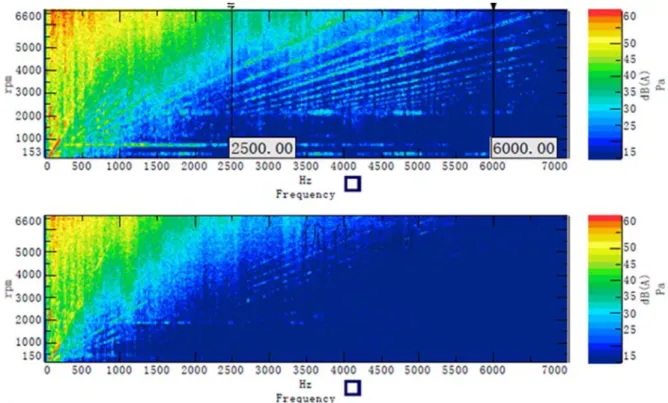
To verify the optimization effects, guaranteed that housing and shaft are not factors of the test. We set up a vehicle to test the NVH performance as figure 17.
Figure 17. Sensor layout in test vehicle of NVH.
Figure 18. Noise map before optimization after optimization.
In Figure 18, top area stands for before the optimization and the bottom stands for the after. It can be seen from the figure that high-frequency noise in the range of 2500~6000Hz is basically eliminated, which is consistent with the subjective evaluation result.
5. Conclusion
From figure 10 and figure 14, we can see that the transmission error peak of the low-speed gear pair reduced from 1.9564um to 0.9897um, and the relative dynamic mesh force peak show in figure. 12 and figure. 16 reduced from 0.359 kN to 0.142 kN . It can be indicated that the transmission error of the gear pair is an important factor of the dynamic mesh force. And from figure. 18 we can see that the reducing of the transmission error can reduce the order noise of the reducer. And from this article, the whine problem can be effectively solved by modifying the macro and micro geometry to improving the contact stress of gear pair and change the NVH excitation spectrum of the reducer. The peak of transmission error is an important index that affects NVH performance of the reducer. So, to solve the NVH problem of the BEV reducer, the transmission error of the gear pair of the reducer should be controlled at a reasonable range, which need a large number of experiments to confirm.
References
[1] Azar R C, Crossley F. Digital simulation of impact phenomenon in spur gear systems [J]. Journal of Engineering for Industry. 1977, 99(3):792-798.
[2] Lin J, Parker R G. Mesh stiffness variation instabilities in two-stage gear systems [J]. Journal of vibration and acoustics. 2002, 124(1):68-76.
[3] Tang Jinyuan, Chen Siyu, Zhong Jue. An improved nonlinear dynamic model for gears [J]. Engineering mechanics. 2008, 25(1): 217-223.
[4] Wang Liansheng. Nonlinear dynamics and NVH performance of the engine and gearbox coupling system [D]. Zhejiang University. 2014.
[5] Rosbi S, Ryu T, Nakae T. Evaluation of dynamic absorber to suppress subharmonic nonlinear vibration in car powertrain [J]. Mechanical Engineering Journal, 2015,
2(3):14-00528-14-00528.
[6] Pan Xiaodong, Liu xianghuan, Lichao, Research on BEV high-speed gear train NVH Performance Optimization [J]. Journals of Chong Qing University of Technology. Nov, 2017 [7] Wang Liang. Design and Research of BEV Reducer’s Structure
[D]. JiLin University. 2015.12; 41-42
[8] FU Jianghua, ZHOU Peng, CHEN Zheming, CHEN Bao, Analysis and Optimization of NVH Performance of Powertrain Mounting in a Passenger Vehicle [J] Machinery Design & Manufacture 2018.6 (6): 226-232
[9] Liu Xiaoang. Design Method of powertrain mounting system based on vehicle vibration control [D]. Guangzhou: South China University of Technology, 2016.
[10] Wang Junpeng, Yuan Liyun, Liu Canli. Performance analysis and optimization of NVH performance of a rear suspension support [J]. Journal of Guangxi University of Science and Technology, 2017, 28(1):65-72.
[12] Wang Xinbo, Study on the overall transfer matrix of gear coupling unit [D]. Shandong University of Technology. 2008 [13] Ji Wenmei, Fang Tong, Chen Songqi, Mechanical vibration [M]
Beijing: Science Press. 1985.
[14] E Yizhong, He Yanzhong, Wang Zheng, Li Fangze, Rotor dynamics [M] Beijing: Tsinghua Press. 1987.
[15] Wang Zheng, Rotor dynamics design of rotating machinery [M] Beijing: Tsinghua Press. 2015.
Biography
Dr. LIU Xianghuan (1982 -), Lianyuan, Hunan province, Senior Engineer, Reducer Project Manager for National Key R&D Project (2018YFB0104900).