Clemson University
TigerPrints
All Theses Theses
12-2013
Knowledge Extraction from Work Instructions
through Text Processing and Analysis
Abhiram Koneru
Clemson University, [email protected]
Follow this and additional works at:https://tigerprints.clemson.edu/all_theses Part of theMechanical Engineering Commons
This Thesis is brought to you for free and open access by the Theses at TigerPrints. It has been accepted for inclusion in All Theses by an authorized administrator of TigerPrints. For more information, please [email protected].
Recommended Citation
Koneru, Abhiram, "Knowledge Extraction from Work Instructions through Text Processing and Analysis" (2013).All Theses. 1769.
KNOWLEDGE EXTRACTION FROM WORK INSTRUCTIONS THROUGH TEXT PROCESSING AND ANALYSIS
A Thesis Presented to the Graduate School of
Clemson University
In Partial Fulfillment
of the Requirements for the Degree Master of Science Mechanical Engineering by Abhiram Koneru December 2013 Accepted by:
Dr. Gregory M. Mocko, Committee Chair Dr. Lonny L. Thompson
ABSTRACT
The objective of this thesis is to design, develop and implement an automated approach to support processing of historical assembly data to extract useful knowledge about assembly instructions and time studies to facilitate the development of decision support systems, for a large automotive original equipment manufacturer (OEM). At a conceptual level, this research establishes a framework for sustainable and scalable approach to extract knowledge from big data using techniques from Natural Language Processing (NLP) and Machine Learning (ML).
Process sheets are text documents that contain detailed instructions to assemble a portion of the vehicle, specification of parts and tools to be used, and time study. To maintain consistency in the authorship process, assembly process sheets are required to be written in a standardized structure using controlled language. To realize this goal, 567 work instructions from 236 process sheets are parsed using Stanford parser using Natural Language Toolkit (NLTK) as a platform and a standard vocabulary consisting of 31 verbs is formed.
Time study is the process of estimating assembly times from a predetermined motion time system, known as MTM, based on factors such as the activity performed by the associate, difficulty in assembling, parts and tools used, distance covered. The MTM compromises of a set of tables, constructed through statistical analysis and best-suited for batch production. These MTM tables are suggested based on the activity described in the work instruction text. The process of performing time studies for the process sheets is
time consuming, labor intensive and error-prone. A set of (IF <Verb> AND <object type> THEN <MTM table>) rules are developed, by analyzing 1019 time study steps from 236 process sheets, that guide the user to an appropriate MTM table. These rules are computationally generated by a decision tree algorithm, J48, in WEKA, a machine learning software package.
A decision support tool is developed to enable testing of the MTM mapping rules. The tool demonstrates how NLP techniques can be used to read work instructions authored in free-form text and provides MTM table suggestions to the planner. The accuracy of the MTM mapping rules is found to be 84.6%.
DEDICATION
To my parents, Sarada and Gandhi. For their unconditional love towards me, I will be forever grateful.
ACKNOWLEDGMENTS
First and foremost I would like to express my deepest gratitude to my advisor, Dr. Gregory Mocko, for his continual support and guidance throughout my time at Clemson. I wish to thank BMW for funding this research and Dr. Killian Funk for his valuable suggestions on the project. I would also like to thank Dr. Lonny Thompson and Dr. Mary Beth Kurz for serving on my committee. A special thanks to the faculty and members of the CEDAR group for their feedback and encouragement.
I would like to take this opportunity to acknowledge all those who have contributed in any way, shape or form to the completion of this thesis. A special mention goes out to the people who contribute to Stack Overflow.
Last but not least, I would like to thank all my friends without whom this thesis would have definitely finished earlier.
TABLE OF CONTENTS
Page
Abstract ... ii
Dedication ... iv
Acknowledgments... v
List of Tables ... viii
List of Figures ... x
Chapter One : Motivation and Research Objectives ... 1
1.1 Motivation and Research Objectives ... 2
1.2 Research Objectives Overview ... 4
1.3 Thesis Outline ... 6
Chapter Two : Background and Literature Review ... 8
2.1 Current trends in automotive industry ... 8
2.2 Text Mining ... 15
2.3 Chapter Summary ... 17
Chapter Three : NLP and machine learning approach to extract knowledge from process sheets ... 18
3.1 Natural Language Processing (NLP) ... 24
3.2 Natural Language Toolkit (NLTK) ... 28
3.3 Text classification ... 33
3.4 WEKA, machine learning workbench ... 41
Chapter Four : Development and Implementation of the Natural Language Processing (NLP) and Machine Learning (ML) tools ... 49
4.1 Building standard vocabulary and object type classifier ... 49
4.2 MTM mapping rules ... 58
Chapter Five : Testing and validation of tools devloped ... 76
5.1 Validation of Object type classifier ... 76
5.2 Comparisons of WEKA classifiers – JRip, PRISM, and J48 ... 78
5.3 Validation of MTM mapping rules generated through WEKA ... 79
5.4 Chapter Summary and Conclusions ... 84
Chapter Six : Conclusions and Future work ... 86
6.1 Summary of tools developed to address the research objectives ... 86
6.2 Broader impact ... 87
6.3 Future Work ... 89
References ... 91
Appendices ... 96
Appendix A: Standard verb vocabulary and MTM mapping rules validation ... 97
LIST OF TABLES
Table 2.1: Sample MTM Table ... 14
Table 3.1: Obtaining time estimates for sample work instruction statement ... 21
Table 3.2: Sample MTM mapping rules ... 23
Table 3.3: Analyses in parsing process ... 25
Table 3.4: Sample PoS tag set... 26
Table 3.5: Sample syntactic tag set ... 26
Table 3.6: Compound work instructions split into single action work instructions ... 29
Table 3.7: Sample edited work instruction text ... 32
Table 4.1: Number of work instructions considered for analysis ... 52
Table 4.2: Sample set of most frequent verbs ... 53
Table 4.3: OPR classification ... 54
Table 4.4: Sample list of standard verbs ... 55
Table 4.5: Dataset before and after oversampling ... 57
Table 4.6: Number of TVGs and time study steps considered for analysis ... 60
Table 4.7: Edited time study text ... 61
Table 4.8: Decision trees with varying minimum number of object instances ... 65
Table 4.9: Decision trees with varying confidence factor ... 65
Table 4.10: Parameters for decision tree pruning ... 66
Table 4.11: Statistics of accuracy and size of decision tree ... 66
Table 4.12: MTM rules - Level 1... 68
Table 4.13: MTM rules - Level 2... 69
Table 4.14: MTM rules - Level 3... 70
Table 5.1: Validation of object type classifier using random split method ... 77
Table 5.2: Validation of object type classifier using k-fold cross validation ... 77
Table 5.3: Comparison of accuracy - Random split vs. Cross validation ... 77
Table 5.4: Summary of results - JRip, PRISM, and J48 ... 78
Table 5.5: Results from testing MTM table generator ... 80
Table 5.6: Relationship matrix between MTM tables identified from TVGs and MTM tables estimated by MTM generator for test time study steps ... 83
LIST OF FIGURES
Page
Figure 1.1: Framework to extract knowledge from unstructured data ... 5
Figure 1.2: Thesis outline ... 6
Figure 2.1: Schematic representation of an assembly line ... 10
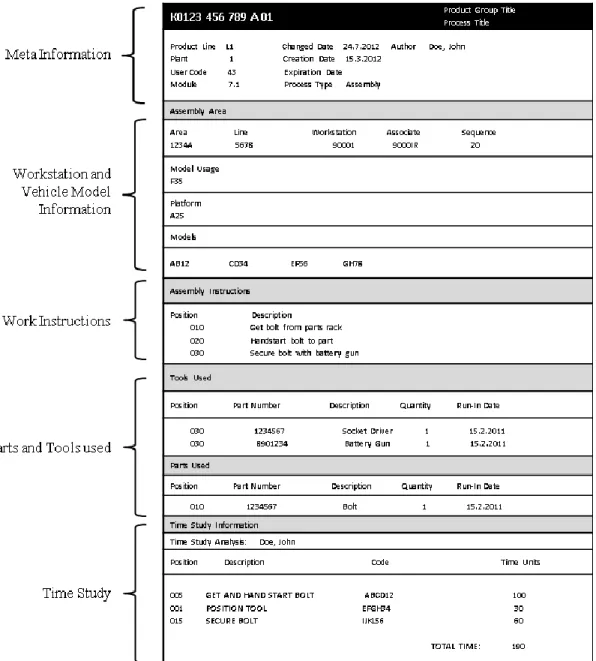
Figure 2.2: Sample process sheet ... 11
Figure 3.1: Sentence structure of work instructions ... 19
Figure 3.2: Parse tree of sample sentence ... 27
Figure 3.3: Parse tree of sample sentence in upper case ... 29
Figure 3.4: Parse tree of sample sentence in sentence case ... 30
Figure 3.5: Incorrectly tagged WI text ... 31
Figure 3.6: Accurately tagged WI text ... 32
Figure 3.7: Schematic representation of text classification ... 34
Figure 3.8: Input vectorization ... 37
Figure 3.9: WEKA Explorer user interface ... 42
Figure 3.10: Sample ARFF dataset ... 43
Figure 3.11: Sample tree graph ... 45
Figure 3.12: Options window to alter parameters of the J48 algorithm ... 46
Figure 4.1: Process flow illustrating extraction of verbs and objects ... 50
Figure 4.2: Extraction of verb and object from sample work instruction ... 52
Figure 4.3: Development of object type classifier ... 57
Figure 4.4: Process flow illustrating the generation of MTM rules ... 59
Figure 4.5: Examples of discarded time study steps ... 60
Figure 4.6: Development of MTM mapping rules using a sample time study step ... 64
Figure 4.7: J48 decision tree with output ... 67
Figure 4.8: Sample rule format ... 67
Figure 4.9: Process flow illustrating the generation of MTM tables ... 71
Figure 4.11: Screenshot illustrating the MTM tables generated for sample work instructions ... 74 Figure 4.12: MTM table generation for sample work instruction ... 74
CHAPTER ONE: MOTIVATION AND RESEARCH OBJECTIVES
The objective of this thesis is to design and implement an automated approach to support processing of historical assembly data. Specifically, this thesis aims to extract useful knowledge about assembly instructions and time studies to facilitate the development of decision support systems, for a large automotive original equipment manufacturer (OEM). This will reduce the cognitive load on the planner by providing decision support during the generation of assembly time estimates. This is achieved by employing the tools and techniques from Natural Language Processing (NLP), Data Mining (DM) and Machine Learning (ML).
Assembly process sheets or process sheets are documents that contain detailed steps, known as work instructions, to assemble a portion of the vehicle, specification of parts and tools to be used, and time study. The consistency in the process sheets can be maintained by standardizing the authorship process through the use of a standardized structure and controlled language. To develop a controlled vocabulary, an automated approach to extract information is required.
Time estimates for each activity described in the process sheets is carried out to perform line balancing. The time estimates are obtained from a pre-determined motion time system containing tables describing various activities. Assigning assembly time estimates is an arduous task dealing with ambiguity. By providing decision support (directing the planner to an appropriate table in the time standards) and automating the process of assigning assembly times estimates, the user effort can be reduced.
1.1Motivation and Research Objectives
This section provides a brief overview of the research objectives and the issues that are being addressed. A detailed description and the outcomes of each objective will be presented in further chapters.
1.1.1Research Objective One
The first research objective is to establish an automated approach to extract information from assembly process sheets written using unrestricted grammar and vocabulary [1–4]. The framework processes the unstructured assembly instructions and captures knowledge to develop a controlled vocabulary of verbs to aid in the standardization of process sheet authorship.
An assembly process sheet includes a complete set of instructions describing the sequence of operations to be performed. Authoring assembly process sheets is a labor intensive process and prone to possible human errors and ambiguity. Currently the process sheets are authored without any restriction on grammar, structure and controlled language. Also the level of detail in assembly instructions greatly varies based on the planner authoring the process sheet. This non-uniformity in authorship between planners leads to inconsistency in process sheets. To address this problem, Peterson[4] has proposed a system to author process sheets using standardized structure and controlled language. The standard vocabulary for the controlled language was developed from data acquired from a sample set of existing process sheets. The individual process sheets have been analyzed and the required information was extracted. This process was performed manually and therefore is a time consuming and error-prone process. Also, manual
extraction of information is not suitable when dealing with many process sheets. The purpose of first research objective stems directly from trying to automate the process of knowledge extraction. The system must be quick, capable of analyzing large amounts of data, and flexible to accommodate different formats in authorship while requiring less effort from a user.
1.1.2Research Objective Two
The second research objective is to develop decision support system using machine learning to aid the planner in estimating assembly times for the work instructions authored in the process sheets.
The process of standardizing work instruction authoring brings about a viable opportunity to estimate assembly times. Renu [5] has explored this area and developed decision support tools to reduce the effort expended by planner during assembly line planning. The assembly time for work instructions is estimated based on the activity to be performed by the associate, from a predetermined motion time system called MTM [6]. Large automotive manufacturers use adapted versions of the MTM for time estimation. The MTM compromises a set of tables, constructed through statistical analysis of historical data. The planner is provided suggestions regarding the MTM table based on rules developed by manually analyzing time studies from existing process sheets. The data analyzed to generate these rules can be overwhelming and be continuously expanding. Manual generation of the rules could lead to loss of information that is not explicit. Also only a small sample set of process sheets were analyzed for generation of rules. The second research objective addresses this issue by developing a decision
support system to automatically and computationally form rules, to assist planners in assembly time estimation, with the support of machine learning algorithms and data analysis. The method must be able to process new information added on a regular basis and generate knowledge for decision support that is reliable.
1.1.3Research Objective Three
The third goal of this research is to develop and implement a decision support tool to enable testing of the MTM mapping rules that are generated from research objective two. The tool is provided with a GUI to demonstrate how NLP techniques can be used to read work instructions, written in free-form text, and provide MTM table suggestions to the planner.
The tools developed to address the first two research objectives are integrated to develop a decision support tool. To standardize the authorship of process sheets Peterson [4] used text element structures in the controlled language. This system restricts the planner’s input and the planners cannot freely author process description. A system is proposed that allows the planners to author work instructions in free form text.
1.2Research Objectives Overview
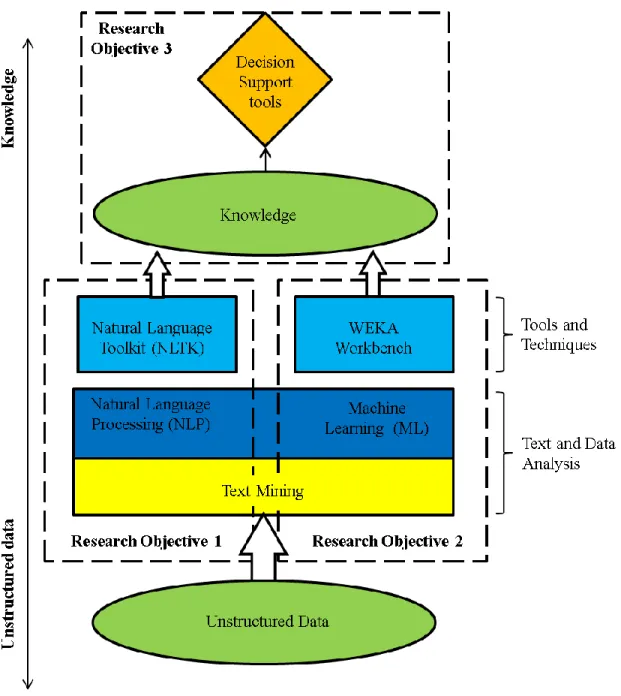
The first research objective aims to develop a system capable of extracting information from thousands of process sheets.. The second research objective aims to develop a decision support system to automatically form rules that aid the planner in assembly time estimation. The outcome of the first two research objectives is to transform unstructured data into useful knowledge that can be utilized to develop tools to
better the processes in domains handling large amounts of data. The third research objective presents the development and implementation of a tool to test and validate the knowledge generated from research objective two. Figure 1.1 illustrates the framework to extract knowledge from unstructured data. The three research objectives are outlined.
1.3Thesis Outline
Error! Reference source not found.A summary of the thesis is included in Error! Reference source not found..
Figure 1.2: Thesis outline
The necessary background and introduction to the current work and processes is included in Chapter Two. Current literature in related research fields is reviewed to better
•Background on current processes and issues encountered •Overview of related literature
CHAPTER TWO: BACKGROUND AND LITERATURE REVIEW
•Introduction of the NLP tools to address the issues encountered •Introduction to machine learning software to automate the process of
knowledge development
CHAPTER THREE: NLP AND MACHINE LEARNING APPROACH TO EXTRACT KNOWLEDGE FROM PROCESS SHEETS
•Process plan to serve as a guide to realizing the tools
•Implementation of NLP techniques to extract knowledge from process sheets
•Integration of NLP techniques and ML tools to develop decision support for systems
CHAPTER FOUR: DEVELOPMENT AND
IMPLEMENTATION OF THE NATURAL LANGUAGE PROCESSING (NLP) AND MACHINE LEARNING (ML) TOOLS
•Validation of results obtained from tools
CHAPTER FIVE: VALIDATION AND TESTING
•Limitations and drawbacks of the tools •Further research for improvement
understand the problems at hand. Best possible methods to address these issues are highlighted.
Chapter Three introduces the NLP tools that are used to perform the necessary operations to extract knowledge from the process sheets. A brief description of WEKA, a machine learning software, is provided. WEKA is used to automate the process of developing knowledge for the decision support tools. A deatiled discussion on each of the tools and the tasks involved is provided and how these tools are inegrated to achieve the desired result.
The development of the tools to realize the two research objectives is presented in Chapter Four. A process plan detailing how each phase serves to solve the problems identfied is presented. The chapter concludes with the implementation of the tools that are developed. A GUI is developed that integrates the tools to direct the planner to an appropriate MTM table based on the work instruction entered.
Chapter Five deals with testing and validation the tools developed in chapter four. The results obtained from the tools are checked against existing data and decision support tools to validate the accuracy of the tool.
The closure for the thesis is presented in Chapter Six with a summary of the tools developed to address the research objectives and the broader reach of the work. This section identifies certain limitations and drawbacks of the developed tools and provides a brief discussion on future work.
CHAPTER TWO: BACKGROUND AND LITERATURE REVIEW
This chapter provides the necessary background regarding the current assembly process in automotive industry. The literature of relevant topics is reviewed to determine the preferred approach to support the development of tools to address the issues outlined.
2.1Current trends in automotive industry
The current automotive market is highly competitive, characterized by intense competition and increasing demands for innovative and customer-oriented products. Recent automotive manufacturing trend has seen a shift from mass production to a JIT (Just-In-Time) production to meet the demands of a more wide and diverse customer base [7]. The customer requirement for product variety needs flexible and intelligent manufacturing systems to be integrated to the current manufacturing processes to achieve low-cost of production, high product variety, high productivity and short delivery times [8].
The application of Artificial Intelligence (AI) in automotive industry is seen in a wide variety of domains ranging from design, manufacturing, and vehicle functionalities [3]. Recent advances in CAD and Artificial Intelligence (AI) have further augmented the manufacturing process by presenting opportunities to perform assembly planning by functional precedence and connectivity relationships [9].
The integration of AI systems in manufacturing processes in automobile industries has seen development of applications in areas such as machine translation of
process sheets, robotic alternative to manual operation, and ergonomic analysis of assembly process [3,10,11].
Abdullah et al. [12] point out that almost half of all production work comprises of assembly process and assembly costs amount to 50% of the entire production cost. There is immense scope of cost cutting, workforce reduction and effective management in the assembly process of automotive industry. Therefore there has been much research in development of tools to improve the assembly planning process.
Rychtyckyj [1–3,11,13] discussed the development of a knowledge based system, known as Direct Labor Management System (DLMS), that supports and manages data pertaining to all stages of the assembly planning process [1–3,11,13]. Process sheets are formal documents that contain detailed instructions, called work instruction, to build a portion of a vehicle. The DLMS allows planners to create process sheets using a restricted vocabulary that are machine readable. The system makes use of AI to check for any conflict among the instructions or ergonomic issues that can occur. The work instructions are mapped onto MODAPTS, a predetermined time standard, to estimate the time required to complete the activities. Furthermore, the system also provides the capability of translating the process sheet to other languages to support activities in other assembly plants that do not use the same language used for writing process sheets as their main language [1,3,13]. Further discussion on assembly planning is provided in the following section.
2.1.1Assembly Process Planning
In an automotive manufacturing industry, the product is carried through a succession of workstations on moving flow line called an assembly line [12]. The complete assembly of the vehicle is performed sequentially on this assembly line by associates allocated to each workstation. This sequence of steps to complete the assembly of a product based on the connectivity relationship of the parts or subassemblies is known as assembly planning [12]. The process of assembly planning is a critical activity in the final production of a vehicle. The cost of assembling a product can be minimized by optimal process planning [14]. A schematic representation of an assembly line is shown in Figure 2.1. The base part moves from work station 1 to work station 4 along the work flow. At each work station, a value adding task is performed and the final product is obtained at the end of the assembly line.
Figure 2.1: Schematic representation of an assembly line
The result of the assembly process planning is the assembly process sheet. Process sheets convey the vehicle assembly information from the process planning department to the shop floor [1–3]. Process sheets, or TVGs, are text documents that contain detailed instructions required to assemble a portion of the vehicle [1]. In addition, process sheets also include information regarding the vehicle model, specifications of parts and tools to be used, quality checks, and assembly time estimates. The complete
assembly of a single vehicle requires about three thousand to five thousand process sheets [15]. These process sheets are allocated to the respective workstations as a reference document for the associates during assembly. Figure 2.2 shows a sample assembly process sheet.
To realize the automation of process planning, to support machine translation, assembly time estimation, and perform ergonomic analysis standardization of information contained within the process sheet is required. Peterson [4] developed a knowledge database system to support standardization the process of creating process sheets, for a global automobile manufacturer. Similar to Ford’s DLMS, Peterson [4] standardized the process of authoring process sheets through controlled language and vocabularies. This restricted use of language and syntax helps maintain consistency of the structure and also the level of detail in the work instructions. The use of controlled language and its benefits has been well documented in Ford’s Direct Labor Management System (DLMS) [1–3]. To develop the standard vocabulary, Peterson and colleagues analyzed a large number of existing process sheets to extract the most frequently used action verbs to generate a reduced standard list of verbs. This process can be automated to reduce the effort and time consumed.
2.1.2Assembly time estimation
The assembly planning activity is performed prior to the start of the vehicle production [15]. This is crucial to optimize the layout of the assembly line, work allocation, and efficient management of personnel. In the conventional method, a process engineer records the time taken by personnel to complete the task. But this procedure is time consuming and burdensome. Also when the personnel is aware that he is being observed and evaluated, his performance can suffer and lead to miscalculation of the time estimates [1,6]. To eliminate these issues, predetermined motion time systems have been developed. Boothroyd and Dewhurst, MTM, and MODAPTS are few frequently used
time standards [1,6,16]. The assembly time estimates obtained from the process sheets allows the users to predict the total time taken to build the vehicle. This time estimation for each assembly process allows planners to perform optimal line balancing, effectively procure material, reduce costs incurred by carrying large inventories, and schedule for shipment to customers, minimize storage costs.
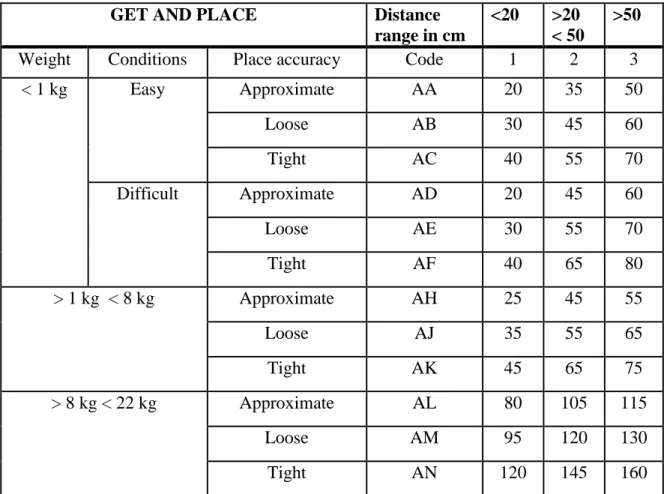
Time study is the process of estimating the time required to carry out a certain task. Maynard et al. [6] have developed a predetermined motion time system, known as Methods-Time Measurement (MTM). The MTM comprise of a set of tables, constructed through statistical analysis, that contain specific codes and time units for all value and non-value adding manual activities that are performed during assembly process. Large automotive manufacturers used adapted versions of the MTM as per their requirement. Based on factors such as the task performed by the associate, difficulty in assembling, parts and tools used, and distance covered the planners assigns each work instruction a time estimate by traversing through the tables. Each MTM table consists of various options that the planner has to narrow down in order to select one code and corresponding time units that relates to the activity described in the work instruction. A sample table from the MTM is shown in Table 2.1.
Table 2.1: Sample MTM Table
GET AND PLACE Distance
range in cm
<20 >20 < 50
>50
Weight Conditions Place accuracy Code 1 2 3
< 1 kg Easy Approximate AA 20 35 50 Loose AB 30 45 60 Tight AC 40 55 70 Difficult Approximate AD 20 45 60 Loose AE 30 55 70 Tight AF 40 65 80 > 1 kg < 8 kg Approximate AH 25 45 55 Loose AJ 35 55 65 Tight AK 45 65 75 > 8 kg < 22 kg Approximate AL 80 105 115 Loose AM 95 120 130 Tight AN 120 145 160
Manually performing time studies for all the process sheets involved in the complete assembly of an automobile is a tedious process. There is a need to automate the process of estimating the assembly time. This need has been addressed by Ford’s Direct Labor Management System (DLMS). Ford’s DLMS uses standard language, known as SLANG to construct all work instructions [1,2]. By standardizing the work instructions through standard vocabulary, the system is capable of reading and interpreting each work instruction and assign time estimates. As mentioned earlier, similar work has been carried out by Peterson [4] and Renu [5].
Peterson’s [4] model to author process sheets using controlled language is leveraged by Renu [5] to assign time estimates for each work instruction. Peterson’s model, to standardize the process of writing work instructions and Renu’s tool, for assembly time estimation are discussed in detail in the following chapter. The basic elements that constitute a work instruction are Verb and Object. Renu’s decision support tool gathers the verb and objects information from a work instruction and directs the user to the MTM table based on a rule set developed from historical data. But these rules have been developed manually from a small set of data. For effective utilization of the decision support tool, the generation of rules must be automated and large amounts of data need to be analyzed. The proposed research aims to bridge the gaps that are encountered. By automating the process of extracting information from unstructured data and generating rules through machine learning, this research further augments the work by Peterson and Renu.
2.2Text Mining
Exploitation of existing knowledge and knowledge acquisition are a key to compete at a global level, in any industry. Text mining or text data mining is the process of extracting useful knowledge from unstructured data. Text mining is a multidisciplinary field, involving information retrieval, knowledge extraction, machine learning and data mining [17].
Recent studies indicate that 80% of the data in an industry is stored in textual format [17]. Though freely available, this data is not availed at the right time and in the right manner and hence it is not utilized to its full potential. The reason is due the
overwhelming nature of the data collected. This problem has been aptly coined as “rich data, poor information” [18]. Large amount of data is accumulated from various sources but no means to filter it into knowledge that can aid in decision making and enhance productivity. It is evident that the availability of information and the ability to exchange and process it is the key to success in global market [19]. Knowledge provides the means to solve problems and predicting future market. Efficient knowledge acquisition necessitates intelligent systems that are capable of gathering large amounts of information and deduce patterns that are implicit.
2.2.1Natural Language Processing (NLP)
As the interaction with computational machines is ever increasing, the need to reduce the gap between man and machine is predominant. Researchers have observed very early on that, a machine that can analyze and respond using natural language rather than a machine language is much more effective and easier to interact with, from a user perspective. This ideology has culminated into the research and development of systems capable of processing natural language. Natural language processing (NLP) is the ability of a system to understand, manipulate and communicate using natural language. The field of NLP brings together tools and techniques from a number of disciplines, namely, Artificial Intelligence (AI), linguistics, and computer science [20–22].
Research efforts into NLP have been ongoing for several decades and the roots trace back to the early 1950’s [20,22–24]. Early application of NLP was seen in automatic machine translation of phrases from one language to the other. This automation
is a consequence of Turing’s model of algorithmic computation, considered to be the foundation of modern computer science [20]. NLP involves design and implementation of computer systems that can effectively read, understand and communicate in human languages. The applications of NLP extend from speech recognition to cross-language information retrieval.
The ability of Natural Language Processing (NLP) is exploited within the scope of this research to extract information from assembly process sheets. Process sheets are a classic example of a technical document written using natural language. NLP tools and techniques are best suited to extract information from large unstructured process sheets and transformed into knowledge to provide decision support within the manufacturing domain. Further discussion on NLP tools and techniques used to extract knowledge from process sheets are presented in Chapter Three.
2.3Chapter Summary
This chapter provides an overview of the assembly process planning in the automotive industry. The chapter presents how standardization of process sheets will aid in automation of assembly time estimation process. The chapter concludes by describing how Information Retrieval (IR) through NLP and Machine Learning (ML) can be used to automatically extract information and develop knowledge for decision support tools.
CHAPTER THREE: NLP AND MACHINE LEARNING APPROACH TO EXTRACT KNOWLEDGE FROM PROCESS SHEETS
This chapter lays the framework to realize the research objectives and forms the core of this thesis. To put this research in context, standardization of process sheets and decision support tools to estimate assembly time are discussed in detail. This discussion serves as an introduction to address the gaps identified.
To standardize the process of authoring process sheets, Peterson analyzed the process sheets for the vocabulary used and the sentence structure used within work instruction text. A process sheets contains work instruction, tools and parts used, time studies, and other meta-information that range from details on allotment of the process sheet to a certain assembly line and location to the diagrammatic representation of the approximate location of the part in the vehicle. The information required to develop a standard vocabulary and controlled language is contained in the section consisting assembly work instructions.
A total of 236 process sheets have been analyzed for this purpose. Each process sheet contains multiple assembly instructions, averaging about three to four instructions. A total of 697 assembly instructions are gathered from the 236 process sheets. A list of frequently used verbs that describe a unique action are gathered. Thus by identifying the verbs used to describe the work instruction actions, a preliminary list of verbs to be used in controlled language is developed. The standard vocabulary for verbs consists of 31 unique actions, each describing a certain action performed by the associate during the assembly process. The sentence structure is developed, based on the existing work
instructions, that is minimalistic while sufficient to clearly write a work instruction. The standard sentence structure of the work instruction is shown in Figure 3.1.
Figure 3.1: Sentence structure of work instructions
Peterson [4] developed a process sheet authorship tool based on the controlled language and standard vocabulary. The tool allows the planner to create work instructions for a process sheet using a standard structure format with the help of drop down menus and free form entry fields.
The process of developing a standard vocabulary required manual extraction of verb from each work instruction. This time consuming activity can be simplified by the NLP approach. NLP tools can be used to automatically read each work instruction from the process sheets and find the verb that describes the primary action of the assembly step. This method will also have the advantage of processing a large number of process sheets in a significantly shorter time since it is a computational method.
In addition to extracting the verb, the primary object from each work instruction is also extracted. This data is required to generate a tool (Object type classifier) which will assist in the development of the decision support to estimate assembly time. Further discussion on the object type classifier will be provided in further chapters.
Each process sheet has several work instructions that are carried out by an associate on the shop floor for that particular assembly activity. The process sheet also
contains a set of time study steps that list out all the time defining actions that will occur during the assembly activity. Each time study step provides information on the time required to carry out a certain action. The combined time of these time study steps provides an estimate of the time required to complete all the assembly instructions described within the process sheet. These time estimates are essential in any manufacturing industry to perform optimal line balancing.
Currently the time studies for each process sheet are written by a planner by observing an associate performing the assembly activity and recording the action steps. The corresponding MTM tables are referred and each activity is denoted a code and time units based on certain parameters. This process is labor intensive and time taking [1].
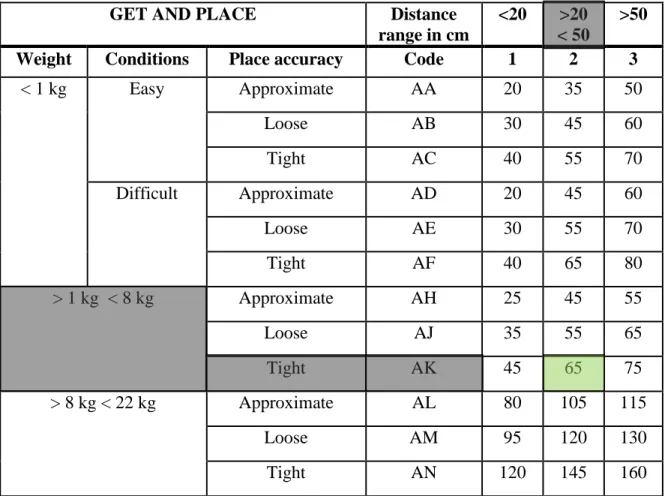
For example consider the work instruction – ‘Get and place bumper on car body’. Presume the bumper weighs 3 kg and is place tightly onto the car body. The associate moves 25 cm in order to pick up the part and place. The steps to determine a suitable MTM code and time units for the work instruction is as follows.
Step 1: Select the appropriate MTM table based on the activity described. In this case, the work instruction statement describes picking up a part and placing it on a sub-assembly. Therefore, the MTM table ‘Get and Place’ is selected.
Step 2: The first column in the MTM table describes the weight of the part. Since the bumper weighs 3 kg, the rows corresponding to the ‘Weight’ parameter (> 1 kg < 8kg) are chosen.
Step 3: The type of fit is described as tight. Therefore in the ‘Place accuracy’ column, the option ‘Tight’ is chosen. The selection of ‘Weight’ and ‘Place accuracy’ parameters points to the MTM code ‘AK’.
Step 4: The user is provided with three choices for the time units. Since the distance moved by the associate is 25 cm, the second column in the ‘Distance range’ is selected and the corresponding time unit of 65TMU is obtained. MTM tables contain time units in TMU (1 TMU = 0.036s).
The illustration to the example is shown in Error! Reference source not found.. he parameters and the time unit are highlighted.
Table 3.1: Obtaining time estimates for sample work instruction statement
GET AND PLACE Distance
range in cm
<20 >20 < 50
>50
Weight Conditions Place accuracy Code 1 2 3
< 1 kg Easy Approximate AA 20 35 50 Loose AB 30 45 60 Tight AC 40 55 70 Difficult Approximate AD 20 45 60 Loose AE 30 55 70 Tight AF 40 65 80 > 1 kg < 8 kg Approximate AH 25 45 55 Loose AJ 35 55 65 Tight AK 45 65 75 > 8 kg < 22 kg Approximate AL 80 105 115 Loose AM 95 120 130 Tight AN 120 145 160
The process of selecting a MTM table based on the activity described in the work instruction and determining a single MTM code based on the parameters is a tedious process. To automate the process of performing time studies, Renu [5] has developed a set of rules that direct the planner to the appropriate MTM table based on the information gathered from the assembly instruction. This automation reduces the cognitive load and repetitive work load on the planner. It is to be noted that these rules only direct the planner to an appropriated MTM table. Work instructions do not contain all the information required to narrow down to a single MTM code and time unit but sufficient information to select a MTM table. Each MTM table has specific set of parameters that drive the planner to single code. Information regarding the parameters is obtained from other information sources such as CAD data, which is not within the scope of this research. The MTM rules are a set of simple IF THEN rules, that utilize the verb and object to determine the table. The MTM rules are in the format shown below.
IF <verb> AND <object> THEN <MTM table>
During the assembly of the vehicle, the associates interact with thousands of objects. This would result in a huge list of rules, which is impractical. To reduce the number and simplify the rules, five object types were created and all the objects belonged to one and only one type. The five object types being – Part, Tool, Consumable, Fixture, and Plant item. Each object is assigned to one object type and this resulted in a simplified rules list as shown below.
Therefore if the planner chooses the verb ‘Scan’ and an object with type ‘Part’, the tool will direct the planner to the appropriate table, in this case ‘Marking and Documenting’. These rules have been manually developed by analyzing 1019 time study steps from 236 process sheets. The verb, object and the MTM table have been extracted and the instances with highest frequency, derived through statistical analysis, are used to form rules. These rules have a mapping accuracy of 75 %. A sample set of the rules are presented in tabular form in Table 3.2.
Table 3.2: Sample MTM mapping rules MTM mapping rules
Action verb
& Object Type MTM Table Name
Align
& Fixture Place
& Plant Item Place
& Tool Motion Cycles
Attach
& Consumable Working with Adhesives
& Fixture Get and Place
Clean
& Consumable Cleaning
Since manually extracting verb and object from each time study and then assigning an object type for each of the extracted object is a burdensome task, NLP tools can be utilized to process a large set of data in a very short time. Also, the rules when developed manually are subject to human error. This can be avoided by using machine learning algorithms to generate rules. Machine learning algorithms are capable of processing large amounts of data and also bring out the implicit relationships between the data that may not be noticed by a human.
To better understand the underlying process of knowledge extraction, a brief description of the NLP techniques and machine learning tools, that are used to develop the decision support tools, is provided. These NLP techniques and machine learning tools work in tandem to extract selected information from a large dataset and transform the data into resourceful knowledge. The following section talks about Natural Language Processing and few of the techniques within NLP.
3.1Natural Language Processing (NLP)
The primary intent of NLP is to extract the meaning of text. Text can be a word, statement, paragraph or an entire document depending on the analysis [25]. In process sheets, this text is in the form of sentences. NLP provides tools to perform syntactic and semantic analysis involving text using computational methods. Syntactic analysis is performed to understand structure of the sentence. It involves the part of speech of the words and parse trees [25]. Semantic analysis provides the meaning, which involves the context of the sentence. It provides the relationship between the syntactic elements.
3.1.1Parsing
Parsing is the process of breaking down text into its components, identifying the part of speech (PoS), outlining the function and syntactic relationship between each component based on the rules of formal grammar and generating a parse tree structure of the text. Essentially parsing pertains only to the process of creating tree structures, but in most cases the entire process is considered parsing. Parsing is preceded by two processes – Tokenizing and Tagging. The first step involves splitting a sentence into single entities
called tokens, by means of user-specified separator. In the second step, tagging, the tokens are assigned a part of speech (PoS) depending on the nature of the token in the sentence. A tree structure is then created based on the grammatical structure of the sentence. The three analyses of the parsing process are shown in Table 3.3.
Table 3.3: Analyses in parsing process
Analysis Process Definition
Lexical Tokenizing Breaking down a sentence into single entities, known as tokens.
Syntactic Tagging Assigning a part of speech (PoS) tag to each of the tokens.
Syntactic Parsing Creating tree structures of the sentence.
The Stanford parser, developed by the Natural Language Processing Group (NLPG) at Stanford University, is a computational implementation of a statistical parser. The Stanford parser analyses the input sentence and constructs a constituent structure that adheres to the syntax [26,27]. The Stanford parser provides Java implementations of probabilistic natural language parsers. In this research, an unlexicalized PCGF (Probabilistic Context Free Grammar) parser is used. The PCGF parser is provides in three different languages apart from English – German, Chinese, and Arabic [26]. The PCFG parser is trained on a large corpus consisting annotated text. Recent studies have showed that unlexicalized parsers have higher accuracy than previously thought [26,28]. Klein and Manning’s [26] research has showed that unlexicalized parsers have a high accuracy of 86.31%, almost as high as state-of-the art parsers.
The parser uses the Penn Treebank schema to denote phrasal categories and annotate the text with Part of Speech (PoS) tags. The Penn Treebank is a huge corpus
consisting of syntactically bracketed and PoS tagged texts. A list of twelve syntactic tags and thirty-six Part of Speech (PoS) tags are used within the Penn Treebank and the Stanford parser to syntactically bracket and annotate the text [29]. Table 3.4 and Table 3.5 show a sample of the PoS and syntactic tag set with their description.
Table 3.4: Sample PoS tag set
Tag Description NN Noun VB Verb JJ Adjective RB Adverb CC Conjunction IN Preposition CD Cardinal number
Table 3.5: Sample syntactic tag set
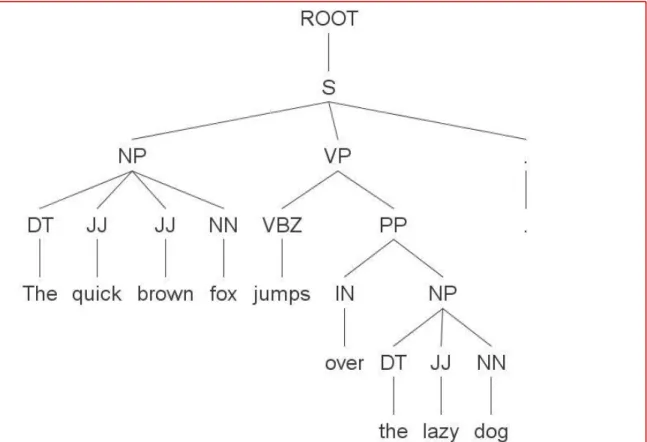
The Stanford parser analyzes the input text and provides the user with various outputs – phrase structure trees, typed dependencies, and plain PoS tagged tokens. The parse tree of a sample sentence “The quick brown fox jumps over the lazy dog.” is shown below in
Figure 3.2
Tag Description
S Simple declarative clause
NP Noun phrase
VP Verb phrase
Figure 3.2: Parse tree of sample sentence
To develop the standard vocabulary and decision support for the tools, it is required to establish a method to automatically extract the verb and object list from the existing 236 TVGs. It is observed that in each of the assembly instruction and time study step, the primary action is a verb (VB) and the object, the verb acts on, is a noun (NN). The Stanford parser is leveraged to accurately tag the action verb and object from each assembly instruction and time study step. A program is written in a suitable scripting language to search for the VB and NN tags from each parsed sentence and extract the corresponding tokens into a text file. A detailed discussion provided in the following sections.
3.2Natural Language Toolkit (NLTK)
The NLTK is a software package for building Python modules to perform linguistic research in Natural Language Processing (NLP). NLTK consists of a set of NLP tools and that provides access to corpora and data manipulation. It provides a suite of text processing libraries for tokenizing, tagging, parsing and classification. Large number of text files can be imported through NLTK, analyzed and presented in a suitable format.
The verb (VB) and noun (NN) tokens relate to the corresponding action verb and objects in an assembly instruction or time study step. Therefore by parsing 236 process sheets, the verb and object from each work instruction and time study can be extracted thus avoiding manual work. The required information can be extracted from the parsed work instructions and time study steps by a python code written using the library of functions available in NLTK. But to process the text, certain amount of pre-processing and editing is required to structure the statements. Further discussion on the required pre-processing is provided below.
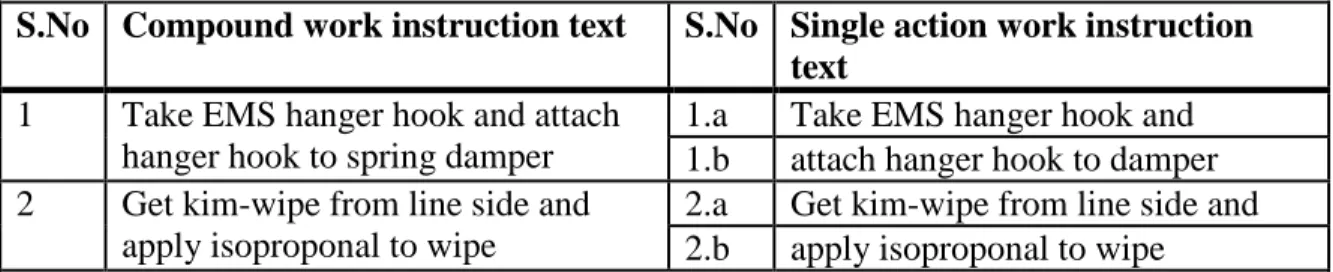
Due to the absence of a standard format, many work instructions have been compounded into a single sentence, describing more than one activity to be performed. For the purposes of ease and simplicity, these compound work instructions have been separated into single action steps as shown in Table 3.6. Therefore each step represents only one action to be performed by the associate. This is the first step in simplifying the data for effective information extraction.
Table 3.6: Compound work instructions split into single action work instructions S.No Compound work instruction text S.No Single action work instruction
text 1 Take EMS hanger hook and attach
hanger hook to spring damper
1.a Take EMS hanger hook and 1.b attach hanger hook to damper 2 Get kim-wipe from line side and
apply isoproponal to wipe
2.a Get kim-wipe from line side and 2.b apply isoproponal to wipe
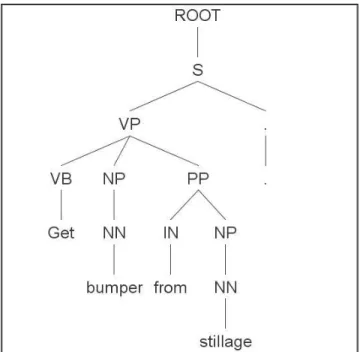
The Stanford parser requires the text input in a certain format to accurately tag words. The work instructions from the TVGs do not follow a standard structure or grammar; therefore it is crucial to perform certain text-preprocessing for effective parsing. Figure 3.3 and Figure 3.4 illustrate the parsed tree structure for work instruction in upper case and sentence case respectively. It is evident that the parser performs poorly when the sentence is entered in upper case and tags each token as a noun, the default tag. The parser performs better while the text is inputted in sentence case and accurately tags each token with the appropriate tag. Therefore the work instruction text from the TVGs is converted to a standard format with punctuation rules for better text analysis.
Figure 3.4: Parse tree of sample sentence in sentence case
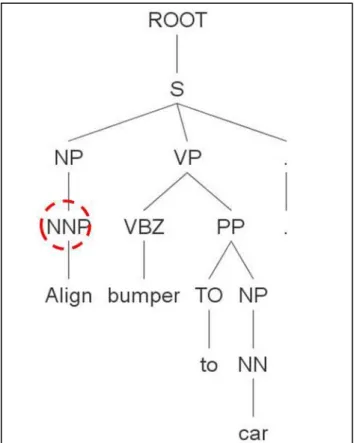
Parsers are trained on corpuses of hand-parsed and complete sentences and therefore are able to almost accurately tag each token with a part of speech (PoS) [30]. The work instructions in the existing TVGs and written in bullet point grammar. The parser cannot adequately identify all the PoS tags of the tokens in a sentence unless additional information is provided. Figure 3.5 shows the token ‘Align’ is tagged as a noun (NNP), highlighted in red. But in fact the token describes an action to be performed by the associate and hence it is a verb (VB).
Figure 3.5: Incorrectly tagged WI text
To address this issue, each work instruction is concatenated with the term “The associate must” at the start of the sentence to provide contextual meaning. The edited work instruction is parsed and the token ‘Align’ is accurately tagged as a verb (VB) by the parser, highlighted in green in Figure 3.6.
Figure 3.6: Accurately tagged WI text
All the work instructions are edited to a suitable format by simple text pre-processing so as to be accurately parsed. The required data from the process sheets is imported into an excel worksheet, edited and exported to a text file to be parsed. Table 3.7 shows a sample of raw work instruction text that has been edited to obtain accurate PoS tags.
Table 3.7: Sample edited work instruction text Raw work instruction text Edited work instruction text
MOVE TO BUMPER STILLAGE. The associate must move to bumper stillage.
ENSURE BUMPER IS FLUSH WITH FEN DER
The associate must ensure bumper is flush with fender.
Get the correct roof rail from line side. The associate must get the correct roof rail from line side.
3.3Text classification
Text classification is the process of categorizing text documents or text files among a set of pre-defined groups [31]. Text classification of data is natural language plays a pivotal role in information retrieval [32]. Text classification goes beyond regular text categorization and document retrieval and finds its application in many real world challenges such as sorting emails, sentiment detection, and search engines [32,33]. In basic text classification, a text document or input is analyzed and then assigned a label that is most appropriate [27]. The classification tasks are generally carried out by machine learning algorithms that can identify certain attributes or features extracted from the input and label the document based on the data the algorithm has been trained on.
A classification process which involves training a classifier model on pre-labeled data is known as supervised learning. Therefore supervised learning requires a training set to learn data properties [34]. The training data consists of text documents that are manually pre-annotated with one or more labels. The feature extractor generates the features and associates them with the relevant labels. The feature-label pair forms the basis for the algorithm to generate the classifier model. The features from the test documents are also extracted and the classifier model and are checked against the feature-label pair and then assigned one or more feature-labels. Figure 3.7 shows the schematic representation of the classification process with supervised learning.
Figure 3.7: Schematic representation of text classification
There are three types of text classification – binary classification, multi-class classification, and multi-label classification. The binary classification involves classifying a given input into either of the two available classes. Classifying a document into only one of many labels is known as a multi-class classification. Essentially a multi-class classification is an extension of binary classification and the same techniques can also be applied to create a multi-class classifier. The third type of classification is the multi-label classification, which involves classify the input into one or more labels. A multi-label classifier can be developed by combining a binary classifier for each label [31].
As discussed previously, each object is assigned one of the five object types that are proposed. The rules are developed in the following format and consist of the elements – verb and object type.
{ {
Each unique set of verb and object type narrows down the choice of MTM tables. Therefore classification of objects into categories is required to provide a mapping between the standard verb and the MTM table. Text classification is most suitable for this purpose since it is memory efficient, versatile and a large training set is available. An object type classifier is developed using the scikit-learn machine learning library to categorize the objects into their respective classes [34]. The object type classifier is a multi-class classifier that categorizes the objects into one of the five pre-defined object types. The main process blocks of text classification are discussed below in detail.
3.3.1Training dataset
In supervised learning, a training dataset is initially provided as an external data source to the algorithm. Based on this dataset, the algorithm generates a model which predicts the label for the test input based on the data properties of the training set [35]. The training set for the object classifier is a manually labeled set of 794 objects with their respective object types. The training data is inputted as two arrays: an array of objects of and an array of their corresponding object types [34].
3.3.2Feature extractor
Feature extraction from text document is a major component of the classification process. A feature extractor analyzes the text data, identifies the data properties and transforms them into numerical features. The training data for the object type classifier is a list of objects with labels, and each object sample represents a document and the features are extracted from the object.
Machine learning algorithms support only certain formats of the features extracted from the datasets. And the format of the features is dependent on the type of algorithm being used to build the model. For a multi-class classification, Support Vector Machines (SVM) are preferred since they are more robust and its ability to process large data when compared to conventional text classification methods [33,36]. Support Vector Machines requires the features to be in the form of vectors [35]. Vectorization involves the process of transforming text documents into a set of numerical feature vectors [34]. The training data is vectorized using the modules provided by the scikit-learn library. Support Vector Machines and machine learning will be discussed in detail in the following sections.
To convert the raw text into feature vectors the text documents are tokenized using whitespaces as separators. The occurrence of the tokens in each document is computed and finally the token are normalized and assigned weights based on their occurrence and importance in the training documents. Each text document in the training set is transformed into an array of numerical feature vectors as shown in Figure 3.8. The training set is arranged into a matrix where each row denotes a text document and each column denotes a feature. Each text document is represented as a binary vector with a
value 1 if the document contains the feature and 0 if the feature does not appear [33]. The vector matrix is provided as input to the algorithm.
Figure 3.8: Input vectorization
This process of feature set extraction is called the “Bag of Words” representation [31,34]. The bag of words representation is a collection of individual tokens, also called as unigrams, which disregard word dependencies. Misspelling, phrases, multi-word expressions, and word derivations are also not taken into consideration in bag of words representation. To counter this drawback, a consecutive set of unigrams are considered, known as n-grams representation, to include word dependencies. The feature extraction module provides parameters that can be modified to extract meaningful features from the data. The maximum and minimum number of characters for the n-grams, analyzer, and cut-off parameters are set for the object type classifier.
3.3.3Machine learning
Machine learning deals with developing systems that are designed to learn and act without being explicitly programmed. The systems adapt to solve a given problem by utilizing sample data or past experience [37]. Text classification in machine learning employs algorithms to generate a decision function that is learned automatically from the data.
Support Vector Machines (SVM) was introduced by Vapnik [38] as a new machine learning algorithm that maps the input data vectors onto a high dimensional feature space and determining a separating hyper-plane between the classes [35,36,38]. They are based on the structural risk minimization principle, which involves finding a hypothesis that guarantees the least true error [36].
SVMs provide functions to classify data that is not linearly separable, by mapping the data on a higher dimensional space without the losing relatedness between the data points. These functions are known as kernel functions [32]. The commonly used kernel functions are linear, radial based function (RBF), polynomial, and sigmoid [35]. Kernel functions are specified for decision functions and are capable of multi-class classification. SVMs are designed to handle high dimensional feature spaces, as is the case of text classification [34,36]. This is possible since SVMs use overfitting protection, which is independent of the number of features. Each document contains only few 1s and mostly 0s, where 1 represents an occurrence of a feature and 0 represents that the feature does not exist in the document. SVMs are capable of handling both dense and sparse vectors as inputs [36].
For a multi-class classification, two approaches are most common – one-vs-one (OVO) and One-vs-all (OVA). In one-vs-one (OVO) approach, one classifier per each pair of classes is constructed and the class which receives the most prediction score is chosen. One-vs-all (OVA), one classifier per each class is constructed. Each class is fitted against all the other classes and the class which classifies the test data with greatest margin is chosen. OVA is the preferred approach for its simplicity, faster processing time, and computational efficiency [32,34]. LinearSVC class with a linear kernel is used to generate the object type classifier since it implements a One-vs-all (OVA) approach [34].
3.3.4Issues with text classification
Though text classification has been greatly advanced over the last decade, certain issues are still open to research efforts. Most machine learning algorithms work well with balanced datasets. But in the case of imbalanced datasets, the overall performance of text classifier deprecates [39]. Imbalanced datasets refers to situations wherein there are far fewer instances of one class when compared to the other class. This results in a skewed classifier that leans towards the majority class. Though the overall accuracy is very high due to the presence of a large dataset of the majority class, the minority class is misclassified, which is usually a major concern. Imbalanced datasets are very common in real world situations like gene profiling and fraudulent credit card detection [40]. The imbalanced dataset problem has also been encountered while developing the object type classifier, and hence requires addressing. Techniques to counter the effects of an
imbalanced dataset, both at data level and algorithmic level, have been proposed. The most commonly used and effective methods are discussed in the following section.
Some of the basic adjustments, done at the data level, to balance the datasets are sampling techniques - under-sampling and over-sampling. In under-sampling approach, the majority class is diminished by extracting a smaller set from the large set of data while maintain the initial dataset of the minority class intact. Under-sampling greatly reduces the training time but at the same time, a risk of information loss exists due to a diminished dataset. Over-sampling is the exact opposite of the under-sampling process. The size of minority class is expanded by replicating the initial instances to reduce the imbalance ratio between the majority class and the minority class. Although this technique avoids information loss, it does not address the issue that the minority class lacks data. New data is not created; rather existing data is duplicated. Also, over-sampling increases computational cost and the effect of labeling errors are greatly multiplied [39–41].
Over-sampling is the preferred approach towards balancing the dataset for the following reasons:
1. The object classifier deals with simple classifying tasks and therefore does not require extensive, complex and computational costly algorithms. 2. Under-sampling of the training data causes further information loss. 3. As the sample data contains only one object for each instance, labeling
3.4WEKA, machine learning workbench
The Waikato Environment for Knowledge Analysis (WEKA) is a suite of Java class libraries that aid in the application of machine leaning and data mining algorithms to real world problems [42,43]. The principal algorithms in WEKA are the classifiers that generate decisions trees and rule sets that structure the dataset. WEKA also provides tools for data manipulation; visualization of results, cross-validation and comparison of rule set [43]. The WEKA workbench brings together several established algorithms that include decision trees, data clustering methods, feature selection and data filtering to a common graphical user interface to extract useful information while providing flexibility to add new algorithms as desired by the user. It allows the user to perform research pertaining to data mining and knowledge extraction without burdening the user with machine learning algorithms. The flexibility and user friendly interface of WEKA workbench is utilized in this research to generate MTM mapping rules.
The primary graphical interface in WEKA is the “Explorer”, which provides easy access to the various algorithms and functionalities [44]. The Explorer window has six different panels that can be accessed from the tabs present at the top as shown in Figure 3.9: WEKA Explorer user interfaceFigure 3.9. The six panels are – Preprocess, Classify, Cluster, Associate, Select attributes, and Visualize. A brief description of each panel and the corresponding data mining tasks supported is presented below.
Figure 3.9: WEKA Explorer user interface
WEKA accepts the data in various formats, including ARFF (Attribute-Relation File Format) and CSV (Comma Separated Values). The ARFF format is WEKA’s native file format and the preferred format used in this research. The ARFF format defines a data set in terms of relation or a table with attributes or columns of data [45]. Figure 3.10 shows a sample dataset in ARFF format. The data can be loaded from a file or from a database using an SQL query or an URL [44].
In the Preprocess panel, data is loaded and transformed using filters available. The filters perform further preprocessing on the data such as delete certain attributes or row
instances with a particular attribute value [46]. The Preprocess panel also provides a histogram of the attributes and statistics of the dataset as seen in Figure 3.9.
Figure 3.10: Sample ARFF dataset
The second panel in WEKA Explorer interface is the Classify panel. It provides the user with access to classification and regression algorithms for analysis. The panel also provides cross-validation tools to analyze the outcome of the algorithm. The Classify panel consists of various machine learning algorithms including decision trees, rule sets, Bayesian classifiers, support vector machines, and nearest-neighbor methods [46]. The Classify panel displays the result of the algorithm used on the data set and also provides the performance of the classifier namely accuracy and confusion matrix.
Clustering is the process of grouping or organizing a set of objects or data instances such that all the members in a group are closely related or similar to each other than objects in other groups. The Association panel consists of algorithms for generating association rules used to identify the relationships between the attributes of the data. Association helps the user to identify the attribute that have the most impact on the prediction model.