programming language. PhD thesis, University of
Nottingham.
Access from the University of Nottingham repository: http://eprints.nottingham.ac.uk/10250/1/thesis.pdf
Copyright and reuse:
The Nottingham ePrints service makes this work by researchers of the University of Nottingham available open access under the following conditions.
· Copyright and all moral rights to the version of the paper presented here belong to the individual author(s) and/or other copyright owners.
· To the extent reasonable and practicable the material made available in Nottingham ePrints has been checked for eligibility before being made available.
· Copies of full items can be used for personal research or study, educational, or not-for-profit purposes without prior permission or charge provided that the authors, title and full bibliographic details are credited, a hyperlink and/or URL is given for the original metadata page and the content is not changed in any way.
· Quotations or similar reproductions must be sufficiently acknowledged.
Please see our full end user licence at:
http://eprints.nottingham.ac.uk/end_user_agreement.pdf A note on versions:
The version presented here may differ from the published version or from the version of record. If you wish to cite this item you are advised to consult the publisher’s version. Please see the repository url above for details on accessing the published version and note that access may require a subscription.
programming language
by Jonathan James Grattage, BSc (Hons)
Thesis submitted to The University of Nottingham
for the degree of Doctor of Philosophy, September 2006
This thesis introduces the language QML, a functional language for quantum computations on finite types. QML exhibits quantum data and control structures, and integrates reversible and irreversible quantum computations.
The design of QML is guided by the categorical semantics: QML programs are in-terpreted by morphisms in the categoryFQCof finite quantum computations, which provides a constructive operational semantics of irreversible quantum computations, realisable as quantum circuits. The quantum circuit model is also given a formal categorical definition via the category FQC.
QML integrates reversible and irreversible quantum computations in one language, using first order strict linear logic to make weakenings, which may lead to the collapse of the quantum wavefunction, explicit. Strict programs are free from measurement, and hence preserve superpositions and entanglement.
A denotational semantics of QML programs is presented, which maps QML terms into superoperators, via the operational semantics, made precise by the category Q. Extensional equality for QML programs is also presented, via a mapping from FQC morphisms into the category Q.
I’d like to thank my supervisors, Thorsten Altenkirch, of the School of Computer Science & IT, and Viacheslav Belavkin, of the School of Mathematical Sciences, for their support and expertise. Thorsten deserves a special mention for his knowledge and enthusiasm in helping me produce this thesis.
I’d also like to thank all the members of the Foundations of Programming Research Group for their help and support, especially: Conor McBride, Graham Hutton, Neil Ghani and Henrik Nilsson. My research colleagues Peter Morris, Catherine Hope, James Chapman, Alex Green, Mark Jago, Wouter Swierstra and Mauro Jaskelioff also deserve a special mention. Thanks also to John Cremona of the School of Math-ematical Science for his useful feedback on my first and second year reports. I am also immensely appreciative of the feedback and enthusiasm of my examiners, Neil Ghani, of the University of Nottingham, and Simon Gay, of the University of Glasgow.
I would like to thank Amr Sabry of Indiana University, Bloomington, USA, and Juliana Vizzotto, of the Universidade Federal do Rio Grande do Sul, Brazil, for their collaboration with Thorsten and I in developing an equational theory for reasoning about QML programs. Their help, suggestions, and enthusiasm for the QML project have been indispensable. I am also indebted to Amr Sabry and his family for their help and hospitality after I became stranded in Indiana for three days.
Thanks are also extended to Peter Selinger, of Dalhousie University, Canada, for his extensive and detailed feedback on my papers and talks, and for his organisation of the Workshop on Quantum Programming Languages. His enthusiasm for the field of quantum programming has been inspiring.
I’d also like to acknowledge the help and support of my friends from computer science, physics, and the real world. I’d like to thank David Camplin especially for his support throughout my academic career.
Thanks are also due to the EPSRC and the LMS, who jointly funded this research via the MathFIT initiative, to the QNET Semantics of Quantum Computation Net-work, and also to the many other bodies that have funded me in various ways.
Lastly, I’d like to thank my family, whose support and encouragement has been iii
invaluable: my wife Janine, my parents Ruth and Trevor, my siblings Rebecca and Stephen, and my grandparents Henry and Ella Swinney, and also to Tess.
For now we see in a glass, darkly; but then face to face: now I know in part; but then I shall understand fully, even as I have been fully understood.
Contents
List of Figures x
1 Introduction 1
1.1 Introduction to quantum computation 1
1.2 Experimental quantum computers 3
1.3 History of quantum computation 5
1.4 Quantum programming 7
1.5 Research outline 9
1.6 Structure of this thesis 11
1.7 Summary 13
2 Reversible classical computation 14
2.1 Physical models of computation 16
2.2 Reversible computations as circuits 19
2.3 Reversible circuits in Haskell 21
2.4 Reversible circuits: examples and theory 24
2.5 Simulating a circuit 27
2.6 Summary 29
3 Reversible quantum computation 31
3.1 Fundamentals of quantum computation 31
3.2 Linear algebra for quantum computation in Haskell 39
3.3 The quantum circuit model 45
3.4 Comparing classical and quantum circuits 48
3.5 Quantum circuits in Haskell 49
3.6 Example quantum circuits 50
3.7 Simulating a quantum circuit 54
3.8 Compiling a quantum circuit 55
3.9 The Deutsch algorithm 55
3.10 Quantum teleportation 59
3.11 Other models of quantum computation 61
3.13 Summary 63
4 FCC: Reversible & irreversible classical computation 64
4.1 Finite Classical Computations 64
4.2 Rudimentary category theory 65
4.3 Reversible computations in FCC≃ 66
4.4 Irreversible computations in FCC 68
4.5 Strict reversible computations 71
4.6 Modelling reversible classical computations in FinSet 71
4.7 Modelling irreversible computations in FinSet 73
4.8 FCC in Haskell 74
4.9 Summary 76
5 FQC: Reversible & irreversible quantum computation 77
5.1 Reversible quantum computations in FQC≃ 78
5.2 Irreversible quantum computations in FQC 80
5.3 Modelling reversible quantum computations in Q≃ 84
5.4 Modelling strict quantum computations in Q◦ 87
5.5 Modelling irreversible quantum computations in Q 88
5.6 Comparing FCC with FQC 93
5.7 FQCin Haskell 94
5.8 Q in Haskell 95
5.9 Summary 98
6 QML: A functional quantum programming language 99
6.1 Quantum data and control 99
6.2 Controlling weakening 100
6.3 Other sources of measurement 102
6.4 The design of QML 103
6.5 Syntax and typing rules 104
6.6 QML Programs 115
6.7 Coproducts in QML 118
6.8 Summary 120
7 Operational semantics of QML 121
7.1 The category of QML terms 122
7.2 Interpretation of judgements 123
7.3 Interpreting operations on contexts 124
7.4 Interpreting QML rules in FQC 125
7.5 A denotational semantics for QML 134
7.6 Compiling QML in Haskell 136
8 Further research 156
8.1 Compositionality of QML 156
8.2 A direct denotational semantics for QML 157
8.3 Infinite data structures and recursion in QML 163
8.4 Other areas of further research 164
8.5 Summary 165
9 Summary and conclusions 166
9.1 List of publications 168
References 170
A Shor’s algorithm and the Quantum Fourier Transform 179
A.1 Efficient factoring: Shor’s algorithm 179
A.2 From period finding to factoring 180
A.3 Probability Analysis 183
A.4 Haskell implementation of Shor’s algorithm 187
A.5 Order-finding by phase estimation 190
A.6 Implementing the three qubit Quantum Fourier Transform 200
List of Figures
2.1 A billiard ball switch operation . . . 18
2.2 The arity function . . . 23
2.3 cnotcircuit and simplification . . . 24
2.4 Circuit representation of the Toffoli gate. . . 25
2.5 Toffoli gate implementation of nand . . . . 26
2.6 The Fredkin gate . . . 26
2.7 The Fredkin gate performing and and not. . . 27
2.8 Compile function for classical circuits . . . 29
3.1 The Bloch Sphere: a geometric representation of a qubit . . . 35
3.2 Vector bind operation. . . 44
3.3 Matrix bind operation . . . 44
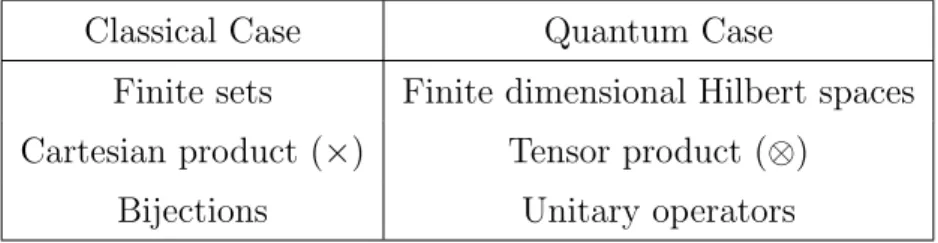
3.4 Comparing reversible classical and quantum computation . . . 49
3.5 A datatype for quantum circuits in Haskell . . . 49
3.6 The quantum circuit arity function . . . 51
3.7 Quantum cnot circuit . . . 52
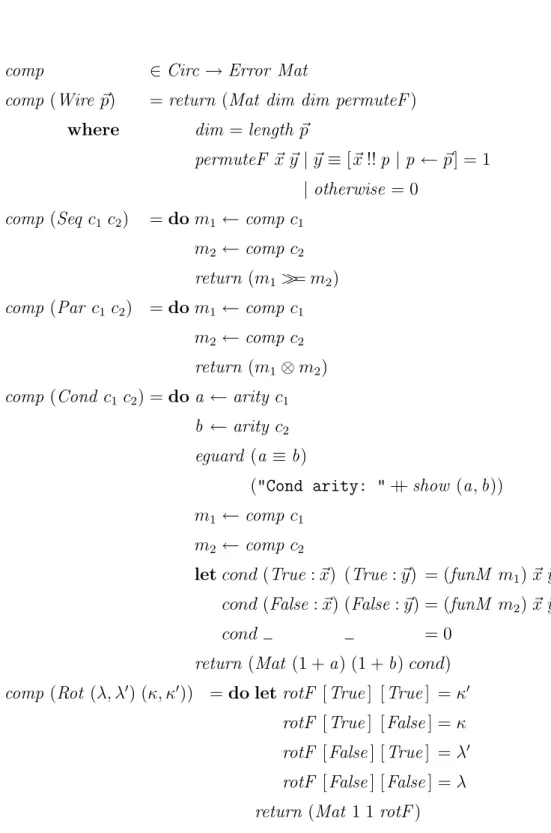
3.8 Compile function for quantum circuits . . . 56
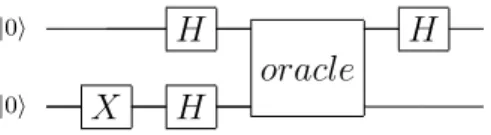
3.9 Quantum circuit implementing the Deutsch algorithm . . . 58
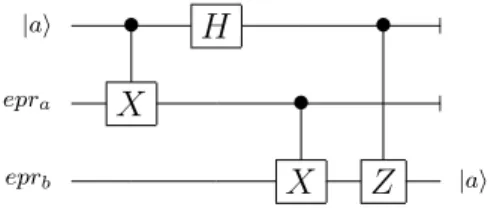
3.10 Quantum circuit implementing the teleportation algorithm . . . 60
4.1 An FCC computation . . . 69
4.2 Sequential composition in FCC: φβ◦α . . . 70
4.3 Parallel composition in FCC: φα⊗β . . . 71
4.4 Composition is preserved by lifting FCC to FinSet . . . 75
5.1 Sequential composition in FQC: φβ◦α . . . 82
5.2 Parallel composition in FQC: φα⊗β . . . 82
5.3 Composition is preserved by lifting FQC toQ . . . 93
5.4 Comparing FCC and FQC . . . 94
6.1 A quantum “sharing” circuit . . . 100
6.2 Interpreting variables as projections . . . 101
6.4 A quantum swap circuit . . . 102
6.5 Inner-products and orthogonality of terms . . . 114
6.6 Inner-products and orthogonality of if◦ terms . . . 115
6.7 The Deutsch Algorithm in QML . . . 117
7.1 The denotational semantic function for QML . . . 135
7.2 QML syntax in Haskell . . . 138
8.1 Diagram showing QML is compositional . . . 157
A.1 The Chinese Remainder Theorem & proof . . . 184
A.2 Example phase estimation circuit . . . 192
A.3 First stage of phase estimation . . . 193
A.4 Schematic representation of order-finding algorithm . . . 197
A.5 Circuit for QFT . . . 199
A.6 The 3-qubit quantum Fourier Transform . . . 200
Chapter 1
Introduction
This chapter details the principal reasons motivating much of the current research into quantum computing, and provides a short history of quantum computation. There is also a discussion of current research into the realisation of quantum computing devices and quantum programming languages. The motivation of the work described by this thesis, the development of a high-level functional quantum programming language, its operational and denotational semantics, and equational theory, are also presented.
1.1
Introduction to quantum computation
A quantum computer is one which makes advantageous use of the non-classical nature of quantum mechanics to compute algorithms in a fundamentally different way to tra-ditional classical methods. Quantum methods give rise to unusual and non-intuitive properties of computations, such as the ability of a computation existing in a quan-tum superposition, i.e. in many states at once. The use of quantum computation does not alter the notion of what is computable; rather the methods by which the computational processes occur are fundamentally, different and rely on the quantum nature of systems to gain efficiency over their classical counterparts.
The efficiency gains made possible by quantum computation were first demon-strated on a computationally interesting problem in 1994, when Peter Shor of AT&T developed a quantum algorithm for factorisation [73]. This algorithm is exponentially faster than any currently known classical algorithm, and proved to be the catalyst
for an explosion in the interest of quantum computers. Classically, factorisation is computationally hard, with the best known classical algorithms having a complex-ity that is super-polynomial. Factorisation is in the Non-deterministic Polynomial (NP) complexity class, and is believed not to be in the Deterministic Polynomial (P) class, and therefore thought to be of intractable difficulty by complexity theorists. For this reason, factorisation, and related problems such as discrete logarithms and order finding problems, have been the basis of many modern cryptosystems, including the widely used RSA protocol [63]. Shor’s factoring result means that by exploiting quantum mechanics, a quantum computer could decipher any secret message that was encrypted using certain popular cryptographic methods in only polynomial time, thus rendering the security of those algorithms void. This would have a huge impact on the fields of computer science and cryptography, if sufficiently powerful quantum computers are ever made available.
Two years later, in 1996, Lov Grover of Bell Labs discovered a quantum based algorithm for the fast searching of an unsorted database [32]. Grover’s algorithm is only polynomially faster than classical search algorithms, but it is provably better than the best classical algorithm [58]. It does not, like Shor’s algorithm, rely upon the unproven classical intractability of the factorisation problem. Grover’s quantum database search algorithm offers a quadratic increase in speed over the best possible classical search algorithm for this problem, which is an exhaustive search. Searching forms the basis of many algorithms, such as solutions to problems in the NP complex-ity class, and as such Grover’s algorithm could simply be ‘plugged into’ these existing algorithms to immediately increase their efficiency, and hence allow them to remain as feasible methods. Returning to cryptography, the searching of a Data Encryption Standard (DES) key-space to find the key used to encrypt a message is one possible application of Grover’s search. Classically, the search-space is huge; to discover a 56-bit DES key would require searching 255 possible keys. Applying Grover’s
quan-tum algorithm would afford a quadratic speed up, requiring only around 185 million operations. This is over one hundred million times more efficient.
Both Shor’s and Grover’s algorithms demonstrate the scale of the increase in efficiency offered by quantum computation, and Shor’s factorisation algorithm has
been described as the quantum computer’s ‘killer app’. However, currently no physical quantum computers exist that can operate with an input larger than a few bits. Still, Grover’s quantum database search algorithm and Shor’s factorisation algorithm have both been implemented on these small scale systems, and have been found to work, but the technology as it presently exists does not scale to larger systems. Solving these fabrication problems is an active area of research in experimental physics today, and current experimental research is discussed briefly in section 1.2.
Several quantum programming languages also are currently under development. These are mostly, at present, low level languages which rely on a semi-formal style. This thesis focuses on the development of a functional language, QML (Quantum Meta Language) for quantum computations on finite types, with integrated reversible and irreversible quantum computation. A brief review of other languages and tech-niques is presented in section 1.4.
1.2
Experimental quantum computers
There are several research groups worldwide attempting to develop physical quan-tum computers, using different experimental arrangements. An active research area in physics which is used in quantum computer fabrication is that of trapped atoms. Atoms may be essentially trapped as an isolated species and then be controlled pre-cisely. The atoms are held in ion traps consisting usually of an electromagnetic cage, and the atom is held inside by using laser cooling to reduce the atom’s energy such that it cannot escape [76]. These trapped atoms could then be used as quantum bits, as described in section 3.1.1. The problem of quantum error correction in physical systems is dealt with comprehensively by Steane [75] and Cory et al [18]. Optically trapped atoms have been used as qubit registers, notably in the operation of acnot
gate [50, 51]. Two qubits were stored in the internal and external degrees of free-dom of an optically trapped atom. Grover’s quantum search algorithm was realised in an optically trapped atom experiment [14]. A trapped atomic ion quantum bit array was used, and following a single query of the search space, the required element was found with an average probability of 60(2)%, exceeding the performance of any
possible classical search algorithm, which can only succeed with a maximum average probability of 50%.
Nuclear Magnetic Resonance, or NMR, is also a possible technique with which to control the properties of individual qubits [45]. NMR makes use of the two spin states of a spin-12 nucleus of an atom, which may be flipped to ±12 in a magnetic field. A molecule is essentially a connected array of atoms, each with a nucleus, which may be used as an array of qubits which may interact with each other. Radio frequency fields may be used to identify and manipulate a single nucleus at a time. Chloroform [17] and cytosine molecules [38] have been used experimentally as quantum computers. A three qubit system has been developed by R. Laflamme and D. G. Cory [6,44] based on malonic acid.
Nanoscale architectures have also been considered as a possibility for fabricating a register of quantum bits, as have quantum optical devices and many other nanoscale constructed devices. Benjaminet al investigated many systems including excitons and spins in quantum dots, using bulk magnets and constant Heisenberg coupling to switch the qubits on and off [9]. Biolattiet al have created an array of quantum dots to act as quantum data with the switching mechanism existing as interband optical transitions. They achieved subpicosecond decoherence-free switching in nanostructures which can be readily created [12]. Schenkel et al considered the use of the spins of electrons and nuclei in P31 atoms embedded in silicon as a qubit register [66]. Turchette et al
used the birefringence of a single atom coupled to an optical resonator. The phase shifts which resulted were used in a quantum phase gate, for which they report the truth table, in reference [79]. Brune et al [20] demonstrated quantum teleportation between two high Q cavities containing a superposition of microwave states. Quantum teleportation has also been demonstrated by Bouwmeesteret al [13]. The passage of information has been shown to be more efficient in quantum matter than in classical matter by Mattle et al [48] who coded information using two entangled particles and performing functions on one only. They transmitted ASCII characters using 5 trits (one of three messages) instead of the conventional 8 classical bits.
There is evidently much active research in various areas of physics in the realisation of quantum computing devices. Currently, the number of quantum bits achieved
experimentally is very small, and needs to increase by an order of magnitude before useful algorithms can be run.
1.3
History of quantum computation
The idea that quantum computing is possible was first put forward, independently, in 1982 by Richard Feynman [25] and Paul Benioff [7, 8]. Feynman’s main motivation was the simulation of other systems which are chiefly governed by quantum mechan-ics. He theorised that a quantum system could more naturally and quickly simulate quantum systems, such as chemical interactions, which can be modelled considering the wavefunctions of the constituent atoms. To perform these kinds of calculations on classical computers requires an exponentially large amount of time, relative to the size of the system, but a quantum computer could efficiently simulate any quan-tum system. Benioff’s premise centred on the continuing trend of miniaturisation in electronic circuitry. Circuits have steadily been manufactured at increasingly smaller scales until now, where they have reached the stage where quantum mechanical effects are significant in the behaviour of the devices. Benioff argued that a computer which makes use of these quantum effects may help the management of this hardware crisis, and perhaps move beyond the miniaturisation barrier.
In 1985 David Deutsch, one of the pioneers in quantum computing following Feyn-man, published a paper that is now considered to be a landmark in physics, although it was largely ignored at the time. In this paper Deutsch [22] hypothesised that quantum computers could perform some tasks much more efficiently than classical computers, but the examples included in the paper were of limited use and application, and were not guaranteed to work. The algorithms presented had to be rerun several times to guarantee the correct answer, wiping out any potential efficiency gains. Nevertheless, it was the ideas first presented in this article which allowed Shor to come up with the quantum factorisation algorithm [73] almost ten years later. Deutsch’s idea can be explained by examining the behaviour of superpositions. It is widely accepted that matter has an associated wave–like nature, and, conversely, that waves exhibit particulate behaviour. An isolated electron in a quantum superposition can travel
along many different routes through a circuit simultaneously (according to quantum theory), as though it were a propagating wave. Imagine a water channel that splits into several branches; a boat could only travel down one branch at a time (classical), whereas a wave in the water can travel along all branches simultaneously (quantum). The essential idea proposed by Deutsch was that quantum computers could make use of quantum effects by having their input in a quantum superposition before any algorithm is applied. This would allow the computer to exist in multiple states si-multaneously, calculating along all the different paths of the algorithm with just one run-through. This is the idea of quantum parallelism, and is one of the two major ideas underpinning all quantum algorithms. The concept of quantum parallelism is different to probabilistic computation, as the quantum mechanical complex-valued su-perpositions can interfere destructively, as waves can. A discussion of the differences between probabilistic and quantum computation is included in section 3.1.1.
The Shor factorisation algorithm, discussed in section 1.1, offered compelling ev-idence that quantum computers could exceed the capabilities of their classical coun-terparts by utilising quantum parallelism. This seemed to be confirmed by Grover’s quantum search algorithm, which was published with a proof of its superiority over any classical algorithm [58]. Much research into quantum computation since Shor’s discovery has been funded by governmental intelligence agencies, and for them the desire is certainly in developing applications for cryptology. This reasoning is justi-fied as commercial quantum cryptographic hardware, from companies such asMagiQ and id Quantique, are now available on the open market. Additionally, there may be undiscovered applications of quantum computing, such as simulations of chemical interactions that could possibly lead to medical breakthroughs.
Shor’s and Grover’s algorithms provide evidence to challenge the (strong) Church-Turing Hypothesis, which states:
“any algorithmic process can be simulated efficiently using a probabilistic Turing machine”
Quantum computers apparently break this assertion: They can simulate themselves (trivially) and classical computers (by the use of universal reversible circuits) effi-ciently, but it is not possible for classical computers to efficiently simulate quantum
devices. The number of bits required to store the state of a quantum computer rises exponentially with the number of quantum-bits (“qubits”) used by the quan-tum algorithm. This highlights the difficulty with quanquan-tum computer simulations, and indeed any simulation of quantum mechanical processes; they are exponentially more complex, both in terms of space efficiency and time required for execution than classical analogues. This fact, in part, highlights the possible benefits of quantum computation, and justifies further research into the theory and practise of quantum computation.
The relatively counter–intuitive behaviour of quantum superpositions, quantum entanglement, and quantum measurement provides one motivation for this thesis. That is to provide a high level, functional, language for expressing these concepts. Even Feynman noted, quoted in [34]:
“I think I can safely say that no one understands quantum mechanics”
1.4
Quantum programming
Quantum programming is now a firmly established field, with many introductory text books available [33,36,53,57], and Preskill’s online course notes [58]. However, quan-tum programs are usually presented in a semi-formal style and on a very low level, usually as families of quantum circuits. This is demonstrated by the presentation of the Deutsch algorithm given in section 3.9. This thesis aims to show that func-tional quantum programming languages can improve the presentation, further our understanding of the power of quantum computing, and lead to new applications of quantum computing – as they have done in conventional programming. Gay provides a full overview of the current state of quantum programming languages in his review paper [27].
One of the first proposals towards a quantum programming language were Knill’s conventions for quantum pseudo-code [43]. Knill defines an imperative pseudocode suitable for implementation on a quantum random access machine (QRAM), which is also proposed in that research. The QRAM model is not formally defined, but it is proposed that it consists of a register machine with the ability to perform quantum
operations, including state preparation, unitary transformation and measurement, on quantum registers. It is acknowledged by Knill that quantum pseudocode as pre-sented is not precise enough to be an implementable quantum programming language. However, it was an important step beyond the use ofad hoc narrative descriptions of how quantum operators and measurements should be applied, as noted by Gay [27]. More recently, ¨Omer implemented an imperative language QCL with quantum primitives and a syntax based on C [54]. This is considered to be the first real quantum programming language with a full definition. Sanders and Zuliani [65] proposed the language qGCL, which extends the probabilistic guarded command language by quantum primitives. A promising avenue of research is the integration of quantum programming with functional programming, [40, 52, 64]. Altenkirch, Vizotto and Sabry [84] have shown that quantum programming can be modelled using Haskell’s arrow library [37], presenting a high level, but constructive, view of quantum effects. Van Tonder has proposed a quantum λ-calculus incorporating higher order pro-grams [80, 81]; however, measurements are not considered as part of this language. In [81] a semantics for a finitary, but higher order, calculus is suggested, based on Hilbert bundles. It is currently not clear, however, how this calculus could be realised operationally, e.g. using quantum circuits.
Selinger’s influential paper [69] introduces a single-assignment (essentially func-tional) quantum programming language, which is based on the separation ofclassical control and quantum data. The language proposed, QPL, is a simple quantum pro-gramming language with some high-level features such as loops, recursive procedures, and structured data types. The language is statically typed, free of run-time er-rors, and has a clear denotational semantics presented in terms of complete partial orders of superoperators, with loops and recursion interpreted as least fixed points, following domain-theoretic semantic formalisms. The high-level structures of QPL are classical, and can be combined with operations on quantum data. Quantum data can be manipulated by using unitary operators or by measurement, which can affect the classical control flow. In more recent work, Selinger and Valiron [72] presented a functional language based on the classical control and quantum data paradigm. The language is based on call-by-value λ-calculus, and includes both classical and
quantum data, with an operational semantics allowing only classical control. The language includes a type-system based on affine intuitionistic linear logic, and they develop a type inference algorithm.
None of the approaches discussed so far introduce quantum control structures. In other words, quantum data can only be processed using combinators corresponding to quantum circuits or by measurement.
1.5
Research outline
The prevalent models of quantum computing at present are based on the idea that a quantum algorithm can be reinterpreted as a unitary transformation on a finite dimensional Hilbert space. This is a time reversible operation, which is followed by measurement modelled as a projection; a so-called designer Hamiltonian. It is a well know result that this is a sufficient model. However it remains to be shown whether always deferring measurement to the final step is an optimal method. Indeed, more recent low-level models of quantum computation make use of measurement as the tool to progress the computation at each step, using a measurement calculus [19,61]. Separating the reversible and irreversible components of a computation in this way is unaccommodating to high level computational structures such as higher order types, continuations, recursive algorithms, and primitive and recursive data structures, as they are known from functional programming and the semantics of programming languages.
This situation can be compared with taking the “billiard ball” model, based on classical mechanics, as the primitive model of computation. Here a computation is modelled as a reversible transformation on the state space followed by a projection, which the reading of the result. The billiard ball model is discussed in section 2.1.2. This is a Turing complete model of computation, and is also adequate in terms of space complexity. However, it is not realistic to attempt to create algorithms using this model, not least due to the lack of high level computational structures.
As noted in section 1.1, physical implementations of quantum computers are cur-rently very small and unable to process complex algorithms. This is a hindrance to
research into quantum algorithms as they cannot be developed in the same way that classical programs are, with the simple testing of new ideas on computers. Nielson and Chuang [53] observe that in order to be interesting, quantum algorithms must not only be comparable to their classical counterparts, but they must also improve upon the efficiency of the classical algorithms. Otherwise, it would be much sim-pler, efficient and cost effective to use the classical algorithm on a classical computer. Designing effective quantum algorithms is made harder by the fact that quantum mechanics itself is counter-intuitive in the way it behaves and the results obtained.
In light of the above discussion, it could be added to Chuang’s assessment that the absence of high level computational structures compounds the problem of coming up with new and useful algorithms. The lack of high level computational structures may be an even greater hindrance to the development of quantum algorithms than the non-intuitive behaviour of quantum mechanics. Indeed, many computational paradigms such as logic programming, relational programming and categorical programming, have been mastered by many, and are quite far removed from any physical reality. These paradigms have been successful mainly due to their accommodating a plethora of high level structures. The lack of effective quantum algorithms has been referred to as “the quantum software crisis”.
Selinger [69] suggests a quantum programming language which is not based on the strict sequential separation of reversible and irreversible computational steps. His ap-proach is based on the mantra “classical control, quantum data”, and demonstrates a one-assignment procedural language that includes recursion. Recursion is interpreted in the category of finite dimensional vector spaces with completely positive operators as morphisms. This category incorporates both unitary transformations and projec-tions, and their compositions as computations. Hence, Selinger shows that a higher level structure such as recursion can be interpreted in a model of irreversible quan-tum computation. He further suggests that other high level data structures could be interpreted in this category.
The aim of this thesis is to use Selinger’s research as a starting point to develop a new functional language for quantum algorithms that supports high level com-putational constructs. This language is called QML, for Quantum-ML (after the
functional language ML). The design of the language is inspired by taking a classical reversible model of computation, and exploring where a similarly designed quantum model differs. A semantics of QML is presented by interpreting terms as morphisms in the category of finite quantum computations FQC. The FQC semantics gives rise to a denotational semantics in terms of superoperators, the accepted domain of irreversible quantum computation, and at the same time to a compiler into quantum circuits, an accepted operational semantics for quantum programs.
In addition, QML features both basic quantum data structures and quantum control structures. In particular QML includes a quantumif construct which analyses quantum data without measuring, and hence without changing the data and therefore preserving any superposition or entanglement. QML thus differs from other work in quantum programming, as it allows both quantum dataand quantum control.
1.6
Structure of this thesis
This chapter gives an introduction to this thesis and motivates the research presented. It includes a presentation of quantum computation and from a historical, theoretical and physical perspective. Current quantum programming languages are reviewed, and the structure of this presentation is described.
Chapter 2 presents a framework for discussing and reasoning about reversible classical computation. Physical models are discussed, and a model of computations as finite, reversible, circuits operating on classical bits is presented. An implementation of this model in Haskell is provided, and two important reversible universal gates are discussed.
Chapter 3 introduces quantum reversible circuits. The theory and linear algebra required to understand quantum computations is introduced, with a Haskell imple-mentation, and a circuit model of reversible quantum computations is developed. This model is compared with the development in chapter2of a reversible model. An implementation of this model is provided, and two quantum algorithms are presented as circuits.
3. Chapter 4 introduces the category FCC, of Finite Classical Computations. The model of reversible classical computations is made precise by defining reversible quan-tum circuits as the morphisms of a reversible subcategory ofFCC, calledFCC≃. The notion of heap and garbage is then introduced to allow irreversible computations to be defined. A denotational interpretation of FCC morphisms in the category of fi-nite sets, FinSet, is also presented. Chapter 5similarly gives a categorical model of reversible and irreversible quantum computations. The reversible quantum circuits introduced in chapter 3give the morphisms in the category FQC≃, of reversible Fi-nite Quantum computations. By introducing heap and garbage, in the same way as is done classically in chapter 5, a categorical model of irreversible quantum compu-tations is developed, the categoryFQC. Strict computations, those that produce no garbage, are also introduced as morphisms of the category FQC◦. As in the classical case, a mathematical denotation for each category is developed where FQC mor-phisms are interpreted as superoperators. This leads to a categorical formalism of the quantum circuit model, which is a contribution of this thesis.
Chapter 6 introduces the functional quantum programming language QML. The design and motivations of QML are discussed, and the syntax and typing rules pre-sented. Several examples of QML programs are discussed, and variations of two important quantum algorithms are presented as QML programs. Discussions of quan-tum branching and orthogonality, and limitations on garbage when quanquan-tum control is used, are also presented. The language QML and it’s syntax and semantics is the main contribution of this thesis.
In chapter 7, the operational semantics of QML is introduced, and is presented as a function that for each QML term derives an appropriate quantum circuit, via the category FQC, which is developed in chapter 5. A category of QML terms is also introduced, and an implementation of the operational semantics is also presented. There is also a discussion of how applying the mathematical interpretation of FQC objects, defined in chapter 5, gives rise to a denotational semantics of QML terms factored through the operational semantics.
Following the definition of the operational semantics of QML, chapter 8discusses further directions the research presented in this thesis could be continued and
ad-vanced. This includes an outline of a denotational semantics for QML that is not factored through the operational semantics, which can be used to show composition-ality. The denotation function of QML is defined as giving for every morphism in the category QML an equivalent morphism in the category Q of superoperators.
The last chapter of this thesis, chapter 9, summaries the contributions of this thesis in a conclusion.
Finally, appendix A provides an extensive discussion and analysis of Shor’s algo-rithm for efficient factoring on a quantum computer. Shor’s algoalgo-rithm is important as it is one of the prime motivations for research in quantum computation, and it makes use of the quantum Fourier transform, which is used by many classes of quantum al-gorithms to gain an efficiency advantage over classical alal-gorithms. An example of the QFT is implemented as a translation from the quantum circuit to a QML program.
1.7
Summary
Quantum computers are potentially very powerful tools which function in a fundamen-tally different way to classical computers. Research into practical implementations and the theory of quantum computing is of increasing interest, and quantum pro-gramming language theory is itself a new and rapidly developing field. The study of quantum computation is justified in its own right as a fundamentally different model of computation, and is further justified by the possibility of computing some classes of computations that are currently impractical using classical hardware.
In this thesis a functional quantum programming language, called QML, is pre-sented, which has both quantum data and quantum control. This thesis includes the details of the development of QML by analogy to classical reversible computation, its categorical operational semantics as quantum circuits, and a denotational semantics presented as an interpretation in the category of superoperators.
Chapter 2
Reversible classical computation
The computers that we use currently are irreversible devices. They generate vast quantities of heat and noise, and little of the energy consumed is used in carrying out computations. The physical framework of computing devices is also inherently irreversible. The basic building blocks of our ‘classical’ computing systems, Boolean circuits, are irreversible. The universal nand gate, for example, is obviously
irre-versible, having two inputs and only a single output. In addition, high-level abstract models of computation, such asλ-calculus and Cartesian closed categories, are based on irreversible processes; indeed, Cartesian products induce projections which are irreversible. This chapter serves to act as an answer to the question; are computers necessarily irreversible devices?
In closed systems, fundamental physical notions of Newtonian mechanics,
Maxwellian electrodynamics, and quantum mechanics are time–reversible physical theories (with particular assignments for boundary conditions), and computing de-vices are physical objects. Open systems, which do allow for irreversible processes, are a derived notion; a subsystem of a larger closed system.
Is there some constraint in the physics of computation that forces irreversibility? Landauer [46] showed in 1961 that it is the act of erasing, or forgetting, information in a physical system that incurs energy loss, and it is from this ‘entropy increase’ that irreversibility stems. This is called Landauer’s Principle, and is an answer to the entropy problem of the “Maxwell’s Demon” thought experiment [42], presented in the next section.
2.0.1 Maxwell’s Demon
Maxwell imagined two containers, A and B, connected by a trapdoor, which is con-trolled by a ‘demon’. The containers are both initially filled with gas molecules at equal temperature. The demon observes the gas molecules on either side of the trap-door, and when a molecule from container A approaches the traptrap-door, the demon allows it through only if it has more than the average energy of all the molecules in container A. Conversely, only slower than average molecules are allowed to move from B to A. This process would eventually result in the average energy of the molecules in B increasing, while the average energy of the molecules in A decreases. Since the temperature of a gas is a function of molecular speed, the temperature in A will have decreased while that of B has increased. This seems to contradict the second law of thermodynamics, which states:
“a closed system will tend towards maximum entropy”
In other words, when one part of an isolated system interacts with another part, en-ergy tends to distribute equally among the accessible enen-ergy states of the system. As a result, the system tends to approach thermal equilibrium, at which point the entropy is at a maximum and the thermodynamic free energy is zero. However, the demon has to be considered part of the system, as it is interacting directly with the gas, and the demon has to store the information about the speed of the molecules of the gas. Landauer realised that certain measurements need not increase thermodynamic en-tropy as long as they are reversible. Due to the connection between thermodynamic entropy and information entropy, this also meant that the information the demon records must not be erased in order to not increase entropy. As the system is finite the demon will eventually run out of information storage space and must begin to erase the information that has been previously gathered. This erasing of the infor-mation is an irreversible process which increases the entropy of the system. Hence the entropy of the system, when the demon is included as part of the system, does not decrease, and the second law of thermodynamics is not violated.
2.0.2 Logically reversible computation
In the early 1970s, Bennett [10] discovered a way of breaking computation down into reversible steps. A excellent summary of the importance of reversible computation is given in [16], also quoted in Abramsky’s work [1]:
Reversible computation: Landauer [46] has demonstrated that it is only the ‘logically irreversible’ operations in a physical computer that necessarily dissipate energy by generating a corresponding amount of en-tropy for every bit of information that gets irreversibly erased; the logi-cally reversible operations can in principle be performed dissipation-free. Currently, computations are commonly irreversible, even though the phys-ical devices that execute them are fundamentally reversible . . . At the basic level, however, matter is governed by classical mechanics and quan-tum mechanics, which are reversible. This contrast is only possible at the cost of efficiency loss by generating thermal entropy into the envi-ronment. With computational device technology rapidly approaching the elementary particle level it has been argued many times that this effect gains in significance to the extent that efficient operation (or operation at all) of future computers requires them to be reversible. The mismatch of computing organisation and reality will express itself in friction: com-puters will dissipate a lot of heat unless their mode of operation becomes reversible, possibly quantum mechanical.
2.1
Physical models of computation
Various physical models of computation have been proposed that make use of the re-versible nature of physics to explain computation. First proposed by Edward Fredkin and Tommaso Toffoli, the billiard ball model of computing can be used as an ide-alised system for modelling high-performance computational processes, and behaves according to conservative logic [26], summarised here.
2.1.1 Conservative logic
“Conservative logic” obeys fundamental physical principles (including reversibility), and as such provides a useful theoretical framework in which to consider high per-formance computation, including efficiency and perper-formance considerations. In par-ticular, conservative logic predicts that sequential circuits may be constructed which
dissipate zero net power, in contrast with the computation devices presently avail-able. The name “conservative logic” derives from the fact that the logic is designed to conserve the energy (and therefore mass, etc.) of the system throughout, thus obeying fundamental principles of physics.
The Church-Turing hypothesis, which states:
“any algorithmic process can be simulated efficiently using a probabilistic Turing machine”
assumes several physical principles, namely that information cannot travel faster than a physical maximum, that the amount of information held in a system of finite size is finite also, and that it is possible to construct physical devices which act in a manner according to a set of physical laws and which can undergo and, not and fan-out
functions. However, theandfunction is inherently irreversible, and as such dissipates energy. It essentially erases some information about the system’s evolution. The fact that computers behave according to physical laws, which allow for the dissipation of heat, leads to a theory of computation which mathematically can allow for a system in which no energy is lost. Though this billiard-ball model is to some extent non-physical at present, because it does not describe the systems which currently exist, it still holds merit as a theory of energy-lossless efficient computation.
The billiard ball model of computing has as its central tenet that it is ideally possible to build sequential circuits with zero internal power dissipation. This is clearly not the situation at present with regards to physical experimental evidence, due to the second law of thermodynamics, which has been written in many different forms and which is often misinterpreted. It states that “a closed system will tend towards maximum entropy.”
Conservative logic takes a different standpoint, and aims to bring the logic and physics of computation together in a new theoretical framework. It is based on the unit wire and the Fredkin gate. The unit wire allows for the storage and transmission of information. The Fredkin gate, fully described later in section 2.4.2, provides a conditional routing gate. Combinations of these two operations allow for information processing in a heat-loss free manner. Essentially, it is theoretically possible to
per-form energy loss-free computation. Following the principle of loss-free computation the physical and reversible “billiard ball model” of computing can be developed.
2.1.2 Overview of the billiard ball model of computation
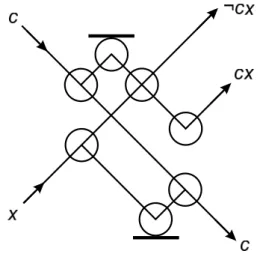
The billiard ball model is an implementation of conservative logic, based upon elastic collisions of billiard balls, both with each other and with reflectors. A basic framework for the model is a 2-D grid along which the balls can propagate and in which mirrors are situated. This system can be arranged to act as any logic circuit. The presence or absence of a ball at any grid point in the framework is equivalent to the binary 1 or 0 signal respectively, and the balls are indistinguishable from one another. The Fredkin gate (see section 2.4.2) can be created in the billiard ball model by using a series of five basic switch gates, shown in figure 2.1.
Figure 2.1: This ‘circuit’ acts as a simple switch operator. In the switch circuit, the control ballc appears to switch the path of the other ballx. In fact, when both balls enter the gate at the same time, they swap roles such that the target ball emerges along the expected path of the control ball. Note that the balls are indistinguishable, the lines denote mirrors, and the circles are snapshots of the balls at collusion instants. If there is no ball at the control input c, a ball at x will go through undeflected and emerge at ¯cx; if a ball is present at c, a ball at x would collide with it (causing the balls to exchange roles) and a ball would emerge at cx.
The billiard ball model predicts that the energy of a computation is proportional to the number of billiard balls involved, at the start and end points, and is not de-pendant on the processes undergone between these two states, no matter how lengthy or complicated. Thermal noise and quantisation issues must be considered as pos-sible energy-loss mechanisms, and these are currently being debated concerning the relevance of their contribution, if any.
Other reversible computing frameworks include the kinematical model proposed by Toffoli [78], the microscopic theory of Bennett [11], the quantum mechanical theory of Benioff [7, 8], and the structural approach of Abramsky [1].
2.2
Reversible computations as circuits
In this section an inductive definition for building reversible circuits will be given. This will then be translated into a Haskell datatype, which will allow fairer compar-isons between quantum computation (as circuits), which are by definition reversible, and classical computation, using the reversible model given here.
Note that the arity of a function is the number of arguments it takes. Similarly, the arity of a circuit is the number of bits, or wires, used throughout the circuit, and is therefore a natural number. By definition, a reversible computation φ must have an inverse,φ−1, such that togetherφ, φ−1 give an isomorphism.
Using these definitions, the set of reversible computations (or circuits) of arity a ∈N, can be defined inductively:
Negation The only non-trivial operation possible on one (classical) bit is the nega-tion operator, also known as the bit-flip, not operator, ¬, or X. As a circuit
diagram this is denoted as:
N2 X
The notation X is traditionally used for negation in circuit diagrams, and N2
indicates that the wire carries a two-valued Boolean variable, a single classical bit. In this case the wire corresponds to one physical wire, rather than a bundle, hence the arity for this circuit is 1.
Negation is trivially reversible as applying it twice recovers the original value:
¬¬x=x
Wires Any possible reordering (permutation) is a valid reversible computation, and in a circuit is shown as a rewiring. This is represented as a bijectionφ:[a]≃[a], where [a] is the initial segment ofa: [a] ={i ∈N|i <a}. This describes any rewiring, including the identity: ida = wires id, where no permutation takes
place. In a circuit diagram a rewiring is usually shown explicitly, for example:
x0 ? ? ? ? x1 x1 ? ? ? ? x2 x2 x0
with the bijection φ(0) = 2, φ(1) = 0, and φ(2) = 1.
Rewiring is again trivially reversible. The arity of the rewiring circuit is the number of wires in the permutation; a in the bijection.
Sequential composition Given reversible circuits φ and ψ, of equal arity, a new circuit can be constructed where the output of ψ is passed as the input to φ. This is written φ◦ψ, and is shown diagrammatically as:
ψ φ _ _ _ _ _ _ _ _ _ _
The arity of the new circuit is equal to the arity of the sub-circuits. As both φ
and ψ are reversible, φ◦ψ can be reversed using ψ−1 and φ−1 by constructing ψ−1◦φ−1.
Parallel composition combines any two reversible circuits in parallel, and can be thought of as the product of circuits. Given any reversible circuits φ and ψ,
φ×ψ can be constructed: φ ψ _ _ _ _
Although the operations φ and ψ operate on disjoint inputs, they combine in
of equal size. The two sub-circuits are not required to have to have the same arity; the arity of the new circuit is the sum of the sub-circuit arities.
The inverse can be constructed using ψ−1 and φ−1, to give φ−1×ψ−1.
Conditional Given reversible circuitsφ and ψ of equal arity, a, the conditional cir-cuitφ|ψcan be constructed. It performs a basicif . . . then . . . else . . .operation: If the control wire is True,then perform ψ on the remainingawires,else apply
φ. The control wire is the first, or uppermost, wire, and gives this circuit an arity of 1 +a; the 1 representing the control wire for the circuits of arity a. The unary conditional is commonly used, which performs the identity if the control isfalse. However, it is straightforward to reduce the binary conditional to the unary:
N2 • X • X
a ψ φ
This representation can be further simplified by introducing a white dot on the control wire to indicate that the controlled circuit is applied only if the control wire is false:
N2 •
a ψ φ
If either φ or ψ is the identity, then the diagram can again be simplified by leaving out that branch.
The inverse is once again given usingψ−1 and φ−1, to constructφ−1|ψ−1.
2.3
Reversible circuits in Haskell
The implementation language used throughout this project is Haskell [55]. Haskell is a purely functional programming language with polymorphic types and a non-strict semantics. It is particularly suited to this research in its inclusion of pattern matching, currying, list comprehensions, guards, and definable operators. The language also supports recursive functions and algebraic data types, as well as lazy evaluation. It
has built-in support for monads and type classes. Due to the mathematical nature of the language it is also particularly well suited to the expression of mathematical and categorical concepts, which are frequently used throughout this work. The language QML, developed in this thesis, has been intentionally modelled to act as a Haskell–like language.
The reversible circuits defined in section 2.2, can be directly translated into a Haskell datatype. A function that translates each circuit into its matrix representation (a compiler) can then be built using this datatype. Other useful functions, such as an evaluator for matrices, can also be defined. The first step is to define a datatype that represents circuits, called Circ:
dataCirc=Not
| Wire [Int]
| Par Circ Circ
| Seq Circ Circ
| Cond Circ Circ
In fact this datatype captures most of the information about reversible circuits given in section 2.2. A circuit can be any of the following: a Not operation; a Wire, which takes as an argument a list of integers describing the permutation (rewiring); aPar (parallel) operation, which takes two sub-circuits as arguments; aSeq (sequen-tial) operation, which also takes two sub-circuits as arguments; and finally a Cond (conditional) operation, which takes the two possible circuits as arguments. Note that Seq simulates the circuit diagrams, so the composition ψ ◦ φ becomes the sequence Seq φ ψ in Haskell, as in the diagrammatic definition of circuits given previously.
The Circ datatype does not capture, due to Haskell type limitations, all the constraints on what constitutes a valid circuit. For example, in the cases of Seq and Cond there is the requirement that the arity (number of wires) in each sub-circuit is the same, in order for them to be wired together correctly. In a dependently typed language, such as Epigram [49], this could be enforced, but in Haskell these type constraints have to be checked by an auxiliary function. This is because Haskell’s type system does not allow data to appear in types; types can only be indexed by other types. The arity of a circuit is data, hence cannot appear in the type. The
arity ∈Circ →Maybe Int
arity (Not) = Just 1
arity (Wire ~x) = doguard (chkPerm ~x) return (length ~x) arity (Par x y) = dom ←arity x
n ←arity y return (m +n) arity (Seq x y) = dom ←arity x
n ←arity y guard (m ≡n) return (m) arity (Cond x y) = dom ←arity x
n ←arity y guard (m ≡n) return (1 +m) chkPerm ∈[Int]→N2
chkPerm ~x = (and [elem x ~x|x ←[0. .length ~x−1]])
Figure 2.2: The arity function
function arity, defined in figure 2.2, makes use of the Maybe monad and guards to model and check for errors. A monad, in this context, is a way of linking together a set of functions, such that there is a predefined order of execution. TheMaybe monad encapsulates the strategy of combining a chain of computations, that may each return Nothing, by ending the chain early if any step produces Nothing as output. In this case, the arity function must ensure that the input has certain properties before the result can be calculated. The Maybe monad simply returns either “Just x” or “Nothing,” which would be the error state. The Maybe monad ensures any errors will be correctly propagated throughout the program.
The Haskell code for the arity function is given in figure 2.2. With this function, a circuit can be tested to see if it is valid by passing it as the argument. If Just x
is returned, where x ∈ N, then the circuit is correct and its arity is x. If the error value Nothing is returned, then there is a circuit arity mismatch, or there is an invalid permutation. The error checking is performed by theguard commands in the problematic cases, which will return Nothing if the error–checking predicates passed to them evaluate to False, and will otherwise allow the computation to continue. In the case of Wire ~x, the guard uses the auxiliary function chkPerm to ensure the permutation (rewiring) is valid. In the case of Seq and Cond it simply ensures that the size of each sub-circuit are equal. More informative error checking could be employed, but at the expense of brevity. This will be expanded on in the case of quantum circuits.
2.4
Reversible circuits: examples and theory
In this section some examples of circuits written in theCircdatatype are discussed, to illustrate the use of theCirc datatype and some principles of reversible computation. A simple controlled-not(cnot) circuit, which negates the second input if the first
is True, and does nothing otherwise, can be defined as the circuit cnot =X|id1
where ida is the identity function on a bits. This circuit can be translated into the
Haskell type Circ as: cnotC ∈Circ
cnotC =Cond Not (Wire [0])
A schematic circuit of cnot, where X is the Not circuit andI is the identity on one bit (wire id1), is shown in figure 2.3, along with the trivial simplification. Note that
the terms 0 and False, and 1 and True, are used interchangeably.
a∈N2 • a b∈N2 X I b⊕a
a∈N2 • a b∈N2 X b⊕a
2.4.1 The Toffoli Gate
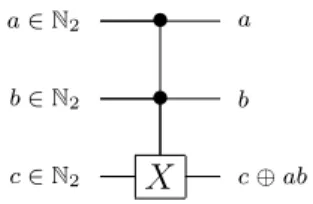
A useful circuit in reversible computation is the three-bit controlled-cnot, called the Toffoli gate. This gate has three inputs, the first two of which are controls and the third is the target. This gate acts as the identity on the target, unless both control bits are set to True, in which case the value of the target bit is flipped. A circuit diagram for the Toffoli gate is shown in figure 2.4. Note how the circuit appears to
a∈N2 • a b∈N2 • b c∈N2 X c⊕ab
Figure 2.4: Schematic circuit representation of the Toffoli gate, or controlled-cnot.
be an extension of thecnot circuit. This fact can be used to define the Toffoli gate
as
toffoli =cnot|id2
which in Haskell becomes: toffoliC ∈ Circ
toffoliC =Cond cnotC (Wire [0,1])
The Toffoli gate is self-inverse, as applying it twice has the effect (a, b, c) → (a, b, c⊕ab)→ (a, b, c). The Toffoli gate is also an important operation in reversible computation, as it can be used to emulate the irreversible nand gate. Being able to use this operation allows any (deterministic) irreversible operation to be implemented reversibly, as the nand gate (with copying, using cnot) is universal; it can be used to generate any functionf ∈ Cn→ Cn. Figure 2.5 shows the circuit for implementing
the nand gate using a Toffoli gate. This assertion holds as long as extra heap input
is available, and a non-useful garbage output is allowed, both of which are required for this reversible implementation of the nand gate.
a∈N2 • a b∈N2 • b
1∈N2 X 1⊕ab
Figure 2.5: Toffoli gate implementation of nand, where the third output gives the nand of the first two; note 1⊕ab=¬(a&b).
2.4.2 The Fredkin Gate
Another example of a useful circuit is the three-bit controlled-swap gate, called the Fredkin gate. This is a universal reversible gate, assuming that input can be initialised in any way, and is used in the billiard-ball model of computation discussed in section
2.1.2. Its behaviour is such that if the control-bit (often the first wire, but sometimes the third) is set to true, then the values of the other two inputs are exchanged. In the circuit representation this can be written using a conditional that either performs a permutation, or the identity:
fredkin =swap|id2
where swap=wiresφ, and φ is the swap bijection. In Haskell the fredkin circuit can be rendered as:
fredkinC ∈ Circ
fredkinC =Cond (Wire [1,0]) (Wire [0,1])
Schematically this is shown in figure 2.6, where a × on a wire denotes aswap oper-ation. Again this operation is self-inverse, and is therefore fully reversible. Another
a∈N2 • a b∈N2 × c∈N2 ×
Figure 2.6: The Fredkin gate, which swaps b and c, but only ifa is True
interesting property of this gate, and a reason why it is useful for the billiard-ball model of computation, is that the number of True and False values is conserved
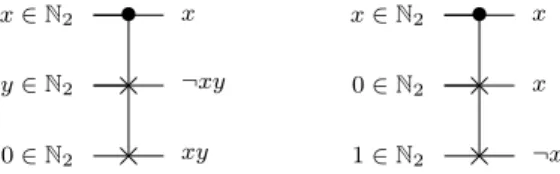
throughout. In the billiard-ball model, where balls represent True values, this is equivalent to the number of balls going into the circuit being the same as the number coming out. This corresponds to the physical phenomenon of conservation of energy (and therefore mass). The two properties of reversibility and conservation make this operation interesting to physicists as both can be motivated by fundamental physical principles. The Fredkin gate can model the operation ‘x and y’ by setting a = x,
b = y and c = False. The outputs are, in the same order, x, ¬xy and the desired
xy. not can also be easily implemented by setting a =x, b =False and c= True,
giving x, x and finally ¬x. Both of these operations are shown in figure 2.7. These
x∈N2 • x y∈N2 × ¬xy 0∈N2 × xy x∈N2 • x 0∈N2 × x 1∈N2 × ¬x
Figure 2.7: The Fredkin gate performing and (left) and not(right)
two operations can be wired together to perform the nand operation, and hence the
Fredkin gate is also universal. Again, this is assuming the availability of extra heap input and garbage output, as required for reversibility.
2.5
Simulating a circuit
TheCirc datatype allows reversible classical circuits to be represented in Haskell. To run circuits a simulator is needed. In this section a compiler from circuits to functions will be defined. Also described is an evaluator which will, given some input, return the output that would be produced by applying that input to the circuit. The input to a circuit is simply a Boolean valued vector with dimension equal to the arity of the circuit. A compiled circuit is a function from (Boolean valued) vectors (possible input vectors) to vectors (the output vector); in other words, a matrix. Vectors and matrices can be simply modelled by the following Haskell type-synonyms:
typeVec = [N2]
2.5.1 Evaluating a circuit
It would be useful to be able to apply some input to a circuit and have the associated output returned. This is achieved by an evaluation function,
eval∈Circ→Vec →Maybe Vec This definition assuming there is a function
comp ∈Circ →Maybe Mat
The functions are defined in this order to simplify the definition of comp, as comp assumes that a circuit passed to it is well-formed. The eval function makes no such assumption, first calling arity on the circuit, which guarantees it is well formed, or produces the error stateNothing. This cannot be done so easily in thecomp function due to its recursive nature. Theevalfunction is fairly simple. It ensures the circuit is valid, via thearity function, then ensures the input is valid for the circuit, by checking its length against the circuit arity, and finally compiles the circuit to a matrix, via comp, to which the input vector is then applied. If the circuit, or input vector, are invalid, thenNothing is returned. This is expressed in Haskell as:
eval∈Circ→Vec →Maybe Vec
eval c v =doa ←arity c
guard (a ≡length v) m ←comp c
return (m v)
2.5.2 Compiling a circuit
In order for the eval function to operate, a function comp ∈ Circ → Mat must be defined, which transposes a circuit into its matrix representation. The function to compile a circuit is defined using pattern matching. Not and Wire are the trivial base cases, whileSeq,Par, andCond recursively callcomp on each sub-circuit, before doing the necessary computations. The behaviour in each case is fully explained by the code, given in figure 2.8.
comp ∈Circ →Maybe Mat
comp (Not) =return (λv →casev of [True] →[False] [False]→[True]) comp (Wire ~p) =return (λvs →[vs!!p |p ←~p])
comp (Seq x y) =dom ←comp y n ←comp x return (m◦n) comp (Par x y) =doax ←arity x
m ←comp x n ←comp y
return (λvs →let(a,b) = splitAt ax vs in m a++n b)
comp (Cond x y) =dom ←comp x n ←comp y
return (λ(v :vs)→if v thenTrue: (m vs) else False: (n vs))
Figure 2.8: Thecomp compile function for classical reversible circuits
2.6
Summary
In this chapter the fundamental notion of how computations are modelled has been explored. Abstract models of computation, such as λ-calculus and Cartesian-closed categories are based on irreversible processes. However, more fundamental physical notions describe processes in closed systems and here all processes are reversible. This includes theories such as Newtonian mechanics, Maxwellian electrodynamics, and quantum mechanics. Open systems, which do allow for irreversible processes, are a derived notion; a subsystem of a larger closed system. This chapter followed the physical notion that reversibility is the fundamental concept to model computation, from which irreversibility may be derived. A framework for reversible computations has been presented in this chapter, with an implementation given in Haskell, and the
Chapter 3
Reversible quantum computation
This chapter will introduce the fundamentals of quantum computing, including the notation, mathematics, and theory. The quantum circuit model will be presented, us-ing a development that follows the format used to describe reversible classical circuits introduced in section 2.2. Throughout the development the differences and similari-ties between classical reversible computation and quantum computing are highlighted and discussed.
An implementation of quantum circuits in Haskell is developed, including a com-piler. A discussion of Deutsch’s Algorithm and Quantum Teleportation is also in-cluded, with a presentation of the algorithms as quantum circuits.
3.1
Fundamentals of quantum computation
To understand quantum algorithms, and how they can achieve the efficiency gains they are theoretically capable of, it is first necessary to study the fundamental physics and mathematics of quantum computers. The focus of this section is not how quantum computers can be fabricated (though this is an active area of research, see section
1.2) but the how the behaviour of quantum computers can be modelled. This section outlines the theory of how quantum computation is modelled mathematically, and how quantum bits interact.