The Use of Computational Intelligence for Security in
Named Data Networking
by
Amin Karami
Submitted to the Computer Architecture Department (DAC) in partial fulfillment of the requirements for the degree of
Doctor of Philosophy in Computer Architecture
at the
UNIVERSITAT POLITE ´CNICA DE CATALUNYA BARCELONA TECH (UPC)
January 2015
c
Amin Karami, 2015. All rights reserved.
The author hereby grants to UPC permission to reproduce and to distribute publicly paper and electronic copies of this thesis document in whole or in part in any medium now known
or hereafter created.
Department . . . . Computer Architecture Department (DAC)
January 2015
Supervisor . . . . Dr. Manel Guerrero-Zapata
Acta de calificación de tesis doctoral
Curso académico: Nombre y apellidosPrograma de doctorado
Unidad estructural responsable del programa
Resolución del Tribunal
Reunido el Tribunal designado a tal efecto, el doctorando / la doctoranda expone el tema de la su tesis doctoral titulada
__________________________________________________________________________________________. Acabada la lectura y después de dar respuesta a las cuestiones formuladas por los miembros titulares del tribunal, éste otorga la calificación:
NO APTO APROBADO NOTABLE SOBRESALIENTE
(Nombre, apellidos y firma)
Presidente/a
(Nombre, apellidos y firma)
Secretario/a (Nombre, apellidos y firma)
Vocal
(Nombre, apellidos y firma) Vocal
(Nombre, apellidos y firma) Vocal
______________, _____ de __________________ de _______________
El resultado del escrutinio de los votos emitidos por los miembros titulares del tribunal, efectuado por la Escuela de Doctorado, a instancia de la Comisión de Doctorado de la UPC, otorga la MENCIÓN CUM LAUDE:
SÍ NO
(Nombre, apellidos y firma)
Presidente de la Comisión Permanente de la Escuela de Doctorado
(Nombre, apellidos y firma)
Secretario de la Comisión Permanente de la Escuela de Doctorado
The Use of Computational Intelligence for Security in
Named Data Networking
by Amin Karami
Submitted to the Computer Architecture Department (DAC) on January 2015, in partial fulfillment of the
requirements for the degree of
Doctor of Philosophy in Computer Architecture
Abstract
Information-Centric Networking (ICN) has recently been considered as a promising paradigm for the next-generation Internet, shifting from the sender-driven end-to-end communication paradigm to a receiver-driven content retrieval paradigm. In ICN, content -rather than hosts, like in IP-based design- plays the central role in the communications. This change from host-centric to content-centric has several significant advantages such as network load reduction, low dissemination latency, scalability, etc. One of the main design requirements for the ICN architectures -since the beginning of their design- has been strong security.
Named Data Networking (NDN) (also referred to as Content-Centric Networking (CCN) or Data-Centric Networking (DCN)) is one of these architectures that are the focus of an ongoing research effort that aims to become the way Internet will operate in the future. Existing research into security of NDN is at an early stage and many designs are still incomplete. To make NDN a fully working system at Internet scale, there are still many missing pieces to be filled in. In this dissertation, we study the four most important security issues in NDN in order to defense against new forms of -potentially unknown- attacks, ensure privacy, achieve high availability, and block malicious network traffics belonging to attackers or at least limit their effectiveness, i.e., anomaly detection, DoS/DDoS attacks, congestion control, and cache pollution attacks. In order to protect NDN infrastructure, we need flexible, adaptable and robust defense systems which can make intelligent -and real-time- decisions to enable network entities to behave in an adaptive and intelligent manner. In this context, the characteristics of Computational Intelligence (CI) methods such as adaption, fault tolerance, high computational speed and error resilient against noisy information, make them suitable to be applied to the problem of NDN security, which can highlight promising new research directions. Hence, we suggest new hybrid CI-based methods to make NDN a more reliable and viable architecture for the future Internet.
Biography
Amin Karami was born in Tehran, Iran. He received a bachelor’s degree in Computer Engineering majoring Hardware from Islamic Azad University of Qazvin, Iran in 2007 and a master’s degree in Informatics from University of Sk¨ovde, Sweden in 2011. Since February 2012, he pursued his PhD degree in Computer Architecture at Universitat Polit´ecnica de Catalunya Barcelona Tech (UPC), Spain. His research interest lies in the computational intelligence methodologies and ap-proaches, optimization based on evolutionary computation techniques, hybrid intelligent systems, next-generation Internet, named data networking, network security, uncertainty visualization, in-formation fusion, and big data analysis.
Acknowledgments
First and foremost, I would like to express my deepest gratitude to my advisor, Dr. Manel Guerrero-Zapata for his constant encouragement, support, patience, and providing me with an excellent atmosphere for doing research. I would like to thank my colleagues at UPC, Amir Darehshoorzadeh and Tarek AlSkaif for their valuable feedback and guidance, which significantly improved the quality of my research.
Finally, my very special thanks to my beloved parents and family without whose inspiration I may never consider pursuing a Ph.D. degree, and wonderful wife, Niloofar Farahani, without whose support I could never finish this journey.
Contents
1 Introduction 17
1.1 Background of Named Data Networking . . . 17
1.2 Research Problem . . . 21 1.3 Contribution . . . 24 1.4 Thesis Plan . . . 27 1.4.1 Dissertation Roadmap . . . 29 2 Background 31 2.1 ICN Architectures . . . 31 2.1.1 CCN/NDN . . . 31 2.1.2 PSIRP/PURSUIT . . . 32 2.1.3 4WARD/SAIL . . . 33 2.1.4 DONA . . . 33
2.2 Naming and Security . . . 34
2.3 Computational Intelligence (CI) methods . . . 35
2.3.1 K-means algorithm . . . 36
2.3.2 Genetic Algorithm (GA) . . . 37
2.3.3 Particle Swarm Optimization (PSO) . . . 37
2.3.4 Fuzzy Set . . . 39
2.3.5 Multilayer Perceptron (MLP) neural networks . . . 41
2.3.6 RBF Neural Networks . . . 42
2.3.7 Adaptive Neuro-Fuzzy Inference System (ANFIS) . . . 43
2.3.8 Non-dominated Sorting Genetic Algorithm (NSGA II) . . . 46
3 A Fuzzy Anomaly Detection System based on Hybrid PSO-Kmeans Algorithm 49
3.1 Related Work . . . 52
3.2 Clustering Problem . . . 52
3.3 Proposed Fuzzy Anomaly Detection System . . . 53
3.3.1 Training Phase . . . 53
3.3.2 Detection Phase . . . 56
3.4 Experimental Results and Discussion . . . 57
3.4.1 Performance Measurement . . . 57
3.4.2 Benchmarking the proposed method . . . 58
3.4.3 Feature Construction . . . 59
3.4.4 Training Phase . . . 60
3.4.5 Detection Phase . . . 61
3.4.6 Results of Training Phase . . . 62
3.4.7 Results of Detection Phase . . . 66
3.4.8 Computational Order . . . 70
3.4.9 Discussion . . . 73
3.5 Conclusion . . . 75
4 An ANFIS-based Cache Replacement Method for Mitigating Cache Pollution Attacks 77 4.1 Related Work . . . 78
4.2 An ANFIS-based cache replacement method for mitigating cache pollution attacks . 79 4.2.1 Data preparation . . . 80 4.2.2 Materials of ANFIS . . . 81 4.3 Experimental setup . . . 82 4.3.1 Simulation environment . . . 82 4.3.2 False-locality . . . 84 4.3.3 Locality-disruption . . . 85 4.4 Experimental results . . . 85
4.4.1 Results of ANFIS design . . . 85
4.4.2 Mitigating false-locality . . . 88
4.4.4 Mitigating combination of both attacks at the same time . . . 90
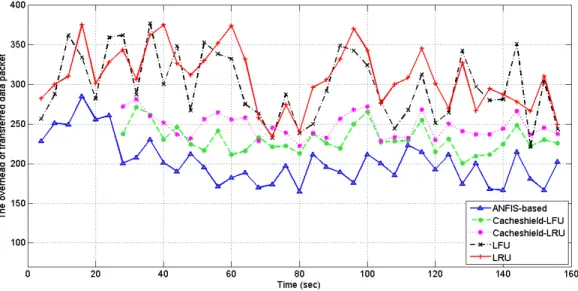
4.4.5 The overhead cost . . . 92
4.5 Conclusion . . . 95
5 A Hybrid Multiobjective RBF-PSO Method for Mitigating DoS Attacks 97 5.1 DoS attacks in NDN . . . 99
5.1.1 Interest Flooding Attack . . . 99
5.2 Related Work . . . 100
5.3 The proposed hybrid intelligent method . . . 101
5.3.1 The proposed intelligent classifier (predictor) . . . 102
5.4 Benchmarking the proposed intelligent classifier (predictor) . . . 106
5.5 Evaluation environment . . . 113
5.6 The proposed countermeasure: proactive detection and adaptive reaction . . . 116
5.6.1 Detection Phase . . . 116
5.6.2 Reaction Phase . . . 119
5.7 Experimental results and evaluation . . . 122
5.7.1 Two facts of DoS/DDoS mitigation in NDN . . . 126
5.7.2 Discussion . . . 127
5.8 Conclusion . . . 128
6 ACCPndn: Adaptive Congestion Control Protocol in NDN by learning capaci-ties 131 6.1 Related Work . . . 133
6.2 Time series analysis . . . 134
6.3 The proposed method: ACCPndn . . . 135
6.3.1 Phase 1: Adaptive Training . . . 135
6.3.2 Phase 2: Fuzzy Avoidance . . . 139
6.4 Experimental Setup . . . 142
6.5 Experimental Results . . . 144
6.5.1 Phase 1: adaptive training . . . 144
6.5.2 Phase 2: fuzzy avoidance . . . 151
6.5.3 Results and Observations . . . 154
7 Mining and Visualizing Uncertain Data Objects and NDN Traffics by Fuzzy
Self-Organizing Map 161
7.1 The Proposed Method . . . 163
7.2 Experimental Results . . . 164
7.2.1 Uncertain data modeling . . . 164
7.2.2 Assessing the quality of visualizations . . . 165
7.2.3 Visualization results . . . 165
7.2.4 Visualizing uncertain traffics in Named Data Networking . . . 167
7.3 Conclusion . . . 168 8 Conclusion 171 8.1 Summary . . . 171 8.2 Future Work . . . 173 9 Acronyms 191 10 Appendix: Publications 195
List of Figures
1-1 NDN (content-centric) vs. IP (host-centric) . . . 18
1-2 Host-Centric Networking vs. Information-Centric Networking . . . 19
1-3 CCN packet types . . . 19
1-4 Overview of the NDN architecture . . . 20
1-5 Architectural overview: how our work fits into the global picture . . . 28
2-1 CCN/NDN architecture overview . . . 32
2-2 PSIRP/PURSUIT architecture overview . . . 33
2-3 4WARD/SAIL architecture overview . . . 33
2-4 Description of velocity and position updates in PSO for a 2-dimensional parameter space . . . 38
2-5 Structure of a three-layer MLP . . . 41
2-6 ANFIS architecture with two inputs and nine rules [1] . . . 44
2-7 Schematic of the NSGA II procedure . . . 47
2-8 The SOM structure. The dark color of neuron in the competition phase indicates the wining neuron. . . 47
3-1 Two steps of the proposed fuzzy anomaly detection system . . . 54
3-2 The sample solution area (fuzzy inference) of proposed fuzzy detection system . . . . 63
3-3 The trends of minimum and maximum combination of DR and FPR at the same time 63 3-4 1st cost function (DBI) in 1000 iterations . . . 65
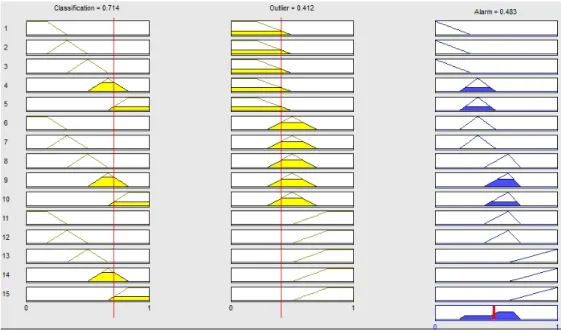
3-5 2nd cost function (MSE) in 1000 iterations . . . 65
3-6 The best cost (DBI) of four clustering results . . . 66
3-7 The MSE value of four clustering results . . . 66 3-8 Seven applied membership functions in detection phase (two inputs and one output) 67
3-9 ROC curves corresponding to the proposed method and other applied methods for
1st scenario (fuzzy approach) . . . 71
3-10 ROC curves corresponding to the proposed method and other applied methods for 1st scenario (non-fuzzy approach) . . . 71
3-11 ROC curves corresponding to the proposed method and other applied methods for 2nd scenario (fuzzy approach) . . . 71
3-12 ROC curves corresponding to the proposed method and other applied methods for 2nd scenario (non-fuzzy approach) . . . 72
4-1 Schematic of the proposed ANFIS-based cache replacement method in NDN . . . 79
4-2 The structure of the proposed ANFIS . . . 82
4-3 Considered network topologies [2] . . . 83
4-4 Final membership functions of the input data . . . 86
4-5 The statistical results on training data set . . . 86
4-6 The statistical results on 1st testing data set . . . 87
4-7 The statistical results on 2nd testing data set . . . 87
4-8 Q-Q plot and statistical results . . . 87
4-9 Results of different pre-populated fake content in XC topology (mean of 10 runs) . . 88
4-10 Results of different pre-populated fake content in DFN topology (mean of 10 runs) . 88 4-11 Results of Hit damage ratio for locality-disruption attack in XC topology (mean of 10 runs) . . . 89
4-12 Results of Hit damage ratio for locality-disruption attack in DFN topology (mean of 10 runs) . . . 89
4-13 The results for 30% false-locality and 70% locality-disruption in XC topology (mean of 10 runs) . . . 90
4-14 The results for 50% false-locality and 50% locality-disruption in XC topology (mean of 10 runs) . . . 90
4-15 The results for 70% false-locality and 30% locality-disruption in XC topology (mean of 10 runs) . . . 91
4-16 The results for 30% false-locality and 70% locality-disruption in DFN topology (mean of 10 runs) . . . 91
4-17 The results for 50% false-locality and 50% locality-disruption in DFN topology (mean
of 10 runs) . . . 92
4-18 The results for 70% false-locality and 30% locality-disruption in DFN topology (mean of 10 runs) . . . 92
4-19 The average of arrival data packets in XC topology . . . 93
4-20 The average of arrival data packets in DFN topology . . . 93
5-1 The overview of the proposed DoS mitigation method in NDN . . . 101
5-2 Proposed intelligent algorithm for more accurate classification . . . 102
5-3 Optimal Pareto fronts of Wine data set . . . 110
5-4 Optimal Pareto fronts of Iris data set . . . 111
5-5 Optimal Pareto fronts of Ionosphere data set . . . 111
5-6 Optimal Pareto fronts of Zoo data set . . . 111
5-7 DFN-like topology . . . 113
5-8 AT&T topology . . . 114
5-9 Optimal Pareto fronts of DFN-like training phase . . . 118
5-10 The histogram analysis of the classification error distribution in DFN-like topology . 118 5-11 Regression of the classification error between target and predicted output in DFN . 118 5-12 unsatisfied-based pushback example . . . 120
5-13 Interest satisfaction ratio for legitimate users in DFN . . . 123
5-14 Interest satisfaction ratio for legitimate users in AT&T . . . 123
5-15 PIT usage with countermeasures in DFN . . . 124
5-16 PIT usage with countermeasures in AT&T . . . 124
5-17 Effects of countermeasures in DFN (Throughput) . . . 125
5-18 Effects of countermeasures in AT&T (Throughput) . . . 125
6-1 Two steps of the ACCPndn . . . 134
6-2 Reflection of the connectivity of data communication network in a neural network considered . . . 135
6-3 Proposed FIS for fuzzy congestion control . . . 141
6-4 ACCPndn: the first phase by a controller and the second phase by routers per interface141 6-5 Considered network topologies . . . 143
6-7 The forecasting results in 1st domain of Switch-like (1st sliding window) . . . 150
6-8 The forecasting results in 2nd domain of Switch-like (2nd sliding window) . . . 150
6-9 RSI membership functions (input) . . . 151
6-10 PIT entries membership functions (input) . . . 152
6-11 Cache hits membership functions (input) . . . 152
6-12 Interface load membership functions (output) . . . 152
6-13 The surface of the proposed fuzzy control system . . . 152
6-14 The sample solution area (fuzzy inference) of proposed fuzzy decision-making system 153 6-15 Average of Data drop in contributing routers’ buffer in DFN-like topology . . . 154
6-16 Average of Data drop in contributing routers’ buffer in Switch-like topology . . . 155
6-17 The total average packet drop rate in both considered topologies . . . 157
6-18 Average of InData in contributing routers in DFN-like topology . . . 158
6-19 Average of InData in contributing routers in Switch-like topology . . . 159
7-1 An example of exact (non-fuzzy) and approximate (fuzzy) distances in a 2-D space for a certain and vague data. . . 162
7-2 The proposed method for mining and visualizing uncertainties. The color of neurons in the competition phase indicates the membership value in which the darker color represents highest value, while the lighter color represents smallest value. . . 163
7-3 U-Matrix of the applied benchmark problems. . . 166
List of Tables
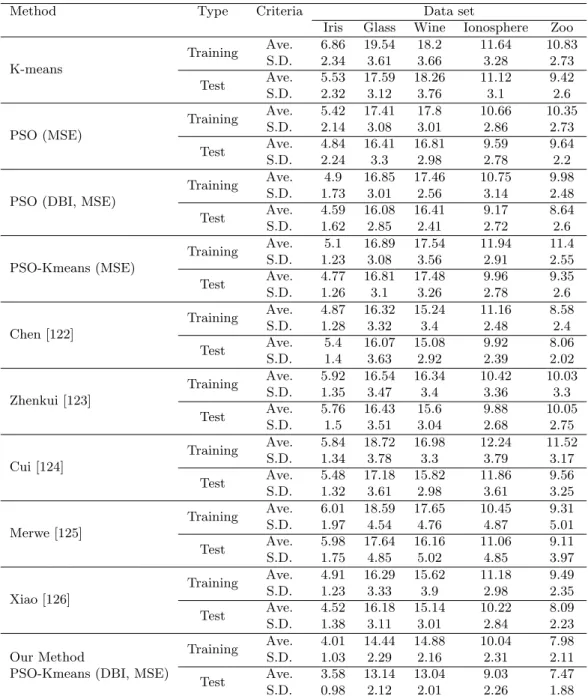
3.1 Comparison of hybrid PSO + K-means approaches in clustering problems . . . 51
3.2 The five applied benchmark data sets . . . 58
3.3 Classification error (%) for our proposed method and applied methods . . . 59
3.4 CCNx Traffic Generation . . . 60
3.5 First scenario of CCNx traffic . . . 61
3.6 Second scenario of CCNx traffic . . . 61
3.7 Rules Matrix . . . 62
3.8 Some fuzzy rules in proposed fuzzy system . . . 62
3.9 Comparison of our proposed method with some other methods . . . 64
3.10 Comparison of membership functions for fuzzy anomaly detection purposes . . . 69
3.11 The 2× 2 contingency table (confusion matrix) . . . 70
3.12 Fuzzy (non-fuzzy) anomaly detection for two applied testing data sets . . . 72
3.13 The computational order of the six methods . . . 73
3.14 The computational time of the six methods . . . 73
4.1 Comparing operation overhead achieved by the proposed scheme over other methods (mean of 10 runs) . . . 94
5.1 The four applied benchmark data sets . . . 107
5.2 adjusting RBF units’ centers in Wine . . . 107
5.3 adjusting RBF units’ centers in Iris . . . 108
5.4 adjusting RBF units’ centers in Ionosphere . . . 108
5.5 adjusting RBF units’ centers in Zoo . . . 108
5.6 Classification of Wine data set based on RBF-PSO optimization algorithm . . . 109
5.8 Classification of Ionosphere data set based on RBF-PSO optimization algorithm . . 109
5.9 Classification of Zoo data set based on RBF-PSO optimization algorithm . . . 110
5.10 Classification of Wine data set based on proposed method . . . 112
5.11 Classification of Iris data set based on proposed method . . . 112
5.12 Classification of Ionosphere data set based on proposed method . . . 112
5.13 Classification of Zoo data set based on proposed method . . . 112
5.14 Network parameters considered . . . 115
5.15 Feature construction . . . 116
5.16 Classification of NDN data set based on proposed method . . . 117
5.17 Comparison of false positive rate (mean of 10 runs) . . . 127
6.1 Interest-Data communications . . . 144
6.2 Accuracy measurement in DFN-like topology (mean of 20 runs) . . . 147
6.3 Accuracy measurement in 1st domain of Switch-like (mean of 20 runs) . . . 148
6.4 Accuracy measurement in 2nd domain of Switch-like (mean of 20 runs) . . . 149
6.5 statistics of packet drop in DFN-like topology (mean of 10 runs) . . . 155
6.6 statistics of packet drop in Switch-like topology (mean of 10 runs) . . . 156
7.1 The four applied benchmark data sets . . . 165
7.2 Performance improvements achieved by the proposed scheme . . . 165
7.3 The quality measurement by Trustworthiness . . . 166
7.4 The quality measurement by Continuity . . . 166
7.5 NDN traffic generation . . . 167
Chapter 1
Introduction
1.1
Background of Named Data Networking
Today, several research projects, both in Europe (PSIRP [3], 4WARD [4], PURSUIT 1, SAIL 2, COMET 3 and CONET [5]) and in the US (CCN [6], DONA [7] and NDN [8]) investigate new network architectures based on Information-Centric Networking (ICN) paradigm. These approaches differ with respect to their specific architectural properties, assumptions and objectives. In general, They have been proposed as a solution for a viable and vital replacement for the current IP-based Internet due to the fundamental limitations of the Internet in supporting today’s content-oriented services [2, 9, 10, 11]. This change from host-centric to content-centric has several significant advantages such as network load reduction, low dissemination latency, scalability, etc. One of the main design requirements for the ICN architectures -since the beginning of their design- has been strong security [12, 13, 14]. Named Data Networking (NDN) [15] is a prominent example and ongoing research effort of ICN design. The main goal of NDN is to support the dissemination of named content rather than the current host-centric (end-to-end) delivery of content to a named host. Fig. 1-1 shows the fundamental difference between NDN and IP-based Internet. The process of requesting a content (data) by a consumer is also illustrated in Fig. 1-2. Users only value what
they download and are not interested about wherecontent is actually stored. The IP layer is the opposite and only cares about thewhere, not about thewhat. This gap becomes a source of several problems such as security.
In NDN, a consumer asks for aContent (Data) by sending anInterest request using name prefix 1
http://www.fp7-pursuit.eu/ 2http://www.sail-project.eu/ 3
Figure 1-1: NDN (content-centric) vs. IP (host-centric)
(content identifier) instead of today’s IP prefix (content location). An Interest packet is routed towards the location of the content’s origin where it has been published. Any router (intermediate node) on the way checks its cache for matching copies of the requested content. The requested content is returned by any node that holds a copy of the content in its cache. On the way back, all the intermediate nodes store a copy of the content in their caches to satisfy subsequent users interested in that content (i.e., in-network caching). In this paradigm, storage for caching information is part of the basic network infrastructure so that NDN (and all ICN architectures) enables efficient and application-independent caching structure. NDN improves data availability by integrating caching within the network and ensure the integrity and provenance of content by moving from securing the communication channel to securing the content [6, 16]. All communication in NDN is performed using two distinct types of packets: Interest and Data (Fig. 1-3). Both types of packets carry a name, which uniquely identifies a piece of data that can be carried in one data packet [17, 18]. Data names in NDN are hierarchically structured, e.g., eight fragment of a YouTube video would be named/youtube/videos/A45tR7Kg5/8. In addition to the data name, each Interest packet also carries a random nonce generated by the consumer. A router checks both the name and nonce of each received Interest packet. If a newly arrived Interest packet carrying the same name as a previously received Interest packet from a different consumer, or a previously forwarded Interest
(a) Host-Centric Networking
(b) Information-Centric Networking
Figure 1-2: Host-Centric Networking vs. Information-Centric Networking
looped back, the router drops the Interest packet. Therefore Interest packets cannot loop. Each
Figure 1-3: CCN packet types
NDN router maintains three major data structures [19]:
1. The Pending Interest Table (PIT) holds all not yet satisfied Interest packets that were sent upstream towards potential data sources. Each PIT entry holds one or multiple incoming physical interfaces and their corresponding Interest packets.
2. The Forwarding Information Base (FIB) forwards Interest packets to one or multiple physical network interfaces based on the forwarding strategies. The strategy module makes forwarding decisions for each Interest packet.
3. The Content Store (CS) or buffer memory temporarily buffers data packets for data retrieval efficiency.
Figure 1-4: Overview of the NDN architecture
Fig. 1-4 gives an overview of the NDN architecture. According to Fig. 1-4, when a NDN router receives an Interest packet, it first checks its CS (cache). If there is no copy of the requested content, it looks up its PIT table. If the same name is already in the PIT and the arrival interface of the present Interest is already in the set of arrival interface of the corresponding PIT entry, the Interest is discarded. If a PIT entry for the same name exists, the router updates the PIT entry by adding a new arrival interface to the set. The Interest is not forwarded further. Otherwise, the router creates a new PIT entry and forwards the present Interest using its FIB. When an Interest packet is satisfied by the content’s origin where it was published, on the way back, all the intermediate nodes store a copy of content in their caches to answer to probable same Interest requests from subsequent requester [12, 20].
Security in the NDN needs to be implemented differently than in current, host-centric networks. In the current Internet most security mechanisms are based on host authentication and then trusting
the data that the host delivers. In contrast, in the NDN, security mechanisms must be relied upon Information Object (IO) itself, not based on the network nodes [6, 7]. Consequently, new information-centric security concepts are required that base security on the information itself [21]. With this new paradigm new kinds of attacks and security challenges -from Denial of Service (DoS) to (user and cache) privacy attacks- will arise that we must provide an efficient and effective security mechanism in NDN. Exiting research into the security in NDN is at an early stage and many designs are still incomplete. To make NDN a practically working system at Internet scale, there are still many pieces to be filled in. This new Internet architecture should be resilient against existing security problems to defense against new forms of -potentially unknown- attacks, achieve high availability of content, ensure data and cache privacy, and block malicious network traffics belonging to attackers or at least limit their effectiveness. To do so, we picked four central topics which take NDN toward a more reliable and viable architecture including anomaly detection, mitigating DoS/DDoS attacks, congestion control/avoidance and mitigating cache pollution attacks. The research problems and our countermeasures are presented in the next sections.
1.2
Research Problem
The following features are the most security-related challenges which NDN should be resilient against them or at least limit their effectiveness with the current systems:
• Anomaly Detection: Attacks and anomalies are deliberate actions against data, contents, software or hardware that can destroy, degrade, disrupt or deny access to a computer network [22]. Hence, the contents should be resilient against both DoS and new forms of -potentially unknown- attacks or at least limit their effectiveness [23]. In order to disarm new kinds of at-tacks, anomalous traffics, and any deviation, not only the detection of the malevolent behavior must be achieved, but the network traffic belonging to the attackers should be also blocked [24, 25, 26]. In this dissertation, we present an intelligent method for anomaly detection in NDN which is described in detail in Chapter 3 and published onNEUROCOMPUTING, Elsevier, [JCR-2013: 2.005 Q1] (28/121 Q1 COMPUTER SCIENCE, ARTIFI-CIAL INTELLIGENCE)[12]:
A. Karami and M. Guerrero-Zapata (2015), A Fuzzy Anomaly Detection System based on Hybrid PSO-Kmeans in Content-Centric Networks, Neurocomputing, 149:Part C, pp. 1253-1269.
And an upcoming book chapter in:
Advanced Research on Hybrid Intelligent Techniques and Applications. IGI Global, Hershey, Pennsylvania (USA), undergoing editing for 2015. [27]
• Cache Pollution Attacks: The ubiquitous in-network caching is a key NDN feature as it reduces overall latency and improves bandwidth utilization for popular content [9, 20, 28, 29, 30]. However, pervasive caching strengthens the security problem of cache pollution attacks in two generic classes: locality-disruption and false-locality [31, 32, 33, 34]. Locality-disruption attacks continuously generate requests for new unpopular files to force routers (i.e., the vic-tims of the attack) to cache unpopular content, thus degrading cache efficiency by ruining the cache file locality. False-locality attacks repeatedly request the same set of unpopular (i.e., fake popular) files, thus degrading the hit ratio by creating a false file locality at cache. In this dissertation, a new cache replacement method in NDN is developed to detect and mitigate these two types of cache pollution attacks in a timely manner, which is described in detail in Chapter 4 and undergoing second revision on 27th Sept. 2014 inCOMNET, El-sevier, [JCR-2013: 1.282 Q2] (17/50 Q2 COMPUTER SCIENCE, HARDWARE & ARCHITECTURE)[35]:
A. Karami, M. Guerrero-Zapata (2014),An ANFIS-based cache replacement method for mit-igating cache pollution attacks in Named Data NetworkingIn COMNET, Elsevier, undergoing 2nd revision on 27th Sept. 2014.
• DoS/DDoS Attacks: In contrast to today’s Internet, a key goal of the NDN project is ”security by design” [17, 32, 36]. Unlike the current Internet (host-based) approach in which security, integrity and trust should be provided in the communication channel, CCN secures content (information) itself and puts integrity and trust as the content properties [19, 37]. However, with this new paradigm, new kinds of attacks and anomalies -from Denial of Service (DoS) to privacy attacks- will arise [38, 39]. The big question is how resilient will this new NDN architecture be against DoS/DDoS attacks [17, 23]. An adversary can take advantage of two features unique to NDN namely Content Store (CS) and Pending Interest Table (PIT) to mount DoS/DDoS attacks specific to NDN such as Interest flooding attacks and content poisoning [23, 40]. In this dissertation, we present a new intelligent hybrid algorithm for proac-tive detection of DoS attacks and adapproac-tive mitigation reaction in NDN, which is described in detail in Chapter 5 and published onNEUROCOMPUTING, Elsevier, [JCR-2013:
2.005 Q1] (28/121 Q1 COMPUTER SCIENCE, ARTIFICIAL INTELLIGENCE) [41]:
A. Karami, M. Guerrero-Zapata (2015),A Hybrid Multiobjective RBF-PSO Method for Mit-igating DoS Attacks in Named Data Networking, Neurocomputing, 151:Part 3, pp. 1262-1282. And an upcoming book chapter in:
Advanced Research on Hybrid Intelligent Techniques and Applications. IGI Global, Hershey, Pennsylvania (USA), undergoing editing for 2015 [42].
• Congestion: Congestion takes place in NDN routers when the number of arrival data pack-ets is higher than the queue’s capacity which causes an overflow in the routers’ buffer [43, 44]. When this happens a high data packet loss and increase in the end-to-end delay occur affect-ing negatively on the performance, stability and robustness of the network [45, 46]. This leads to under-utilization of the available resources and degradation of throughput and quality of service [47, 48]. This research work develops an Adaptive Congestion Control Protocol in NDN (ACCPndn) by learning capacities to control congestion traffics before they start im-pacting the network performance, which is described in Chapter 6 and submitted toJNCA, Elsevier, [JCR-2013: 1.772 Q1] (28/121 Q1 COMPUTER SCIENCE, ARTIFI-CIAL INTELLIGENCE)[49]:
A. Karami, M. Guerrero-Zapata (2014),ACCPndn: Adaptive Congestion Control Protocol in Named Data Networking by learning capacitiesIn JNCA, Elsevier, submitted on 10th May 2014.
And later, another idea talked and presented at Xerox Co.:
M. H. Ardestani,A. Karami, P. Sarolahti and J. Ott (2013),Congestion Control in Content-Centric Networking using Neural Network, Talk and Presentation in CCNxCon 2013, 5-6th September 2013, Parc (Xerox Co.), California, USA [50].
In order to protect NDN infrastructure, we need flexible, adaptable and robust defense systems or protocols, which can make intelligent decisions (ideally, in real-time) in detecting wide variety of threats and unknown attacks, achieving high availability of content, ensuring data and cache privacy, and blocking malicious network traffics belonging to attackers or at least limit their ef-fectiveness. Computational Intelligent (CI) techniques seem promising to enhance NDN security measures, and have been increasingly applied in the area of information security and information assurance. CI is a well-established paradigm, where new theories and concepts with a sound
bi-ological understanding have been evolving. The most current computer systems and algorithms have many characteristics of biological computations that are difficult or impossible to do with conventional computations.
Computational Intelligence (CI) techniques and methodologies [51] known for their ability to adopt and to exhibit fault tolerance, high computational speed and error resilient against noisy informa-tion, compensate for the limitations of security challenges in NDN. Thus, the methods of Compu-tational Intelligence (CI) provide a practical alternative for solving mathematically intractable and complex problems [52].
1.3
Contribution
As we observed, the demand for secure NDN to defense against new forms of -potentially unknown-attacks, achieve high availability, protect privacy, and block adversaries’ traffics becomes an impor-tant issue that must be carefully considered. In this dissertation, we propose novel solutions for security in NDN that are based on the application of Computational Intelligence (CI) methodologies and approaches in order to face with large-scale, unknown DoS/DDoS and (user and cache) privacy attacks, and network congestion without becoming a single point of failure or initiating latency to the network flows to enable network entities to behave in an adaptive and intelligent manner in a dynamic environment. This approach can also be an innovative solution because NDN can adopt itself to unpredictable complex evolution of network environments and security problems.
The aim of this dissertation is to propose some solutions to explore how the core methods of Computational Intelligence (CI), which encompass artificial neural networks, fuzzy sets, evolution-ary computation methods, swarm intelligence, soft computing, and other similar computational models can be employed in the NDN context to solve some of the security-related challenges -from DoS attacks to privacy attacks- with the current systems.
The contributions of this dissertation can be summarized as follows:
1. We proposed a novel fuzzy anomaly detection system based on the hybridization of PSO and K-means clustering algorithms. This system consists of two phases: the training phase with two simultaneous cost functions as well-separated clusters by DBI and local optimization by MSE, and the detection phase with two combination-based distance approaches as classifica-tion and outlier. Experimental results and analysis show the proposed method in the training phase is very effective in determining the optimal number of clusters, and has a very high
detection rate and a very low false positive rate at the same time. In the detection phase, the proposed method clearly outperforms other applied method in terms of AUC (area under the ROC curve), accuracy, sensitivity and specificity. In addition, the times of increment on com-putational time of proposed method is relative smaller than the other considered methods. Please refer to Chapter 3 for our detailed contribution.
2. We proposed a novel ANFIS-based cache replacement method to mitigate two generic cache pollution attacks namely false-locality and locality-disruption in NDN. Simulation results showed that the proposed method provides very accurate results as compared to LRU and LFU algorithms independently and in conjunction with CacheShield scheme. Experimental results and analysis show the proposed ANFIS-based cache replacement method is very ef-fective in determining and mitigating the fake content, and has a very high detection rate of locality-disruption attacks to replace them when new content is added to a full cache in a timely manner. The extensive analysis satisfies the objectives of the experiment and ensure that the proposed ANFIS-based caching for mitigating cache pollution attacks can yield high accuracy as compared to other methods without very much computational cost. Please refer to Chapter 4 for our proposed countermeasure.
3. NDN is a newly proposed future Internet architecture which it is important to address its re-silience in face of DoS/DDoS attacks. We examined the most current instances of DoS/DDoS attacks to show that an adversary with limited resources can serve service degradation for legitimate users. We then introduced our intelligent hybrid algorithm for proactive detection of DoS attacks and adaptive reaction for mitigating. In the detection phase, a combination of multiobjective evolutionary optimization and RBF neural network has been applied. This approach consists of two phases: training/optimization and prediction/classification. In the training phase, we investigate the implementation of a multiobjective approach and PSO in the design of RBF neural network in order to improve the accuracy of classification problems. We apply NSGA II to determine the Pareto solutions of RBF units’ centers in terms of the well-separated centers through DBI and their local optimization through MSE. Then, the op-timization and tuning of the units’ widths and output weights are accomplished by using the PSO, where the each particle encodes a set of widths and weights. Moreover, the structure of this step is simple and easy to implement, yet very effective in terms of several perfor-mance criteria. In the prediction phase, we employ a simple algorithm to classify efficiency
the new input patterns with the minimum misclassification error. This hybrid algorithm was applied on four benchmarking data sets to verify the algorithm accuracy and robustness in classification problems. Subsequently, after constructing a more accurate classifier (detector), we performed a simple adaptive reaction algorithm by enforcing explicit limitations against adversaries which was very effective and efficient for shutting down the attackers with the robust recovery from network failures and accuracy more than 90% in terms of the average of Interest satisfaction ratio for legitimate users, the PIT usage, the number of received con-tents (throughput), and a very low false positive rate over 10 simulation runs. Please refer to Chapter 5 for our proposed countermeasure against DoS/DDoS attacks in NDN.
4. We developed an Adaptive Congestion Control Protocol in Named Data Networking (AC-CPndn) by learning capacities that works in two phases. The first phase -adaptive training-forecasts the source of congestion together with the amount of congestion in NDN routers with a Timed-Lagged Feedforward Network (TLFN) optimized by hybridization of PSO and GA. The second phase -fuzzy avoidance- employs a non-linear fuzzy logic-based control system based on the outcomes of first phase, which it makes a proactive decision in each router per interface to control and/or prevent packet drop well enough in advance. Extensive simulations and experimental results show that ACCPndn sufficiently satisfies the performance metrics and outperforms two previous proposals such as NACK and HoBHIS in terms of the minimal packet drop and high-utilization (retrying alternative paths) in bottleneck links to mitigate congestion traffics. In addition, it is found to be scalable with respect to varying bandwidths, delays, packet generation, and replacement policies in cache and PIT table. Please refer to Chapter 6 for our proposed countermeasure against congestion in NDN.
5. Uncertainty is widely spread in real-world data. Uncertain data -in computer science- is typically found in the area of sensor networks where the sensors sense the environment with certain error. Traffic uncertainty refers to traffic volumes belong to more than one pattern (i.e. both normal and attack), and associated with each pattern by a set of membership levels. We investigate the implementation of fuzzy set theory through the application of Fuzzy C-means clustering algorithm in the context of SOM neural network in order to improve the accuracy of visualizing uncertain data bases. The experimental results over the uncertain traffics in Named Data Networking show that the proposed method is effective and precise in terms of the applied performance criteria. We suggest this research work to help to foster discussions
and new research ideas among our readers. We plan to improve the proposed method for various uncertain models and big uncertain network traffic data in the future. Please refer to Chapter 7 for our proposed method.
1.4
Thesis Plan
As can been seen from the above-mentioned sections, NDN has a very clear and a promising network architecture being considered as a possible replacement for the current IP-based (host-centric) Internet infrastructure in order to overcome the fundamental limitations of the current Internet. However, strong security has been one of the main design requirements for this architecture. Fig. 1-5 depicts how our work in this dissertation fits into the global picture.
Chapter 3 looks at the anomaly detection through a fuzzy anomaly detection system based on hybrid PSO-Kmeans algorithm. Experimental results in this chapter demonstrate that the proposed algorithm can achieve to the optimal number of clusters, well-separated clusters, as well as increase the high detection rate and decrease the false positive rate at the same time when compared to some other well-known clustering algorithms.
Chapter 4 then looks into the cache pollution attacks and its countermeasures. In this research work, a new cache replacement method based on Adaptive Neuro-Fuzzy Inference System (ANFIS) is presented to mitigate the cache pollution attacks in NDN. The ANFIS structure is built using the input data related to the inherent characteristics of the cached content and the output related to the content type (i.e., healthy, locality-disruption, and false-locality). The proposed method detects both false-locality and locality-disruption attacks as well as a combination of the two on different topologies with high accuracy, and mitigates them efficiently without very much computational cost as compared to the most common policies.
Chapter 5 looks into the countermeasures against DoS/DDoS attacks in NDN. We present a new intelligent hybrid algorithm for proactive detection of DoS attacks and adaptive mitigation reaction in NDN. The evaluation through simulations in this chapter shows that the proposed intelligent hybrid algorithm (proactive detection and adaptive reaction) can quickly and effectively respond and mitigate DoS attacks in adverse conditions in terms of the applied performance criteria.
Chapter 6 tackles the congestion problem. NDN is subject to congestion when the number of data packets that reach one or various routers in a certain period of time is so high than its queue gets overflowed. To address this problem many congestion control protocols have been
proposed in literature which, however, they are too high sensitive to their control parameters as well as unable to predict congestion traffic well enough in advance. This research work develops an Adaptive Congestion Control Protocol in NDN (ACCPndn) by learning capacities to control congestion traffics before they start impacting the network performance. Extensive simulations and experimental results show that ACCPndn sufficiently satisfies the applied performance metrics and outperforms some previous proposals in terms of the minimal packet drop and high-utilization (retrying alternative paths) in bottleneck links to mitigate congestion traffics.
Figure 1-5: Architectural overview: how our work fits into the global picture
Finally, Chapter 7 provides a new research direction for our readers towards the visualization of uncertain network traffic data in NDN. Uncertainty is widely spread in real-world data. Uncertain data -in computer science- is typically found in the area of sensor networks where the sensors sense the environment with certain error. Mining and visualizing uncertain data is one of the new challenges that face uncertain databases. We present a new intelligent hybrid algorithm that applies fuzzy set theory into the context of the Self-Organizing Map to mine and visualize uncertain objects. The algorithm is tested in some benchmark problems and the uncertain traffics in NDN.
Experimental results indicate that the proposed algorithm is precise and effective in terms of the applied performance criteria. This is our initial idea as a future work to help to foster discussions and new research ideas among our readers by some improvements such as visualizing big uncertain network traffic data in NDN.
Obviously, there can be still other missing pieces in this picture that are not addressed in this dissertation. However, we believe that the five topics we picked are central to take NDN toward a practically working system.
A final note on the terminologies used in this dissertation: we may use NDN and CCN terms interchangeably. Interests are sometimes also referred to as requests while data packets may be called content or responses.
1.4.1 Dissertation Roadmap
The rest of the dissertation is organized as follows.
Chapter 2 presents an overview of Information-Centric Networking (ICN) architecture. Among the several ICN architectures, we picked NDN as the basis of our architecture due to its popularity and existence of open source prototype and a ns-3 based simulator as ndnSIM [53]. We propose the NDN naming and security in Section 2.2. We also describe the core methods of Computational Intelligence (CI) in Section 2.3.
We then move on to discuss papers related to the four picked specific topics we studied in this dissertation, namely anomaly detection (Chapter 3), mitigating cache pollution attacks (Chapter 4), mitigating DoS/DDoS attacks (Chapter 5), and congestion control (Chapter 6). Chapter 7 provides a new research direction into the visualization of uncertain network traffic data in NDN.
Finally, Chapter 8 summarizes the entire dissertation’s contributions and pointed out a few possible directions for further research.
Chapter 2
Background
This section describes common ICN architectures and follows by naming and security issues in ICN. At last, the Computational Intelligence (CI) methodologies and approaches are described.
2.1
ICN Architectures
People exploit the Internet to get contents such as web pages, music or video files. These users only valuewhat they download and are not interested aboutwherecontent is actually stored. The IP layer is the opposite and only cares about thewhere, not about the what. The gap between the actual usage of the Internet and the services offered by IP becomes the source of several problems, i.e., usability, performance, security, and mobility. Therefore, new approach is necessary to directly provide users with contents at the network layer, instead of providing communication channels between hosts. This paradigm is shifting from IP to chunks of named content.
ICN is a promising network architecture being considered as a possible replacement for the current IP-based Internet infrastructure. In ICN with a top-down approach, content -rather than hosts, like in IP-based design- plays the central role in the communications. In this section, we provide a survey of the most prominent ICN architectures in the literature. Please refer to [21, 30, 54] for more complete surveys of ICN.
2.1.1 CCN/NDN
Jacobson et al. [6] proposed the Content-Centric Networking (CCN) architecture in PARC which puts named contents at the thin waist of the protocol stack. The main idea in the CCN is that, an Interest request for a content object is routed towards the location of the content’s origin where it
has been published. Any router or intermediate node on the way checks its cache for matching copies of the requested content. If a cached copy of any piece of Interest request is found, it is returned to the requester along the path the request came from. On the way back, all the intermediate nodes store a copy of content in their caches to answer to probable same Interest requests from subsequent requester (see Fig. 2-1).
Figure 2-1: CCN/NDN architecture overview
CCN is widely recently applied in the research community and become one of the Future Internet Architecture (FIA) projects funded by National Science Foundation (NSF) under the new name of Named Data Networking (NDN) [8]. In NDN, a strategy layer mediates between the named data layer and the underlying network technologies to optimize resource usage, e.g., to select a link in a multi-homed node, while a security layer applies security functionality directly on named data. We have already employed this architecture in detail in Chapter 1 since it is the basis of our ICN architecture.
2.1.2 PSIRP/PURSUIT
Publish-Subscriber Internet Routing Paradigm (PSIRP), later continued by the Publish-Subscribe Internet Technology (PURSUIT) is a ICN project supported by European Union FP7 (The Sev-enth Framework Program) [55]. The PURSUIT architecture consists of three separate functions: rendezvous, topology management and forwarding. When the rendezvous function matches a sub-scription to a publication, it directs the topology management function to create a route between the publisher and the subscriber. This route is finally used by the forwarding function to perform the actual transfer of data (see Fig. 2-2).
Figure 2-2: PSIRP/PURSUIT architecture overview
2.1.3 4WARD/SAIL
The Architecture and design for the future Internet (4WARD)1 project and its continuation Scal-able and Adaptive Internet Solutions (SAIL)2, both funded by the EU Framework 7 Programme,
are investigating designs for the Future Internet. In 4WARD/SAIL Information Objects (IOs) are published into the network, registered with a Name Resolution Service (NRS). The NRS also is used to register network locators that can be used to retrieve data objects that represents the published IOs. When a receiver want to retrieve an IO, the request for the IO is resolved by the NRS into a set of locators. These locators are then used to retrieve a copy of the data object from the best available source(s) (see Fig. 2-3).
Figure 2-3: 4WARD/SAIL architecture overview
2.1.4 DONA
the Data Oriented Network Architecture (DONA) [7] from UC Berkeley is one of the first complete ICN architectures, as it radically changes naming by replacing the hierarchical URLs with flat names. In DONA, each data is given a self-certifying flat name and name resolution and data caching by Data handlers (DHs). DHs are responsible for routing clients’ requests to nearby copies
1Available: http://www.4ward-project.eu/ 2
of the data. DONA allows a client to request a piece of data by its name, rather than the producer’s address. The architecture contains two fundamental operational primitives, namely: FIND -allows a client to request a particular piece of data by its name not its location; and REGISTER -allows content providers to indicate their intent to serve a particular data object.
2.2
Naming and Security
Naming plays an important role in the ICN architectures. In today’s Internet architecture, the storage locations of information are mainly named, e.g., Uniform Resource Locators (URLs) relating to a network node and file structure to name files, and Internet Protocol (IP) addresses to name the interfaces of the storage nodes. In contrast in ICN we name the information itself, i.e., naming Information Objects (IOs) via location-independent object identifier. Naming is closely related to security in several ICN architectures. In current Internet, security is mainly based on trusting the source of information via authentication and securing the data channel via encryption. In the ICN, security cannot be applied to the storage location as the network and users should benefit from any available copy of the desired content. Consequently, new information-centric security concepts are required that base security on the information itself. A popular approach followed by several ICN architectures is to integrate security aspects with the naming concept (the object IDs). The five general technical security goals are defined in the ICN context as follows:
• Confidentiality: only valid/legal entities (users or systems) can read secured information (IOs and corresponding metadata).
• Data integrity: it applies by self-certification techniques to identify accidental or intentional changes to IOs and the corresponding metadata.
• Accountability: the owner of information can be authenticated and identified by:
– Owner authentication: Binds the information securely to a virtual entity, e.g., by a pseudonym or a public/private key pair.
– Owner identification: Binds the information securely to a real-world entity, e.g., a per-son’s unique identity or an institution.
• Availability: The IOs and corresponding metadata published in the network must be available and accessible for (authorized) entities. The in-network caching widely plays an important role in availability.
• Access Control: Access (i.e., read, write, execute) to IOs and/or corresponding metadata can be restricted to the authorized entities.
2.3
Computational Intelligence (CI) methods
Computational Intelligence (CI) is a fairly new research field with competing definitions [51]. How is it related to others branches of computer science such as artificial intelligence (AI), data mining, in-telligent agents (systems), knowledge discovery in data (KDD), machine learning (intelligence), nat-ural computing, parallel distributed processing, pattern recognition, probabilistic methods, graph-ical methods, soft computing, multivariate statistics, optimization and operation research? This is very confusing issue that means different definition with different people. For example, a definition of CI is [56]: CI is the study of the design of Intelligent Agents (IA) and IA is a system that acts intelligently based on its circumstances and its goal. It learns from experience, and it makes appropriate choices given perceptual limitations and finite computation.
Another definition is from Prof. Bezdek, the father of fuzzy pattern recognition theory which defined a computationally intelligent system as follows [57]: A system is called computationally intelli-gent if it deals only with numerical (low-level) data, has a pattern recognition component, and does not use knowledge in the AI sense; and additionally, when it (begins to) exhibit (i) computational adaptivity; (ii) computational fault tolerance; (iii) speed approaching human-like turnaround, and (iv) error rates that approximate human performance.
It states that a computationally intelligence system should be characterized with the capability of computational adaption, fault tolerance, high computational speed and less error-prone to noisy information sources. Computational adaption refers to the system should be capable of changing its parameters following some guidelines (e.g., optimizing criteria) and depending on the temporal changes in its input and output instances. Most of the ANN models and Evolutionary Algorithm (EA) satisfy this characteristic. Computational fault tolerance is a general characteristic of a parallel and distributed system. In a parallel or distributed system, computational resources like variables, procedures and software tools are usually replicated at the distributed units of the com-puting system. Hence, a damage of a few units usually does not cause malfunctioning of the entire system, parameters the same resources are available at other units. ANN and fuzzy logic have their inherent characteristics of fault tolerance, GA and belief networks too can be configured in a parallel fashion to provide users the benefit of fault tolerance. Moreover, based on the Bezdek’s
definition a computationally intelligent system should deal with low level (numerical) information and should not use knowledge in the AI sense. Since fuzzy logic, ANN, GA, and belief networks satisfy these characteristics [58, 59].
CI is different from the well-known field of Artificial Intelligence (AI). Artificial Intelligence (AI) aims to emulate human intelligence in forms of machines so that enable act and think like the human beings. This intelligence is the computational part of the ability to achieve goals in the world. The AI Depot3 in 2001 uses the following definition: ”Artificial Intelligence is a branch of science which deals with helping machines find solutions to complex problems in a more human-like fashion. This usually involves borrowing characteristics from human intelligence, and applying them as algorithms in a computer friendly way.”
AI (a high-level cognitive function) handles symbolic knowledge representation, while CI (a low-level cognitive function) handles numeric representation of information [60]. Although there is not yet full agreement on what computational intelligence exactly is, there is a widely accepted view on the areas belonging to CI [51]: artificial neural networks, fuzzy sets, evolutionary computation, swarm intelligence, and soft computing. In continue, we briefly review some core methods of CI that have been applied to solve current security-related challenges in NDN.
2.3.1 K-means algorithm
The K-means algorithm [61] groups the set of data points into a predefined number of the clusters in terms of a distance function. The most widely used method is Euclidean distance in which a small distance implies a strong similarity whereas a large distance implies a low similarity. The Eq. (2.1) shows the Euclidean distance calculation between two data points (x and y) withN objects in a n-dimensional space. Distance(x, y) = v u u t N X i=1 (xi−yi)2 (2.1)
The standard K-means algorithm is summarized as follows:
1 Randomly initialize the K cluster centroids.
2 Assign each object to the group with the closest centroid. Euclidean distance measures the minimum distance between data objects and each cluster centroid.
3
3 Recalculate the cluster centroid vector, using mj = 1 nj X ∀datap∈Cj datap (2.2)
where,mj denotes the centroid vector of the clusterj,nj is the number of the data vectors in
cluster j,Cj is the subset of the data vectors from clusterj, and datap denotes the pth data
vector.
4 Repeat step 2 until the centroids do not change any more in the predefined number of iteration or a maximum number of iterations has been reached.
2.3.2 Genetic Algorithm (GA)
Genetic Algorithm (GA) is a search heuristic and stochastic optimization technique based on bio-logical evolution theory and genetic principles developed by Holland on 1975. GA adopts a group of simulated encoded chromosomes and calculates the fitness function of these chromosomes. GA ap-plies three kinds of genetic operators: selection, crossover and mutation to produce next generation. This evolution process continues until the stopping criteria are met. The selection operator chooses chromosomes from a population for later breeding (recombination or crossover). The crossover operator combines (mates) two chromosomes (parents) to produce a new chromosome (offspring). The idea behind crossover is that the new chromosomes might be better than both of the parents if it takes the best characteristics from each of the parents. The mutation operator alters one or more gene values in a chromosome from its initial state. This can result in entirely new gene values being added to the gene pool. With these new gene values, the genetic algorithm might be able to arrive at better solution than was previously possible. Mutation helps the genetic algorithm to avoid being trapped in a local optimal. GA is appropriate for large-sized and nonlinear space problems which solution is unpredictable [62]. One of the main advantages of the use of GA is that it is less likely to fall into a certain local minimum or maximum [63, 64].
2.3.3 Particle Swarm Optimization (PSO)
The PSO was firstly introduced by Kennedy and Eberhart in 1995 [65]. It was inspired by the social behavior of a bird flock or fish school. It is a population based meta-heuristic method that optimizes a problem by initializing a flock of birds randomly over the search space where each
bird is referred as a ”particle” and the population of particles is called ”swarm”. The particles move iteratively around in the search space according to a simple mathematical formula over the particle’s position and velocity to find the global best position. In then-dimensional search space, the position and the velocity of i th particle at t th iteration of algorithm is denoted by vector
Xi(t) = (xi1(t), xi2(t), ..., xin(t)) and vector Vi(t) = (vi1(t), vi2(t), ..., vin(t)), respectively. This
solution is evaluated by a cost function for each particle at each stage of algorithm to provides a quantitative value of the solution’s utility. Afterwards, a record of the best position of each particle based on the cost value is saved. The best previously visited position of the particle i at current stage is denoted by vector Pi = (pi1, pi2, ..., pin) as the personal bests. During this process,
the position of all the particles that gives the best cost until the current stage is also recorded as the global best position denoted by G = (g1, g2, ..., gn). The structure of the velocity and the
position updates is depicted in Fig. 2-4. Each iteration is composed of three movements: in the first movement, particle moves slightly toward the front in the previous direction with the same speed. In the second movement, it moves slightly toward the previous itself best position. Finally, in the third movement, moves slightly toward the global position.
Figure 2-4: Description of velocity and position updates in PSO for a 2-dimensional parameter space
At each iteration, the velocity and the position of each particle are defined according to Eqs. (2.3) and (2.4), respectively:
Vi(t) =ω∗Vi(t−1) +c1ϕ1(Pi−Xi(t−1))
+c2ϕ2(G−Xi(t−1))
(2.3)
Xi(t) =Xi(t−1) +Vi(t) (2.4)
continue moving in the same direction. Decreasing the inertia over time introduces a shift from the exploratory (global search) to the exploitative (local search) mode [66, 67]. Generally, the inertia weight ω is reduced linearly. There are several selection strategies of inertia weight ω which have been described in [68, 69]. c1 and c2 are positive constant (social) parameters called acceleration
coefficients which control the maximum step size between successive iterations. ϕ1 andϕ2 are two
independently positive random number drawn form a uniform distribution between 0.0 and 1.0. According to [67], a good starting point is to set ωstart to 0.9, ωend to 0.4, and c1 =c2 = 2.
The velocity and position of a particle might end up positioning the particle beyond the boundary [V armin, V armax] of the search space. Therefore, the need of having a scheme which can bring
such particles back into the search space. In our proposal, we apply Set On Boundary strategy. According to this strategy the particle is reset on the bound of the variable which it exceeds [70]. LetXC denote a current velocity or position of a solution, thenXC is set toXCnew as follows:
XC →XCnew= −0.1∗(V armax−V armin) if XC < lowerbound 0.1∗(V armax−V armin) if XC > upperbound (2.5)
An additional strategy called velocity reflection is also applied. Velocity reflection allows those particles that move toward the outside the boundary to move back into the search space according to Eq. (2.6).
Vi(t+ 1)→ −Vi(t+ 1) (2.6)
2.3.4 Fuzzy Set
In classical set theory, an element either belongs or not to a set of elements. Therefore, the membership evaluation is boolean. A more flexible approach would be fuzzy set theory, where elements belong to sets with certain degree of membership that takes its value in the interval [0 1]. This makes fuzzy set theory suitable for complex models where some things are not either entirely true nor entirely false and where the problems are somehow ambiguous or it is needed to manage subjective judgments or opinions. In our scenario, it could be used to decide things like ”Is the PIT entry rate average or very high?”. Therefore, fuzzy set theory can be successfully employed when
most of the decision making attributes are qualitative in nature, with the possibility of subjective assessment [71]. In fuzzy set theory, a linguistic variable is a variable whose values are words or sentences in natural or artificial language [72]. A fuzzy rule is defined as a conditional statement in the form:
IF x is A T HEN y is B (2.7) Where x and y are linguistic variables; A and B are linguistic values determined by fuzzy sets on the universe of discourse X and Y, respectively. These rules are then mathematically represented by a membership function. The membership provides a measure of the degree of presence for every element in the set [73]. A fuzzy system often consists of four main parts: fuzzification, rules, inference engine, and defuzzification [19]. In the fuzzification step, a crisp set of input data is converted to a fuzzy set using fuzzy linguistic terms and membership functions. In step 2, a list of fuzzy statements are constructed to create what is called ”rule base”. That rule base will be used to process the fuzzy data by a computational unit, which will output again fuzzy sets. In the defuzzification step, that fuzzy output is mapped to a crisp (non-fuzzy) output using the membership functions.
Fuzzy set in anomaly detection
Fuzzy set theory is a method of representing the vagueness and imprecision which is appropriate for anomaly detection for two major reasons [51, 74]:
1. The anomaly detection problem involves many numeric attributes in collected audit data and various derived statistical measurements. Building models directly on numeric data causes high detection errors, and
2. The security itself involves fuzziness, because the boundary between the normal and abnormal is not well defined.
Fuzzy logic also can work with other popular data mining technique as outlier detection. Since malicious behavior is naturally different from normal behavior, abnormal behavior should be con-sidered as outliers [75, 76]. Fuzzy logic can help to construct more abstract and flexible patterns for intrusion detection and thus greatly increase the robustness and adaption ability of detection systems [51]. Hence, fuzzy approach can reduce the false positive rate with higher reliability in de-termining intrusive activities, due to any data (normal or attack) may be similar (closest distance) to some clusters.
2.3.5 Multilayer Perceptron (MLP) neural networks
In the last years, various neural network models have been developed for different applications including signal processing, pattern recognition, system modeling and so on [77]. The multi-layer perceptron (MLP) with back-propagation learning is the most popular and commonly used neural network structure due to its simplicity, effectiveness and excellent performance in many applications that require to learn complex patterns [78, 79]. Multi Layer perceptron (MLP) is a feed-forward neural network with one or more hidden layers between input and output layer. Feed-forward means that data flows are in the forward direction, from input to output layer. MLP can solve problems which are not linearly separable [80]. A graphical representation of a MLP is shown in Fig. 2-5. In the training phase of the MLP, the training set is presented at the input layer and the
Figure 2-5: Structure of a three-layer MLP
parameters of the network (weights and biases) are dynamically adjusted using gradient-descent based delta-learning rule (back-propagation learning) to achieve the desired output [81, 82]. The training process of MLP neural network is defined as follows:
Step 1: Network initialization. The connection weights and bias of the network are initialized
randomly, setting up the network learning rate η, the error threshold ε, and the maximum itera-tionsT.
Step 2: Data preprocessing. Data samples are usually partitioned into three sets: training,
valida-tion and test. The training sets are used for training (to adjust the weights and biases) the network; the validation sets are the part that assesses or validates the predictive ability of the model during the training to minimize overfitting; the test sets are used for independent assessment of the model’s predictive ability (generalization performance) after training.
Step 3: Training network. input the training sets into MLP, compute network predicted output
as follows: E = 1 2 m X k (ˆy(k)−y(k))2 (2.8) Where, ˆ y(k) =φk( m X i=1 Wikh(i)) k= 1,2, ..., l. (2.9)
Where, φk is an activation function for neuron k in hidden layer, h(i) is the output value for
neuron (node)iin the hidden layer,Wik is weight connection between neuroniin hidden layer and
neuronkin output layer,landmare the number of neurons for output layer and the hidden layer, respectively. h(i) is calculated by:
h(i) =φi( n
X
j=1
WijXj +bi) i= 1,2, ..., m (2.10)
Where, φi is an activation function for neuron iin hidden layer, Wji is the weight connection
be-tween neuron iand input j, X is input value, and bi is the bias connection of neuron iin hidden
layer.
Step 4: Updating the weights and biases. update network weights and biases according to the
prediction error E, making the predictive value of the network as close to actual values through a Back-propagation algorithm.
Step 5: Judgment of whether the end condition is met. If E <=ε, network training is stopped
and go to step 7.
Step 6: Judgment of whether an overfitting has occurred. If accuracy of the validation error has
not been satisfied network training is stopped and go to step 7; otherwise, return to step 3 to continue training.
Step 7: Judgment of generalization performance. Run test data set by trained network for
gener-alization performance measurement.
Step 8: Further usage. if the prediction error of the network is acceptable, use the network for
further usage; otherwise, go to the Step 1 and train the network again until an ideal network with desire accuracy is found.
2.3.6 RBF Neural Networks
Radial Basis Function (RBF) is a kind of feed-forward neural networks, which were developed by Broomhead and Lowe in 1998 [83]. This type of neural networks use a supervised algorithm