1
Admissions Policy
2020/21
2
1. The Rationale:Foremarke broadly follows the National Curriculum for England in our Primary and Secondary Schools.
The School year runs from September to July; children can be admitted to Foremarke during the school year if a place becomes available (subject to KHDA guidelines)
Foremarke is oversubscribed in certain year groups and places may become high demand. For this reason, Foremarke cannot take every pupil who applies to the school and thus has procedures in places for the allocation of places, including a ‘waiting list’ policy, available on request.
This policy outlines the procedures by which Foremarke offers places at the school. The school’s admissions policy is guided by the stipulations of the Dubai Inclusive
Education Framework (DIEPF) (Published November 2017).
The School’s admission policy adheres to the stipulations of the UAE Federal Law No 29 of 2006 concerning the Rights of People of Determination
The School’s admission policy adheres to the stipulations of the Dubai Law No 2 of 2014 concerning the Protection of the Rights of Persons with Disabilities in the Emirate of Dubai
The School’s admission policy adheres to the stipulations of the UAE Executive Council
Resolution No. (2) of 2017 Regulating Private Schools in the Emirate of Dubai
(in particular, Article 4 clause 14; Article 13, clauses, 16, 17 and 19; Article 23 clause 4).
Article 4 Clause 14: To establish the conditions, rules, and standards that are required to
facilitate the enrolment and integration of Students with disabilities in Private Schools;
Article 13 Clause 16: To treat its Students equitably and not discriminate against them on
grounds of nationality, race, gender, religion, social class, or special educational needs of Students with disabilities;
Article 13 Clause 17: To admit Students with disabilities in accordance with the terms of its
Educational Permit, the rules adopted by the KHDA, and the relevant legislation in force;
Article 13 Clause 19: To provide all supplies required for conducting the Educational activity,
includes devices, equipment, furniture, and other supplies which the KHDA deems necessary, such as the supplies required by Students with disabilities;
3
Article 23 Clause 4: To provide a special needs friendly environment and academic
programmes appropriate for Students with disabilities in accordance with the rules and conditions determined by the KHDA and the concerned Government Entities in this respect;
Equal treatment:
We welcome children from many different ethnic and racial groups, backgrounds and creeds. Human rights and freedoms are respected but must be balanced with the lawful needs and rules of our School Community and the rights and freedoms of others. All candidates for admission will be treated equally, irrespective of their, or their parents' religion, belief, sect, faith, creed, race, colour or ethnic origin.
2. Inclusion and Special Educational Needs:
The School welcomes students of determination. The School is committed to
a) Ensuring that admission to the School is not conditional upon the
submission of a medical diagnosis; (DIEPF Standard 1.1)
b) Ensuring students are not refused admission based only on their
experience of SEND; (DIEPF Standard 2.1)
c) Ensuring students who experience SEND will receive “sibling priority”
for admission to a specific school or educational programme; (DIEPF Standard 2.2)
d) Ensuring that students who experience SEND will be guaranteed the right
to receive quality education and training in all types and phases of schooling across Dubai; (DIEPF Standard 2.3)
e) Ensuring that students who experience SEND will be actively supported to
participate in the process of learning as they develop their potential, and build relationships with their peers, through social interactions in age appropriate common learning environments; (DIEPF Standard 2.4)
f) Providing access to appropriate provision, resources and curricular options
for students of determination.
g) Ensuring that students who experience SEND will be provided with the
support, accommodations and curricular modifications required to enable equitable access to educational opportunities; (DIEPF Standard 2.5)
h) Ensure they promote the principle of equity for students who
experience SEND. (DIEPF Standard 2.6)
The School will comply with its legal and moral responsibilities under UAE Law, in order to accommodate the needs of applicants.
4
The School is committed to making its admissions procedures accessible to students who experience SEND. For this reason, the School needs to be aware of any known disability or special educational need which may affect a child's ability to participate in the admissions procedure, so that it can make adjustments to its standard admissions procedures to accommodate applicants who experience SEND and that the School can cater adequately for the pupil should an offer of a place be made.
Parents of a child who experiences SEND should provide the School with full details prior to the admissions procedure, at registration, or subsequently before accepting the offer of a place.
The School will do all that is reasonable to ensure that the information and application procedure is accessible for disabled candidates and will make such reasonable adjustments as necessary. For example, the School may be able to provide an examination paper in large font for a visually impaired pupil.
3. Admissions to Early Years (FS1 and FS2)
Foremarke School Early Years Department considers the following things before admitting a pupil:
1) Age on 31st August: the school will work with parents to identify their appropriate year of entry,
particularly for those born between Sept 1st and December 31st’
2) Previous curriculum studied
3) Reports from Nursery or Relevant Agencies
4) Observations or Profiles of the Child if available
Our Admissions Procedure:
Children are registered for Foremarke Dubai using our admissions form;
This form tells us the age of the pupil and from this, we are able to work out their age on 31st
August, and therefore, the Year Group that the child should enter according to the UK curriculum or the KHDA 13 year school system.
The child is invited for an assessment on site or this can be conducted at an associated Nursery.
This assessment is age appropriate, the assessments use the development stages of the EYFS which are appropriate to the age of the child and the year band of entry.
For admission to Foremarke, we expect that children will fall within the expected level of the
UK EYFS curriculum for the specific year band.
At times we may invite children back for an assessment at a later date. If a need is identified at
the assessment we may invite a child back for a second assessment with specific support staff to assess the full nature of a child’s needs and to ensure that as a school we put the most effective provision in place for every child.
Children who are emerging, which is lower than the expected standard are sometimes offered
places in lower year groups. These decisions are made on a case by case basis by the Head of the respective key stage;
The parents are informed of their child’s performance in a letter that details the results, and in
some cases limited feedback may be offered to parents. In most instances the results will be limited to a pass or fail mention.
At times there may be a need to place conditions on offers, to ensure that the correct support is
in place for the child.
4. Admissions to Junior School
5
5) Age on 31st August; the school will work with parents to identify their appropriate year of entry,
particularly for those born between Sept 1st and December 31st’
6) Academic potential;
7) Pastoral references;
8) Previous curriculum studied.
Our Admissions Procedure:
Children are registered for Foremarke Dubai using our admissions form;
This form tells us the age of the pupil and from this, we are able to work out their age on 31st
August, and therefore, the Year Group that the child should enter;
The child undertakes an entrance test. This test is age appropriate and results will be compared
against the strength of current pupils studying at the school in similar year and age bands;
For admission to Foremarke, we expect that children will fall within the average band of our
current pupils, that is, obtain an equivalent score to those already in attendance in our school;
Children who fail to make the expected standard are rarely offered places in lower year groups.
These decisions are made on a case by case basis by the Head of the respective key stage;
Pass or fail, the parents are informed of their child’s performance in a letter that details the
results, and in some cases limited feedback may be offered to parents. In most instances the results will be limited to a pass or fail mention.
5. Admissions to Senior School (ages 11-16)
Foremarke Senior School will consider the following prior to the admission of a pupil:
1) Age on 31st August;
2) The current year group (English system) or grade (American system) that the prospective
pupil is in. Except in the case of transferring from the Southern Hemisphere to the Northern Hemisphere (where we will ask them to sit for a test in the correct age group), pupils have to have passed through the previous year/grade to get into the following year at Foremarke;
3) Pastoral references
4) Academic potential.
Our Admissions Procedure:
Children are registered for Foremarke School using our admissions form;
This form tells us the age of the pupil and from this, we are able to work out their age on 31st
August and therefore, the year group that the child should enter;
The child undertakes an entrance test. This test is age appropriate and tests a child’s ability for
the correct year group;
Towards the end of Y6, however, the children sit an age appropriate Cognitive Ability Test (CAT) to give the Senior School an indication as to their academic potential and whether the Senior School is best suited to meet the academic needs of each pupil. It would be expected that, if the CAT was to indicate that the ability to flourish might present a problem for individual children, this would have been recognised much earlier and appropriate action taken by the school and the family concerned.
Based on the results of this test, recommendations as to which particular educational pathway might be most suitable for each individual child will be made. Parents might wish to consider alternative arrangements for the child’s senior school education.
6
The post-16 provision at Foremarke Dubai consists of a number of pathways with each student selecting the most suitable route based upon their personal career objectives and academic ability.
In all cases a CAT4 test is taken as part of the admissions process to ensure the suitability of the student for any given programme. Low mean SAS scores may result in students being directed towards the vocational pathways.
7. ‘Year Groups’ and ‘Grades’
The British education system is based on a programme of education that may last for thirteen (13) years. Other education systems around the world follow a 12 year system. The 13 year British cycle is organised in year groups, the 12 year cycle is organised in ‘grades’.
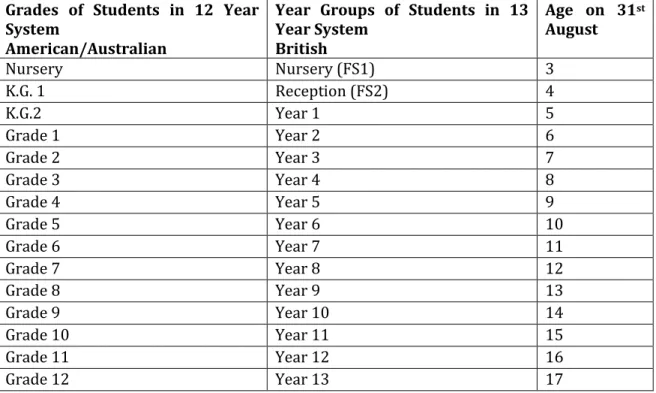
British Year Groups and American/Australian Grades are not synchronised. Nevertheless, the content of the curriculum and academic expectations in core subjects is broadly similar across age groups. Therefore it is possible to formulate a ‘table of equivalences’ to clarify the transfer of pupils between grades and year groups. (see Fig 1).
From the table below, we can see that a pupil who is 7 years old on 1st September will be admitted to
the Grade System in Grade 2 and the British system in Year 3. However, this child’s previous educational experience, and therefore academic level, will be broadly the same. If the child were to be transferred from Grade 2 to Year 2, the child would be a year older than his classmates and would, in effect, be repeating the same work. Therefore, for the child’s education to progress as it should, the child should transfer from Grade 2 to Year 3. This allows for continuity, it does not represent promotion.
Fig. 1 Table of Equivalences
Grades of Students in 12 Year System
American/Australian
Year Groups of Students in 13 Year System British Age on 31st August Nursery Nursery (FS1) 3 K.G. 1 Reception (FS2) 4 K.G.2 Year 1 5 Grade 1 Year 2 6 Grade 2 Year 3 7 Grade 3 Year 4 8 Grade 4 Year 5 9 Grade 5 Year 6 10 Grade 6 Year 7 11 Grade 7 Year 8 12 Grade 8 Year 9 13 Grade 9 Year 10 14 Grade 10 Year 11 15 Grade 11 Year 12 16 Grade 12 Year 13 17
7
It is important to note that should a pupil come from a school system that starts in the winter months, they are tested and then placed with the appropriate class based on the age and results. In that such students have completed two terms in their home country, it is likely they would be put ahead (missing one term) rather than back (two terms).
Other Non-Academic Considerations
1) Once a place is offered and accepted the parents of the successful pupil must submit all the registration documents required by KHDA and UAE authorities.
2) The pupil has no issues with the previous school, such as disciplinary or financial.
DATE May 2020
REVIEW DATE May 2021
Owner Admissions Manager/Deputy Head of Foremarke