John Hunt
A Beginner’s
Guide to Scala,
Object Orientation
and Functional
Programming
Second Edition
A Beginner
’
s Guide to Scala, Object Orientation
and Functional Programming
John Hunt
A Beginner
’
s Guide
to Scala, Object Orientation
and Functional Programming
Second Edition
John Hunt
Midmarsh Technology Ltd Bath, Wiltshire
UK
ISBN 978-3-319-75770-4 ISBN 978-3-319-75771-1 (eBook) https://doi.org/10.1007/978-3-319-75771-1
Library of Congress Control Number: 2018932535
1st edition:©Springer International Publishing Switzerland 2014 2nd edition:©Springer International Publishing AG 2018
This work is subject to copyright. All rights are reserved by the Publisher, whether the whole or part of the material is concerned, specifically the rights of translation, reprinting, reuse of illustrations, recitation, broadcasting, reproduction on microfilms or in any other physical way, and transmission or information storage and retrieval, electronic adaptation, computer software, or by similar or dissimilar methodology now known or hereafter developed.
The use of general descriptive names, registered names, trademarks, service marks, etc. in this publication does not imply, even in the absence of a specific statement, that such names are exempt from the relevant protective laws and regulations and therefore free for general use.
The publisher, the authors and the editors are safe to assume that the advice and information in this book are believed to be true and accurate at the date of publication. Neither the publisher nor the authors or the editors give a warranty, express or implied, with respect to the material contained herein or for any errors or omissions that may have been made. The publisher remains neutral with regard to jurisdictional claims in published maps and institutional affiliations.
Printed on acid-free paper
This Springer imprint is published by Springer Nature The registered company is Springer International Publishing AG
This book is dedicated to my wife Denise; you
are a constant source of inspiration to me.
Contents
1 Introduction . . . 1
1.1 Introduction . . . 1
1.2 What Is Scala? . . . 1
1.3 Why Scala? . . . 2
1.4 Java to Scala Quick Comparison . . . 3
1.5 Scala Versions . . . 5
1.6 Is This Book for You? . . . 5
1.7 Approach Taken by This Book . . . 5
2 Elements of Object Orientation. . . 7
2.1 Introduction . . . 7
2.2 Terminology. . . 7
2.3 Types of Hierarchy. . . 9
2.4 The Move to Object Technology . . . 12
2.5 Summary . . . 12
2.6 Exercises . . . 13
2.7 Further Reading . . . 13
3 WhyObjectOrientation?. . . 15
3.1 Introduction . . . 15
3.2 The Procedural Approach . . . 15
3.2.1 A Naked Data Structure . . . 16
3.2.2 Procedures for the Data Structure . . . 16
3.2.3 Packages . . . 17
3.3 Does Object Orientation Do Better?. . . 17
3.3.1 Packages Versus Classes. . . 17
3.3.2 Inheritance . . . 19
3.4 Summary . . . 20
4 Constructing an Object-Oriented System . . . 21
4.1 Introduction . . . 21
4.2 The Application: Windscreen Wipe Simulation. . . 21
4.3 Where Do We Start?. . . 22
4.4 Identifying the Objects . . . 23
4.5 Identifying the Services or Methods. . . 24
4.6 Refining the Objects . . . 26
4.7 Bringing It All Together . . . 26
4.8 Where Is the Structure?. . . 29
4.9 Summary . . . 31 4.10 Exercises . . . 31 4.11 Further Reading . . . 32 References . . . 33 5 Functional Programming . . . 35 5.1 Introduction . . . 35
5.2 What Is Functional Programming? . . . 35
5.3 Advantages to Functional Programming . . . 37
5.4 Disadvantages of Functional Programming. . . 39
5.5 Scala and Functional Programming . . . 40
6 Scala Background. . . 41
6.1 Introduction . . . 41
6.2 The Class Person . . . 41
6.3 Functional Programming . . . 43
6.4 A Hybrid Language . . . 44
7 A Little Scala . . . 47
7.1 Introduction . . . 47
7.2 The Scala Environment . . . 47
7.3 The Scala Shell. . . 48
7.4 The Scala IDE . . . 49
7.4.1 Creating an IntelliJ Project . . . 52
7.4.2 Inside IntelliJ . . . 53
7.4.3 Creating a Module . . . 53
7.5 Implementing the Object. . . 56
7.6 Running the Application . . . 56
7.6.1 Scala Interpreter Console. . . 57
7.7 Scala Classpath. . . 58
7.8 Compiling and Executing Scala . . . 58
7.9 Memory Management . . . 60
7.9.1 Why Have Automatic Memory Management? . . . 60
7.9.2 Memory Management in Scala . . . 61
7.9.3 When Is Garbage Collection Performed? . . . 61
7.9.4 Checking the Available Memory. . . 61
8 Scala Building Blocks . . . 65
8.1 Introduction . . . 65
8.2 Apps and Applications . . . 65
8.3 The Basics of the Language. . . 67
8.3.1 Some Terminology. . . 67
8.3.2 The Message Passing Mechanism . . . 68
8.3.3 The Statement Terminator. . . 68
9 Scala Classes. . . 69
9.1 Introduction . . . 69
9.2 Classes. . . 69
9.2.1 Class Definitions. . . 69
9.2.2 Developing a Class Definition. . . 70
9.2.3 Classes and Messages. . . 72
9.2.4 Instances and Instance Variables . . . 72
9.2.5 Classes and Inheritance. . . 73
9.2.6 Instance Creation . . . 76
9.2.7 Constructors. . . 77
9.2.8 Auxiliary Constructors . . . 79
9.2.9 Class Initialisation Behaviour . . . 80
9.2.10 Review of Classes and Constructors. . . 81
9.3 Case Classes. . . 82 9.3.1 A Sample Class . . . 83 10 Scala Methods. . . 87 10.1 Introduction . . . 87 10.2 Method Definitions . . . 87 10.2.1 Method Parameters. . . 89 10.2.2 Comments . . . 91
10.2.3 The Local Variables Section . . . 93
10.2.4 The Statements Section. . . 94
10.2.5 The Return Operator. . . 94
10.2.6 An Example Method. . . 95
10.2.7 Overriding toString. . . 96
10.2.8 Defining Property Methods . . . 98
10.3 Named Parameters . . . 100
11 Packages and Encapsulation. . . 103
11.1 Introduction . . . 103
11.2 Packages . . . 103
11.2.1 Declaring a Package . . . 104
11.2.2 Additional Package Definitions Options . . . 104
11.2.3 An Example Package . . . 109
11.2.4 Accessing Package Elements. . . 110
11.2.5 An Example of Using a Package. . . 111
11.3 Import Options . . . 112
11.4 Additional Import Features . . . 113
11.5 Package Objects . . . 114
11.6 Key Scala Packages . . . 115
11.7 Default Imports. . . 115
11.8 Encapsulation . . . 116
11.8.1 Scala Visibility Modifiers . . . 116
11.8.2 Private Modified. . . 117
11.8.3 Protected Modifier . . . 118
12 Building a Class . . . 121
12.1 Introduction . . . 121
12.2 Create a New Module . . . 121
12.3 Create a New Package. . . 123
12.4 Create a New Class. . . 124
12.5 Defining the Class. . . 125
12.6 Adding Behaviour. . . 126
12.7 Test Application . . . 126
12.8 Override Tostring . . . 128
12.9 Extras. . . 130
13 Classes, Inheritance and Abstraction . . . 131
13.1 Introduction . . . 131
13.1.1 What Are Classes for? . . . 131
13.2 Inheritance Between Types . . . 132
13.3 Inheritance Between Classes . . . 133
13.3.1 The Role of a Subclass. . . 134
13.3.2 Capabilities of Classes . . . 135
13.3.3 Overriding Behaviour . . . 136
13.3.4 Protected Members. . . 137
13.4 Restricting a Subclass . . . 138
13.5 Abstract Classes . . . 139
13.6 The Super Keyword . . . 142
13.7 Scala Type Hierarchy . . . 143
13.8 Polymorphism. . . 144
14 Objects and Instances. . . 147
14.1 Introduction . . . 147
14.2 Singleton Objects . . . 147
14.3 Companion Objects. . . 149
14.3.1 Companion Object Behaviour . . . 151
14.3.2 A Object or an Instance . . . 152
15 Value Classes . . . 155
15.1 Introduction . . . 155
15.2 Value Classes. . . 155
15.3 Simple Value Type Example. . . 156
15.4 Additional Value Class Concepts. . . 157
15.5 Negating Value Classes. . . 158
16 Scala Constructs. . . 159
16.1 Introduction . . . 159
16.2 Numbers and Numeric Operators. . . 159
16.2.1 Numeric Values . . . 159
16.2.2 Arithmetic Operators. . . 160
16.3 Characters and Strings. . . 161
16.3.1 Characters . . . 161 16.3.2 Strings. . . 161 16.4 Assignments. . . 162 16.5 Variables . . . 164 16.5.1 Temporary Variables. . . 164 16.5.2 Pseudo-Variables . . . 165 16.5.3 Variable Scope. . . 165
16.5.4 Option, Some and None . . . 165
16.5.5 Boolean Values . . . 167
16.5.6 Literals. . . 167
16.6 Messages and Message Selectors . . . 168
16.6.1 Invoking Methods. . . 168
16.6.2 Precedence. . . 168
16.7 Summary . . . 169
17 Control and Iteration . . . 171
17.1 Introduction . . . 171 17.2 Control Structures. . . 171 17.2.1 The if Statement. . . 171 17.2.2 If Returns a Value . . . 173 17.3 Iteration . . . 174 17.3.1 For Loops . . . 174 17.3.2 For Until . . . 175
17.3.3 For Loop with a Filter . . . 175
17.3.4 Longhand for Loop. . . 176
17.3.5 For-Yield Loop. . . 176 17.3.6 While Loops. . . 177 17.3.7 Do Loops. . . 178 17.3.8 An Example of Loops. . . 179 17.4 Equality . . . 180 17.5 Recursion. . . 180
17.5.1 The Match Expression . . . 183
18 Traits . . . 187
18.1 Introduction . . . 187
18.2 What Are Traits? . . . 187
18.3 Defining a Trait . . . 189
18.4 Using a Trait . . . 190
18.5 Abstract Trait Members. . . 193
18.6 Dynamic Binding of Traits . . . 193
18.7 Sealed Traits. . . 195
18.8 Marker Traits . . . 195
18.9 Trait Dependencies . . . 196
18.10 To Trait or not to Trait . . . 198
19 Further Traits. . . 199
19.1 Introduction . . . 199
19.2 Stackable Modifications. . . 199
19.3 Fat Versus Thin Traits. . . 204
19.4 Universal Traits . . . 205
19.5 Traits for a Data Type. . . 207
19.6 Single Abstract Method (SAM) Traits . . . 208
20 Arrays. . . 211
20.1 Introduction . . . 211
20.2 Arrays . . . 211
20.2.1 Arrays of Objects. . . 213
20.2.2 Ragged Arrays. . . 215
20.3 Creating Square Arrays . . . 217
20.4 Looping Through Arrays. . . 218
20.5 The Main Method Revisited . . . 219
21 Tuples. . . 223 21.1 Introduction . . . 223 21.2 Tuples . . . 223 21.3 Tuple Characteristics. . . 224 21.4 Tuple Classes . . . 224 21.5 Creating a Tuple. . . 224 xii Contents
21.6 Working with Tuples. . . 225
21.7 Iterating Over a Tuple. . . 226
21.8 Element Extraction . . . 227
22 Functional Programming in Scala. . . 229
22.1 Introduction . . . 229
22.2 Scala as a Functional Language. . . 229
22.3 Defining Scala Functions. . . 230
22.4 Class, Objects, Methods and Functions. . . 233
22.5 Lifting a Method. . . 235
22.6 Single Abstract Method Traits . . . 235
22.7 Closure. . . 237
22.8 Referential Transparency. . . 239
23 Higher-Order Functions . . . 241
23.1 Introduction . . . 241
23.2 Higher-Order Function Concepts . . . 241
23.3 Scala Higher-Order Functions . . . 242
23.4 Using Higher-Order Functions. . . 244
23.5 Higher-Order Functions in Scala Collections. . . 245
24 Partially Applied Functions and Currying . . . 247
24.1 Introduction . . . 247
24.2 Partially Applied Functions . . . 248
24.3 Currying. . . 250
24.3.1 Introduction to Currying . . . 250
24.3.2 Defining Multiple Parameter List Functions . . . 250
24.3.3 Using Curried Functions . . . 251
24.3.4 Building Domain-Specific Languages. . . 252
25 Scala Collections Framework . . . 255
25.1 Introduction . . . 255
25.2 What Are Collections? . . . 255
25.3 Scala Collections. . . 256
25.3.1 Package Scala.Collection. . . 258
25.3.2 Common Seq Behaviour. . . 259
25.3.3 Common Set Behaviour . . . 260
25.3.4 Common Map Behaviour . . . 260
26 Immutable Lists and Maps. . . 261
26.1 Introduction . . . 261
26.2 The Immutable List Collection. . . 261
26.2.1 List Creation . . . 261
26.2.2 List Concatenation . . . 262
26.2.3 List Operations. . . 264
26.2.4 List Processing. . . 265
26.2.5 Further List Processing. . . 265
26.2.6 Pattern Matching . . . 269
26.2.7 Converting to a List . . . 270
26.2.8 Lists of User Defined Types . . . 270
26.3 The Immutable Map Type. . . 272
27 Immutable and Mutable Collection Packages . . . 275
27.1 Introduction . . . 275 27.2 Package Scala.Collection.Immutable. . . 275 27.2.1 Sequences . . . 275 27.2.2 Sets. . . 278 27.2.3 Maps. . . 279 27.3 Package Scala.Collection.Mutable . . . 279 27.3.1 ArrayBuffer . . . 280 27.3.2 ListBuffer. . . 281 27.3.3 LinkedList . . . 282 27.3.4 Stack. . . 282 27.3.5 HashMap. . . 283 27.4 Generic Collections. . . 284 27.5 Summary . . . 285 28 Type Parameterisation . . . 287 28.1 Introduction . . . 287
28.2 The Set Class . . . 287
28.3 Adding Type Parameterisation . . . 288
28.3.1 The MyQueue Mutable Class . . . 288
28.3.2 The Immutable Queue Class . . . 290
28.4 Variance. . . 292
28.5 Lower and Upper Bounds . . . 293
28.6 Combining Variance and Bounds. . . 293
29 Further Language Constructs. . . 295
29.1 Introduction . . . 295 29.2 Implicit Conversions . . . 295 29.3 Implicit Parameters . . . 297 29.4 Implicit Objects . . . 299 29.5 Implicit Classes. . . 301 29.6 Scala Annotations. . . 303 29.7 Type Declarations. . . 305 29.8 Enumerations . . . 306 29.9 Lazy Evaluation . . . 311 xiv Contents
30 Exception Handling. . . 313
30.1 Introduction . . . 313
30.2 What Is an Exception? . . . 313
30.3 What Is Exception Handling? . . . 315
30.4 Throwing an Exception. . . 316
30.5 Catching an Exception. . . 317
30.6 Try Block Returns a Value . . . 320
30.7 Defining an Exception. . . 321
30.8 A More Functional Approach . . . 322
30.9 The Try Type. . . 325
31 Akka Actors . . . 327
31.1 Introduction . . . 327
31.2 The Actor Model . . . 327
31.3 Some Terminology . . . 328
31.4 Scala Threads. . . 329
31.5 Akka Scala Actor Library . . . 330
31.6 Concurrent Hello World . . . 332
31.7 Concurrent Actors. . . 335
31.8 The Akka Actor API. . . 336
31.9 Actor Lifecycle. . . 337
31.10 Akka Configuration. . . 339
31.11 Actor DSL . . . 343
32 Further Akka Actors . . . 345
32.1 Introduction . . . 345
32.2 Generating a Result from an Actor. . . 345
32.3 Futures. . . 348
32.4 Dispatchers. . . 351
32.5 Actor Hierarchies . . . 354
32.6 Actor Supervision. . . 355
32.7 Good Practices . . . 360
33 Scala and JDBC Database Access. . . 361
33.1 Introduction . . . 361
33.2 Why JDBC?. . . 361
33.3 What Is JDBC?. . . 362
33.4 Working with JDBC . . . 364
33.5 The Database Driver . . . 365
33.6 Registering Drivers . . . 366
33.7 Setting Up MySQL. . . 367
33.8 Setting Up the Database . . . 368
33.8.1 Starting/Stopping/Connecting to MySQL . . . 368
33.9 Creating a Database . . . 369
33.9.1 Adding a User . . . 369
33.9.2 Selecting to Work with a Database . . . 370
33.9.3 Creating a Table. . . 370
33.9.4 Adding Data to a Table. . . 371
33.10 Opening a Connection. . . 372
33.11 Inserting into a Table . . . 374
33.12 Obtaining Data from a Database . . . 376
33.13 Update an Existing Row . . . 378
33.14 Deleting from a Table. . . 379
33.15 Creating a Table . . . 379 33.16 Stored Procedures . . . 381 33.17 JDBC Data Sources. . . 381 33.18 Connection Pooling. . . 384 33.19 JDBC Metadata . . . 386 33.19.1 DatabaseMetaData . . . 387 33.19.2 ResultSetMetaData . . . 388
34 Scala Style Database Access . . . 389
34.1 Introduction . . . 389
34.2 Slick . . . 389
34.3 Querulus. . . 390
34.4 Squeryl. . . 391
34.5 O/R Broker. . . 392
35 Slick: Functional Relational Mapping for Scala . . . 395
35.1 Introduction . . . 395
35.2 Obtaining Slick. . . 395
35.3 Connecting to a Database . . . 397
35.4 Mapping Tables to Scala Types. . . 398
35.5 Table Query Interface . . . 400
35.6 Creating Tables. . . 401
35.7 Inserting Data. . . 401
35.8 Composing Database I/O Actions. . . 402
35.9 Example Setting Up a Database. . . 402
35.10 Querying for Data. . . 404
35.11 Updating, Upserting and Deleting Data . . . 407
36 Testing . . . 409
36.1 Introduction . . . 409
36.2 Types of Testing. . . 409
36.3 What Should Be Tested?. . . 410
36.4 Types of Testing. . . 411
36.4.1 Unit Testing. . . 412
36.4.2 Integration Testing . . . 413
36.4.3 System Testing. . . 413 36.4.4 Installation Testing. . . 413 36.4.5 Smoke Tests. . . 414 36.5 Automating Testing. . . 414 37 Scala Testing. . . 415 37.1 Introduction . . . 415
37.2 Scala Runtime Test Facilities. . . 415
37.2.1 Validation Checks. . . 415
37.2.2 Using Require and Assert . . . 416
37.3 Test Libraries in Scala. . . 417
37.3.1 ScalaTest . . . 417
37.3.2 Spec . . . 417
37.3.3 ScalaCheck. . . 418
37.4 Scalatest Testing Framework . . . 418
37.4.1 Setting up Your Scala Project . . . 418
37.4.2 ScalaTest and JUnit . . . 419
37.4.3 Scala Test and Functional Test Suites . . . 424
37.5 Scalatest and Feature Tests . . . 425
37.6 Test-Driven Development . . . 427 37.6.1 The TDD Cycle . . . 427 37.6.2 Test Complexity. . . 428 37.6.3 Refactoring. . . 429 38 Play Framework. . . 431 38.1 Introduction . . . 431 38.2 Introduction to Play. . . 431
38.2.1 Working with a Web Application . . . 432
38.2.2 How Play Changes the Stack. . . 432
38.3 Starting with Play . . . 434
38.3.1 Download and Install Play . . . 434
38.3.2 Using a Play Starter Project. . . 434
38.3.3 Starting the Application . . . 436
38.4 Examining the Structure of the Application . . . 438
38.5 Editing the Application . . . 439
38.5.1 Working with Your IDE . . . 439
38.5.2 Importing into IntelliJ. . . 439
38.5.3 Working with the Application . . . 441
38.6 Model–View–Controller . . . 442
38.7 Exploring the Play Application . . . 444
39 RESTful Services . . . 447
39.1 Introduction . . . 447
39.2 RESTful Services . . . 447
39.3 A RESTful API . . . 448
39.4 Creating the RESTful Web Application . . . 449
39.5 JavaScript and jQuery . . . 454
39.6 The jQuery Client. . . 455
39.6.1 Obtaining jQuery . . . 455
39.6.2 Adding jQuery to the Application . . . 456
40 Scalaz . . . 463
40.1 Introduction . . . 463
40.2 Obtaining Scalaz. . . 463
40.3 Scalaz Overview. . . 464
40.4 Some Useful Typeclasses . . . 465
40.4.1 Equals Typeclass . . . 465
40.4.2 Order Typeclass . . . 465
40.5 Standard Class Extensions. . . 466
40.5.1 Extensions to Option. . . 466
40.5.2 Boolean Extensions. . . 468
40.5.3 Extensions to List. . . 469
40.5.4 Extensions for Map. . . 470
40.5.5 Extensions to String . . . 471
40.6 The Other Either. . . 471
40.7 Tagging . . . 472
41 GUIs in Scala Swing. . . 475
41.1 Introduction . . . 475
41.2 Windows as Objects . . . 475
41.3 Windows in Scala. . . 476
41.4 Scala Swing . . . 477
41.5 Scala Swing Packages. . . 478
41.6 Swing Scala Worked Examples . . . 480
41.6.1 Simple Hello World UI. . . 480
41.6.2 Panels and UI Layout. . . 481
41.6.3 Working with a BorderPanel. . . 482
41.6.4 Working with a BoxPanel. . . 484
41.6.5 Displaying a Table . . . 485
42 User Input in Scala Swing . . . 489
42.1 Introduction . . . 489
42.2 Handling User Input . . . 489
42.2.1 Scala Swing Actions. . . 492
42.2.2 Working with Menus . . . 494
42.3 A Simple GUI Example . . . 496
43 Scala Build Tools . . . 501
43.1 Introduction . . . 501
43.2 Why We Need a Build Tool . . . 501
43.3 Maven . . . 502
43.3.1 Maven Repositories . . . 504
43.3.2 The Maven POM . . . 504
43.3.3 Scala and Maven . . . 506
43.3.4 Maven Lifecycle Commands. . . 508
43.4 SBT. . . 508
43.4.1 Creating an SBT Project . . . 510
43.4.2 SBT Lifecycle Commands. . . 512
44 Scala & Java Interoperability. . . 515
44.1 Introduction . . . 515 44.2 A Simple Example . . . 515 44.3 Inheritance . . . 517 44.4 Issues. . . 517 44.4.1 Scala Objects . . . 518 44.4.2 Companion Modules. . . 519 44.4.3 Traits. . . 521 44.5 Functions . . . 524 44.6 Collection Classes. . . 528
44.7 Implementing a Java Interface . . . 530
Chapter 1
Introduction
1.1
Introduction
This book is intended as an introduction to Scala for computer science students or those actively involved in the software industry. It assumes some familiarity with standard computing concepts, such as the idea of compiling a program and exe-cuting this compiled form, and with the basics of procedural language concepts such as variables and allocation of values to variables. However, the early chapters of the book do not assume any familiarity with Object Orientation nor functional programming. They also step through other concepts with which the reader may not be familiar (such as list processing). From this background, it provides a practical introduction to object and functional technology using Scala, one of the newest and most interesting programming languages available.
This book introduces a variety of concepts through practical experience. It also tries to take you beyond the level of the language syntax to the philosophy and practice of Object-Oriented development and functional programming.
In the remainder of this chapter, we will consider what Scala is, why you should be interested in Scala and whether this book is for you.
1.2
What Is Scala?
Scala is a new programming language developed by Martin Odersky and his team at the EPFL (Ecole Polythenique Fererale de Lausanne, Lausanne, Switzerland) and now supported by Lightbend Inc. (previously known as Typesafe).
The name Scala is derived from Sca(lable) La(nguage) and is a multi-paradigm language, incorporating Object-Oriented approaches with functional programming.
What does this mean in practice? It means that you can write applications as pure Object-Oriented solutions using Classes, Objects and Traits. You can exploit
©Springer International Publishing AG 2018
J. Hunt,A Beginner’s Guide to Scala, Object Orientation and Functional Programming, https://doi.org/10.1007/978-3-319-75771-1_1
inheritance, polymorphism and abstraction and encapsulation techniques. In this respect, Scala is very much like any other Object-Oriented language (such as Java, C# or C++). However, you can also develop solutions using purely functional programming principles in a similar manner to languages such as Haskell or Clojure. In such an approach, programs are written purely in terms of functions that take inputs and generate outputs without any side effects.
Scala though is different in that it is a hybrid programming language. That is, it is possible to combine the best of both worlds when creating a software system. You can therefore exploit Object-Oriented principles to structure your solution but integrate functional aspects when appropriate. Whilst this approach is not unique (the Common Lisp Object Systems did something similar in the 1980s), it is cer-tainly bringing functional programming to the mainstream and integrating it within an environment that can execute almost anywhere.
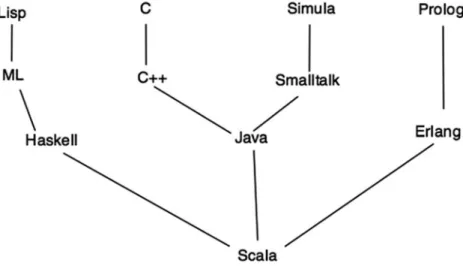
Of course Scala has not been developed in isolation and has been influenced by many of these and other languages. The influences on the Scala language are shown in Fig.1.1.
1.3
Why Scala?
This of course raises the question why Scala and why now? There are a number of reasons why Scala should be a language that is given serious consideration by any development project. We have already mentioned that fact that it coherently brings together two very powerful programming paradigms that combined can allow very elegant, concise and maintainable systems to be created. However, there are other reasons why Scala is of interest. Thefirst is that Scala can be compiled to Java Byte
Fig. 1.1 Scala Genealogy
Codes. This means that a Scala system can run on any environment that supports the Java Virtual Machine (or JVM). There are already several languages that compile to Java Byte Codes. This list includes Java but also extends to Ada, JavaScript, Python, Ruby, Tcl and Prolog. Scala is just another such language. However, this has the additional advantage that Scala can also be integrated with any existing Java code base that a project may have. It also allows Scala to exploit the huge library of Java projects available both for free and for commercial use.
Another reason to consider Scala is that one of the design goals for the Scala development team was to create:
A scalable language suitable for the construction of component based software within highly concurrent environments.
This means that it has several features integrated into it that support large software developments. For example, the Actor model of concurrency greatly simplifies the development of concurrent applications. In addition, the syntax reduces the amount of code that must be written by a developer (at least compared with Java). This is because it avoids a lot of the boilerplate code that any Java developer will be familiar with.
To summarise then, the following points can be made that Scala:
• Provides Object-Oriented concepts including classes, objects, inheritance and abstraction.
• Extends these (at least with reference to pre Java 8) to include Traits which represent data and behaviour that can bemixed into classes and objects.
• Includes functional concepts, such as functions as first-class entities in the language, as well as concepts such as Partially Applied functions and Currying which allow new functions to be constructed from existing functions.
• Uses statically typed variables and constants with type inference used wherever possible to avoid unnecessary repetition.
• Has interoperability (mostly) with Java.
To return the question of‘Why now?’—now is a good time to be learning about Scala. At the time of writing Scala has been in commercial use (at least to my knowledge) for seven years and has stabilised and addressed some of the concerns that commercial development projects had about early version of Scala.
1.4
Java to Scala Quick Comparison
As a comparison, for those who are familiar with Java, the following two listings compare and contrast equivalent code defined in Java and Scala. Do not worry at this point too much about the syntax; it is more for illustration than the specifics of either Java or Scala at this point.
Here is the Java class:
class Person {
private StringfirstName; private String lastName; private int age;
public Person(StringfirstName, String lastName, int age) {
this.firstName =firstName; this.lastName = lastName; this.age = age;
}
public void setFirstName(StringfirstName) { this.firstName =firstName; }
public void String getFirstName() { this.firstName; }
public void setLastName(String lastName) { this.lastName = lastName; }
public void String getLastName() { this.lastName; }
public void setAge(int age) { this.age = age; }
public void int getAge() { return this.age; } }
And here is the equivalent Scala class:
class Person(varfirstName: String, var lastName: String, var age: Int)
As you can see, the Scala version is much shorter but actually captures the same concepts. The core concepts here are that:
A Person has three properties firstName, lastName and age. These properties are readable and writable. When a newPersonis constructed, you must provide values for thefirstName,lastNameand the age.
Both listings implement these concepts; however, in Java’s case it has no concept of a property and thus we must define how the data is held internally to a Person and how it can be accessed or updated via various getter and setter methods. In contrast, Scala has a concept of properties and thus we do not need to write the update and access style methods. Instead, we need to decide if they are read-only (known as vals)or read–write properties (as indicated by the keywordvar).
1.5
Scala Versions
There have been severalsignificantScala versions over recent years. It is useful to be aware of these so that if you are looking at blogs or articles on the Web you can see which ones are relevant to you. Previous significant versions have been Scala 2.9, 2.10 and 2.11. This book focuses on Scala 2.12 which is the current release at the time of writing.
1.6
Is This Book for You?
This book does not assume a great deal of programming experience. However, it is not a basic introduction to programming. Instead, it is aimed at those with little programming and no functional or Object-Oriented experience. It does introduce concepts such as lists, data collections, forloops and conditional control state-ments. However, it assumes a basic understanding of how programs work, of what a programming stack might be, that memory must be allocated for data, etc.
It can also be used to develop some basic knowledge of programming into a more in-depth knowledge of a particular technology. It could also be used to support an introduction to programming course.
1.7
Approach Taken by This Book
In general, the book takes a very “hands-on” approach to the whole subject and assumes that you will implement the examples as you progress. It supports this through many examples that take you through how to use the Scala IDE to support what you are doing as well as providing complete code examples with indications of the expected outcomes. Unlike many books on Scala, the focus is on using Scala within an IDE and constructing simple applications rather than using the interactive Scala interpreter. In addition, all the samples used in the book are available from Springer to be downloaded and used in your own IDEs.
References Haskell
• http://www.haskell.org/ Clojure
• http://clojure.org/
Common Lisp Object System
• Sonya E. Keene, Object-Oriented Programming in Common LISP: A Programmer’s Guide to CLOS, Pub. Addison Wesley, (Jan 1989) 0201175894.
• List of JVM Languageshttp://en.wikipedia.org/wiki/List_of_JVM_languages The Scala programming language home page
• seehttp://www.scala-lang.org The Scala mailing list
• seehttp://listes.epfl.ch/cgi-bin/doc_en?liste=scala The Scala wiki
• seehttp://scala.sygneca.com/ Lightbend Inc.
• https://www.lightbend.com/
Chapter 2
Elements of Object Orientation
2.1
Introduction
This chapter introduces the core concepts in Object Orientation. It concisely defines the terminology used and attempts to clarify issues associated with hierarchies. It also discusses some of the perceived strengths and weaknesses of the Object-Oriented approach. It then offers some guidance on the approach to take in learning about objects.
2.2
Terminology
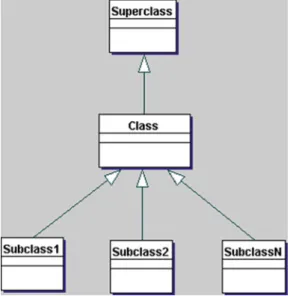
Class A class defines a combination of data and procedures that operate on that data. Instances of other classes can only access that data or those procedures through specified interfaces. A class acts as a template when creating new instances. A class does not hold any data but it specifies the data that is held in the instance. The relationship between a class, its superclass and any subclasses is illustrated in Fig.2.1.
SubclassA subclass is a class that inherits from another class. For example, in the last chapter, Student Employee is a subclass of Temporary Employee. Subclasses are, of course, classes in their own right. Any class can have any number of subclasses.
SuperclassA superclass is the parent of a class. It is the class from which the current class inherits. For example, in the last chapter, Temporary Employee is the superclass of Student Employee. In Scala, a class can have only one superclass.
©Springer International Publishing AG 2018
J. Hunt,A Beginner’s Guide to Scala, Object Orientation and Functional Programming, https://doi.org/10.1007/978-3-319-75771-1_2
Fig. 2.1 Relationship between class, superclass and subclass
Instance or objectAn instance is an example of a class. All instances of a class possess the same data variables but contain their own data. Each instance of a class responds to the same set of requests.
John setDepartment setHourlyRate printPaySlip printBirthdayMessage payExpenses Employee Class 1455 8989F 220 name
Class to instance relationships
department employeeNo hourlyRate Chris 3345 9987B 560 name department employeeNo hourlyRate Kate 1455 1122A 250 name department employeeNo hourlyRate
Instance variableThis is the special name given to the data which is held by an object. The “state” of an object at any particular moment relates to the current values held by its instance variables. (In Scala, there are also class-side variables, referred to as static variables, but these will be discussed later.) Figure2.2 illus-trates a definition for a class in pseudo-code. It includes some instance variable definitions: fuel, mileage and name.
MethodA method is a procedure defined within an object. In early versions of Smalltalk, a method was used to get an object to do something or return something. It has since become more widely used; languages such as CLOS and Scala also use the term. Two methods are defined in Fig. 2.2: one calculates the miles per gallon, while the other sets the name of the car object.
MessageOne object sends a message to another object requesting some oper-ation or data. The idea is that objects are polite, well-behaved entities which carry out functions by sending messages to each other. A message may be considered akin to a procedure call in other languages.
Single or multiple inheritance Single and multiple inheritance refer to the number of superclasses from which a class can inherit. Scala is a single inheritance system, in which a class can only inherit from one class. C++ is a multiple inheritance system in which a class can inherit from one or more classes.
2.3
Types of Hierarchy
In most Object-Oriented systems there are two types of hierarchy; one refers to inheritance (whether single or multiple) and the other refers to instantiation. The inheritance hierarchy (or extends hierarchy) has already been described. It is the way in which an object inherits features from a superclass.
The instantiation hierarchy relates to instances rather than classes and is important during the execution of the object. There are two types of instance hierarchy: one indicates a part-ofrelationship, while the other relates to a using relationship (It is referred to as anis-a relationship.).
The difference between an is-a relationship and a part-of relationship is often confusing for new programmers (and sometimes for those who are experienced in Fig. 2.2 A simple Scala class definition
one language but are new to Object-Oriented programming languages, such as Scala). Figure2.3illustrates that a studentis-atype of person, whereas an engine is part-ofa car. It does not make sense to say that a student ispart-ofa person or that an engineis-a type of car!
In Scala, extends relationships are generally implemented by the subclassing mechanism. It is possible to build up large and complex class hierarchies which express these extends relationships. These classes express the concept of inheri-tance, allowing one class to inherit features from another. The total set of features is then used to create an instance of a class. In contrast,part-ofrelationships tend to be implemented using instance variables in Scala.
However, is-a relationships and classes are not exactly the same thing. For example, if you wish to construct a semantic network consisting of explicit is -a relationships between instances you will have to construct such a network manually. The aim of such a structure is to represent knowledge and the relation-ships between elements of that knowledge, and not to construct instances. The construction of such a network is outside the scope of the subclassing mechanism and would therefore be inappropriate.
If John is an instance of a class Person, it would be perfectly (semantically) correct to say that John is-a Person. However, here we are obviously talking about the relationship between an instance and a class rather than a subclass and its parent class. A further confusion can occur for those encountering Scala after becoming familiar with a strongly typed language. These people might atfirst assume that a subclass and a subtype are essentially the same. However, they are not the same, although they are very similar. The problem with classes, types andis-a relation-ships is that on the surface they appear to capture the same sorts of concept. In Fig.2.4, the diagrams all capture some aspect of the use of the phrase is -a. However, they are all intended to capture a different relationship.
The confusion is due to the fact that in modern English we tend to overuse the termis-a. We can distinguish between the different types of relationship by being more precise about our definitions in terms of a programming language, such as Scala. Table2.1defines the relationships illustrated in Fig. 2.4.
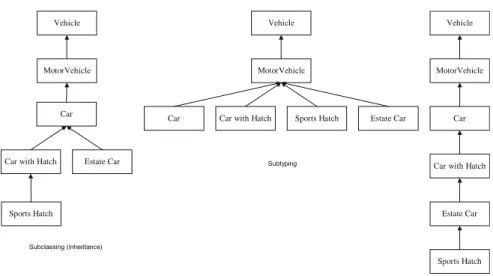
To illustrate this point, consider Fig.2.5, which illustrates the differences between thefirst three categories.
Thefirst diagram illustrates the potential relationships between a set of classes that define the behaviour of different categories of vehicle. The second diagram presents the subtype relationships between the categories. The third diagram
Person
Student
Car
Engine
is-a part-of
Fig. 2.3 is-adoes not equal part-of
Vehicle Vehicle Vehicle Car Sports Car Sports Car Sports Car Car Car
is-a sub typing subclassing
Vehicle
Car
instance MGF
Fig. 2.4 Satisfying four relationships
Table 2.1 Types ofis-arelationships
Specialisation One thing is a special case of another
Type One type can be used interchangeably with another type (substitutability relationship)
Subclassing or inheritance
An implementation mechanism for sharing code and representations Instantiation One thing is an example of a particular category (class) of things
Vehicle
Estate Car Car with Hatch
Car MotorVehicle Sports Hatch Subclassing (inheritance) Vehicle Estate Car Car with Hatch
Car MotorVehicle Sports Hatch Subtyping Vehicle Estate Car Car with Hatch
Car MotorVehicle
Sports Hatch
Specialization
Fig. 2.5 Distinguishing between relationships
illustrates a straight specialisation set of relationships. Notice that althoughestate caris a specialisation ofcar with hatch, its implementation (the subclassing hier-archy) indicates that it does not share any of its implementation with thecar with hatch class. It is worth noting that type relationships are specifications, while classes (and subclasses) are implementations of behaviour.
2.4
The Move to Object Technology
At present you are still acclimatising to Object Orientation. It is extremely important that from now on you do your utmost to immerse yourself in Object Orientation, object technology and Scala. This is because when youfirst encounter a new language or paradigm, it is all too easy to say that it is not good because you cannot do what you could in some other language or paradigm. We are all subject to the“better the devil you know than the devil you don’t”syndrome. If you embrace Object Orientation, warts and all, at least for the present, you will gain most.
In addition, it is a fact of life that most of us tend tofit in learning something new around our existing schedules. This may mean, for example, that you are trying to read this book and do the exercises while still working in C, VisualBasic, Ada, etc. From personal experience, and from teaching others about Scala, I can say that you will gain most by putting aside a significant amount of time and concentrating on the subject matter involved. This is not only because Object Orientation is so different, but also because you need to get familiar not only with the concepts but also with Scala and its development environment.
So have a go, take a“leap of faith”and stick with it until the end. If, at the end, you still cannot see the point, then fair enough, but until then accept it.
2.5
Summary
In this chapter, we reviewed some of the terminology introduced in the previous chapter. We also considered the types of hierarchy which occur in Object-Oriented systems and which can atfirst be confusing. We then considered the pros and cons of Object-Oriented programming. You should now be ready to start to think in terms of objects. As has already been stated, this will atfirst seem a strange way to develop a software system, but in time it will become second nature. In the next chapter we examine how an Object-Oriented system might be developed and structured. This is done without reference to any source code as the intention is to familiarise you with objects rather than with Scala. It is all too easy to get through a book on Smalltalk, C++, Scala, etc., and understand the text but still have no idea how to start developing an Object-Oriented system.
2.6
Exercises
Research what other authors have said about single and multiple inheritance. Why do languages such as Smalltalk and Scala not include multiple inheritance?
Look for terms such as class, method, member, member function, instance variable and constructor in the books listed in the further reading section. When you have found them, read their explanation of these terms and write down your understanding of their meaning.
2.7
Further Reading
Suggested further reading for this chapter includes Coad and Yourdon (1991), Winston and Narasimhan (2001) and Meyer (1988). In addition all the books mentioned in the previous chapter are still relevant.
Chapter 3
Why
Object
Orientation?
3.1 Introduction
The previous chapter introduced the basic concepts behind Object Orientation, the terminology and explored some of the motivation. This chapter looks at how Object Orientation addresses some of the issues that have been raised with procedural languages. To do this it looks at how a small extract of a program might be written in a language such as C, considers the problems faced by the C developer and then looks at how the same functionality might be achieved in an Object-Oriented language such as Scala, Java or C#. Again do not worry too much about the syntax you will be presented with, it will be Scala but it should not detract from the legibility of the examples.
3.2 The Procedural Approach
As has already been stated, Object Orientation provides four things: 1. Encapsulation
2. Abstraction 3. Inheritance 4. Polymorphism.
It has been claimed that these four elements combine to provide a very powerful programming paradigm, but why? What is so good about Object Orientation?
©Springer International Publishing AG 2018
J. Hunt,A Beginner’s Guide to Scala, Object Orientation and Functional Programming, https://doi.org/10.1007/978-3-319-75771-1_3
3.2.1
A Naked Data Structure
Consider the following example: record Date {int day; int month; int year; }
This defines a data structure for recording dates. There are similar structures in many procedural languages such as C, Pascal and Ada. It is naked because it has no defenses against procedures accessing and modifying its contents.
So what is wrong with a structure such as this? Nothing, apart from the issue of visibility? That is, what can see this structure and what can update the contents of the structure? For example, code could set the day to 1, the month to 13 and the year to 9999. As far as the structure is concerned the information it holds isfine (that is day = 01, month = 13, year = 9999). This is because the structure only knows it is supposed to hold an integer, it knows nothing about dates per se. This is not surprising, it is only data.
3.2.2
Procedures for the Data Structure
This data is associated with procedures that perform operations on it. These operations might be to test whether the date represents a date at a weekend or part of the working week. It may be to change the date (in which case the procedure may also check to see that the date is a valid one.
For example:
• isDayOfWeek(date); • inMonth(date, 2); • nextDay(date);
• setDay(date, 9, 23, 1946);
How do we know that these procedures are related to the date structure we have just looked at? By the naming conventions of the procedures and by the fact that one of the parameters is a data (record).
The problem is that these procedures are not limited in what they can do to the data (e.g. the setDay procedure might have been implemented by a Brit who assumes that the data order is day, month and year. However, it may be used by an American who assumes that date order is month, day, year. Thus the meaning of setDay(date, 9, 23, 1946) will be interpreted very differently. The American views this as the 23rd of September 1946, while the Brit views this as the 9th of the 23rd
month, 1946. In either case, there is nothing to stop the date record being updated with both versions. Obviously the setDay() procedure might check the new date to see it was legal, but then again it might not. The problem is that the data is naked and has no defense against what these procedures do to it.
Indeed, it has no defense against what any procedures that can access it, may do to it.
3.2.3
Packages
One possibility is of course to use a package construct. In languages such as Ada packages are commonplace and are used as a way of organizing code and restricting visibility. For example,
package Dates is type Date is….
function isDayOfWeek(d: Date) return BOOLEAN; function inMonth(d: Date, m: INTEGER) return
BOOLEAN; …
The package construct now provides some ring fencing of the data structure and a grouping of the data structure with the associated functions. In order to use this package a developer must import the package (e.g. using with and uses in Ada). They can then access the procedures and work with data of the specified type (in this case Date). There can even be data that is hidden from the user within aprivate part. This therefore increases the ability to encapsulate the data (hide the data) from unwelcome attention.
3.3 Does Object Orientation Do Better?
This is an important question “Does Object Orientation do any better”than the procedural approach described above? We will first consider packages, then inheritance…
3.3.1
Packages Versus Classes
It has been argued (to me at least) that a package is just like a class. It provides a template from which you can create executable code, it provides wall around your data with well-defined gateways, etc. However, there are a number of very sig-nificant differences between packages and classes.
Firstly, packages tend to be larger (at least conceptually) units than classes. For example, theTextIOpackage in Ada is essentially a library of textual IO facilities, rather than a single concept such as the class String in C#. Thus packages are not used to encapsulate a single small concept such asDate,but rather a whole set of related concepts (as indeed they are used in C# itself where they are called namespaces). Thus a class is afiner level of granularity than a package even though it provides similar levels of encapsulation.
Secondly, packages still provide a relatively loose association between the data and the procedures. A package may actually deal with very many data structures with a wide range of methods. The data and the methods are related primarily via the related set of concepts represented by the package. In contrast a class tends to closely relate data and methods in a single concept. Indeed, one of the guidelines presented later in this book relating to good class design, is that if a class represents more than one concept, split it into two classes.
Thus this close association between data and code and means that the resulting concept is more than just a data structure (it is closer to a concrete realization of an abstract data type). For example:
class Date {
val day: Int = 1 val month: Int 1 val year: Int = 14
def isDayOfWeek(): Boolean = {..} }
Anyone using an instance ofDatenow gets an object which can tell you whether it is a day of the week or not and can hold the appropriate data. Note that the isDayOfWeek() method takes no parameters, it does not need to as it and the date is a part of the same thing. This means that a user of a Date object will never get their hands on the actual data holding the date (i.e. the integers day, month and year). Instead, they are forced to go via the internal methods. This may only seem a small step, but it is a significant one, nothing outside the object may access the data within the object. In contrast the data structure in the procedural version, is not only held separately to the procedures, the values for day, month or year could be modified directly without the need to use the defined procedures.
For example, compare the differences between an ADA-esque excerpt from a program to manipulate dates:
d: Date; setDay(d, 28); setMonth(d, 2); setYear(d, 1998); isDayOfWeek(d); inMonth(d, 2);
Not that it was necessary tofirst create the data and then to set thefields in the data structure. Here we have been good and have used the interface procedures to do this. Once we had the data set-up we could then call methods such as IsDayOfWeekandInMonthon that data.
In contrast the Scala code uses a constructor to pass in the appropriate initial-ization information. How this is initialized internally is hidden from the user of the class Date. We then call method such asisDayOfWeek() andisMonth(12) directly on the object date.
val d = new Date(12, 2, 1998) d.IsDayOfWeek()
d.InMonth(12)
The thing to think about here is where would code be defined?
3.3.2
Inheritance
Inheritance is the key element that makes an Object-Oriented language more than an object-based language. An object-based language possesses the concept of object, but not of inheritance. Indeed, inheritance is the thing that marks an Object-Oriented language as different from a procedural language. The key concept in inheritance is that one class can inherit data and methods from another, thus increasing the amount of code reuse occurring as well as simplifying the overall system. One of the most important features of inheritance (ironically) is that it allows the developer to get inside the encapsulation bubble in limited and controlled ways. This allows the subclass to take advantage of internal data structures and methods, without com-promising the encapsulation a forded to objects. For example, let use define a subclass of the classDate(extends are used to indicate inheritance in Scala): class Birthday extends Date {
val name: String = "" val age: Int = 0
def isBirthday(): Boolean = {..} }
The methodisBirthday()could check to see if the current date, matched the birthday represented by an instance of Birthday and return true if it does and false if it does not.
Note however, that the interesting thing here is that not only have I not had to define integers to represent the date, nor have I had to define methods to access such dates. These have both been inherited from the parent classDate.
In addition, I can now treat an instance ofBirthdayas either a Date or as a Birthdaydepending on what I want to do!
What would you do in languages such as C, Pascal or Ada? One possibility is that you could define a new package Birthday, but that package would not extend Dates, it would have to import Dates and add interfaces to it etc.? However, you certainly could not treat a Birthday package as a Dates package.
In languages such as Scala, because ofpolymorphism, you can do exactly that. You can reuse existing code that only knew about Date, for example:
• def test(Date d): Unit = {..} • t.test(birthday)
This is because Birthday is indeed a type of Date as well as being a type of Birthday.
You can also use all of the features defined for Date on Birthdays: • birthday.isDayOfWeek()
Indeed you do not actually know where the method is defined. This method could be defined in the class Birthday (in which it would override that defined in the classDate). However, it could be defined in the classDate(if no such method is defined in Birthday). However, without looking at the source code there is no way of knowing!
Of course you can also use the new methods defined in the class Birthday on instance (objects) of this class. For example:
• birthday.isBirthday()
3.4 Summary
Classes in an Object-Oriented language provide a number of features that are not present in procedural languages. Hopefully by the end of the book you will agree that they are useful additions to the developers’toolbox. If not, give it time, one of the problems that we all face (myself included) is a reluctance to change. To summarise, the main points to be noted from this chapter on Object Orientation are: • Classes provide for inheritance.
• Inheritance provides for reuse.
• Inheritance provides for extension of data type. • Inheritance allows for polymorphism.
• Inheritance unique feature of Object Orientation.
• Encapsulation represents a particularly good Software Engineering feature in Object Orientation.
Chapter 4
Constructing an Object-Oriented System
4.1
Introduction
This chapter takes you through the design of a simple Object-Oriented system without considering implementation issues or the details of any particular language. Instead, this chapter illustrates how to use Object Orientation concepts to construct a software system. Wefirst describe the application and then consider where to start looking for objects, what the objects should do and how they should do it. We conclude by discussing issues such as class inheritance and answer questions such as“where is the structure of the program?”.
4.2
The Application: Windscreen Wipe Simulation
This system aims to provide a diagnosis tutor for the equipment illustrated in Fig.4.1. Rather than use the wash–wipe system from a real car, students on a car mechanics diagnosis course use this software simulation. The software system mimics the actual system, so the behaviour of the pump depends on information provided by the relay and the water bottle.
The operation of the wash–wipe system is controlled by a switch which can be in one offive positions: off, intermittent, slow, fast and wash. Each of these settings places the system into a different state:
©Springer International Publishing AG 2018
J. Hunt,A Beginner’s Guide to Scala, Object Orientation and Functional Programming, https://doi.org/10.1007/978-3-319-75771-1_4
Switch setting
System state
Off The system is inactive
Intermittent The blades wipe the windscreen every few seconds Slow The wiper blades wipe the windscreen continuously
Fast The wiper blades wipe the windscreen continuously and quickly
Wash The pump draws water from the water bottle and sprays it onto the windscreen For the pump and the wiper motor to work correctly, the relay must function correctly. In turn, the relay must be supplied with an electrical circuit. This elec-trical circuit is negatively fused, and thus the fuse must be intact for the circuit to be made. Cars are negatively switched as this reduces the chances of short circuits leading to unintentional switching of circuits.
4.3
Where Do We Start?
This is often a very difficult point for those new to Object-Oriented systems. That is, they have read the basics and understand simple diagrams, but do not know where to start. It is the old chestnut,“I understand the example but do not know how to apply the concepts myself”. This is not unusual and, in the case of Object Orientation, is probably normal.
The answer to the question “where do I start?” may at first seem somewhat obscure; you should start with the data. Remember that objects are things that exchange messages with each other. The things possess the data that is held by the system and the messages request actions that relate to the data. Thus, an Object-Oriented system is fundamentally concerned with data items.
Before we go on to consider the Object-Oriented view of the system, let us stop and think for a while. Ask yourself“where would I start if I was going to develop
Fig. 4.1 Windscreen wash–wipe system
such a system in C or Pascal or even Ada?”In most cases, the answer is“with some form of functional decomposition”. That is, you might think about the main func-tions of the system and break them down into subfuncfunc-tions and so on. As a natural part of this exercise, you would identify the data required to support the desired functionality. Notice that the emphasis would be on the system functionality.
Let us take this further and consider the functions we might identify for the example presented above:
Function Description
Wash Pump water from the water bottle to the windscreen Wipe Move the windscreen wipers across the windscreen
We would then identify important system variables and subfunctions to support the above functions.
Now let us go back to the Object-Oriented view of the world. In this view, we place a great deal more emphasis on the data items involved and consider the operations associated with them (effectively, the reverse of the functional decom-position view). This means that we start by attempting to identify the primary data items in the system; next, we look to see what operations are applied to, or per-formed on, the data items;finally, we group the data items and operations together to form objects. In identifying the operations, we may well have to consider additional data items, which may be separate objects or attributes of the current object. Identifying them is mostly a matter of skill and experience.
The Object-Oriented design approach considers the operations far less important than the data and their relationships. In the next section we examine the objects that might exist in our simulation system.
4.4
Identifying the Objects
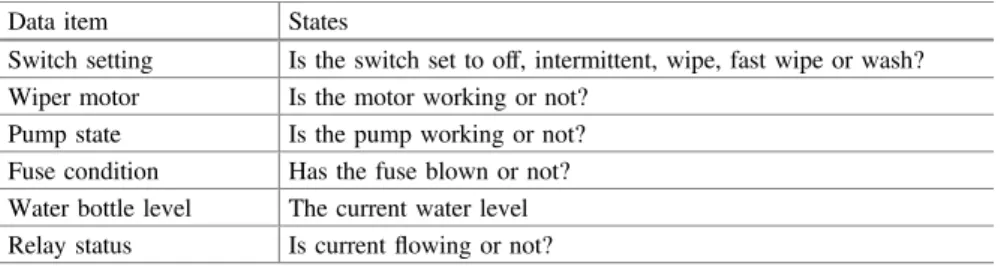
We look at the system as a whole and ask what indicates the state of the system. We might say that the position of the switch or the status of the pump is significant. This results in the data items shown in Table4.1.
Table 4.1 Data items and their associated state information
Data item States
Switch setting Is the switch set to off, intermittent, wipe, fast wipe or wash? Wiper motor Is the motor working or not?
Pump state Is the pump working or not? Fuse condition Has the fuse blown or not? Water bottle level The current water level Relay status Is currentflowing or not?
The identification of the data items is considered in greater detail later. At this point, merely notice that we have not yet mentioned the functionality of the system or how it mightfit together, we have only mentioned the significant items. As this is such a simple system, we can assume that each of these elements is an object and illustrate it in a simple object diagram (Fig.4.2).
Notice that I have named each object after the element associated with the data item (e.g. the element associated with the fuse condition is the fuse itself) and that the actual data (e.g. the condition of the fuse) is an instance variable of the object. This is a very common way of naming objects and their instance variables. We now have the basic objects required for our application.
4.5
Identifying the Services or Methods
At the moment, we have a set of objects each of which can hold some data. For example, the water bottle can hold an integer indicating the current water level. Although Object-Oriented systems are structured around the data, we still need some procedural content to change the state of an object or to make the system achieve some goal. Therefore, we also need to consider the operations a user of each object might require. Notice that the emphasis here is on theuser of the objectand what theyrequire of the object, rather than what operations are performed on the data. Let us start with the switch object. The switch state can take a number of values. As we do not want other objects to have direct access to this variable, we must identify the services that the switch should offer. As a user of a switch we want to be able to move it between its various settings. As these settings are essentially an enumerated type, we can have the concept of incrementing or decrementing the switch position. A switch must therefore provide a moveUp and a moveDown interface. Exactly how this is done depends on the programming language; for now, we concentrate on specifying the required facilities.
If we examine each object in our system and identify the required services, we may end up with the Table4.2.
Fig. 4.2 Objects in simulation system
We generated this table by examining each of the objects in isolation to identify the services that might reasonably be required. We may well identify further ser-vices when we attempt to put it all together.
Each of these services should relate to a method within the object. For example, the moveUp and moveDown services should relate to methods that change the
state instance variable within the object. Using a generic pseudo-code, the
moveUpmethod, within theswitch object, might contain the following code:
define methodmoveUp() if state == "off" then
state = "wash"
elseif state == "wash" then state = "wipe"
endif
end define method
This method changes the value of the state variable in switch. The new value of the instance variable depends on its previous value. You can define
moveDownin a similar manner. Notice that the reference to the instance variable illustrates that it is global to the object. ThemoveUp method requires no param-eters. In Object-Oriented systems, it is common for few parameters to be passed between methods (particularly of the same object), as it is the object that holds the data.
Table 4.2 Object services
Object Service Description
Switch moveUp Increment switch value
moveDown Decrement switch value
state? Return a value indicating the current switch state Fuse working? Indicate if the fuse has blown or not
Wiper motor working? Indicate whether the wipers are working or not Relay working? Indicate whether the relay is active or not Pump working? Indicate whether the pump is active or not Water bottle fill Fill the water bottle with water
extract Remove some water from the water bottle empty Empty the water bottle
4.6
Re
fi
ning the Objects
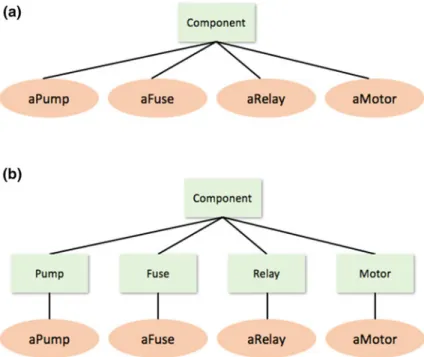
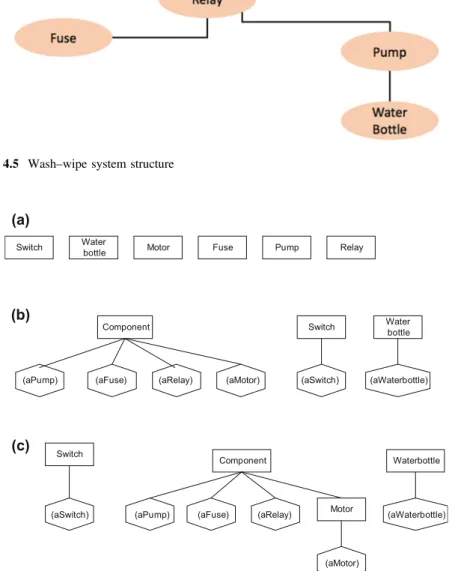
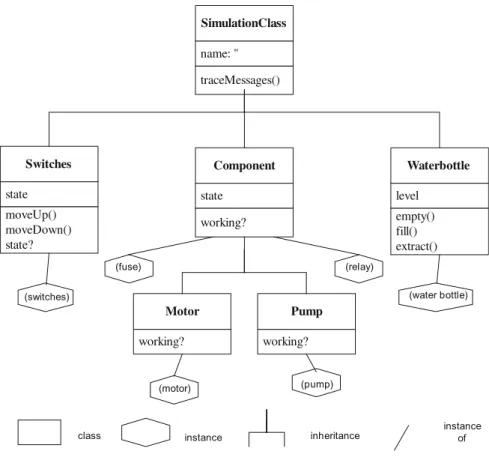
If we look back to Table4.2, we can see that fuse, wiper motor, relay and pump all possess a service called working? This is a hint that these objects may have something in common. Each of them presents the same interface to the outside world. If we then consider their attributes, they all possess a common instance variable. At this point, it is too early to say whether fuse, wiper motor, relay and pump are all instances of the same class of object (e.g. a Component class) or whether they are all instances of classes which inherit from some common super-class (see Fig.4.3). However, this is something we must bear in mind later.
4.7
Bringing It All Together
So far we have identified the primary objects in our system and the basic set of services they should present. These services were based solely on the data the objects hold. We must now consider how to make our system function. To do this, we need to consider how it might be used. The system is part of a very simple diagnosis tutor; a student uses the system to learn about the effects of various faults on the operation of a real wiper system, without the need for expensive electronics.
Fig. 4.3 Possible classes for components in the simulation
We therefore wish to allow a user of the system to carry out the following operations:
• change the state of a component device • ask the motor what its new state is.
The moveUp and moveDown operations on the switch change the switch’s state. Similar operations can be provided for the fuse, the water bottle and the relay. For the fuse and the relay, we might provide achangeStateinterface using the following algorithm:
define methodchangeState() if state == "working" then
state = "notWorking" else
state = "working" endif
end define method
Discovering the state of the motor is more complicated. We have encountered a situation where one object’s state (the value of its instance variable) is dependent on information provided by other objects. If we write down procedurally how the value of other objects affects the status of the pump, we might get the following pseudo-code:
if fuse is working then if switch is not off then
if relay is working then pump status = "working" endif
endif endif
This algorithm says that the pump status depends on the relay status, the switch setting and the fuse status. This is the sort of algorithm you might expect tofind in a
main()program. It links the subfunctions together and processes the data. In an Object-Oriented language (such as Scala), we do not have a main program in the same way that a C program has. Instead themain()method in Scala is an initiating point for an Object-Oriented system (in Scala this is simplified further by the use of the App trait). As it is part of an object, the main method can trigger the creation of instances, but it is not itself part of those instances. This can be con-fusing atfirst; however, if you think of themain()method in Scala as initiating a program, that is the starting point for a program, then you are fairly close.
In an Object-Oriented system, well-mannered objects pass messages to one another. How then do we achieve the same effect as the above algorithm? The answer is that we must get the objects to pass messages requesting the appropriate information. One way to do that is to define a method in the pump object that gets the required information from the other objects and determines the motor’s state. However, this requires the pump to have links to all the other objects so that it can send them messages. This is a little contrived and loses the structure of the underlying system. It also loses any modularity in the system. That is, if we want to add new components, then we have to change the pump object, even if the new components only affect the switch. This approach also indicates that the developer is thinking too procedurally and not really in terms of objects.
In an Object-Oriented view of the system, the pump object only needs to know the state of the relay. It should therefore request this information from the relay. In turn, the relay must request information from the switches and the fuse.
Figure4.4illustrates the chain of messages initiated by the pump object: 1. pump sends aworking?message to the relay
2. relay sends astate?message to the switch the switch replies to the relay
3. relay sends a secondworking?message to the fuse the fuse replies to the relay
the relay replies to the motor
If the pump is working, then the pump object sends the final message to the water bottle
4. pump sends a messageextractto the water bottle.
In step four, a parameter is passed with the message because, unlike the previous messages that merely requested state information, this message requests a change in
Fig. 4.4 Collaborations between the objects for wash operation
state. The parameter indicates the rate at which the pump draws water from the water bottle.
The water bottle should not record the value of the pump’sstatusas it does not own this value. If it needs the motor’s status in the future, it should request it from the pump rather than using the (potentially obsolete) value passed to it previously. In Fig.4.4, we assumed that the pump provided the serviceworking?which allows the process to start. For completeness, the pseudo-code of theworking?
Method for the pump object is:
defworking?() begin
this.status = relay.working(). if this.status == "working" then water_bottle.extract(this.status)
endif end
end define method
This method is a lot simpler than the procedural program presented earlier. At no point do we change the value of any variables that are not part of the pump, although they may have been changed as a result of the messages being sent. Also, it only shows us the part of the story that is directly relevant to the pump. This means that it can be much more difficult to deduce the operation of an Object-Oriented system merely by reading the source code. Some Scala environ-ments (such as the Scala IDE) alleviate this problem, to some extent, through the use of sophisticated browsers.
4.8
Where Is the Structure?
People new to Object Orientation may be confused because they have lost one of the key elements that they use to help them understand and structure a software system: the main program body. This is because the objects and the interactions between them are the cornerstone of the system. In many ways, Fig.4.4shows the Object-Oriented equivalent of a main program. This also highlights an important feature of most Object-Oriented approaches: graphical illustrations. Many aspects of object technology, for example, object structure, class inheritance and message chains, are most easily explained graphically.
Let us now consider the structure of our Object-Oriented system. It is dictated by the messages that are sent between objects. That is, an object must possess a reference to another object in order to send it a message. The resulting system structure is illustrated in Fig.4.5.