User-centric QoE-driven Vertical Handover Framework in Heterogeneous Wireless
Networks
Li Liu, Lingfen Sun, Emmanuel Ifeachor School of Computing, Electronics and Mathematics
Plymouth University Plymouth, UK
{li.liu; L.Sun; E.Ifeachor}@plymouth.ac.uk Abstract— With the advance of wireless technology and
popularity of mobile devices, more and more people rely on mobile devices for multimedia services (such as video streaming and video call). A mobile device can be connected and roamed to different networks in heterogeneous wireless networks. The Media Independent Handover (MIH) framework is designed by IEEE 802.21 group to support seamless vertical handover between different networks. However, how to select an appropriate network from available ones and when to execute the handover remain the key challenges in MIH. This paper proposed a user-centric QoE-driven vertical handover (VHO) framework based on MIH that aims to maintain acceptable QoE of different mobile application services and to select an appropriate network based on users’ preferences (e.g. on cost). Further a user-centric QoE-driven algorithm is implemented in the proposed framework. Its performance is evaluated and compared with other two VHO algorithms based on Network Simulator 2 (NS2) for video streaming services over heterogeneous networks. The preliminary results show that the proposed algorithm could maintain better QoE and at the same time, take into account user’s preference on cost when compared with other two algorithms.
Keywords: Heterogeneous networks, QoE, vertical handover, user-centric, MIH.
I. INTRODUCTION
In recent years, with the development of mobile devices and wireless technology, most of mobile devices are able to connect to different wireless networks such as UMTS (3G), WIFI, WIMAX (4G) and LTE (4G). Users use different applications on smart phones anywhere, anytime, and over any networks. The number of people using applications on smart mobile phones also increases significantly. According to Cisco Visual Networking Index (VNI) forecast, Wi-Fi and mobile devices will reach about 66% of IP traffic and 82% of all consumer Internet traffic will be video by 2020 [1]. With the increase of mobile video data, it is vital for service providers to provide satisfactory Quality of Experience (QoE) for end users for mobile video service delivery (such as video streaming, e.g. YouTube and video gaming). From both customer and service providers’ perspectives, cost is also a major concern for a service provisioning. However, not any single wireless technology could fulfill the
requirements of quality and cost at the same time. Hence, it is necessary to take advantage of different wireless technologies to provide good QoE, and at the same time, maintain reasonable cost of mobile data for customers. In order to utilize different wireless technologies, mobile services should be handed over between different wireless technologies to achieve seamless vertical handover without affecting the users’ experience.
IEEE 802.21 group designs a Media Independent Handover (MIH) framework to support seamless vertical handover between different networks [2, 3]. However, how to select an appropriate network from available networks and when to execute the vertical handover still remain open questions and are the key challenge in MIH [4-6]. Most of existing researches on VHO algorithms are focused on quality of services (QoS), such as network parameters (bandwidth and packet loss). Only few proposed VHO algorithms considering about the QoE of multimedia services and aiming for achieving the highest QoE all the time [7-9]. Due to the limited network resources, we consider that it is impossible to achieve the highest QoE all the time which might cause unnecessary handover and incur high cost for users. Further each user might have different considerations on cost and mobile bill. Thus both QoE and user preference (e.g. on cost) should be taken into account when designing a VHO algorithm. Additionally, different type of video also should be considered due to its impact on QoE. This paper proposed a user-centric QoE-driven vertical handover (VHO) framework based on the MIH framework. It aims to maintain acceptable QoE of different application services for users and to select appropriate network based on users’ budget and concern. A user-centric QoE-driven VHO algorithm is also implemented and the performance is evaluated and compared with QoS-based VHO algorithms with three different types of videos on NS2.
The rest of paper is structured as follows: the background of vertical handover and the MIH framework will be introduced in Section II. In Section III, the related work will be reviewed. Then, the user-centric QoE-driven VHO framework and algorithm are described in Sections VI. Then performance evaluation and results analysis will be presented V. Finally, the conclusion and future work will be summarized in Section VI.
Figure 1: Handover Management Concept [5] Figure 2: MIH Framework [2]
II. BACKGROUND A. Handover Management
Most of recent smart phones have multi-interfaces that allow users to connect to multi-networks such as UMTS (3G) and WIFI. Handover management is the key component of mobility management to support data roaming from one network to another network [5]. In handover management concept, there are many features such as mobility scenarios and handover types. All the features of handover concept are presented in Fig. 1. Depending on the mobility scenario, there are two kinds of handover: horizontal handover and vertical handover. Horizontal handover means that the handover happens between two access points with same wireless technology. If the two access points have different wireless technology, the handover is called vertical handover. However, the handover also could be classified as different types of handover based on other features such as handover control and handover type. The process of handover management includes three phases as following:
Handover Information Gathering: to collect all
required information from available networks for supporting handover decision phrase.
Handover Decision: to analyze all collected
information, to select target network from available networks and to decide when to execute handover depending on the handover algorithm.
Handover Execution: to connect to the selected network based on the handover decision and to switch connection to targeted network.
Among the above three phases, the handover decision phase is the key of handover management process. An appropriate handover decision could improve the QoS and provide users decent QoE. Otherwise, users would have poor quality of experience for the provided service. The handover decision is made by a handover algorithm (also called handover strategies). There are many different handover algorithms based on different decision criteria such as Radio
Signal Strength (RSS), user preference and QoS parameters. For example, user-centric VHO algorithm will consider users’ requirement into handover decision based on users’ preferences [10, 11]. However, in the current market, most of mobile applies network-based handover algorithm for vertical handover. For the network-based VHO algorithm, when WIFI network is connected, all data will be downloaded and uploaded through WIFI network without considering the network condition of WIFI network. If users would like to use mobile network, the only way is to disable the WIFI interface. Considering that a WIFI network is free or cheaper than a mobile network, a VHO algorithm could be designed in a flexible way to users. Furthermore, some users also have mobile data allowance, so that they would be happy to enjoy good QoE within their mobile data allowance when the network condition of WIFI network becomes poor. The proposed VHO algorithm make handover decision based on users’ preferences and QoE, thus it could be classified as user-centric QoE-driven VHO algorithm.
B. Media Independent Handover Framework
As mentioned above, the MIH framework is designed by IEEE 802.21 group to support seamless vertical handover. In MIH framework, there is a central entity called media independent handover function (MIHF). MIHF is located between network layer and link layer and supports information exchange between two different devices and handover execution. In MIHF, IEEE 802.21 defines three services: MIH information services, MIH event services and MIH command services.
MIH information services are used to collect and exchange required information between two devices. All events in lower layers will be detected by MIH event services. MIHF will generate MIH events based on detected events, and then propagate the MIH events to upper layers. Hence MIH information services and MIH event services could provide essential information for handover decision. MIH command services provide the function for MIHF to execute handover. The flows of information, events and commands in MIH framework are exhibited in Fig. 2.
Figure 3: User-centric QoE-driven VHO Framework Procedures
but the VHO algorithm might be the limitation. As the network-based VHO algorithm is default VHO algorithm in MIH framework that is not good enough to provide good QoS and QoE for users. Hence, the proposed VHO framework is designed based on MIH framework to provide better QoE for users.
III. RELATED WORK
In recent years, development of vertical handover algorithms becomes more and more popular as it still is the key challenge of mobility management in heterogeneous networks. A VHO algorithm decides the target network and the time to execute a vertical handover. If a VHO algorithm selects inappropriate network, it would cause unnecessary cost or degradation of users’ experience. However, even though a VHO algorithm selects an appropriate network to handover to, when to execute VHO still is a challenge. If a VHO execution was initiated too early or late, excessive cost or degradation of users’ experience would occur. Hence, in order to make an appropriate VHO decision, the criteria of VHO algorithm should be chosen carefully. Koundourakis et al and Zahran et al proposed RSS-based VHO algorithms to select target network based on the RSS [12, 13]. RSS-based VHO algorithms will select the target network which has the highest RSS. RSS-based VHO algorithms could minimize degradation in congestion situation. However, RSS-based VHO algorithms have some disadvantages such as high handover delay and time consuming. Cost function-based VHO algorithms select the best available network based on calculation of specific parameters from available networks [14-16]. They evaluate each available network and measure the sum of weighted function of specific parameters. Then, the network with the highest score will be selected as target network. Cost function-based VHO algorithms could achieve high throughput and low handover latency. However, these algorithms consider only network QoS parameters which are not directly linked with users’ QoE. Calvagna, Modica and Ormond et al proposed user-centric VHO algorithms in terms of cost and QoS [10, 11]. These algorithms tried to fulfill users’ satisfaction with non-real-time applications such as FTP file transfer. However, more QoS parameters (e.g. packet loss) need to be taken into account to improve efficiency of the user-centric VHO algorithms. Moreover, their works are only limited to FTP applications without consideration of multimedia services. Some QoE-based VHO algorithms have been proposed in [8, 9, 17]. The QoE-based VHO algorithms select a target network with the highest predicted MOS that could provide relative good QoE for users. However, it is unnecessary to always connect to network with highest MOS. Always connecting to network with highest MOS could cause unnecessary handover and waste of energy. Furthermore, those QoE-based VHO algorithms ignore the video content type and cost that will affect the QoE to users. In our previous work [18], a QoE-driven VHO algorithm is proposed to maintain acceptable QoE for users. The algorithm could avoid unnecessary handover and save the energy. However, the work is only limited to QoE without consideration of user preference (e.g. cost) and the performance comparison was only carried out
with a network-based VHO algorithm. In this paper, a user-centric QoE-driven VHO framework is designed to allow users to decide how to select a network based on their budget and cost concerns. The proposed framework could be applied with different QoE-driven VHO algorithm to maintain acceptable QoE of different applications for users. Regarding to video applications, a user-centric QoE-driven VHO algorithm is also proposed in this paper to evaluate the performance of video streaming in proposed framework. Furthermore, the performance of user-centric QoE-driven VHO algorithm will be compared with QoS-based VHO algorithm.
IV. USER-CENTRIC QOE-DRIVEN VHOFRAMEWORK A. User-centric QoE-driven VHO Framework
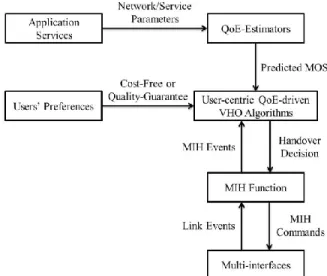
User-centric QoE-driven VHO framework is based on MIH framework to fulfill users’ requirements with different application services in heterogeneous networks. Most of users are not care about what happen in wireless networks. From users’ perspective, cost and users’ experience are the most important concerns. Since users also have different requirements of cost and users’ experience for different application services, it is necessary to make VHO decision based users’ preferences. The procedures of user-centric QoE-driven VHO framework is shown in Fig 3. Depending on the types of application services, related QoE-Estimators and user-centric QoE-driven VHO algorithms will be applied in the proposed framework. QoE-Estimators always keep monitoring the QoE of application services. QoE-Estimators will collect related network and service parameters to predict QoE in terms of MOS. Then the predicted MOS will be sent to user-centric QoE-driven VHO algorithm. Users can set users’ preferences depending on their concerns which will be considered by user-centric VHO algorithm. When multi-interfaces detect the link events, such as link up and link down, it will send related information of the link event to MIHF. Once MIHF received the link events, MIHF would generate MIH events and propagate to user-centric
QoE-Figure 4: User-centric QoE-driven VHO Algorithm Procedures
Table 1: Coefficients of QoE Prediction Model for All Content Types Coeff SM GW RM a1 4.5796 3.4757 3.0946 a2 -0.0065 0.0022 -0.0065 a3 0.0573 0.0407 0.1464 a4 2.2073 2.4984 10.0437 a5 7.1773 -3.7433 0.6865
driven VHO algorithm for supporting handover decision. However, the proposed VHO algorithm would only be activated by MIH event (receiving radio advertisement). If MIHF is implemented in a network access point, the access point will broadcast MIH radio advertisement to inform other MIH users. For example, if there is no other network available, to activate user-centric is kind of useless energy consumption. However, once a new available network is detected by MIHF, the user-centric QoE-driven VHO algorithm will be activated by MIH event. All required information would be analyzed to make handover decision based on users’ preference. Once the handover decision is made, user-centric QoE-driven VHO algorithm will send the decision to MIHF. Then, depending on the decision, MIHF will control the multi-interfaces by MIH commands. B. User-centric QoE-driven VHO Algorithm
A user-centric QoE-driven VHO algorithm is designed to maintain acceptable QoE of video streaming based on predicted MOS and user’s preferences. Hence this algorithm could select an appropriate network to fulfill users’ actual requirements during VHO. A reference-free QoE assessment model is applied to measure QoE of video streaming in the user-centric driven VHO framework as the QoE-Estimator [19]. This model is able to assess QoE of video streaming over different wireless networks based on the parameters of application and network, such as pack error rate (PER), sending bitrate (SBR) and frame rate (FR). The nonlinear equation is shown in (1). Moreover, the QoE prediction model classifies three types of video depending on the content movement of video: Slow Movement (SM), Gentle Walking (GW) and Rapid Movement (RM). Table 1 shows all coefficients of different types of content. This reference-free QoE prediction model will act as QoE-estimator to measure QoE of video streaming in user-centric QoE-driven VHO algorithm.
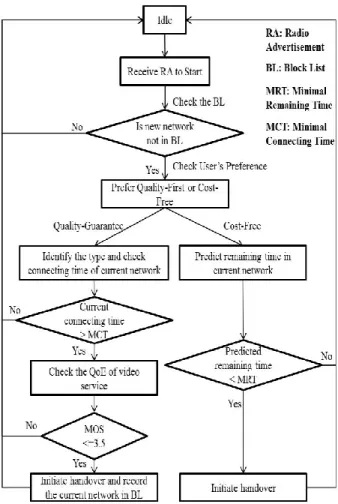
(1) The user-centric QoE-driven VHO algorithm allows users to decide how to select target network depending on users budgets and concerns. Fig. 4 displays procedures of user-centric QoE-driven VHO algorithm. Users could set users’ preferences as quality-guarantee or cost-free. Quality-guarantee means that the proposed VHO algorithm maintains acceptable QoE of video streaming. If the users’ preferences is set to cost-free, the proposed VHO algorithm works as network-based VHO algorithm. It is note that user-centric QoE-driven VHO algorithm is set to connect to new WIFI network automatically when users are using mobile network.
The reason is that WIFI networks are supposed to be cheaper than mobile network and are able to provide good QoE for users. Once user-centric QoE-driven VHO algorithm received the MIH event of receiving radio advertisement (RA), it would check the block list (BL) at first. BL is used to store the information of the networks which have been connected before and have poor network condition. If the received RA is from the network which has been stored in BL, user-centric QoE-driven VHO algorithm would just ignore this network and turn itself back to idle statue. Otherwise user-centric QoE-driven VHO algorithm would continue checking the user’s preference. If user’s preference was set to cost-free, user-centric QoE-driven VHO algorithm would just check the remaining time in current network. If user is going to stay the coverage of current network less than minimal remaining time (MRT), user-centric QoE-driven VHO algorithm would target this network and initiate the handover execution. Otherwise, user-centric QoE-driven VHO algorithm would ignore this network and switch itself to idle statue. Cost-free function could avoid extra cost for users, as user-centric QoE-driven VHO algorithm would always decide to connect to WIFI network as long as it is available. However, the acceptable QoE is not able to be guaranteed, if the user select cost-free in user-centric QoE-driven VHO algorithm.
Figure 5: Simulation Topology
Table 2: Simulation Parameters Parameters UMTS WIFI
Bandwidth 384 kbps 11 Mbps Coverage 500 m 50 m
Paramters Mobile User
Speed 1 m/s
Parameters SM
Video Video GW Video RM
Video Frames 3000 3000 3060 Frame rate 25 25 25 Sending Bitrate 18 kps 256 kps 512 kps Nevertheless, some users have some mobile data
allowance and concern about the QoE, they could choose quality-guarantee function in user-centric QoE-driven VHO algorithm to maintain the acceptable QoE of video streaming. As shown in Fig. 4, if users’ preference was set to quality-guarantee, user-centric QoE-driven VHO algorithm would check the type and connecting time of current connecting network firstly. Then if the current connecting time is longer than minimal connecting time (MCT), then user-centric VHO algorithm would check the QoE of video streaming. Otherwise user-centric QoE-driven VHO algorithm would become idle statue. MCT is used to avoid unnecessary handover like Ping-pong, because QoE of video streaming needs time to recover the quality after handover from poor network. At the end, if predicted MOS of video streaming was more than 3.5 (value of acceptable QoE), user-centric QoE-driven VHO algorithm will decide to stay in current connecting network. Otherwise, user-centric QoE-driven VHO algorithm would initiate the handover and record the current connecting network in BL to avoid unnecessary handover. User-centric QoE-driven VHO algorithm allow users to decide how to select target network depending on their budget and interests. Hence, no matter users are concerned about QoE or prefer free service, users’ different requirements could be satisfied by user-centric QoE-driven VHO algorithm.
V. PERFORMANCE EVALUATION AND ANALYSIS A. Simulation Parameters and Topology
User-centric QoE-driven VHO algorithm is implemented in MIH framework in Network Simulator 2.29 (NS 2.29). Evalvid module also is implemented in NS 2.29 to provide video application with input video trace data. The simulations are designed to evaluate the video streaming performance of user-centric QoE-driven VHO algorithm under UMTS network and WIFI network. This simulation also plans to compare the performance of user-centric
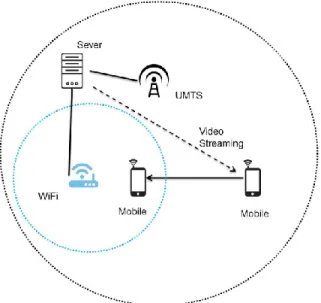
QoE-driven VHO algorithm and QoS-based VHO algorithm. Fig. 5 shows the topology of simulation. At the beginning of this simulation, the mobile user will use real time video application under UMTS network at 20th second. Then the mobile user will walk into and stay in office. There is WIFI router to provide free WIFI network in office. However, the WIFI network will become congestion with different packet loss rate at 56th second. Packet loss rates will be set to from 0% to 10% with the increasing of 2%. In this simulation, if packet loss rate is set to a value, packet loss rate would not always be the value. The packet loss rate would randomly change up and down around the value. However, the average packet loss rate will be the value. In this simulation, there are three H.264 videos with different types of movement are applied in this simulation to evaluate the performance of user-centric QoE-driven VHO algorithm. In order to compare the performance of different VHO algorithms, QoS-based VHO algorithm and network-QoS-based VHO algorithm also will be evaluated with same simulation scenario. The quality-guarantee function will be selected in user-centric QoE-driven VHO algorithm. For the QoS-based VHO algorithm, 8% packet loss rate will be set as the threshold for tricking the handover. Network-based VHO algorithm will be evaluated as cost-free function of user-centric QoE-driven VHO algorithm. The main simulation parameters are shown in Table 2. There are three main questions for this simulation:
Whether user-centric QoE-driven VHO framework could maintain acceptable QoE of video streaming for users?
Whether user-centric QoE-driven VHO algorithm could provide better QoE of video streaming for users than QoS-based VHO algorithm?
Whether the performance of user-centric QoE-driven VHO algorithm would be affected by the difference of content movement?
Whether user-centric QoE-driven VHO framework could maintain the acceptable QoE of video streaming and also keep the cost at reasonable low? B. Results and Analysis
After the simulations, all results were divided into five sets based on different packet loss rates. Due to the large amount of results, a set of results with 4% packet loss rate will be displayed and analyzed as example in this paper. Furthermore, the overall MOS of different VHO algorithms
Figure 7: Average MOS of GW video under 4% packet loss
Figure 6: Average MOS of SM video under 4% packet loss Figure 8: Average MOS of RW video under 4% packet loss
also will be presented.
Fig. 6 shows the average MOS of SM video with 4% packet loss rate. When packet loss rate was set to 4%, only QoS-based VHO algorithm executed handover from WIFI to UMTS network. The other two VHO algorithms kept connecting with WIFI network until the end of simulation. QoS-based achieve best QoE of SM video in this set of simulation. However, is this handover really worthy in this situation? Even though QoS-based VHO algorithm reached high QoE, but it cost more mobile data which means more cost. User-centric QoE-driven VHO algorithm and network-based VHO algorithm did not provide relative high QoE of SM video as QoS-based VHO algorithm. But the QoE of SM video provided by user-centric QoE-driven VHO algorithm and network-based VHO algorithm are always acceptable and the MOSs were more than 4 at most of time. Furthermore, user-centric QoE-driven VHO algorithm and network-based VHO algorithm kept connecting to WIFI network which meant no extra cost. Since SM video is insensitive to packet loss, the difference of QoE between 4 and 4.5 is just slight for SM video. Thus it is unworthy to pay extra money for similar QoE of SM video. In this case, user-centric QoE-driven VHO algorithm made better decision than QoS-based VHO algorithm.
The average MOS of GW video with 4% packet loss is shown as Fig. 7. In this set of simulation, both of user-centric QoE-driven VHO algorithm and QoS-based VHO algorithm executed handover from WIFI network to UMTS network. When packet loss started happening, all of three VHO algorithms decided to stay connecting to WIFI network. At that period of time, the QoEs of GW video are acceptable. When user-centric QoE-driven VHO algorithm detected unacceptable QoE of GW video, it performed the handover from WIFI network to UMTS network immediately. However, QoS-based VHO algorithm did not detect that the QoE of GW video became unacceptable as quick as user-centric QoE-driven VHO algorithm. QoS-based VHO algorithm only noticed poor QoE of GW video until the QoE became even worse. Since user-centric QoE-driven VHO
algorithm detected unacceptable QoE of GW video earlier than QoS-based VHO algorithm, it provided acceptable QoE of GW video earlier than QoS-based VHO algorithm. Even though user-centric QoE-driven VHO algorithm produced more cost than QoS-based VHO algorithm, but what the most important was that user-centric VHO algorithm fulfilled users’ requirement and and avoided the worse packet loss. Network-based VHO algorithm still kept connecting to WIFI network all the time. Hence user-centric QoE-driven VHO algorithm achieves better QoE of GW video than QoS-based VHO algorithms and avoid the QoE of GW video becoming unacceptable again.
Fig. 8 displays average MOS of RM video with 4% packet loss rate. In this situation, user-centric QoE-driven VHO algorithm immediately detected dramatically descent of QoE of RM video. Then user-centric QoE-driven VHO algorithm executed handover from WIFI network and mobile network around 62th second and it effectively maintained acceptable QoE of RM video for users. However, QoS-based
Figure 10: Overall MOS of GW video under different packet loss rate
Figure 9: Overall MOS of SM video under different packet loss rate
VHO algorithm failed to provide good QoE for users. When QoE of RM video significantly dropped and became unacceptable, QoS-based VHO algorithm did not detect it. Finally, QoS-based VHO algorithm noticed the terrible QoE of RM and made handover decision quite late about 135th second. Since RM video is very sensible to packet loss, packet loss could seriously affect the QoE of RM video. Hence, QoS-based VHO algorithm cannot identify the significant degradation of QoE of RM video by only considering packet loss rate. It is clear that the performance of user-centric QoE-driven VHO algorithm was much better than QoS-based VHO algorithm. QoS-based VHO algorithm provided around 75 seconds terrible and unacceptable QoE of RM video for users. The performance of network-based VHO algorithm also was terrible, but it was understandable and acceptable by users. Because users selected cost-free function in user-centric QoE-driven VHO algorithm that meant the users did not concern much about QoE and prefer no extra cost.
In order to analyze and compare overall performance of three VHO algorithms, the overall MOSs of three different videos under diverse packet loss rates are shown in Fig. 9, 10 and 11. Note that overall MOS means the QoE from the beginning of video application to the end. The overall MOS of SM video under diverse packet loss rate is displayed as Fig. 9. QoS-based VHO algorithm always maintained the overall QoE at almost perfect level around 4.5. When packet loss rate increased from 0% to 6%, the overall QoE of user-centric QoE-driven VHO algorithm and network-based VHO algorithm were same (more than 4) and decreased with the increasing of packet loss rate. Nevertheless, when packet loss rate became more than 6%, user-centric QoE-driven VHO algorithm detected unacceptable QoE of SM video and executed handover form WIFI network to UMTS network for maintaining acceptable QoE for users. But network-based VHO algorithm still kept connecting to WIFI network and its QoE of SM video carried on dropping with packet loss rate increasing. For SM video, QoS-based VHO algorithm seems
could provide better QoE for users than user-centric QoE-driven VHO algorithm. However, there was no significant difference of QoE between user-centric QoE-driven VHO algorithm and QoS-based VHO algorithm. Moreover overall QoE of both VHO algorithms were blameless. But QoS-based VHO algorithm created more cost on mobile network. There is meaningless to make users pay extra for similar QoE of SM video.
Fig. 10 depicts the overall MOS of GW video under different packet loss rates. For GW video, the performance of user-centric QoE-driven VHO algorithm and QoS-based VHO algorithm were similar. It is clear that both of user-centric QoE-driven VHO algorithm and QoS-based VHO algorithm detected QoE dropping, when the packet loss rate was set to 4%. Furthermore, the performance of user-centric QoE-driven VHO algorithm is slight better than QoS-based VHO algorithm. Then, with the enlargement of packet loss rate, the performance of user-centric QoE-driven VHO algorithm and QoS-based VHO algorithm were almost same. For network-based VHO algorithm, the overall QoE of GW video decreased with the increscent of packet loss rate.
Fig. 11 shows the overall MOS of RM video with diverse packet loss rates. It is obvious that user-centric QoE-driven VHO algorithm successfully maintained QoE of RM video for users, no matter how packet loss rate changed. For QoS-based VHO algorithm, when packet loss rate was set to 2% and 4%, the QoE of RM video became unacceptable. Once packet loss rate increased to 6% and over, the performance of QoS-based VHO algorithm got close to user-centric QoE-driven VHO algorithm. Since QoS-based VHO algorithm only take packet loss rate into consideration so that it cannot notice the serious degradation of QoE of RM video. In terms of network-based VHO algorithm, the QoE of RM video dramatically decreased with packet loss rate increasing. Thus, regarding to RM video, user-centric QoE-driven VHO algorithm accomplished best performance among three VHO algorithms. Even though RM video is easy to be affected by packet loss rate, user-centric QoE-driven VHO algorithm
Figure 11: Overall MOS of RM video under different packet loss rate
still maintain the brilliant QoE of RM for users. VI. CONCLUSION AND FURTURE WORK
This paper proposed a user-centric QoE-driven VHO framework to allow users to set users’ preferences to cost-free or quality-guarantee depending on their budget and concern. Through several sets of simulation, the performance of user-centric QoE-driven VHO framework has been evaluated in terms of video streaming. Furthermore user-centric QoE-driven VHO algorithm is compared with QoS-based VHO algorithm with diverse packet loss rates and three video with different types of content movement. The results showed that, firstly, user-centric QoE-driven VHO framework can effectively maintain acceptable QoE of video streaming for users. Secondly, User-centric QoE-driven VHO algorithm can provide better users’ satisfaction of video streaming than QoS-based VHO algorithm. Thirdly, the performance of user-centric QoE-driven VHO algorithm would not be affected by content movement of video. Finally, user-centric QoE-driven VHO framework can maintain the acceptable QoE of video streaming, meanwhile it also can avoid unnecessary handover and meaningless cost. Hence, user-centric QoE-driven VHO framework is able to maintain QoE of different application services in heterogeneous networks.
In the future, a video adaptation scheme is planned to apply into user-centric QoE-driven VHO framework to improve performance. User-centric QoE-driven VHO framework also will be evaluated with other application services.
REFERENCES
[1] Cisco. (June 2016). Cisco Visual Networking Index: Forecast and
Methodology, 2015–2020. Available:
http://www.cisco.com/c/en/us/solutions/collateral/service- provider/visual-networking-index-vni/complete-white-paper-c11-481360.html
[2] O. Khattab and O. Alani, "Survey on Media Independent Handover (MIH) Approaches in Heterogeneous Wireless Networks," in Wireless Conference (EW), Proceedings of the 2013 19th European, 2013, pp. 1-5.
[3] A. De La Oliva, A. Banchs, I. Soto, T. Melia, and A. Vidal, "An overview of IEEE 802.21: media-independent handover services,"
Wireless Communications, IEEE, vol. 15, pp. 96-103, 2008.
[4] M. Zekri, B. Jouaber, and D. Zeghlache, "A review on mobility management and vertical handover solutions over heterogeneous wireless networks," Computer Communications, vol. 35, pp. 2055-2068, 2012.
[5] M. Kassar, B. Kervella, and G. Pujolle, "An overview of vertical handover decision strategies in heterogeneous wireless networks,"
Computer Communications, vol. 31, pp. 2607-2620, 2008.
[6] J. Marquez-Barja, C. T. Calafate, J. C. Cano, and P. Manzoni, "An overview of vertical handover techniques: Algorithms, protocols and tools," Computer Communications, vol. 34, pp. 985-997, Jun 2011. [7] A. Khan, L. Sun, E. Jammeh, and E. Ifeachor. (2010, Quality of
experience-driven adaptation scheme for video applications over wireless networks. IET Communications4(11), 1337-1347.
[8] J. Jailton, T. Carvalho, W. Valente, C. Natalino, R. Frances, and K. Dias, "A quality of experience handover architecture for heterogeneous mobile wireless multimedia networks,"
Communications Magazine, IEEE, vol. 51, pp. 152-159, 2013. [9] K. Piamrat, A. Ksentini, C. Viho, and J. Bonnin, "QoE-based network
selection for multimedia users in IEEE 802.11 wireless networks," in
Local Computer Networks, 2008. LCN 2008. 33rd IEEE Conference on, 2008, pp. 388-394.
[10] A. Calvagna and G. D. Modica, "A user-centric analysis of vertical handovers," presented at the Proceedings of the 2nd ACM international workshop on Wireless mobile applications and services on WLAN hotspots, Philadelphia, PA, USA, 2004.
[11] O. Ormond, J. Murphy, and G. m. Muntean, "Utility-based Intelligent Network Selection in Beyond 3G Systems," in 2006 IEEE International Conference on Communications, 2006, pp. 1831-1836. [12] G. Koundourakis, D. I. Axiotis, and M. Theologou, "Network-Based
Access Selection in Composite Radio Environments," in 2007 IEEE Wireless Communications and Networking Conference, 2007, pp. 3877-3883.
[13] A. H. Zahran, B. Liang, and A. Saleh, "Signal threshold adaptation for vertical handoff in heterogeneous wireless networks," Mob. Netw. Appl., vol. 11, pp. 625-640, 2006.
[14] A. Hasswa, N. Nasser, and H. Hassanein, "Tramcar: A Context-Aware Cross-Layer Architecture for Next Generation Heterogeneous Wireless Networks," in Communications, 2006. ICC '06. IEEE International Conference on, 2006, pp. 240-245.
[15] R. Tawil, G. Pujolle, and O. Salazar, "A Vertical Handoff Decision Scheme in Heterogeneous Wireless Systems," in Vehicular Technology Conference, 2008. VTC Spring 2008. IEEE, 2008, pp. 2626-2630.
[16] Z. Fang and J. McNair, "Optimizations for vertical handoff decision algorithms," in Wireless Communications and Networking Conference, 2004. WCNC. 2004 IEEE, 2004, pp. 867-872 Vol.2.
[17] C. Quadros, E. Cerqueira, A. Neto, A. Pescape, A. Riker, R. Immich, et al., "A quality of experience handover system for heterogeneous multimedia wireless networks," in Computing, Networking and Communications (ICNC), 2013 International Conference on, 2013, pp. 1064-1068.
[18] L. Liu, L. Sun, and E. Ifeachor, "A QoE-driven vertical handover algorithm based on media independent handover framework," in
Wireless and Mobile Computing, Networking and Communications (WiMob), 2015 IEEE 11th International Conference on, 2015, pp. 51-58.
[19] A. Khan, L. Sun, and E. Ifeachor, "Content Clustering Based Video Quality Prediction Model for MPEG4 Video Streaming over Wireless Networks," in 2009 IEEE International Conference on Communications, 2009, pp. 1-5.
![Figure 1: Handover Management Concept [5] Figure 2: MIH Framework [2]](https://thumb-us.123doks.com/thumbv2/123dok_us/10127328.2913485/2.918.505.835.798.1035/figure-handover-management-concept-figure-mih-framework.webp)