PROBLEMS ENCOUNTERED WITH THE IMPLEMENTATION OF
AN ACTIVITY-BASED COSTING SYSTEM
By
Nangan Christian Konan
Submitted in partial fulfilment of the requirements for the degree of
Master Technology in Cost and Management Accounting
to be awarded at the Nelson Mandela Metropolitan University
December 2012
Supervisor: Professor Pieter Pelle
Co-supervisor: Ms Lizel Bester
i
DECLARATION
I, Nangan Christian Konan, hereby declare that the treatise for Master Technology in Cost and Management Accounting to be awarded is my own work and that it has not previously been submitted for assessment or completion of any postgraduate qualification to another University or for another qualification.
ii
ACKNOWLEDGEMENTS
I would like to express my gratitude to all persons who gave me a great deal of help in my study and research period. In particular, the following individuals are acknowledged:
My Heavenly Father who is the source of my strength and who guides me spiritually.
My supervisor, Professor Pieter Pelle, Head of the Department of Applied Accounting, for the professional manner in which he guided me through this study. My co-supervisor, Ms Lizel Bester, for her assistance.
The companies which responded to the survey, for their assistance in the research.
My mother, Mathilde, who supported and encouraged me during my studies. My wife, Nina, for all her support during the completion of this document.
This treatise is dedicated to the two most important persons in my life, my mother and my wife.
iii ABSTRACT
The activity-based costing (ABC) system is a cost allocation technique which appears to have many benefits over the traditional costing systems. However, companies that have attempted to implement ABC have encountered various difficulties. Thus, there is a need to investigate the problems faced by companies while implementing ABC. The main objective of this study was to find solutions to overcome the problems encountered by South African companies during the implementation of an activity-based costing system.
An online questionnaire survey was considered an appropriate measurement method for this study. The targeted population of the study included companies that have dealt with the process of ABC implementation. Thus, some 63 companies were identified as part of the study sampling frame. A total number of 21 questionnaires were returned out of the 63 questionnaires sent to the targeted companies, giving a response rate of 33%. The quantitative data were processed using STATISTICA software, leading to appropriate descriptive statistical analysis, including frequencies, means, medians and standard deviations. The results of the empirical study revealed that the major problems faced by South African companies while implementing an ABC system were:
the lack of basic knowledge and skill of ABC techniques by employees; the fact that ABC was complex and required too many detailed records; the fact that ABC was too time-consuming for the personnel; and
employees’ resistance because they do not exactly know ABC.
Based upon the relevant literature and the empirical study, recommendations were made in order to address the identified problems. However, due to the small sample size (21 firms) and the low response rate (33%) observed, the findings of this study could not be generalised to the entire targeted population. Future research could investigate the ABC adoption rate in South Africa.
Key words: activity, activity-based costing (ABC), cost, driver, implementation, problem, success.
iv TABLE OF CONTENTS Page DECLARATION i ACKNOWLEDGEMENTS ii ABSTRACT iii TABLE OF CONTENTS iv LIST OF ABBREVIATIONS xi
LIST OF FIGURES xii
LIST OF TABLES xiii
LIST OF ANNEXURES xiv
CHAPTER ONE
INTRODUCTION AND BACKGROUND OF THE STUDY
1.1. INTRODUCTION 1
1.2. PROBLEM STATEMENT 2
1.3. OBJECTIVES OF THE STUDY 3
1.3.1. Main objective 3
1.3.2. Sub-objectives 3
1.4. RESEARCH DESIGN AND METHODOLOGY 3
1.4.1. Literature study 3
1.4.2. Empirical study 4
1.4.2.1. Sample selection 4
1.4.2.2. Measurement instrument 4
1.5. DELIMITATION OF THE RESEARCH 4
1.6. PRIOR RESEARCH ON THE RELEVANT TOPIC 5
1.7. DEFINITION OF CONCEPTS 5
1.7.1. Activity 5
1.7.2. Activity-based costing (ABC) 6
1.7.3. Cost 6
1.7.4. Cost centre or cost pool 6
1.7.5. Cost driver 6
1.8. SIGNIFICANCE OF THE RESEARCH STUDY 7
v
CHAPTER TWO
ACTIVITY-BASED COSTING (ABC)
Page
2.1. INTRODUCTION 9
2.2. TRADITIONAL COSTING SYSTEMS (TCS): TREATMENT OF
OVERHEADS 9
2.2.1. Product-cost distortions and cross-subsidies 10
2.2.2. Excluding non-manufacturing costs 10
2.3. MECHANISM OF ABC 11
2.4. COMPARISON BETWEEN TCS AND ABC 14
2.5. FACTORS PROMPTING THE DEVELOPMENT OF AN ABC SYSTEM 15
2.5.1. Diversity of the product range 15
2.5.2. Significance of indirect costs 16
2.5.3. Level of competition within the industry 16
2.6. BENEFITS OF ABC 16
2.7. LIMITATIONS OF ABC 17
2.8. ABC PRACTICAL APPLICATIONS 18
2.8.1. Budgeting 18
2.8.2. Cost modelling 18
2.8.3. Cost reductions 19
2.8.4. Customer profitability analysis (CPA) 19
2.8.5. New product or service design 19
2.8.6. Performance measurement 20
2.8.7. Product or service output decisions 20
2.8.8. Product or service pricing 20
2.8.9. Stock valuation 20
2.9. PROBLEMS IN THE IMPLEMENTATION OF AN ABC SYSTEM 21
2.9.1. Lack of top management support 21
2.9.2. Technical or resource constraints 22
2.9.3. Misconceptions about ABC 22
2.9.4. Lack of coherence with organisation’s goal and culture 23 2.9.5. Summary of the main difficulties in implementing ABC system 23
vi
CHAPTER THREE
IMPLEMENTATION OF AN ACTIVITY-BASED COSTING SYSTEM
Page
3.1. INTRODUCTION 26
3.2. CRITICAL SUCCESS FACTORS (CSFs) OF ABC IMPLEMENTATION 26
3.2.1. Technical variables 27
3.2.1.1. Software packages 27
3.2.1.2. Gathering data on cost drivers 27
3.2.1.3. Identifying activities 28
3.2.1.4. Knowledge of data requirement and data collection 28
3.2.1.5. Participation of external consultants 28
3.2.2. Behavioural and organisational variables 29
3.2.2.1. Top management support 29
3.2.2.2. Linkage to competitive strategies 30
3.2.2.3. Performance evaluation and compensation 30
3.2.2.4. Non-accounting ownership 30
3.2.2.5. Sufficient resources 31
3.2.2.6. Training in designing, implementing and using an ABC system 31 3.2.2.7. Consensus about clarity of the objectives of the ABC system 31
3.2.3. Organisational structure variables 32
3.2.4. Organisational culture variables 32
3.3. IMPLEMENTING AN ACTIVITY-BASED COSTING SYSTEM 32 3.3.1. Define activities, activity cost pools, and cost drivers 34
3.3.1.1. Define activities 34
3.3.1.2. Methods for identifying and classifying activities 35
3.3.1.3. Hierarchy of resources and activities 36
3.3.1.4. Aggregating activities 37
3.3.1.5. Activity cost pool or activity cost centre 37
3.3.1.6. Cost drivers 38
3.3.2. Assign overhead costs to activity cost pools 40
3.3.2.1. Direct traceable costs 40
vii
3.3.2.3. Unallocated costs 41
3.3.3. Calculate cost driver rates 41
3.3.4. Assign overhead costs to activity cost objects 42
3.3.5. Prepare management reports 42
3.3.5.1. Product profitability report 43
3.3.5.2. Customer profitability report 43
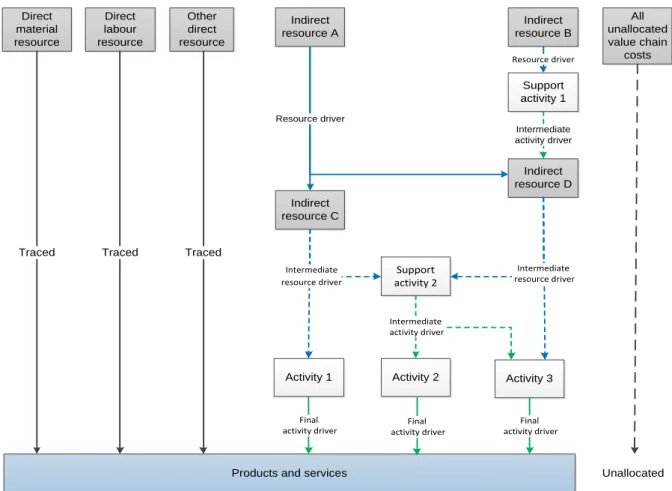
3.4. MULTISTAGE ACTIVITY-BASED COSTING SYSTEM 43
3.5. ACTIVITY-BASED MANAGEMENT 44
3.5.1. Value-added activity 45
3.5.2. Non-value-added activity 45
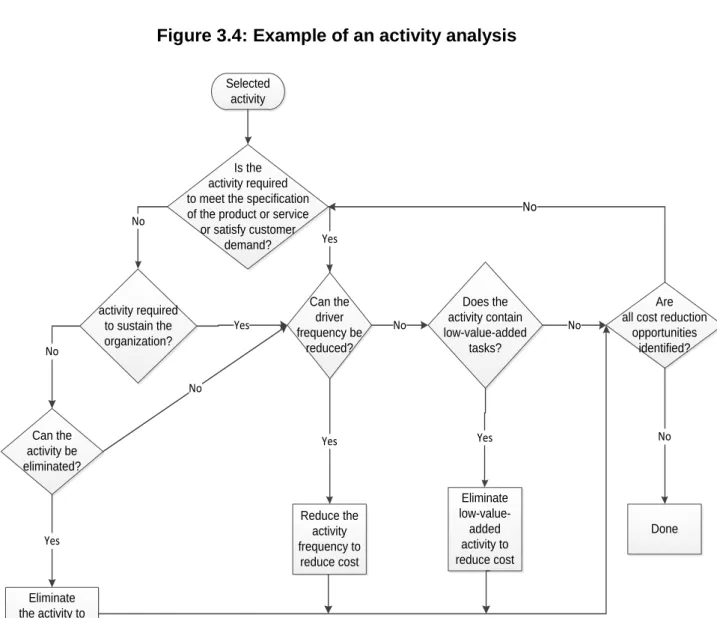
3.5.3. Activity analysis 45
3.6. ACTIVITY-BASED COSTING SOFTWARE 47
3.6.1. Stand-alone system 47
3.6.2. Integrated system 47
viii
CHAPTER FOUR
RESEARCH DESIGN AND METHODOLOGY
Page
4.1. INTRODUCTION 49
4.2. CONCEPT OF RESEARCH 49
4.3. RESEARCH DESIGN 49
4.4. RESEARCH APPROACH 50
4.4.1. Qualitative research approach 50
4.4.2. Quantitative research approach 51
4.4.3. Comparison between qualitative and quantitative research approaches 52
4.4.4. Appropriate research approach 54
4.5. RESEARCH METHOD: SURVEY 54
4.6. RESEARCH POPULATION AND SAMPLING 55
4.6.1. Targeted population 55
4.6.2. Sampling frame 55
4.6.3. Sampling method 56
4.7. QUESTIONNAIRE DESIGN 57
4.7.1. Type of questionnaire: internet self-administered questionnaire 57
4.7.2. Type of questions 57
4.7.2.1. Dichotomous questions 58
4.7.2.2. Multiple-choice questions 58
4.7.2.3. Open-ended questions 58
4.7.2.4. Scale-type questions 58
4.7.3. Description of the questionnaire 59
4.8. RELIABILITY AND VALIDITY 60
4.8.1. Reliability 60
4.8.2. Validity 60
4.9. DATA ANALYSIS STRATEGY 60
ix
CHAPTER FIVE
EMPIRICAL STUDY AND PRESENTATION OF THE RESULTS
Page
5.1. INTRODUCTION 62
5.2. RESPONSE RATE FOR THIS STUDY 62
5.3. PERSONAL BACKGROUND OF THE RESPONDENTS 63
5.3.1. Current position of the respondents 64
5.3.2. Total years of professional experience of the respondents 65 5.3.3. Highest level of education achieved by the respondents 66
5.4. COMPANY INFORMATION 67
5.4.1. Industrial sector 67
5.4.2. Number of employees 68
5.4.3. Annual turnover 68
5.5. ACHIEVEMENT OF THE RESPECTIVE STUDY OBJECTIVES 69 5.5.1. Main objective: to find solutions to overcome the difficulties encountered
by companies while implementing an ABC system 69 5.5.2. Sub-objective 1: to determine the advantages of adopting an ABC system
over the traditional costing systems 69
5.5.3. Sub-objective 2: to identify the problems experienced while implementing
an ABC system 73
5.5.4. Sub-objective 3: to identify the critical success factors in implementing
ABC 74
5.5.5. Sub-objective 4: to examine the process involved in the implementation of
an ABC system 76
x
CHAPTER SIX
CONCLUSIONS AND RECOMMENDATIONS
Page
6.1. INTRODUCTION 82
6.2. SIGNIFICANT FINDINGS RELATED TO THE RESEARCH OBJECTIVES 82 6.2.1. Findings of the sub-objective 1: to determine the advantages of adopting
an ABC system over the traditional costing systems 82 6.2.2. Findings of the sub-objective 2: to identify the problems experienced while
implementing an ABC system 84
6.2.3. Findings of the sub-objective 3: to identify the critical success factors in
implementing ABC 85
6.2.4. Findings of the sub-objective 4: to examine the process involved in the
implementation of an ABC system 86
6.3. RECOMMENDATIONS 87
6.4. LIMITATIONS 88
6.5. AREAS FOR FUTURE RESEARCH 89
xi
LIST OF ABBREVIATIONS
ABB Activity-based budgeting ABC Activity-based costing
ABC & M Activity-based costing and management ABM Activity-based management
CIMA Chartered institute of management accountants CPA Customer profitability analysis
CSFs Critical success factors IT Information technology
JSE Johannesburg stock exchange MBA Master in business administration TCS Traditional costing system
xii
LIST OF FIGURES
Page
Figure 1.1: The ABC causation link 2
Figure 2.1: The mechanism of ABC 11
Figure 2.2: The activity-based two-stage procedure 13 Figure 3.1: Critical success factors of an ABC system implementation 26 Figure 3.2: Activity-based costing model example 33 Figure 3.3: Multistage activity-based costing system 44
Figure 3.4: Example of an activity analysis 46
Figure 5.1: Current position of the respondents 64
Figure 5.2: Years of professional experience of the respondents 65
Figure 5.3: Number of employees 68
Figure 5.4: Activity-based costing (ABC) applications 72 Figure 5.5: Method used to identify the list of activities 77
Figure 5.6: Categories of activities 78
xiii
LIST OF TABLES
Page
Table 2.1: A comparison between TCS and ABC 14
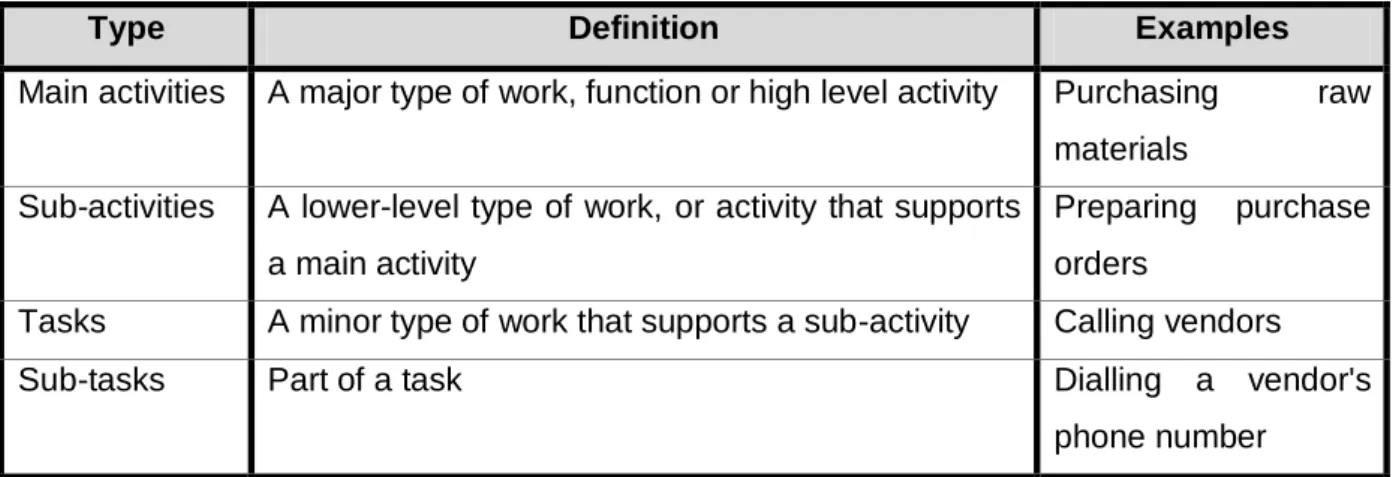
Table 2.2: Summary of the difficulties encountered in implementing ABC 24 Table 3.1: Distinction between main activities, sub-activities, tasks and sub-tasks 34 Table 4.1: Distinguishing characteristics of qualitative and quantitative approaches 53 Table 5.1: Current level of ABC adoption within respondent companies 63 Table 5.2: Highest level of education achieved by the respondents 66
Table 5.3: Industrial sectors 67
Table 5.4: Companies’ business environment attributes 70 Table 5.5: ABC benefits over traditional costing systems 71 Table 5.6: Obstacles in the implementation of an ABC system 73 Table 5.7: Critical success factors in implementing an ABC system 75 Table 5.8: Steps which must be taken when implementing ABC 76 Table 5.9: Defining the value-added and non-value-added activities as part of the
ABC implementation process 80
Table 5.10: Level of satisfaction with regard to the current overhead cost allocations and overall product/service costing system 81
xiv
LIST OF ANNEXURES
Page
Annexure A: Cover letter 101
1
CHAPTER ONE
INTRODUCTION AND BACKGROUND OF THE STUDY
1.1. INTRODUCTION
During the 1980s the limitations of traditional product-costing systems began to be widely publicised. These systems were designed decades ago when most companies manufactured a narrow range of products, and direct labour and materials were the dominant factory costs. Overhead costs were relatively small, and the distortions arising from inappropriate overhead allocations were not significant. Information-processing costs were high, and it was therefore difficult to justify more sophisticated overhead allocation methods (Drury, 2012: 254).
According to Drury (2012: 254), today companies produce a wide range of products; direct labour represents only a small fraction of total costs, and overhead costs are of considerable importance. Simplistic overhead allocations using a declining direct labour base cannot be justified, particularly when information-processing costs are no longer a barrier to introducing more sophisticated cost systems. Furthermore, the intense global competition of the 1980s has made decision errors due to poor cost information more probable and more costly. According to Holzer and Norreklit (1991), quoted in Drury (2004: 374), over the years the increased opportunity cost of having poor cost information, and the decreased cost of operating more sophisticated cost systems, increased the demand for more accurate product costs. It is against this background that activity-based costing (ABC) has emerged.
According to Proctor, Burton, Pierce and Burmiston (2009: 250), the main objective of ABC is to produce an accurate cost for each product in the range. The thinking behind ABC is that, in order to control costs, it is necessary for costs to be calculated accurately. A positive side-effect of this is that other important decisions, for example setting prices, will then be that much more effective. ABC achieves this increase in accuracy through a simple logic:
Products cause activities to happen. Activities cause costs to be incurred.
2
This causation link, fundamental to ABC, is illustrated in Figure 1.1 below. Figure 1.1: The ABC causation link
Products cause Activities cause Costs
Source: Proctor et al (2009: 250)
Niemand, Meyer, Botes and Van Vuuren (2006: 170) confirm that the ABC system is based on the principle that products are created from activities and costs are allocated on the basis of activities. However, in spite of the far-reaching rewards associated with ABC, only a small proportion of South African companies have endeavoured to realise the benefits of this revolutionary costing and management technique (Wessels & Shotter, 2000: 216). Besides, Marivic (2004: 13) claims that in the last decade there is growing evidence that many firms that have attempted to implement ABC are experiencing problems with the implementation of ABC and, in the extreme, are not having success with it. Therefore, there is a need to investigate the difficulties hindering the successful implementation of ABC.
1.2. PROBLEM STATEMENT
This leads to the following question which represents the main problem that will be addressed by this research:
What are the difficulties encountered by South African companies while implementing an ABC system?
To address the main problem, the following sub-problems need to be considered: Are companies able to weigh up their need to adopt an ABC system over the
traditional costing systems (TCS)?
What are the current problems experienced during the implementation of an ABC system?
Can the critical success factors (CSFs) in implementing ABC be clearly identified in the South African environment?
3 1.3. OBJECTIVES OF THE STUDY
1.3.1. Main objective
The main objective of the study is to find solutions to overcome the difficulties encountered by companies while implementing an ABC system in the South African environment.
1.3.2. Sub-objectives
In order to achieve the main objective of the research, the following sub-objectives have been formulated:
to determine the advantages of adopting an ABC system over the traditional costing systems;
to identify the problems experienced while implementing an ABC system; to identify the critical success factors in implementing ABC; and
to examine the process involved in the implementation of an ABC system. 1.4. RESEARCH DESIGN AND METHODOLOGY
The research procedures which the study will follow to investigate the main and sub-objectives are presented by means of:
1.4.1. Literature study
In order to achieve the objectives of this study, a relevant literature review examining ABC and its implementation, will be conducted to provide a conceptual framework for this treatise. Many different sources of information will be used, such as books, journal articles, electronic databases, the internet and other relevant sources.
4 1.4.2. Empirical study
The empirical study will consist of the following:
1.4.2.1. Sample selection
To carry out the empirical study, a minimum of twenty companies using an ABC system in South Africa will be chosen.
1.4.2.2. Measurement instrument
In order to obtain empirical perspectives, an online questionnaire will be sent via email to selected companies using ABC as their costing system. Those companies will be distinguished by:
identifying some selected Johannesburg Stock Exchange (JSE) companies as being ABC user firms;
identifying ABC user companies that had been mentioned by previous research studies; and
selecting some ABC users through the internet website of consultancies which provide software and external assistance to ABC user companies.
The questionnaire will be developed from the literature review analysis. 1.5. DELIMITATION OF THE RESEARCH
Delimitating the research serves the purpose of making the research topic manageable from a research point of view. The current study will be conducted in South Africa and companies will not be selected by looking at their sector of activity but regarding the fact that they have implemented or are implementing an ABC system.
5
1.6. PRIOR RESEARCH ON THE RELEVANT TOPIC
Sartorius, Eitzen and Kamala (2007: 1) state that ABC has been researched extensively in developed countries. A study by Elhamma (2012: 82) illustrates that in the United States, the United Kingdom and France, surveys between the early 1990s and 2008 have indicated an increasing extent of ABC adoption in each of these countries. In the United States, the adoption rate of the ABC method increased from 11% in 1993 to 52% in 2003 and that of the United Kingdom’s companies increased from 6% in 1991 to 23% in 2001. Manufacturing firms in France increased their ABC adoption from 15.9% in 2002 to 33.3% in 2008.
However, Sartorius et al (2007: 1) acknowledge that research on the adoption of the ABC method in South Africa is limited. As reported in Wessels and Shotter (2000: 216), Wessels (1999:43, 53) observed that only 15.18% of the responding listed companies in South Africa have attempted to implement ABC.
Furthermore, Sartorius et al (2007: 1) indicate that the adoption rate of ABC in listed companies in Gauteng is 12%. Given that listed companies in Gauteng constitute 51% of all listed companies in South Africa, it is reasonable to assume that this rate is applicable to all listed companies within South Africa.
1.7. DEFINITION OF CONCEPTS
The following definitions of concepts related to this research study are: 1.7.1. Activity
Activity is any discrete task that an organisation undertakes to make or deliver goods or a service (Hilton, Maher & Selto, 2008: 53). Drury (2012: 253) also points out that activities consist of the aggregation of many different tasks and are described by verbs associated with objects. According to the Chartered Institute of Management Accountants (2005: 3), Niemand et al (2006: 172) and Proctor et al (2009: 252), activities can be classified and analysed into four major categories, which are: unit-level activities, batch-unit-level activities, product-sustaining activities and facility-sustaining activities.
6 1.7.2. Activity-based costing (ABC)
ABC is an approach to the costing and monitoring of activities which involve tracing resource consumption and costing final outputs. Resources are assigned to activities, and activities to cost objects based on consumption estimates. The latter utilise cost drivers to attach activity costs to outputs (The Chartered Institute of Management Accountants, 2005: 3).
1.7.3. Cost
As a noun, cost is the amount of cash or cash equivalent paid or the fair value of other consideration given to acquire an asset at the time of its acquisition or construction (International Accounting Standards 16).
As a verb, cost means to ascertain the cost of a specified thing or activity. The word “cost” can rarely stand alone and should be qualified as to its nature and limitations (The Chartered Institute of Management Accountants, 2005: 9).
1.7.4. Cost centre or cost pool
The area of an organisation for which costs are collected for the purposes of cost ascertainment, planning, decision making, and control. Cost centres are determined by individual organisations; they might be based on a function, department, section, individual, or any group of these. Cost centres are of two main types: production cost centres in an organisation are those concerned with making a product; while service cost centres provide service to other parts of the organisation (Dictionary of accounting, 2010: 116).
1.7.5. Cost driver
Cost driver is a factor influencing the level of cost. Cost driver is often used in the context of ABC to denote the factor which links activity resource consumption to product outputs, for example the number of purchase orders would be a cost driver for procurement cost (The Chartered Institute of Management Accountants, 2005: 13).
7
1.8. SIGNIFICANCE OF THE RESEARCH STUDY
Jacob (2005) and Van de Walt (2005), quoted in Sartorius et al (2007: 2), state that the importance of the implementation of an ABC system is underlined by the need for South African companies to find ways to reduce costs in the new market-led environment.
This implies that if ABC is successfully used to reduce costs and increase the competitiveness of firms in South Africa, it might serve as an impetus to other African countries to adopt ABC and modernise their management control systems. Therefore, if the problems associated with implementing ABC in South Africa are excessive, relative to the benefits of implementing ABC, South African companies should be aware of this before attempting the costly exercise of implementing ABC (Sartorius et al, 2007: 2).
1.9. CHAPTER OUTLINE
The research study has been divided into the following chapters: Chapter One: Introduction and background of the study
This chapter introduces the research problem and the objectives of the study. Chapter One also provides a brief explanation of the research design and methodology adopted for the study.
Chapter Two: Activity-based costing (ABC)
This chapter will mainly provide a literature review which indicates the advantages of adopting an ABC system and the difficulties faced by companies during its implementation.
Chapter Three: Implementation of an activity-based costing system
The purpose of this chapter will be to provide a literature review focusing on the critical success factors of the implementation of an ABC system. In addition, the different stages involved in the implementation of ABC will be discussed.
8
Chapter Four: Research design and methodology
The research design and methodology chapter will discuss the research methods used. Chapter Four will mainly deal with the selection of the sample, the structure of the questionnaire, the data analysis strategy and the limitation of the study.
Chapter Five: Empirical study and presentation of the results
In Chapter Five, after reporting the response rate of the survey, the major findings resulting from the empirical study will be presented.
Chapter Six: Conclusions and recommendations
This chapter will conclude the study and give recommendations about the topic. The conclusions will be based on both the literature study and the empirical findings. Proposals for further research will also be made.
9
CHAPTER TWO
ACTIVITY-BASED COSTING (ABC)
2.1. INTRODUCTION
Chapter Two will provide an overview of the treatment of overhead costs through traditional costing systems (TCS), describe the mechanism of ABC and then illustrate a comparison between TCS and ABC. Thereafter factors prompting the development of an ABC system in an organisation, as well as benefits and limitations of ABC, will be discussed. Furthermore, ABC development and practical applications revealed by the literature will be outlined. Before concluding this chapter, the problems in the implementation of an ABC system will be discussed.
2.2. TRADITIONAL COSTING SYSTEMS (TCS): TREATMENT OF OVERHEADS
According to Marivic (2004: 8), TCS is designed for companies that have homogeneous products, large direct costs compared to indirect costs, limited ability to collect data and low costs. However, many companies have found that ABC tends to assign costs to products based on an arbitrarily developed average rather than the actual resource usage. As a result, products that are more complex to build and consume more resources (for example, more inspections, machine setups, materials) are not necessarily assigned to their fair share of costs. Instead, many of these complex products’ costs could be unfairly assigned to simpler products. Thus, the complex products are undercosted, and the simple products are overcosted (Hilton et al, 2008: 146).
According to Martin (2012: 6), two main issues tend to occur when traditional costing system methods are used to provide information for management decision purposes. One has to do with product-cost distortions or cross-subsidies and the other relates to exclusion of non-manufacturing costs.
10
2.2.1. Product-cost distortions and cross-subsidies
First, in traditional costing, only production volume-related measures are used to allocate overhead costs to products, even though many products do not consume indirect resources (overhead) in proportion to the volume of products produced. Since many types of indirect resource costs are caused by, or driven by, non-production volume-related product characteristics, such as size and complexity, traditional costing tends to distort product costs. This means that too much overhead cost is allocated to some products, while too little overhead cost is allocated to other products. These distortions are frequently referred to as cross-subsidies (Martin, 2012: 7).
According to Horngren, Datar and Rajan (2012: 140), product-cost cross-subsidisation means that if a company undercosts one of its products, it will overcost at least one of its other products. Similarly, if a company overcosts one of its products, it will undercost at least one of its other products. A product is undercosted if it consumes a high level of resources but is reported to have a low cost per unit and conversely a product is overcosted if it consumes a low level of resources but is reported to have a high cost per unit.
2.2.2. Excluding non-manufacturing costs
A second problem with TCS is that tracing product-related administrative, marketing and distribution costs to product inventories is not a generally acceptable procedure allowable for external reporting. However, engineering design, marketing, distribution and customer service costs are clearly part of the costs of placing a product in the hands of the customer. Since these non-manufacturing costs might differ substantially from product to product and from customer to customer, ABC traces these costs to products and customers using additional cost pools and cost drivers (Martin, 2012: 8).
Marivic (2004: 7) states that traditional costing system is suitable for collecting and accumulating costs but not for converting costs into useful managerial information.
Furthermore, Cokins (2001), cited by Marivic (2004: 7), claims that contrary to popular belief, ABC does not replace the established traditional costing that has been adopted for so long now. ABC is really a translator and not a replacement in a
11
sense that it translates the “chart of accounts” expenses into language that people can understand and also into elements of costs, which give more flexibility.
2.3. MECHANISM OF ABC
ABC is a cost-accounting technique that allows an organisation to determine the actual cost associated with each product and service produced by the organisation without regard to the organisational structure (Marivic, 2004: 9). According to Khozein (2009: 381), ABC focuses on activity as a cost object since activity is the main reason for costing. In such a system, costing is first assigned to activities and then through activities, given to other objects, such as products and services. The basic mechanism of ABC is depicted in Figure 2.1.
Figure 2.1: The mechanism of ABC
Resources Resource cost assignment Activities Resource cost assignment Cost object Resource drivers Activity drivers Unused resources Unused activities People, materials, consumables, machines, money, facilities, etc Processes, selling, purchasing, assembling, etc Products, services, customers, markets, channels, etc How many resources an activity requires To what extent an object utilises an activity Source: 12manage (2012)
12
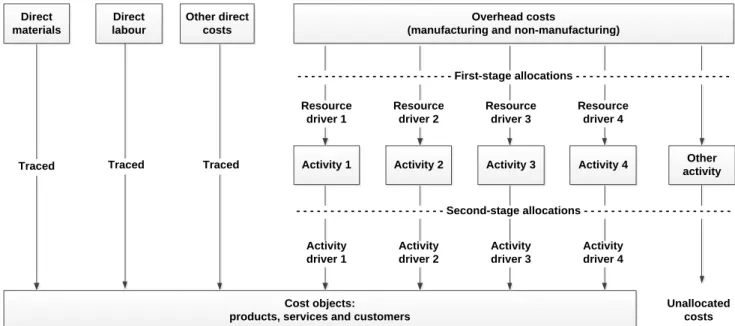
In more detail, the approach initially involves dividing the production procedure into a series of activities and allocating overhead costs to each. This model assigns more indirect costs into direct costs compared to conventional costing models. Then, based on the levels of these activities consumed by the final products or services being produced, it allocates overhead cost to each of these. Production costs are thus allocated through a cost driver method in two stages to minimise distortions (Lin, 2012: 13).
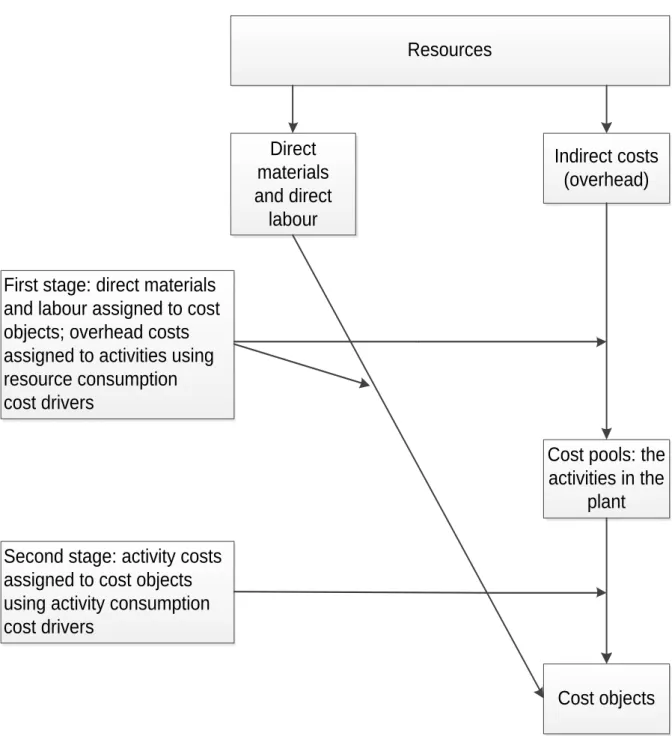
Activity-based costing systems differ from volume-based costing systems by linking uses of resources to activities and linking activity costs to products, services, or customers. The first stage assigns factory overhead costs to activities by using appropriate resource consumption cost drivers. The second stage assigns the costs of activities to cost objects using appropriate activity consumption cost drivers that measure the demands cost objects place on the activities (Blocher, Stout and Cokins, 2010: 130). An illustration of the ABC two-stage cost-assignment procedure is provided in Figure 2.2.
13
Figure 2.2: The activity-based two-stage procedure
Cost pools: the activities in the plant Resources Indirect costs (overhead) Direct materials and direct labour
First stage: direct materials and labour assigned to cost objects; overhead costs assigned to activities using resource consumption cost drivers
Second stage: activity costs assigned to cost objects using activity consumption cost drivers
Cost objects
Source: Blocher et al (2010: 130)
Blocher et al (2010: 130) state that by using cost drivers in both the first and second stage cost allocations, ABC provides more accurate measures of product or service costs for the cost of activities that are not proportional to the volume of outputs produced.
14
2.4. COMPARISON BETWEEN TCS AND ABC
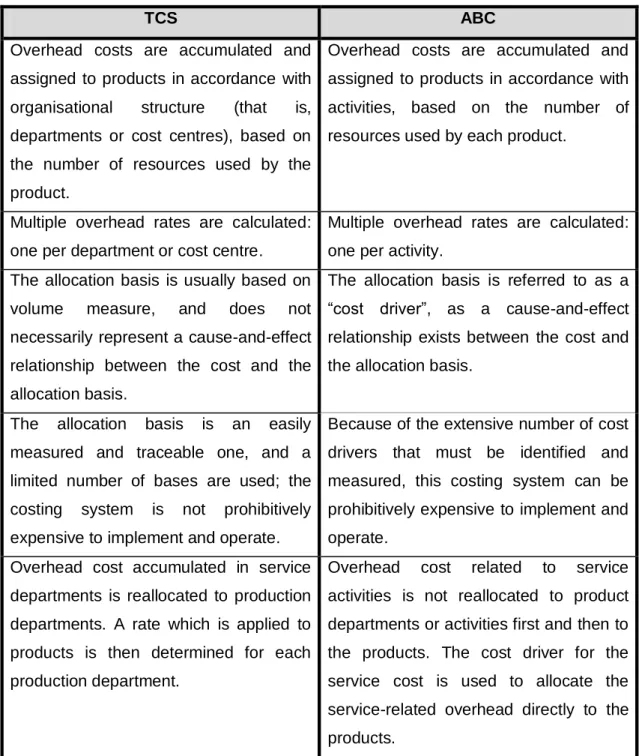
The main relevant comparative aspects between TCS and ABC are highlighted in Table 2.1 below.
Table 2.1: A comparison between TCS and ABC
TCS ABC
Overhead costs are accumulated and assigned to products in accordance with
organisational structure (that is,
departments or cost centres), based on the number of resources used by the product.
Overhead costs are accumulated and assigned to products in accordance with activities, based on the number of resources used by each product.
Multiple overhead rates are calculated: one per department or cost centre.
Multiple overhead rates are calculated: one per activity.
The allocation basis is usually based on
volume measure, and does not
necessarily represent a cause-and-effect relationship between the cost and the allocation basis.
The allocation basis is referred to as a “cost driver”, as a cause-and-effect relationship exists between the cost and the allocation basis.
The allocation basis is an easily measured and traceable one, and a limited number of bases are used; the costing system is not prohibitively expensive to implement and operate.
Because of the extensive number of cost drivers that must be identified and measured, this costing system can be prohibitively expensive to implement and operate.
Overhead cost accumulated in service departments is reallocated to production departments. A rate which is applied to products is then determined for each production department.
Overhead cost related to service
activities is not reallocated to product departments or activities first and then to the products. The cost driver for the service cost is used to allocate the service-related overhead directly to the products.
15
Result: Overheads are averaged out
between products. The overheads
assigned to products are not
representative of the long-term cost savings if the product in question were not produced. Consequently, this method of allocation does not support strategic or long-term decision-making.
Result: The allocated overhead reflects
the extent to which that product causes costs to be incurred. In other words, the
overhead allocated represents the
amount that could be saved in the long term if the product were not produced. Consequently, this method of allocation supports strategic or long-term decision-making.
Source: Roos, Cairney, Chivaka, Fourie, Haji, Joubert, Pienaar, Stack, Streng, Swartz and Williams (2011: 166)
2.5. FACTORS PROMPTING THE DEVELOPMENT OF AN ABC SYSTEM
According to Roos, Cairney, Chivaka, Fourie, Haji, Pienaar, Stack, Swartz and Williams (2008: 166), the extent to which ABC is important for management in an entity depends on three main factors:
the diversity of the product range (the more diverse, the more important); the significance of indirect costs (the more significant, the more important); and the level of competition within the industry (the more intense, the more important,
as cost accuracy is vital).
Drury (2012: 265) also identifies the same factors as primary requirements to consider before implementing ABC.
2.5.1. Diversity of the product range
Product variety is commonly associated with the need to consider activity-based costing. Whether products are variations of the same product line or products are in numerous product families, adding products causes numerous overhead costs to increase (Kinney & Raiborn, 2011: 129).
16 2.5.2. Significance of indirect costs
Certain products and services create substantially more overhead costs than others do. Although some of these additional overhead costs are caused by product variety or product/process complexity, others are related to support services. For instance, some products require high levels of advertising; some use expensive distribution channels; and some require the use of high-technology machinery. If only one or two overhead pools are used, the overhead related to specific products will be spread over all products. The result will be increased costs for products that are not responsible for the increased overhead (Kinney & Raiborn, 2011: 130).
2.5.3. Level of competition within the industry
According to Kinney and Raiborn (2011: 130), a change in a company’s competitive environment could also indicate a need for better cost information. In fact, Horngren et al (2012: 145) note that as markets have become more competitive, managers have felt the need to obtain more accurate cost information to be able to make important strategic decisions, such as how to price products and which products to sell. Making correct pricing and product mix decisions is critical in competitive markets because competitors quickly capitalise on a company’s mistakes.
2.6. BENEFITS OF ABC
According to Weygandt, Kimmel and Kieso (2010: 161), the primary benefit of ABC is its ability to provide more accurate product costing for decision-making purposes. Blocher et al (2010: 133) report that the major benefits of activity-based costing that many firms have experienced are:
Better profitability measures - ABC provides more accurate and informative product costs, leading to more accurate product and customer profitability measurements and to better-informed strategic decisions about pricing, product lines, and market segments.
Better decision making - ABC provides more accurate measurements of activity-driving costs, helping managers to improve product and process value by making better product- design decisions, better customer-support decisions, and fostering value-enhancement projects.
17
Process improvement - the ABC system provides the information to identify areas where process improvement is needed.
Cost estimation - improved product costs lead to better estimation of job costs for pricing decisions, budgeting, and planning.
Cost of unused capacity - since many firms have seasonal and cyclical fluctuations in sales and production, there are times when plant capacity is unused. This can mean that costs are incurred at the batch-, product-, and facility-level activities, but are not used. Capacity is supplied but not used in production. ABC systems provide better information to identify the cost of unused capacity and maintain a separate accounting for this cost. Overall, the goal is to manage capacity levels to reduce the cost of underutilisation of capacity and to price products and services properly.
2.7. LIMITATIONS OF ABC
According to Accounting for Management (2012: 2), despite an ABC system helping decision-makers to manage overhead costs and understand profitability of products and customers, ABC has many limitations or disadvantages:
Implementing an ABC system is a major project that requires substantial resources. Once implemented an ABC system is costly to maintain. Data concerning numerous cost drivers must be collected, checked, and entered into the system.
ABC produces numbers such as product margins that are at odds with the numbers produced by TCS.
ABC data can be easily misinterpreted and must be used with care when used in making decisions. Costs assigned to products, customers and other cost objects are only potentially relevant. Before making any significant decision using ABC data, managers must identify which costs are really relevant for the decisions at hand.
Reports generated by ABC systems do not conform to external reports. Consequently, an organisation involved in ABC should have two cost systems: one for internal use and one for preparing external reports.
18 2.8. ABC PRACTICAL APPLICATIONS
According to Innes and Mitchell (1995: 138), ABC use has extended beyond purely product costing to varied range of cost-management applications, including budgeting, cost modelling, cost reductions, customer profitability analysis, new product or service design, performance measurement, product or service output decisions, product or service pricing, and stock valuation.
2.8.1. Budgeting
According to Glad and Becker (1994: 157), the fundamental activity-based costing system principles and methodology provide a superb basis for the budgeting process. Activity-based budgeting (ABB) is therefore a logical progression from activity-based costing and management. Barfield, Raiborn and Kinney (2001: 682) define ABB as a planning approach applying activity drivers to estimate the levels and costs of activities necessary to provide the budgeted quantity and quality of production. ABB can be applied to nearly any activity and is useful for managing product and period costs.
However, a primary requirement for employing ABB is a thorough understanding of activity-based costing and management (ABC & M) premises and systems. An ABB system comprises, mutatis mutandis, the same principles as ABC & M (Glad & Becker, 1994: 157).
2.8.2. Cost modelling
According to Martin (2012: 17), traditional costing system tends to categorise costs as fixed and variable, whereas ABC structure costs are in a hierarchy of levels, reflecting the way according to which costs vary. In an ABC system costs are classified by unit-level, batch-level, product-level, customer-level and facility-level. This cost modelling is based on the fact that ABC logic looks at costs from a long-run perspective, while the traditional fixed/variable cost behaviour methodology is based on a short-run perspective.
19 2.8.3. Cost reductions
According to Innes and Mitchell (1995: 139), ABC gives visibility to costs by detailing the organisation’s activities and its respective costs. Instead of simply recording costs by the type of input which they represent, ABC categorises costs by the way in which they are consumed. This novel perspective lends itself to analyses which focus on cost-reduction possibilities.
2.8.4. Customer profitability analysis (CPA)
According to Hartgraves, Morse and Davis (2009: 191), one of the most beneficial applications of ABC is in the analysis of the profitability of customers. Indeed, Blocher et al (2010: 146) state that CPA focuses on identifying customer service activities and cost drivers and determining profitability of each customer or group of customers. Customer service includes all activities to complete the sale and satisfy the customer, including advertising, sales calls, delivery, billing, collections, service calls, inquiries, and other forms of customer service. CPA allows managers to:
identify most profitable customers;
manage each customer’s costs-to-serve;
introduce profitable new products and services;
discontinue unprofitable products, services, or customers;
shift a customer’s purchase mix toward higher-margin products and service lines; offer discounts to gain more volume with low costs-to-serve customers; and choose types of after-sale services to provide.
A good understanding of the profitability of a firm’s current and potential customers can help firms to improve overall profits and to become more.
2.8.5. New product or service design
Hilton et al (2008: 161) state that ABC information for existing products or services can be helpful for estimating the costs of new products or services if the activities used for making these new products or services are similar to those used for making the existing ones.
20 2.8.6. Performance measurement
Many organisations are now focusing on activity performance as a means of facing competitors and managing costs. To monitor efficiency and effectiveness of activities, performance measures are required. Activity performance measures consist of measures relating to costs, time, quality and innovation (The Institute of Chartered Accountants of India, 2011: 145).
2.8.7. Product or service output decisions
According to Harrison and Killough (2006: 189), ABC information provides analytic value to profit-oriented decisions in a controlled environment. In this regard, Innes and Mitchell (1995: 145) state that the following main types of output decisions to which ABC is applied are:
establishing output volume levels; making or buying a component; and
dropping or keeping a product service line. 2.8.8. Product or service pricing
Foong and Ho (2009: 78) point out in their study the inadequacy of the traditional volume-based cost allocation approach for formulation of appropriate pricing strategy to meet challenges of the increasingly competitive market. In contrast, the adoption of the ABC approach to cost allocation could improve understanding of management regarding resource consumption for the various activities undertaken within the company, and consequently the ABC information could be used to revise the company’s pricing strategy to eliminate or mitigate serious threats from the competitors.
2.8.9. Stock valuation
Cokins (2001: 138) suggests that one use of standard product costs obtained from an ABC system should be the stock valuation. A study about the applications of ABC in the United Kingdom’s largest companies led by Innes and Mitchell (1995: 144) indicated that only 29% of ABC adopters use ABC for stock valuation. This low rate takes into consideration the fact that non-manufacturing ABC users might not
21
perceive stock valuation as an issue regarding their insignificant level of stock. Even though Innes and Mitchell (1995: 144) observed that for the most part external auditors had accepted this novel means of cost determination for ABC adopters, Hilton et al (2008: 147) state that ABC is used to establish product costs for managerial decision-making purposes, such as whether to continue offering a product, and not for stock valuation for external reporting.
2.9. PROBLEMS IN THE IMPLEMENTATION OF AN ABC SYSTEM
Based on the literature review, some of the most important problems encountered by companies implementing an ABC system are:
2.9.1. Lack of top management support
Sartorius et al (2007: 13) identify the lack of top management support in an ABC implementation project as a central problem for the non-implementation of ABC. According to Majid and Sulaiman (2008: 49), top management seems to be unimpressed with the ABC system and perceives ABC to be the same as that of other costing techniques. As a consequence, top management is quite reluctant to spend the company’s resources on putting ABC into practice. In this regard, Wessels and Shotter (2000: 222) observe that the intensity of the lack of management support increases especially when the top management is more concentrated or focused on other priorities in the firm, as being more important than the ABC initiative or when ABC initiative is not aligned with the company strategy. Furthermore, a key-related problem cited by Wessels and Shotter (2000: 223) is that the implementation of ABC is too time-consuming for operational managers.
According to Wessels and Shotter (2000: 222), another problem experienced by companies to a lesser degree is the lack of internal project support. The project sponsor is the manager or executive within an organisation who is not directly involved in the operational work of the project but who can oversee a project, delegate authority to the project manager and provide support as a trainer or coach to the project manager. The project sponsor has sufficient authority or influence to direct all the staff involved in a project – or as many as possible – and to get the co-operation of key stakeholders. The project sponsor ensures that the project is
22
aligned with the organisational strategy and compliant with policy (Passenheim, 2009: 17).
2.9.2. Technical or resource constraints
According to Marivic (2004: 12), the difficulties in implementing ABC are technical and complex, since the steps involved need detailed records of the costs associated with producing products and services. Marivic (2004: 12) also observes that employees lack basic knowledge and skill of ABC techniques. Furthermore, Sartorius et al (2007: 13) state that other technical or resource obstacles include a difficult definition of cost centres and cost drivers, a lack of adequate information or technology system, a difficult accumulation of data needed for ABC and a difficult integration of ABC data with another system.
Equally important, according to Majid and Sulaiman (2008: 46), is that one resource constraint encountered by companies during the implementation of an ABC system is the high cost of the implementation, especially the cost of IT (purchasing and updating specific software).
Finally, a study by Wessels and Shotter (2000: 222) indicates that problems linked to a lack of adequate employee resources include that ABC is too time-consuming for accounting personnel; there is a high turnover of ABC project team individuals and only accounting personnel are involved in a project team.
2.9.3. Misconceptions about ABC
Sartorius et al (2007: 13) state that the misconceptions about ABC lead to an inadequate marketing of ABC and a negative publicity within companies. In fact, Marivic (2004: 12) believes that ABC would be adopted more readily by various companies if ABC were marketed better by the accountants themselves. Consequently, companies face employee resistance while implementing ABC. In this regard, Majid and Sulaiman (2008: 49) state that the lower-level employees are sceptical of the new system, primarily because they do not know what ABC is all about.
Furthermore, Sartorius et al (2007: 14) state that the satisfaction with alternative systems, which is another barrier for implementing ABC, refers to the fact that
23
decision-makers are satisfied with the current cost system and find ABC inappropriate for the company business sector or only suitable for manufacturing. 2.9.4. Lack of coherence with organisation’s goal and culture
Wessels and Shotter (2000: 222) state that problems pertaining to a lack of coherence with the organisation’s goal and culture are an incompatibility of ABC with company strategy, an inadequate training of managers, an inadequate training of implementers, an inadequate training of users and a resistance to change in organisational culture.
2.9.5. Summary of the main difficulties in implementing ABC system
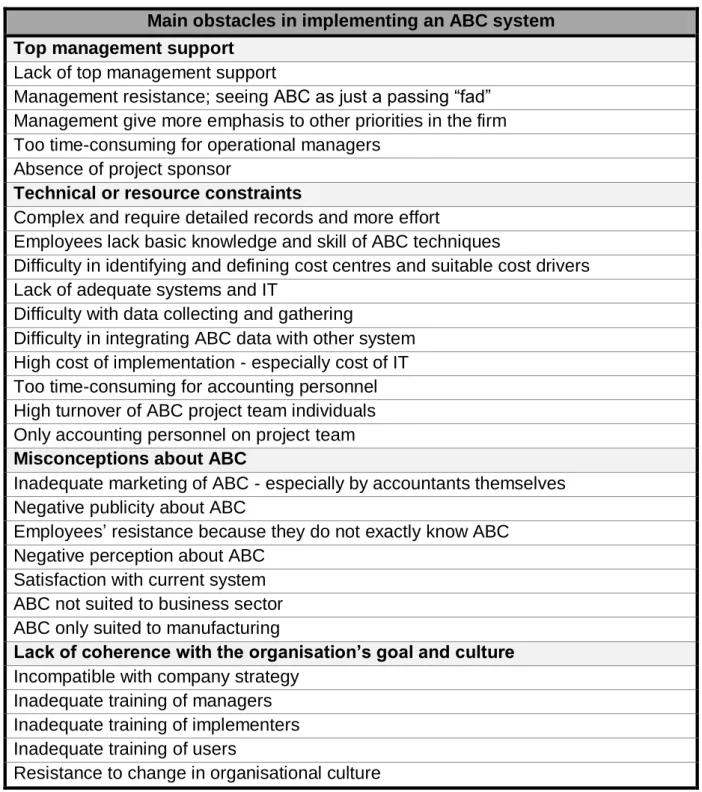
Khozein and Dankoob (2011: 615) believe that one significant way for achieving a successful ABC implementation is not to repeat the mistakes made by others and to give credence to the mistakes leading unsuccessful entities to failure. To know the failure reasons will aid in implementing an ABC system consciously, and to avoid failure reasons can affect higher successes. Some principle problems cited by the literature hindering the implementation of an ABC system are set out in Table 2.2.
24
Table 2.2: Summary of the difficulties encountered in implementing ABC
Main obstacles in implementing an ABC system Top management support
Lack of top management support
Management resistance; seeing ABC as just a passing “fad” Management give more emphasis to other priorities in the firm Too time-consuming for operational managers
Absence of project sponsor
Technical or resource constraints
Complex and require detailed records and more effort
Employees lack basic knowledge and skill of ABC techniques
Difficulty in identifying and defining cost centres and suitable cost drivers Lack of adequate systems and IT
Difficulty with data collecting and gathering
Difficulty in integrating ABC data with other system High cost of implementation - especially cost of IT Too time-consuming for accounting personnel High turnover of ABC project team individuals Only accounting personnel on project team Misconceptions about ABC
Inadequate marketing of ABC - especially by accountants themselves Negative publicity about ABC
Employees’ resistance because they do not exactly know ABC Negative perception about ABC
Satisfaction with current system ABC not suited to business sector ABC only suited to manufacturing
Lack of coherence with the organisation’s goal and culture Incompatible with company strategy
Inadequate training of managers Inadequate training of implementers Inadequate training of users
Resistance to change in organisational culture Source: Author’s own compilation (2012)
25 2.10. CONCLUSION
Chapter Two provided a brief presentation of TCS before introducing ABC. In addition, the factors indicating the need for implementing ABC in an organisation were identified according to the literature, as well as discussing the benefits and limitations of an ABC system. Thereafter, practical applications of outputs generated by an ABC system were outlined.
Furthermore, problems experienced by companies while implementing an ABC system were also revealed through analysing previous studies. In this regard, Khozein and Dankoob (2011: 614) advise that being aware of the different reasons of failures and difficulties in implementing an ABC system could increase the possibility of success in the future. Chapter Three will firstly focus on the critical success factors of the implementation of an ABC system and secondly set out the different steps involved in implementing an ABC system.
26
CHAPTER THREE
IMPLEMENTATION OF AN ACTIVITY-BASED COSTING SYSTEM
3.1. INTRODUCTION
Chapter Three will discuss the process of implementing an ABC system within an organisation. Firstly, this chapter will highlight the critical success factors (CSFs) in implementing an ABC system and secondly, the different steps involved in implementing ABC will be outlined. This chapter will conclude by providing an overview of the notion of activity-based management.
3.2. CRITICAL SUCCESS FACTORS (CSFs) OF ABC IMPLEMENTATION
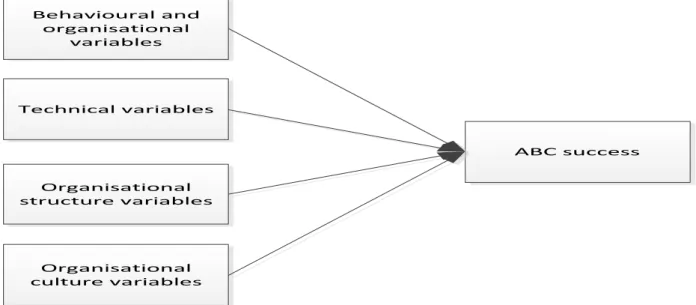
According to CIMA Publishing (2011: 133), critical success factors (CSFs) are a limited number of areas in which results, if they are satisfactory, will ensure successful competitive performance for the business. In their research, investigating factors influencing activity-based costing success, Fei and Isa (2010a: 148) established a research framework which identifies behavioural and organisational variables, technical variables, organisational structure variables and organisational culture variables as having a positive relationship with ABC success in an organisation. The proposed framework is depicted by Figure 3.1 below:
Figure 3.1: Critical success factors of an ABC system implementation
Behavioural and organisational variables Technical variables Organisational structure variables Organisational culture variables ABC success
27 3.2.1. Technical variables
Lana and Fei (2007), cited by Fei and Isa (2010a: 149), reviewed previous empirical studies about factors affecting ABC success and summarised the technical factors used by past research. Technical factors are:
software packages;
gathering data on cost drivers; identifying activities;
knowledge of data requirement and data collection; and the participation of external consultants.
3.2.1.1. Software packages
Majid and Sulaiman (2008: 39) believe that obtaining suitable ABC software is one of the pertinent factors to ensure a successful ABC system implementation. According to Gosselin (2005: 17), many consulting firms have developed ABC software to facilitate data processing. Moreover, surveys have revealed that electronic spreadsheets are more commonly used than ABC software because the costs of customisation of the ABC software are too high.
The Chartered Institute of Management Accountants (2001: 5) advises one to use spreadsheets at the beginning of the ABC project until the company identifies exactly what its needs are, and then buy the software that meets these needs. However, Innes, Mitchell and Sinclair (2000: 354) concluded in their research that a technical characteristic of the system, such as the type of software adopted, has no association with success.
3.2.1.2. Gathering data on cost drivers
According to Miller (1996: 99), data gathering is a critical element to a successful ABC implementation. However, Cooper, Kaplan, Maisel, Morrissey and Oehm (1992: 300) reported in their study some difficulties in gathering data needed for the activity-based model, especially for the cost drivers. Further, Miller (1996: 40) states that data gathering is an integral part of each step reviewed through the process of ABC implementation. Data gathering plays a significant role in the activity analysis. Thus,
28
in order to gather data on cost drivers, Turney (1992: 241) suggests three primary sources for ABC data:
the accounting department, which provides data about the cost of resources; information about activities, which comes from people who do the work; and
information about activity drivers, which is found in the company’s information systems.
3.2.1.3. Identifying activities
Activities form the basis of measurement of all relevant information in an ABC system. It is therefore imperative to define the activity at the right level of detail. Too much detail would cause an information overload and too little detail might lead to insufficient information being available for analysis (Glad & Becker, 1994: 199).
3.2.1.4. Knowledge of data requirement and data collection
Drury (1992: 111) states that data collection is the cornerstone of an activity-based costing system. Indeed, by collecting the appropriate information, it is possible to conceive an activity database from which various analyses can be undertaken. Depending on the structure of the organisation, data is collected in different ways. For instance, in some departments staff members complete their own forms; in others, existing records, such as sale invoices, are analysed. Because the information reported by ABC is used to help managers make decisions, data collection needs to be accurate enough to ensure managers make the right decisions.
3.2.1.5. Participation of external consultants
Player and Keys (1999: 21) assert that a consultant’s role is to help the company be successful - a role that includes a knowledge transfer from the consultant to company management and users of ABC information. If ABC team members do not have time or do not know how to implement an ABC system, a consulting approach can help implementation of the move forward.
In fact, Liu and Pan (2007: 262) reveal in their study that the involvement of external consultation during the early stages of the ABC project is perceived as necessary
29
and useful because of the novice state of ABC application. Furthermore, Cooper et al (1992: 299) add that external consultants play a facilitating role and are typically involved in tasks such as:
conducting initial training and awareness seminars for management and the ABC team;
helping the ABC team to structure interviews;
assisting the ABC team in transferring both hard data from the company’s databases and soft data from management interviews and estimates into an ABC software; and
assisting in the data analysis and preparation of reports and presentations to the project sponsor and senior management.
3.2.2. Behavioural and organisational variables
Shield and Young (1989), as cited by Fei and Isa (2010a: 149), identified the following seven behavioural and organisational variables that are important to cost management practices:
top management support;
linkage to competitive strategies;
performance evaluation and compensation; non-accounting ownership;
sufficient resources;
training in designing, implementing and using the cost management system; and consensus about the clarity of the objectives of the cost management system.
3.2.2.1. Top management support
Wessels and Shotter (2000: 217) list top management support for the ABC project as one of the first main influencing factors for the success of an ABC system implementation. Further, a study by Fei and Isa (2010b: 2306) highlighted the fact that only top management support is positively and significantly associated with ABC successful implementation. The stronger the top management support of the ABC implementation; the higher level of ABC success could be achieved. In addition, Wessels and Shotter (2000: 218) confirm that management support is furthermore
30
crucial by providing resources (time, personnel, funding) and ensuring that other projects in the firm do not take precedence over the ABC initiative.
3.2.2.2. Linkage to competitive strategies
Shields (1995), and Shields and McEwen (1996), as cited by Fei and Isa (2010b: 2304), reported that ABC success is still influenced by the degree to which an ABC system is linked to the competitive strategy of a company. If a company could integrate ABC and the competitive strategy closer, the company has a higher possibility of implementing an ABC system successfully.
However, Fei and Isa (2010b: 2304) concluded that there is an insignificant relationship between ABC successful implementation and the competitive strategy of the enterprise.
3.2.2.3. Performance evaluation and compensation
According to Miller (1996: 200), activity-based costing information, when integrated and linked to performance evaluation and compensation, is used as a performance model of compensation and reward. Linkage and integration of ABC to the compensation and reward systems of the organisation will motivate ABC’s full integration. People pay attention to projects that are visible, given attention by management and that affect their revenue. In many respects, performance evaluation and compensation are linked and integrated with activities. Employees are paid for doing activities. Most job descriptions include description of activities and tasks. Organisations pay and hire people to do the activities required to deliver their products and services to the customer and to run and administer the business. Salaries are compensation for doing organisational activities. Activities that require significant skill levels or specialised knowledge are compensated at higher levels than activities that require minimal skill or knowledge.
3.2.2.4. Non-accounting ownership
A study by Maelah and Ibrahim (2007: 121) revealed that there is a significant positive relationship between non-accounting ownership and ABC implementation. The support received from non-accounting departments has a positive significant
31
influence on ABC adoption and implementation. Furthermore, Blocher et al (2010: 151) identify non-accounting ownership as a key factor for a successful ABC implementation. The process of ABC implementation requires close collaboration among management accountants, engineers, and manufacturing and operating managers. Managers need to perform as a team in identifying activities, cost drivers, and requisite information, both financial and non-financial. Management and employees could then be more willing to implement the ABC system because they feel included and share in ownership of the new system.
3.2.2.5. Sufficient resources
Shields (1995:161), quoted in Wessels and Shotter (2000: 218), states that adequate resources are one of the variables that appear to be significantly correlated with ABC successful implementation. Furthermore, Sartorius et al (2007: 15) concluded in their study that adequacy of resources with the ABC project is among the critical success factors for ABC implementation in South Africa. Therefore, Cooper et al (1992: 295) list resources required to develop an activity-based costing system as including internal personnel, outside consultants, time, data and software.
3.2.2.6. Training in designing, implementing and using an ABC system
Good training is important to provide a fast understanding of ABC to its users. Well-trained users are able to quickly assimilate ABC information and put it to use in successfully improving the ABC system. Training is a key element of information empowerment; the further down the organisation the management goes with training, the greater the impact ABC will have (Turney, 1992: 297).
3.2.2.7. Consensus about clarity of the objectives of the ABC system
Turney (1992: 149) noted the importance of communicating the organisation’s objective to the people in the organisation. Each person should understand the importance of the company’s mission and how each objective relates to their activity. When employees understand the positive impact of the new ABC system on the company’s objectives, they become more involved in the ABC project.