ScholarWorks
Walden Dissertations and Doctoral Studies Walden Dissertations and Doctoral StudiesCollection
2016
New Graduate Nurses: Evaluating an Innovative
Mixed Method Orientation Program
Mary Josette Armendariz-Batiste Walden University
Follow this and additional works at:https://scholarworks.waldenu.edu/dissertations Part of theNursing Commons
This Dissertation is brought to you for free and open access by the Walden Dissertations and Doctoral Studies Collection at ScholarWorks. It has been accepted for inclusion in Walden Dissertations and Doctoral Studies by an authorized administrator of ScholarWorks. For more information, please [email protected].
Walden University
College of Health Sciences
This is to certify that the doctoral study by Mary Armendariz-Batiste
has been found to be complete and satisfactory in all respects, and that any and all revisions required by
the review committee have been made.
Review Committee
Dr. Alice Conway, Committee Chairperson, Health Services Faculty Dr. Patti Urso, Committee Member, Health Services Faculty Dr. Tracy Andrews, University Reviewer, Health Services Faculty
Chief Academic Officer Eric Riedel, Ph.D.
Walden University 2016
Abstract
New Graduate Nurses: Evaluating an Innovative Mixed Method Orientation Program by
Mary Josette Armendariz-Batiste
MS, Walden University, 2009
BS, University of Texas Medical Branch, 2004
Project Submitted in Partial Fulfillment of the Requirements for the Degree of
Doctor of Nursing Practice
Walden University May 2016
Abstract
Institutions are recruiting new graduate nurses to fill their vacancies. The aim of this project was to create a new graduate nurse orientation program that consists of the Essentials of Critical Care Orientation (ECCO) program created by the American Association of Critical Care Nurses (2014), scenarios, and simulation that will result in an increase in nurses’ sense of their ability to provide safe patient care, communicate effectively, perform skills, and increase their sense of institutional support. The theoretical framework for this mixed methods project was Benner’s “From Novice to Expert.” The convenience sample participants consisted of 17 baccalaureate-prepared new graduate nurses. The Casey-Fink Graduate Nurse Experience Survey was
administered prior to the orientation program and again at the completion. Content analysis was used for Section I of the survey, which pertains to the top 3 skills nurses are uncomfortable performing. In the presurvey, chest tube care, ECK/EKG/telemetry, and tracheostomy were listed. However, they were not listed on the post survey. The findings resulted in a correlation between skills that were taught during simulation and scenarios. Fisher's exact test was used for Sections II, III, and IV of the survey. There was no statistically significant difference in the pre and post survey as it pertained to questions regarding safe patient care, communication, and sense of institutional support. Results of this study are inconclusive and do not fully support the orientation program. Nurse leaders have a social mandate to ensure new graduate nurses are supported and have the resources needed to provide safe patient care. The program that was created and implemented was an attempt to assist new graduate nurses with their transition into practice.
New Graduate Nurses: Evaluating an Innovative Mixed Method Orientation Program by
Mary Josette Armendariz-Batiste
MS, Walden University, 2009
BS, University of Texas Medical Branch, 2004
Project Submitted in Partial Fulfillment of the Requirements for the Degree of
Doctor of Nursing Practice
Walden University May 2016
i
Table of Contents
List of Tables ... iv
List of Figures ...v
Section 1: Nature of the Project ...1
Introduction ...1 Problem Statement ...1 Background ...2 Purpose Statement ...3 Project Objectives ...4 Significance/Relevance to Practice ...4
Evidence-Based Significance of the Project ...5
Implications for Social Change in Practice ...7
Definitions of Terms ...8
Assumptions and Limitations ...9
Summary ...9
Section 2: Review of Scholarly Evidence ...10
Literature Review...10
New Graduate Nurse Orientation ... 10
Mixed Method Nurse Orientation ... 11
Didactic Approach to Orientation ... 13
Simulation-and-Scenarios Approach to Orientation ... 14
ii
Conceptual Models, Theoretical Frameworks ...16
Summary ...17
Section 3: Approach ...18
Project Design/Methods ...18
Population and Sampling ...19
Data Collection ...19
Data Analysis ...21
Project Evaluation Plan ...21
Summary ...22
Section 4: Findings, Discussion, and Implications ...23
Summary of Findings ...23
Discussion of Findings in the Context of Literature ...29
Implications...31
Practice ... 31
Research ... 31
Social Change ... 32
Project Strengths and Limitations ...32
Recommendations for Remediation of Limitations in Future Work ...33
Summary ...34
Section 5: Findings, Discussion, and Implications ...35
Dissemination Plan ...35
iii
As Scholar ... 35
As Practitioner ... 35
As Project Developer ... 36
Summary and Conclusion ...37
References ...38
Appendix A: Letter of Permission ...47
Appendix B: Survey ...49
iv List of Tables
Table 1. Results for Patient Safety ... 25 Table 2. Results for Communication ... 25 Table 3. Results for Support ... 26
v List of Figures
Figure 1. Presurvey results for skill………..27 Figure 2. Postsurvey results for skill………...28
Section 1: Nature of the Project Introduction
Doctor of Nursing Practice graduates are leaders in their clinical areas. They educate peers and colleagues, and they evaluate and translate theory and data into
evidence-based practice (Roberts, 2013). This project proposal is an effort to address one hospital’s nursing shortage by hiring new graduate nurses and creating an innovative orientation program in an attempt to assist with their transition to practice by increasing their sense of their ability to provide safe patient care, communicate effectively, and perform skills, as well as their sense of institutional support. The project took place in an acute care academic hospital. According to the data posted on the study organization’s website, the institution is part of a statewide academic health system. It consists of a school of medicine, school of nursing, school of health professionals, and the graduate school of biomedical sciences. The institution has approximately 77 clinic locations that consist of primary and specialty care. There is a 590-bed acute care hospital, 62 adult intensive care beds, and 291 adult medical surgical beds. Collaboration will occur among the director of nursing research, nurse educators and clinical nurse specialist, inpatient medical surgical units, and intensive care units. This paper presents an overview of an evidence-based research project informed by results of a review of the literature. Finally, the paper describes the approach, design, methods, findings, and recommendations.
Problem Statement
The institution in which the project took place is currently experiencing a shortage of experienced nurses; therefore, new graduate nurses are being hired to fill vacancies.
These vacancies can be attributed to the nursing shortage and attrition. Unfortunately, new graduate nurses’ transition to practice can be a struggle due to increasing acuity on wards and in ICUs. This struggle can lead nurses to feel that they lack the ability to provide safe patient care, communicate effectively, and perform skills, as well as to sense a lack of institutional support.
Background
According to the American Association of Colleges of Nurses (2014), the national average turnover rate for nurses is approximately 14%. It is estimated that 1 million nurses will reach retirement age in the next 10-15 years. As reported by the Texas
Department of Health Services (2010), “The Texas Center for Nursing Workforce Studies (TCNWS) estimates that, between 2005 and 2020, the demand for RNs in Texas will rise by 86 percent, while the supply will grow by only 53 percent with strategies already in place” (p. 1). At the organization that is the site of the proposed project, the human resource department estimated that the turnover rate for fiscal year 2013 was 9.33%. Additionally, the general care wards and the intensive care units average 4.5 separations per month. These factors are driving the need to turn to new graduate nurses to fill vacancies.
Additionally, patient acuity is increasing on medical-surgical units and throughout the hospital. Simmons (2010) has stated, “Healthcare settings are increasingly filled with uncertainty, risk, and complexity due to increased patient acuity” (p. 1151). In a 2010 report from the Institute of Medicine (IOM) on the future of nursing practice, it was recommended that institutions implement a transition-to-practice program for new
graduate nurses that expands their competencies in providing safe patient care. The American Nurses Association (2014) has stated that the nursing profession is responsible for developing processes that ensure the competencies of nurses and that assuring nursing competencies is the responsibility of all stakeholders. The Joint Commission of Hospital Accreditation has stated that competence requires critical thinking and the ability to transfer knowledge to provide safe patient care (Toth, 2011). According to Romyn, Linton, Giblin, Hendrickson, Limacher, Murray, and Zimmel (2009), “The problems to be addressed are complex, and a wide range of sustainable, evidence-based approaches are required to resolve them” (p. 13).
Purpose Statement
Workforce shortages, complex healthcare organizations, and increasing patient acuity have reinforced the importance of new graduate nurses’ ability to successfully transition into the inpatient care environment (Wolff, Pesut, & Regan, 2010). At the institution that is the focus of this study, the previous orientation process consisted of a nurse residency program and a bedside competency-based orientation process with a clinical preceptorship. While this orientation process was based on clinical competencies, it did not offer time away from the bedside to practice and develop new skills.
Additionally, it did not provide advanced knowledge or a rationale as to why a nurse might perform an intervention.
The purpose of this project was to implement a newly created mixed method orientation process that could enhance the transition of new graduate nurses into practice. Outcome measures, based on topics to be covered in orientation, included new graduate
nurses’ sense of their ability to provide safe patient care, communicate effectively, and perform skills, as well as their sense of institutional support. The title of the project is New Graduate Nurses: Evaluating an Innovative Mixed Method Orientation Program.
Marshburn, Engelke, and Swanson (2009) found that as new nurses become more confident with their skills, their performance improves. The question driving my project was the following: For a new graduate nurses’ orientation program, would the addition of the Essentials of Critical Care Orientation (ECCO) program created by the American Association of Critical Care Nurses (2014), scenarios, and simulation correlate with increases in nurses’ sense of their ability to provide safe patient care, communicate effectively, and perform skills, as well as their sense of institutional support?
Project Objectives
The main objective of this project was to implement an orientation program for new graduate nurses that would assist with their transition to practice and result in increases in the following for the participants:
• sense of their ability to provide safe patient care • sense of their ability to communicate effectively • sense of their ability to perform skills
• sense of institutional support
Significance/Relevance to Practice
The new graduate nurse orientation may bridge the gap between nursing
graduation and successful transition into nursing practice. The importance of this type of program has been well documented in the literature. Brakovich and Boham (2012)
performed a study in a five-hospital healthcare system. They used the Casey-Fink Graduate Nurse Survey with 157 participants and confirmed that new graduate nurses were having difficulty transitioning to practice. Results showed that stress, job
performance, lack of skill, knowledge, and confidence were feelings the new graduate nurses experienced.
Due to changes in healthcare and reimbursement from the Centers for Medicare and Medicaid Services, patients who would have previously remained in intensive care are now being transferred and cared for on the wards. It is important that a program is implemented to improve new graduate nurses’ sense of their ability to provide safe patient care, communicate effectively, and perform skills, as well as their sense of institutional support. The proposed program could assist in developing new graduate nurses’ abilities as described above by implementing a new mixed method orientation.
Evidence-Based Significance of the Project
With average turnover rates of approximately 14% for nurses nationally (Li & Jones, 2013) and an increase in the number of nurses retiring due to the aging workforce, institutions are turning to new graduate nurses to fill voids. For this reason, institutions must find ways to assist new nurses in the transition into practice and to facilitate learning experiences for these nurses. Orientation programs should be designed to increase the competency and skills of new graduate nurses (Lin, Viscardi, & McHugh, 2014). The proposed program provides a possible means of assuring new graduate nurses’ successful transition from student nurse to advanced beginner.
Mellor and Greenhill (2014) recognized the need for new graduate nurses to be able to provide safe patient care. They facilitated focus group discussions with 21 new graduate nurses. The participants described scenarios in which they felt they were not prepared for, such as acting as a team leader. QSR NVivo 7 software was used to create a concept map, and themes were identified. Results revealed that new graduate nurses often felt unsafe and unprepared to provide patient care. Mellor and Greenhill concluded that there is a need for transition-to-practice programs focusing on patient safety for new graduate nurses.
Rush, Adamack, Janke, Gordon, and Ghement (2015) concluded that the
availability of nursing transition programs assisted with the assimilation of new graduate nurses into the hospital environment. The proposed orientation program offers didactic instruction, simulation, and scenarios to assist with new graduate nurses’ assimilation into the hospital environment. Transition programs can come in many forms, such as mentorship or nurse residency; regardless of type, they are essential to the orientation process.
Cost is another factor that should be considered in relation to the need for
transition-to-practice programs. Trepanier, Early, Ulrich, and Cherry (2012) conducted a cost-benefit analysis to determine the economic outcome of new graduate transition-to-practice programs. A retrospective review was conducted, and secondary analysis was conducted using stepwise regression. The analysis included data from 15 hospitals. The results of their analysis indicated a decrease in labor cost due to a reduction in contract labor of approximately $10 to $50 per patient day.
Likewise, the cost of the proposed transition-to-practice program was analyzed. The cost of training a new graduate nurse was estimated at $36,424.00 per nurse. However, using a new graduate nurse rather than a contract nurse yields savings of $689.00 per 12-hour shift. Results of the analysis revealed a return on investment within approximately two months.
Implications for Social Change in Practice
Nurses have a social mandate to ensure safe care for their patients. IOM (2010) states, “Care within the hospital continues to grow more complex, with nurses having to make critical decisions associated with care for sicker, frailer patients” (p. 3).
Additionally, Hester and Botha (2012) discovered that the inability to transition knowledge into practice caused new graduate nurses to feel guilty and incompetent. Orientation programs and internships contribute to the development of proficiency and self-assurance among new graduate nurses (Scott, Engelke, & Swanson, 2008). For this reason, there is a need to implement a program that will assist new graduate nurses in providing safe care.
Walden University’s (2013) statement on its vision, mission, and goals presents positive social change as a result of creating and applying ideas and strategies that establish a feeling of worth and dignity among individuals. As a DNP student who is soon to graduate, I seek to evoke social change within my profession to ensure that I am supporting new graduate nurses to the fullest extent possible. A transition-to-practice program that assists in increasing new graduates’ feelings of empowerment, confidence, and preparedness for their work environment could help new graduate nurses enter the
workforce with dignity and worth. In this way, the proposed project is congruent with Walden’s mission, vision, and goals.
Definitions of Terms
The following is a list of terms with definitions to ensure readers’ understanding of the program.
Casey-Fink: A survey developed for nursing graduates to enhance their educational formation (zumerang.com, 2014). The instrument is designed to measure, among other things, new nurse graduates’ perception of their confidence in
communication, skill performance, communication, and ability to provide safe patient care (Fink, Krugman, Casey, & Goode, 2008).
Internship/residency: Program designed to provide the new graduate nurse with the tools and resources for success in the practice setting (Zinn, Guglielmi, Davis, & Moses, 2012).
Graduate: “A person who has received a degree or diploma upon completing a course of study, as in a university, college, or school” (“Graduate,” 2014).
New: “People new to such work or unaccustomed” to (“New,” 2016).
Orientation: “An introduction … to guide one in adjusting to new surroundings, employment, activity, or the like” (“Orientation,” 2014).
Simulation: A technique that replaces and amplifies real experiences with guided experiences and that duplicates substantial aspects of the real world in a fully interactive fashion (Wordsworth, 2013).
Transition: “Movement, passage, or change from one position, state, stage, subject, concept, etc. to another; change” (“Transition,” 2014).
Assumptions and Limitations
According to Burns and Grove (2009), “Assumptions are statements that are considered to be true; however, they have not been scientifically tested” (p. 688). A major assumption made regarding the implementation of this program was that
participants would answer questions honestly on the survey. Another assumption was that despite educational preparation, all new graduates will experience the same issues. A limitation of the program was a small sample size. The group consisted of approximately 17 candidates. This group was composed of bachelor’s-degree-prepared nurses.
Summary
The nursing shortage is experienced worldwide, and if it is not addressed, it could have a severe impact on patient care (Chan, Tam, Lung, Wong, and, Chau, 2013). The need to combat the nursing shortage and nurse vacancies by hiring new graduate nurses is growing. At the same time, the complexity of patients’ conditions and their acuity is increasing. Several national organizations and accrediting bodies have identified the need to prepare new graduate nurses for their transition to practice. It is the duty of Nurse Leaders to ensure that such programs are created and implemented. For this reason, it is necessary to develop new graduate nurse transition programs that promote patient safety, effective communication, skill performance, and a sense of institutional support.
Section 2: Review of Scholarly Evidence Literature Review
The ability to integrate and synthesize literature is a requirement for doctorally prepared nurses (Im & Chang, 2012). The purpose of this project was to implement a newly created mixed method orientation process that could enhance the transition of new graduate nurses into practice. Outcome measures, based on the topics covered in
orientation, included nurses’ ability to provide safe patient care, communicate effectively, and perform skills, as well as nurses’ sense of institutional support. For this section, a systematic review of the literature was performed. Keywords for the literature search included new graduate nurses, orientation process, transition to practice programs, case scenarios, and simulation. The following databases were used: CINAHL, MEDLINE, Ovid, ProQuest, and Cochrane. Results were limited to research studies conducted in the past 8 years. A brief description of the results follows.
New Graduate Nurse Orientation
Kramer (2012) explained that the IOM (2010) and the American Organization of Nurse Executives (2010) are advocates for transition-into-practice programs for new graduate nurses. Kramer performed a qualitative study to determine which elements of a transition-into-practice program were successful in assisting new graduate nurses. Kramer discovered that delegation, prioritization, managing patient care, decision making, collaboration, and conflict resolution were necessary skills that the new graduates mastered and that assisted them significantly in their transition to practice. These skills can aid nurses in feeling empowered and confident in the work environment.
Goode, Lynn, Krsek, Bednash, and Jannetti (2009) compared the results of surveys taken by new graduate nurses and evaluated a 1-year nurse residency program. The program consisted of a series of monthly seminars that focused on leadership, patient outcomes, and professional development (Krugman et al., 2006). Instruments used to measure the results of the program were the Casey-Fink, the Gerber Control Over Nursing Practice Scale, the McCloskey Mueller RN Job Satisfaction Scale, and a
Program Evaluation Scale developed by the research team. The survey was administered to the participants upon hire, as well as 3 months and 6 months after hire. The results of the evaluations revealed that new graduate nurses improved their organizational,
prioritization, communication, and clinical skills from 3.06 to 3.27 on a scale of 1 to 5. In summary, transition-to-practice programs improve new graduate nurses’ feelings of support. These programs may differ in structure. However, they are needed for new graduate nurses’ successful transition to practice.
Mixed Method Nurse Orientation
In this section, I review the literature found regarding a mixed method approach to orientation for new graduate nurses. For the purpose of this literature review, a mixed method approach to orientation involves an orientation that includes the use of didactic instruction, hands-on experience, and a clinical bedside preceptorship.
Glynn and Silva (2013) performed a qualitative descriptive study to explore the experiences of new graduate nurses in the emergency room who participated in a formal internship program. The program involved both didactic and hands-on approaches. Interviews with new graduate participants were conducted. The new graduates felt that
they acquired new knowledge, increased their proficiency, and received assistance with role transition. The results of the study revealed that use of didactic as well as hands-on approaches and the presence of preceptors were critical to a successful transition to practice.
Bashford, Shaffer, and Young (2012) used a mixed method study to investigate whether or not a competency-based orientation process was beneficial to new graduate nurses. In their study, they assessed new graduate nurses’ basic core nursing skills, clinical reasoning, and ability to communicate. The new graduate nurses then participated in didactic, simulation, and case-study scenarios. Methods used to evaluate this
orientation process were field notes and a survey that was administered to the new graduate nurses. Results showed that 87% of newly graduated nurses valued a
competency-based orientation process. The new graduate nurses felt that this process enhanced their self-esteem and knowledge. They also felt that the program identified further learning needs.
Rush, Adamack, Gordon, Lilly, and Janke (2013) performed a review of the literature to identify best practices for nurse orientation programs. They sought to
determine common themes surrounding the success of nursing orientation programs. Four themes were identified: education, support and satisfaction, competency along with critical thinking, and work environment. Regarding best practices for nurse transition programs, the results were limited due to the variability of research design. However, results of their review strongly supported programs that offered opportunities for practical skill development, formal education, and peer support. Overall, the results
revealed that nurse orientation programs were successful in promoting nurse retention and increased competency.
Didactic Approach to Orientation
In an exploratory qualitative study, Kaddoura (2010) discovered that critical thinking skills may be developed through the use of the Essentials of Critical Care
Orientation (2009) offered by the American Association of Critical Care Nurses. Through a convenience nonprobability sampling method, eight new graduate nurses was selected. Semistructured interviews were conducted. Data were analyzed through a qualitative content analysis approach, and themes were identified that described critical thinking skill development. There were five major points identified: effectiveness of content in developing critical thinking skills, need to provide other teaching modalities, need for a facilitator, need for teaching/learning environment, and need to optimize learning by including learning in a blended teaching environment.
Chesnutt and Everhart (2007) conducted a pilot program to assist new graduate nurses’ orientation into a surgical intensive care unit. In addition to a formal nurse residency program, they implemented a didactic education component. An orientation process that consisted of various stages was developed. The focus of the first five stages consisted of documentation, knowledge and skills, pathophysiology, critical thinking, and time management and delegation. Additionally, four didactic modules were developed that focused on cardiac, pulmonary, renal, and neurological disease processes.
Participants’ competencies were assessed before advancement from stage to stage. The total orientation time was 6 months. New graduate nurses indicated that they felt more
competent at the end of the program. Preceptors also expressed satisfaction with the program. Chesnutt and Everhart stressed the need to develop an orientation program that would meet the needs of new graduate nurses due to the increased acuity of patients in the hospital setting.
Simulation-and-Scenarios Approach to Orientation
Abe, Kawahara, Yamashina, and Tsuboi (2013) conducted a prospective study using a questionnaire. They sought to determine whether simulation education would increase nurse competency. To do so, they created a training program consisting of lectures, training procedures, and scenario simulations. The scenario simulations were divided into four sections, and each section was conducted two times. Participants assessed their technical skills, and a teamwork questionnaire was completed to evaluate nontechnical skills and team participation. Teamwork scores showed a significant increase in attitudes and confidence. The results indicated that simulation did increase nurses’ technical and nontechnical skills.
Stirling, Smith, and Hogg (2012) conducted a pilot study to determine whether simulation supports professional development. Additionally, they sought to determine whether simulation transfers to practice. Eight new nurses participated, and practice educators facilitated. Results revealed that the participants felt empowered, confident, and competent. Results also showed a positive impact on skills in the practice
environment.
Gordon and Buckley (2009) studied the effects of simulation on graduate medical-surgical nurses and their perception of their ability and confidence when
responding to medical emergencies. Pre and post surveys were administered to 50 graduate nurse participants; descriptive statistics were then used. Results showed improvement (p < .05) in participants’ ability to intervene in medical emergencies and confidence postsimulation. Buckley and Gordon (2011) performed a follow-up study to evaluate the ability of medical-surgical nurses to respond to deteriorating patients after classroom teaching and training through simulation. Thirty-eight graduate registered nurses participated, and a pre and post survey design study was used. The findings of the study showed that the graduate nurses were able to respond to emergent situations in a systematic way. The results of the study also suggested that using simulation in addition to classroom education results in a more clinically competent and confident nurse.
Bricker and Paradee (2011) performed a simulation project to assist in the transition and development of new graduate nurses in a high-acuity specialty unit. Scenarios were implemented as teaching guides and were facilitated by expert clinical staff. This provided new graduate nurses with a safe environment to practice clinical skills. Bricker and Paradee reported that new graduate nurses’ average rating of satisfaction with simulation was 4.0 on a 5-point Likert scale. Additionally, the new graduate nurses verbalized an increase in knowledge and felt more confident in the clinical setting.
Summary
For this literature review, I examined various types of orientation for new graduate nurses. The literature reviewed indicated that a general orientation method resulted in an increase in new graduate nurses’ feeling that they were supported. A mixed
methods approach to the orientation process was also studied. The literature review revealed that knowledge acquisition, proficiency, competence, support, and satisfaction resulted from this type of orientation process. An orientation process using didactic instruction resulted in knowledge acquisition and critical thinking. One study noted that this was necessary due to increased patient acuity. An orientation approach involving simulation and scenarios was also researched. Results concerning this type of new graduate nurse orientation revealed that it enhanced new graduate nurses’ feelings of knowledge, ability to communicate, and ability to provide safe patient care. Therefore, based on the literature, I concluded that the combined use of the Essentials of Critical Care Orientation (2014), scenarios, and simulation could assist new graduate nurses with an increased sense of their ability to provide safe patient care, communicate effectively, and acquire skills, as well as an increased feeling of institutional support.
Conceptual Models, Theoretical Frameworks
Middle-range theories guide research by providing a focus and aims (Fawcett & Garity, 2009). The middle-range theoretical framework chosen for this project was Benner’s “from novice to expert” model. The focus of this project was on the first two stages of Benner’s model: novice and advanced beginner. According to Benner’s theory, nursing involves practical knowledge obtained in school and skills acquired through experiences (“From Novice to Expert,” 2013).
In Benner’s first stage, the novice is described as a nursing student or nurse graduate. This individual has acquired the basic knowledge required for nursing practice. Novice nurses primarily use rules to guide their nursing practice (Blum, 2010).
Benner contended that pattern recognition for novice nurses can be taught through a series of situations. These teaching experiences allow the novice to develop intuition, an experiential knowing. This skill acquisition assists the nurse with moving to the advanced beginner stage (Altmann, 2007). Therefore, it is possible for Benner’s theory to be viewed as a hybrid of middle-range theory and practice (Gardner, 2013).
Benner’s theoretical assumptions regarding pattern recognition and situation exposure framed this project, as evidenced by new graduate nurses entering the nursing profession at the participating location participating in didactic instruction, scenarios, and simulation. This was expected to assist the new graduate nurses in developing
experiential skills. Basic knowledge and skill acquisition could assist new graduate nurses in moving along the continuum from novice nurse to advanced beginner.
Summary
Review of scholarly evidence supports various types of orientation processes. For the new graduate nurse transition-to-practice program conducted for this project, a mixed method orientation was used. The mixed method approach to orientation included the use of the Essentials of Critical Care Orientation (2014), scenarios, and simulation. This approach may result in increases in new graduate nurses’ sense of their ability to provide safe patient care, communicate effectively, and perform skills, as well as in their sense of institutional support. Benner’s (1984) “from novice to expert” model was used as a theoretical framework. Focus was on the development of novices with basic knowledge that would allow them to become advanced beginners who possess intuition and knowing obtained from experiences.
Section 3: Approach Project Design/Methods
The purpose of this project was to implement a newly created mixed method orientation process that would enhance the transition of new graduate nurses into practice. Outcome measures, based on topics covered in orientation, included new graduate nurses’ sense of their ability to provide safe patient care, communicate
effectively, and perform skills, as well as their sense of institutional support. The project design was a quantitative and qualitative descriptive correlational study. A presurvey was administered. The intervention was performed, and a postsurvey was conducted at the completion of the orientation process. The limitation of this type of study is the inability to attribute causation fully to the intervention because there is no randomization and no control group (Terry, 2012). The study took place over a period of approximately four weeks. The new graduate nurses participated in a mixed method orientation process that consisted of the Essentials of Critical Care Orientation (ECCO; 2014), scenarios, and simulation.
New graduate nurses were hired and attended hospital orientation in addition to general nursing orientation. The orientation process took approximately one week to complete. During Week 2, the new graduate nurses began the mixed method orientation described in this project. The new graduate nurses’ program was conducted from Monday through Friday for 8 hours each day. In the morning from 8-12, the new graduate nurses were assigned ECCO (2014) modules. In the afternoon, the new graduate nurses
participated in simulation and scenarios. This mixed method orientation took approximately four weeks to complete.
Population and Sampling
The participants of this program were a convenience sample of 17 new graduate nurses. The sample consisted of new graduate nurses who had been interviewed and hired by nurse managers to work on medical-surgical and intensive care units. Both the
medical-surgical and critical care nurse graduates participated in a 4-week educational program. The sample consisted of bachelor’s-degree-prepared nurses and baccalaureate-prepared nurses for whom nursing was a second baccalaureate degree (BACCII). By completing and returning surveys, participants consented to participate in the study. The survey was distributed via Survey Monkey. Casey-Fink granted permission to remove the demographic data covered in Section V to protect the identity of participants. All other data were anonymous, and no identifying information was included.
Data Collection
The survey instrument that was administered was Casey-Fink Graduate Nurse Experience Survey instrument © (see Attachment II in the Appendix). Permission was granted to use the Casey-Fink Graduate Nurse Survey. Reliability estimate score using Cronbach’s alpha was 0.89. This instrument uses both open-ended questions and Likert-scale responses (Fink et al., 2008).
This survey was originally developed in 1999. It was revised in 2002 and again in 2006. In 2002, Casey, Fink, Krugman, M., and Ropst (2004). performed a descriptive, comparative study to determine the stresses and challenges of new graduate nurses at six
acute-care hospitals in Denver. They used the Casey-Fink Graduate Nurse Experience Survey, which was derived from a comprehensive literature review. The tool was used to gather demographic information and to measure new graduates’ perceptions of skill performance, confidence level, job satisfaction, and role transition. The tool was initially tested on 12 new graduate nurses and was tested for content validity by a panel of nurse experts and educators. The tool was then used to survey approximately 250 new graduate nurses over a 3-year period at intervals of 3, 6, and 12 months, after which the instrument was psychometrically analyzed and revised.
The Casey-Fink Graduate Nurse Survey was re-evaluated in 2006 to determine whether the qualitative data could enrich the quantitative data and whether any of the qualitative questions could be converted into quantitative questions. The results of the qualitative analysis resulted in further revisions of the instrument. As a result, the Casey-Fink Graduate Nurse Survey consists of five sections. The first section refers to skills and the top three skills that the new graduate nurse is uncomfortable performing. The second section is a list of 25 questions, 24 of which are rated on a 4-point Likert scale. This section contains questions about things such as communication, comfort level, feelings, and stress. There is an additional seven-part question to which the respondent answers "yes" or "no" in relation to a series of stressors. The third section concerns satisfaction and consists of nine questions using a 5-point Likert scale. The fourth section addresses transition and includes four multiple-choice questions. The fifth section concerns demographics (Williams, Goode, Krsek, Bednash, & Lynn, 2007).
Data Analysis
Outcomes measured were the new graduate nurses’ sense of their ability to provide safe patient care, communicate effectively, and perform skills, as well as their sense of institutional support. Frequencies were run on Section I of the survey, in which new graduate nurses were asked to list three skills they were uncomfortable performing. Due to the small sample size, the appropriate test for this project was Fisher's exact test. Fisher's exact test calculates an exact probability value for the relationship between two dichotomous variables, as found in a two-by-two cross table. It can be used in place of the chi-square test when the sample size is small. Fisher’s exact calculates the difference between the data observed and the data expected. It is called an exact test because the significance of the deviation from a null hypothesis can be calculated exactly. This test was used to test the differences in the pretests and posttests after the orientation (Polit, 2010). Survey data were collected and entered into the Statistical Package for the Social Sciences 20.0 (SPSS). Significance was determined at p < .05 or less. Data were
analyzed, and results were revealed.
Project Evaluation Plan
The project evaluation plan consisted of review of the summative data gathered via the survey questions. As stated above, by completing and returning the surveys, participants consented to participate in the study. The survey was distributed via Survey Monkey. The data were anonymous, and no identifying information was included in the surveys. Results for the questions were reviewed with the assistance of the director of nursing research and the statistician for clinical data management at the participating
facility. The survey data from before the intervention and the postsurvey data were compared to ascertain whether there was an increase in the new graduate nurses’ sense of their ability to provide safe patient care, communicate effectively, and perform skills, as well as their sense of institutional support. The expectation was that there would be positive change, as indicated by differences in mean responses pre and post intervention in participants’ sense of their ability to provide safe patient care, communicate
effectively, and acquire skills, as well as in their feeling of institutional support. Summary
The future of nursing depends on newly licensed registered nurses (NLRNs), who often need help in transitioning from an academic environment to the clinical setting (Spiva et al., 2013, p. 24). The need to develop an orientation process to improve new graduate nurses’ transition to practice has been recognized on a global level (Dyess & Parker, 2012). This DNP project involved the implementation and evaluation of a
transition-to-practice program that provided a mixed method orientation process based on the Essentials of Critical Care Orientation by AACN (2002), case scenarios, and
simulation. The guiding principle of this project was based on a review of the evidence base and the need to develop a successful transition-to-practice orientation process for new graduate nurses.
Section 4: Findings, Discussion, and Implications Summary of Findings
This project involved the development of a mixed method orientation process that consisted of ECCO (2014), scenarios, and simulation. The project objective was to implement an orientation program for new graduate nurses that would assist with their transition to practice and result in an increase in new graduate nurses’
• sense of their ability to provide safe patient care • sense of their ability to communicate effectively • sense of their ability to perform skills
• sense of institutional support
Seventeen new graduate nurses were hired and on-boarded to the institution. They attended 1 day of human resource orientation and 4 days of nursing orientation. The new graduate nurses then began a 4-week new nurse graduate orientation process.
Orientation was held from Monday through Friday for 8 hours each day. In the morning, the new graduate nurses were given computer time and assigned ECCO modules to be completed. In the afternoon, the new graduate nurses were assigned simulations or scenarios with various skill stations. The new graduate nurses had two opportunities to participate in simulation in an advanced simulation lab. Other simulations were taught in a classroom setting via skill stations and scenarios.
Institutional Review Board approval was received, IRB 15-0028, from the
institution in which the project was performed and from Walden University. An informed consent document was provided to the new graduate nurses, which notified them that
participation was voluntary and anonymous. A presurvey consisting of the Casey-Fink New Graduate Nurse Survey was administered via email through Survey Monkey. In order to maintain anonymity, demographic information was not required. At the end of the orientation program, a postsurvey was administered as described above. The number of participants in the survey was small, with 11 presurvey responses and three postsurvey responses completed.
Two-proportions statistical analysis was used. This involved a test of two binomial proportions. It used the two-proportions command to compute a confidence interval and perform a hypothesis test of the difference between two proportions. Minitab offers two hypothesis tests for the difference between two proportions: Fisher's exact test and a test based on a normal approximation. The normal approximation test may be inaccurate for samples in which the number of events in either sample is less than five, or when the difference between the numbers of trials and events in either sample is less than five. Fisher's exact can be used when the sample size is small. Fisher’s exact test is a statistical procedure that tests the significance of the difference in proportions (Polit, 2014, p. 491).
Statistical analysis was performed on the Casey-Fink questions that referred to patient safety, communication, and support. The total number of agree and strongly agree responses was used as the numerator in the proportion. The number of total responses was used as the denominator. Reverse-scoring questions were taken into account when counting the agrees and strongly agrees. There was no significant difference between the presurvey and postsurvey responses.
Table 1
Results for Patient Safety
Sample X N Sample p
Post 9 15 0.600000
Pre 31 44 0.704545
Difference = p (1) - p (2)
Estimate for difference: -0.104545
95% CI for difference: (-0.386746, 0.177655)
Test for difference = 0 (vs ≠ 0):
Z = -0.75
p-value = 0.454
Fisher’s exact test: p-value = 0.528
Table 2
Results for Communication
Sample X N Sample p
Post 13 18 0.722222
Pre 33 57 0.578947
Difference = p (1) - p (2)
Estimate for difference: 0.143275
95% CI for difference: (-0.100124, 0.386674)
Test for difference = 0 (vs ≠ 0):
Z = 1.09
p-value = 0.277
Table 3
Results for Support
Sample X N Sample p
Post 24 27 0.888889
Pre 78 83 0.939759
Difference = p (1) - p (2)
Estimate for difference: -0.0508701
95% CI for difference: (-0.179991, 0.0782504)
Test for difference = 0 (vs ≠ 0):
Z = -0.88
p-value = 0.377
Fisher’s exact test: p-value = 0.403
In Section I of the Casey-Fink New Graduate Nurse Survey, new nurses are asked to list the top three skills they are comfortable performing. This section was used to assess the project question regarding the new graduate nurses’ ability to perform skills. Frequencies were run on these questions, and the presurvey and postsurvey responses were compared.
In the presurvey skill listing, chest tube care (placement, pleurovac) was rated the number one skill that the new graduate nurses were not comfortable performing. Chest tube placement and pleurovac skill was performed on Day 13 of the internship program. In the postsurvey skill assessment, the new graduate nurses did not list chest tube placement and pleurovac as a skill they were uncomfortable performing.
The second skill the new graduates listed as being uncomfortable performing on the presurvey was ECK/EKG/telemetry care. On Day 5 of the internship program, rhythm recognition is a skill taught to the new graduate nurses. Additionally, “Basic
Hemodynamic Monitoring” is an ECCO module that is completed. In reviewing the postsurvey skill data, I found that ECK/EKG/telemetry monitoring was not a skill that the new graduate nurses indicated that they were uncomfortable performing.
Blood product administration, death/dying/end-of-life care, and tracheostomy care were the third set of skills that the new graduate nurses were uncomfortable performing. Tracheostomy management is a skill reviewed on Day 4 of the internship program, and blood management is reviewed on Day 8. Death/dying/end-of-life care is not taught during the internship program and is not addressed in ECCO. Blood product
administration and death/dying/end-of-life care were skills that the new graduate nurses listed on the postsurvey as those that they were uncomfortable performing. Tracheostomy care was not listed on the postsurvey as a skill that the new graduate nurses were
uncomfortable performing.
Other skills listed in the presurvey were assessment, code/emergency response, IV medication, IV starts, prioritization/time management, and vent care/management. Of these skills, code/emergency response and vent care were taught in the new graduate nurse internship program. On the postsurvey, code/emergency response was not listed as a skill that the new graduate nurses were uncomfortable performing. However, vent care was listed as a skill that the new graduate nurses were uncomfortable performing.
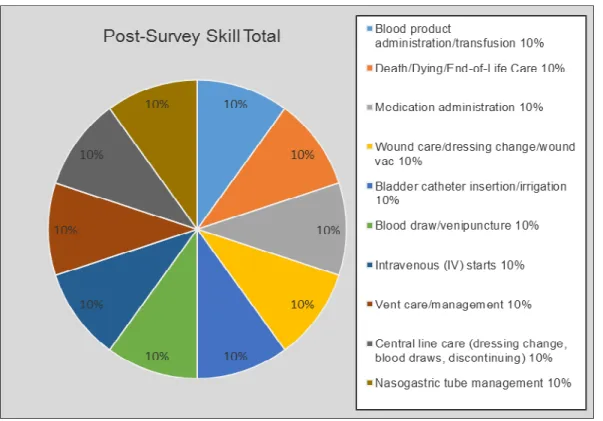
Skills listed on the postsurvey that were not listed on the presurvey were medication administration, wound care/dressing change/management, bladder catheter insertion/irrigation, blood draw/venipuncture, central line care, and nasogastric tube management. Of the skills listed on the postsurvey, wound care/dressing
change/management, blood draws/venipunctures, and central line care were skills taught in the internship program.
3% 9% 6% 23% 6% 9% 14% 3% 6% 6% 9% 6%
Pre-Survey Skill Total
Assessment Skills 3%Blood product
administration/transfusion 9% Charting/documentation 6% Chest tube care (placement, pleurovac) 23%
Code/Emergency Response 6% Death/Dying/End-of-Life Care 9% ECK/EKG/Telemetry care 14% Intravenous (IV) medication administration/pumps/PCAs 3% Intravenous (IV) starts 6%
Prioritization/time management 6% Tracheostomy care 9%
Vent care/management 6% Figure 1. Presurvey results for skills.
Figure 2. Postsurvey results for skills.
In summary, the findings are inconclusive. However, a correlation could be drawn between skills that were taught during simulation and scenarios. The first example is chest tube care, which was at 23% on the presurvey and was not listed on the postsurvey. The second would be ECK/EKG/telemetry care, which was at 14% on the presurvey and was not listed on the postsurvey.
Discussion of Findings in the Context of Literature
Regarding safe patient care and skill performance, Twibell, St. Pierre, Johnson, Barton, Davis, Kidd, and Rook (2012) conducted a survey of nurse executives and new graduate nurses. The study revealed that nurse executives believed that only 10% of new graduate nurses are adequately prepared to provide safe and effective patient care. New graduate nurses agreed that they lacked the skills and confidence necessary to provide
safe care for patients. Although some correlation can be drawn regarding skill performance, the data for providing safe patient care were inconclusive.
Effective communication is also a skill that is necessary for new graduate nurses. Ortiz (2014) surmised that new graduate nurses were entering the workforce with a lack of professional confidence. She performed a qualitative study to determine how new graduate nurses accounted for their lack of professional confidence. Seventeen new graduate nurses participated. Data collection consisted of recorded interviews and transcripts, which were manually analyzed. Ortiz found that communication was among the reasons new graduate nurses gave to explain their lack of professional confidence. Unfortunately, the data regarding communication were inconclusive for this mixed method orientation program.
Parker, Giles, Lantry, and McMillan (2014) conducted a mixed method cross-sectional study with both a quantitative and qualitative approach to identify factors that impact new graduate nurses’ transition to practice, satisfaction, and decision to stay. Two hundred and eighty-two new graduate nurses responded to an online survey. Parker et al. concluded that institutional support was imperative when transitioning new graduate nurses into practice. The data collected for this mixed method orientation program did not validate the sense of institutional support.
Although findings for this study were inconclusive, there is literature to support the need to continue the mixed method orientation program. Evaluation of the program should also continue. Successful transition of new graduate nurses into an acute-care setting is important for patient safety.
Implications Practice
Benner’s “from novice to expert” theory indicates that nurses gain skills on a continuum with a sound basis in both knowledge and experience (Altmann, 2007). Based on Benner's assertion, it is important to develop new graduate nurse orientation processes that meet the needs of new graduate nurses when they are transitioning from the
classroom into practice. Such programs would provide a strong education base through didactic instruction and offer opportunities for new graduate nurses to develop skills through scenarios and simulation that would assist them in moving along the continuum from novice to advanced beginner. It is recommended that the proposed new graduate nurse mixed orientation method which consists of ECCO, scenarios, and simulation continue.
Research
The American Nurses Association (2010) states, “Nurses drive the development of structures and processes used by organizations to build, expand upon, or advance nursing knowledge through research.” Although there is a large amount of literature to support the need for new graduate nurse orientation programs and transition-to-practice programs, the elements required to ensure a successful transition to practice have yet to be identified. The mixed method orientation program and data collection should continue, and outcomes should be evaluated to determine the success of the program.
Social Change
There are many professional organizations, governing bodies, and focus reports that identify and support the need for new graduate nurse transition-to-practice programs. As nurse leaders, it is a social mandate to ensure that patients receive safe, high-quality patient care. With an increased need to hire new graduate nurses into acute care,
programs must be developed to assist with their transition into this practice setting. Programs must be implemented and evaluated to ensure adequately prepared of new graduate nurses with the knowledge and skills necessary to practice in an acute-care setting. Benner, Sutphen, Leonard, and Day (2009), explains that the development of nursing knowledge should transition from a “decontextualized knowledge to an emphasis on teaching for a sense of salience, situated cognition, and action, in particular,
situations” (p. 82). The proposed mixed method orientation program provides new graduate nurses with the opportunity to apply knowledge to context and simulated situations.
Project Strengths and Limitations
A strength of this project was the fact that all demographic information was removed from the audit tool. This allowed the individuals who responded to the survey to remain anonymous. Another strength of the project was the fact that a valid survey instrument was used to collect data.
The use of a convenience, nonrandom sample of new nurse graduates with less than 1 year of experience was a limitation of this study. Another limitation of the study was the small sample size. Because of the small sample size, external validity, the degree
to which results may be generalized to the population, may be compromised (Polit, 2010, p. 366). Lack of control over the presurvey group and postsurvey group resulted in an inability to identify or ensure that the group that responded to the presurvey also
responded to the postsurvey. Because of this, a definitive correlation between cause and effect could not be drawn for the program.
Recommendations for Remediation of Limitations in Future Work Because the institution in which this project was conducted hires approximately 10 new graduate nurses every 6 months, it will be difficult to increase the sample size. To overcome the small sample size, the project should be continued and studied over time to gather more data and better evaluate the program. A strength of the program was the use of the Case-Fink Graduate Nurse Experience Survey, a validated survey tool.
Unfortunately, the survey tool was long and not able to capture the data needed for effective evaluation of the program. One recommendation is to create a survey tool that is more specifically geared toward the evaluation of the program. Face validity could be used to validate the survey tool. Additionally, eliminating demographic data and
maintaining anonymity were important, as this project was submitted to the Institutional Review Board as a quality improvement project and exempt status was awarded. To overcome lack of control over the presurvey group and the postsurvey group, informed consent to participate in the study could be obtained. The postsurvey could be
administered to only those participants who consented and completed the presurvey. The described process would require submission to the IRB under a different category.
Summary
Through this project, I sought to evaluate the development of a mixed method orientation process for new graduate nurses that consisted of ECCO (2014), scenarios, and simulation. The project objective was to implement an orientation program for new graduate nurses that would assist with their transition to practice and that would result in increases in new graduate nurses’
• sense of their ability to provide safe patient care • sense of their ability to communicate effectively • sense of their ability to perform skills
• sense of institutional support
Results of this project were found to be inconclusive. There was no statistically significant difference in the Casey-Fink Graduate Nurse Experience Survey as it pertained to questions regarding safe patient care, communication, and sense of institutional support. In reference to the increase in skills, a slight correlation can be drawn, but there were no concrete data to determine success.
Section 5: Findings, Discussion, and Implications Dissemination Plan
The results of this project will be disseminated to nursing leadership. This will be done via a PowerPoint presentation to the chief nursing officer and the nursing directors. I will then work with the nursing educators and the clinical nurse specialist to continue the project.
Analysis of Self As Scholar
Scholarship is one of the hallmarks of doctoral education (AACN, 2006). The AACN (2006) has listed four aspects of scholarship: discovery, teaching, application, and integration. I have always had a great interest in assisting new graduate nurses with their transition into the clinical environment. This interest was generated by my experiences as a new graduate nurse and by my observations of other new graduate nurses who entered the nursing profession. It was derived from reflection and thought concerning how I could take the learning opportunities I was offered and use them to teach and assist other new graduate nurses with their transition. I then used this interest to search for evidence, synthesize the evidence, and apply the evidence. As a scholar, I have developed an innovative newly created orientation program for new graduate nurses.
As Practitioner
DNP Essential VIII, Advanced Nursing Practice, states that the DNP program prepares graduates to “educate and guide individuals and groups through complex health and situational transitions” (AACN, 2006). The acute inpatient hospital setting is an
extremely complex environment. Nurse leaders and advanced practice nurses, have the responsibility to ensure that patients receive safe, high-quality care. It is the responsibility of nurse leaders to ensure that new graduate nurses who enter the acute-care environment are trained to provide this type of care. I believe that, as a practitioner, I have grown from a nurse at the bedside precepting new graduate nurses one on one to a leader whose responsibility is to ensure that new graduate nurses receive the training needed to provide safe, high-quality care.
As Project Developer
Those in the field of nursing must continue to seek and generate additional knowledge on which to base decisions (Arndt & Netsch, 2012). This project has offered me an opportunity to evaluate a mixed method orientation program and analyze the data received from the new graduate nurses who participated. In reviewing the data, I have recognized the need to continue evaluating this project to gain more robust data and base any changes to the program on these data.
This project has helped me to grow professionally. In the process of developing this project, I have learned the meaning of persistence. I began this project with a plan and a goal. I quickly realized that my plan and goal were going to require much feedback and revision to produce a scholarly project. It has taken much effort on my part to accept feedback and use it constructively to continue this project. I have also learned the
meaning of humility. I have learned to identify my limitations and ask for assistance when needed. All of these learning opportunities have helped me to grow and increase my professional skills and my project development skills.
Summary and Conclusion
As previously stated, findings for this study were inconclusive; however, there is literature to support the need to continue the mixed method orientation program.
Evaluation of the program should also continue. Successful transition of new graduate nurses into an acute-care setting is important for the safety of patients.
This orientation project has been adopted by the institution. The institution will continue evaluating and refining the program based on feedback from the new graduate nurses. The nursing leadership group at the institution in which I am employed is
committed to hiring new graduate nurses; therefore, we will exhaust all avenues to ensure that we develop a program to ease their transition to practice.
References
Abe, Y., Kawahara, C., Yamashina, A., & Tsuboi, R. (2013). Repeated scenario
simulation to improve competency in critical care: A new approach for nursing education. American Journal of Critical Care, 22(1), 33-40.
doi:10.4037/ajcc2013229
Adams, P., Bartlett, L., Blasdel, D., Giesler, J., Haley, B., Hendricks, R., ... Proctor- Holmes, M. A. (2014). Restructuring the new nurse orientation program: Making it meaningful, relevant, engaging, and pertinent to quality patient outcomes. MedSurg Matters!, 23(2), 13-15.
Altmann, T. (2007). An evaluation of the seminal work of Patricia Benner: Theory or philosophy? Contemporary Nurse: A Journal for the Australian Nursing Profession, 25(1-2), 114-123. doi:10.5172/conu.2007.25.1-2.114
American Organization of Nurse Executives (2010). AONE guiding principles: The role of the nurse in future patient care delivery. Retrieved from http://www.aone.org /resources/PDFs/AONE_GP_for_Role_of_Nurse_Future.pdf
Arndt, J. V., & Netsch, D. S. (2012). Research study or quality improvement project? Journal of Wound, Ostomy & Continence Nursing, 39(4), 371-375. Retrieved from http://www.lww.com
Bashford, C., Shaffer, B., & Young, C. (2012). Assessment of clinical judgment in nursing orientation: Time well invested. Journal for Nurses in Staff Development, 28(2), 62-65. doi:10.1097/nnd.0b013e31824b4155
Benner, P., Sutphen, M., Leonard, V., & Day, L. (2009). Educating nurses: A call for radical transformation. San Francisco, CA: Jossey-Bass.
Benner, P. (2013) From novice to expert: Retrieved from http://currentnursing.com /nursing_theory/Patricia_Benner_From_Novice_to_Expert.html
Blum, C. (2010). Using the Benner intuitive-humanistic decision-making model in action: A case study. Nurse Education in Practice, 10(5), 303-307.
doi:10.1016/j.nepr.2010.01.009
Brakovich, B., & Bonham, E. (2012). Solving the retention puzzle: Let's begin with nursing orientation. Nurse Leader, 10(5), 50-61. doi:10.1016/j.mnl.2012.03.010 Bricker, D. J., & Pardee, C. J. (2011). Nurse experts jump-start clinical simulation in
rehabilitation nursing: Supporting new graduate transition to competence. Nursing Education Perspectives, 32(1), 34-36. doi:10.5480/1536-5026-32.1.34
Buckley, T., & Gordon, C. (2011). The effectiveness of high fidelity simulation on medical–surgical registered nurses' ability to recognize and respond to clinical emergencies. Nurse Education Today, 31(7), 716-721.
doi:10.1016/j.nedt.2010.04.004
Burns, N., & Grove, S. (2009). The practice of nursing research: Appraisal, synthesis, and generation of evidence. St. Louis, MO: Saunders Elsevier.
Casey, K., Fink, R., Krugman, M., & Ropst, J. (2004). The graduate nurse experience. Journal of Nursing Administration, 34(6), 303-311. Retrieved from
Chan, Z. C., Tam, W. S., Lung, M. K., Wong, W. Y., & Chau, C. W. (2013). A
systematic literature review of nurse shortage and the intention to leave. Journal of Nursing Management, 21(4), 605-613. doi:10.1111/j.1365-2834.2012. 01437.x Chesnutt, B., & Everhart, B. (2007). Meeting the needs of graduate nurses in critical care
orientation: Staged orientation program in surgical intensive care. Critical Care Nurse, 27(3), 36-52. Retrieved from http://ccn.aacnjournals.org/
Dyess, S., & Parker, C. G. (2012). Transition support for the newly licensed nurse: A programme that made a difference. Journal of Nursing Management, 20(5), 615-623. doi:10.1111/j.1365-2834.2012.01330.x
Fawcett, J., & Garity, J. (2009). Evaluating Research for evidence-based nursing. Philadelphia, PA: F. A. Davis.
Fink, R., Krugman, M., Casey, K., & Goode, C. (2008). The graduate nurse experience: Qualitative residency program outcomes. Journal of Nursing Administration, 38(7-8), 341-348. Retrieved from http://www.lww.com/
Gardner, L. (2013). Benner, reflection and expertise: Some further thoughts. Nurse Education Today, 33(3), 183-184. doi: 10.1016/j.nedt.2012.09.013
Glynn, P., & Silva, S. (2013). Meeting the needs of new graduates in the emergency department: A qualitative study evaluating a new graduate internship program. Journal of Emergency Nursing, 39(2), 173-178. doi:10.1016/j.jen.2011.10.007 Goode, C., Lynn, M., Krsek, C., Bednash, G., & Jannetti, A. (2009). Nurse residency
programs: An essential requirement for nursing. Nursing Economic 27(3), 142. Retrieved from http://www.ajj.com/services/pblshng/nej/default.htm
Gordon, C., & Buckley, T. (2009). The effect of high-fidelity simulation training on medical-surgical graduate nurses' perceived ability to respond to patient clinical emergencies. Journal of Continuing Education in Nursing, 40(11), 491-500. doi:10.3928/00220124-20091023-06
Hester C., & Botha, A. (2012).Guided reflection as a tool to deal with the theory- practice gap in critical care nursing students. Health SA Gesondheid, 17(1), 1-9.
doi:10.4102/hsag.v17i1.591
Hunsberger, M., Baumann, A., & Crea-Arsenio, M. (2013). The road to providing quality care: Orientation and mentorship for new graduate nurses. Canadian Journal of Nursing Research,45(4), 72-87 16p.
Im, E., & Chang, S. (2012). A systematic integrated literature review of systematic integrated literature reviews in nursing. Journal of Nursing Education, 51(11), 632-640. doi:10.3928/01484834-20120914-02
Institute of Medicine Report: The future of nursing: Leading change, advancing health – report recommendations. Retrieved from
http://www.iom.edu/~/media/Files/Report Files/2010/The-Future-of- Nursing/Future of Nursing 2010 Recommendations.pdf
Kaddoura, M. (2010). Effect of the essentials of critical care orientation (ECCO) program on the development of nurses' critical thinking skills. Journal Of Continuing Education in Nursing, 41(9), 424-432. doi:10.3928/00220124- 20100503-05
(2012). The organizational transformative power of nurse residency programs. Nursing Administration Quarterly, 36(2), 155-168.
doi:10.1097/naq.0b013e318249fdaa
Krugman, M., Bretschneider, J., Horn, P., Krsek, C., Moutafis, R., & Smith, M. (2006). The National post baccalaureate graduate nurse residency program: A model for excellence in transition to practice. Journal for Nurses in Staff Development, 22(4), 196-205. Retrieved from http://www.lww.com/
Li, Y., & Jones, C. B. (2013). A literature review of nursing turnover costs. Journal Of Nursing Management, 21(3), 405-418. doi:10.1111/j.1365-2834.2012.01411.x Lin, P. S., Viscardi, M. K., & McHugh, M. D. (2014). Factors influencing job
satisfaction of new graduate nurses participating in nurse residency programs: A systematic review. Journal of Continuing Education In Nursing, 45(10), 439- 450. doi:10.3928/00220124-20140925-15
Marshburn, D., Engelke, M., & Swanson, M. (2009). Relationships of new nurses' perceptions and measured performance-based clinical competence. Journal of Continuing Education in Nursing, 40(9), 426-432. doi:10.3928/00220124-20090824-02
Mellor, P., & Greenhill, J. (2014). A patient safety focused registered nurse transition to practice program. Contemporary Nurse: A Journal for The Australian Nursing Profession, 47(1/2), 51-60. doi:10.5172/conu.2014.47.1-2.51