THESIS
Submitted by SITI RAHMAH NIM. 140203061
Student of Fakultas Tarbiyah dan Keguruan
Department of English Language Education
FAKULTAS TARBIYAH DAN KEGURUAN
UNIVERSITAS ISLAM NEGERI AR-RANIRY BANDA ACEH 2019 M/ 1440 H
First of all, I would like to express the deepest praises and thanks to Allah SWT, the almighty, the lord of the universe who has given me health, strength, opportunity, and blessing in finishing the thesis. Peace and Salutation be upon the prophet Muhammad SAW, the role model and the one who shows the beauty of Islam rahmatan lil ‘alamin.
The most prestigious thanks and love for my family, the support system of my life; my lovely mother, Ratna Dewi, S.KM, and my beloved dady Mahdan S.T, my precious sisters and brother, Siti Rahmi, Siti Az-Zahra and Rafa Zamzani.
My great appreciation for my supervisors Siti Khasinah, M. Pd and Mulia, M. Ed for the enormous helps and guidance in preparing and finishing the thesis. My grateful thanks addressed for all lecturers of English Language Education program as well.
Last but not least, my special thanks for the one who never leave me behind, make life much easier to live in, and always support me in my high and low, my cousins and all of my friends.
May Allah bless and reward them for all the good things they have done.
Siti Rahmah
iii
NIM : 140203061
Faculty : Fakultas Tarbiyah dan Keguruan
Major : Department of English Language Education
Thesis title : The Students’ Problems in Listening Comprehension of TOEFL Test
Main Supervisor : Siti Khasinah, M.Pd. Co- Supervisor : Mulia, M.Ed.
Keyword : students; TOEFL; listening comprehension; problems
TOEFL is one of the proficiency tests which have been applied by many universities and institutions to test students’ English language skills. It also becomes one of the graduation standard requirements in the universities for the students, including in State Islamic University of Ar-Raniry Banda Aceh (UIN Ar-Raniry). However, many students faced the problems in answering the TOEFL especially in section one which is about Listening Comprehension. This research is underlied with two research questions: What are the most difficult elements faced by the students in answering listening section of TOEFL test and what are the factors influencing the difficulty in answering Listening Comprehension of TOEFL test? The research was conducted to the students’ of English Department UIN Ar-Raniry. The population was 118 students’ of tenth semester in academic year 2018/2019 and the sample was 9 students, who were selected through purposive sampling technique based on a creterion that they have taken the TOEFL test more than 3 times. The data of this research were collected by using test and interview. The result of the test indicate that there are some elements in listening comprehension that are considered difficulty the students such as synonym of keyword, expression of agreement, idioms, and identifying detail information. The result of the interview reveals that the factors influencing the difficulties came from six factors including tool problem, content of the listening text problems, mental condition, physical condition, environmental condition, and also time problem.
iv DECLARATION OF ORIGINALITY ... i ACKNOWLEDGEMENT ... ii ABSTRACT ... iii TABLE OF CONTENTS ... iv LIST OF TABLES ... vi
LIST OF APPENDICES... vii
CHAPTER I INTRODUCTION 1 A.Background of Study ... 1 B. Previous Studies ... 5 C.Research Questions ... 7 D.Research Aims ... 8 E. Significance of Study ... 8 F. Scope of Study ... 9 G.Terminologies ... 9
CHAPTER II LITERATURE REVIEW 11
A.Test of English as a Foreign Language ... 11
a. The History of TOEFL ... 11
b. Types of TOEFL ... 12
B. Listening ... 19
a. The Definition of Listening... 19
b. The Definition of Listening Comprehension ... 22
c. Listening Comprehension Section ... 24
d. Types of Listening Task ... 25
e. Types of Listening Process ... 26
f. The Problem of Listening ... 27
CHAPTER III RESEARCH METHODOLOGY 30 A.Research Design ... 30
B. Population ... 30
C.Sample ... 31
D.Technique of Data Collection ... 31
1. Test ... 31
2. Interview ... 32
E. Technique of Data Analysis ... 33
CHAPTER IV FINDINGS AND DISCUSSION A.Findings of the Study ... 34
1. Findings of the Test... 34
2. Findings of the Interview ... 38
v AUTOBIOGRAPHY
vi
Table 2.1 The Paper-Based TOEFL Test (PBT) Format ... 13
Table 2.2 The Computer-Based TOEFL Test (CBT)... 15
Table 2.3 The Internet-Based TOEFL Program (IBT) Format ... 16
Table 2.4 The Institutional Testing Program (ITP) Format ... 19
Table 4.1 Error Statictics of Part A ... 34
Table 4.2 Error Statictics of Part B ... 35
Table 4.3 Error Statictics of Part C ... 36
Table 4.4 Total Percentage of Part A, Part B, and Part C ... 37
Table 4.5 Statictics of the Highest Frequency of Error ... 37
vii
Appendix I Appointment Letter of Supervisor
Appendix II Recommendation Letter from the Fakultas Tarbiyah dan Keguruan to conduct field research
Appendix III Confirmation letter from Department of English Language Education
Appendix IV Instrument of the research ( Test Sheet and Interview
Protocol)
Appendix V Answer Key
Appendix VI Interview Transcript Appendix VII Documentation
1 CHAPTER I INTRODUCTION
A. Background of Study
English skills is very important, whether in everyday life or in educational world, technology, and business. English has become a tool for international communication in transportation, commerce, banking, tourism, technology, diplomacy and scientific research (Brown, 2001). English proficiency is needed in the globalization era. TOEFL (Test of English as a Foreign Language) is one of the measurements for English proficiency. In Indonesia, TOEFL test is originally conducted by English Language System (ELS), a specific institution for TOEFL Test, known as Institutional TOEFL (Mahmud, 2014). Nowadays, TOEFL is used in many occasions such as, continuing study at university and get scholarships and getting a job in both national and international companies. TOEFL is the requirements for knowing their English proficiency.
TOEFL test is one of the proficiency tests that are designed to measure people's ability in a language, regardless of any training they may have had in that language. TOEFL tests are often used as a testing tool. The reliance on TOEFL (Test of English as a Foreign Language) for various testing purposes of English proficiency have reached such a point that most universities and colleges both overseas and domestic adopt this standardized test as a part of graduation requirements. Especially, in State Islamic University of Ar-Raniry, TOEFL is also used as the requirement for undergraduate thesis examination. The students who
want to take their thesis exam are required to pass the standard minimum score of the TOEFL, of 500 for English Education Department students and of 400 for non-English Education Department students.
Many students think that Listening Comprehension of TOEFL test is extremely difficult for students who have never done the test before. Many students fail in attempting the TOEFL test because of problems in answering listening section.
Graham (2006) said that there are some other factors that increase learners’ listening comprehension problems such as restricted vocabulary, poor grammar, and misinterpretations about listening tasks. According to Seferoglu and Uzakgoren (2004), some other listening comprehension problems are related to the kind of listening materials. Bloomfield et al. (2010) and Walker (2014) expressed that one of the serious problems of listening comprehension is related to the pronunciation of words that is different from the way they appear in print. Due to the fact that the spoken language varies to the form of the written language, the recognition of words that make the oral speech can create some difficulties for students. Buck (2001) mentioned a lot of problems in listening activities like unknown vocabularies, unfamiliar topics, fast speech rate, and unfamiliar accents. Hasan (2000) indicated that unfamiliar words, difficult grammatical structures, and the length of the spoken passages are the most important factors that cause problems for learners’ listening comprehension. He continued that clarity, lack of interest, and the demand for complete answers to listening comprehension questions are the serious difficulties of students’ listening comprehension.
According to Teng (2002), there are four factors called listener factors, speaker factors, stimulus factors, and context factors that impact students’ listening comprehension.
According to Kurita (2012), learners may find listening comprehension skill difficult to learn and this requires teachers to change their listening exercises into more effective ones. The development of listening comprehension skill helps learners to succeed in language learning and increase their comprehensible input. Since learners’ self-confidence in listening comprehension can be increased, they are motivated to have access to spoken English like conversations with native speakers.
Listening section demands the examinees to demonstrate their ability to spoken English. The examinees must listen to various types of passage on a tape recording and respond to multiple choice questions about the passage. In Listening Comprehension, timing is about 0.7 minute for one item. Students must listen to the conversation, read the answer, analyze the answer, then choose the answer.
According to Chastain (1988), listening comprehension is divided into four components. The first is the ability to differentiate all sounds, intonation patterns, and voice qualities in the second language and to distinguish between them and the same sounds in the native language. The second is the understanding of the whole message uttered by a speaker. Rivers (1981) said that the understanding of spoken messages depend on comprehension of semantic
meaning, moving from what one comprehends in the sound sequence with respect to the knowledge of syntax only when the meaning is not understandable.
The third is the ability to hold that message in one’s auditory memory until it can be processed. To develop the learners’ auditory memory, teachers should know that they hear as much language as possible. This means that most of the class time should be carried out in the language being taught. The speed of presentation and difficulty level of the content must be adjusted to the learners. Language activities that are comprehensible increase auditory memory. The significant point here is the idea of improvement. The improvement from the simpler to the more intricate sentences should be slow and continuous. The speed of delivery should be increased based on the learners’ ability to understand (Chastain, 1988). Comprehension is the speech reception at the syntactic, lexical, pragmatic, and discourse levels.
The last component is comprehension. It involves different steps. The first step is to establish the context. Real language happens within a communicative framework and the listener should know the framework to recreate the speaker’s message. The second step is to activate related background knowledge and use it to predict the ideas the message may have. The third step is to anticipate the general content of the message. Skilled listening requires that listener look ahead in anticipation of what is coming. They are checking the received material as opposed to trying to make an unexpected and immediate interpretation (Kaspar, 1984). The fourth step is to sample the important meaning carrying components of the material. Listeners should expend more energy to understand material about
unfamiliar topics and they rely more on linguistic clues to make up for their lack of background knowledge. The last step is to use the samples to confirm or reject the formerly made anticipations. When the samples are in line with listeners’ anticipations, they accept them as being correct. When the samples do not comply with their anticipations, they should reconsider either their anticipation or the material as they look for making the message meaningful (Kaspar, 1984).
Based on the description above, the writer would like to conduct a research about the students’ problems in Listening Comprehension of TOEFL Test.
B. Previous Studies
As has been previously mentioned, this study aims to find out the students’ challenging aspects in answering Listening Comprehension of TOEFL test and to know the factors influencing the difficulty in answering Listening Comprehension of TOEFL test. The researcher conducts a research about the students’ problem in Listening Comprehension of TOEFL test. Thus, the researcher also includes previous studies to support and strengthen this research.
First study was done by Liyeni Pratiwi (IAIN Sultan Maulana Hasanuddin Banten) in 2017, under a research entitled “An Analysis of the Difficulties Encounterd by Non-English Department Students’ in TOEFL Test of Listening Section”. This research focused on the problem which faced by non- English Department Student in TOEFL test of listening section, especially when they listen to the native speaker and the subject, included the difficulties of
students and causes of students difficulties in TOEFL test of listening section. The setting of the study was at IAIN Banten and the participant were 15 students of Arabic academic year 2017-2018 eighth semester who join TOEFL test. The writer used qualitative method. The data collection techniques of this research were documentation, archival records, interview, direct observation, and participant observation. The researcher analyzed the data by using content analysis. The result from this research indicated that the students’ recapitulation score in listening section of TOEFL test was poor, by percentage 60% of students include 9 students of fifteen participants were very low understanding, and 40% of students’ include 6 students were low understanding. It means that the students were unfamiliar to do the TOEFL test. and the result of this study showed that there were some points of the students’ manner to overcome their difficulties such as asking to the lecturer the unknown the material, asking the unknown the new vocabulary, listen English music by remembering the lyrics for new vocabulary, etc.
The second study was done by Iskandar Abdul Samad,Miftahul Jannah, and Siti Sarah Fitriani Syiah Kuala University in 2017. The title of this research is “EFL Students’ Strategies Dealing with Common Difficulties in TOEFL Reading Comprehension Section”. This research focused on understanding students’ difficulties and strategies to deal with TOEFL reading comprehension. The setting of the study was at English Education Department of Syiah Kuala University and the participant were thirty undergraduate students. This study used descriptive quantitative method. The data collection techniques of this research were test and
questionnaires. The researchers analyzed the data from thetest using the lists of aspects and skills in reading comprehension. While for questionnaires, the scoring was using 4-point Likert scale. The results from this research indicated five difficult reading aspects encountered by the students; answer implied detail questions correctly by percentage 26%, answer stated detail questions correctly by percentage 14%, the use of context to give meanings of difficult words by percentage 12%, answer main idea questions correctly by percentage 11%, and determine meanings from word parts by percentage 9%. In addition, their strategies to complete the reading comprehension section of the TOEFL test were also found.
To elaborate the explanation above, the researcher concludes that the first research was done by Liyeni Pratiwi, the writer used qualitative method. On the contrary, the second research which was done by Iskandar Abdul Samad et. al. The researchers used descriptive quantitative method. Therefore, this study attempts to employ mix method approach to investigate the students’ problems in Listening Comprehension of TOEFL test.
C. Research Questions
Based on the background of this study, the writer formulates the research question as follows:
1. What are the most difficult elements faced by the students in answering listening section of TOEFL test?
2. What are the factors influencing the difficulty in answering Listening Comprehension of TOEFL test?
D. Research Aims
Based on the previous research question stated, the objective of this study was intended to figure out the most difficult elements faced by the students in answering listening section of TOEFL test and to know the factors influencing the difficulty in answering Listening Comprehension of TOEFL test.
E. Significance of Study
The writer wishes that this research result can be significance not only for the writer but also for the lecturer and the students.
1. For the Lecturer
The writer hopes that this research will give more benefit for the lecturers of English Education by providing the information about the students’ problem in Listening Comprehension of TOEFL test. Thus, they can know the causes, factors, and solutions used to overcome the students' problem, so that the lecturers can decide which teaching strategies can be used to help the students in doing listening section in TOEFL test. Therefore, teacher can apply the suitable method for them.
2. For the Students
This study is expected for helping students’ evaluate their ability in Listening Comprehension of TOEFL test. Trough this research, the students’ will be aware of that problem and try to seek solutions to improve their listening skill.
3. For the Writer
This research is conducted to increase the writer knowledge about TOEFL test in Listening Comprehension.
F. Scope of Study
This study is only focused on the students’ problems in Listening Comprehension of TOEFL test. Then, the population and sample of this study was tenth semester students’ of English Department UIN Ar-Raniry in academic year 2018/2019 around 118 students’ and the researcher took 9 students who have taken the TOEFL test more than 3 times.
G. Terminologies
Terminology is explanation of key words. In this part, the writer would explain some terminologies which in the title of this research.
a. Students’ Problem
(Sardiman, 2007) The students are a group of people that places the central position in teaching-learning process. According to A.S. Hornby (1995), problem is a thing that is difficult to deal with or to understand. Based on the definition above, the writer concludes that students problem is any condition that a student is not easy to understand his/her target language.
b. Listening Comprehension
This section to measures the ability to understand English as it is spoken in North America. The oral features of the language are stressed, and the problems tested include vocabulary and idiomatic expression as
well as special grammatical constructions frequently used in spoken English. The stimulus material and oral questions are recorded in standard North American English; the response options are printed in the test books (ETS, 2007).
c. TOEFL Test
TOEFL stands for the ‘Test of English as a Foreign Language’. The test is designed to measure the English proficiency of non-English speaking people and is divided into three sections. There is fixed time for each section and each section is having multiple-choice questions with four possible choices for each question.
11 CHAPTER II LITERATURE REVIEW
A. Test of English As a Foreign Language a. The History of TOEFL
Before going further to the deeper explanation about TOEFL, it is better for people to know what term “test” means. A test, in simple term, is “a methods of measuring a person’s ability, knowledge, or performance in a given domain” (Brown, 2004, p. 3). The word “test” comes from the Latin word. “Testum” which means “the instrument to measure the land” (Haladyna, 2004, p.3).
TOEFL which stands for Test of English as a Foreign Language is a standardized test for measuring students‟ English language capabilities. The TOEFL is a large-scale language assessment. It is “arguably the most well-known and widely used large-scale language assessment in the world” (Kunnan, 2008, p. 140). The TOEFL test is a test to measure the level of English proficiency of nonnative speakers of English. It is probably the most often used examination in the admissions process of foreign students to colleges and universities. However, these school often do not consider the student’s grades in schools which he or she previously attended and the records from any intensive English program in which the student was enrolled. All this depends on the school’s admission criteria. The score is acceptable to given school also depends on the regulation for that particular school.
Since 1963, the TOEFL test has been used by various government agencies in the United States and internationally, such as the Ford Foundation, Fulbright, The Agency of International Development, Latin America Schoolarship Program, the Colombo Plan, as well as various institutions or other agencies as a standard mastery of the English language for prospective recipients of such institutions. According to ETS, more than 27 million people from around the world have signed up to take the TOEFL test since the test was first launched.
b. Types of TOEFL
The official TOEFL Test is currently administered around the world in different types (Abboud and Hussein, 2011):
1) The Paper-Based TOEFL (PBT) 2) The Computer-Based TOEFL (CBT) 3) The Internet-Based TOEFL (IBT) 4) Institutional Testing Program(ITP)
The followings are the explanation about four types of TOEFL currently administerd around the world :
1) The Paper-Based Test (PBT)
According to Philip (2003, p. xv-xvi) the Paper Based Test is one of the International Testing Programs. It includes four sections which are as follows:
a. Listening Comprehension
It is used to evaluate the test-takers ability to understand spoken English.The test-takers must listen to different types of recorded passages and answer multiple choice questions about these passages.
b. Structure and Written Expression
It is used to evaluate the test-takers ability to recognize grammatically correct English sentences. In this section, they have to choose the correct answer to complete sentences and to identify grammatical errors in sentences.
c. Reading Comprehension
It is used to measure the test-takers ability to understand written English passages. Then, the test-takers must answer multiple choice questions concerning the ideas and the meaning of words in those reading passages.
d. Test of Written English (TWE):
It is used to evaluate the test-takers ability to write correct, organized and meaningful English essays. The examinees must write a certain essay on a given topic in only thirty minutes. The format of these four sections, the number of items for each of them, and the time which is assigned for each of them can be clarified in the following table (Gear and Robert, 2002, p.8):
Table 2.1 The Paper-Based TOEFL Test(PBT) format
Section Number of
Items
Time Listening:
Part A Questions about short conversations
Part B Questions about longer conversations
Part C Questions about lectures or talks
Total
Structure and Written Expression: Completing sentences correctly
30 8 12 50 15 30-40 Minutes
Identifying errors Total
Reading Comprehension: Questions about reading passages Total
Test of Written English
(TWE): One essay, 250-300 words
25 40 50 50 25 Minutes 30 Minutes
2) The Computer-Based TOEFL (CBT)
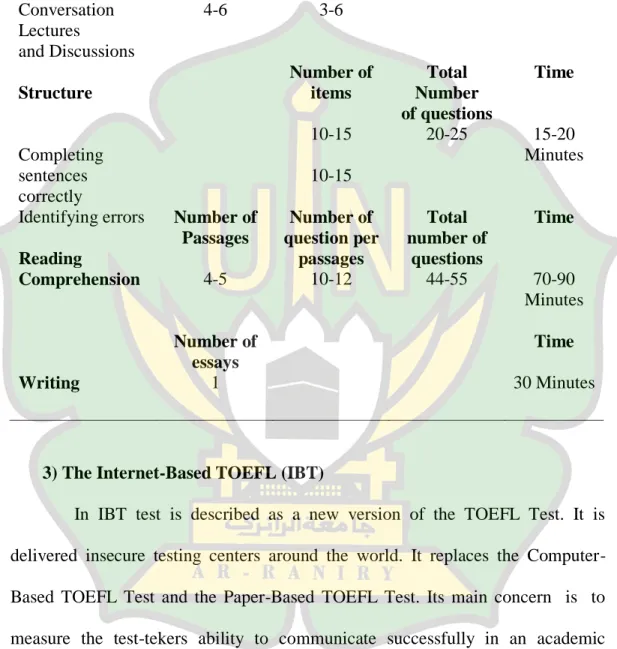
The Computer-Based TOEFL Program comprises four sections: Listening, Structure,Writing and Reading. The writing section in this test is equivalent to the Test of Written English (TWE) in the Paper-Based TOEFL Test. In addition, everyone who takes the TOEFL during the same administration may not see or answer the same questions. These questions are selected according to the level of the student's proficiency. In this test, there are three sub–scores: Listening, Structure, Writing, and Reading. Actually, the total score is limited on a scale of (0–300). (Sharpe, 2009, p. 11).
The format, the number, and types of questions, that can be seen in the Computer-Based TOEFL Test, are shown in the following table (Gear and Robert, 2002, p. 2) :
Table 2.2 The Computer-Based TOEFL Test (CBT) Format Listening Number of passages Number of questions per passages Total number of questions Time Short Dialogues Short Conversation Lectures and Discussions Structure Completing sentences correctly Identifying errors Reading Comprehension Writing 11-17 2-3 4-6 Number of Passages 4-5 Number of essays 1 1 2-3 3-6 Number of items 10-15 10-15 Number of question per passages 10-12 30-59 Total Number of questions 20-25 Total number of questions 44-55 40-60 Minutes Time 15-20 Minutes Time 70-90 Minutes Time 30 Minutes
3) The Internet-Based TOEFL (IBT)
In IBT test is described as a new version of the TOEFL Test. It is delivered insecure testing centers around the world. It replaces the Computer-Based TOEFL Test and the Paper-Computer-Based TOEFL Test. Its main concern is to measure the test-tekers ability to communicate successfully in an academic setting. It includes a new section which is the Speaking Section. This section is used to evaluate the examinees' ability to Speak English. Moreover, there are new integrated Writing and Speaking tasks. These tasks are used to evaluate the test-tekers ability to combine and communicate in formation which is from different
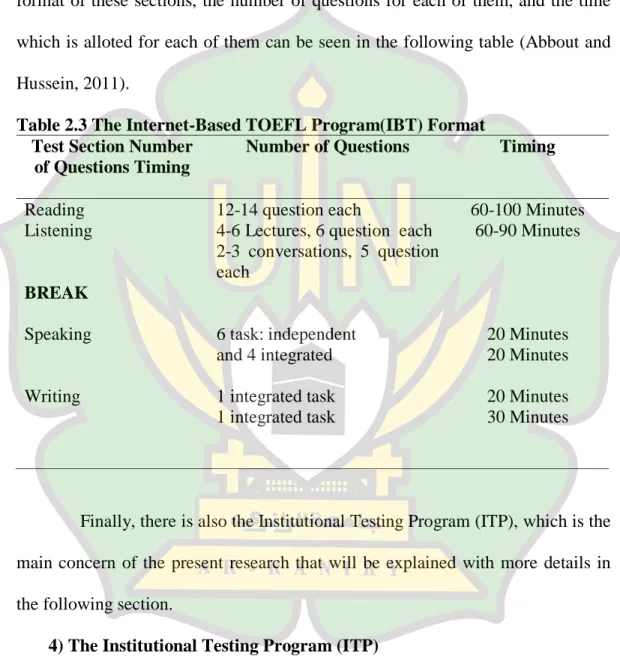
sources. To sum up, this test consists of four sections: Reading, Listening, Speaking and Writing. It tests all the four skills that are influential for effective and successful communication, i.e. listening, speaking, reading and writing. The format of these sections, the number of questions for each of them, and the time which is alloted for each of them can be seen in the following table (Abbout and Hussein, 2011).
Table 2.3 The Internet-Based TOEFL Program(IBT) Format Test Section Number
of Questions Timing
Number of Questions Timing
Reading Listening BREAK Speaking Writing 12-14 question each
4-6 Lectures, 6 question each 2-3 conversations, 5 question each 6 task: independent and 4 integrated 1 integrated task 1 integrated task 60-100 Minutes 60-90 Minutes 20 Minutes 20 Minutes 20 Minutes 30 Minutes
Finally, there is also the Institutional Testing Program (ITP), which is the main concern of the present research that will be explained with more details in the following section.
4) The Institutional Testing Program (ITP)
In The Institutional Testing Program, it is clear that ITP Test, i.e. (the Institutional Testing Program) began in 1965 and is still administered throughout the world. Actually, it differs from other TOEFL Test Programs because it gives qualified universities, English language institutes, and other agencies the
opportunity to use older forms of International Testing Program paper-based TOEFL Test or the Preliminary Test of English as a Foreign Language (Pre-TOEFL) to their own students using their own facilities and staff and setting their own test dates (Abboud and Hussein, 2011). To provide depth understanding about ITP, there are more explanations about the score determination and the structure of the ITP , as follows:
a. The Determination of Score
According to Pyle and Munoz (1982) the test score is determined by adding the total number of correct answer in each section and then changing these “raw scores” into “converted scores”. The total number of correct answers is counted also and it is called "raw score". Then, the raw score for each section is converted by certain statistical means to a number on a scale. The converted score is different for each examination. It is based on the difficulty of the test. There is no way that you can use any simple mathematics to determine the converted score. ITP TOEFL section scores are reported as scaled scores that can range within 31-68. In addition, the total scores can range within 310-677. The total converted score “is then determined by adding the three converted scores and multiplying the result by 3½ (or multiplying by 10 and dividing by 3). Such as in the following:
Section1 Section2 Section3
Example: 48 + 56 + 52
The paper version of the TOEFL Test is scored on a scale of 217 to 677 points. Different universities, institutions and organizations have their own TOEFL requirements. The dates of the scores to be mailed to the students are listed in the TOEFL Information Bulletin. Scores are generally mailed out approximately five to six weeks after the test date for all over test centers (Phillips, 2003, p. xvi).
b. The Structure of the Institutional Testing Program
As for The Institutional Testing Program (2006:3), it is mentioned that the purpose of ITP TOEFL Test is to measure English proficiency of people whose native language is not English. In fact, it consists of three sections. Each section contains a multiple-choice format in order to evaluate the ability to understand North American English. It is given in a single session of about twoand a half hours to complete it besides completing the admission procedures. These sections are:
a) Listening Comprehension:
It is used to evaluate the examinees ability to understand spoken English. b) Structureand Written Expression:
It is used to evaluate the examinees ability to recognize language that is appropriate for standard written English.
c) Reading Comprehension:
It is used to evaluate the examinees ability to read and understand short passages. The format of these sections, the number of questions for each of them,
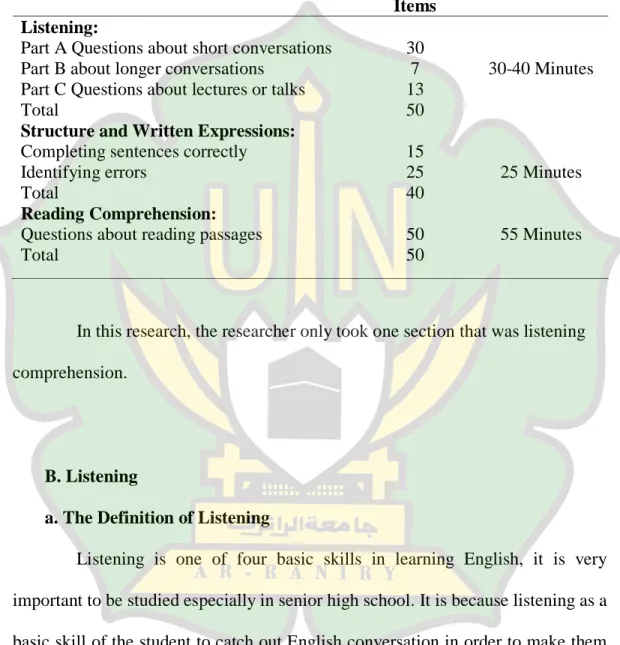
and the time which is given for each of them can be seen in the following table (see TOEFL Practical Tests, 2003) :
Table 2.4 The Institutional Testing Program (ITP) Format
Section Number of
Items
Time Listening:
Part A Questions about short conversations Part B about longer conversations
Part C Questions about lectures or talks Total
Structure and Written Expressions: Completing sentences correctly Identifying errors
Total
Reading Comprehension: Questions about reading passages Total 30 7 13 50 15 25 40 50 50 30-40 Minutes 25 Minutes 55 Minutes
In this research, the researcher only took one section that was listening comprehension.
B. Listening
a. The Definition of Listening
Listening is one of four basic skills in learning English, it is very important to be studied especially in senior high school. It is because listening as a basic skill of the student to catch out English conversation in order to make them understand about what the speaker say and what the speaker means. This involves understanding speakers accent and pronunciation, his grammar and his vocabulary and grasping the speakers meaning.
According to Pollard (2008), listening is one of the receptive skills and as such it involves students in capturing and understanding the input of English. While reading the other receptive skill, involves the students in understanding and interpreting the written word.
In the classroom, students have to listen carefully and attentively to the lectures and classroom discussion in order to understand and retain the information for later recall. In the other hand, that listening is not only the first of the language arts skills developed, it is also the skill most frequently used both the classroom and daily life. Clearly, much of the educational process is based on skills in listening. The students have to spend most of their time in listening to what the lecture says, for instance, giving the material of English in the classroom, listening ability plays a significant role in the development of other language arts skills. Listening can also helps the students to build their vocabulary, develop their language proficiency, and improve their language usage.
According to Miller which was quoted by Stepanoviene (2012) on her English journal that more than fourty percent of our daily communication is spent on listening, thirty-five percent on speaking, about sixteen percent in reading, and only nine percent on writing. Yet listening remains one of the least understood processes in language learning despite the recognition of critical role it plays both in communication and in language acquisition.
Therefore, learning listening has the target great influence on students to improve their skills in learning English as English foreign learners. Despite they assumed that listening is more than difficult to be learned than the other skill of
English learning. However, this does not become an obstacle for the lectures in doing their obligation to teach them for improving their skills especially in listening skills.
Despite Gilakjani (2011) mentioned on his English journal that arguing what is successful listening, “understanding is not something that happens because of what a speaker say, the listener has a crucial pat to play in the process, by activating various types of knowledge, and by applying what we knows to what he hears and trying to understand what the speakers means”.
However, skill students will not be improved best without the guidance from the lecturer. The lecturer plays such a significant in building up their skills. By each lesson, the lecturer shows the ways in each stage to the student in listening comprehension. Generally, there are three stages: pre-listening, while-listening, and post-listening.
According to Brown (2004) adapted from Richard (1983) that there are micro macro skills that needed in an enable listener. The micro-skills involved in understanding what someone says to us. The listener has to: retain chunks of language in a short-term memory, discriminate among the distinctive sounds in the new language, recognize stress and rhythm patterns, tone patterns, intonational contours, recognize reduced forms of words, distinguish word boundaries, recognize typical word-order patterns, recognize vocabulary, detect key words, such as those identifying topics and ideas, guess meaning from context, and detect sentence constituents such as subject, verb, object, prepositions, and the like.
The macro-skills for conversational discourse are the following: recognize cohesive devices in spoken discourse, recognize the communicative functions of utterances, according to situations, participants, and goals, infer situation, participants, goals using real-world knowledge, distinguish between literal and implied meanings, develop and use a battery of listening strategies, such as detecting key words, and guessing the meaning of words from context.
In conclusion, listening is a process of identifying and understanding what the speakers say, which includes understanding a speaker’s pronunciation, grammar and vocabulary. The macro and micro skills in listening are very essential in performing listening comprehension.
b. The Definition of Listening Comprehension
There are different definitions of the term “listening comprehension.” Listening comprehension is the different processes of understanding the spoken language. These include knowing speech sounds, comprehending the meaning of individual words, and understanding the syntax of sentences (Nadig, 2013 as cited in Pourhosein Gilakjani & Sabouri, 2016). According to Hamouda (2013), listening comprehension refers to the understanding of what the listener has heard and it is his/her ability to repeat the text despite the fact that the listener may repeat the sounds without real comprehension.
O‘Malley, Chamot, and Kupper (1989 as cited in Pourhossein Gilakjani & Ahmadi, 2011) said that listening comprehension is an active process in which the listener constructs meaning through using cues from contextual information and
from existing knowledge, while relying upon numerous strategic resources to perform the task requirement.
Lynch (2012) defines listening comprehension as the ability to understand the native speakers’ spoken language. He also points out that, in listening to spoken language, the ability to decode the speaker’s intention is of required for a competent listener, in addition to other abilities such as processing the linguistic forms like speech speed and fillers, coping with listening in an interaction, understanding the whole message contained in the discourse, comprehending the message without understanding every word, and recognizing different genres.
Listening are skill which impacts in specific ways upon the classroom context in general and upon the individual learner in particular. Listening is identifying the sounds of speech and processing into words and sentence. When process listening, it use ears to receive some words and use brain to convert the words into messages the mean something.
It has already known that ear is one of the very important of body organ, that ear is an appliance that is listening bad and good something that or listen something result text record sound or native spoken language. In teaching students comprehension as a foreign language, the people must realize that one is possible without the other. The listener in this case probably heard the actual sounds of the utterance quite clearly and oven distinguished words and listening not only helps people to speak clearly to other people. Listening is an active process of constructing meaning, and that is done by applying knowledge to the incoming sound.
Based on the statement above, the writer can conclude that listening is very important skill. Without listening we don’t know what the people say or feel to us and also difficult to communicative with other. Because before we speak we listen first. Beside that, not only the proof of importance listening but also listening should be taught due to become a good listener and soon a good speaker.
c. Listening Comprehension Section
Listening section of TOEFL PBT tests the listening ability of the examinees about the comprehension in the level of sentence, dialogs, extended conversations, and mini talks (Sulistyo, 2009). In listening section, there are three parts tested, namely Part A (short dialogues) which consists of 30 questions, Part B (longer dialogues) which consists of 8 questions, and part C (lecture or talks) which consists of 12 questions (Ananda, 2016).
The short conversation is in short form that is only 2-4 sentences between two people followed by 1 question. The points tested in this part are synonyms of the keywords stated in the listening, certain vocabulary, idioms, phrasal verbs, conditionals, wishes, causatives, modals, negative expressions, inferring meaning from intonation, and listens for language functions (Dang, 2016).
The second part of listening comprehension is longer conversation. In longer conversation, the dialogs provided are much longer, that is 16-20 sentences, performed by two people followed by 4-5 questions (Hartono, 2009). The points asked included in this part are identifying main idea and topic, and identifying detail information (Dang, 2016).
The last part is lectures or talks. It is in the form of narration by a single speaker about history, geography, science, art and culture, or education. This part has 10-15 complex sentences followed by 4-5 sentences. The testing points in this section are similar to long conversation part, namely identifying main idea and topic, and identifying detail information (Dang, 2016).
d. Types of Listening Task
Listening process need understanding, responding, and evaluating, the teachers of English language have to choose the type of listening for the approach of listening comprehension.
The comprehension approach also favors a single type of listening task: 1) The listener has to identify various points of information within the next; 2) Listening therefore demands a high level of attention throughout the passage; 3) The points that are targeted are selected by the teacher or materials writer, not
by listener
4) The listener is often required to focus upon micro-points rather than macro-one. There are many different ways of classifying task type. They can be classified according to the role of the learners: whether they are involved in reciprocal or non reciprocal listening. They can be classified according to the types of strategies demanded of the listeners: listening for gist, listening for specific information, making inferences based on what they hear, and so on.
In conclusion, it is important to be able to distinguish between these different categories of listening because students may face different kinds of difficulties with different sorts of listening task. When we have a clear
understanding of the difficulties that students face, we are able to choose a suitable range of techniques to help them.
e. Types of Listening Process 1. Bottom-Up Processing
It is agreed that the language process has a definite order, it means from the lowest level of detail and moving up to the highest level (Buck, 2001, p.2). The same view is directly applicated in listening, precisely in the Bottom –up processing, to assume that in this process the listener focuses and gives much importance to the smallest units of speech than the individual words and after to phrases to combine them in order to achieve understanding and build a hole (Harmer, 2001). He argues that without a good understanding of a reasonable proportion of the details gained through some Bottom-up processing, we will be unable to get any clear general picture of what the text is about. According to Helgesen and Brown (1995), with Bottom-up processing, students start with the component parts: words, grammar and the like. This process sees language comprehension to be a passing through consecutive stages, or level, and the out put of one stage becomes the input of the coming next high stage (Buck, 2001, p.2).
2. Top-Down Processing
Many perspectives appear to indicate that the processing of different types of knowledge doesn't occur in a fixed sequence and order. They come to reject the first view saying that it is possible to understand the meaning of a word without decoding its sounds. This is due to the interference of another type of
knowledge (non linguistic one) including knowledge of the world around us and this is the concern of Top-down processing (Buck, 2001, p.2). Top down process is the opposite of Bottom-up, students start from their background knowledge (Helgesen, Brown, 1995).
(Harmer, 2001) indicates that in this processing, the listener tends to get the message' general view and absorb the overall picture of the listening passage .This is helped if the listener has the ability to have appropriate expectations of what is going to come across.
As a conclusion, to successfully realize the process of listening, it is better to suggest a combination between the two processing "Bottomup, top -down", and many specialists argue that this interaction is the case almost immediately .
f. The Problem of Listening
Listening difficulties is internal and external characteristic that interrupt text understanding directly related to cognitive. Hamouda (2013) stated that factors causing students listening comprehension problem were categorized into different sources including problems related to the listening text, listening problems related to task and activities, listeners problems related to the listeners and lectures methodology. There are several difficulties which may appear during or before listening:
1. Quality of Recorded Material
The quality of sound system also affects understanding of listening. Low quality of recorded material could be caused by noises, or unclear pronunciations. Based on the study conducted by Hamouda (2013) stated that the majority of the students think the difficulties they encountered in listening comprehension were due to the bad recording quality/poor- quality tapes or disks. For example, the cassette might be recorded while there were noises around or the cassette is used for such a long time so the quality was worn out. Unclear sounds resulting from poor-quality equipment could also interfere with the listener’s comprehension.
2. Unfamiliar Vocabulary
Butt (2010) reported that the major problem hindering in listening comprehension was that the students’ vocabulary was too limited to understand the message.
3. Physical Conditions
Not only the difficulties come from the message, the listener or the speaker but also come from the environment surrounding the students. According to Bloomfield et al (2010), noise or distortion in the audio signal interferes with listening comprehension for listeners. Sometimes inconvenience of classrooms affects students listening comprehension. The temperature of class can be counted as a factor that makes listening comprehension difficult.
4. Problems Pertaining to Noise
Noise is another environmental barrier to comprehension. Noise, including both background noises on the recording and environmental noises, can
take the listener’s mind off the content of the listening passage. The poorly preparation of lab also students cannot be concentrated on listening to the recording material.
5. Lack of Concentration
According to Yagang (1993), the listening comprehension process is also a relatively complex psychological process. In psychology, it is stated that when a person feels nervous or anxious he or she may not be concentrated. When one felt uncomfortable, his or her ability to listen is greatly reduced. Boredom and frustration are other barriers to listening comprehension. Boredom and frustration may affect the extent to which attention is paid to listening.
30 CHAPTER III
RESEARCH METHODOLOGY
A. Research Design
This research was designed as descriptive study which aimed to figure out the most difficult elements faced by the students in answering listening section of TOEFL test and to know the factors influencing the difficulty in answering Listening Comprehension of TOEFL test. The research used mixed methods to get quantitative and qualitative data in a research. Creswell (2003) asserts that as a methodology, mixed method focus on collecting, analyzing and mixing both quantitative and qualitative data in one study or series of study. The quantitative data used test technique, the researcher wanted to find out the most difficult elements faced by the participants in answering listening section of TOEFL test. In addition, the qualitative data were collected through interview, in order to figure out the factors influencing the participants difficulties in answering Listening Comprehension of TOEFL test.
B. Population
The population of this research was tenth semester students’ of English Department UIN Ar-Raniry in academic year 2018/2019 around 118 students’. (Prodi PBI, 2019).
C. Sample
In selecting the sample, the writer used purposive sampling technique. This technique is used to determine the sample with certain consideration (Sugiyono, 2013). The sample of this study was student who have taken the TOEFL test more than 3 times. In fact, the researcher found 13 participants,who met the criterion. However only 9 of them were available for this research. Then, 9 were selected as the participants for both test and interview.
D. Technique of Data Collection
The data of this research were collected using the test and interview. 1. Test
Test is a set of questions or exercises or other instruments used to measure the individuals or group skills, knowledge, intelligence, ability or attitude of group or individual (Arikunto, 1998, p. 51). The test was adapted from Longman COMPLETE COURSE for the TOEFL test ( Preparation for the Computer and Paper Tests) (see appendix IV). The test format was the same as the general TOEFL test which is multiple-choice form. It consist of three part: part A (Short Dialogues), part B (Long Conversation) and part C (Talks). The total questions of the test were 50 questions, there are 30 questions in part A, 8 questions in part C, and 12 questions in part C. The students were given 35 minutes to complete the test.
2. Interview
According to Harrel and Bradly (2009), interviews are discussions, usually one onone between an interviewer and an individual, meant to gather information
on a specific set of topics. This interview aims to get the more information toward the student’s problem in Listening Comprehension of TOEFL test by asking questions to one by one of them and getting more specific information to suffice the research data.
In this research, the researcher gathered data by using 9 students to get information about the factors influencing the difficulty in answering listening comprehension of TOEFL test. The researcher used semi-structured interview to involve kinds of open-ended questions based on the researcher needs to cover the research questions’ answer.
According to Larsen-freeman and Long (1991) the open-ended nature of the question defined the topic under investigation but provide opportunities for both interviewer and interviewee to discuss some topics in more detail. If the interviewee had difficulty answering the question or provided only a brief response, the interviewer could use clues to encourage the interviewee to consider the question further.
To conduct the interview, the researcher had a list of standard questions that must be answered by all the interviewee in the interviews (see appendix IV). The interview was held face to face and it was audio recorded easy to recall all information gained from the interviewee for later analysis.
E. Technique of Data Analysis
Data analysis is the process of systematically searching and arranging all information gained from test and interview. The data were analyzed through
several stages. For the test, the researcher began with checking the answers given by the students. After that, the writer classified the correct and incorrect answers. Then, the writer counted the percentage of error in each topic by using a formula by Sudijono (2010)
P = x 100% In which:
P = Percentage of error in each topic
f = The number of wrong answer in each topic N = Total number of all
In test session, which had the highest percentage of error was considered as the most difficult elements faced by the students in answering listening section of TOEFL test. On the other hand, the qualitative data from the interview were analyzed by regarding the response of the students in each questions and used the coding procedure to classify the data into some categories. The researcher used open coding technique. Firstly, the researcher transcribe the data. Then, the researcher analyzed the factors influencing the difficulties of participants in TOEFL listening comprehension test based on the data. Lastly, the writer put into description in order to make it clearly understandable.
34 A. Findings of the Study
1. Findings of the Test
The researcher analyzed the students’ problems in Listening Comprehension of TOEFL test. In this case, she used a test as the instrument for data collection to find out the most difficult elements faced by the students in answering listening section of TOEFL test. The results of the test are presented in the following tables, and each table represents each part of listening test, part A, part B, and part C.
Table. 4.1 Error Statistics in Part A Item No. Correct
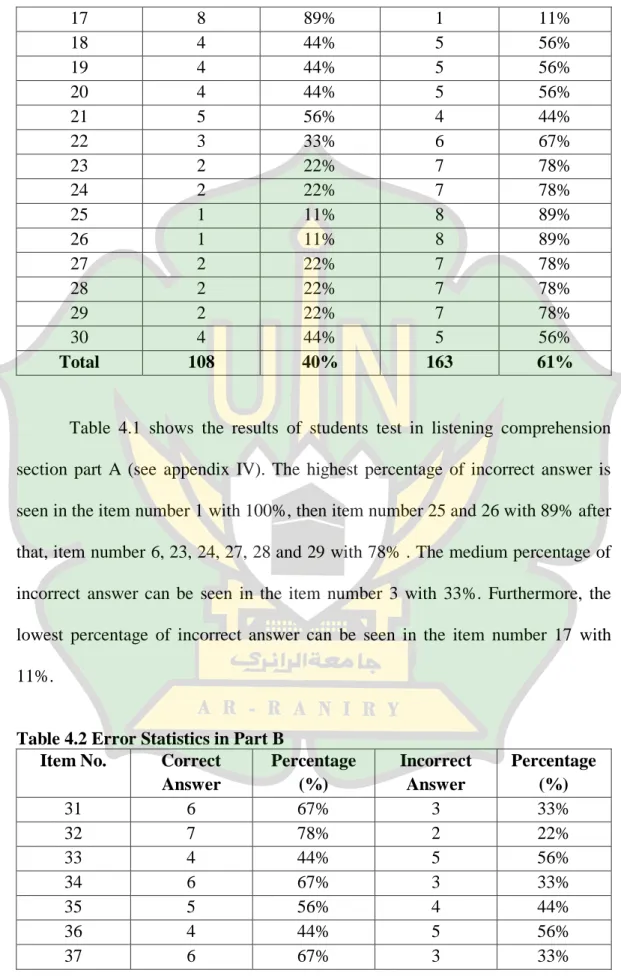
Answer Percentage (%) Incorrect Answer Percentage (%) 1 0 0% 9 100% 2 4 44% 5 56% 3 6 67% 3 33% 4 7 78% 2 22% 5 4 44% 5 56% 6 3 33% 7 78% 7 3 33% 6 67% 8 3 33% 6 67% 9 5 56% 4 44% 10 5 56% 4 44% 11 5 56% 4 44% 12 3 33% 6 67% 13 4 44% 5 56% 14 3 33% 6 67% 15 5 56% 4 44% 16 4 44% 5 56%
17 8 89% 1 11% 18 4 44% 5 56% 19 4 44% 5 56% 20 4 44% 5 56% 21 5 56% 4 44% 22 3 33% 6 67% 23 2 22% 7 78% 24 2 22% 7 78% 25 1 11% 8 89% 26 1 11% 8 89% 27 2 22% 7 78% 28 2 22% 7 78% 29 2 22% 7 78% 30 4 44% 5 56% Total 108 40% 163 61%
Table 4.1 shows the results of students test in listening comprehension section part A (see appendix IV). The highest percentage of incorrect answer is seen in the item number 1 with 100%, then item number 25 and 26 with 89% after that, item number 6, 23, 24, 27, 28 and 29 with 78% . The medium percentage of incorrect answer can be seen in the item number 3 with 33%. Furthermore, the lowest percentage of incorrect answer can be seen in the item number 17 with 11%.
Table 4.2 Error Statistics in Part B Item No. Correct
Answer Percentage (%) Incorrect Answer Percentage (%) 31 6 67% 3 33% 32 7 78% 2 22% 33 4 44% 5 56% 34 6 67% 3 33% 35 5 56% 4 44% 36 4 44% 5 56% 37 6 67% 3 33%
38 5 56% 4 44%
Total 43 60% 29 40%
Table 4.2 shows the results of students test in listening comprehension section of TOEFL part B. In this part, the highest percentage of students’ incorrect answers is in item number 33 and 36 with 56%. The medium percentage of students’ incorrect answers is shown in the item number 31, 34 and 37 with 33%. Moreover, the lowest percentage of students’ incorrect answer can be seen in the item number 32 with 22%.
Table 4.3 Error Statistic in Part C Item No. Correct
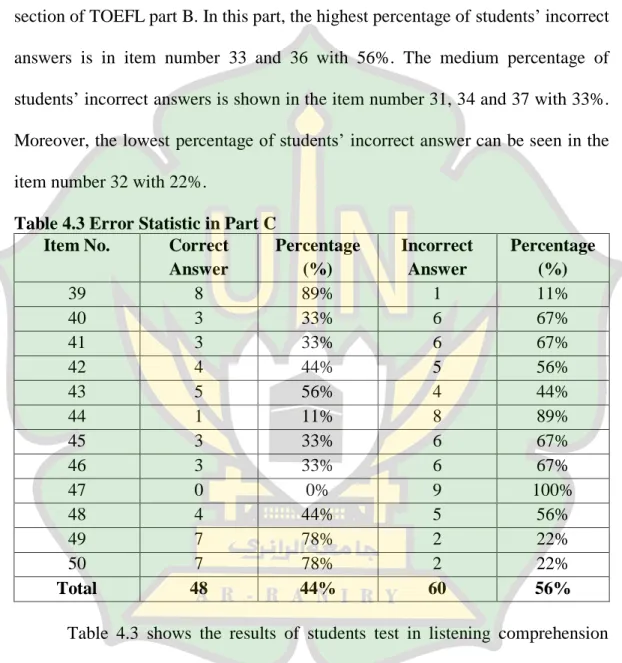
Answer Percentage (%) Incorrect Answer Percentage (%) 39 8 89% 1 11% 40 3 33% 6 67% 41 3 33% 6 67% 42 4 44% 5 56% 43 5 56% 4 44% 44 1 11% 8 89% 45 3 33% 6 67% 46 3 33% 6 67% 47 0 0% 9 100% 48 4 44% 5 56% 49 7 78% 2 22% 50 7 78% 2 22% Total 48 44% 60 56%
Table 4.3 shows the results of students test in listening comprehension section of TOEFL part C. In this part, the highest percentage of students’ incorrect answers is in item number 47 with 100% and item number 44 with 89% . The medium percentage of students’ incorrect answers was shown in the item number 43 with 44%. Moreover, the lowest percentage of students’ incorrect answer can be seen in the item number 49 and 50 with 22% then, item number 39 with 11%.
Table 4.4 Total Percentage of Part A, Part B, and Part C
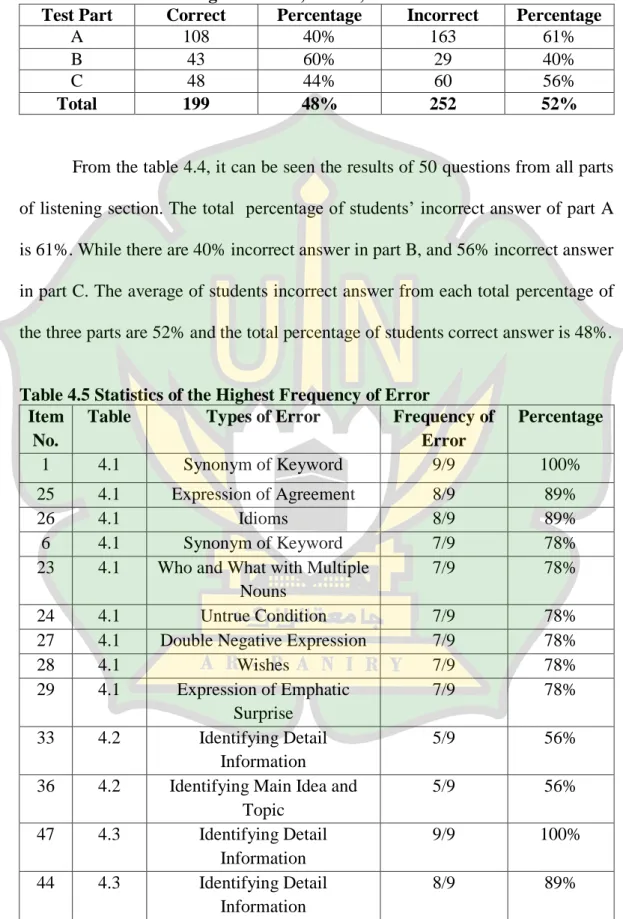
Test Part Correct Percentage Incorrect Percentage
A 108 40% 163 61%
B 43 60% 29 40%
C 48 44% 60 56%
Total 199 48% 252 52%
From the table 4.4, it can be seen the results of 50 questions from all parts of listening section. The total percentage of students’ incorrect answer of part A is 61%. While there are 40% incorrect answer in part B, and 56% incorrect answer in part C. The average of students incorrect answer from each total percentage of the three parts are 52% and the total percentage of students correct answer is 48%.
Table 4.5 Statistics of the Highest Frequency of Error Item
No.
Table Types of Error Frequency of
Error Percentage 1 4.1 Synonym of Keyword 9/9 100% 25 4.1 Expression of Agreement 8/9 89% 26 4.1 Idioms 8/9 89% 6 4.1 Synonym of Keyword 7/9 78%
23 4.1 Who and What with Multiple Nouns
7/9 78%
24 4.1 Untrue Condition 7/9 78%
27 4.1 Double Negative Expression 7/9 78%
28 4.1 Wishes 7/9 78% 29 4.1 Expression of Emphatic Surprise 7/9 78% 33 4.2 Identifying Detail Information 5/9 56%
36 4.2 Identifying Main Idea and Topic 5/9 56% 47 4.3 Identifying Detail Information 9/9 100% 44 4.3 Identifying Detail Information 8/9 89%
Total 81% Table 4.5 shows the results of the highest frequency of students error in answering listening comprehension. There are 13 items considered as the most difficult questions overall the 50 questions. Thus, the researcher spesified 5 major difficult elements the students had in the tests by percentage 89%-100%, the explanation will be discussed on the discussion.
2. Findings of the Interview
In this section, the researcher discusses the results of the interview which involved 9 students as the samples. The section concern on the listening comprehension. In addition, the focus of the interview was to know the factors influencing the difficulty in answering Listening Comprehension of TOEFL test.
In doing the interview, the writer gave some questions related to the topic about the students problem in listening comprehension of TOEFL test. After the writer finished interviewing, the writer found some factors causing students difficulties in listening comprehension of TOEFL test.
Findings of the interview showed that there were some of problems or difficulties in answering listening comprehension of TOEFL test as follow:
a. Problems related to Listening Material involved Tools
First question from number five (see appendix IV) was asked to know the problem in listening materials involved tools of listening comprehension. The result showed some of the interviewee responded the difficulties in listening
material involved tools because lack of tools. It could be seen from the students’ statements as follows:
“ When the speaker just in front of the room and I sit behind I can’t hear the audio”.
“ When the speaker is to far away like when I sit behind I can’t hear anything that’s the problem”.
“ Maybe tape, because if we got back seat we can’t hear the audio, just in front there is a tape”.
b. Problems related to the Content of the Listening Text
The second question was asked to know the difficulties about the content of the listening text. The result of the second question showed, all of participants found that the difficulties in content of the listening text are lack of vocabulary, unfamiliar vocabulary, and long sentences. All participants responded:
“ The difficulties about content, I think the first one unfamiliar vocabulary and then the native speakers speak so long, and I don’t get the information clearly”.
“ I mean like the lack of vocabulary sometimes I don’t know the vocabulary and that annoying”.
“ The problem that I found like unfamiliar vocab that can be a problem to answer the questions”.
“ Maybe unfamiliar vocab and then so that difficult to understand about the dialogue”.
“ The lack of vocabulary, in part A”. “ The unfamiliar vocabularies”.
“ There are some vocabularies that aren’t familiar to me”. “ I think unfamiliar vocabulary”.
c. Problems related to Mental Condition
The third question was asked to know the problems related to mental condition in listening comprehension. The result showed all of the interviewee have various answer, almost all of them found the difficulties in listening comprehension because they feel sleepy and boring. There were few of them said the problems of mental condition are lost concentration and nervous. It could be seen from the students’ statements as follows:
“ Sometimes I lost the concentration, especially in Part B and Part C because I feel bored to hear the long dialogue”.
“ Sometimes because it so cold and then I feel like bored and sleepy”. “ Maybe about mental condition is if we get TOEFL test in the afternoon
about 02.00 p.m. feel like tired and sleepy”.
“ When I feel nervous like that so I don’t concentrate to answer the TOEFL test”.
“ Bored and sleepy”.
“ Sometimes I feel bored and sleepy because the time is so long my brain is tired to think the questions”.
“I feel bored”.
“Sometimes I feel sleepy when I am bored”.
“ I feel bored, sometimes I lost consentration while the test”.
d. Problems related to Physical Condition
The fourth question was asked to know the difficulties of physical condition in listening comprehension of TOEFL test. The participants answer that the problems related physical condition are stomach ache and body ache while the test. Some of them said:
“ Maybe I feel sometimes like I wanna got sick when I got stomach ache and it’s really annoying me”.
“ I got bodyache when it’s so cold and make me not focus”.
“ The problem was when I took the TOEFL test in the morning, sometimes I feel stomach ache maybe because the AC (Air Conditioner) so cold.
This case make me not focus in answer the question”.
e. Problems related to Environmental Condition
The fifth question was asked to know the problem about environmental condition in listening comprehension of TOEFL test. The result showed, some of participants found that the difficult in answering listening comprehension of TOEFL test toward environmental condition is temperature of AC (air conditioner) so cold. Some of the participants responded:
“ I can’t to concentration and focus if class of the test so cold”. “ When the AC (Air Conditioner) is so cold”.
“ Sometimes the air conditioner temperature is too cold”.
f. Problems related to Time
The last question was asked to know the other factors influencing the difficulties in answering listening comprehension of TOEFL test. The result showed of the last question, one student responded the other problem is lack of time. It could be seen from the student statement as follows:
“ I think I need extra time because I think I don’t have enough time to answer all the questions”.
B. Discussion
This section explains the discussions of the research questions stated in chapter I. Here are the following explanation:
1. Research Question Number 1: What are the most difficult elements faced by the students in answering listening section of TOEFL test?
From the results obtained, there were 5 major difficult elements the students had in the tests, as follows:
a) In item number 1 (see Table 4.1) in which all students taking the test failed to get the correct answer or 100% error. In this question about synonym of keyword, the partipants might face difficulties when choosing the correct answer that they ignored about choosing synonyms. They preferred an answer with the same sounds as what they heard. It is implied that they would have wrong answer if they used similar sounds to answer. This notion has been claimed by
(Phillips, 2001, p. 33) that it is often the incorrect answers are answers that contain words with similar sounds but have different meanings from what the listener hear on the recording, the listener should definitely avoid these answer. The students’ lack of vocabulary and knowledge about synonym words might be one of the reasons of this matter. Stepanoviene (2012) agrees that one difficult for listening comprehension is limited vocabulary or knowledge of academic terms.
b) In item number 25 (see table 4.1), 89% students failed to succeed in the test. It could be indicated that the question related expression agreement was difficult for them. The students are unfamiliar with the expressions of , “neither do I”, “ so do I”, “me too”, and “he doesn’t either”. They have to know those expressions well. So that they will be easier to recognize and comprehend them when they find them in the conversation.
c) In item number 26 (see table 4.1), 89% students did not pass the test. There were 8 students out of 9 students who failed in this item test. Most of them was difficult to determine the idioms, Phillips (2001, p. 72) confirms that “Idiom questions can be difficult for students because they seem to be describing one situation when they are really describing a different situation”. From some students answer sheet, they choose an answer with the same sounds as what they heard “ I