This is a peerreviewed, postprint (final draft postrefereeing) version of the following in press document, For noncommercial use only. Derounian, J. Mobiles in class?, Active Learning in Higher Education. Copyright © 2017 (James Derounian). Reprinted by permission of SAGE Publications. and is licensed under All Rights Reserved license:
Derounian, James ORCID: 0000000317389764 (2017) Mobiles in class?
Active Learning in Higher Education. ISSN 14697874 (In Press)
Official URL: https://doi.org/10.1177/1469787417745214 DOI: http://dx.doi.org/10.1177/1469787417745214 EPrint URI: http://eprints.glos.ac.uk/id/eprint/5261 Disclaimer The University of Gloucestershire has obtained warranties from all depositors as to their title in the material deposited and as to their right to deposit such material. The University of Gloucestershire makes no representation or warranties of commercial utility, title, or fitness for a particular purpose or any other warranty, express or implied in respect of any material deposited. The University of Gloucestershire makes no representation that the use of the materials will not infringe any patent, copyright, trademark or other property or proprietary rights. The University of Gloucestershire accepts no liability for any infringement of intellectual property rights in any material deposited but will remove such material from public view pending investigation in the event of an allegation of any such infringement. PLEASE SCROLL DOWN FOR TEXT.Mobiles in class?
James Garo Derounian
University of Gloucestershire, UKAbstract
Change and exploration offer students and staff the opportunity to positively embrace use of mobile devices in higher education teaching, so that the much-vaunted pursuit of technology-based co-production of learning can become a reality. There is a need to evaluate the incidence and effect of the use of mobile devices in class, however, given the newness and rapidly changing nature of the technologies. This study presents a review of the pros and cons of students using mobile phones, smartphones, laptops and tablets in contact sessions. It sets out to determine how the potential of mobile devices for learning may be realised, and negatives minimised, given that the literature paints a very mixed picture of both positive and negative impacts of using mobile devices for higher education teaching and learning. In addition, there are insights from students about how they and lecturers can practically enhance use of technologies in class. There remain gaps in research around this topic, for example, looking at whether students undertaking different subjects respond
differently to the use of mobile devices for study.
Keywords
devices, mobiles, perceptions, social media, technologies
To be or not to be in higher education (HE) … ?
A key issue for both students and staff at universities and colleges is what to do about mobile devices in the lecture room. According to the UK communications watchdog Ofcom, in 2015, 93% of adults in the United Kingdom owned or used a mobile phone, while 66% had a smartphone.
Similarly, Australia has 19.4 million mobile users out of a total population of just over 24 million (Statista online, 2017). In North America, the time spent on mobiles by adults has increased from 12% of that spent on devices (in 2008) to 51% in 2015 - a threefold increase, while in South Africa, there are some 20 million smartphone users, with students accounting for a large proportion of these (eLearning industry, 2016). The basic message is that equipment – such as mobile phones, smartphones, laptops and tablets – is ubiquitous and increasingly a daily part of life for many worldwide (Economides and Grousopoulou, 2010; Voelkel and Bennett, 2014). What then do we discover about students and mobile usage? We find a fast-moving and emotive topic. At a time when many homes are filled with electronic gadgets, educationalists are attempting to gauge how much technology to bring into classes (Earl, 2012). This is an issue that research casts light on, in that it is common to observe students physically present, yet mentally absorbed by non-course-related information on mobile devices (Kuznekoff et al., 2015). There is evidence for and against the use of mobile devices within undergraduate teaching. This ambiguity mirrors exploratory research that conveys the pros and cons of Twitter for e-learning in HE (Kassens-Noor, 2012). The dilemma is neatly encapsulated by McCoy (2013), who argues that digital devices, while important, if used in the classroom for non-class purposes, may negatively impact learning.
A survey concludes that students and staff share enthusiasm for mobile devices, but actual use in academic settings remains low, notwithstanding widespread usage by the public (Alrasheedi et al., 2015; Dahlstrom et al., 2016). Such technologies are therefore widely used, particularly by the
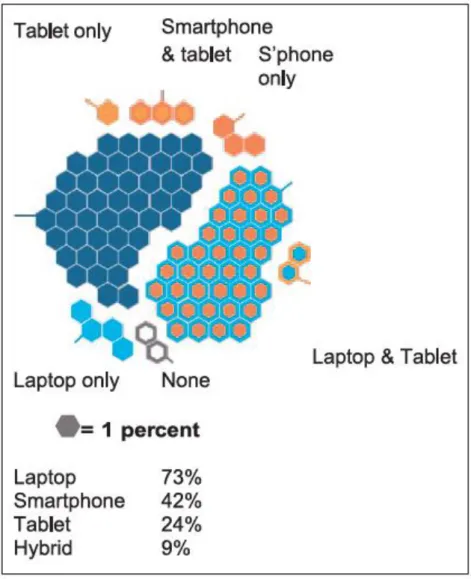
young, and present both opportunities and challenges for teachers and learners in HE. Facebook dominates social networking among teenagers, with 68% listing this as their main social networking site, providing a familiar and comfortable means through which to share information, contacts, and promote discussion of study themes and topics (Waghid and Waghid, 2016). The same survey reports 68% of teens texting at least once a day. Research into Twitter as an aid to participatory learning shows that interaction using this, supported by tutors, enables significant dialogue (Prestridge, 2014). But, this is a rapidly evolving arena in which innovations are arriving at a fast pace, so as examples, both Snapchat (2013) and WhatsApp (which combined with Facebook in 2014) both arrived on the scene after the Common Sense Media findings. A study of students shows how they are likely to use mobile devices on a typical study day (Figure 1).
Figure 1 US college students’ daily use of mobile devices. Source: Pearson, Student Mobile Device Survey 2015 National Report: College Students.
The enjoyment of, and access to, electronic resources can clearly be seen as a benefit of using mobile devices in contact sessions. Furthermore, while most teens do not believe that use of social media affects their emotional welfare, many more report a positive impact on their well-being than having a negative impact (Common Sense Media, 2012).
There are four benefits of mobile technologies in class, namely, preparing students for the future, enabling up-to-date learning, using mobile devices as alternative textbooks and expanding learning beyond the classroom (Wainwright, 2012). In addition, students respond positively to the stimulus of
mobile devices (Lynch, 2015). They stay on task and correct mistakes as they proceed, and learning in this way excites them. There is also the uncomfortable thought – for teaching academics – that students may be on their devices because they are not engaged or are bored by the teacher and teaching (Narendran et al., 2017; Olufadi, 2015). Therefore, a benefit of mobiles in class may ironically be as a welcome alternative to the tedium of particular instruction. However, it does not follow that students will focus on the instructor or information when the class is technology-free. While there is paper to doodle on, lists to prepare, windows to look out of or newspapers to scan, lecturers will face partially attentive classes (Dahlstrom et al., 2016). Weimer (2015) argues that what stops students texting is the possibility or actuality of confrontation in class, where a teacher takes their device, lowers a grade or removes them from the session and then goes on to query what effect such collisions have on the atmosphere and continuing teacher–student relationships.
Given that so many would describe themselves as ‘addicted’ to their phones, that they wished they could ‘unplug’ and that they expressed worry at the pressure of constant texting and posting (Common Sense Media, 2012), use in class may therefore be seen to feed a craving rather than provide respite. Furthermore, instant access to multiple sources of information, such as email, Internet, games and calendars, encourages multitasking that can induce continuous partial attention and distraction (Patient and Bere, 2013; Rahman et al., 2013; Tossell et al., 2015). This may be considered a negative in life, let alone study. As examples, continuous partial focus sounds a recipe for disaster when driving, operating machinery or spending time with friends. Given that users say they often encounter derogatory speech online (Common Sense Media, 2012), use in class may be inadvertently exposing students to the damaging behaviours of others. Study use of devices may play to the strengths and habits of some over others. Another (potential) division according to the Pearson (2015) study (supported by Newhouse and Rennie, 2001) is that students believe they know more than lecturers about how to use mobile devices for learning. This could, of course, be seen as a positive to encourage co-production of learning but equally may induce anxiety among staff, fearing of loss of respect and diminished control of class-based activities.
Students who text in class frequently take poorer notes, retain less information and do worse in tests based on the material (Kuznekoff and Titsworth, 2013). Those multitasking on a laptop during lectures, for example, note-taking, texting and on Twitter, gain lower test scores compared to those who did not multitask, and others in direct view of a multitasking peer scored lower on a test compared to those who were not (Sana et al., 2013). So there is seemingly a direct and indirect negative effect. Students not using mobile phones in class wrote down 62% more information in notes and scored a full grade and a half higher in a multiple-choice test than students using their mobile phones (Kuznekoff and Titsworth, 2013). It is argued strongly that student use of laptops in class worsens academic performance (Patterson and Patterson, 2017). In addition, laptop note-takers do not perform, as well as those taking notes longhand, with regard to conceptual questions, nor do they recall content to the same degree over time (Mueller and Oppenheimer, 2014).
Narendran et al. (2017) go so far as to suggest that jamming devices should be installed in lecture rooms to incapacitate mobile use. But in opposition to this prevailing view, research by Jose et al. (2016) demonstrated that an Information and Communication Technologies (ICT) tool was significant in helping to improve academic performance.
Lecturers agree that students need digital literacy to be successful in studies and life (Pew, cited in Lynch, 2015). It is perhaps surprising then that only 47% see a strong need for their students to be digitally prepared for life. This may reflect the students’ belief that they know more than staff about how to use electronic gadgets for learning (Aiyegbayo, 2015; Newhouse and Rennie, 2001), which also links to the argument that lecturer authority can be undermined when mobile technologies enter the classroom. There are other pitfalls: bringing devices to university may draw attention to differences based on class, whereby some students are perceived to be more privileged than others,
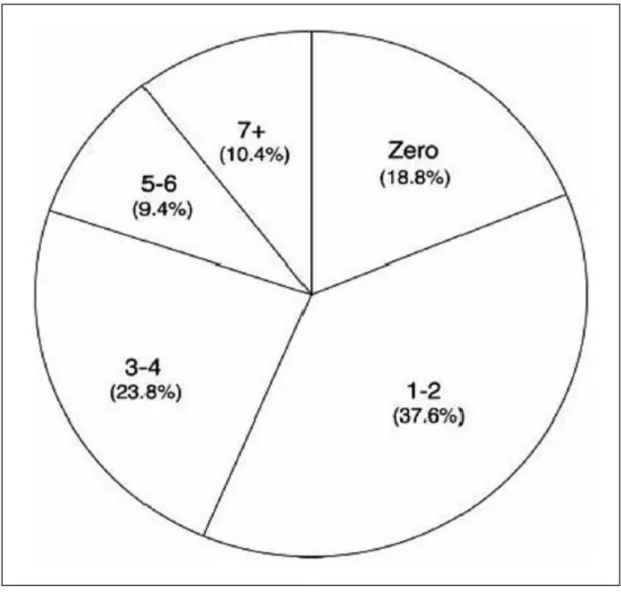
and there is always the possibility of theft (Lynch, 2015). It is also argued that course materials are seldom designed for display on smartphones and that as a result navigation on websites, whether via a learning management system or any other, is very difficult (Farley et al., 2015). The spectre of using cell phones to cheat is a possibility, and there is evidence that students are less likely to use devices during smaller classes and in those fostering group activities and participation (Berry and Westfall, 2015). Large class sizes embolden students to use their mobiles, with little fear of being discovered or reprimanded. Figure 2 indicates how often students feel impelled to check their mobiles during an average class.
Figure 2 Number of times students report checking phones in an average class. Source: Berry and Westfall (2015).
The literature conveys mixed messages about the presence of mobile devices in class (MacCallum and Jeffrey, 2009). As a result, there is a need to discover whether student consensus exists on how best mobile devices can be deployed as a learning aid, and negatives reduced. It is this student perspective on what is – and what is not – beneficial in terms of using mobile technologies in class, that is the overall aim of this study and a gap in the literature. To this end, the research endeavours to establish how often students use a mobile device for activities such as note-taking and searching for material relevant to the class, but also how frequently students are, in fact, texting friends or arranging their social lives. In addition, how regularly do they check their mobiles in class and what
do they perceive to be the strengths and drawbacks of using mobile phones during contact sessions in terms of rank order?
Methodology
Participants
A total of 100 students participated in the study. Out of them, 49 studied BSc (Hons) Criminology, while 21 were Applied Social Sciences undergraduates at a university in the south west of England. There were 19 BA Sociologists and 11 who were studying Criminology and Sociology combined (Table 1). Most of the respondents were in the second year (41%) or final year (57%) of an undergraduate degree. A minority were first-year undergraduates (2%). All of the students were familiar with the presence of Moodle (Virtual Learning Environment (VLE)) support, discussions, availability of lecture notes and electronic resources, such as e-books, linked to their modules. Prior to the beginning of the study, the undergraduates expressed general interest in the topic. Students were informed by the author of this study of the opportunity to take part. All completions were anonymous, and the collected data could not be linked to an individual. Furthermore, students were prompted to participate by their peers on the basis that this would encourage involvement and not expose them to any potential teacher–student coercion.
Table 1 Breakdown of survey respondents by course.
BSc Criminology
49
BA Sociology
19
BSc Criminology and Sociology
11
BSc Applied Social Sciences
21
Total
100
Source: Author’s survey, 2017
Design and procedure
A 10-question survey was initially created reflecting key ideas from the literature, presented in the form of a Strengths, Weaknesses, Opportunities and Threats (SWOT) analysis, regarding student use of mobile devices in class. A total of 10 Social Sciences students (full time undergraduate, middle and final years) were invited to complete a pilot survey. As a result of feedback, one of the strengths listed in a survey question was reworded to clarify meaning. The marginally revised questionnaire was then made available via a hyperlink embedded in an explanatory email, sent to Social Sciences undergraduates studying across all three levels. Students were asked how often they used a mobile device for note-taking, searching for material relevant to the class, texting friends, for Facebook posts and arranging their social life, and if they used it for any other things during class. They were asked to what extent they agreed with the statement ‘access to a mobile device during class is beneficial for student learning’, and having been provided with a list of the strengths of using mobile devices in class, they were asked to select the three statements that they agreed with most. The same was then carried out with the list of negatives, the opportunities and the threats. They were asked, if they thought whether or not staff knowing more about how to use mobile devices for learning than the students themselves was either an opportunity or a threat, and asked to explain their answer. Finally, they were asked to think of any more strengths, weaknesses, opportunities or threats of using mobile devices in class and for their comments on anything else that they would like to say on this topic. The questionnaire was completed by students at the author’s university. The returns were made via free SurveyMonkey software. The survey was capped at 100 completions, shortly after which the 10 students involved in the pilot phase were invited to a focus group to
discuss the results and to generate a guidance note for staff and students, indicating what was deemed appropriate and not recommended, in terms of mobile use in class. Since respondents are anonymous, they have been given pseudonyms. Ethical approval was not sought or deemed necessary.
Measures and analysis
The SurveyMonkey software automatically tallied replies to the questions. In addition, free text comments were offered by 43 responding students and then grouped by the author according to themes based on keywords.
Findings
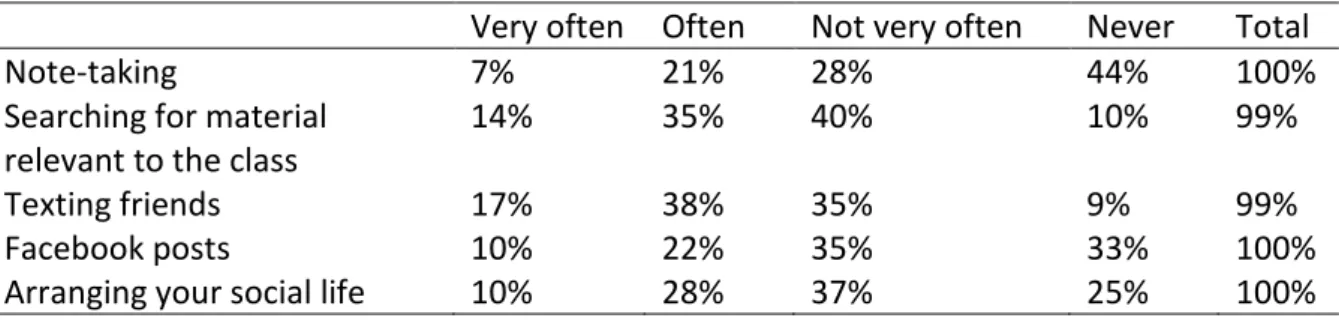
As shown in Table 2, almost half of the sample said they used mobiles often or very often for searching out material relevant to the class, while over a quarter took electronic session notes often/very often. A substantial number were, however, often or very often engaged in non-study activities: 55% texting, 32% on Facebook and 38% sorting their social life.
Table 2 How often respondents use a mobile device for the following during a typical university class.
Very often Often
Not very often
Never
Total
Note-taking
7%
21%
28%
44%
100%
Searching for material
relevant to the class
14%
35%
40%
10%
99%
Texting friends
17%
38%
35%
9%
99%
Facebook posts
10%
22%
35%
33%
100%
Arranging your social life
10%
28%
37%
25%
100%
Source: author’s survey 2017.
Students were then asked to state the extent to which they agreed with the statement, ‘access to a mobile device during class is beneficial for student learning’. A majority, 45%, agreed to differing degrees, 23% disagreeing or strongly disagreeing, while the remaining 32% were neutral. The top three strengths of using mobiles in class – those most commonly selected – related to ‘open access’ materials electronically available to anyone at any time, use of mobile devices to access electronic textbooks that thereby extends learning beyond the classroom and the fact that mobiles are widely owned and used by students (Table 3).
Table 3 Survey responses on strengths of using mobiles in class: rank order.
Answer choices
Responses
Availability of ‘open access’ materials (for everyone)
56
Acts as alternative textbooks, expands learning beyond the classroom
54
Mobile devices widely available and used by students
49
Enables access to up-to-date learning
43
Social media promotes student interaction and friendships
39
Prepares students for future use of mobile technologies
15
Positive impact of use on emotional well-being
13
Fosters group learning, peer support and networking
12
Total respondents
79
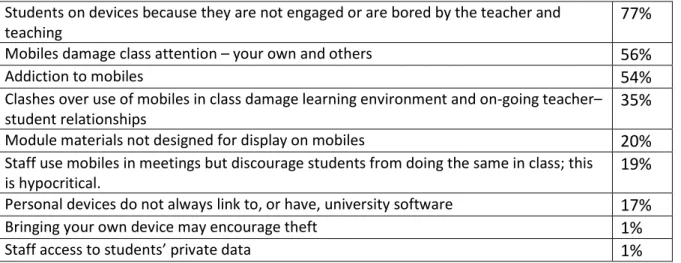
Respondents also identified a number of weaknesses concerning the use of mobiles in class (Table 4). The most common response was that students were on their devices because the teacher and/or teaching were boring, not engaging or both (77%). Over half (56%) believed that mobiles damaged class attention – their own and that of others. Around half (54%) of respondents also acknowledged that they believed themselves addicted to their mobile and impulsively bound to use it.
Table 4 Students’ perceived drawbacks to using mobile devices in class.
Students on devices because they are not engaged or are bored by the teacher and teaching
77%
Mobiles damage class attention – your own and others
56%
Addiction to mobiles
54%
Clashes over use of mobiles in class damage learning environment and on-going teacher– student relationships
35%
Module materials not designed for display on mobiles
20%
Staff use mobiles in meetings but discourage students from doing the same in class; this is hypocritical.
19%
Personal devices do not always link to, or have, university software17%
Bringing your own device may encourage theft
1%
Staff access to students’ private data
1%
The opportunities that respondents foresaw for student use of mobiles in staff–student contact sessions all registered above 60%: 86% perceived that lecturers and students could share teaching and learning over space and time. Similarly, there was widespread use by students of social media (73%) which suggests that they would be familiar with the format and functionality if asked to use such platforms for learning activities; recognition that they need digital literacy to be successful academically and in life (70%), and last is the opportunity for disabled students and staff (61%) to access learning. In terms of threats to teaching (Table 5), it was acknowledged that use of mobiles for non-class purposes may reduce student learning. Similarly, most (77%) felt classroom learning was threatened by student–staff clashes over use of devices. More than half (56%) were concerned that access to mobiles may facilitate cheating, and 40% mentioned hate/derogatory speech and cyber-bullying as a threat.
Table 5 The perceived threats of mobile use by students in class, in rank order.
Use for non-class purposes may reduce student learning
94%
Staff–student confrontations over use of mobile devices in class
77%
Mobile devices enable cheating
56%
Significant ‘derogatory speech’ online/cyber-bullying
40%
Limited learning technology support, power cuts, slow www. and so on
23%
Inequality: Black and minority ethnic (BME) students are heavier mobile users than White studentsOne question asked for comment on whether students knowing more than staff about how to use mobile devices for learning is both an opportunity and a threat: 48% agreed with this ambivalent status, while 14% did not agree that there were pros and cons, and 38% chose to explain their reasoning. Half of the respondents wrote along the lines that ‘younger people have grown up being the technology generation which is why they’ll know more about technologies such as mobile phones’ (John). This ties in with Abigail’s suggestion that it is ‘an opportunity for students to teach staff about mobile phones and their uses!! Creates a positive learning relationship’.
However, 8 out of 38 respondents (21%) commented that staff ‘are up to date with mobile devices otherwise they cannot work in the current world’ (Alastair). They cited examples where lecturers ‘are aware of online apps and resources which allow for extended research and participation in the lecture that students were previously unaware of’ (Joyce); Fergus mentioned specifically that lecturers have ‘regularly shown me positive ways to use my phone to aid learning’. Having dyslexia ‘makes note taking a struggle, and I have been shown various apps to overcome this’ (Dylan). Additionally, ‘they often encourage us to use them when doing further research in the lecture breaks’ (Amber). Other responses were either ambiguous or did not directly answer the question. As an example Ahmed noted, ‘I’ve never thought about how much a staff member knows about using a phone for learning because it doesn’t really matter, as long as I know what to do with it’.
Finally, respondents were given the chance to set down any other strengths, weaknesses, opportunities or threats of using mobile devices in class: 43 took this opportunity and 57 did not. Discursive comments fell under a series of 8 positive and 8 negative themes, presented in Table 6.
Table 6 Positives and negatives of using mobile devices in class.
Positives of using mobile devices in class:
1. ‘Useful when working in groups to learn more about the subject matter to get a better discussion going’ (Fran)
2. Quick access to Internet to explore a topic and develop new ideas 3. Communicate quickly and more efficiently
4. Access session materials, lecture notes and PowerPoints 5. Ability to type legible and retrievable notes
6. ‘Knowing if family are ok if someone is ill’ or in case of terrorist attack
7. Aids concentration via use of varied teaching techniques – quizzes, in-class surveys and so on 8. Interactive electronic engagement ‘requires you to think and for everyone to answer and even the ones too shy to speak out loud can enter answers and see how they do’
Negatives of using mobile devices in class:
1. Distraction/disruption: ‘The beeps and ringtones are disruptive to others’
2. Disrespectful ‘when someone is presenting to you, to be sat on your phone’ (George)
3. ‘Nothing turns me off a lecture more than lecturers asking me to not use my phone … it feels belittling’
4. Temptation: ‘so easily able to jump from an academic journal to Facebook’ …. ‘it’s just there next to you/in your bag … ’
5. Uncertainty: ‘It should be made clear whether students are expected to have access … during class as on occasions when I did not have a mobile device I felt as though I did not have access to the same information as others … ’
7. ‘Cyber-bullying is a large threat for anyone because it’s so easy to hurt people when you’re not face-to-face and hiding behind a screen’
8. ‘Information online can be fake or incomplete, and if the student relies on them, it can be harmful to their general knowledge and … academic development’
Discussion and conclusion
The primary purpose of this study was to discover whether student consensus exists on how best mobile devices can be deployed as a learning aid, and negatives reduced. Furthermore, to establish how often students use a mobile device for activities like note-taking and searching for material relevant to the class, but also how frequently students are, in fact, texting friends or arranging their social lives, something raised by Economides and Grousopoulou (2010). Finally, how regularly do they check their mobile in class and what do they perceive to be the strengths and drawbacks of using mobile phones during contact sessions in terms of rank order?
The findings reinforce what the literature shows in terms of widespread use of mobile devices by students, both within and outside the classroom. The findings also show that students
simultaneously registered potential and actual possibilities and pitfalls of using mobiles in class; this ties in with findings by Economides and Grousopoulou (2010). While nearly half of students self-reported regularly searching for material relevant to classes – a point supported by Hinton (2017) and Bradley et al. (2010) – similar levels articulated frequent non-study texting, posting messages and arranging their social calendar. The impulsive nature of mobile use is strongly reinforced by student responses, with just over half agreeing that mobiles damaged their own and peers’ attention to studies. A similar percentage believed themselves to be addicted and, therefore, could not resist referring to their mobiles. This tallies with the findings of Narendran et al. (2017) that 57% of students recorded that they used social media regularly in lectures and that a majority utilise it to communicate with friends or for gaming linked to addiction or to avoid boredom.
But equally the opportunities that respondents identified for use of mobiles in staff–student contact sessions all registered above 60%. Far out in front was a perception that staff and students could share teaching and learning over space and time, so that study may take place at individual convenience in terms of when and where it occurs. This acknowledgement of freedom and flexibility chimes with findings made by MacCallum and Jeffrey (2009), Samuel et al. (2012) and Moreira et al. (2017). Then in quick succession came widespread use by students of social media; recognition that they needed digital literacy to be successful, and last the potential access to learning for disabled students and staff afforded by mobile technologies.
Having established the problems and possibilities for mobiles, students generated a series of practical suggestions on how the potential of mobile devices for learning can be realised, and problems minimised. Some of these recommendations are directed at both students and staff, such as putting phones on silent at the start of a teaching session and both parties being explicit at the beginning of a module or class whether mobile use for study-related purposes is/not encouraged. Others are specific to either staff or students. For example, a lecturer building in a ‘free 5 minutes’ per teaching hour, during which students can use their mobiles for whatever they choose. Students, however, are encouraged by their peers to suggest to tutors during class on how a session or topic can be investigated and elaborated using e-resources, thus giving practical expression to co-production of teaching and learning.
The limitations of the study are as follows. The data come from 100 undergraduates studying Social Sciences courses at one university in one particular country, that is, a small sample size and limited by discipline and context. The findings and respondents do not account for the views of
postgraduates, or from courses and subjects other than the Social Sciences, and do not reflect the culture and inputs of those studying beyond this context. The findings could therefore be considered more illustrative than representative. A limitation of the online survey is that students self-selected as to whether they participated or not. It may therefore be that the more motivated contributed, thereby perhaps skewing the results. There could also be an element of social desirability conveyed in the student views given. It is possible that answers have been framed in a way that respondents believed to be more acceptable than their ‘true’ answer. The effect might be to over-report socially desirable attitudes and under-record undesirable ones. Where such self-editing occurs, it constitutes a form of bias.
In terms of a future research agenda, there remain significant areas and gaps to explore in detail. For example, broadening the scope to draw on other universities and those studying subjects beyond the Social Sciences. There must in addition be a broad research field to establish whether student views are universal or diverge significantly according to context. For example, how are students in one discipline but studying on different continents likely to view use of mobile devices in class? Similarly, it may be worthwhile investigating if changes are detected in use from fresher to middle year to final year first degree study. Furthermore, this study bundles together ‘mobile devices’, and research on specific use of laptops, smartphones and tablets could be worthwhile. Are tablets, as an example, better for note taking than smartphones? There is a need to determine the degree to which the impact of devices differs from one student to another according to personality and characteristics. The possibility of cyber-bullying resulting from in-class mobile use is an additional area that could be explored. Finally, it would be interesting to see whether this ‘snapshot’ of student attitudes is reflecting nothing more than transitional views. Opinions on usage may simply reflect, in 2017, an uneasy and uncomfortable crossing point towards virtual total coverage of mobile devices for learning and teaching.
The messages emerging from this study highlight an opportunity for student–staff collaborations to effectively harness mobiles for learning. Examples of appropriate cooperation might be students alerting staff to innovative technologies to aid research, searching for materials or communicating information. A lecturer should know what they wish to convey, but a student may know how best to disseminate such information. Students can be more up to date as consumers and users of
technologies, which may complement staff members’ capabilities as curators of materials unearthed. The student can be likened to a digger at an historical site, where it requires the staff member, as archaeologist, to add complementary skills in interpreting and assessing the validity of what a student has brought to the surface. To effectively integrate technology into classrooms, academics must continue to examine the positive and negative impacts of technologies on learning (Sung et al., 2016). Technologies are changing rapidly and no doubt will continue to do so. There will be pressure to integrate current and new tools in productive ways for student benefit.
In line with literature and student feedback informing this article, the technologies augment face-to-face interactions, including teaching and learning. A final message, therefore, is that our humanity remains central to learning and teaching. Someone to incite curiosity and feed creativity and imagination continues centre stage (Jobs, 1995). Change and exploration offer both students and staff the opportunity to positively engage and embrace use of mobile devices in HE teaching, so that we can make real the much-vaunted possibilities of technology-based co-production of learning (Rahman et al., 2013).
Declaration of Conflicting Interests
The author(s) declared no potential conflicts of interest with respect to the research, authorship, and/or publication of this article.
Funding
The author(s) received no financial support for the research, authorship and/or publication of this article.
References
Aiyegbayo O (2015) How and why academics do and do not use iPads for academic teaching? British Journal of Educational Technology 46(6): 1324–1332.
Alrasheedi M, Capretz LF and Raza A (2015) A systematic review of the critical factors for success of mobile learning in higher education (university students’ perspective). Journal of Educational Computing Research 52(2): 257–276.
Berry MJ and Westfall A (2015) Dial D for distraction: The making and breaking of cell phone policies in the college classroom. College Teaching 63(2): 62–71.
Bradley C, Weiss M, Davies C, et al. (2010) A little less conversation, a little more texting please - A blended learning model of using mobiles in the classroom. In: Proceedings of the 5th international blended learning conference ‘Developing Blended Learning Communities’, University of Hertfordshire, Hatfield, 16–17 June, pp. 1–11. Nottingham: Nottingham Trent University.
Common Sense Media (2012) Social Media, Social Life: How Teens View Their Digital Lives. Available
at:
https://www.commonsensemedia.org/research/social-media-social-life-how-teens-view-their-digitallives (accessed 14 February 2017).
Dahlstrom E, Brooks DC, Pomerantz J, et al. (2016) ECAR Study of Undergraduate Students and Information.
EDUCAUSE Center for Analysis and Research (ECAR). Available at: https://library.educause.edu/~/ media/files/library/2016/10/ers1605.pdf (accessed 22 May 2017).
Earl R (2012) Do cell phones belong in the classroom? The Atlantic, 18 May. Available at: https://www.theatlantic.com/national/archive/2012/05/do-cell-phones-belong-in-the-classroom/257325/ (accessed 13 February 2017).
Economides AA and Grousopoulou A (2010) Mobiles in education: Students’ usage, preferences and desires. International Journal of Mobile Learning and Organisation 4(3): 235–252.
elearning industry (2016) Mobile technology in the classroom, 20 July. Available at:
https://elearningindustry.com/5-uses-mobile-technology-in-the-classroom (accessed 16 February 2017).
Farley H, Murphy A, Johnson C, et al. (2015) How do students use their mobile devices to support learning? A case study from an Australian regional university. Journal of Interactive Media in Education 1, part 14.
Hinton Z (2017) How can we integrate students’ use of mobile devices within the lecture lesson plan and improve engagement? Spark: UAL Creative Teaching and Learning Journal 2(3): 196– 206.
Jobs S (1995) Smithsonian institution interview. Available at:
http://americanhistory.si.edu/comphist/sj1.html (accessed 15 February 2017).
Jose I, Castillo-Manzano JI, Castro-Nuño M, et al. (2016) Does pressing a button make it easier to pass an exam? Evaluating the effectiveness of interactive technologies in higher education. Administration and Business Management 47(4): 710–720.
Kassens-Noor E (2012) Twitter as a teaching practice to enhance active and informal learning in higher education: The case of sustainable tweets. Active Learning in Higher Education 13(1): 9–21.
Kuznekoff J, Munz S and Titsworth S (2015) Mobile phones in the classroom: Examining the effects of texting, Twitter, and message content on student learning. Communication Education 64(3): 344 365.
Kuznekoff JH and Titsworth S (2013) The impact of mobile phone usage on student learning. Communication Education 62(3): 233–252.
Lynch M (2015) Do mobile devices in the classroom really improve learning outcomes? Available at:
http://theconversation.com/do-mobile-devices-in-the-classroom-really-improve-learning-outcomes-38740 (accessed 15 February 2017).
MacCallum K and Jeffrey L (2009) Identifying discriminating variables that determine mobile learning adoption by educators: An initial study. In: Paper to ASCILITE (Australasian society for computers in learning in tertiary education) conference, Auckland, New Zealand, 29 September-1 October.
McCoy BR (2013) Digital Distractions in the Classroom Phase II: Student Classroom Use of Digital Devices for Non-class Related Purposes (Paper 71).Faculty Publications, College of Journalism & Mass Communications, University of Nebraska–Lincoln. Available at:
http://digitalcommons.unl.edu/cgi/viewcontent.cgi?article=1070&context=journalismfacpu b (accessed 14 February 2017).
Moreira F, Ferreira MJ, Santos CP, et al. (2017) Evolution and use of mobile devices in higher
education: A case study in Portuguese higher education institutions between 2009/2010 and 2014/2015. Telematics and Informatics 34(6): 838–852.
Mueller PA and Oppenheimer DM (2014) The pen is mightier than the keyboard: Advantages of longhand over laptop note taking. Psychological Science 25(6): 1159–1168.
Narendran N, Lally MS and Rajany J (2017) Social media use and perception of live lectures by medical students. Journal of Evidence-based Medicine and Healthcare 4(16): 921–924. Newhouse P and Rennie L (2001) A longitudinal study of the use of student-owned portable
computers in a secondary school. Computers & Education 36(3): 223–243. Ofcom online (2015) Fast facts. Available at:
https://www.ofcom.org.uk/aboutofcom/latest/media/facts (accessed 12 February 2017).
Olufadi Y (2015) Gravitating towards mobile phone (GoToMP) during lecture periods by students: Why are they using it? And how can it be measured? Computers & Education 87: 423–436. Patient R and Bere A (2013) Using mobile instant messaging to leverage learner participation and
transform pedagogy at a South African university of technology. British Journal of Educational Technology 44(4): 544–561.
Patterson RW and Patterson RM (2017) Computers and productivity: Evidence from laptop use in the college classroom. Economics of Education Review 57(C): 66–79.
Pearson (2015) Student Mobile Device Survey 2015. National report: College students. Available at:
https://www.pearsoned.com/wp-content/uploads/2015-Pearson-Student-Mobile-Device-Survey-College.pdf (accessed 14 February 2017).
Pew Research Center (2015) Teens, social media & technology overview 2015. Available at:
http://www.pewinternet.org/files/2015/04/PI_TeensandTech_Update2015_0409151.pdf
(accessed 17 July 2017).
Prestridge S (2014) A focus on students’ use of Twitter – Their interactions with each other, content and interface. Active Learning in Higher Education 15(2): 101–115.
Rahman A, Gamal A, Al Hamoud A, et al. (2013) Does mobile phone affect academic progress among medical students? The Egyptian Journal of Community Medicine 31(1): 67–76.
Samuel C, Utulu SC and Alonge A (2012) Use of mobile phones for project based learning by undergraduate students of Nigerian private universities. International Journal of Education and Development Using Information and Communication Technology 8(1): 4–15.
Sana F, Weston T and Cepeda NJ (2013) Laptop multitasking hinders classroom learning for both users and nearby peers. Computers & Education 62: 24–31.
Statista online (2017) Number of mobile phone users in Australia from 2011 to 2019 (in millions). Available at:
Sung Y-T, Chang K-E and Tzu- Chien Liu T-C (2016) The effects of integrating mobile devices with teaching and learning on students’ learning performance: A meta-analysis and research synthesis. Computers & Education 94: 252–275.
Tossell C, Kortum P, Shepard C, et al. (2015) You can lead a horse to water but you cannot make him learn: Smartphone use in higher education. British Journal of Educational Technology 46(4): 713-724.
Voelkel S and Bennett D (2014) New uses for a familiar technology: Introducing mobile phone polling in large classes. Innovations in Education and Teaching International 51(1): 46–58.
Waghid Z and Waghid F (2016) Examining digital technology for (higher) education through action research and critical discourse analysis. South African Journal of Higher Education 30(1): 1– 19.
Wainwright A (2012) 4 benefits of having mobile technology in the classroom. Available at:
http://www.securedgenetworks.com/blog/4-Benefits-of-having-mobile-technology-in-the-classroom (accessed 15 February 2017).
Weimer M (2015) How concerned should we be about cell phones in class? Faculty Focus, 14 October. Available at: