E-Commerce and its Impact in Logistic Management: A State of Art
Hussain Bux Marri,
aDepartment of Industrial Engineering and Management, Mehran
University of Engineering & Technology, Jamshoro, Sindh, Pakistan.
E-mail:
[email protected]
b
Department of Information Systems and Computing, Brunel University West
London, Uxbridge, Middlesex, UB8 3PH
E-mail:
[email protected]
Zahir Irani, Department of Information Systems and Computing, Brunel University
West London, Uxbridge, Middlesex, UB8 3PH
E-mail: [email protected]
Angappa Gunasekaran, Department of Management, Charlton College of Business,
University of Massachusetts, Dartmouth, 285 Old Westport Road North
Dartmouth, MA 02747-2300, USA.
E-mail:
[email protected]
Abstract
Logistics management is defined as that part of the supply chain process that plans, implements, and controls the efficient, effective flow and storage of goods, services, and related information from the point of origin to the point of consumption in order to meet customers' requirements. Traditional logistical issues may be amplified by an e-commerce venture. Adopting e-commerce may greatly expand the marketplace. The organization needs to be concerned with its ability to deliver its product to potential customers. Realizing the importance of E-commerce in logistic management, an attempt has been made in this paper to review the existing literature with the objective to gain insights into the impact of E-commerce in logistic management. The advantages of the E-commerce in logistic management are offered. Finally, summary of findings and calculations are presented.
Keywords: E-Commerce, logistic management and literature review.
1. Introduction
Logistics has a tremendous potential to play a major strategic role in companies. With increased global competition, the logistics function can be further exploited to allow a company to gain a competitive advantage (Sum et al., 2001). Logistics can be defined as a process of operation that includes the purchasing, storing, transporting, and distributing of physical goods. Logistics can be classified into two types: social logistics and corporate logistics. Corporate logistics includes supply logistics, production logistics, sales logistics, reverse logistics and disposal logistics. Most companies prefer 3PL. In the new economy, the focus has been on core strengths; and on providing real-time information, globalizing service demands, visibility in key performance indicators, collaboration in supply chain operations, and e-commerce development.
As stated by Gunasekaran and Ngai, (2003), Logistics encompasses all of the information and material flows throughout an organization. It includes everything from the movement of a product or from a service that needs to be rendered, through to the management of incoming raw materials, production, the storing of finished goods, its delivery to the customer and after-sales service (Pollitt, 1998). The scope of logistics has changed since the emergence of new technologies and strategic alliances in order to compete on flexibility and responsiveness. The growing importance of logistics arises from companies becoming globalize to gain access to new markets, realize greater production efficiencies, and tap technological competencies beyond their own geographical borders (Cooper, 1993). A
1
Marri et al.,reduction in trade barriers and the emergence of advanced technologies have led to a great interest in logistics in recent years. Currently, logistics operations include purchasing, distribution, the managing of inventories, packaging, manufacturing, and even customer services.
EC is possibly the most promising application of information technology witnessed in recent years. It is revolutionizing supply-chain management and has enormous potential for manufacturing, retail and service operations (Gunasekaran et al., 2002). EC is the process of conducting business electronically among various entities in order to satisfy an organizational or individual objective. A key ingredient of EC, sometimes referred to as electronic trading, is the advertisement and procurement of goods and services over the Internet. EC provides new channels for the global marketing of tangible goods and presents opportunities to create new businesses providing information and other knowledge-based intangible products. EC contributes to economic efficiency in five important ways. They are: (a) shrinking distances and timescale, (b) lowering distribution and transaction costs, (c) speeding product development, (d) providing more information to buyers and sellers and (e) enlarging customer choice and supplier reach (Levis, 1996).
EC provides the capacity to buy and sell products and information on the Internet as well as other online services. It is obvious that EC can be described in many ways. Perhaps the most useful description of EC would link it to trading: EC is trading by means of new communications technology. It includes all aspects of trading, including commercial market creation, ordering, supply chain management and the transfer of money (Garrett and Skevington, 1999). EC is actually a generic title that describes a range of technologies and practices that are now available to improve the effectiveness of trading relationships. At the application level, typical technologies would include: telephone, fax, EDI, electronic mail, electronic funds transfer, and the Internet – more specifically the Web.
Taking into account the above factors, a framework has been developed in this paper to study the role of E-Commerce in logistic management. The formation of the paper follows as: Section 2 of the paper presents the background of logistic management and E-Commerce. Literature review regarding the impact of E-Commerce in logistic management is presented in Section 3. Advantages of E-commerce in logistic management are offered in section 4. Finally, the conclusion and summary of findings and recommendations are presented in Section 5.
2.
Logistic Management and E-Commerce
According to Dignum (2002) logistics form an important aspect of any business transaction. The fact that a transaction is performed electronically might not seen to matter too much. Although this is true if one looks just at a single transaction, new opportunities and challenges exist when most transactions are performed electronically. Let us first look at a development that is taking place at many large companies, the shifting of the stock from the company to the supplier. Due to the rather long lead times in the ordering process, traditionally a company keeps a considerable stock of routine products like office supplies. Once a week (or month) new supplies are ordered to replenish the stock. Due to the dramatically reduced lead times of the order process, and therefore the possible quick reaction of the supplier, this stock can be reduced to almost zero. Whenever a product is needed, it can be delivered within a few days by the supplier to the person who needs it, thus eliminating the need to keep an expensive stock.
2
As stated by Anderson et al., (2003), E-commerce may, however, have a significant effect on the spatial distribution of economic activities. Broadly speaking, the locational choices of firms and households depend on spatial patterns of accessibility. A relatively small number of delivery firms with prior experience in this type of service (in the U.S., UPS, U.S. Postal Service and FedEx are the dominant players) have benefited from the rapid growth in both B2C and B2B e-commerce. Not only has the volume of goods they handle increased, but the range of services they provide to the e-retailer has expanded as well. Many failures in e-retail over the last few years have been in large part the
Marri et al.,
outcome of the fact that e-retail site developers have placed too much emphasis on site design and marketing and not enough on the more mundane order fulfillment process (Silverstien et al., 2001). Firms such as UPS have taken this problem as an opportunity to add a full range of logistical services to their package delivery business. The UPS e-logistic Web site begins with the banner, “You take the orders, we will take it from there”. They offer to completely manage the fulfillment process including inventory management, delivery, returns and even customer service.
The distribution center is the hub and channel location that provides storage and transportation support to consumers, enterprises and other logistic service providers. Distribution services and logistics management are the core issues for the successful operations of distribution center (Huang et al.,
2001). Logistic service companies, such as UPS and FedEx, provide enterprises and individuals with systematic transportation management, demand forecasting, information management, warehousing, inventory control and distribution services. The distribution center is an organization that aggregates and distributes goods for customers. In a highly specialized global logistics environment, the key players are the manufacturers, warehousing service providers, domestic freighters and international freighters. In addition, wholesalers and distributors combine their roles to sell and deliver goods from multiple manufacturers to international clients through a centralized channel. Through various distribution channels, the global logistic services facilitate goods delivery between various enterprises that are geographically separated.
Electronic Commerce (EC) tends to mean different things to different people. The definition which is felt to be most appropriate is “the application of advanced information technology to increase the effectiveness of the business relationships between trading partners”. According to Nagi and Wat (2002) there is no universal accepted definition of EC. However, Kalakota and Whinston (1997) have provided the particular definition of EC based on the following:
¾ From a communications perspective, EC is the delivery of information, products/services, or payments via telephone lines, computer networks, or any other means.
¾ From a business process perspective, EC is the application of technology toward the automation of business transactions and workflow.
¾ From a service perspective, EC is a tool that addresses the desire of firms, consumers, and management to cut service costs while improving the quality of goods and increasing the speed of service delivery.
¾ From an online perspective, EC provides the capability of buying and selling products and information on the Internet and other online services.
3.
Literature Review
According to Gunasekaran and Ngai, 2003, Over years, logistics has developed from single-party logistics (self-managed) to 5PL (multi-party), using e-logistics networks focusing on global operations. 3PL is contractual logistics focusing on regional operations. The main objectives behind the outsourcing of logistics services are to: reduce operating costs; meet demand fluctuations; and reduce capital investment. The general problems that arise in corporate logistics include delayed and inaccurate information, incomplete services, slow and inefficient operations, and a high product damage rate. The possible consequences are an inability to provide inter-linked services, high operating costs, a rate of high inaccuracy, and a lack of flexibility in responding to changing demand requirements.
E-logistics and the outsourcing of logistics business processes are subsets of a larger external logistics market. E-logistics can be defined as the transfer of goods and services using Internet communication technologies such as electronic data interchange (EDI), e-mail and World Wide Web (WWW). The supply chain is an integrated business model for logistics management. It covers the flow of goods from suppliers through manufacturing and distribution chains to the end consumer. Christopher (1992) argued that the real competition is not company against company, but rather supply chain against
3
Marri et al.,supply chain. In recent years, information systems (IS) are increasingly being regarded as resources that support various business processes.
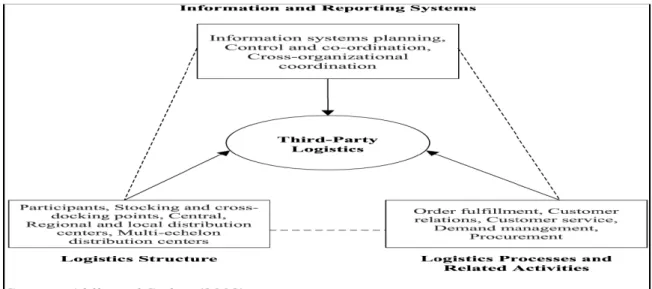
Aldin and Stahre (2003) presented a conceptual model (see Figure 1) for logistics supply chain management, with a special focus on 3PL. This model consists of three major components:
(a) Logistics structure;
(b) Logistics processes and related activities; and (c) Information and reporting systems.
All three components are essential for a successful 3PL operation. Logistics structure includes the participants in the logistics processes, inventory storage points, multi-echelon distribution centers and warehouses. Logistics processes and related activities comprise order fulfillment processes, customer relationship management, and customer service, and procurement and demand management. Finally, information and reporting systems are essential for any management system, as they drive the decisions based on the data collected. These include the designing and planning of information systems, control and coordination, and cross-organizational coordination. IT such as the intranet, extranet, Internet, WWW and EDI facilitate the integration of activities in the logistics supply chain (Angeles, 2000).
Figure 1: A conceptual model for supply chain management
Gunasekaran and Ngai (2003) have proposed a 3PL model with five major dimensions. These are: (a) strategic planning; (b) inventory management; (c) transportation; (d) capacity planning; and (e) information technology. This model has the objective of developing management control systems, resource management systems and integrating logistics activities. The details of the model are given in Figure 2.
Source: Gunasekaran and Ngai (2003)
Figure 2: A conceptual model for 3PL.
4
Marri et al.,With the growing trend towards the use of international supply chain and e-commerce, logistic service providers for product warehousing, transportation and delivery are placing great emphasis on information technology to be competitive globally (Trappey et al., 2004). According to statistics from Council of Logistics Management (MOEA, 2000), 20 to 30 percent of total production costs are directly attributed to distribution and logistics management. Investment in efficient distribution and logistics management systems can considerably improve enterprise competitiveness. Further, logistics management can significantly affect the efficiency of production, distribution and the quality of total customer services.
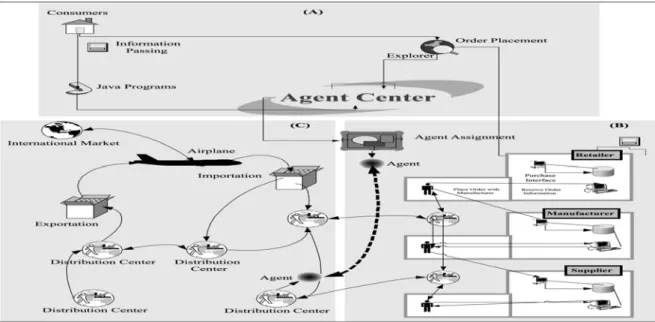
For instance, when large numbers of orders are transferred among different logistics service companies, the status of customer requests can hardly be obtained in real time and thus an effective approach for online status tracking of global logistic service is needed. Trappey et al., (2004) have provided mobile agent-based online logistic service tracking system (OLSTS) facilitates integration of the logistic services of different organizations without increasing Internet-based human queries as shown in figure 3. The objectives of the proposed approach are to provide customers with an intelligent mechanism to track the service status among inter-organizational, global logistic alliances. The system is designed for the following three participants to meet their operational requirements and to enhance their business competitiveness:
(a) Customers: Expect their requests for products or services from distributors and manufacturers to be fulfilled on time.
(b) Product/service suppliers: Receive the orders from customers and efficiently fulfill them by cooperating with the logistic service providers.
(c)
Logistic service providers: Provide logistic services with a full range of information support provided to both buyers and sellers in order to enhance the business efficiency of the customers.Source: Trappey et al., 2004
Figure 3: The conceptual framework for an agent-based logistic service support system
5
The first selection of e-commerce models, models describing EC, represent a fairly abstract view. Indeed they might be considered as attempts to define the concept of e-commerce. The electronic commerce areas model is the first such model considered (Choi et al., 1997). This model depicts differences between e-commerce and traditional commerce. The portrays e-commerce as a three-dimensional space, with purely traditional commerce in the front bottom left area and purely electronic commerce in the back top right area. All other portions represent a mixture of the two commerce
Marri et al.,
vehicles. This model also identifies product, agent and process as being three key dimensions by which to distinguish e-commerce from traditional commerce.
The second model considered, the electronic commerce domain matrix (Riggins and Rhee, 1998), suggests four dimensions of e-commerce. The model is useful as a tool for classifying the specific focus of a venture. In the planning context, the model identifies the importance of marketing and technology to the venture, and therefore focuses on the need to examine these dimensions in the planning phase of venture.
Third, Chan and Swatman (1999) developed the electronic commerce component model (ECCM). The purpose of the ECCM was to develop a research framework that included all current components and extension of e-commerce. As a tool for developing a planning model, the component model may support legality, logistics, technology and operations as potential model dimensions.
Models representing e-commerce process
The second selection of e-commerce models is models representing e-commerce process. A process model may be described as a model that answers how value-creating activities are carried out (Gordijn
et al., 2000). Such models provide insight into methods of conducting e-commerce and help identify possible weaknesses for a specific organization. However, as technology and environment change, the models may also need adaptation to reflect the changes. Two examples of process models are briefly discussed below. It should be noted that the e-commerce models represent two stages in its evolution. The first model presented is specific to EDI (formerly considered to define e-commerce), while the next model depict processes employing the web (Kao and Decou, 2003).
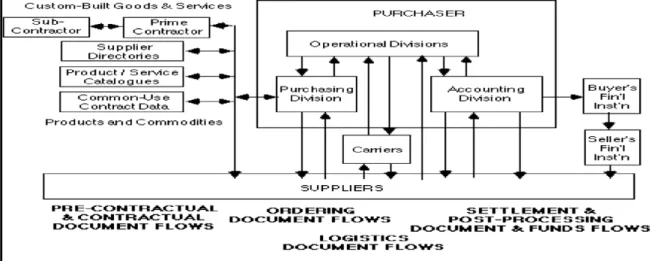
The first model, the phases of e-commerce (Figure 4), represented e-commerce as a five stage process (Clarke, 1993). The model demonstrates that e-commerce technology can be utilized in the pre-contractual, pre-contractual, ordering and logistics, settlement and post-processing phases of business activities. It also demonstrates the interrelationships between those particular activities. The model is reflective of a bricks and mortar manufacturing environment, with e-commerce tools integrated into the process. In making a decision to adopt e-commerce, this model is useful for such organizations in that it provides a structure for technology innovation. To support a bricks and mortar manufacturing environment this model suggests the importance of considering logistics, technology and operations during the planning phase of process.
Figure 4: Phases of electronic commerce.
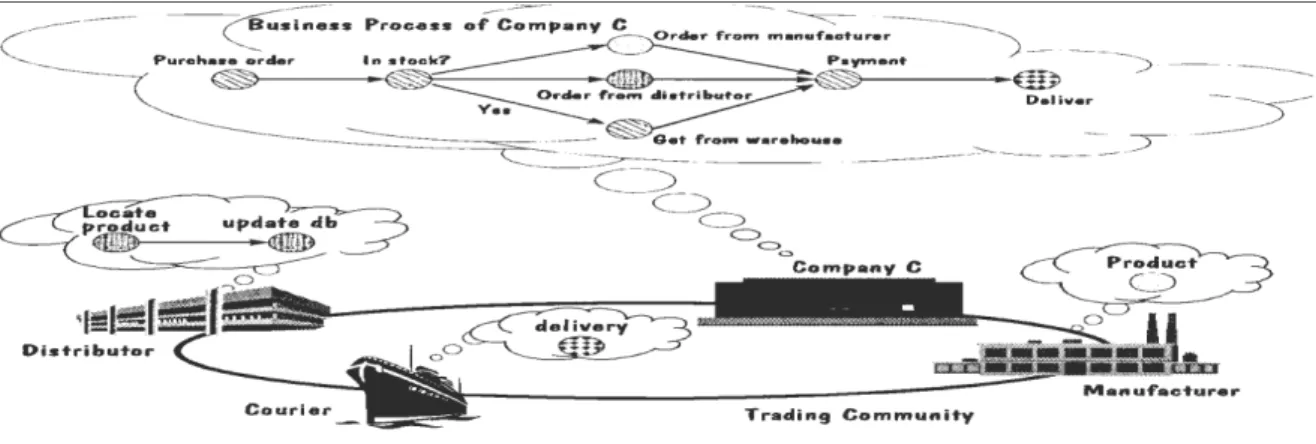
In the final e-commerce process model examined, Lazcano et al., (2000) demonstrated a virtual process within the individual business environment (Figure 5). This model recognizes the integration of e-commerce technology in materials management from the ordering of the product to the delivery of the finished goods.
6
Marri et al.,7
Figure 5: Virtual process as part of the business processes.Models representing e-commerce business models.
The final selection of e-commerce models examined is that of e-commerce business models. A number of models have been suggested to describe e-commerce business models (Viehland, 1999; Rappa, 2000). Hoffman et al., (1995) advanced six functional types of commercial Web sites – online storefront, Internet presence (flat ad, image and information), content (fee-based, sponsored, searchable database), mall, incentive site and search agent. Viehland, (1999) identified three specific business models that rely on inter organizational networks to exist – the virtual retailing model, the distributed storefronts model and the buyer-led pricing model. Rappa (2000) suggested that nine categories of business models exist on the web. They are the brokerage, advertising, infomediary, merchant, manufacturer, affiliate, community, subscription and utility models. As a further example, Hofacker (2000) suggested four categories of Internet marketing – communicating, selling, providing content and providing a network function. The models describe above are summarized in Table I.
Table 1: E-commerce business models
Source Model
Description
Online storefront model Offer direct sales through an electronic channel
Internet presence model
Flat ad – single page electronic flayers, no links Image – appeal is emotional, rather than rational Information – provide rational, detailed information
Content model
Fee-based – provider supplies and / or pays for content which consumer pays to access
Sponsored – site sells advertising space to reduce or eliminate fees Searchable database – merchants or advertisers pay provider for information
placement in searchable database
Mall model Collection of online storefronts
Incentive site model Form of advertising that attracts potential customer to site (pull site)
Hoffman et al., (1995)
Search agent model Identify other sites through keywords search Virtual retailing model Offer direct sales through an electronic channel Distributed storefronts model Link from one virtual retailer to other virtual retailers
Viehland (1999) Buyer-led pricing model Buyer states selling price and willing seller is located
Brokerage model Buyers and sellers brought together to facilitate transactions Advertising model Provide content and services mixed with advertising messages Infomediary model Collect information on consumers and sell to other businesses Merchant model Wholesalers or retailers sell goods through auction or price lists Manufacture model Takes advantage of Web to reduce distribution channels
Affiliate model Affiliates provide purchase-point click-through to the merchant and receive percentage of revenues from sale
Community model Based on user loyalty to site (sense of community)
Subscription model User pays for access to site
Rappa (2000)
Utility model User pays by metered usage of site
Communicating Businesses use Internet to communicate with customers and potential customers
Selling Direct marketing via Internet
Providing content Web site is actual product
Hofacker (2000)
Providing a network function Facilitates access to content provided by someone else
Marri et al.,
4. Benefits of E-commerce in Logistics Management
Following are some of the benefits of E-commerce in logistic management:
¾ shorten procurement cycles through the use of on-line catalogues, ordering, and payment; ¾ significantly increase the speed of communication, especially international communication; ¾ drastically reduce purchasing and production cycles;
¾ reduce the cost of communications directly (E-mail and EDI save on postage) and speed up communication can reduce inventory and related inventory and purchasing costs;
¾ promote closer relationship with customers and suppliers, e.g. web sites enable companies to maintain customers and suppliers apprised of developments that concern them and practice effective relationship marketing;
¾ provide a quick and easy way of exchanging information about a company and its products, internally and externally e.g. WWW sites, Intranets, and extranets;
¾ direct savings: The cost of delivering information to customers over the Internet results in substantial savings to senders (when compared with non-electronic delivery or delivery via VAN systems). Major savings are also realized in the direct delivery of digitized products (such as music and software) as compared to the costs of traditional delivery;
¾ reduced cycle time: The delivery time for digitized products and services can be reduced to seconds. Also, the administrative work related to physical delivery, especially across international borders, can be reduced significantly, reducing the cycle time by more than 90 percent;
¾ customer service: Customer service can be greatly enhanced by enabling customers to find detailed information online. (For example, FedEx allows customers to trace the status of their packages.) Also, intelligent agents can answer standard e-mail questions in seconds. Finally, human expert services can be expedited using help-desk software.
5. Conclusion and Summary of Findings and Recommendations
An attempt has been in this paper to highlight the scope of E-Commerce and logistic management. A literature review has been conducted to investigate the impact of E-Commerce in logistic management. E-commerce has spread rapidly in recent years. With its business-to-consumer, business-to-business, and internal applications, an ever-increasing number of businesses are under pressure to engage in e-commerce. Based on the Internet and other advanced computing technologies, e-commerce provides many opportunities. However, since its success depends not only on technological implementation, but on reengineering the traditional business processes, participating in e-commerce has its risks as well. Success in Internet-based electronic commerce depends on how organizations strategically position their products and services through other Internet-based electronic communities and intermediaries, as well as on how they facilitate the interactions with their customers, suppliers, and partners.
Despite the benefits and success stories a number of issues remain to be resolved such as security. It is believed that this concern regarding security will be lessened owing to a series of international developments. Other issues regarding the growth of the Internet are the lack of: a public key infrastructure (particularly for international trade), governmental stance, access, reliability (service levels), integrated applications and understanding/ awareness of the Internet-based e-commerce capabilities, and finally the relative cost of required technologies.
The integrated supply network structure with suitable visibility and usage of real-time data transfer is another area of great importance. Research and development of new logistics service concepts should also be promoted as well as research on the effects and possibilities of using new product data management and product identification methods.
8
Marri et al.,The development of electronic business will increase the importance of delivery accuracy, delivery frequency and delivery time in emerging new supply networks. This applies to logistics both in B2B and B2C segments. Research and development programs are necessary in order to study how the required delivery patterns can be reached and how to measure their potential benefits.
New technologies, like product identification technologies, mobile technologies and applications that utilize satellite location technologies (GPS) are seen as enablers for the new logistical systems that will be necessary to fully benefit from e-business.
It may be necessary to locate warehouses throughout the world to provide competitive delivery of goods. Conversely, steps may need to be taken to restrict sales of the product in foreign countries in order to avoid logistical problems. When planning an e-commerce venture, both digital and traditional logistics should be considered. Being able to successfully communicate through e-commerce channels and to competitively deliver the product to customers, will always is a relevant issue.
Acknowledgement
The authors are extremely thankful to the Higher Education Commission of Pakistan for providing financial assistance to carry out this research project. The thanks also go to the Department of Industrial Engineering and Management, Mehran University of Engineering and Technology, Jamshoro, Sindh, Pakistan, the Department of Information Systems and Computing, Brunel University West London and the Department of Management, Charlton College of Business, University of Massachusetts, Dartmouth, USA for providing essential assistance to make this work possible.
References
Aldin, N., and Stahre, F., 2003. ’Electronic commerce, marketing channels and logistics platforms – wholesalers perspective’. European Journal of Operational Research, 144: 270-279.
Anderson, W.P., Chatterjee, L., and Lakshmanan, T.R., 2003. ’E-commerce, transportation and economic geography’. Growth and Change, 34 (4): 415-432.
Angeles, R., 2000. ’Revisiting the role of Internet-EDI in the current electronic commerce scene’.
Logistics Information Management, 13 (1/2): 45-57.
Chan, E., and Swatman, P.M.C., 1999. ’Electronic commerce a component model’. 3rd Annual Collector Conference on Electronic Commerce.
Choi, S., Stahl, D., and Whinston, A.B., 1997. ’The economics of electronic commerce’. Macmillan Technical Publishing, Indianapolis, IN.
Christopher, J., 1992. ’Logistics and supply chain management: strategies for reducing cost and improving cost and improving services’. Pitman Publishing, Boston, MA.
Clarke, R., 1993. ’EDI is but one element of electronic commerce’. 6th International EDI Conference, Bled.
Cooper, J.C., 1993. ’Logistics strategies for global businesses’. International Journal of Physical Distribution & Logistics Management, 23 (4): 12-23.
Decina, M., and Trecordi, V., 1999. ’Voice over Internet protocol and human-assisted e-commerce’.
IEEE Communication Magazine, 37: 64–67.
Dignum, F., 2002. ’E-commerce in production: some experiences’. Integrated Manufacturing Systems,
13 (5): 283-294.
Garrett, S.G.E., Skevington, P.J., 1999. ’An introduction to e-commerce’. BT Technology, 17 (3): 11–16.
Gordijn, J., Akkermans, H., and van Vliet, H., 2000. ’Business modeling is not process modeling: conceptual modeling for e-Business and the Web’. PP. 40-51, Available at http://citeseer.nj.nec.com/297423.html
Gunasekaran, A., Marri, H.B., McGaughey, R.E., Nebhwani, M.D., 2002. ’E-Commerce and its impact on operations management’. International Journal of Production Economics, 75: 185-197.
9
Marri et al.,Gunasekaran, A., and Ngai, E.W.T., 2003. ’The successful management of a small logistics company’. International Journal of Physical Distribution & Logistic Management, 33 (9): 825-842. Hofacker, C.F., 2000. ‘Internet Marketing, Digital Springs’. Dripping Springs, TX.
Hoffman, D.L., Novak, T.P. and Chatterjee, P., 1995. ‘Commercial scenarios for the Web’. available at: www.ascusc.org/jcmc/vol1/issue3/hoffman.html
Huang, S.M., Kwan, I.S.Y., and Hung, Y.C., 2001. ’Planning enterprise resources by use of a reengineering approach to build a global logistics management system’. Industrial Management & Data System, 101 (9): 483-491.
Kalakota, R, and Whinston, A.B., 1997. ’Electronic Commerce: A Manager’s Guide’. Addison-Wesley, Reading, MA.
Kao, D., and Decou, J., 2003. ’A strategy-based model for e-commerce planning’. Industrial Management & Data Systems, 103 (4): 238-252.
Lazcano, A., Alonso, G., Schuldt, H., and Schuler, C., 2000. ’The WISE approach to electronic commerce’. International Journal of Computer Systems Science and Engineering, 15 (5): 343-355. Levis, K., 1996. ’Electronic commerce’. British Telecommunications Engineering, 14 (4): 281–285. Ministry of Economic Affairs (MOEA), 2000. ’Yearbook of logistic service in Taiwan’. Taipei. Ngai, E.W.T., and Wat, F.K.T., 2002. ’A literature review and classification of electronic commerce
research’. Information and Management, 39: 415-429.
Pollitt, D., 1998. ’View point: getting logistics on to boardroom agenda’. International Journal of Physical Distribution & Logistics Management, 28 (3): 168-169.
Rappa, M., 2000. ‘Business models on the Web’. available at: http://digitalenterprise.org/ models/models.html
Riggins, F.J., and Rhee, H., 1998. ’Towards a unified view of electronic commerce’. vailable at: http://riggins-mgt.iac.gatech.edu/papers/unified.htm
Silverstein, M., Stranger, P., and Abdelmissih, N., 2001. ’The next chapter in business-to-consumer e-commerce: Advantage incumbent’. The Boston Consulting Group, Boston.
Sum, C-C., Teo, C-B., and Ng, K-K., 2001. ’trategic logistics management in Singapore’.
International Journal of Operations & Production Management, 21 (9): 1239-1260.
Trappey, A.J.C., Trappey, C.V., Hou, J.L., and Chen, B.J.G., 2004. ’Mobile agent technology and application for online global logistic services’. Industrial Management and Data System, 104 (2): 169-183.
Viehland, 1999. ’New business models for electronic commerce’. paper presented at the17th Annual International Conference of the Association of Management/International Association of Management, available at: www.massey. ac.nz/~DViehlan/ businessmodels.html.