Value Webs: Using
Ontologies to Bundle
Real-World Services
Hans Akkermans, Ziv Baida, and Jaap Gordijn,
Free University Amsterdam
Nieves Peña, Ander Altuna, and Iñaki Laresgoiti,
Labein
R
eal-world services
—that is, non-software-based services—differ significantly
from Web Services, usually defined as software functionality accessible and
con-figurable over the Web. Because of the economic, social, and business importance of the
service concept in general, we believe it’s necessary to rethink what this concept
means in an ontological and computational sense. Most current semantic approaches focus on the com-puter science and software aspects of services inso-far as they lie within the Web environment. Such a view is incomplete and unnecessarily limiting, because current Web Services ignore significant ele-ments of the service context. A Semantic Web approach can—and should in our view—represent and reason about what we call value webs: services that have a grounding in the real world, beyond their Web elements and references alone.
The OBELIX(Ontology-Based Electronic I
ntegra-tion of ComplexProducts and Value Chains) project has therefore developed a generic component-based ontology for real-world services. This OBELIXservice ontology is first of all a formalization of concepts that represent the consensus in the business science liter-ature on service management and marketing. In addi-tion, our ontology embodies a number of systems-theoretic notions that specify how diverse service elements, seen as individual “Lego blocks,” can con-nect to each other to form a larger service system: a
service bundle. Here, various topological connection and typing rules play a key role, similar to the design of complex engineering systems.
Furthermore, we express our service ontology in a graphical, network-style representation, and we’ve developed support tools that facilitate end-user mod-eling of services. Then, automated knowledge-based configuration methods let business designers and analysts analyze service bundles. We’ve tested our ontology, methods, and tools on applications in real-world case studies of different industry sectors.
An interdisciplinary approach
We believe that ontology research and application can cover and handle more than current semantic approaches do. First, Semantic Web Services research still lacks convincing realistic industrial use cases that are the basis of practical use and empirical validation of ontologies and problem-solving methods.
Second, ontology research and application re-quires an interdisciplinary approach to services that draws not only from computer science and AI but also from economics, systems theory, and business practice. Such an approach will lead to ontological descriptions that capture much richer service pro-files, even of hitherto unseen services. For example, the need exists to more clearly distinguish requester-(customer) and supplier-oriented service descrip-tions. Suppliers and customers have different roles in, and viewpoints on, a service, which leads to dif-ferent ontological commitments and descriptions. Furthermore, service industry practice shows that “nonfunctional” aspects (such as quality features) are empirically important to service selection, com-position, marketing, and sales.
Third, implementation of richer service descrip-tions requires Semantic Web reasoning methods beyond description or frame logics or process-flow-oriented algorithms such as AI-style planning. Accordingly, this article gives a brief overview of what a broader interdisciplinary approach brings to the semantics of services, and outlines its applica-tion to some novel industrial use cases, which cur-rently also have no working solutions through main-stream nonsemantic methodologies.
The O
BELIXproject has
developed a
component-based
ontology for
real-world services, along
with methods and tools
for graphical modeling
of services and for
knowledge-based
configuration of
service bundles.
Service bundling
All industry sectors that face increasing market pressures or technological innovation face the issue of service bundling. Companies don’t usually offer just a single service to a customer but a more or less interrelated col-lection of them. This enables broader, better
coverage of customers’ needs while achiev-ing scale and scope efficiencies in service cost by sharing and reusing service elements.
To handle service bundles, we must deal with two simultaneous dimensions of com-plexity. First, real-world services have high variability, in that they consist of many
diverse elements. In the trading of commod-ity goods, which still dominates e-commerce, a componential approach is already well developed (witness, for example, companies such as Dell and Cisco). In the service sector, component-based support for bundling ser-vices is still inadequate. A likely reason is
S e m a n t i c W e b S e r v i c e s
Serviceis by now a rather overloaded term. Until recently, research on services was the domain of business schools, which since the late ’70s have produced a wealth of literature on service marketing and management. This literature gives a general framework on what (real world) services are and how they’re different from physical goods. Widely used recent texts are Services Marketing: People, Technology, Strategy1and Service
Man-agement and Marketing: A Customer Relationship Management Approach.2
An important observation for ontology research is that this literature now shows a consensus on many important points. Representative definitions of service often contain recurring elements: • Valarie Zeithaml and Mary Jo Bitner—
“Services are deeds, processes and performances.”1
• Irving Kotler—“Any act or performance that one party can offer to another that is essentially intangible.”1
• Christian Grönroos—“Activities … of a more or less intangible nature that normally … take place in interactions between the customer and service employees and/or physical resources or goods and/or systems of the service provider, which are provided as solu-tions to customer problems.”2 Service viewpoints
The literature we just discussed has provided input material for our onto-logical description of real-world ser-vices. Our OBELIXservice ontology
dis-tinguishes three interrelated top-level viewpoints (see Figure A):
• The service valueviewpoint describes the service from a customer’s perspective. • The service offering viewpoint
de-scribes the service from a supplier’s perspective.
• The service processviewpoint de-scribes how the service offering is put into operation.
The service value and offering viewpoints
The O
BELIX
Service Ontology
(2) (1) Customer Describes ... concept relationship indirect relationship
Requires is willing to give 1, ...* 1, ...* Service quality (C) Demand
Thing (C) Thing is a composite concept.This is modeled as Direct Indirect Psychological
A B B is a subclass of A A B B is a part of A Property Supplier Optional bundle (OB) Enhancing/ core (CE) Supporting/core (CS) Bundle (BU) Substitute (SU) Excluding (EX) Has a Has a 1 Supplies Has a Uses Results in Has a 1, ...* Service element Function Resource Elementary service element Service bundle 0, ...* 0, ...* Dependent Dependee Sacrifice
Price Relationship costs
2, ... Elementary Complex
Thing
Figure B. Service subontologies representing the (1) service value (customer) viewpoint and (2) service-offering (supplier) viewpoint.
Service value Service process
Service configuration Service operationalization Participation Service offering
that the high variability and intangibility of real-world service elements easily escapes automated description and design.
Second, many services are coproductions of different suppliers. A commonly quoted aspect of services is that customers them-selves often take part in their production. For
instance, many fast-food outlets suppose that their customers clean the tables. Another common example is Internet service provi-sion, in which the customer must have both IP facilities and telecommunications con-nectivity. These resources usually come from different companies, although most
cus-tomers perceive Internet service provision as a single, undivided service. So, we must be able to model a coproduction network of component-based service supply.
Service bundling is different from Web Service composition. The latter currently occurs at the workflow or service process The service value viewpoint, which IT
approaches often overlook, expresses the customer needs or demands that should be satisfied by acquiring a service of a cer-tain quality, in return for a cercer-tain sacri-fice. Figure B1 shows an object model of this subontology’s major concepts. This subontology models service quality by employing quality frameworks used in business (for example, the SERVQUAL
mod-el). Quality features are important in pro-filing and composing services because they serve as selection handles for cus-tomers. One example is star ratings for hotels. Quality features also occur in e-commerce: you can download low-resolu-tion digital photographs for free, but you must pay for high-resolution photographs. Sacrifice includes not only price but also intangible relationship costs such as cus-tomer effort spent in service coproduction, and inconvenience (waiting in line, and search and download time).
The service-offering viewpoint (see Fig-ure B2) represents the supply-side perspec-tive of a service. This perspecperspec-tive centers around the concept of a service element. Figure B2 shows only the ontological elements necessary to understand the business nature of this perspective. Service elements represent what a supplier offers to its customers. They’re what the business literature defines as a service—a business performance of a typically intangible nature. Examples are money transfer, transportation, haircuts, Internet radio, and electricity supply. A service element can be decomposed into smaller service elements, as long as these smaller ele-ments can be offered to customers sepa-rately, possibly by different suppliers.
The business literature distinguishes different roles or functions of service ele-ments from a supplier perspective: • A core service (the main business)
• A supporting supplementary service (it makes the core service possible) • An enhancing supplementary service
(it improves the core service value by adding features)
Service elements might also be substitutes for one another or exclude one another.
These functional rules concerning indi-vidual service elements are important in computing feasible service bundles. A ser-vice bundle is a set of serser-vice elements that can be provisioned together as a whole that’s compatible with these rules.
We don’t discuss the service process viewpoint here because the literature already contains much research that’s adoptable (for example, ebXML [Elec-tronic Business Using Extensible Markup Language], Web Services Flow Language, Business Process Execution Language, the DAML/OWL-S service process,3or Petri net
semantics4); our work focuses more on
ser-vice profiles. However, one concept that’s key to both the service-offering and ser-vice process viewpoints is that of resource: anything that’s either an input or an out-come of a service element.
Typing
In real-world services, resources are typed (see Figure C). (This typing is absent in the DAML/OWL-S notion of resources.) These types clearly show services’ great variability.
Some services might result, at least partially, in tangible results (for example, a meal in a restaurant), whereas other service out-comes might be highly intangible. A the-ater or art museum aims to produce a memorable customer experience. A haircut, a trip, or car maintenance basically results in a state change. Many services produce an even more abstract outcome—a capability or right to do something: a credit card, for-mal education, a driver’s license, or clearing music rights. This typing of resources plays an important role in our automatic config-uration of services (see the sidebar “The Configuration Algorithm”), because it pro-vides additional constraints on the possi-ble outcome-input connections between different service elements.
References
1. C. Lovelock, Services Marketing: People, Tech-nology, Strategy, 4th ed., Prentice Hall, 2001. 2. C. Grönroos, Service Management and
Marketing: A Customer Relationship Man-agement Approach, 2nd ed., John Wiley & Sons, 2000.
3. S. McIlraith, T. Son, and H. Zeng, “Semantic Web Services,” IEEE Intelligent Systems, vol. 16, no. 2, 2001, pp. 46–53.
4. W. van der Aalst, “Don’t Go with the Flow: Web Services Composition Standards Ex-posed,” IEEE Intelligent Systems, vol. 18, no. 1, 2003, pp. 72–76. Physical goods Import Monetary resources Human resources Information
resources Capability Experience
State change Relationship with other ontologies
United Nations Standard Products and Services Code UNSPSC
level. Associated computational techniques such as planning thus incorporate ontologi-cal commitments to temporal notions such as states and their ordering. In contrast, service bundling is a business development activity that lives at the service profile level (to use the DAML/OWL-S terminology). Its declar-ative specification makes commitments not in terms of time and flow, but only to mereo-logical and topomereo-logical notions such as con-nectivity. This leads to the need for other rea-soning methods. For example, in this article we describe configuration techniques that are
adaptations to the service domain of problem-solving methods originating from the design of large-scale technical systems.
Graphical modeling and
configuration
We developed the OBELIXservice ontology (see the related sidebar) using ontology edi-tors such as OntoEdit and Protégé, and the ontology is available in RDF Schema form. Testing in industrial use cases from very dif-ferent sectors is the main empirical mecha-nism for ontology validation. However, not
many practitioners can do their work directly from representations such as RDF. So, we’ve developed graphical representations for ser-vices and their composition that are much more intuitive for domain experts and prac-titioners. These graphical techniques help model services in a configurable way.
Visualizing service elements
Figure 1a shows the visualization of a ser-vice element in our ontology. We visualize service elements similarly to engineering-system components, so that we can use the knowledge-based configuration methods to automatically create service bundles. Con-figuration is a well-researched design task, simplified by the availability of a set of pre-defined components, connections, and asso-ciated parameters and constraints.1,2
Portsmodel a component’s possible con-nectivity with other system parts.3In
techni-cal systems, ports are often typed: a wall out-let actually represents ports for making electrical connections. In service modeling, we use analogous structuring ideas. Every service element has two types of ports:input portsand outcome ports. The provisioning of any service element requires resources
(inputs or outcomes of a service element) and results in the availability of other resources. An input port indicates a certain resource that’s a prerequisite for carrying out this ser-vice element; an outcome port indicates the result of carrying out this service element. A special characteristic of our service ontology is that resources are typed (see the sidebar, “The OBELIX Service Ontology”). Each
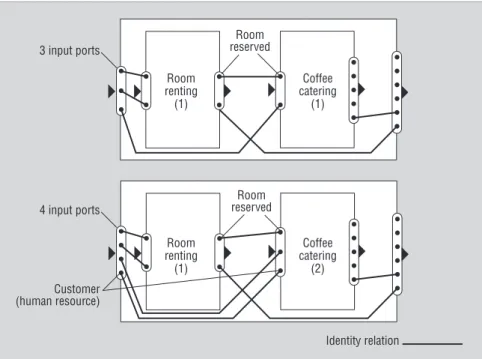
resource has a corresponding port. Figure 1b shows two instances of the same service ele-ment for organizing a conference.
S e m a n t i c W e b S e r v i c e s
Ports Ports Input interface Outcome interface Service element Every port of an outcome interface refers to one resource (service outcome) Every port of an input interface refers to one resource (service input) Sugar• Product quality: basic • Process quality: regular • No human resource input • Two input ports
Coffee catering (1) Cutlery Milk Coffee Ability to freshen up Sugar Customer
• Product quality: basic • Process quality: basic (self-service)
• Customer is a human resource (input)
• Three input ports Coffee catering (2) Cutlery Milk Coffee Ability to freshen up Room Payment (b) (a) Room Payment
Figure 1. Service elements: (a) a generic service element; (b) different instances of the same service element in a bundle for organizing a conference. In the first instance, service personnel pour coffee; in the second, conference attendees pour their own coffee.
Service element Service element Service element Service element Service element Identity relation Service element Service bundle (b) (c) (a) Service bundle Service bundle
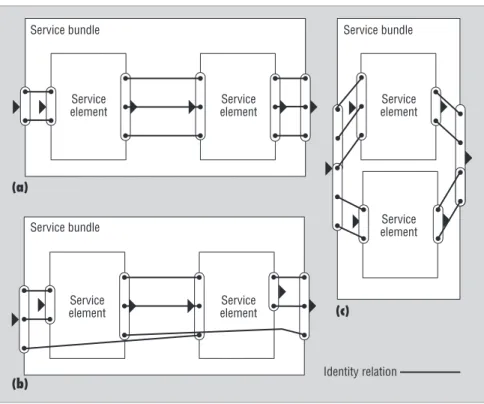
Figure 2. Different kinds of service bundling: (a) strongly connected service elements; (b) weakly connected service elements; (c) independently connected service elements.
all outcome ports forms its outcome interface. Knowledge-based configuration of service bundles also requires constraints. We distin-guish two main types of constraints. Inher-ent constraintsare on service-related values (such as quality properties of associated resources or conditional input-outcome con-straints on the relation between quality level and payment). Functionsare constraints on the role dependencies between service ele-ments. In this way, we’ve achieved an onto-logical and visual description of service ele-ments as configurable components in a larger service bundle system.
Constructing service bundles
Figure 2 depicts different ways to con-struct a service bundle from several service elements. As a composite service element, a service bundle also has an input and an out-come interface. These interfaces are identical to the union of all the input and outcome interfaces of that bundle’s service elements. Two exceptions to this general rule exist. First, certain resources can be consumable
more than once; that is, they can appear in sev-eral service elements (particularly,information
resources can be used multiple times). Second, for resources that have the com-positenessproperty, we can model multiple resources of the same type as a single resource. For instance, when two bundled service elements both require a paymentinput, we can compose a single paymentresource from these two inputs. Often, the price for such bundling is lower than the sum of the separate prices.
A service bundle’s input interface must provide all the inputs of all that bundle’s ser-vice elements, unless they’re provided inter-nally (one service element might produce an outcome that a different service element con-sumes as an input). In Figure 2, connection links between ports mean that one port uses a resource that another port provides.
Service bundling is recursive: any service bundle is a service element. Figure 3 gives a small example for online organizing of con-ferences. This glass-box view shows a ser-vice bundle’s internal serser-vice element struc-ture and is of particular interest to service suppliers. The associated black-box view (not shown here) ignores the internal
struc-ture; it contains only the service bundle’s inputs and outcomes as a whole. So, it’s often the most useful view for letting the end cus-tomer know whether the services satisfy his or her external requirements. The combina-tion thus yields a rich approach to service profiling with our OBELIXontology.
The OBELIXservice tool
Figure 4 diagrams the architecture of the OBELIXservice tool, which is a CASE (com-puter-assisted software engineering) tool that enables graphical modeling of services. The tool contains the underlying business rules from the OBELIXservice ontology so
Service ontology developer Service model developer Service model developer Ontology editor Service RDF Schema Service XSVG database
XSVG Scalable Vector Graphics for X Windows Service-modeling
graphical editor
Service RDF file or database Services
RDF exporter
Other tools and analyzers (for example, the e3-value business
model tool)
Figure 4. The architecture of the OBELIXservice tool, which enables graphical modeling of services. (1) (1) Room renting (1) Coffee catering (2) Customer (human resource) 4 input ports Room reserved Identity relation
that it can notify users about any omissions or mistakes when they violate ontological rules. It also automatically generates the
RDF representation of the service domain ontologies from the graphical model. Our knowledge-based configuration tool(which
we discuss in the next section) employs this representation.
Supporting business
applications
Using our techniques, we modeled numer-ous services that can be offered to customers in a bundle in various industrial case studies. One of these studies was a business analysis of service bundling related to energy supply, carried out for a Norwegian power distribu-tion utility. In this case, individual service elements include electricity supply, electric-ity transmission, hot water distribution (for room heating and tap water), broadband Internet access, IT services, sales and instal-lation of electrical appliances (heat pumps and energy control systems, to reduce energy consumption and regulate temperature), and remote-control services.
Figure 5 shows a screen shot of the service tool for this case study, indicating the depen-dencies between service elements. CS means that a service element is a necessary part of the bundle in relation to the core service. OB means that it’s an optional feature in a bun-dle. EX (not shown in the figure) means that two service elements exclude one another and so can’t be part of the same bundle. The screen shot shows a draft model that serves as input to our configuration tool. Other fig-ures in this article (particularly Figfig-ures 3 and 6) show model visualizations of the situation after configuration.
Different business considerations drove this case study. Electricity is a common mass com-modity in a competitive market (power mar-kets are liberalized worldwide; Norway did so in 1991). For a power company to differentiate itself from the competition isn’t easy. Because customers can freely choose their energy sup-plier, one strategic option is to offer better, richer customer service to retain customers. Moreover, additional customer service should exploit cost advantages by sharing and reusing existing service elements (for example, billing or maintenance). It should also improve return on investment for the existing infrastructure by using it as the carrier for more services (asset management: for example, the fiber optics for controlling the power grid might have enough extra capacity to also support broadband Inter-net access). So, the primary question is, what new service bundles are financially attractive for both the customer and supplier and are technically realizable?
Once we model all individual service ele-ments, with their mutual functional
depen-S e m a n t i c W e b depen-S e r v i c e s
Minimum service bundle
Payment Electricity transmission Billing electricity transmission Transmission state change Broadband Internet Contract electricity transmission Broadband access Billing broadband access Contracting broadband access Electricity supply Electricity Billing electricity supply Contract electricity supply
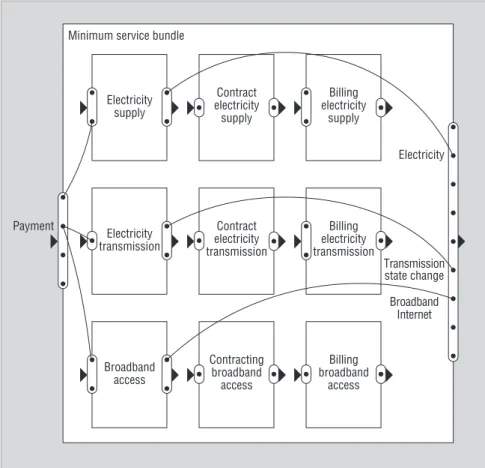
Figure 6. A computed service bundle including electricity supply (the core service) and broadband Internet access.
Figure 5. A screen shot from the OBELIXservice tool for bundling energy services. CS means that a service element is a necessary part of the bundle in relation to the core service. OB means that it’s an optional feature in a bundle.
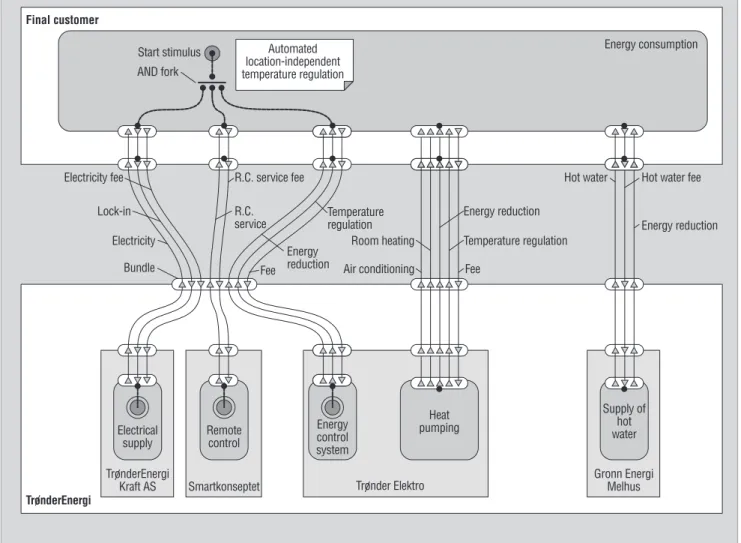
dencies, and establish the set of customer requirements, the configuration tool pro-duces all the service bundles that are feasi-ble with respect to all constraints and require-ments. We explain our problem-solving method in the sidebar “The Configuration Algorithm.” Figure 6 shows an answer that the configuration tool produced for this case. The next step of the service business analy-sis is to feed the configuration results into another tool for analyzing the new business models’ financial attractiveness. For this we have developed the e3-value tool, which is based on our ontology for networked e-busi-ness models.4,5Figure 7 shows a new
busi-ness model reflecting service-bundling deci-sions that this tool produced. This modeling and simulation tool also carries out quantita-tive net-present-value calculations of the cash flows between all actors in spreadsheet form,
to establish the profitability of new business models and service bundles. In addition, it lets users perform numerical sensitivity analyses of key parameters by computing the results of what-if scenarios.
Reflections on ontology
development
The development of ontologies as formal conceptualizations is, we suggest, a key sci-entific method for theory formation in infor-mation science that aims to bridge human and computer understanding. We consider an ontology to be “good” if it’s used in and val-idated against independent, external business scenarios and industrial use cases. In view of the current state of the art of Semantic Web Services, industrial-use-case testing’s impor-tance can hardly be overstated.
So, we carried out several real-world case
studies in different industry sectors. Such case studies are useful in their own right and can help convince practitioners about the added value of semantics-based methods. Moreover, case studies turn out to be methodologically important as stress tests and “triangulation methods” for ontologies, reasoning tech-niques, and support tools. Consequently, the OBELIXontologies have undergone significant
refinement over the past years as a result of their industrial application. Specialization of a generic service ontology to a specific domain is best done by domain specialists themselves, with the generic ontology devel-opers serving a “help desk” role.
We also noticed that for developing appli-cation-oriented ontologies, the available gen-eral tools and languages aren’t very suitable. Therefore, we developed the graphical for-mats to enable direct visual modeling. The
Smartkonseptet
Hot water fee Electricity fee Lock-in Electricity R.C. service fee R.C. service Energy reduction Energy reduction Room heating Energy reduction Hot water Fee Temperature regulation Temperature regulation Air conditioning Fee Electrical supply Remote control Energy control system Heat pumping Supply of hot water Gronn Energi Melhus Bundle TronderEnergi
Kraft AS Tronder Elektro
TronderEnergi
Figure 7. A possible new business model reflecting computed service-bundling decisions, as produced by our e3-value tool. This tool also helps analyze projected cash flows to assess the financial attractiveness of envisaged service bundles.
S e m a n t i c W e b S e r v i c e s
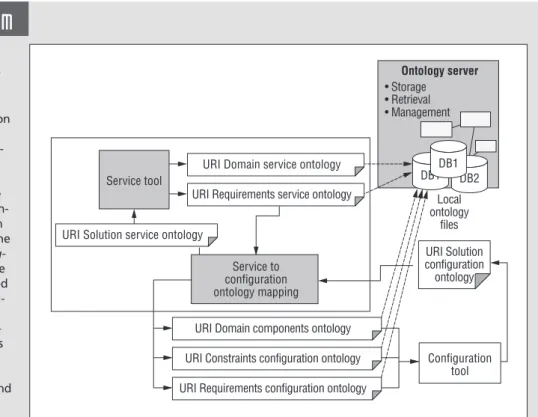
Figure D shows how the OBELIX
ontology-based tools collaborate in service configuration.
The configuration method we use for service bundling is based on a generic configuration ontology (with these core concepts: compo-nents, connections, associations, constraints, and requirements).
First, we map the OBELIXservice ontology’s elements onto the con-figuration ontology (for more on the OBELIXservice ontology, see the related sidebar). Next, the config-uration toolcomputes all feasible configurations; these are then fed back to the service toolfor visual-ization and further analysis.
As inputs, the configuration al-gorithm uses three subontologies of the configuration ontology. A components ontologydescribes components (service elements) and their associated resources (inputs and outcomes).
A constraints ontologydefines various types of constraints. There are mainly two types. Functionsare
dependencies between service elements. Inherent constraints include the constraints that no loops are permitted and that an outcome port must be connected to an input port, and various other business rules stemming from the service ontology.
Finally, a requirements ontologydescribes restrictions on the desired inputs and outcomes to guide configuration. These requirements express the end customer demands by defining the type of resources required and the constraints on their property values.
The configuration tool outputs to the service tool an ontol-ogy (in RDF form) that provides all feasible service bundles such that the computed solutions
• Explicate what service elements are part of the bundle and how they’re connected through the resources used • Obey all given constraints
• Satisfy all input customer requirements
Configuration has two phases. Suppose the user has as re-quirements to get resources R1 and R2, and that service ele-ment X1 provides R1, and services Y1 and Y2 provide R2.
High-level configuration
This phase has two steps. The first consists of identifying ini-tial elements for the service bundle. On the basis of the given requirements, the configuration tool knows which resources are required (R1, R2). It searches for all service elements that pro-vide the requested resource types, and finds that X1 provides R1 and that Y1 and Y2 provide R2.
The second step involves applying functions. Some service elements might require or exclude others. Suppose we have the two functions Excluding(X1, Y1) and Core/enhancing(Y2, Z1).
Applying the first function means that {X1, Y1} can’t be in the same service bundle. The second function means that Y2 might— but doesn’t have to—be bundled with service element Z1. So, we infer two possible service bundles: {X1, Y2} and {X1, Y2, Z1}. Each is a good solution. The algorithm applies functions to all the con-sidered service elements in a bundle. Whenever the configura-tion tool adds a service element to a bundle, the algorithm ap-plies available function information again to check the bundle’s consistency.
These steps produce a set of feasible service bundles. These bundles provide the required resource types but don’t yet guarantee that all values of resource properties that the cus-tomer specified are satisfied. The algorithm’s next step per-forms this latter task.
Detail-level configuration
This phase creates connections between ports of the service ele-ments in a bundle. It repeats for every service bundle that the first phase generated. This phase connects, as a rule of thumb, as many ports as possible within a bundle. Two ports in a bun-dle may be connected if they meet all these requirements: • They belong to different service elements.
• They have different types (input or outcome). • They require or provide the same resource.
The configuration engine then checks all restrictions regard-ing the range of service property values. Standard constraint solvers are adequate for this. Any input or outcome port that isn’t connected to other ports in the same bundle will appear in the service bundle’s input or outcome interface. Any high-level bundle might have multiple detail-level solutions.
Service tool • Storage • Retrieval • Management Service to configuration ontology mapping Ontology server URI Solution configuration ontology Local ontology files URI Domain service ontology
URI Requirements service ontology
URI Domain components ontology
URI Requirements configuration ontology URI Constraints configuration ontology URI Solution service ontology
Configuration tool DB1 DB2
DB1
Figure D. How the OBELIXontology tools collaborate in service configuration.
associated ontology language representations such as RDF and OWL stay “under the hood” of the OBELIXservice tool because the tool
automatically creates them from the visual diagrams. This significantly lowers the bar-riers for practitioners.
We intend to make publicly available exten-sive case and ontological data on an area of investigation that we didn’t discuss here. It concerns the automatic clearing of music rights for Internet radio stations. This domain contains yet another intriguing mixture of business logic considerations and technical challenges that must be simultaneously solved in a mutually consistent fashion, in a net-worked situation with many different actors (music rights societies, Internet radio stations, and artists and producers, in different coun-tries). Like the power distribution use case we discussed, this provides another rich challenge and test problem for any Semantic Web and Web Service approach to real-world services.
T
he overview in this article is admittedly brief and thus high-level. Extensive technical reports concerning the OBELIXontol-ogy development and the related industrial case studies, demos, and tools are available at http://obelix.e3value.com. Several other ex-amples and case studies of our ontology-based business modeling and analysis are available at http://busmod.e3value.com. We also plan to make the e3-value tool, service tool, and configuration tool publicly available as open-source software. For a comparison of the OBELIXresearch to other related research, see
the “Related Work” sidebar.
Acknowledgments
The European Commission partially supported this work in the context of the EU-IST Project OBELIX(Ontology-Based Electronic Integration of ComplexProducts and Value Chains, EU-IST-2001-33144). For models, tools, and data on appli-cation examples, we’re indebted to Andrei Morch, Hanne Sæle, and Gunnar Salseggen (SINTEF
Energy Research and TrønderEnergi, Norway); Hans-Peter Schnurr, Hans Trost, and Wolfgang Sperling (Ontoprise, Germany); Bert Hazelaar (SENA, Netherlands); and Tim Smithers, Jessica Aguado, Carlos Pedrinaci, and Amaia Bernaras (Technological Park of San Sebastian, Spain). Arthur Koks, Dennis Veltrop, Rashid Sohrabkhan, and Stephan Hoekstra (Free Univ. Amsterdam) did much of the tool development reported in this arti-cle. We also thank Terry Payne (Univ. of South-ampton) for many in-depth discussions on DAML/ OWL-S, and the anonymous reviewers for several useful comments that we incorporated.
References
1. T. Gruber, G. Olsen, and J. Runkel, “The Con-figuration Design Ontologies and the VT Ele-vator Domain Theory,”Int’l J. Human-Computer Studies, vol. 44, nos. 3–4, 1996, pp. 569–598. 2. C. Löckenhoff and T. Messer, “Configura-tion,”The CommonKADS Library for Exper-tise Modeling—Reusable Problem Solving Components, J. Breuker and W. Van De Velde, eds., IOS Press, 1994, Chap. 9.
Overall, our research adds a needed interdisciplinary perspec-tive. Its contributions and strengths are (purposely) at the ser-vice profile level, where we offer both business-relevant exten-sions important to any generic service ontology and additional computational methods such as configuration. We believe that, specifically, the value-based and recursive approach to service bundles, strong typing of resources, explicit handling of function dependencies between configurable service elements, and the computational treatment of nonfunctional properties such as quality are useful OBELIXcontributions to service com-position and analysis. The main computational focus of DAML/ OWL-S is at the service process level, with a grounding in WSDL. However, we see no major technical obstacles in linking DAML/ OWL-S’s service process to the OBELIXservice-profiling ontolo-gies and methods.
WSMO/WSMF (Web Service Modeling Ontology/Framework, www.wsmo.org) is still in an early, underspecified stage. In essence, it’s an extension of UPML (Unified Problem-Solving Method Description Language),2which in turn is a distributed,
Web version of the CommonKADS knowledge modeling frame-work.3It thus has a knowledge-modeling outlook that’s similar
to OBELIX. The framework focuses especially on the mediators needed to connect the many different components of Seman-tic Web Services. WSMO also distinguishes between Web Ser-vices and real-world serSer-vices, but unlike OBELIX, it doesn’t imple-ment the general concepts inherent to services in the ontology itself.
The Internet Reasoning Service4has many ideas similar to
WSMO—among them its roots in UPML—but has been practi-cally implemented. It caters for different Web Service tasks and problem-solving methods, of which OBELIX-style service
config-a generic ontology thconfig-at’s config-applicconfig-able to config-a wide clconfig-ass of service domains.
Like WSMO, DOLCE5has a weak intrinsic conceptual notion of services. However, it provides mechanisms for further formal-ization and axiomatic grounding of service ontologies such as ours in terms of foundational ontologies. For example, it gives a formalization of the idea that the same object can play more than one role in a service. This can be applied to the OBELIX on-tology concept of resources and further formalize aspects of the different customer-supplier viewpoints on a service.
The visual representations of service models and ontologies discussed in this article are unique to OBELIX.
References
1. S. McIlraith, T. Son, and H. Zeng, “Semantic Web Services,” IEEE Intelligent Systems, vol. 16, no. 2, 2001, pp. 46–53.
2. B. Omelayenko et al., “UPML: Language and Tool Support for Mak-ing the Semantic Web Alive,” Spinning the Semantic Web, D. Fen-sel et al., eds., MIT Press, 2003, pp. 141–170.
3. A.T. Schreiber et al., Knowledge Engineering and Management, MIT Press, 2000.
4. M. Crubézy et al., “Configuring Online Problem-Solving Resources with the Internet Reasoning Service,” IEEE Intelligent Systems, vol. 18, no. 2, 2003, pp. 34–42.
5. P. Mika et al., “Foundations for Service Ontologies: Aligning OWL-S to DOLCE,” Proc. 13th World Wide Web Conf.(WWW 2004), ACM Press, 2004, pp. 563–572.
3. W.N. Borst, J.M. Akkermans, and J.L. Top, “Engineering Ontologies,”Int’l J. Human-Computer Studies, vol. 46, nos. 2–3, 1997, pp. 365–406.
4. J. Gordijn and J.M. Akkermans, “Designing and Evaluating E-Business Models,”IEEE
Intelligent Systems, vol. 16, no. 4, 2001, pp. 11–17.
5. J. Gordijn and J.M. Akkermans, “Value-Based Requirements Engineering: Exploring Innov-ative E-Commerce Ideas,”Requirements Eng. J., vol. 8, no. 2, 2003, pp. 114–134.
T h e A u t h o r s
Hans Akkermansis a professor and the head of the Business Informatics Section at the Free University Amsterdam and is an international consultant. His research interests are interdisciplinary information science, distributed intelligence, and innovation with advanced information and communication technologies (ICT). He’s the chair of the board of the Netherlands Graduate Research School of Information and Knowledge Systems, the scientific direc-tor of EnerSearch AB, an international industrial consortium on ICT in energy, and the coordinator of this area for the European Commission. He also leads Vubis, the Amsterdam multidisciplinary research center for business infor-mation sciences. He holds a cum laude PhD in theoretical physics from the University of Groningen. Contact him at Vrije Universiteit Amsterdam, Faculty of Sciences, Section Business Informatics FEW/BI, De Boelelaan 1081a, NL-1081 HV Amsterdam, Netherlands; [email protected].
Ziv Baidais a researcher in the Business Informatics Section at the Free Uni-versity Amsterdam. He’s developing the OBELIXservice ontologies and tools,
and some OBELIXindustrial use cases. He received his MSc in computer sci-ence and software engineering from the Free University Amsterdam. Con-tact him at Vrije Universiteit Amsterdam, Faculty of Sciences, Section Busi-ness Informatics FEW/BI, De Boelelaan 1081a, NL-1081 HV Amsterdam, Netherlands; [email protected]; www.cs.vu.nl/~ziv.
Jaap Gordijnis an assistant professor of e-business at the Free University Amsterdam. He previously was a consultant for Deloitte & Touche and Cisco. His research interests are networked business modeling, value-based require-ments engineering, and innovative e-business applications, and he developed the e3-value ontology and related methodology and tools. He received his PhD in computer science from the Free University Amsterdam. Contact him at Vrije Universiteit Amsterdam, Faculty of Sciences, Section Business Infor-matics FEW/BI, De Boelelaan 1081a, NL-1081 HV Amsterdam, Nether-lands; [email protected]; www.cs.vu.nl/~gordijn/research.htm.
Nieves Peñaworks on developing intelligent systems and semantic tech-nologies at Labein. She previously worked for Xerox on the Mobiledoc proj-ect, which integrated Internet technology with mobile clients. She received her bachelor degree in physics (electronic and automatic) from the University of the Basque Country. Contact her at the Information Society and Regional Development Unit, Labein, Parque Tecnológico de Bizkaia, Edificio 700, 48160, Derio, Bizkaia, Spain; [email protected].
Ander Altunais a research fellow in Labein’s Information and Knowledge Society Unit. His research focuses on using ontologies as knowledge bases to solve complex configuration problems. He received his MSc in electrical and computer engineering from the Faculty of Engineering of the University of the Basque Country. Contact him at the Information Society and Regional Development Unit, Labein, Parque Tecnológico de Bizkaia, Edificio 700, 48160, Derio, Bizkaia, Spain; [email protected].
Iñaki Laresgoitiperforms research on information technologies for power systems at Labein. He coordinates the ScadaOnWeb and OBELIXprojects. He’s the Spanish national representative at the Working Group 14 (system interfaces for distribution management) of the International Electrotechnical Commission’s Technical Committee 57. He received his MSc in applied mechanics from the University of Michigan. Contact him at the Energy Unit, Labein, Parque Tecnológico de Bizkaia, Edificio 700, 48160, Derio, Bizkaia, Spain; [email protected].
How to Reach Us
Writers
For detailed information on submit-ting articles, write for our Editorial Guidelines ([email protected]) or access www.computer.org/ intelligent/author.htm.
Letters to the Editor
Send letters to
Dennis Taylor, Lead Editor IEEE Intelligent Systems 10662 Los Vaqueros Circle Los Alamitos, CA 90720 [email protected] Please provide an email address or daytime phone number with your letter.
On the Web
Access www.computer.org/intelligent for information about IEEE Intelligent Systems.
Subscription Change of Address
Send change-of-address requests for magazine subscriptions to address. [email protected]. Be sure to specify
IEEE Intelligent Systems.
Membership Change of Address
Send change-of-address requests for the membership directory to [email protected].
Missing or Damaged Copies
If you are missing an issue or you received a damaged copy, contact [email protected].
Reprints of Articles
For price information or to order reprints, email [email protected] or fax +1 714 821 4010.
Reprint Permission
To obtain permission to reprint an article, contact William Hagen, IEEE Copyrights and Trademarks Manager, at [email protected].